Tashkent in One Day: A Full Walking Guide to Uzbekistan’s Capital

One day in Tashkent, the capital of Uzbekistan, sounds like too little, but you can actually fit in a lot. I spent the morning wandering a museum and a shop full of handmade cotton, the afternoon riding the metro like it was an underground museum, and I ended the day with a plate of plov roughly the size of half the table. Here’s my route, in order.
Tashkent in One Day — How the Route Works
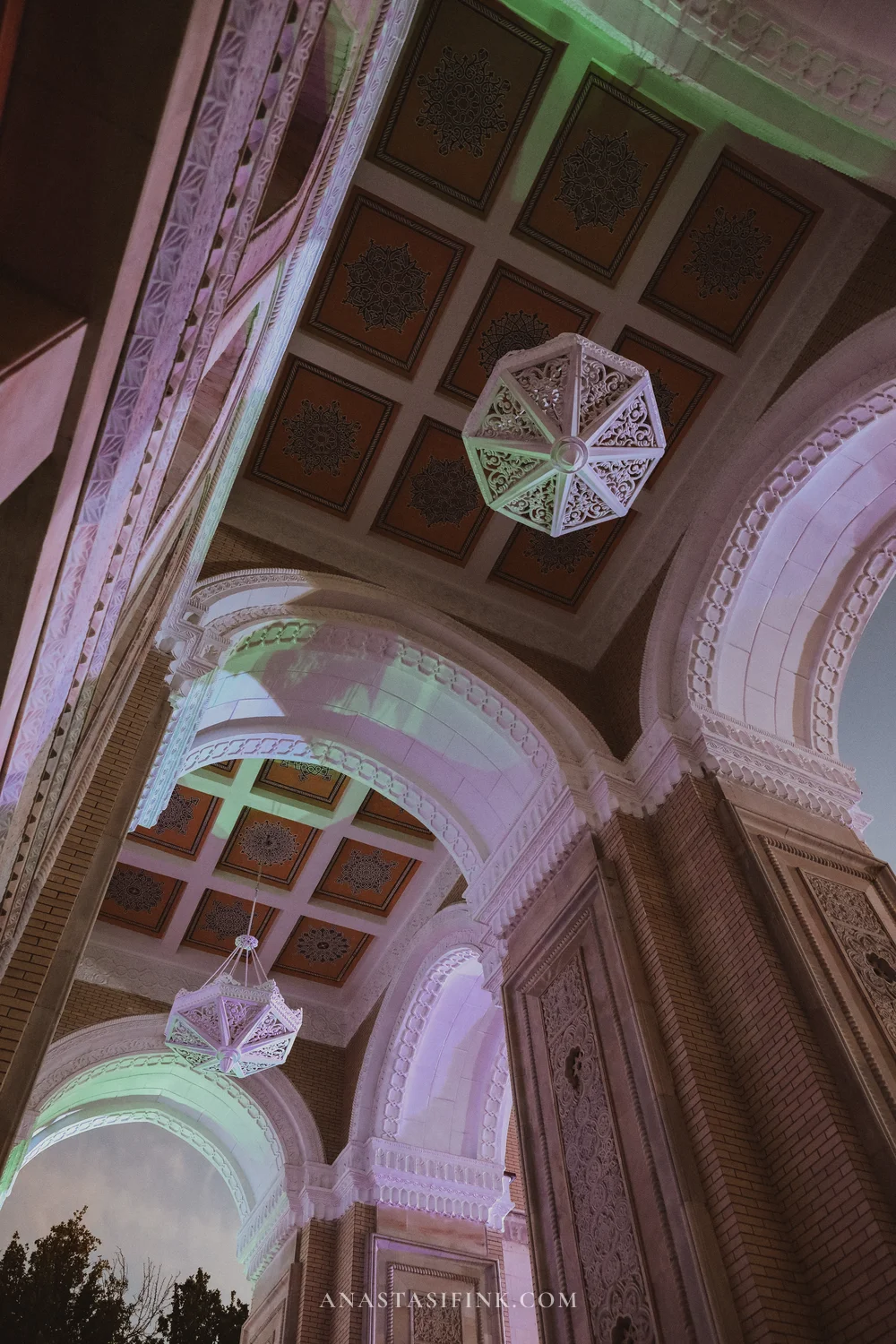
Tashkent is the capital of Uzbekistan and the largest city in Central Asia. After the 1966 earthquake it was almost entirely rebuilt, which is why Soviet modernist blocks stand right next to the clay courtyards of the old town — and why there’s a metro hiding underground that locals proudly show off to visitors as a sight in its own right.
The whole route below is genuinely doable in a day. The distances are big, but the metro saves you — it’s fast, beautiful and cheap. We start with a calm morning at a museum and end with a giant plate of plov.
Tashkent, the Capital of Uzbekistan: What to Know First
Tashkent is the capital of Uzbekistan and a big city, so plan the day around the metro and ride-hailing taxis rather than walking. The metro runs roughly from 05:00 to midnight, and you pay by card or token. Prices are in so’m: a metro ride is about 1,700 so’m (~$0.14), a portion of plov about 30,000-40,000 so’m (~$3-4). A local SIM or eSIM is handy for maps and booking rides. Haggling at Chorsu Bazaar is normal, and at Besh Qozon the plov often runs out by evening, so go at lunchtime.
1. Museum of Applied Arts
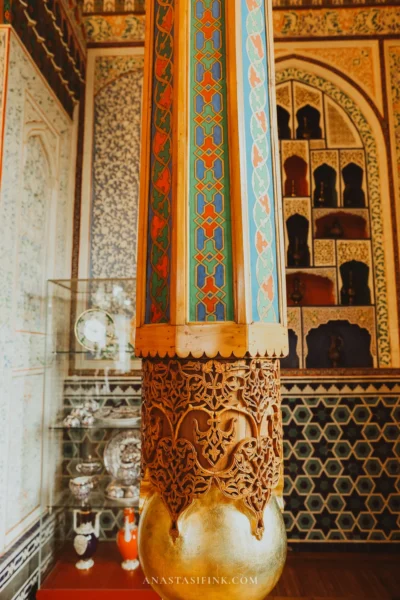
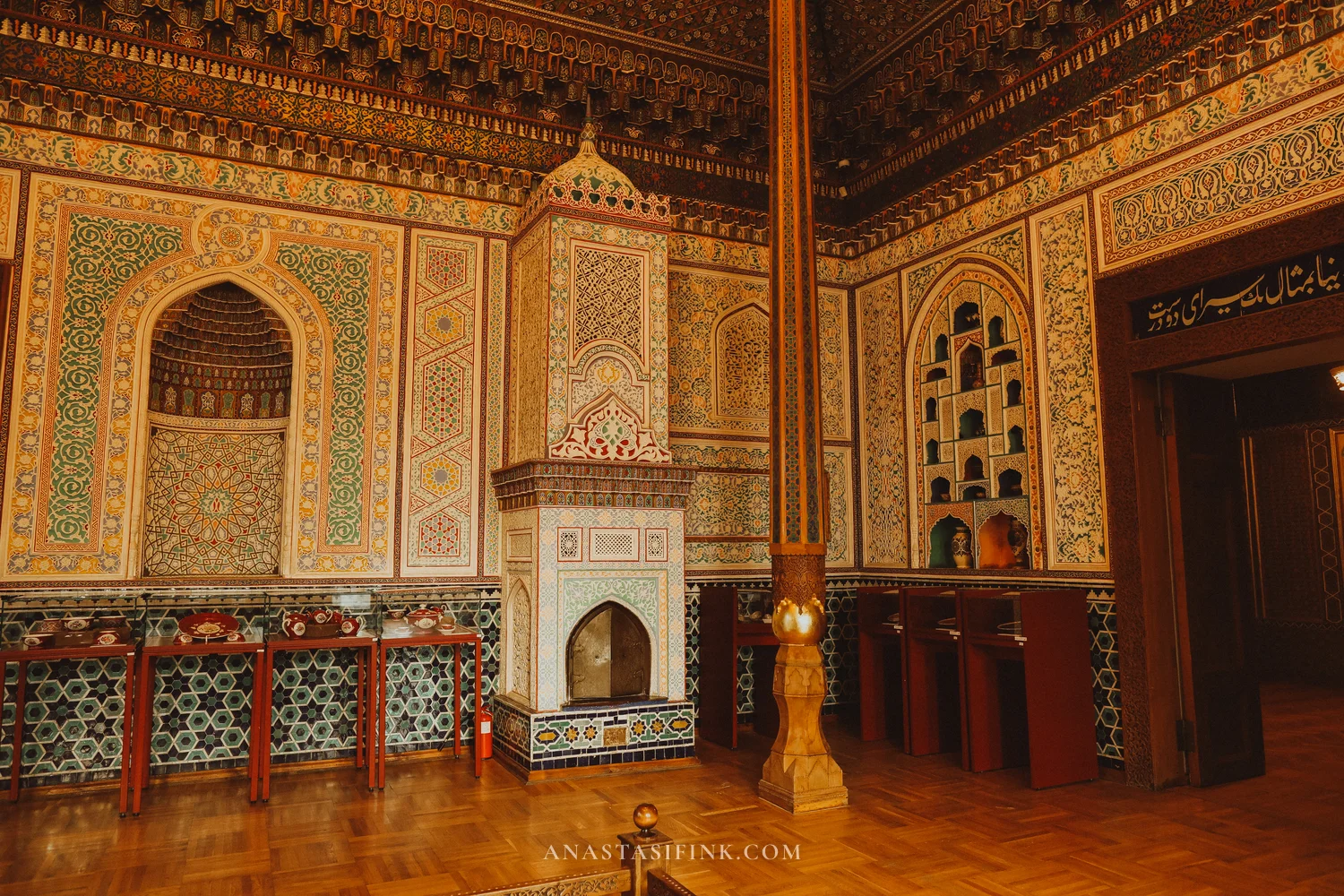
The best way to start the day is the Museum of Applied Arts, also known as the Polovtsev House. It’s the former mansion of a Russian diplomat from the early 20th century: unassuming from the outside, but inside you’ll find rooms completely covered in carved ganch plaster, painted patterns and coloured mosaic. It also holds a collection of Uzbek crafts — carpets, hand-embroidered suzani, ceramics, lacquer miniatures and national instruments.
I’ve written about this place on its own — with the story of the house, prices and all the practical details. If you want the full picture, here it is: Museum of Applied Arts in Tashkent — the Polovtsev House.
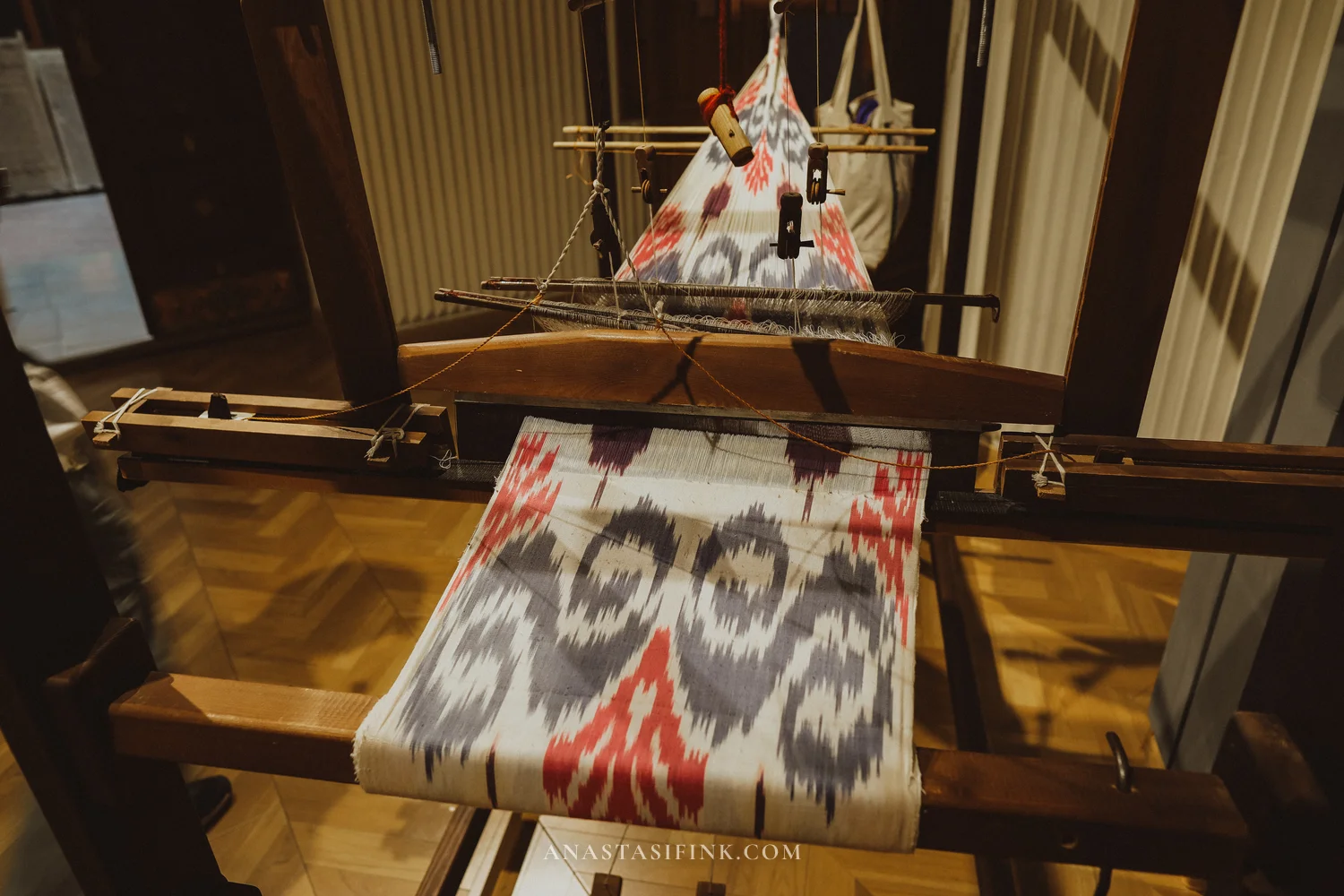
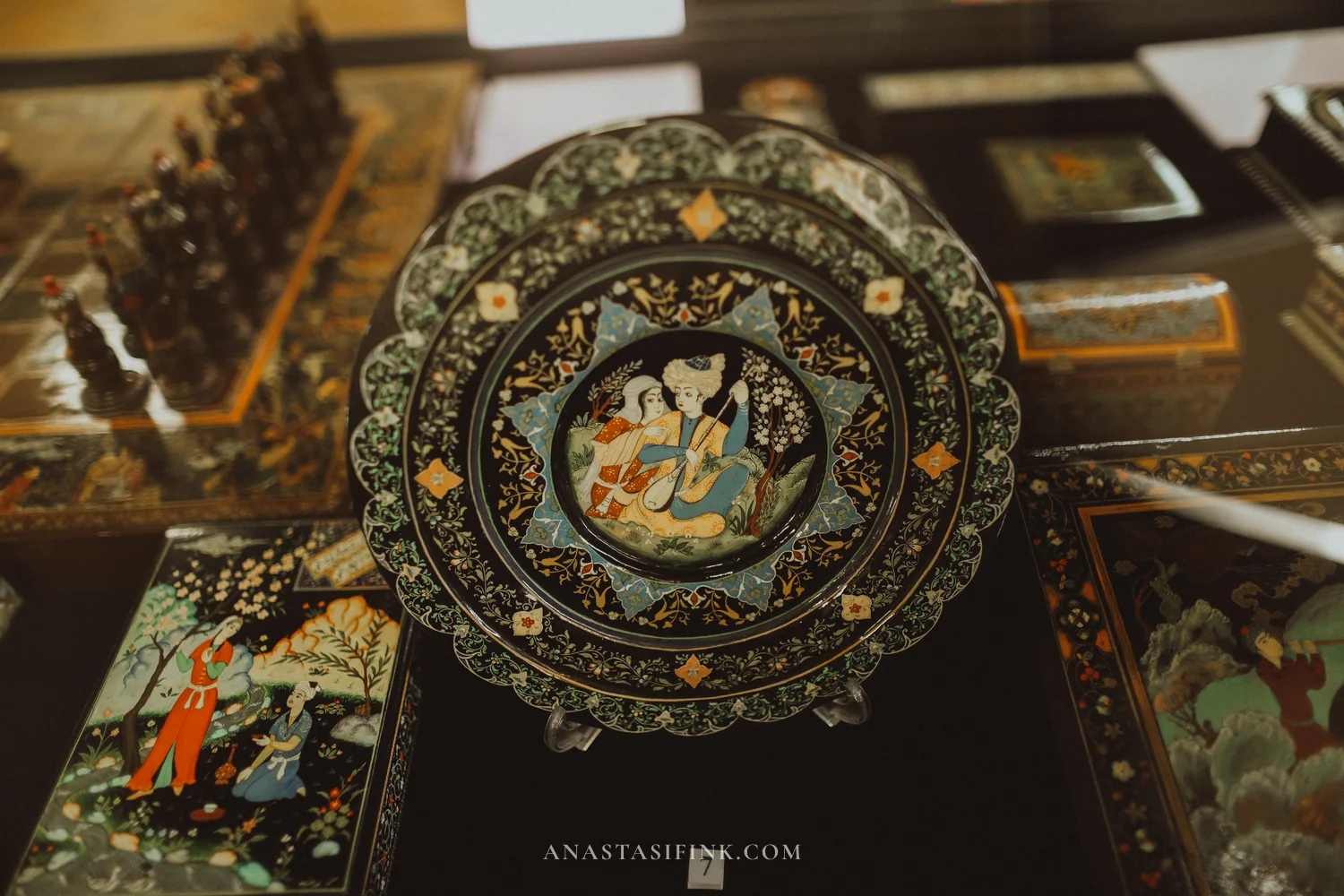
On the left, a loom used to weave ikat by hand. On the right, a lacquer miniature — these are painted with a fine brush in several layers
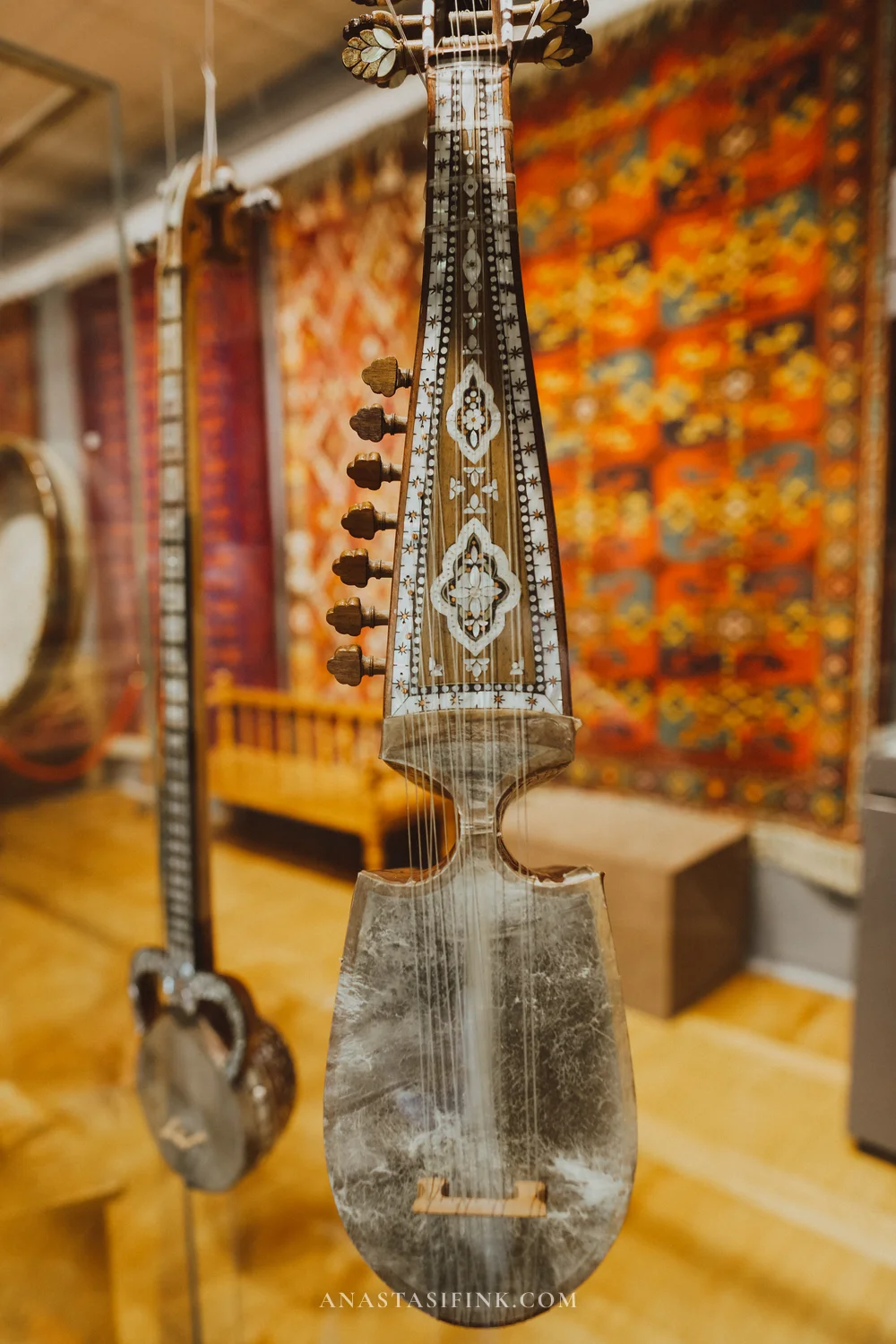
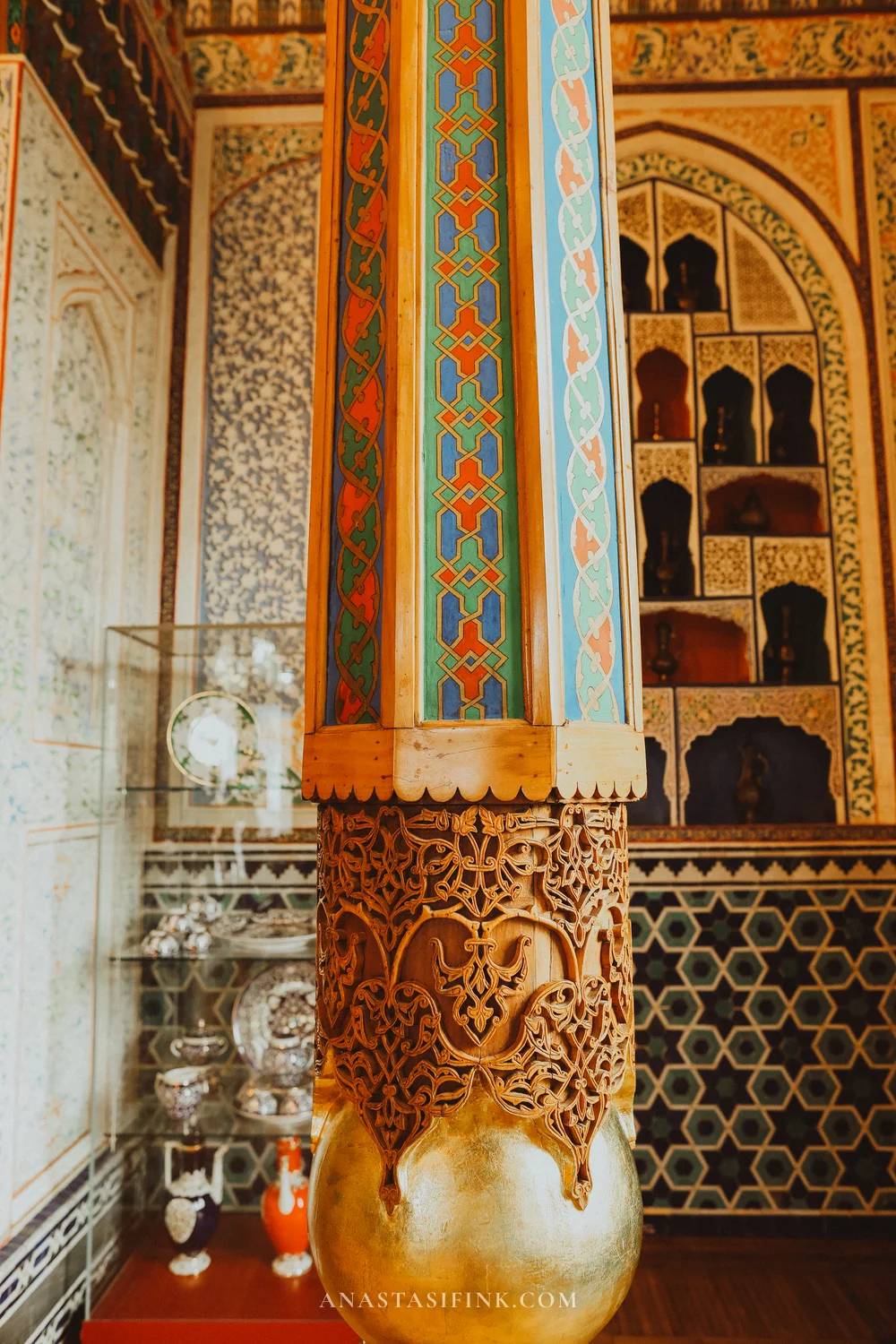
Antique stringed instruments set against carpets, and a carved column in one of the halls
Practical info
- Address: 15 Rakatboshi St, Tashkent
- GPS: 41.2947, 69.2725
- Opening hours: 09:00–18:00, open daily
- Entry: around 40,000 so’m (~$3), photography costs extra
- How long to spend: 40–60 minutes
2. Human House — a Shop of Handmade Uzbek Crafts
Ten minutes away is Human House. Handmade goods from all over Uzbekistan are brought here, and it’s the best place in the city to buy real local souvenirs. It’s everything at once: gallery, shop and tea room. It smells of wood and fabric, there are paintings by Tashkent artists on the walls, and the shelves are packed with ceramics, books, old samovars and textiles.
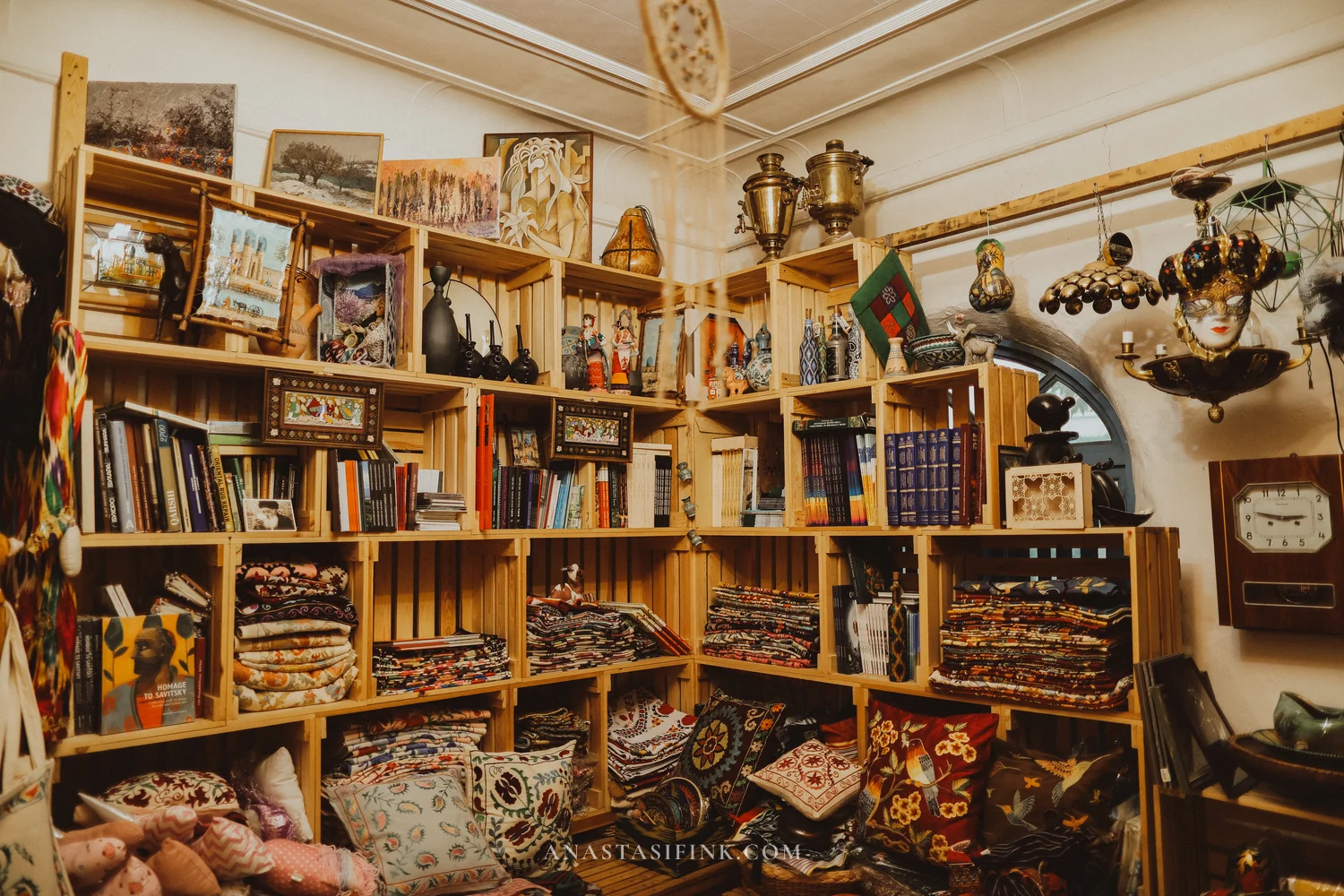
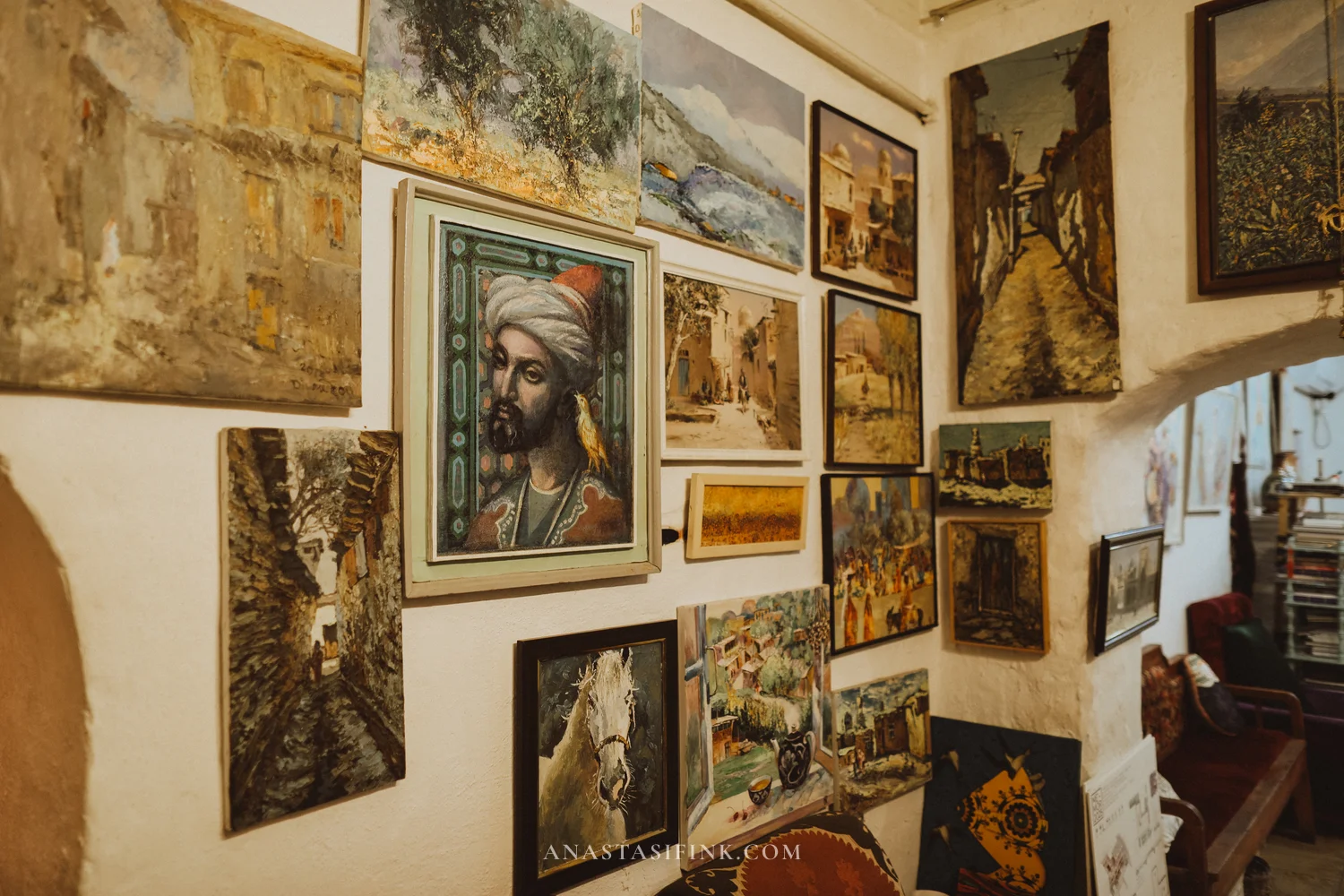
Ceramics and books on the shelves, works by Tashkent artists on the wall
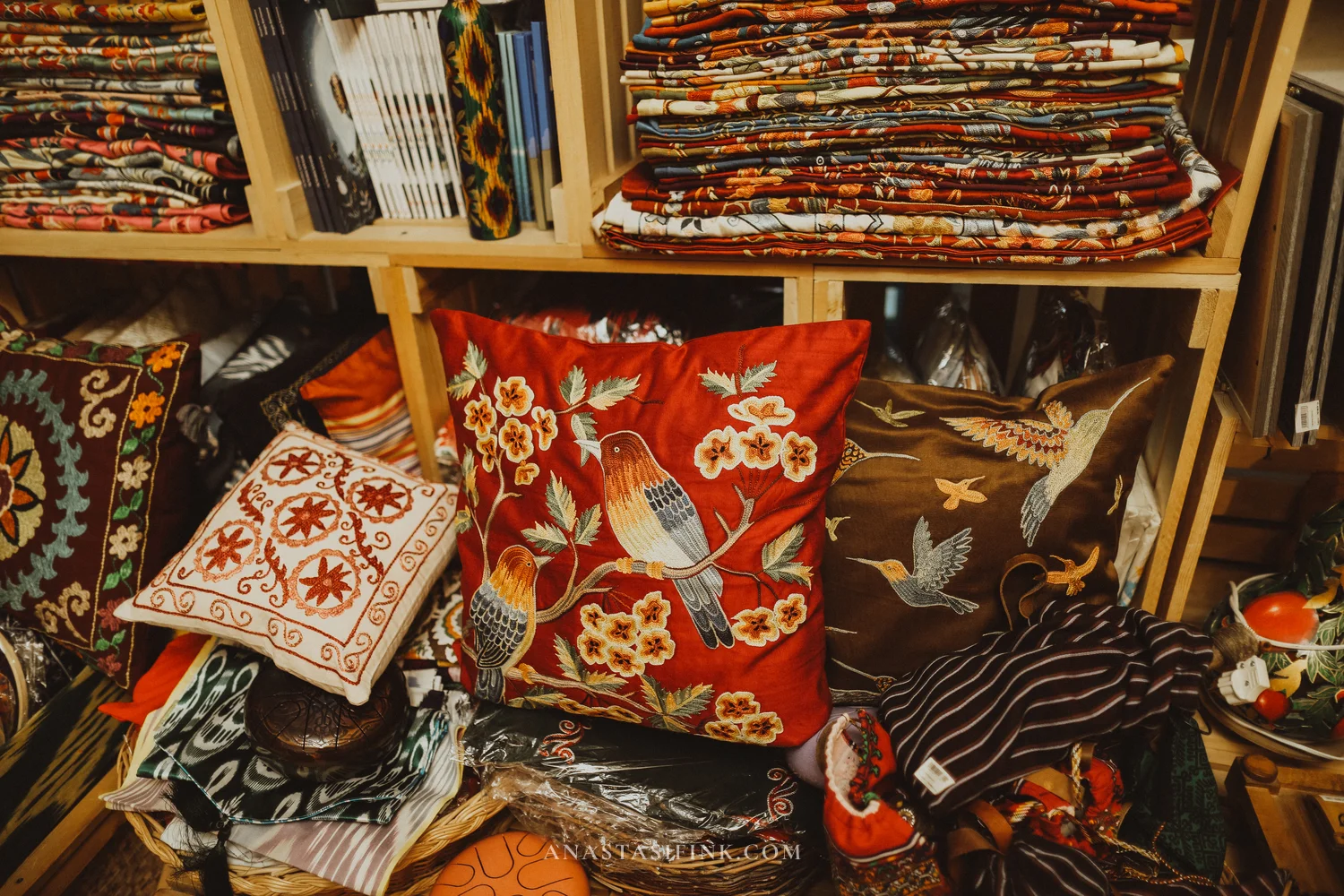
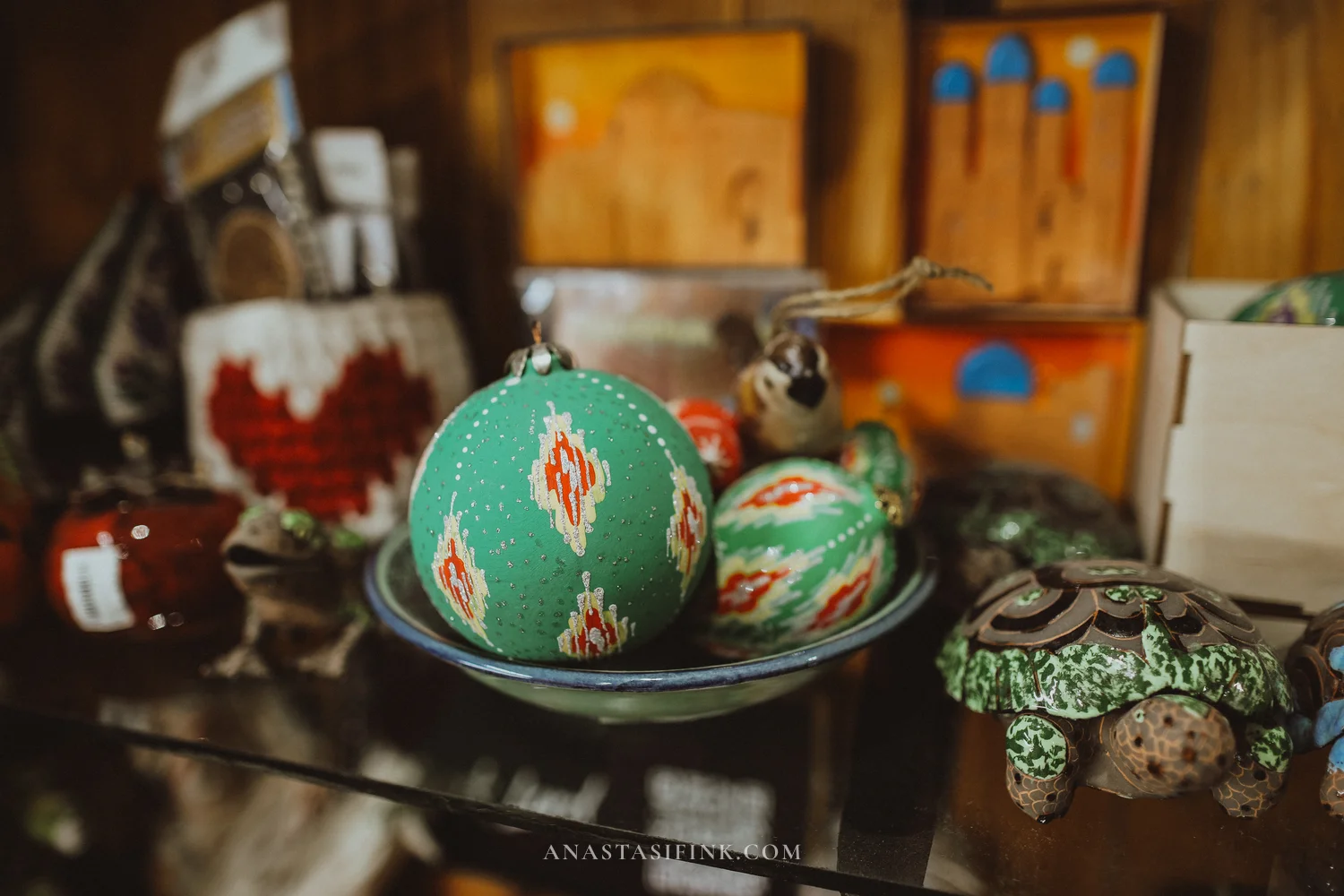
Embroidered cushions with birds and small souvenirs with ikat patterns — all handmade
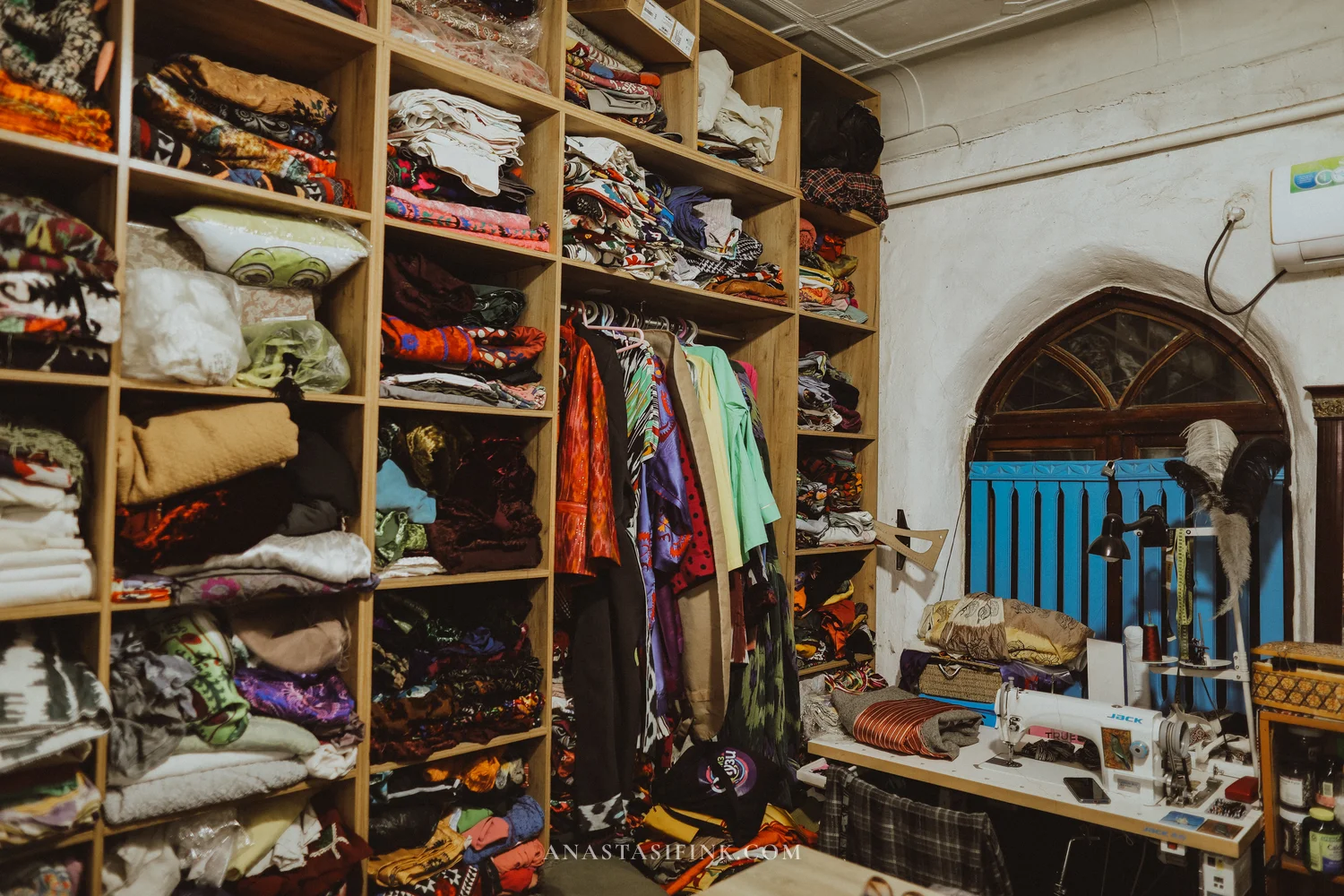
I’d especially recommend Human House to anyone who wants to take home a real robe — a chapan. The brand works only with natural materials: silk and cotton, no synthetics. The robes are sewn by hand, often from ikat fabric, which is first dyed by hand in several colours and then woven — that’s what gives the pattern its soft, “blurred” edges. There’s a sewing machine at the back of the shop: some of the pieces are finished right here.
There are also lovely postcards and stickers by local artists here — a cheap souvenir that’s easy to carry home. And when your feet give out, you can settle into a cosy corner with tea: herbal tea or coffee comes with Uzbek sweets, surrounded by suzani on the walls and colourful ribbons overhead.
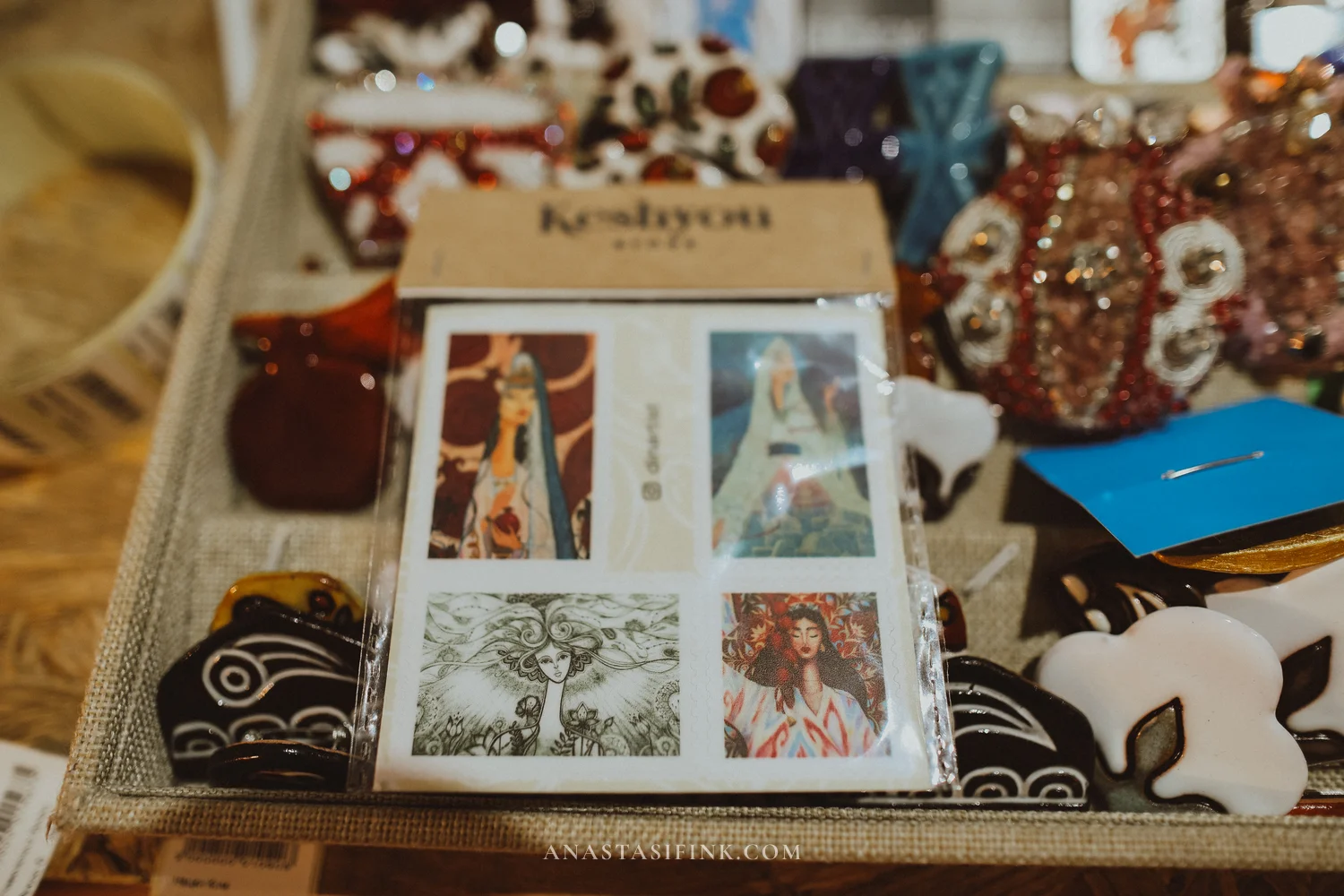
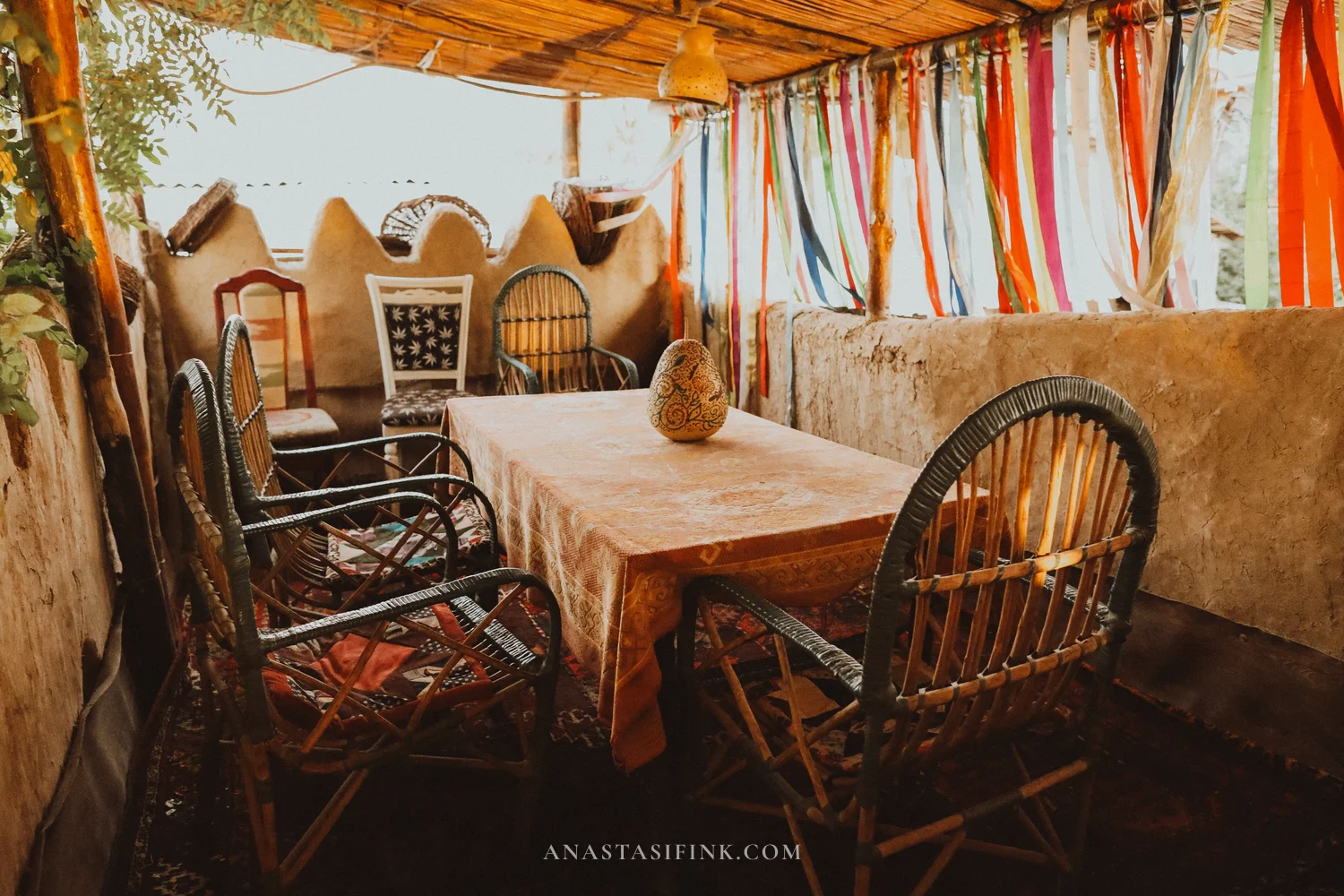
Postcards and stickers by local artists, and the tea corner where you can rest with a cup of tea
Practical info
- Address: 43 Kichik Mirobod St, Tashkent
- GPS: 41.2977, 69.2853
- Opening hours: 10:00–19:00, daily
- Entry: free; tea and sweets are extra
- What to buy: a silk or cotton robe, ceramics, postcards and stickers by local artists
On the Way to the Metro
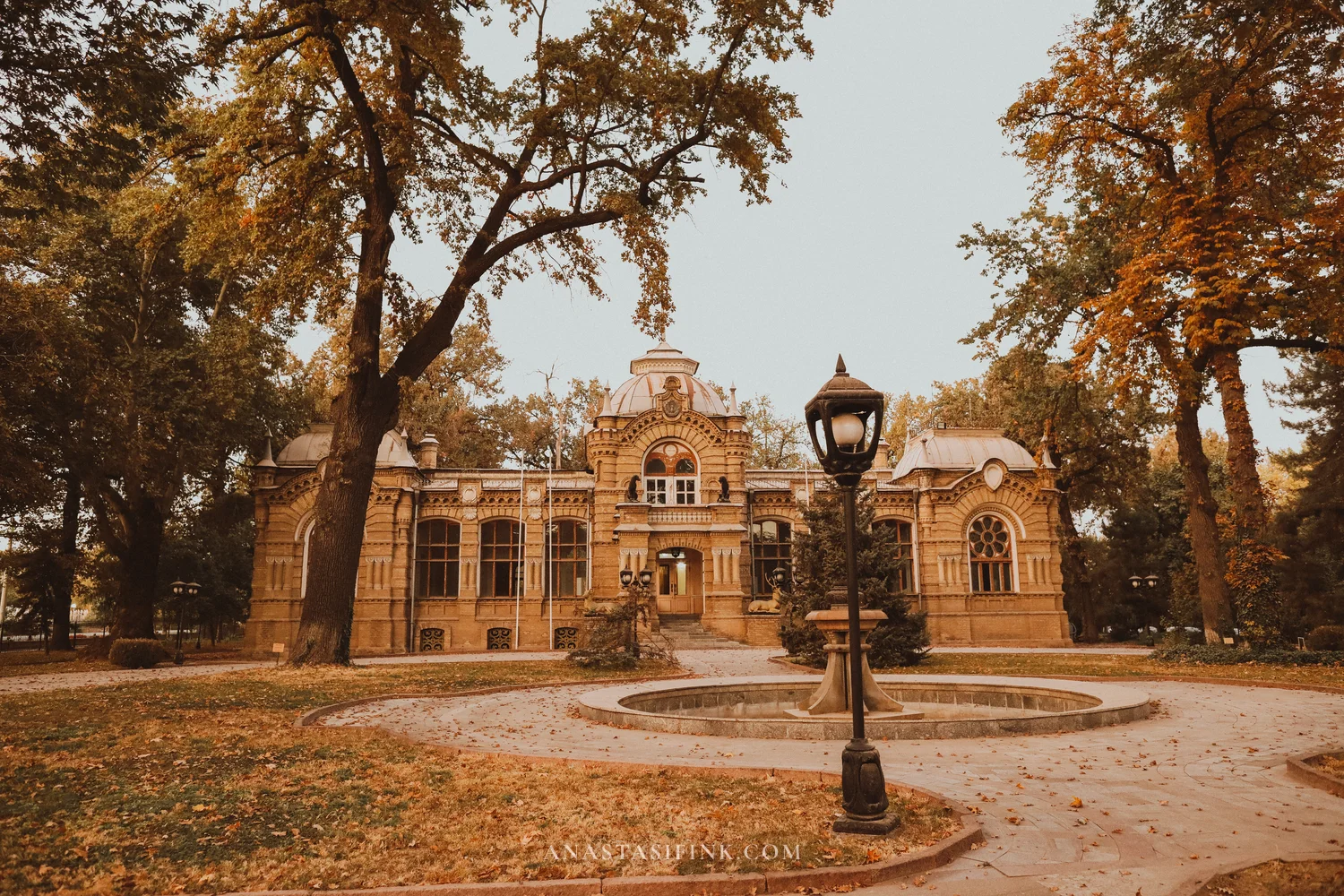
Next you need to head into the centre, toward the metro stations, and there’s plenty to see along the way. You’ll pass the palace of Grand Duke Nikolai Konstantinovich Romanov, built in 1891 for a grandson of Emperor Nicholas I who was exiled to Turkestan. There’s no need to set aside time for it: the building now houses Uzbekistan’s Ministry of Foreign Affairs and you can’t go inside. But since it’s right on your path, pause for a couple of minutes by the fence — the turreted facade is lovely, especially in autumn when the park is buried in leaves.
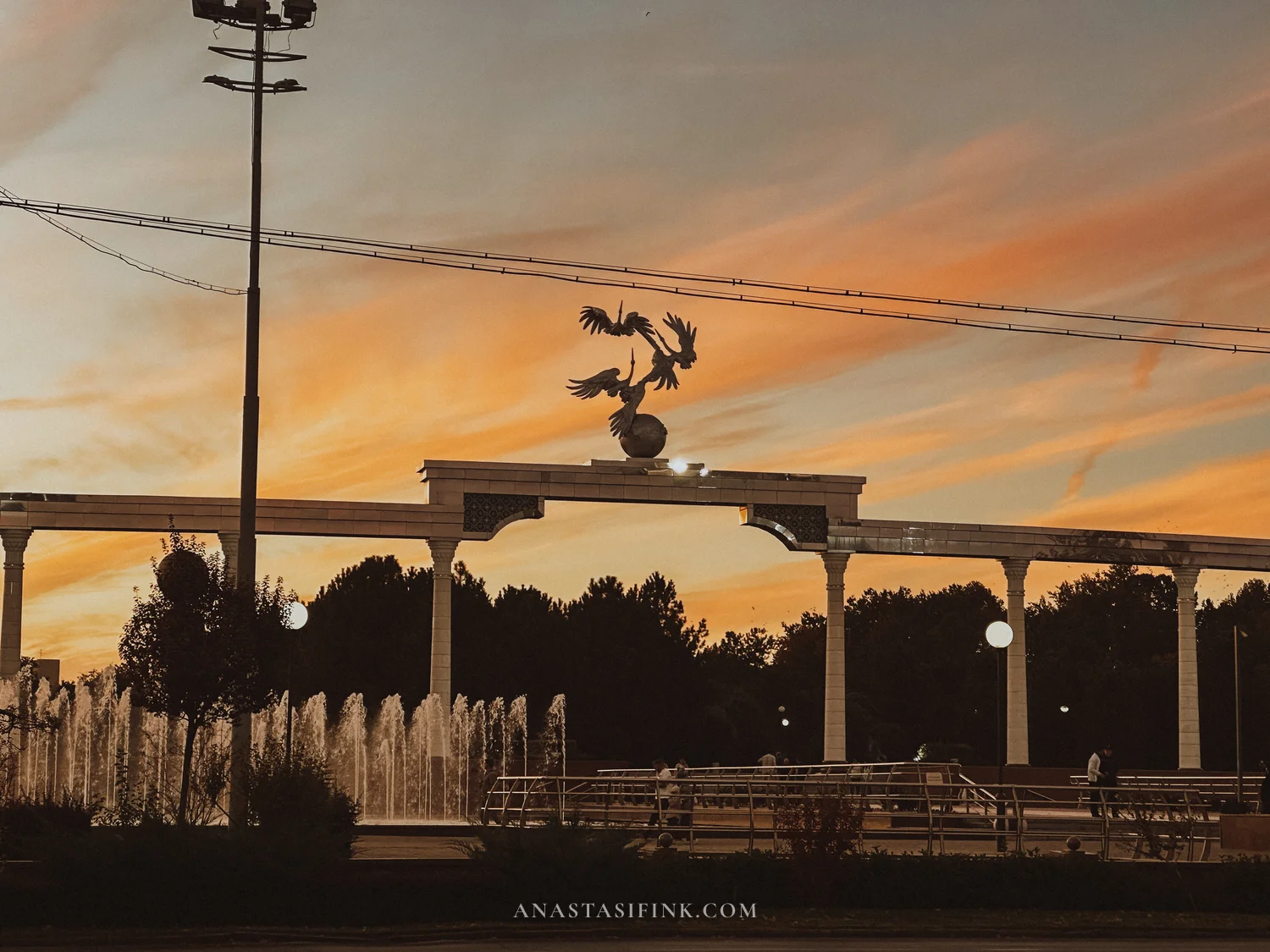
Honestly, between the stops on the route you should just keep looking around. Tashkent is a city of contrasts: Soviet modernist facades with concrete panjara latticework, huge murals on the ends of apartment blocks, and the white Ezgulik Arch near Independence Square. The arch is crowned by three storks — a symbol of peace and calm; in Uzbekistan the stork is considered a bird of good fortune.
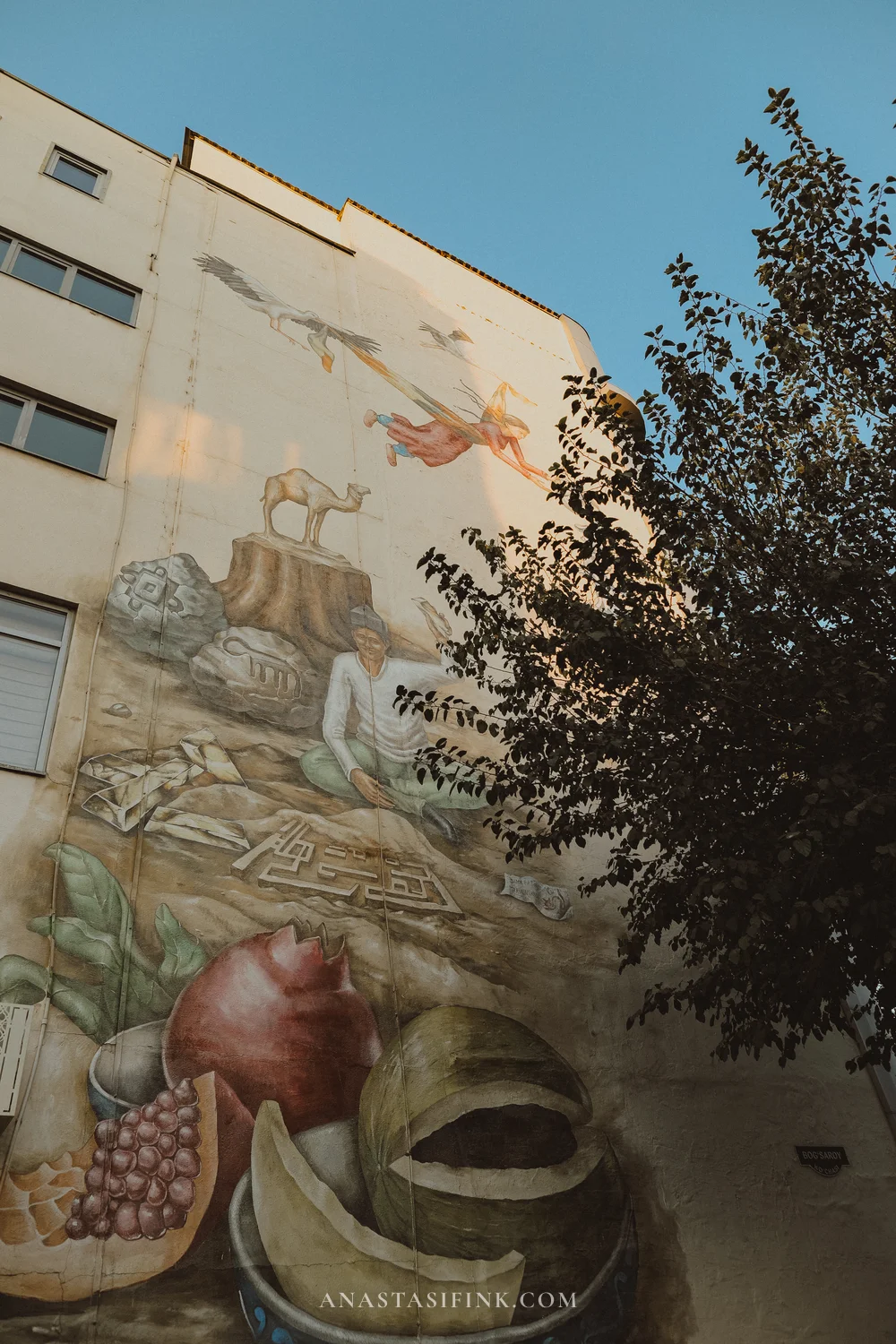
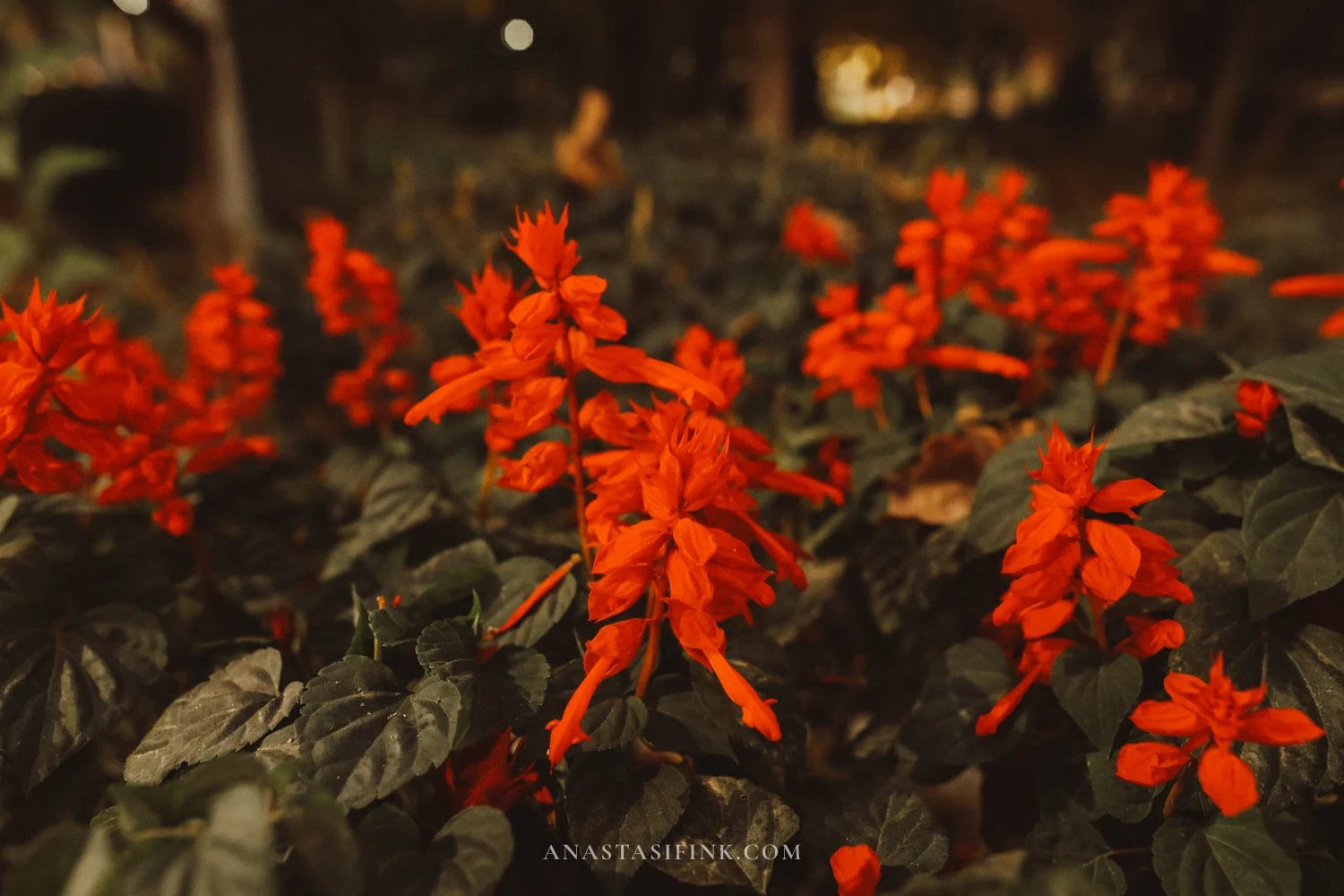
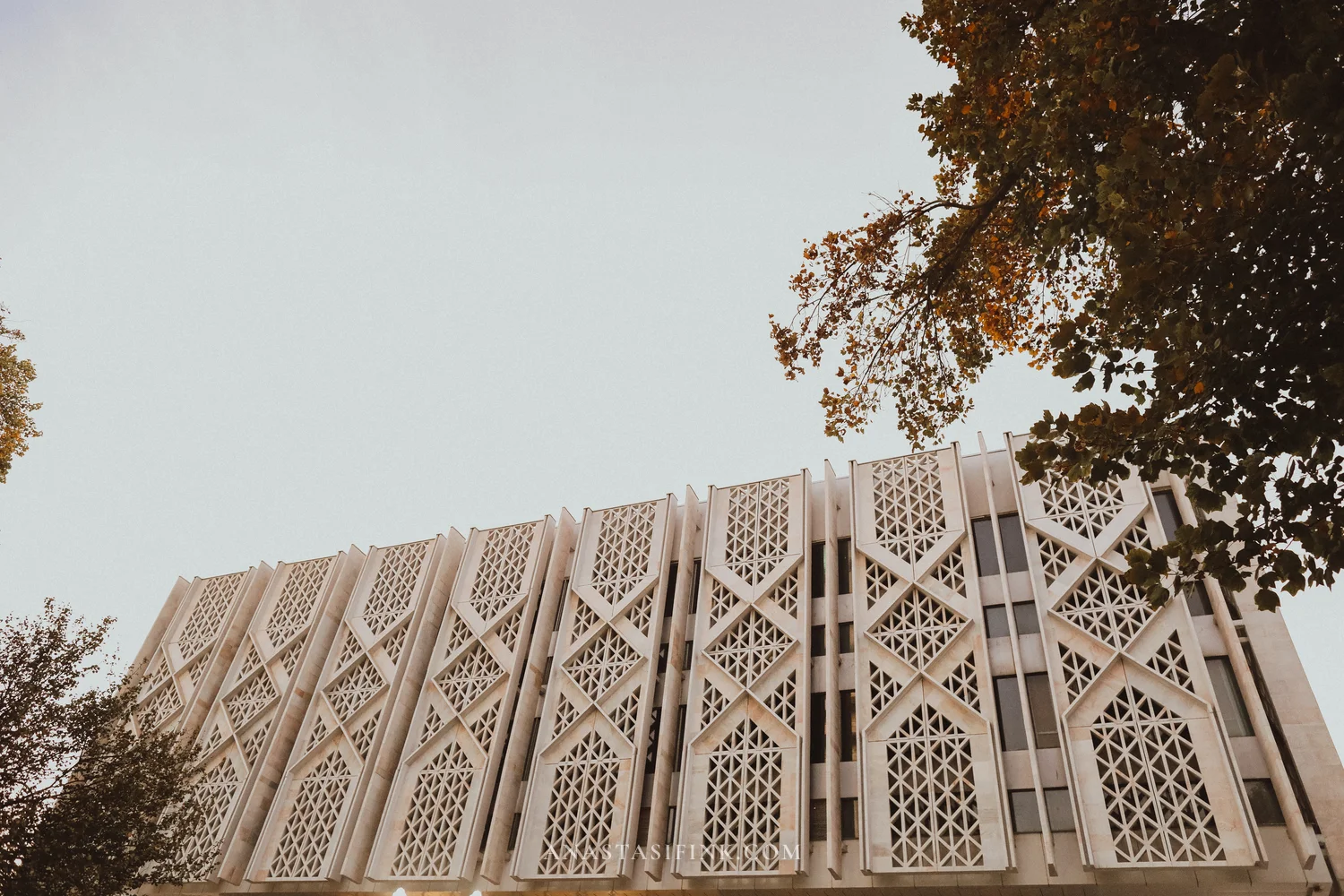
City details: flowerbeds of bright salvia and concrete latticework on facades in the Soviet modernist style
3. Tashkent Metro — an Underground Museum
A must-do is the Tashkent metro. It opened in 1977 and was the first metro in Central Asia. Each station was designed by a different artist, so they’re all distinct: some are dedicated to space, others to poets, others to cotton.
By the third station I realised I was no longer riding to get anywhere, just to get off and see the next one — and lost a good forty minutes without noticing. My advice is the same: ride through several stations and get off at each one. A single ride costs about 1,700 so’m (~$0.14), so you can hop on and off as many times as you like.
The blue station is Kosmonavtlar (“Cosmonauts”). It’s dedicated to space exploration: dark blue walls and round ceramic medallions with portraits of cosmonauts, among them Yuri Gagarin and Valentina Tereshkova.
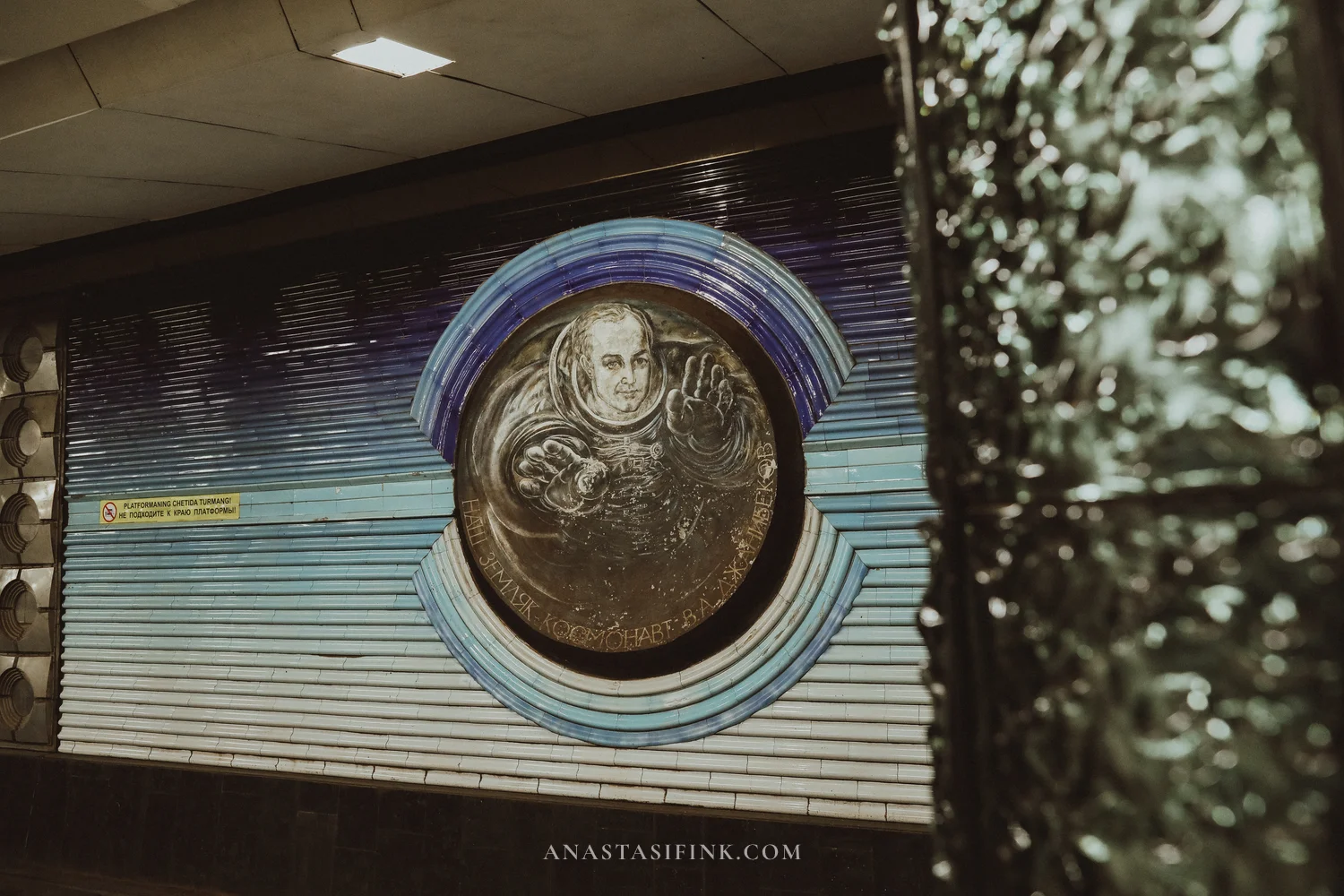
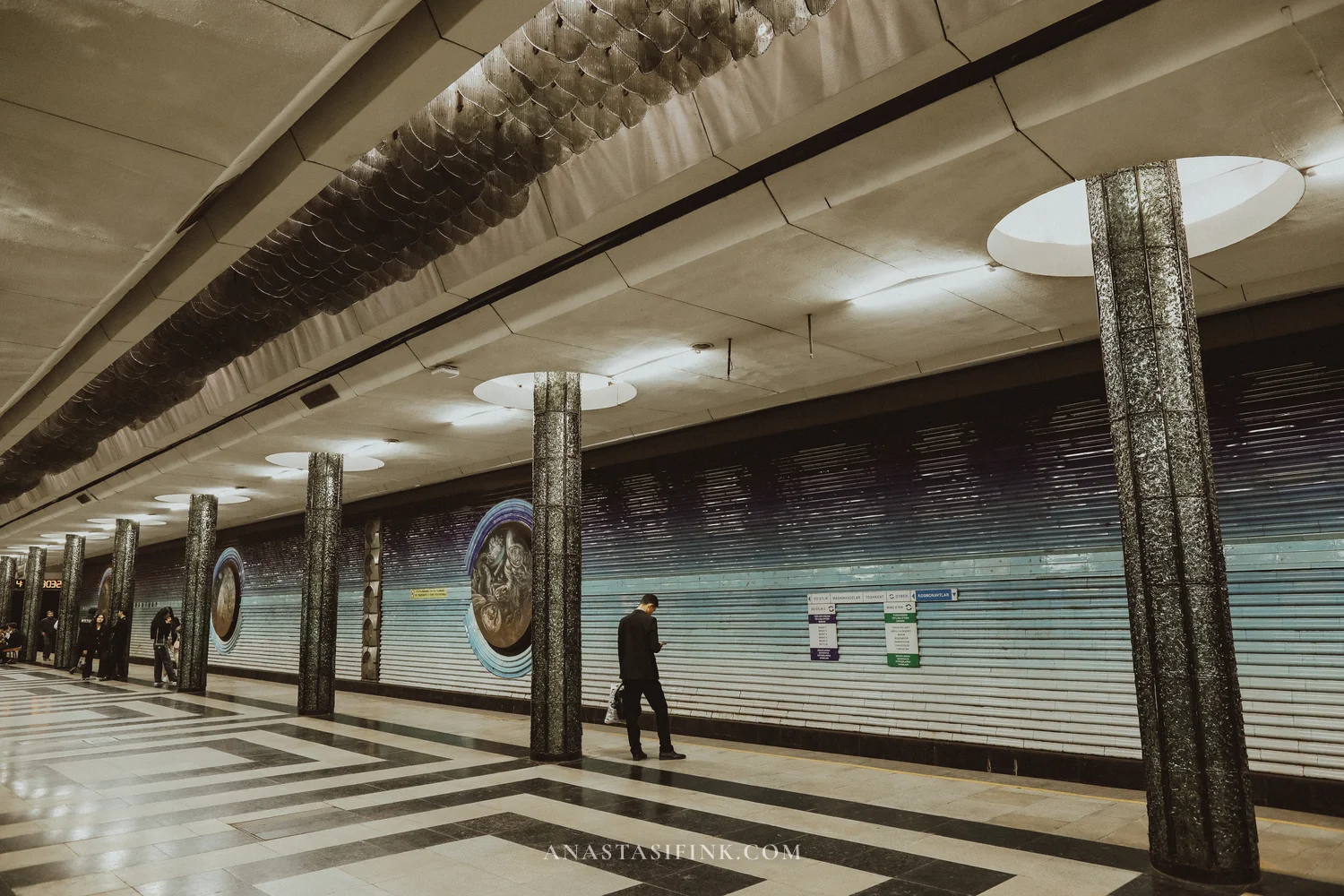
Kosmonavtlar station: blue walls and medallions with cosmonaut portraits running the length of the platform
Uzbekistan station has lamps shaped like cotton bolls. Cotton is Uzbekistan’s main crop, so the motif turns up everywhere. Here the lights are made in the shape of open bolls, which makes the station look wonderfully festive.
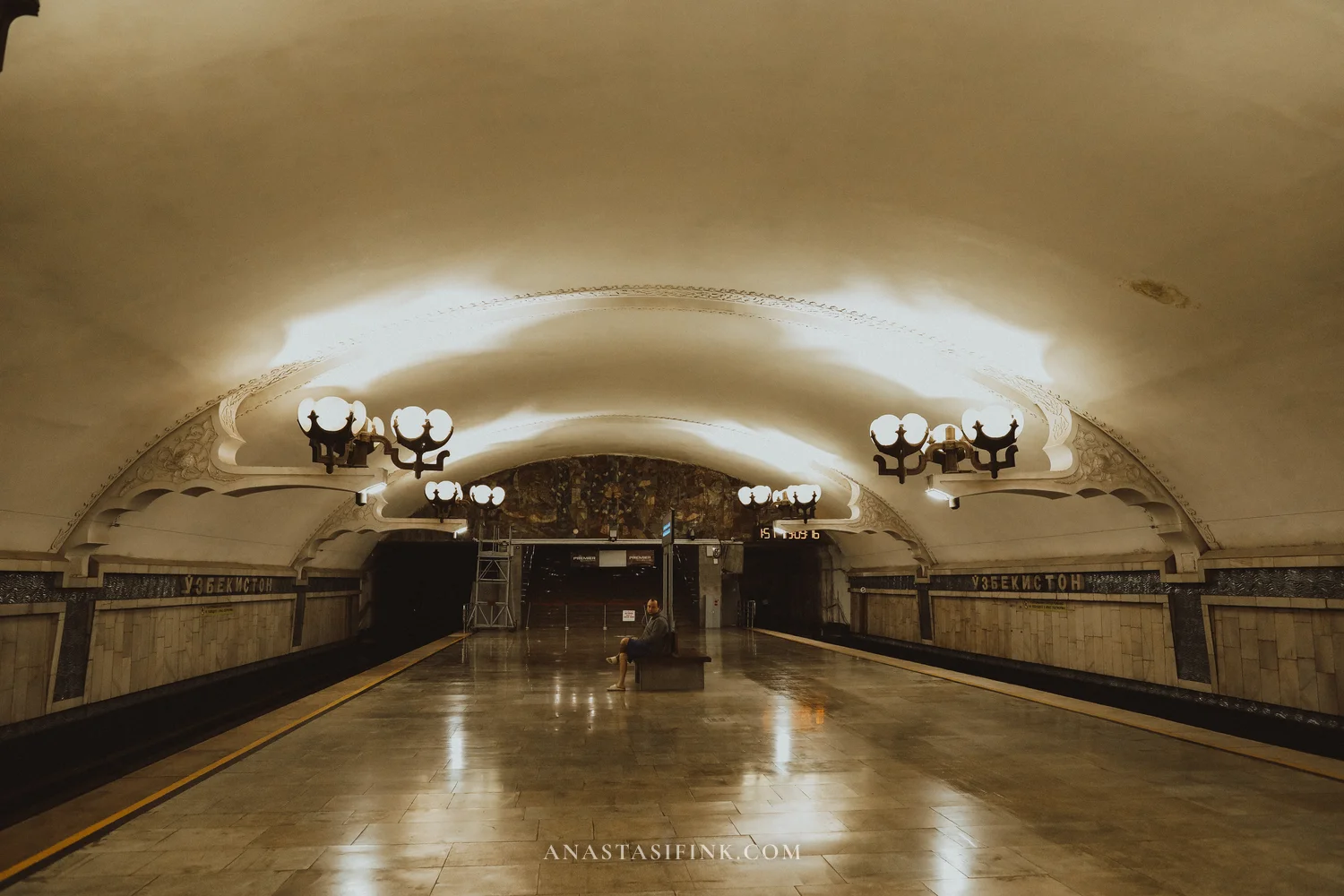
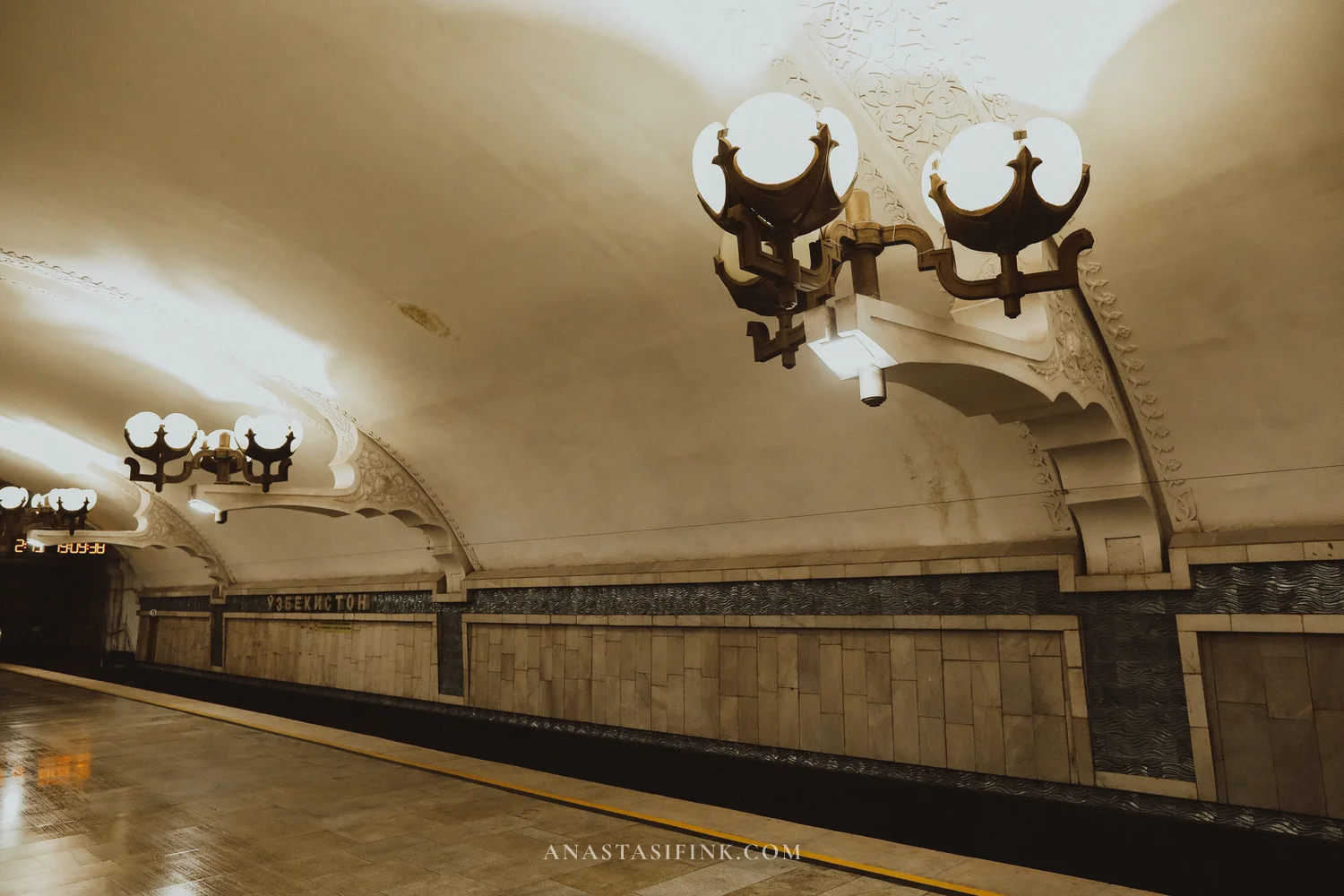
Uzbekistan station: the chandeliers are shaped like open cotton bolls
Alisher Navoi station is named after the 15th-century poet and built like a medieval mosaic gallery: blue domes with gold patterns, pointed arches and ceramic medallions with miniatures. Of all the stations, it looks most like the madrasas of Samarkand and Bukhara.
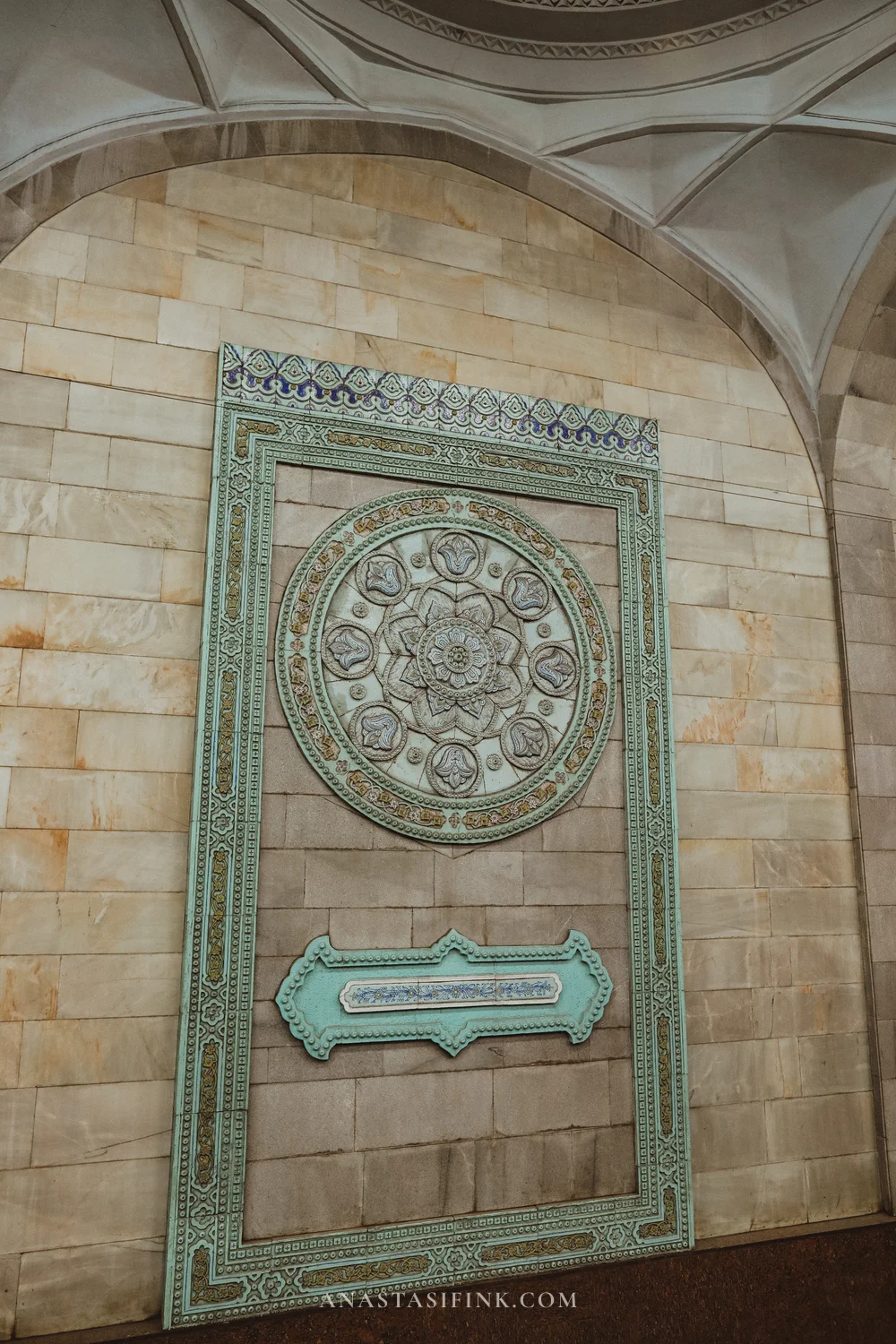
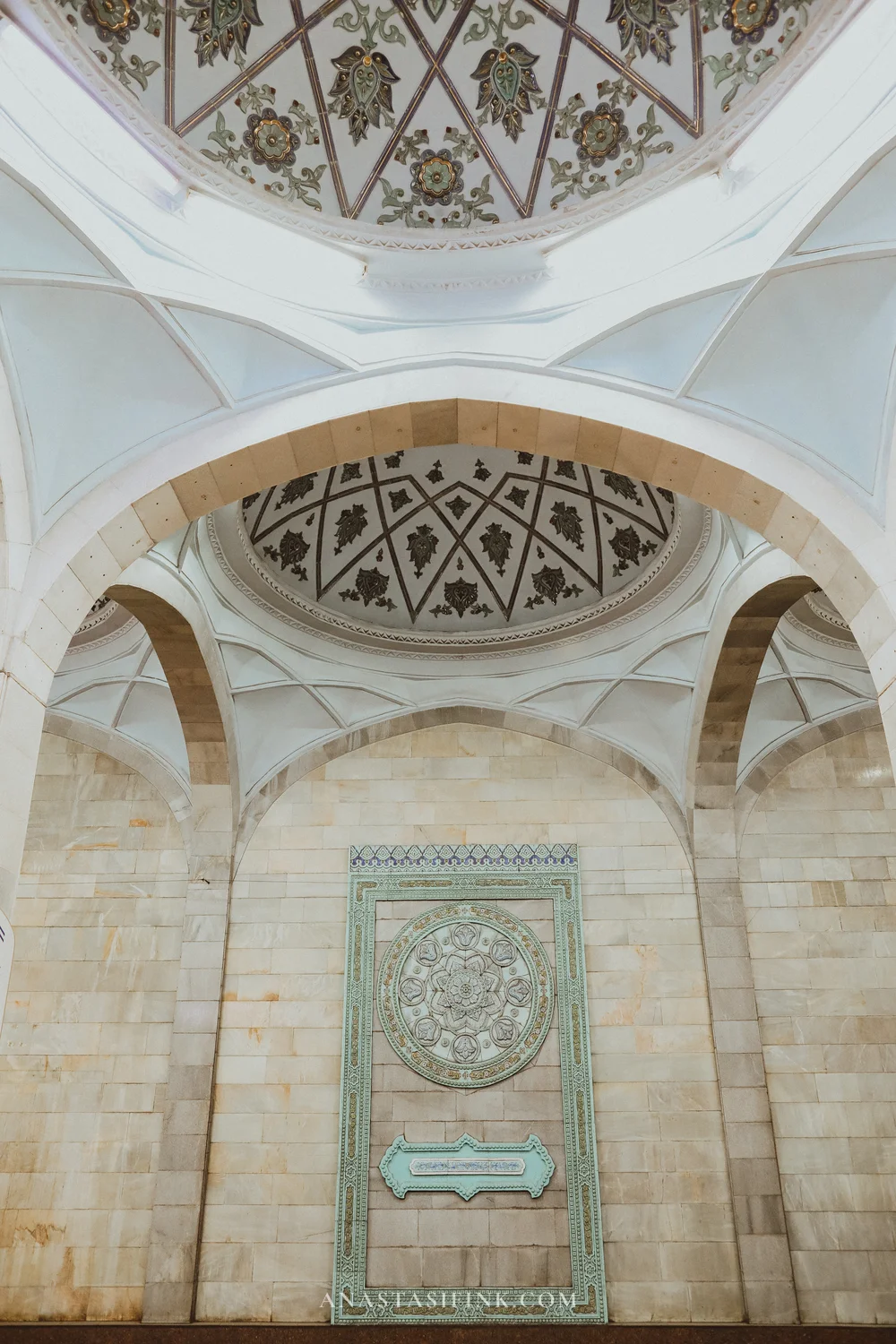
Alisher Navoi station: the painted domes and ceramic medallions echo medieval architecture
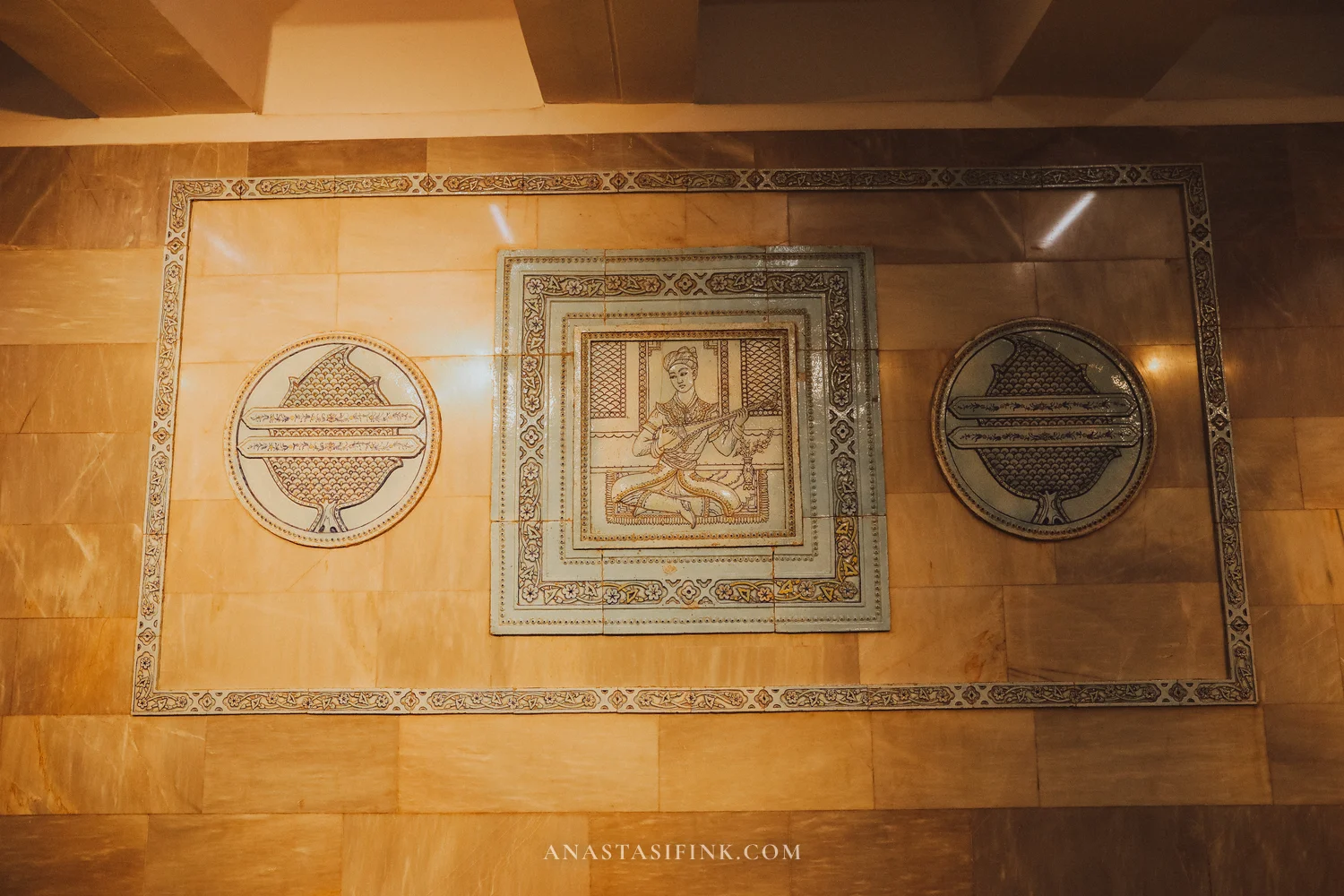
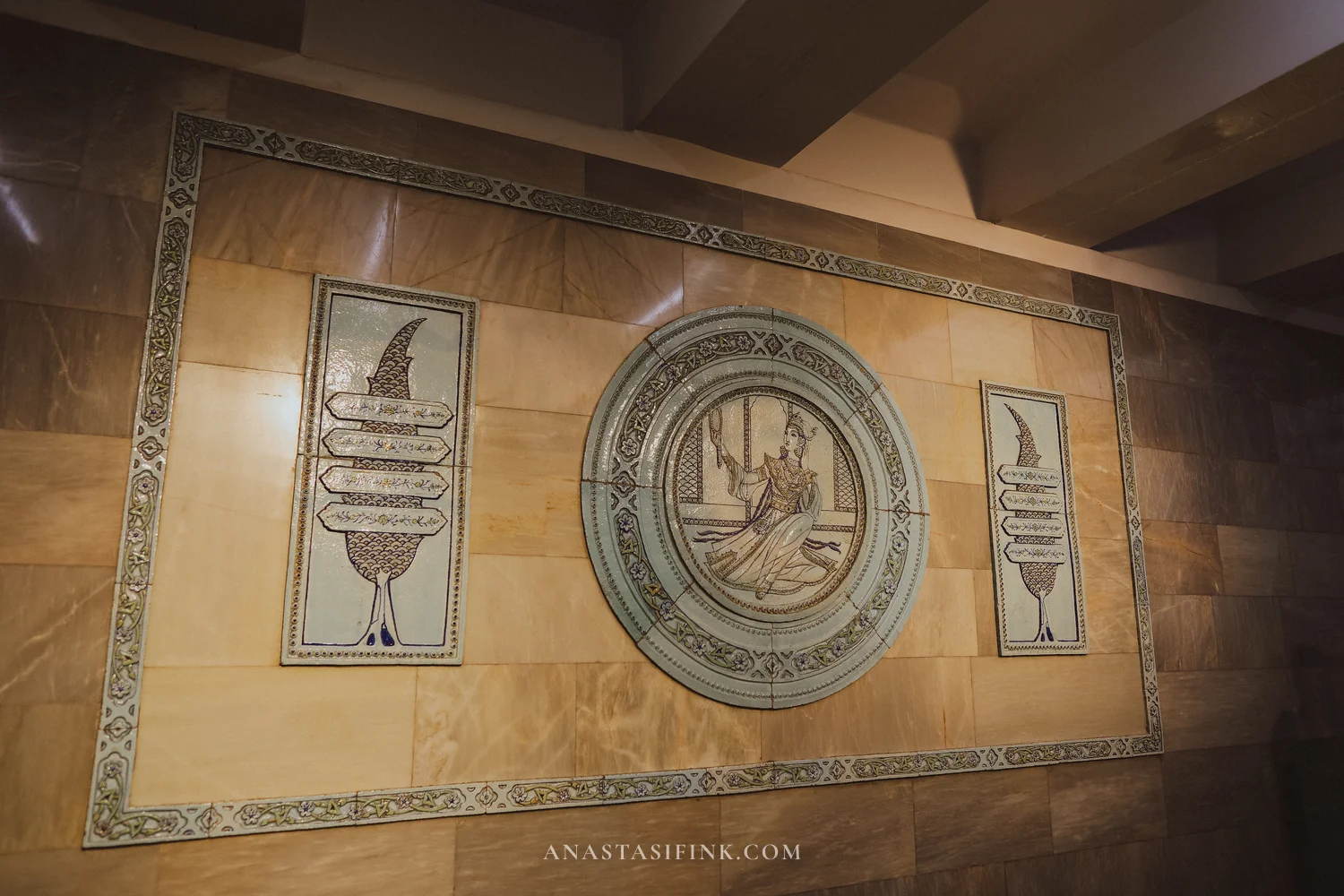
Mosaic panels with figures along the Alisher Navoi platform
Pakhtakor station translates as “cotton picker”, and its walls are lined with blue-and-yellow mosaic showing cotton flowers. At other stations it’s worth simply looking up — the carved ceilings with chandeliers look positively palatial.
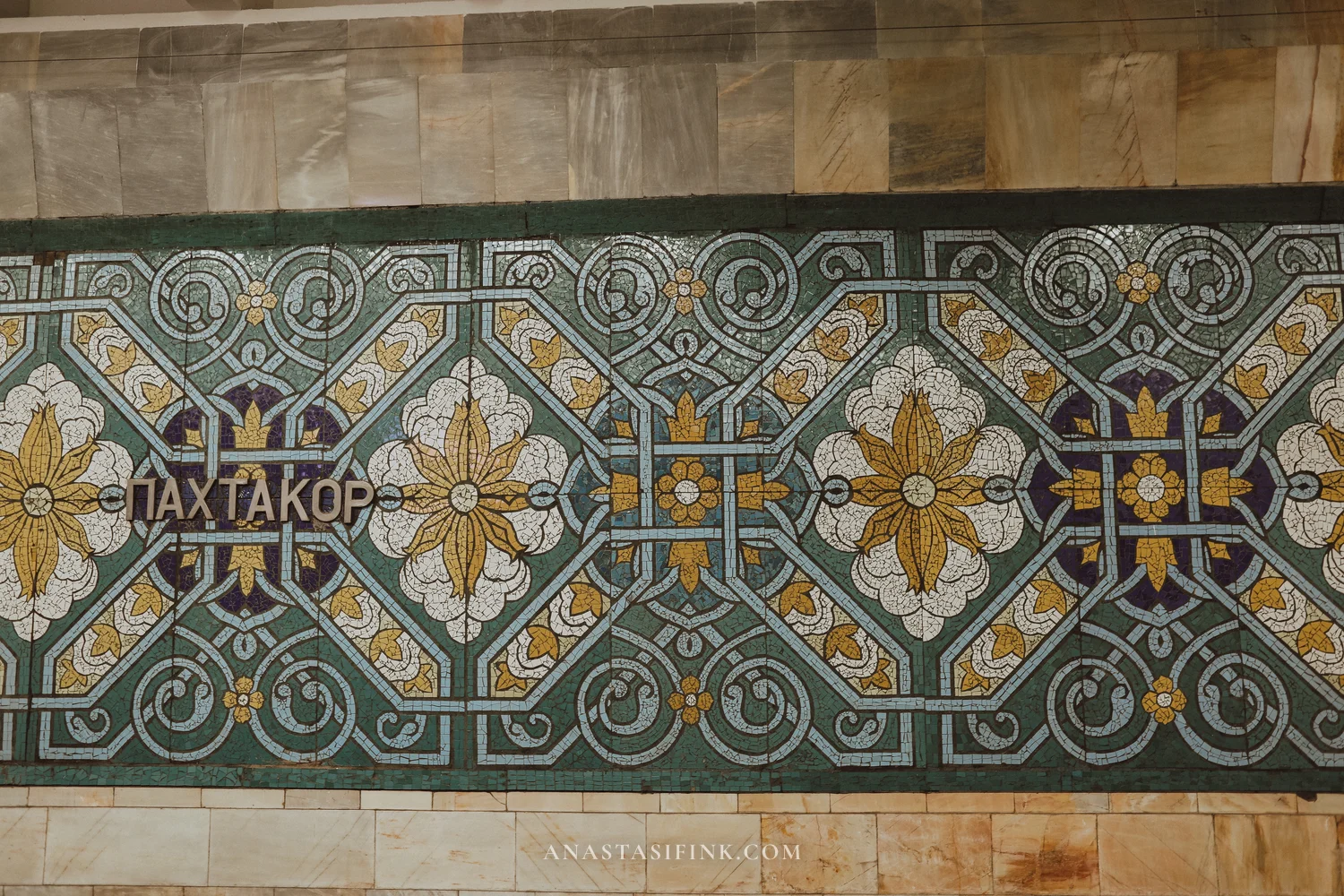
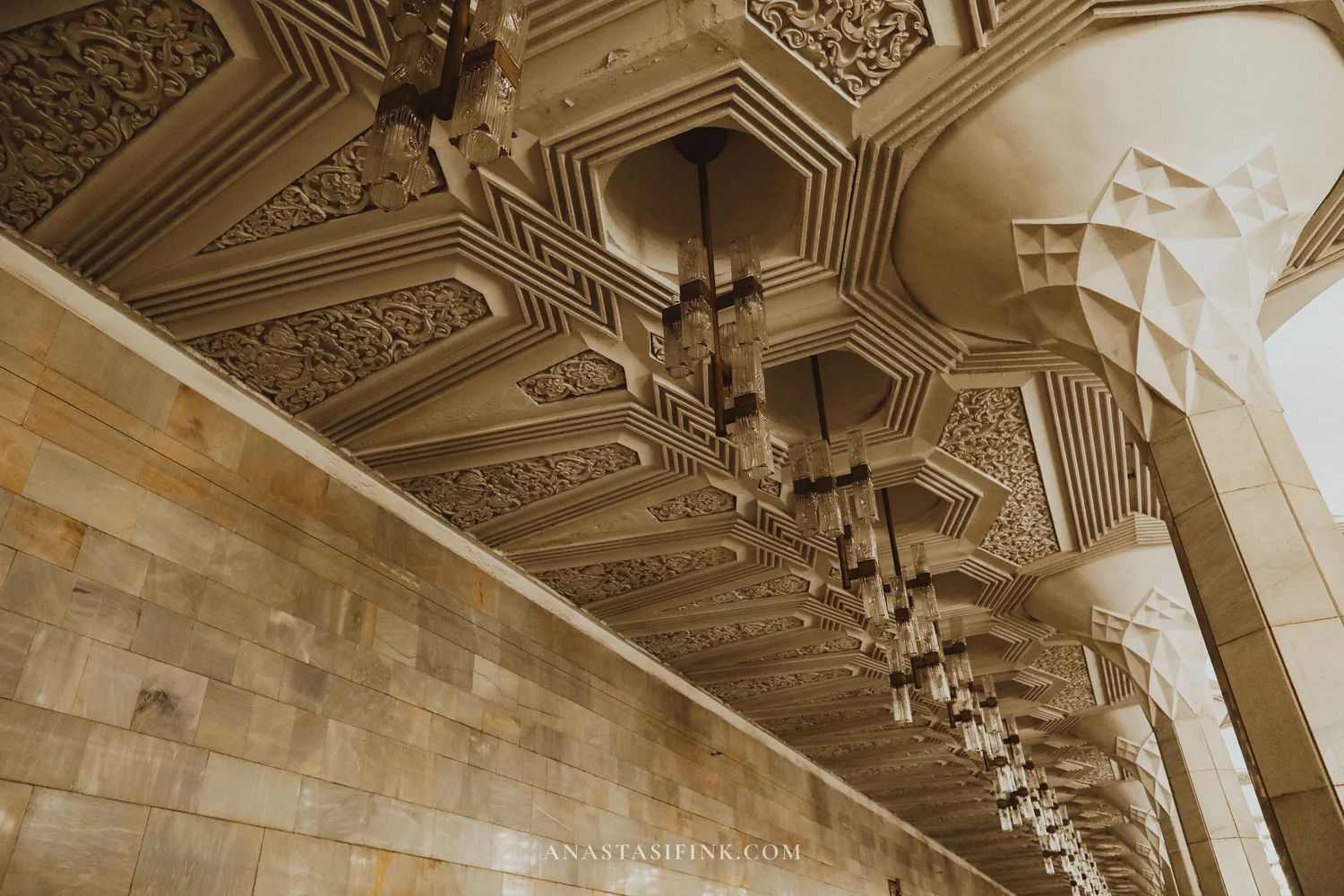
The Pakhtakor mosaic with cotton flowers, and a carved ceiling at one of the stations
Practical info
- Cost: one ride ~1,700 so’m (~$0.14), pay by card or token
- Opening hours: roughly 05:00–24:00
- How to do it: get off at every station — exiting and re-entering costs extra, but it’s a tiny amount
- Tip: photography is allowed now, but avoid shooting the turnstiles and security
4. Chorsu Bazaar
By midday, head to Chorsu, the main bazaar of old Tashkent. Trade has gone on here since at least the 13th century, and the current building with its enormous blue dome was built in the 1980s. From the outside the dome looks sternly Soviet, but it’s clad in white-and-blue tiles with Uzbek patterns — an instantly recognisable symbol of the city.
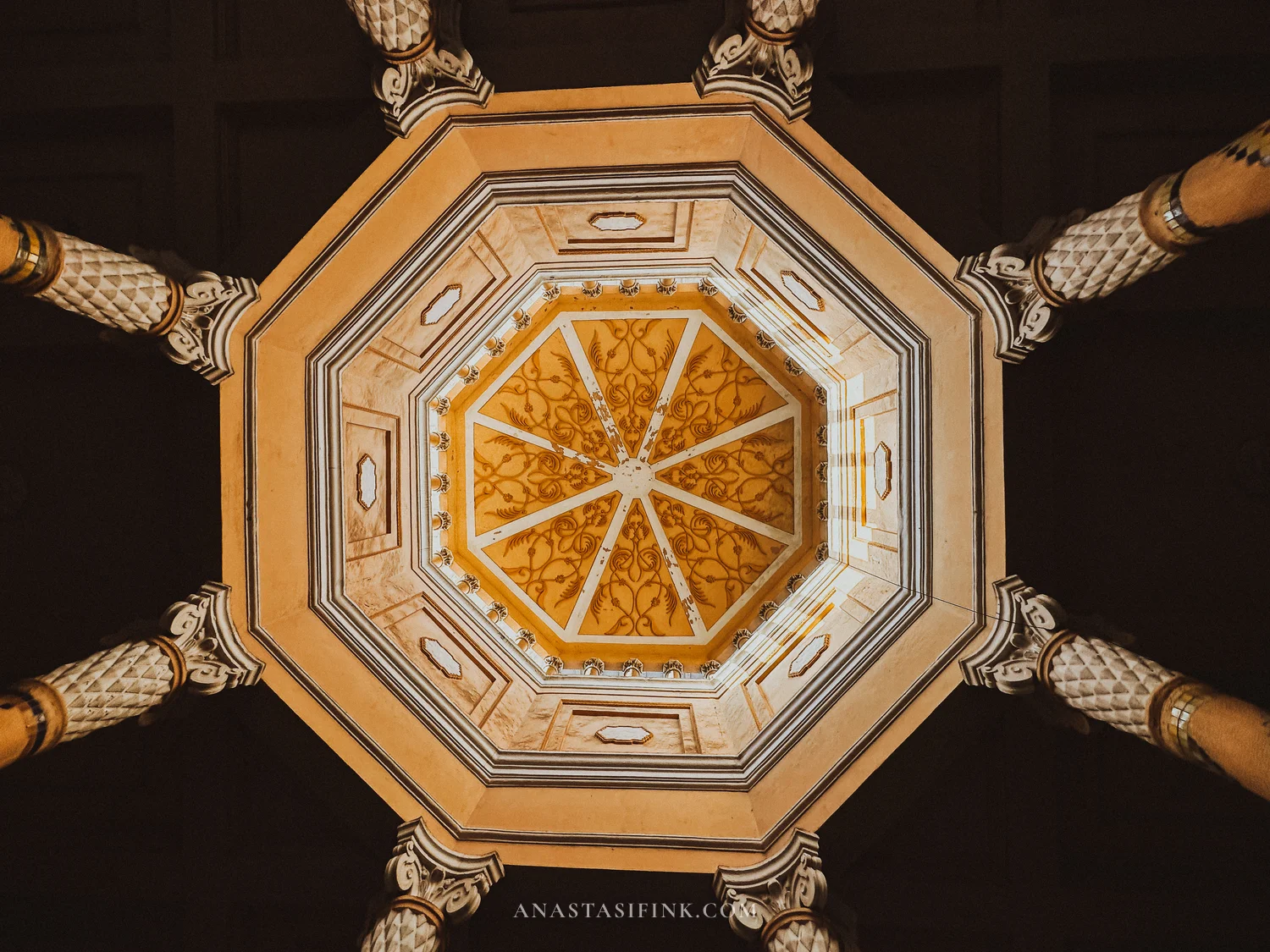
Under the dome and all around it is everything that grows and is made in Uzbekistan: mountains of spices, dried fruit, nuts, fresh vegetables and fruit. The counters are lined with bright tiles, and the sellers let you taste almost everything.
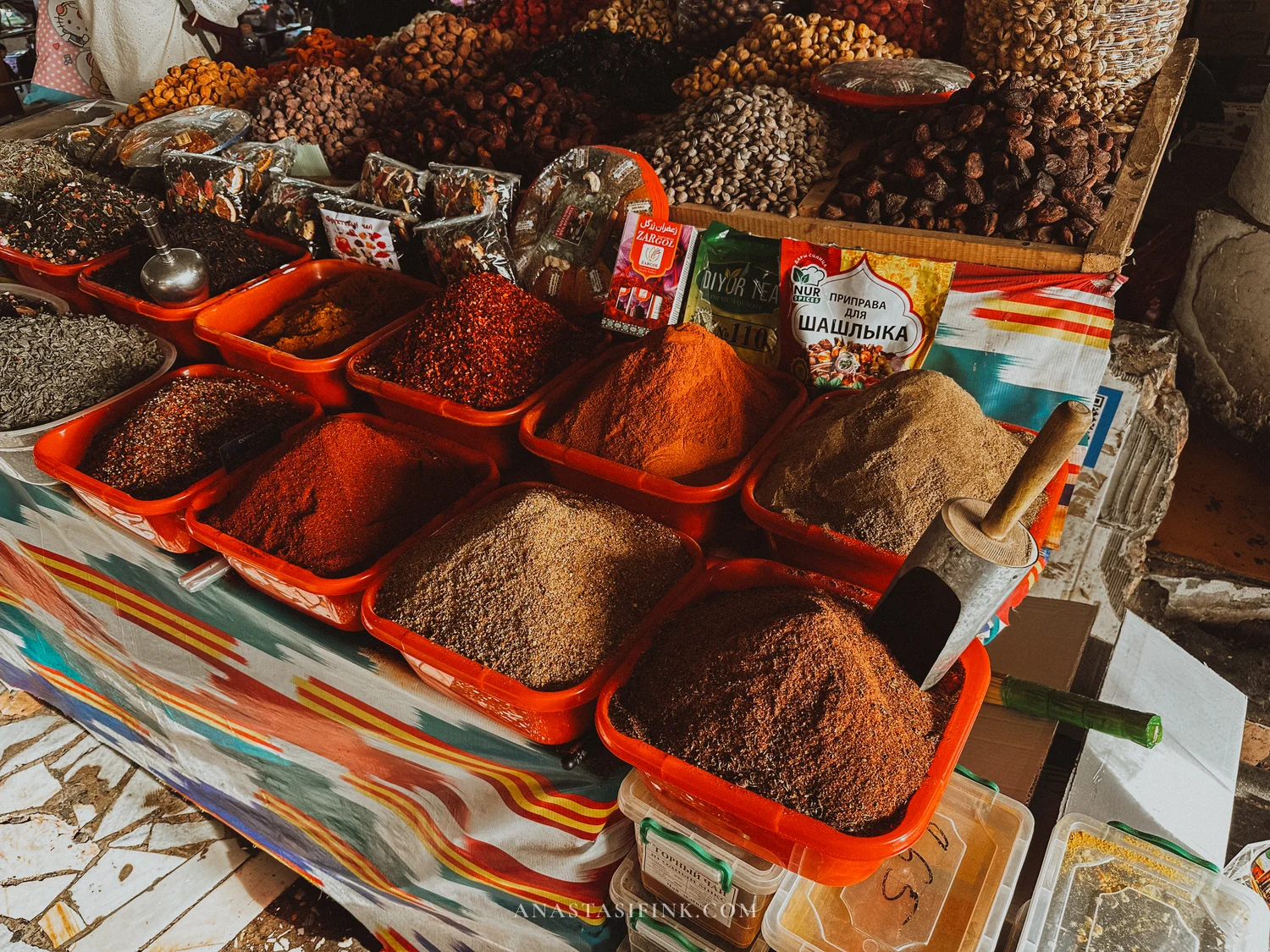
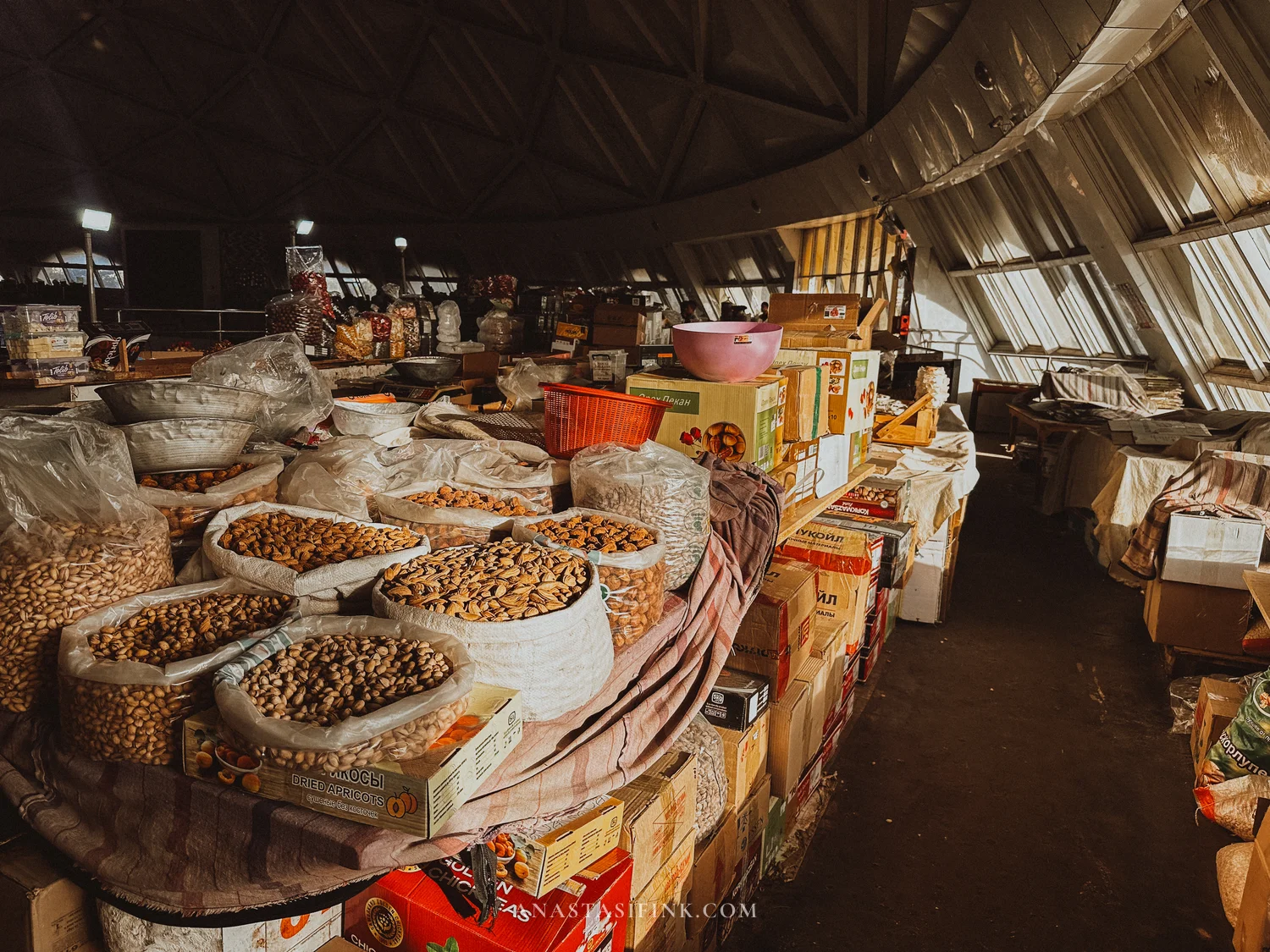
Spices piled into little mounds, and dried fruit and nuts stretching out in endless rows
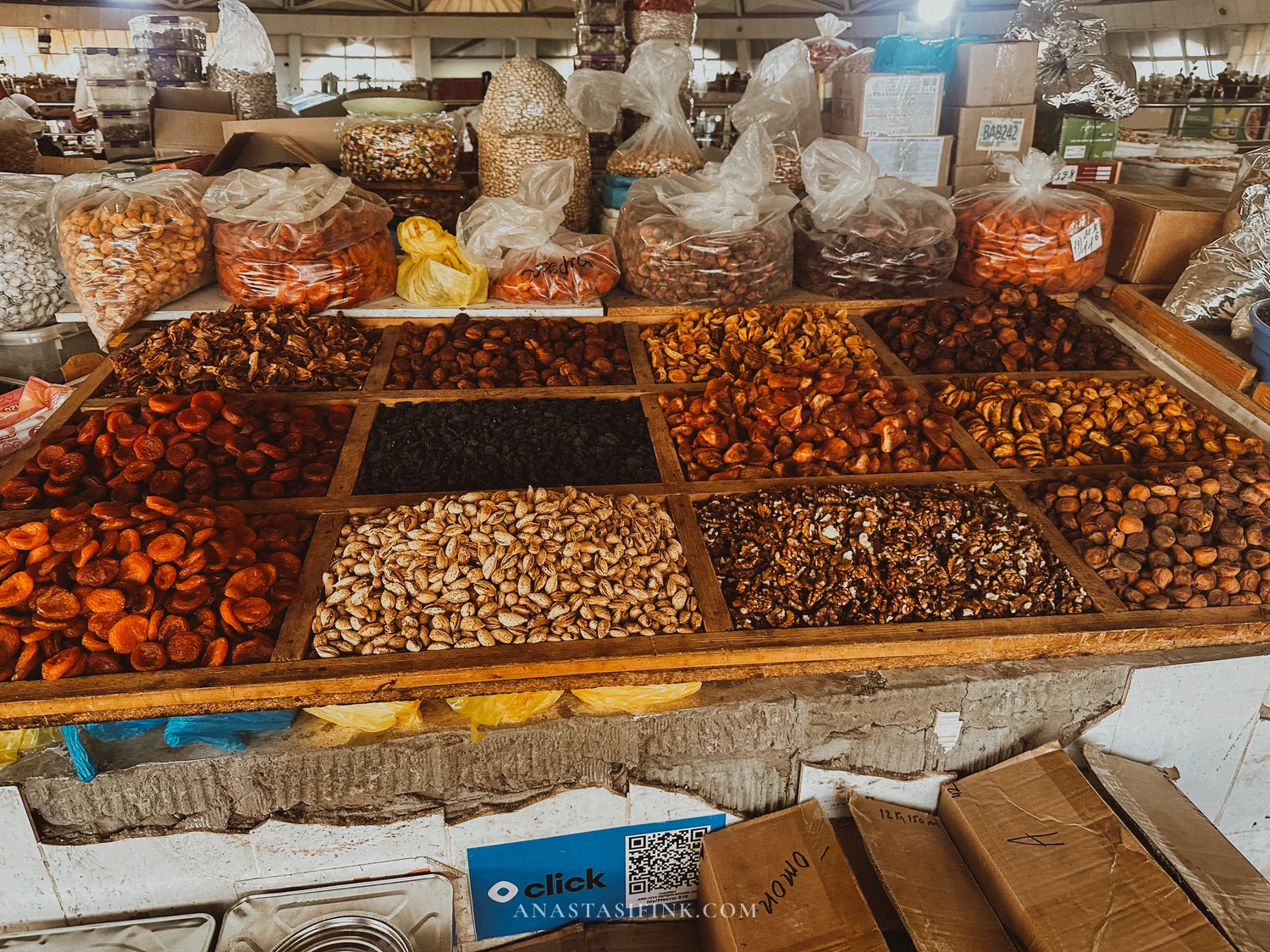
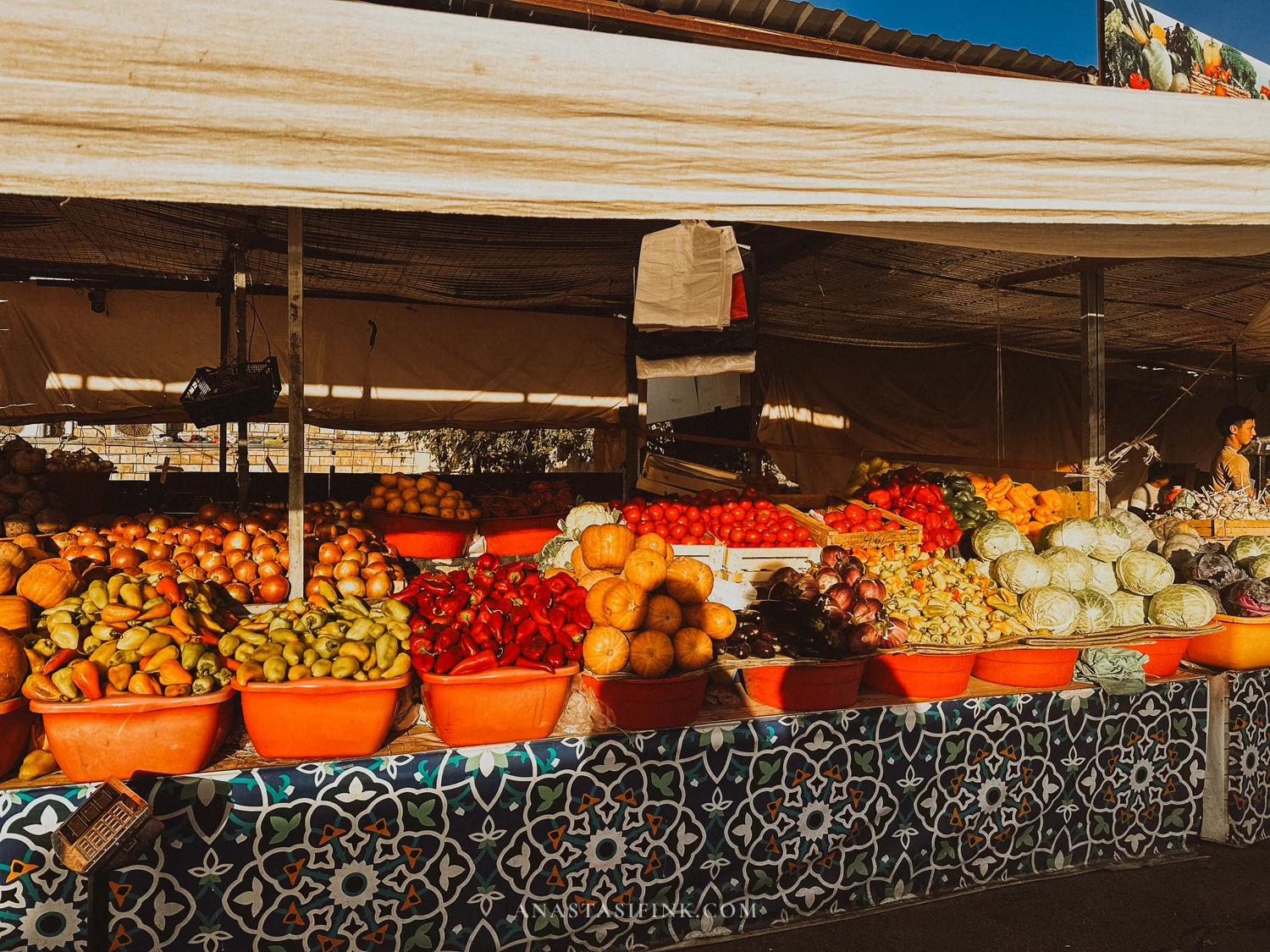
On the left, dried apricots, raisins and nuts; on the right, fresh vegetables in colourful basins
Be sure to get some halva while you’re there — locals use the word for a whole family of Eastern sweets: a dense treat made from seeds or nuts ground with sugar. There are dozens of kinds — sunflower, sesame, with nuts. In the photo it’s the version shaped like a nut roll, sliced into pieces. Sellers are happy to let you try different sorts before you buy.
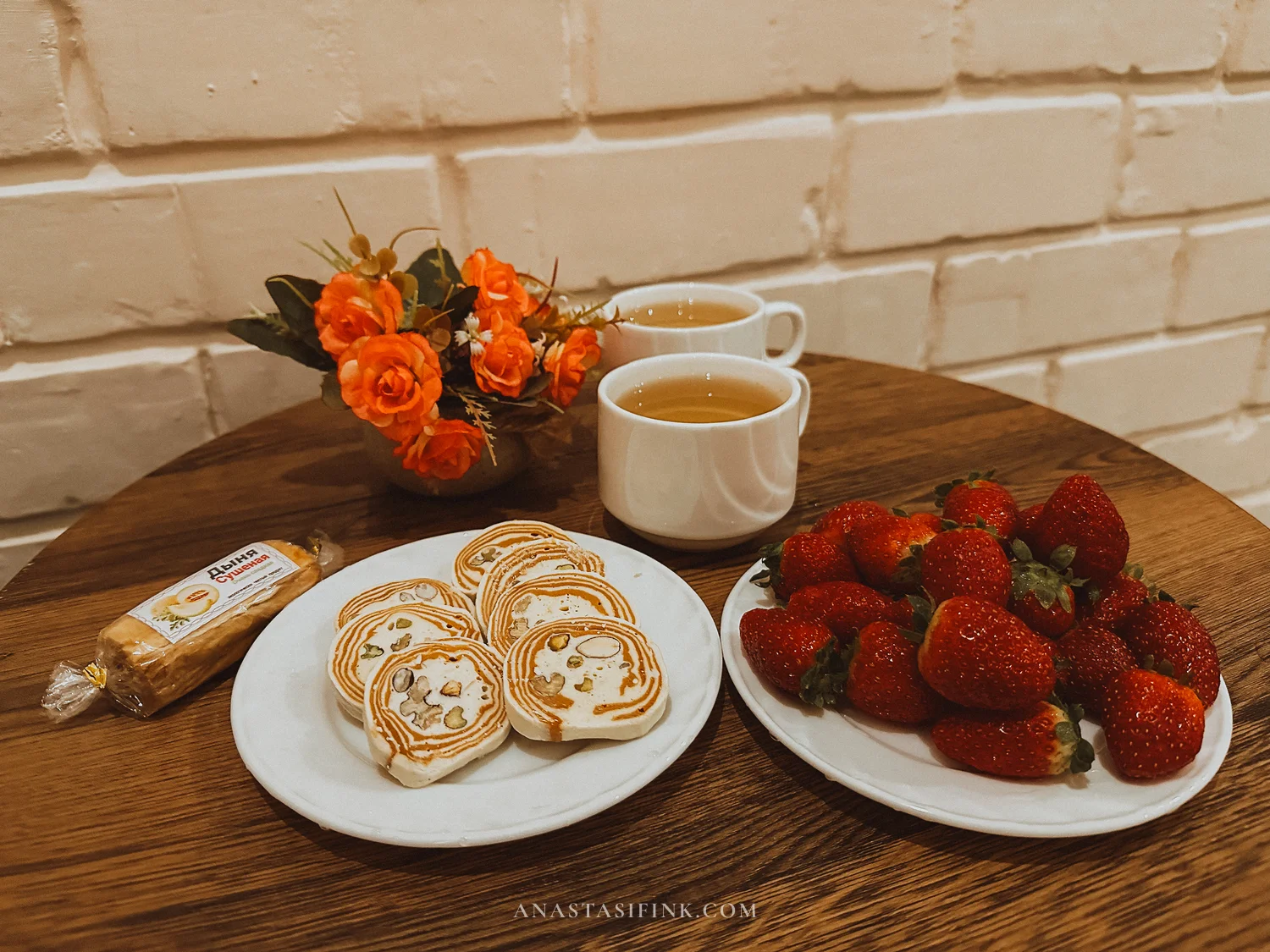
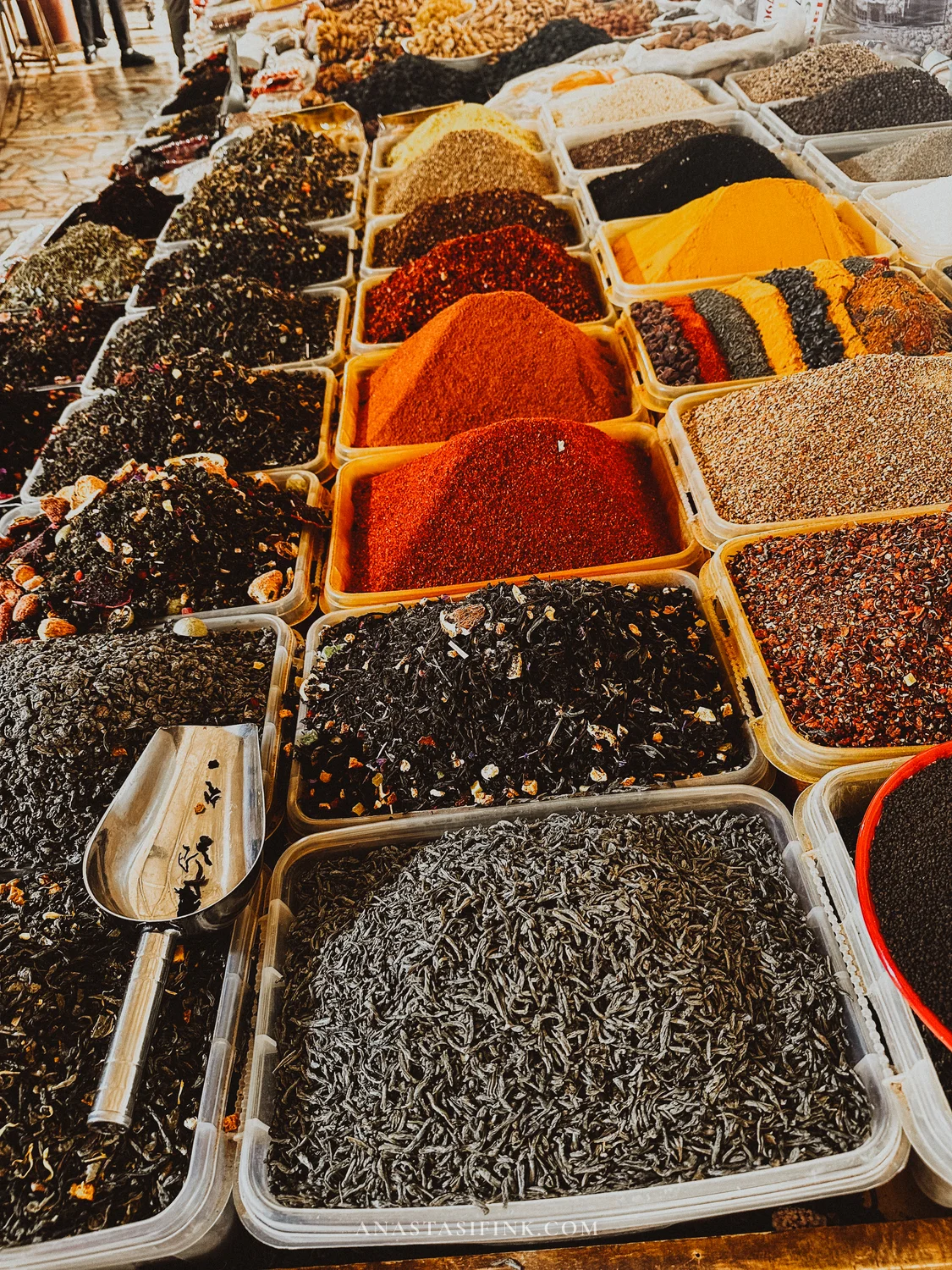
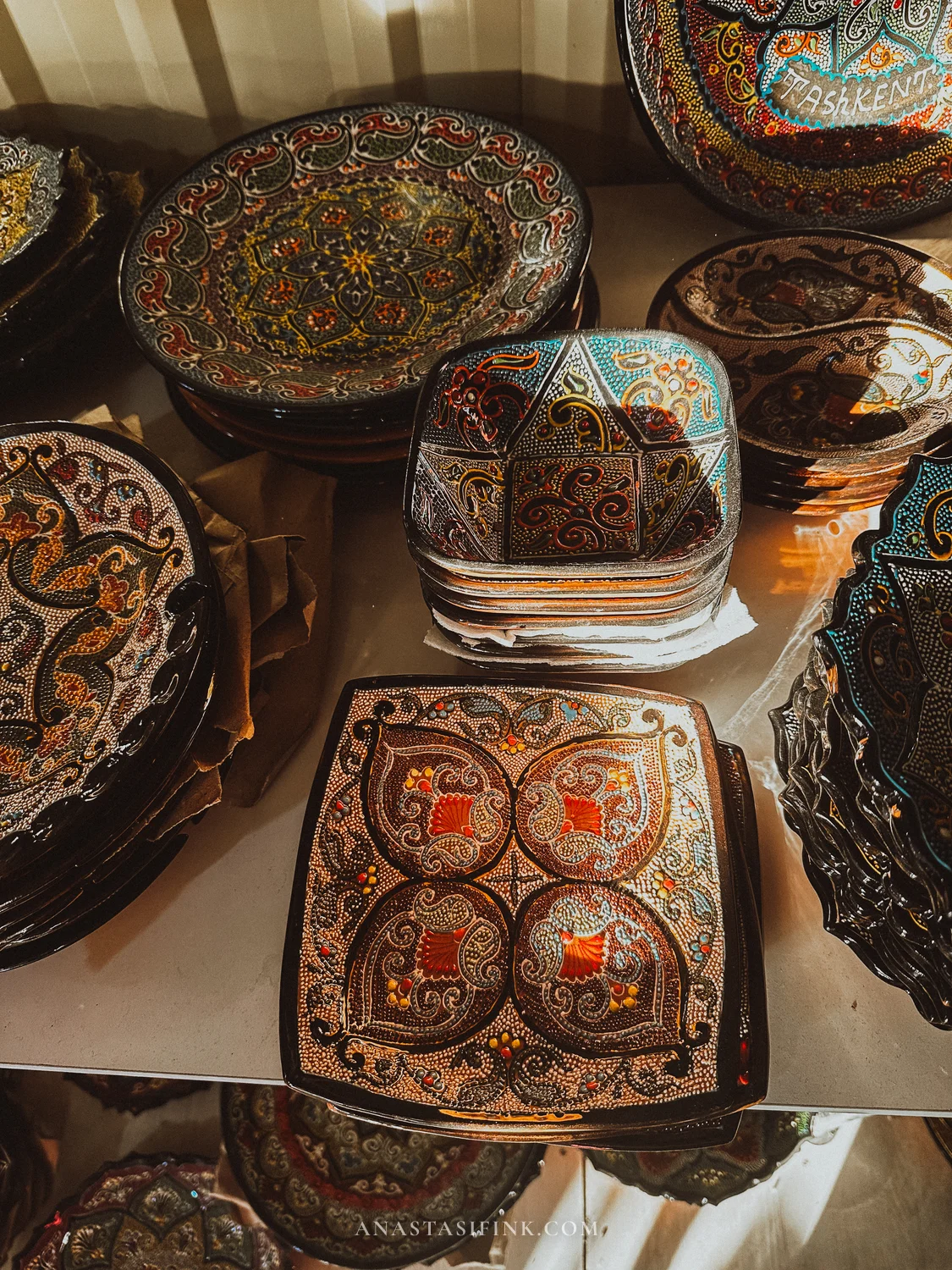
Loose tea and spices, and hand-painted ceramics — another popular souvenir from Chorsu
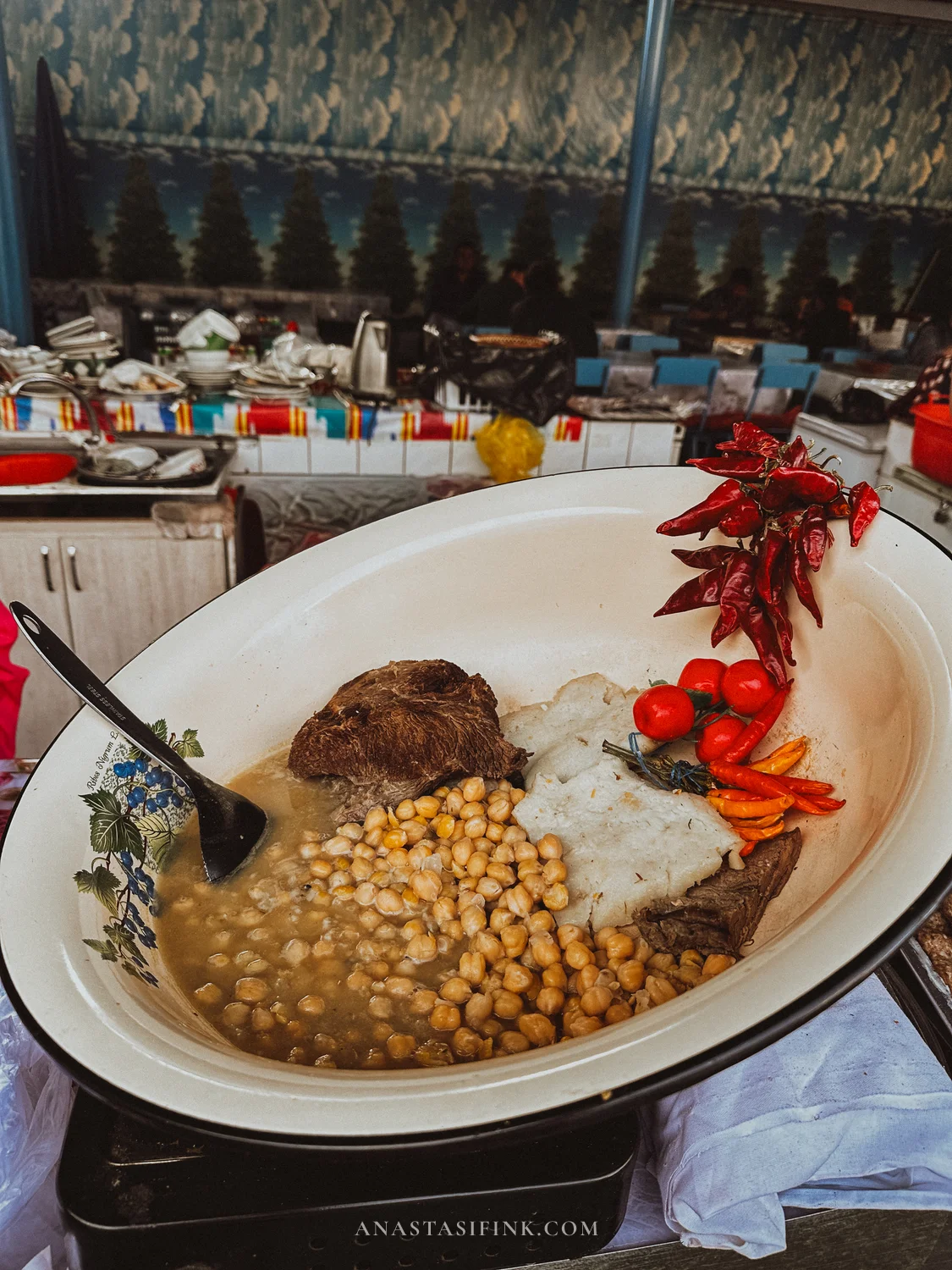
Chorsu also has hot rows of ready-made food. Portraits of the cooks hang above the counters, steam pours out from under the canopies, and cauldrons cook enough for everyone at once. This is where you can try local food — a big bowl of chickpeas with boiled meat and hot pepper, for example.
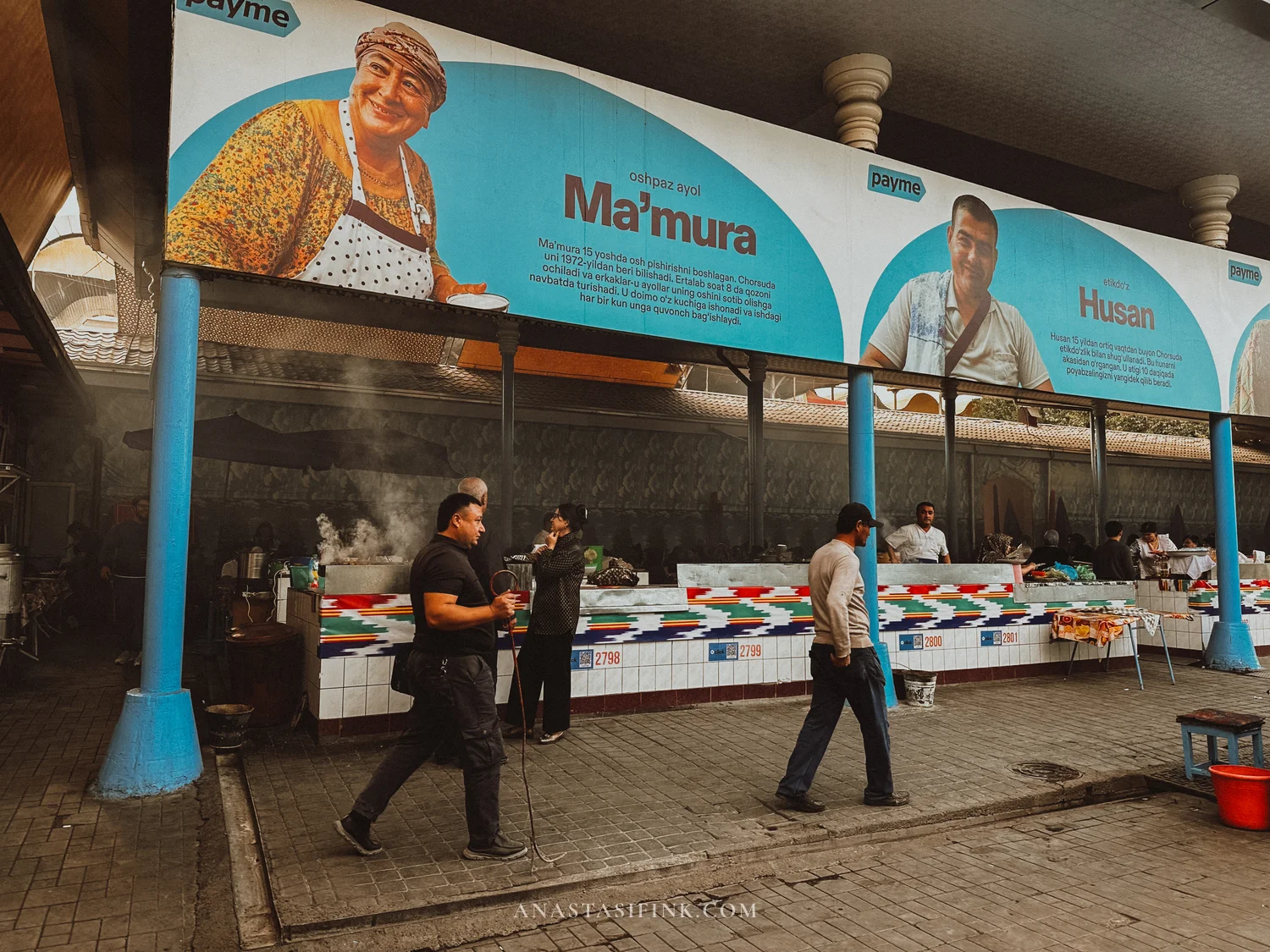
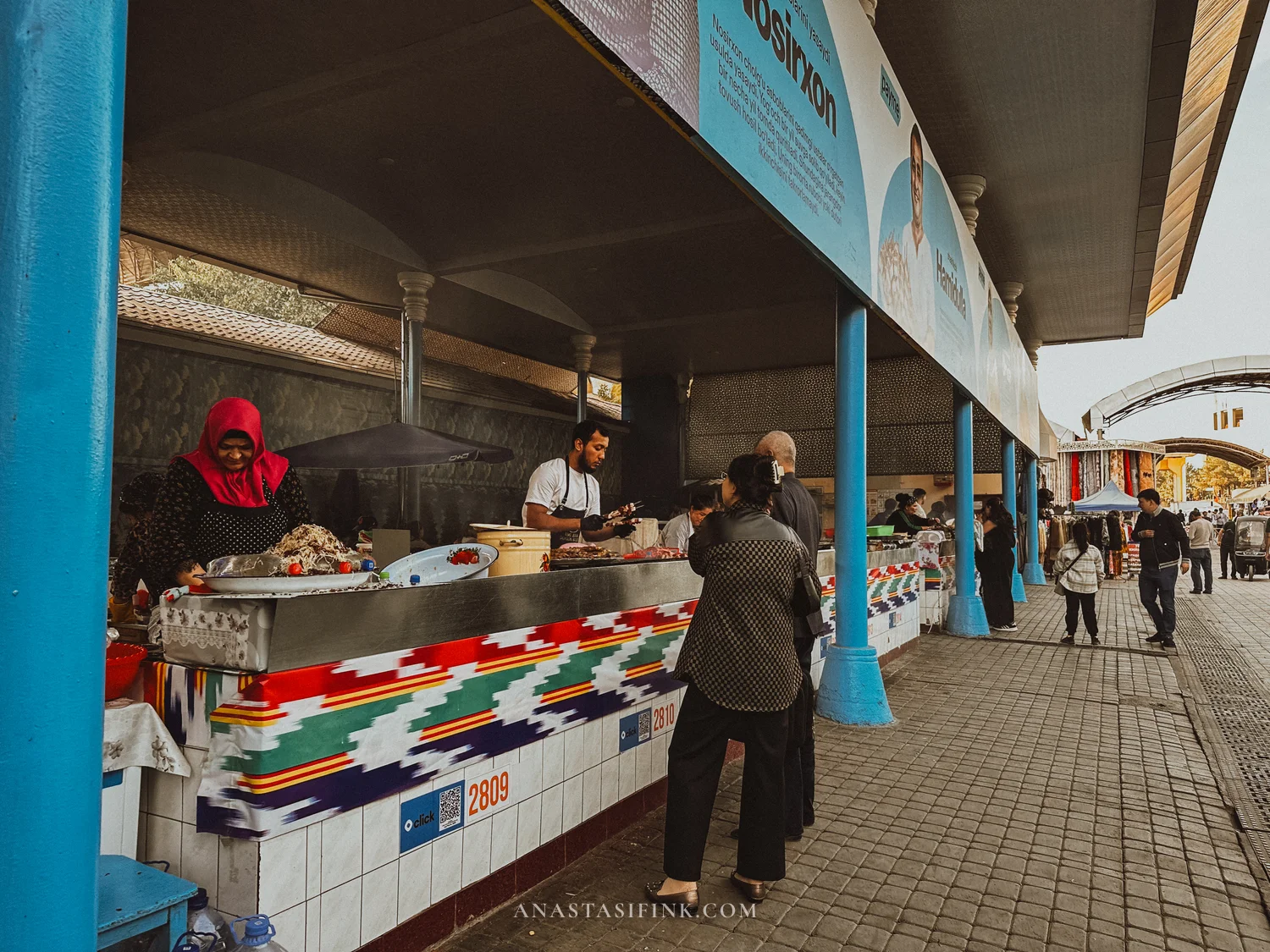
The hot rows of Chorsu: portraits of the cooks above the counters, cauldrons cooking for the whole crowd
Practical info
- Address: Chorsu Square, old town, Tashkent
- GPS: 41.3264, 69.2350
- Opening hours: roughly 06:00–19:00, best to come before noon
- Entry: free
- What to buy: halva, dried fruit, spices, ceramics
- Tip: haggling at Chorsu is normal, and the sellers will offer you tastes before you buy
5. A Real Silk-and-Cotton Robe — Bibi Hanum
If you didn’t find your robe at Human House, go to Bibi Hanum. It’s a Tashkent brand founded in 2006, making clothes from hand-woven ikat — silk and cotton dyed and woven by hand by craftswomen from the Fergana Valley.
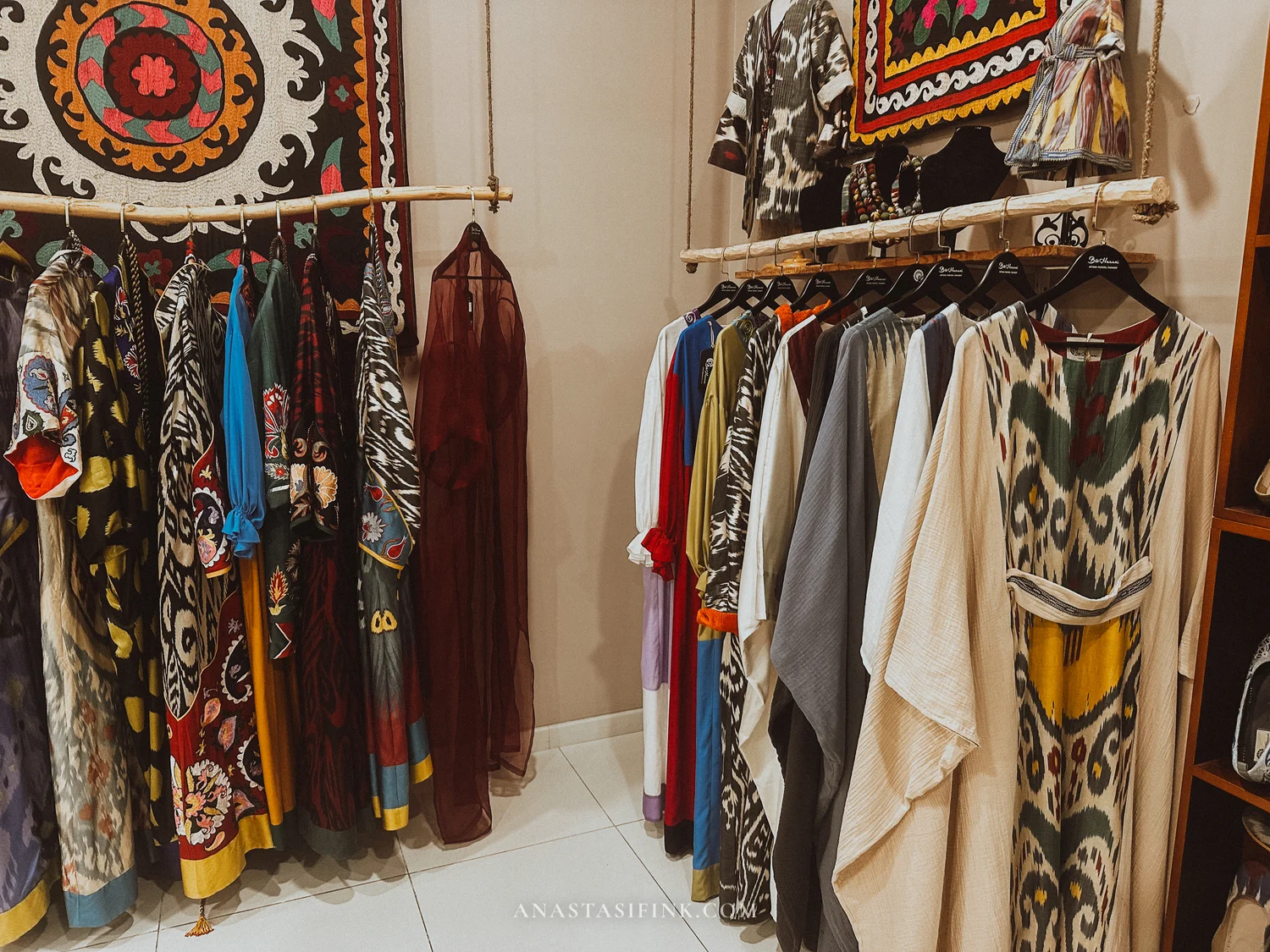
This is where you buy an authentic robe in genuine silk and cotton. Prices start at around $200, and a good robe runs $400–500. It’s not cheap, but it’s a handmade piece: the fabric is made by hand from thread to finished cloth, and a robe like this lasts for years.
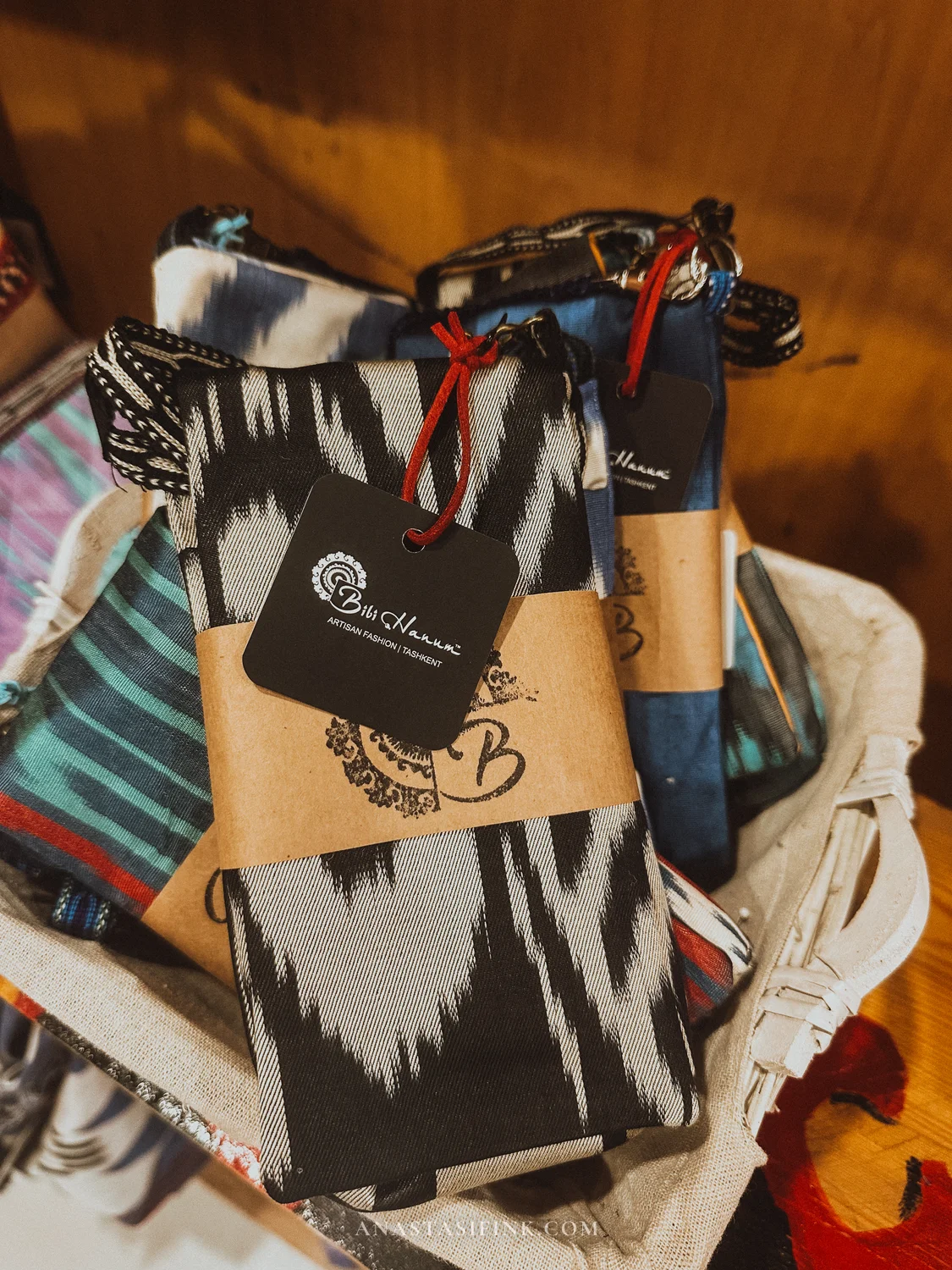
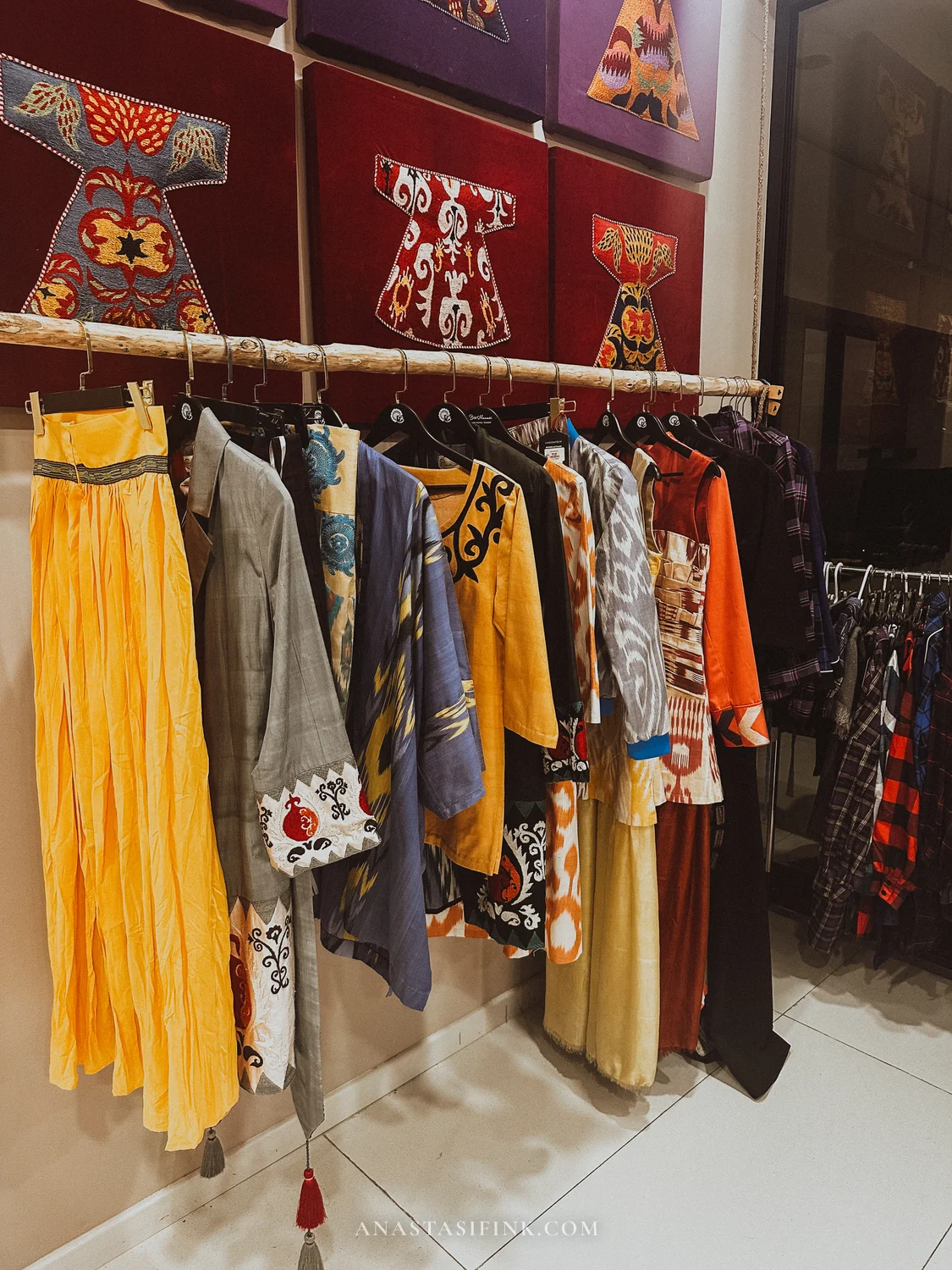
Pieces with Bibi Hanum’s own tags and rows of silk chapans — with mini robes on the wall above them as samples of the cut
Practical info
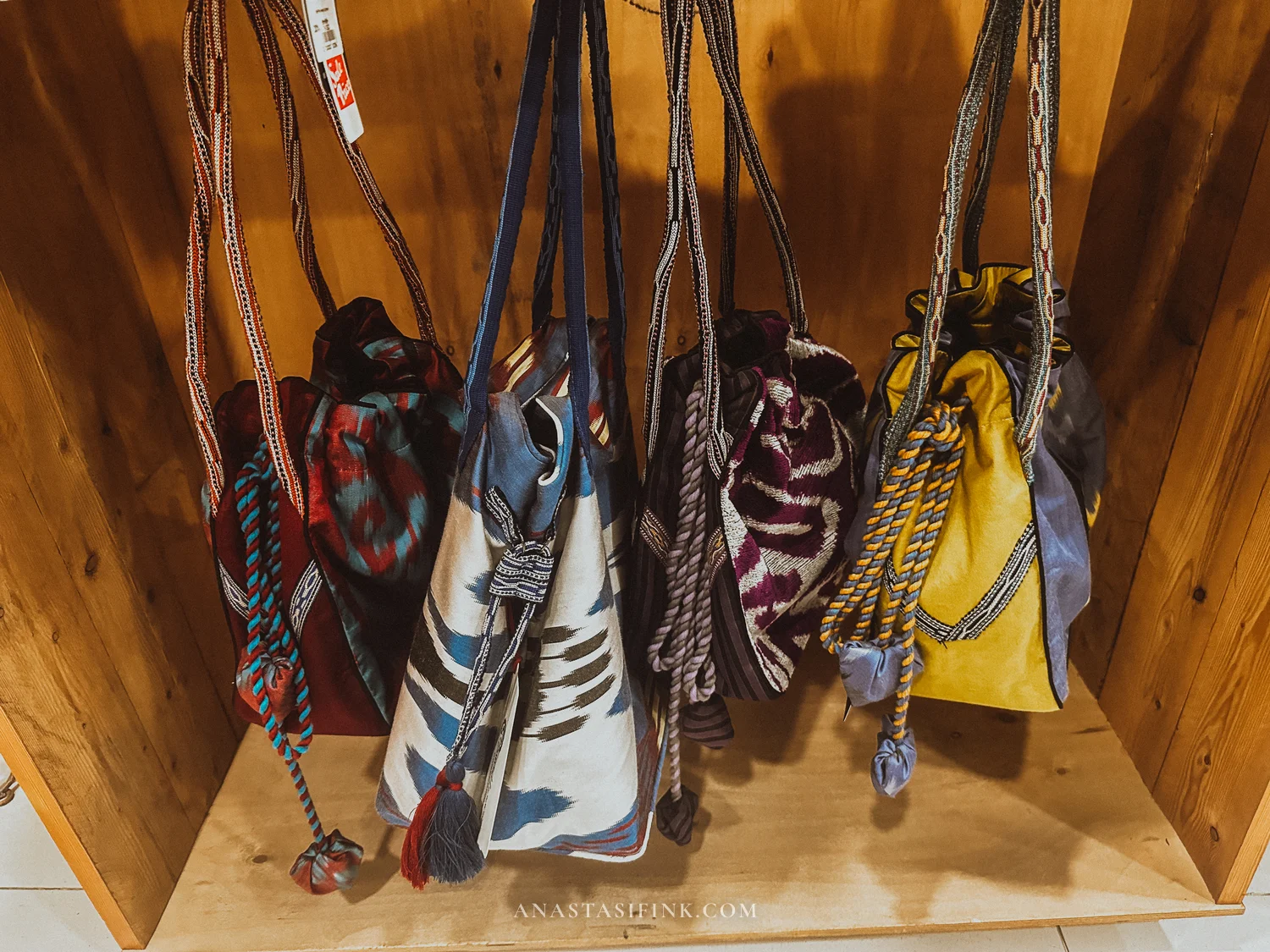
- What to buy: a chapan robe, dresses, bags in handmade ikat (silk, cotton)
- Prices: robes from ~$200, a good one $400–500
- Google Maps: Bibi Hanum on the map
- Tip: check the fabric content — real ikat is made from silk and cotton, and its pattern always has soft edges
6. Plov for Dinner — Besh Qozon
You have to end your day in Tashkent with plov. Plov (or osh) is the star dish of Uzbek cuisine — rice with meat, carrots, onion and spices; UNESCO has added it to its list of intangible cultural heritage. For proper plov, you go to Besh Qozon — “Five Cauldrons” — one of the city’s main plov centres at the foot of the TV tower.
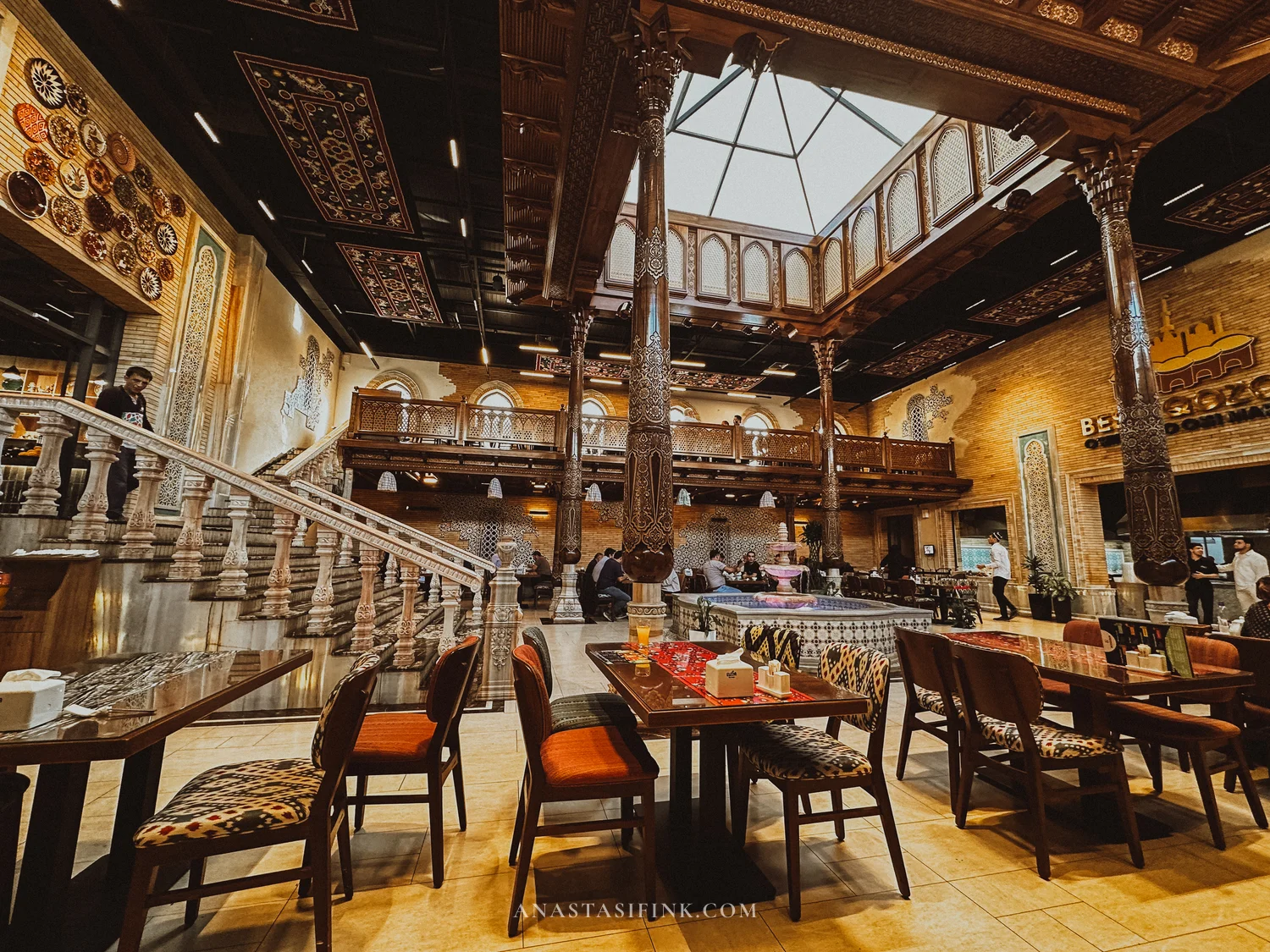
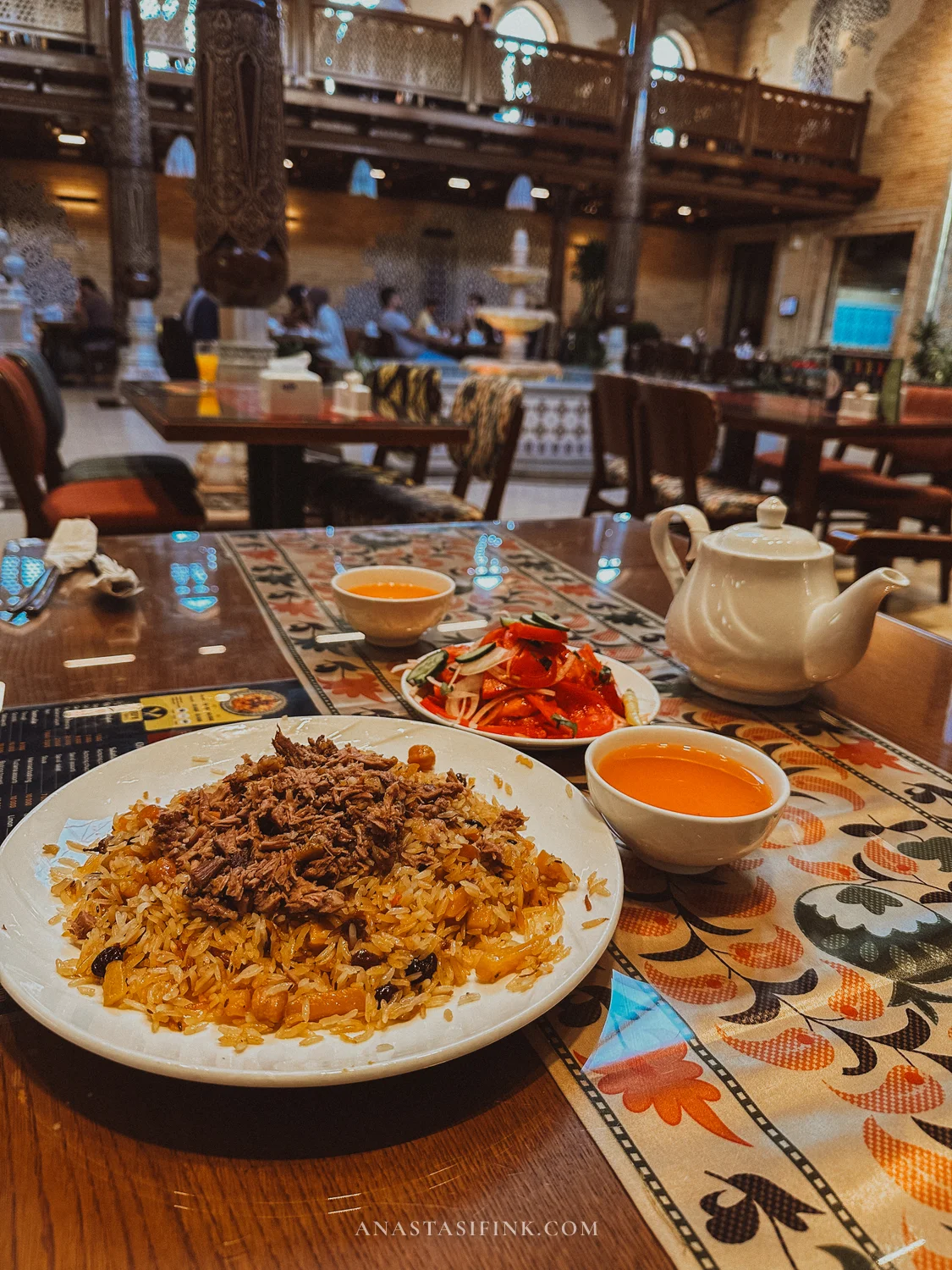
They cook the plov here from morning in giant cauldrons. The portions are big — one is easily enough for two. It comes with achik-chuchuk salad of tomatoes and onion — you’ll find it all over Uzbekistan, though the best one I had wasn’t here but in Bukhara (I wrote about that restaurant in my Bukhara guide). Simple, filling, no frills.
Practical info
- Address: by the Tashkent TV tower, Bog’ishamol St
- GPS: 41.3510, 69.2895
- Opening hours: roughly 09:00–16:00, or until the plov runs out
- Price: a portion of plov ~30,000–40,000 so’m (~$3–4)
- Google Maps: Besh Qozon on the map
- Tip: come at lunchtime — the plov often runs out by evening
One Day in Tashkent — the Quick Version
– Morning: Museum of Applied Arts → Human House (robes, tea, postcards)
– Midday: head into the centre (passing the Romanov Palace from the outside) → the metro (Kosmonavtlar, Uzbekistan, Alisher Navoi, Pakhtakor)
– Afternoon: Chorsu Bazaar (halva, dried fruit, the hot food rows) → Bibi Hanum for a robe
– Evening: plov at Besh Qozon
Between the stops it’s the metro and ride-hailing taxis, which work all over the city and cost very little. You won’t see all of Tashkent in one day, but a route like this gives you a real feel for the place: the old bazaar, Soviet modernism, the crafts, and a metro that’s worth going underground for on its own.
Nearby: Tashkent is one stop on my 7-day Uzbekistan itinerary, along with 3 days in Bukhara and 2 in Samarkand. Find more places in all my Uzbekistan travel guides.
In a day you can realistically do the Museum of Applied Arts, the Human House shop, ride the beautiful metro stations, wander Chorsu Bazaar, drop by Bibi Hanum for a robe and finish with plov at Besh Qozon. On the way into the centre you can glance at the Romanov Palace from the outside. It’s all linked by the metro and taxis.
Yes, absolutely. Each station was designed by a different artist, so this first metro in Central Asia doubles as an underground gallery. Grab a ride for ~1,700 so’m (~$0.14) and get off at every station — for that money you can ride all day.
It depends on your budget. For a cheaper souvenir version, try Human House. For a serious piece in handmade ikat, go to Bibi Hanum: prices start at $200, and a good robe will run $400–500.
Halva (as locals call the nut and sesame sweets here), dried fruit, nuts, spices. The sellers will offer you a taste before you buy — don’t be shy, it’s part of the ritual. And if you’re hungry, the bazaar has hot rows of ready-made food. Come before noon.
Besh Qozon by the TV tower is one of the most famous plov centres. A portion costs around 30,000–40,000 so’m (~$3–4) and is clearly not sized for one. Important: the plov is cooked in the morning and runs out by evening, so go at lunchtime.
No — the building houses Uzbekistan’s Ministry of Foreign Affairs and isn’t open to visitors. It’s not worth a special trip, but if it happens to be on your way into the centre, pause for a couple of minutes by the fence and admire the facade, especially in autumn.
Many nationalities — including EU countries, the UK, Japan and dozens more — can enter Uzbekistan visa-free for up to 30 days. US citizens need an e-visa, which is quick and easy to get online before you travel. Always check your own country’s current rules before booking.
One day is enough to get a genuine taste of the city — the old bazaar, the metro, the crafts and the plov — which is exactly what the route above covers. If you have more time, you can slow down, add a hammam or a day trip, but a single well-planned day works surprisingly well.
The main options are the metro (fast, cheap and beautiful) and ride-hailing taxis, which work all over the city. The distances are big, so you won’t walk the whole route, but with the metro one day is completely realistic. A local SIM or eSIM is cheap and handy for maps and booking rides.
Tashkent. It’s the capital of Uzbekistan and the largest city in Central Asia. After the 1966 earthquake it was almost entirely rebuilt, which is why Soviet modernist blocks stand right next to the clay courtyards of the old town.