Registan Square, Samarkand: A Complete Visitor’s Guide

This place stopped me in my tracks. Honestly, I’d fly back to Samarkand just to stand on this square again. Below is everything I learned on the ground, plus my tips for visiting.
What Registan Actually Is
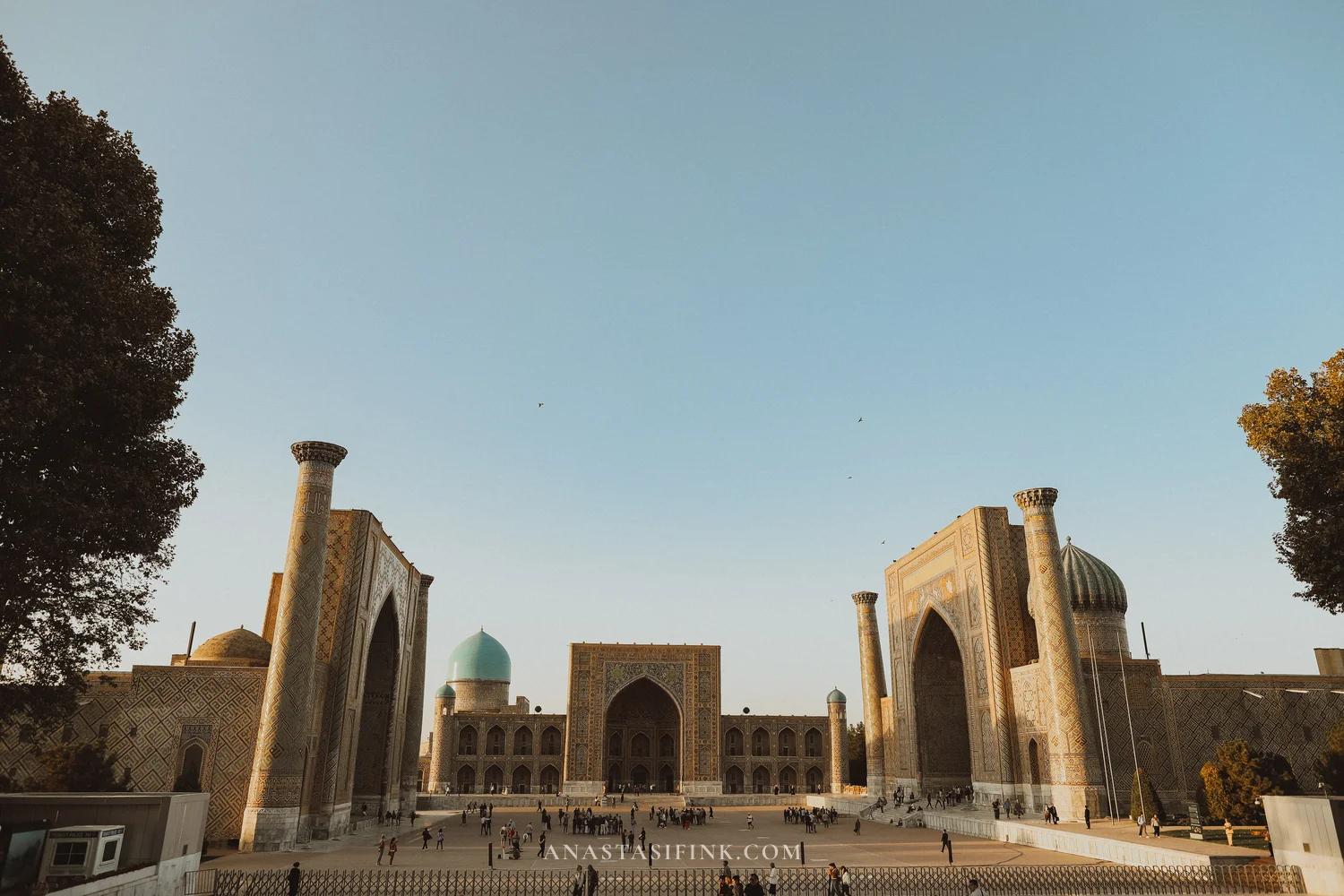
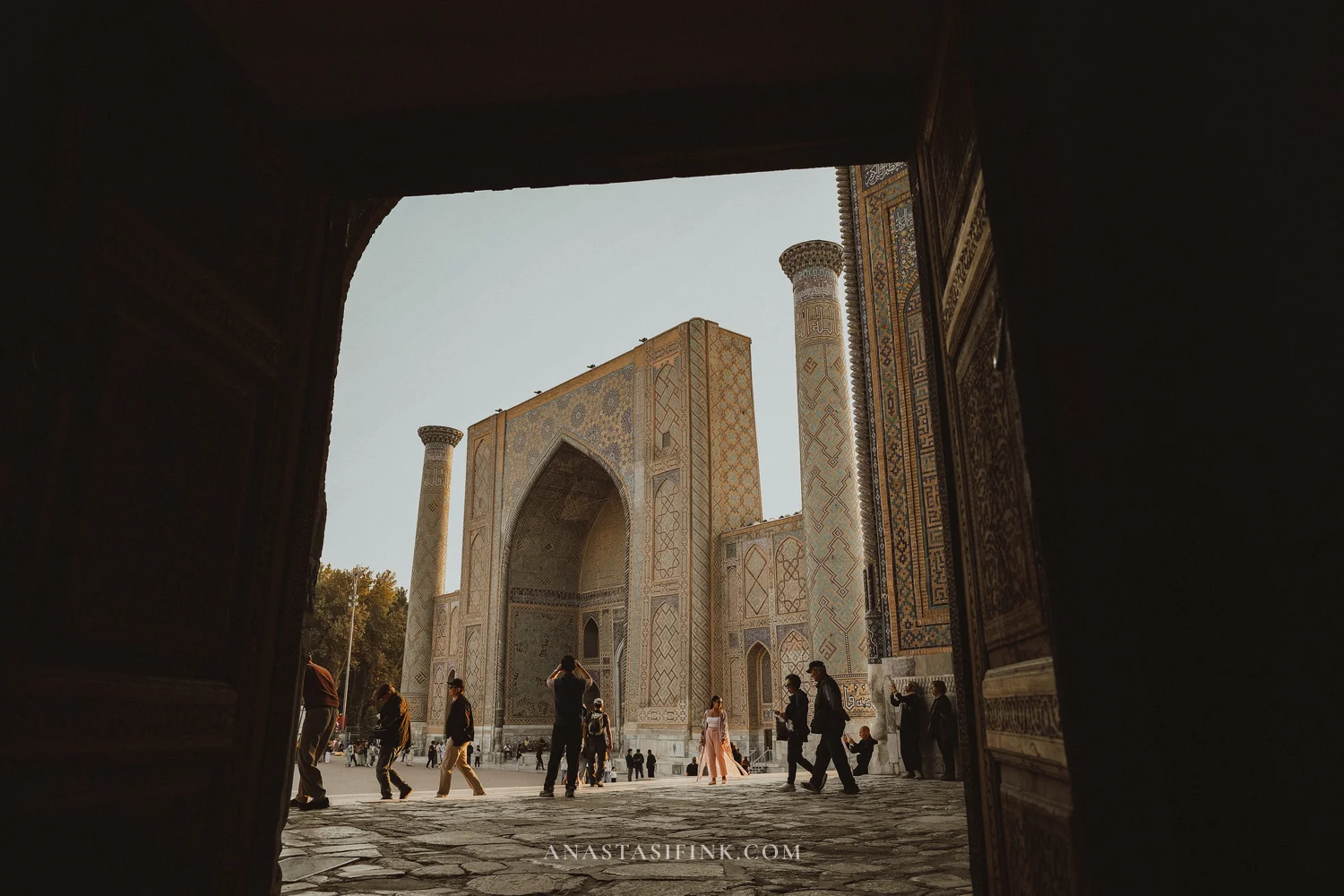
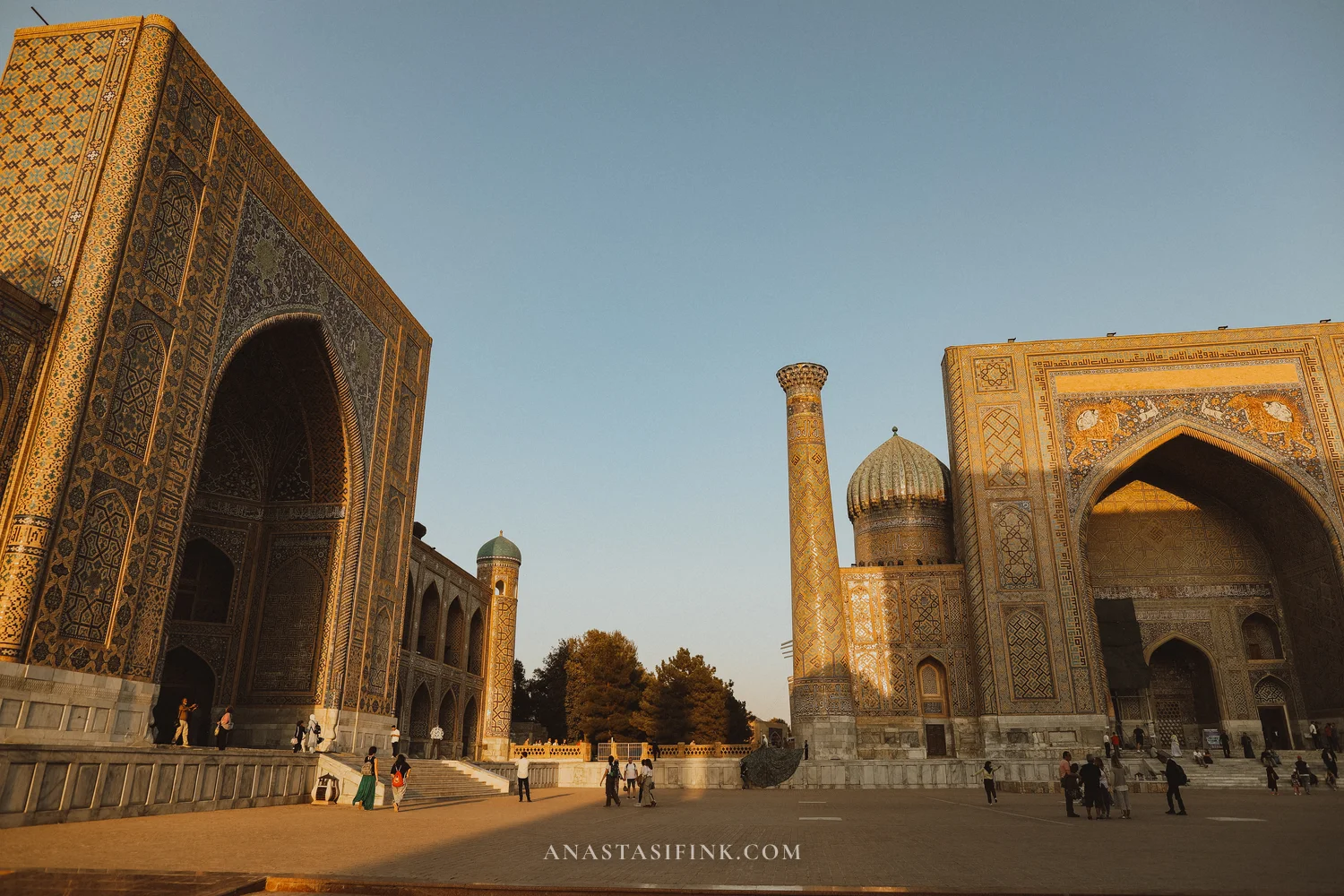
“Registan” comes from Persian and means “sandy place.” It’s the main square of Samarkand and, in my opinion, the single most recognizable image of all Uzbekistan. Three enormous madrasahs from the 15th to 17th centuries, arranged in a horseshoe facing each other, form one of the most cohesive architectural ensembles in Central Asia. Since 2001, Registan has been on the UNESCO World Heritage list as part of Samarkand’s historic center.
If you’re trying to picture the scale, think of Registan as the Roman Forum of Central Asia. Except instead of a single ruined monument, you get three intact masterpieces, and from one spot in the middle of the square you can see all of them at once.
The Three Madrasahs
A madrasah is an Islamic place of higher learning, somewhere between a university and a seminary. There are three of them on Registan:
- Ulugh Beg madrasah (1417–1420) – on the left
- Sher-Dor madrasah (1619–1636) – on the right
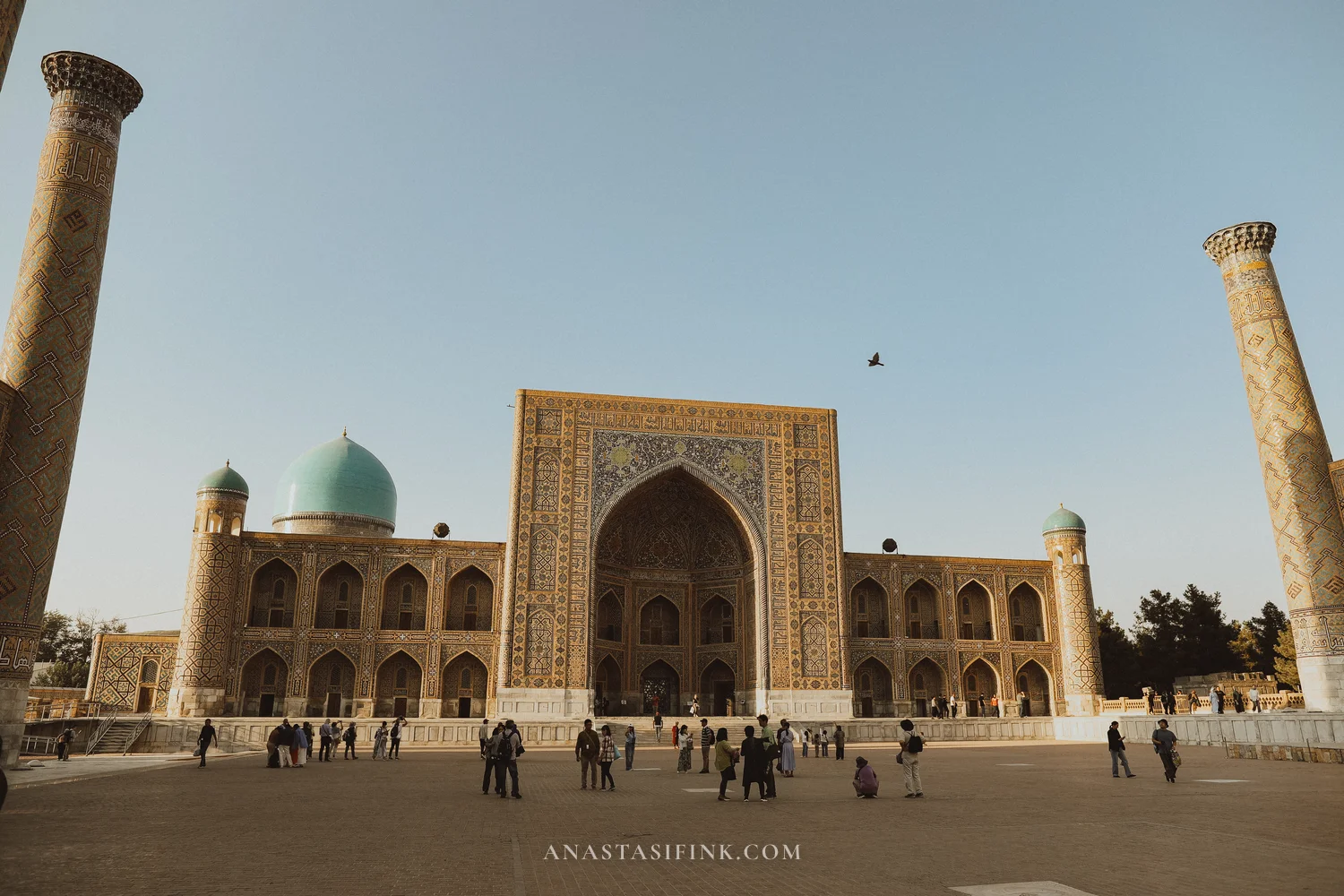
- Tilya-Kori madrasah (1646–1660) – in the center
They were built at different times by different rulers, but each architect worked hard to fit into the existing ensemble. It worked beautifully.
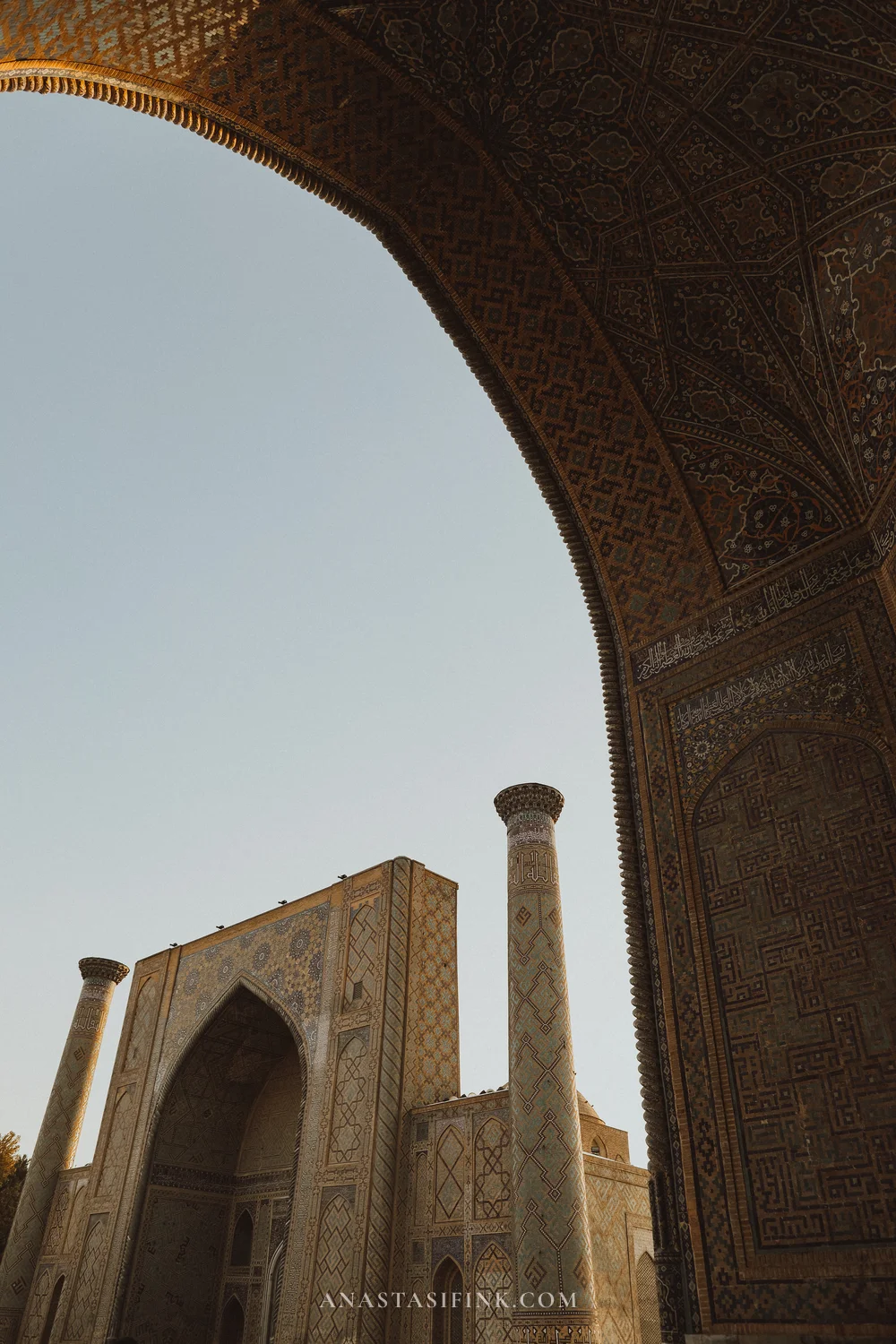
Ulugh Beg Madrasah (1417–1420)
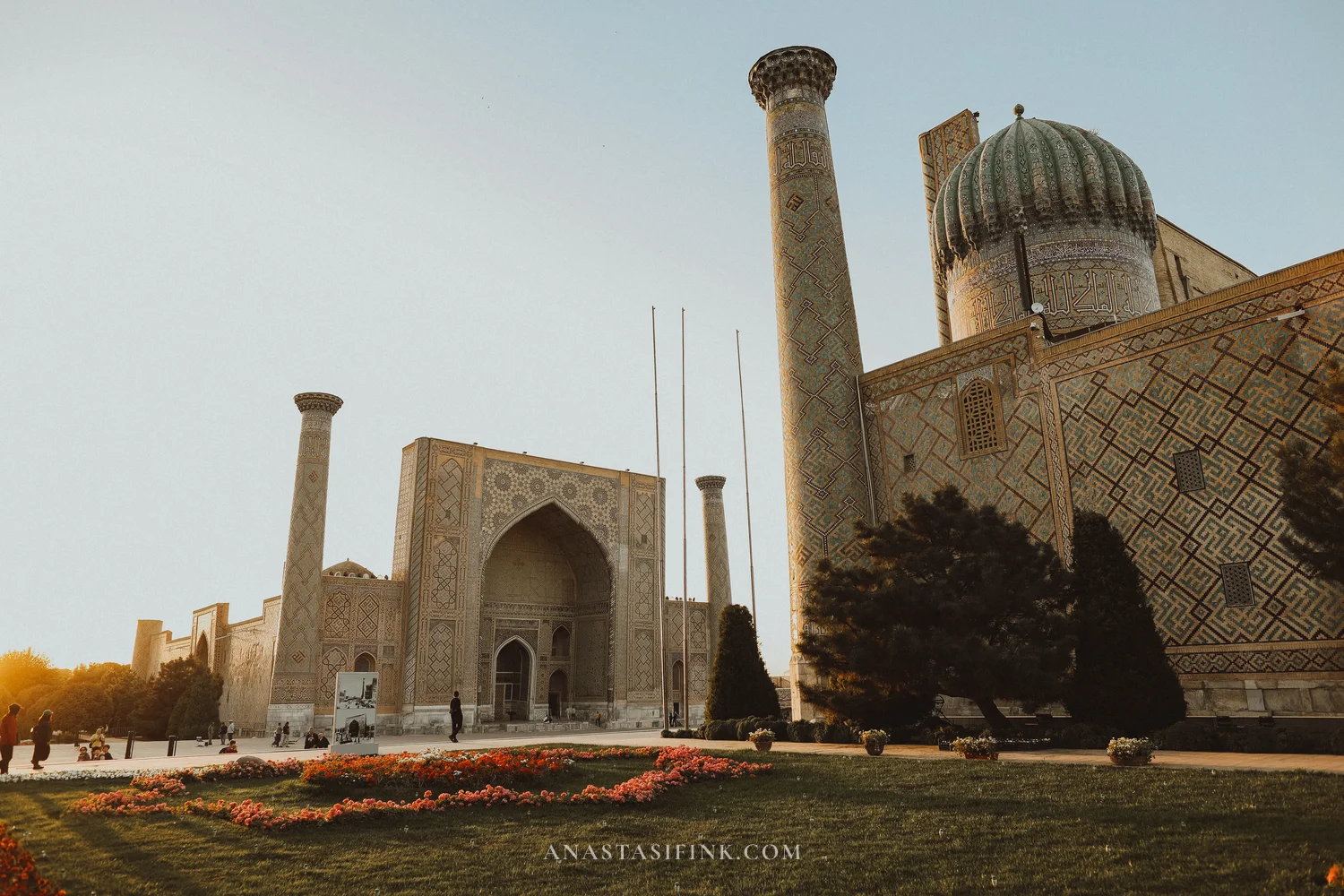
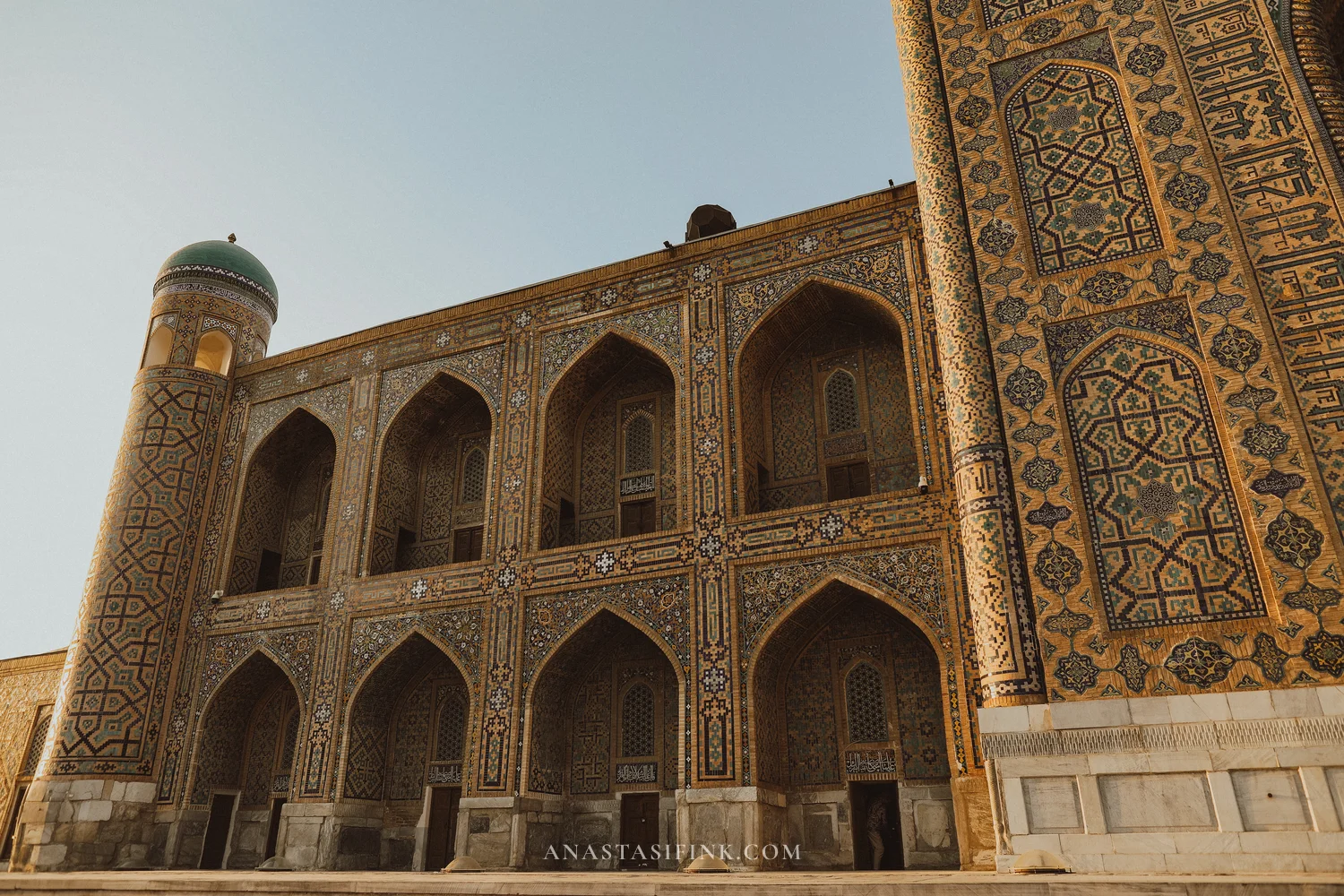
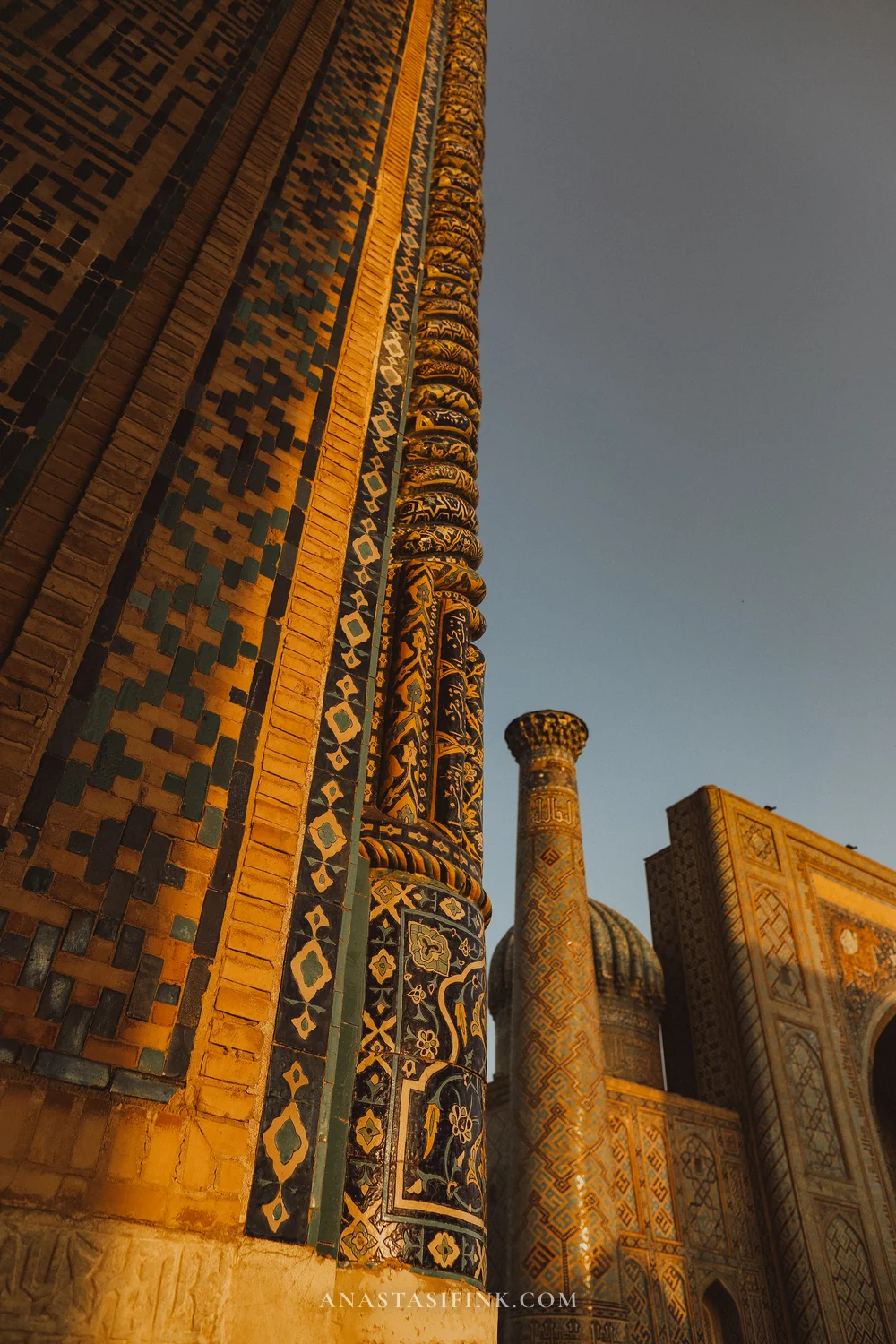
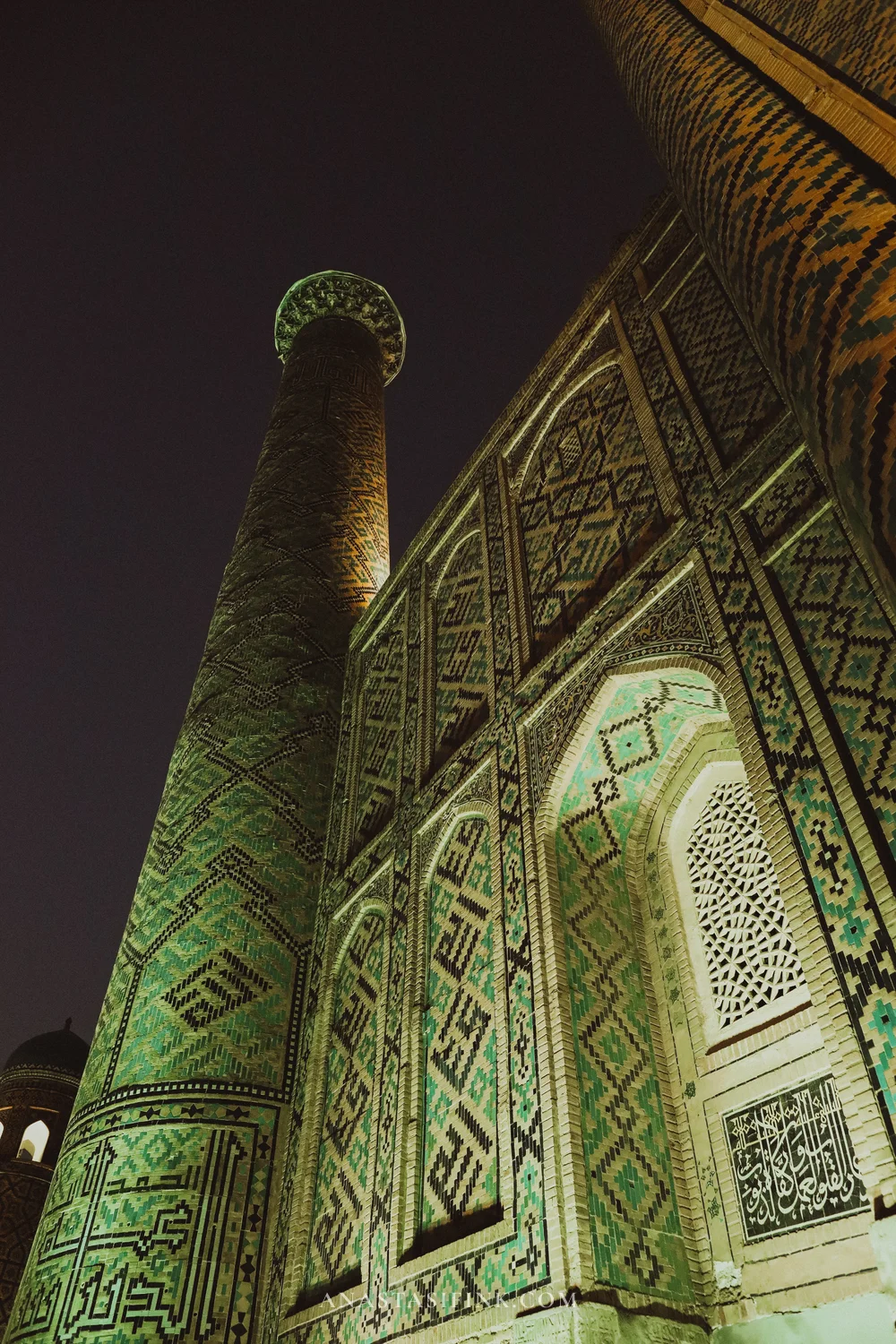
The oldest of the three. It was commissioned by Ulugh Beg, the grandson of Tamerlane, ruler of Samarkand, and one of the great astronomers of his time. Those blue stars worked into the ornament on the main portal? They’re a nod to his obsession with the night sky. In the 15th century this was one of the finest Islamic universities anywhere, teaching theology, mathematics, and astronomy side by side. The building itself measures 56 by 81 meters, with four corner minarets at 33 meters each.
You can climb one of the Ulugh Beg minarets, which most visitors don’t realize. Near the entrance there’s usually a guy with a small sign offering the climb for an extra fee. It leads to a tiny viewing platform where the entire square spreads out below you. There’s sometimes a short line, but it moves fast.
Sher-Dor Madrasah (1619–1636)
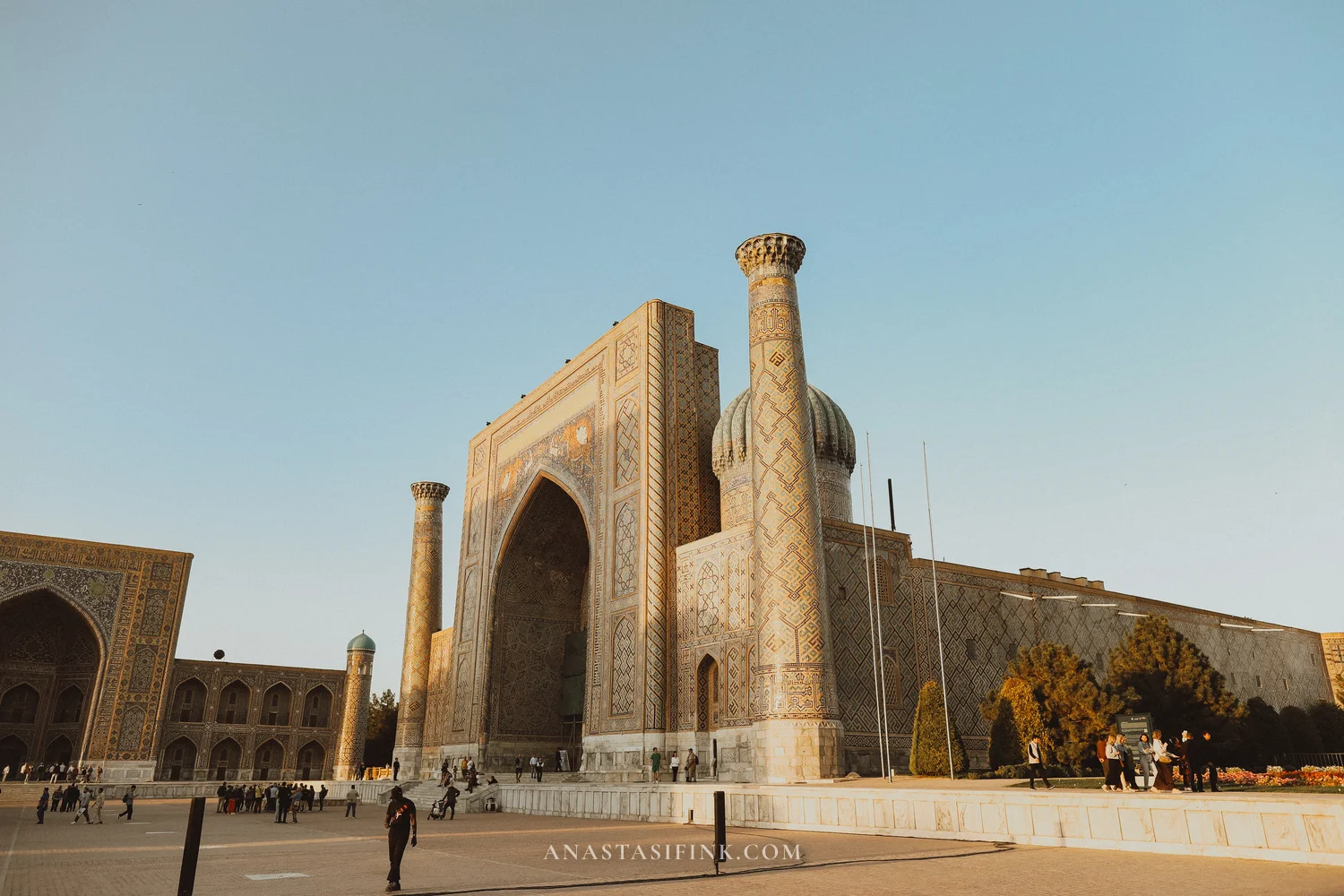
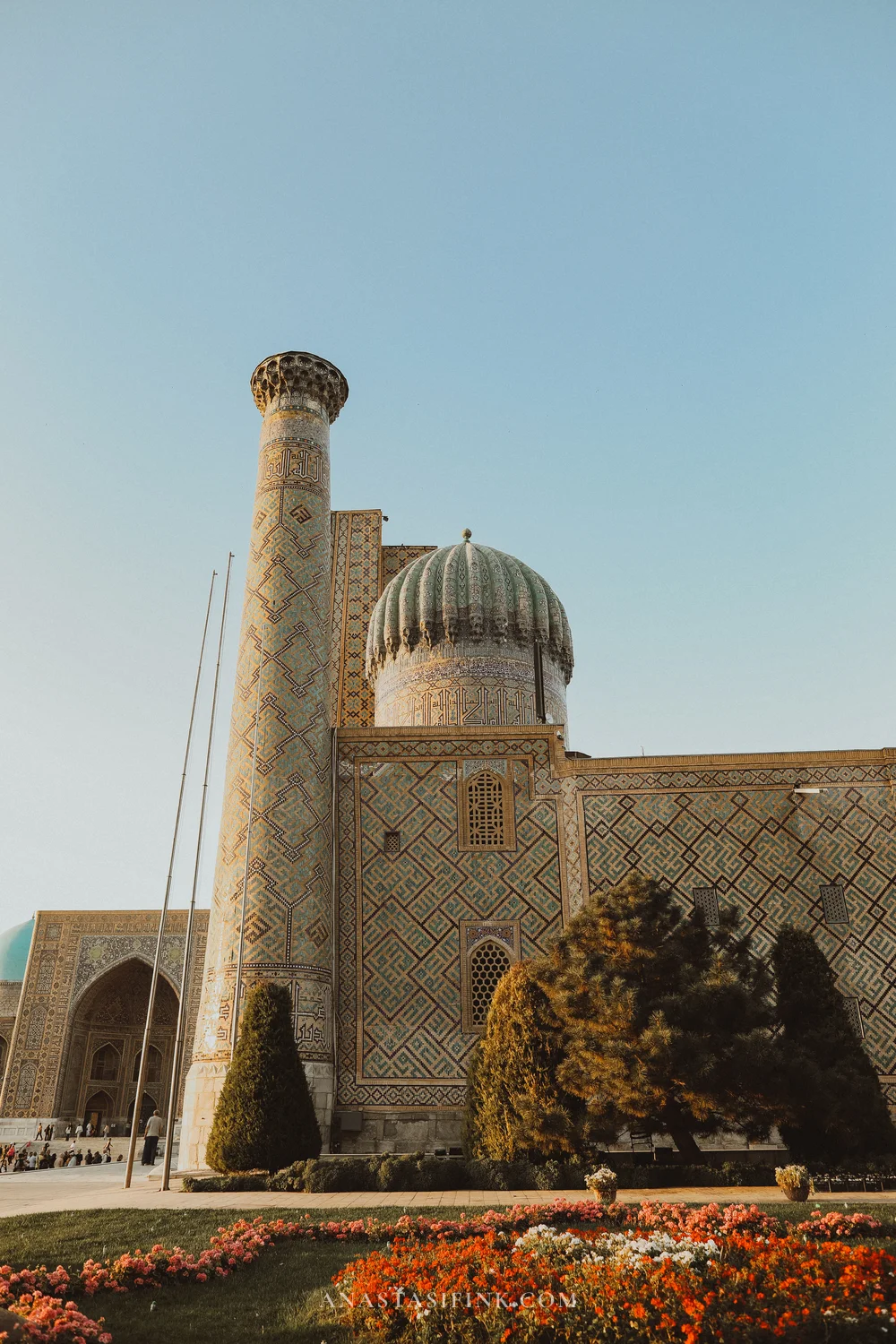
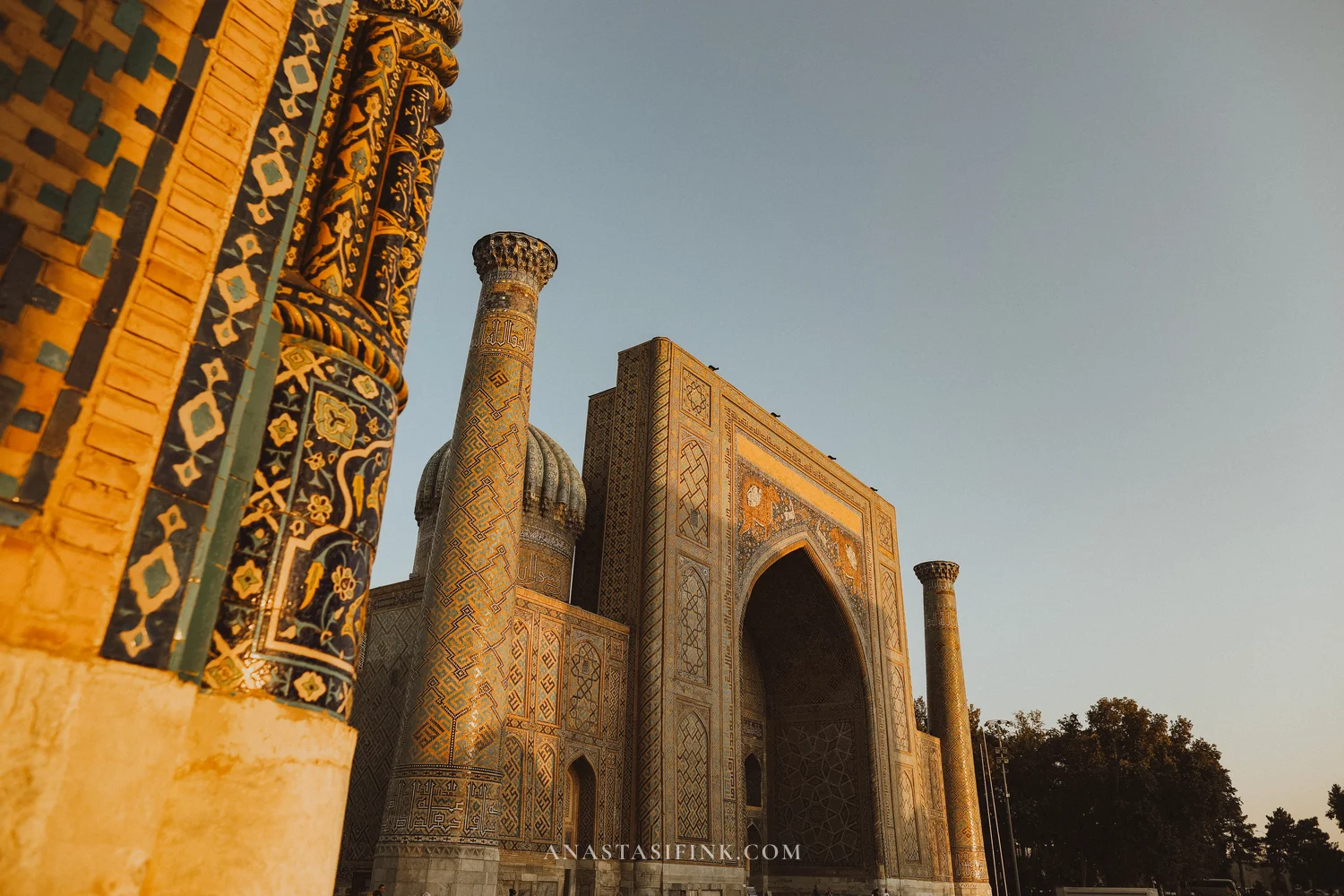
Built two centuries after Ulugh Beg, on the orders of Uzbek ruler Yalangtush Bakhadur. “Sher-Dor” translates as “the one bearing tigers,” and the main portal shows a mosaic of tigers (or lions, depending on which scholar you ask) with a sun rising on each one’s back, the sun’s face distinctly human. This is incredibly rare in Islamic architecture. Sharia traditionally forbids images of living creatures, but the artists found a workaround: the beasts are clearly mythical, and the sun has a face that reads as both male and female at once.
Local legend says the Sher-Dor minarets lean a bit, like a subtle Pisa. You can’t climb them, but you can climb the Ulugh Beg minaret next door (see above).
Tilya-Kori Madrasah (1646–1660)
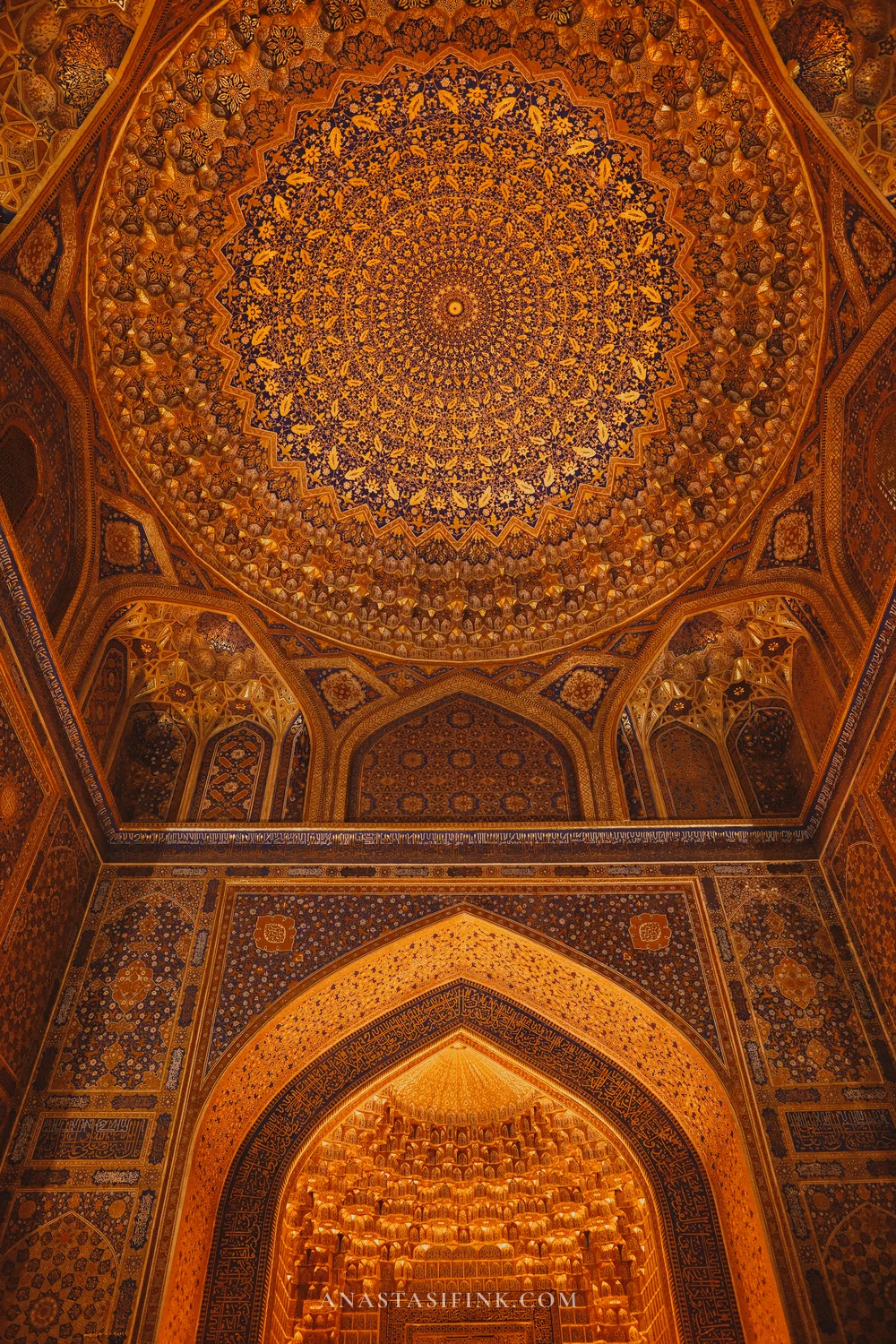
The latest and the most jaw-dropping. “Tilya-Kori” means “decorated with gold.” Inside the northern wing there’s a mosque whose ceiling and walls are coated in real gold leaf. When you step inside, the whole room seems to glow from within. Tilya-Kori was built on the site of an old caravanserai, finished about a decade after Sher-Dor, and it served two purposes at once: a school and the main Friday mosque of Samarkand at the time.
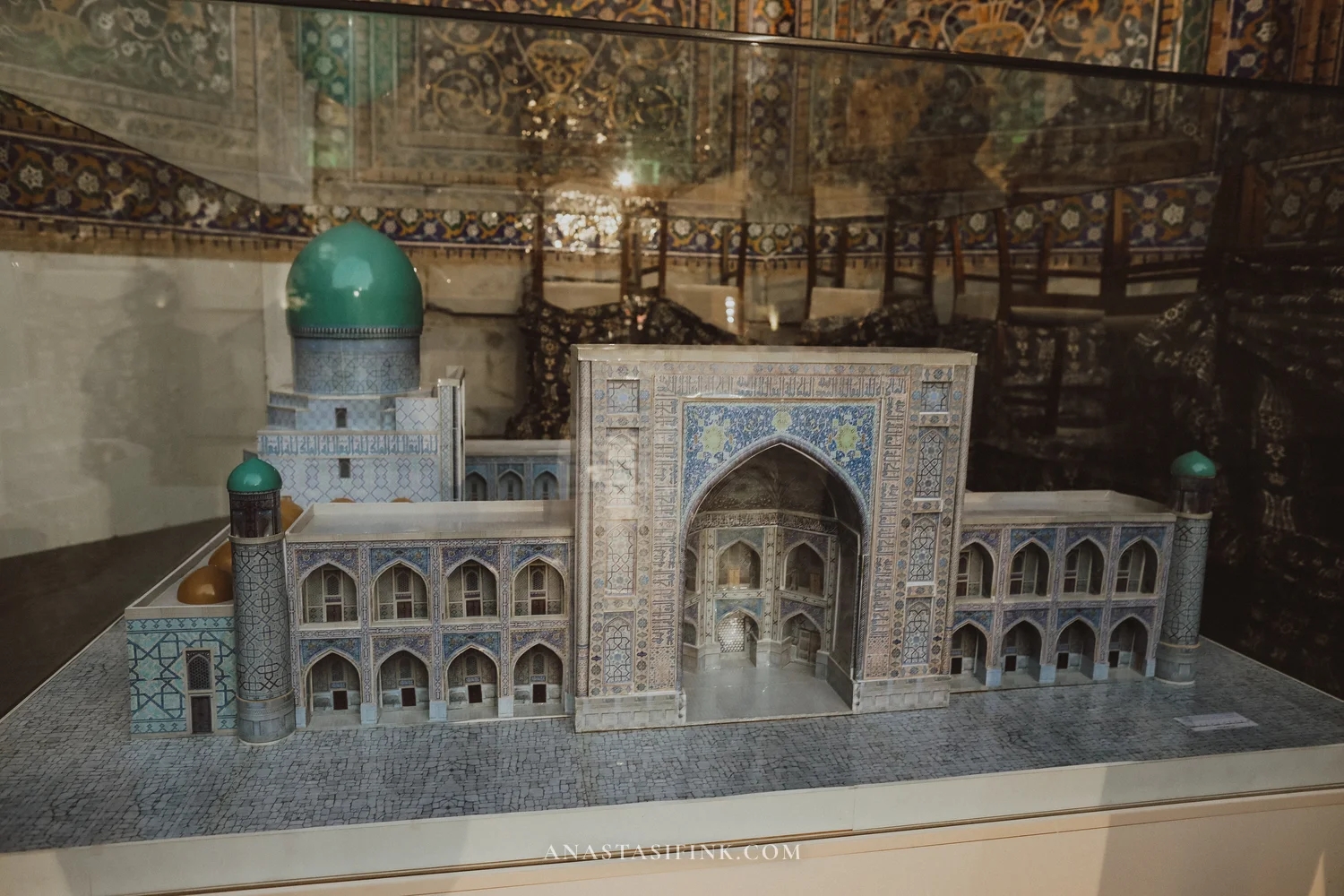
What’s Inside (Using Ulugh Beg as an Example)
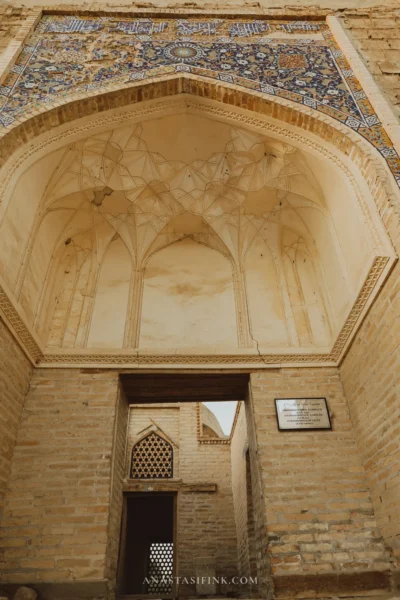
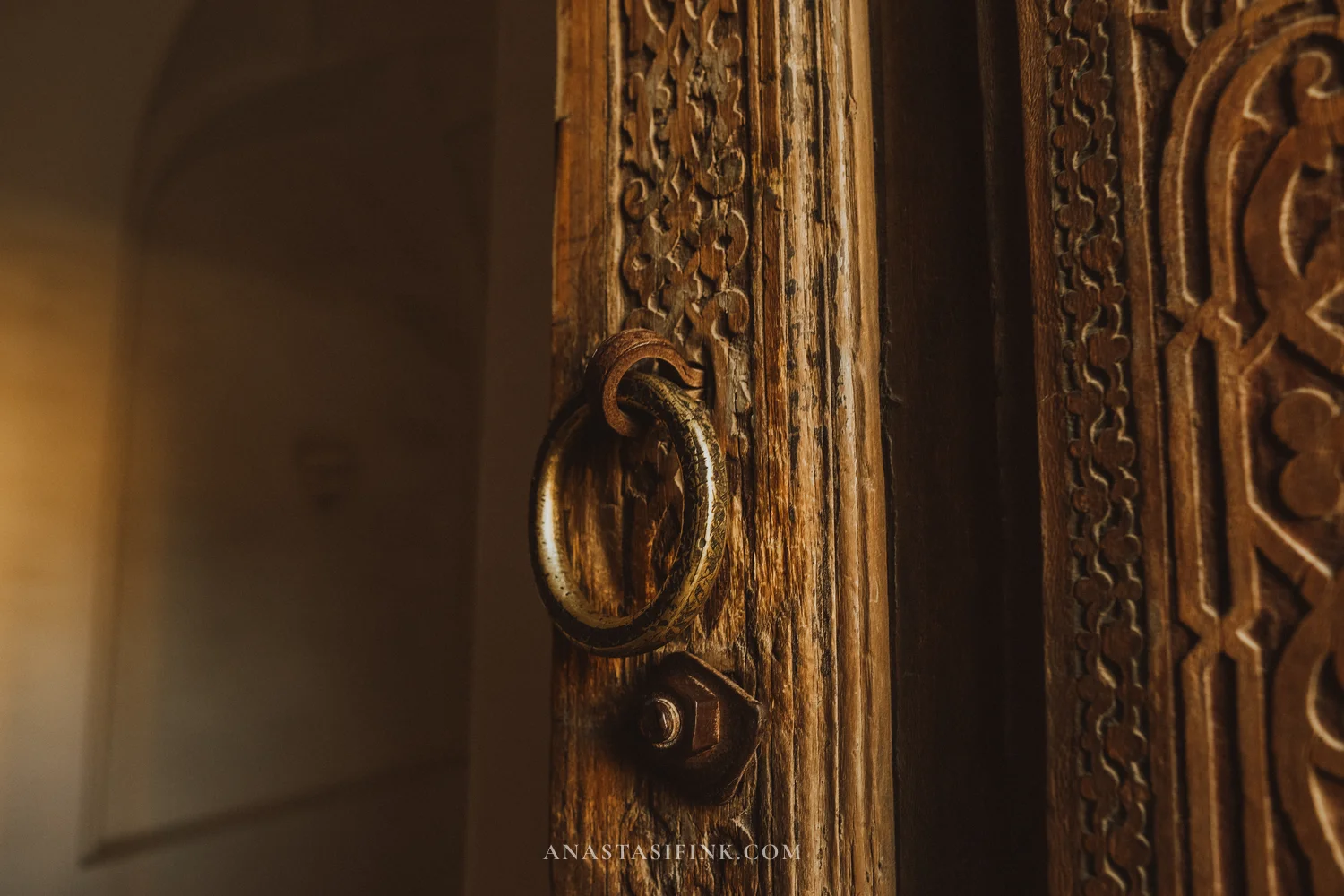
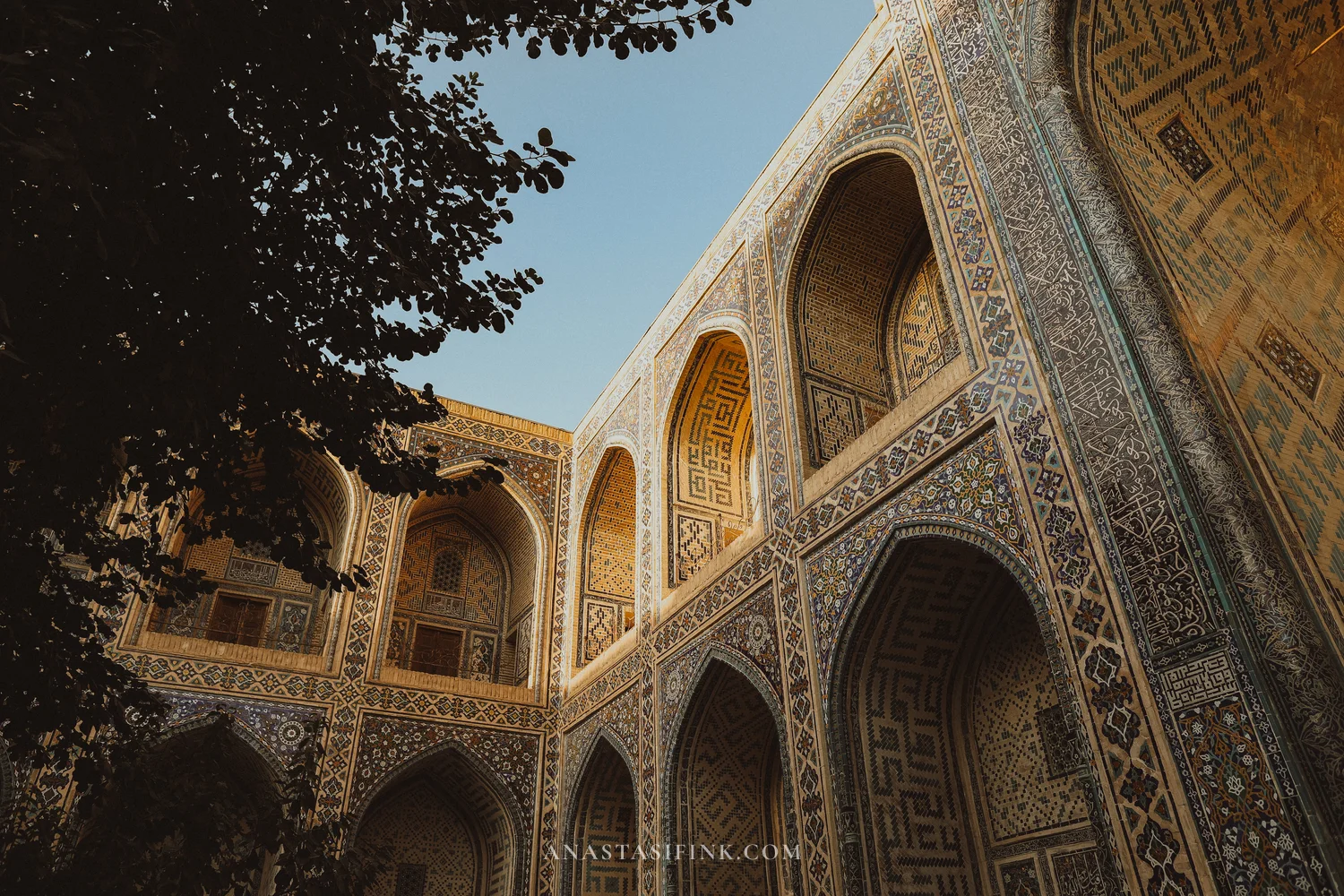
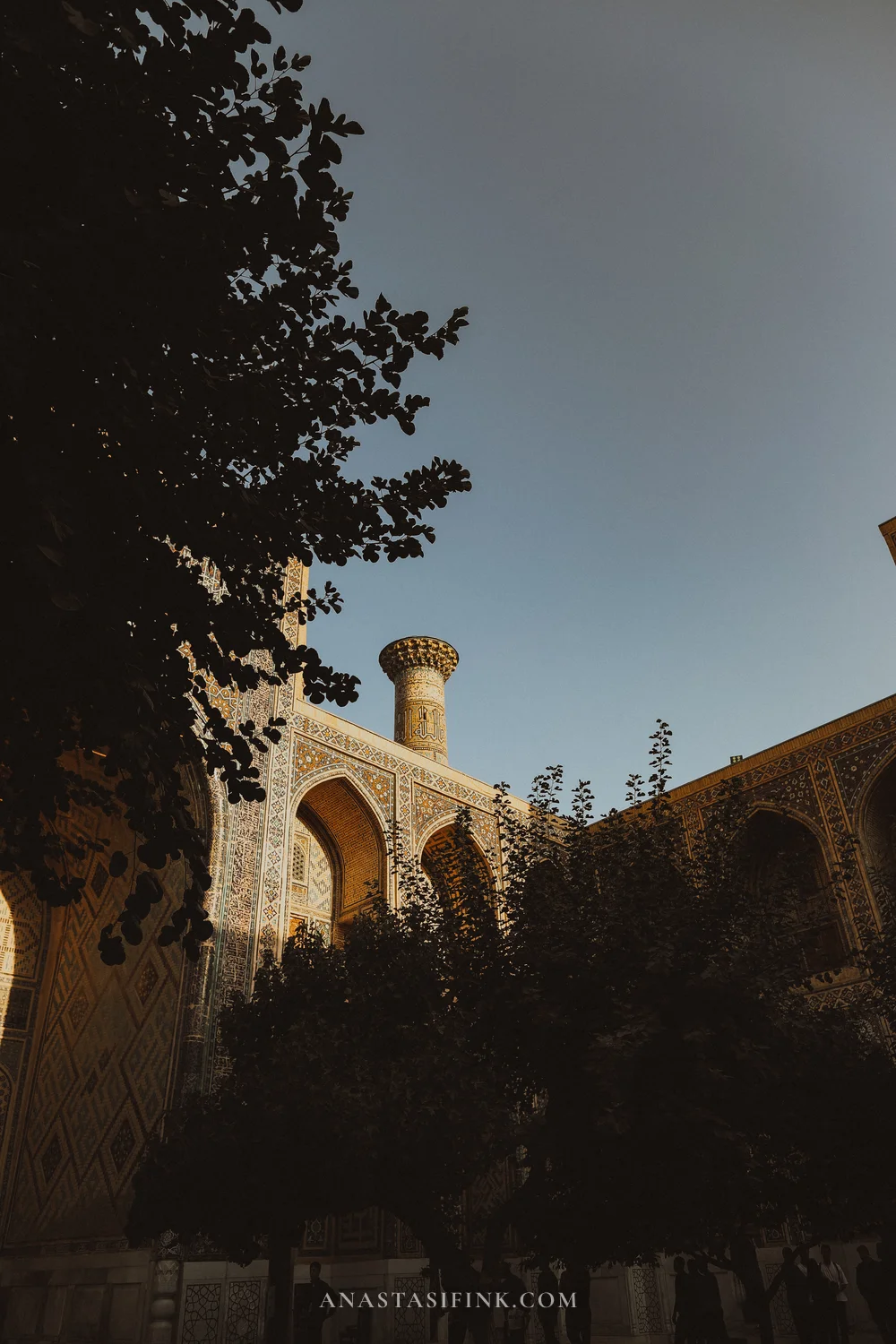
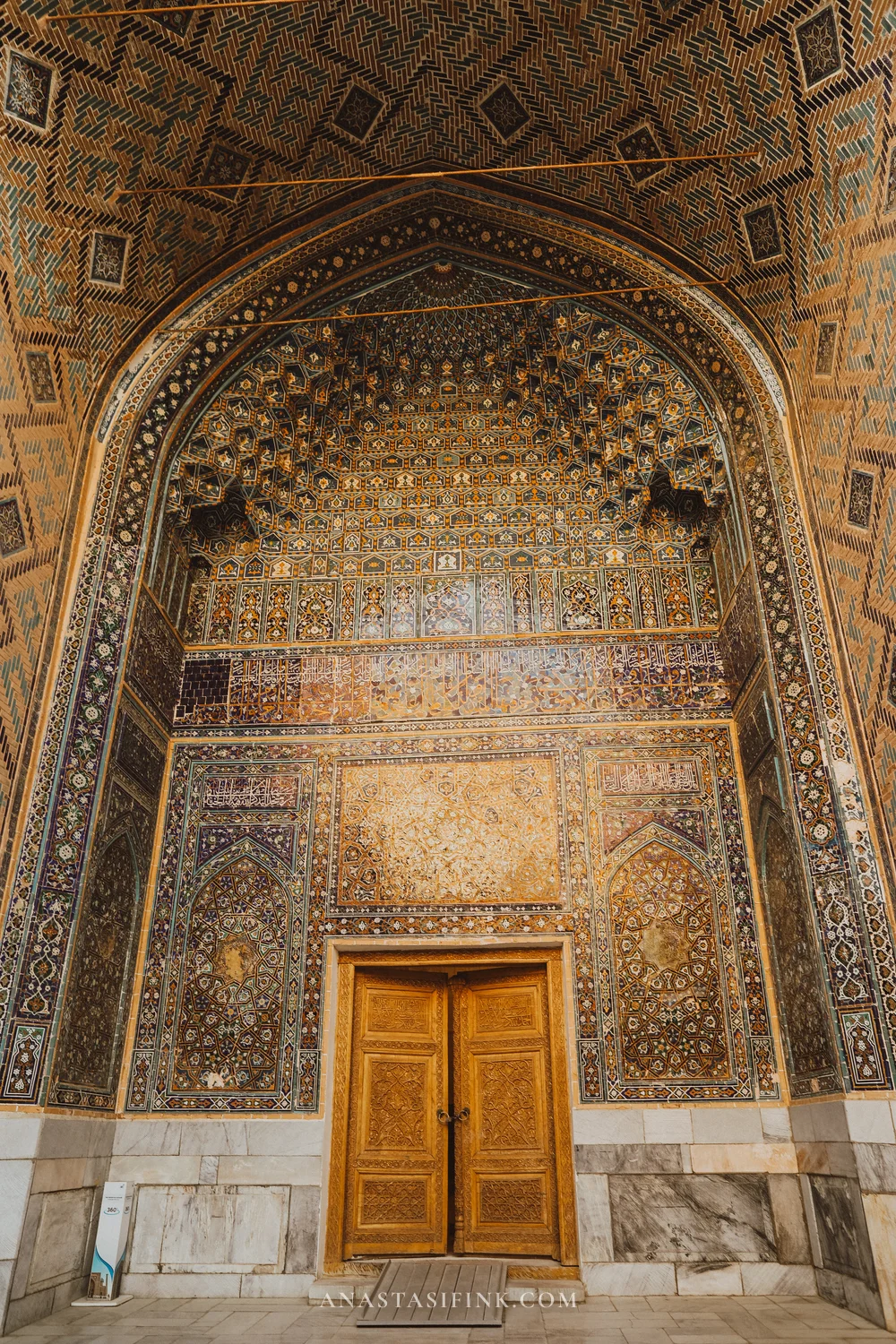
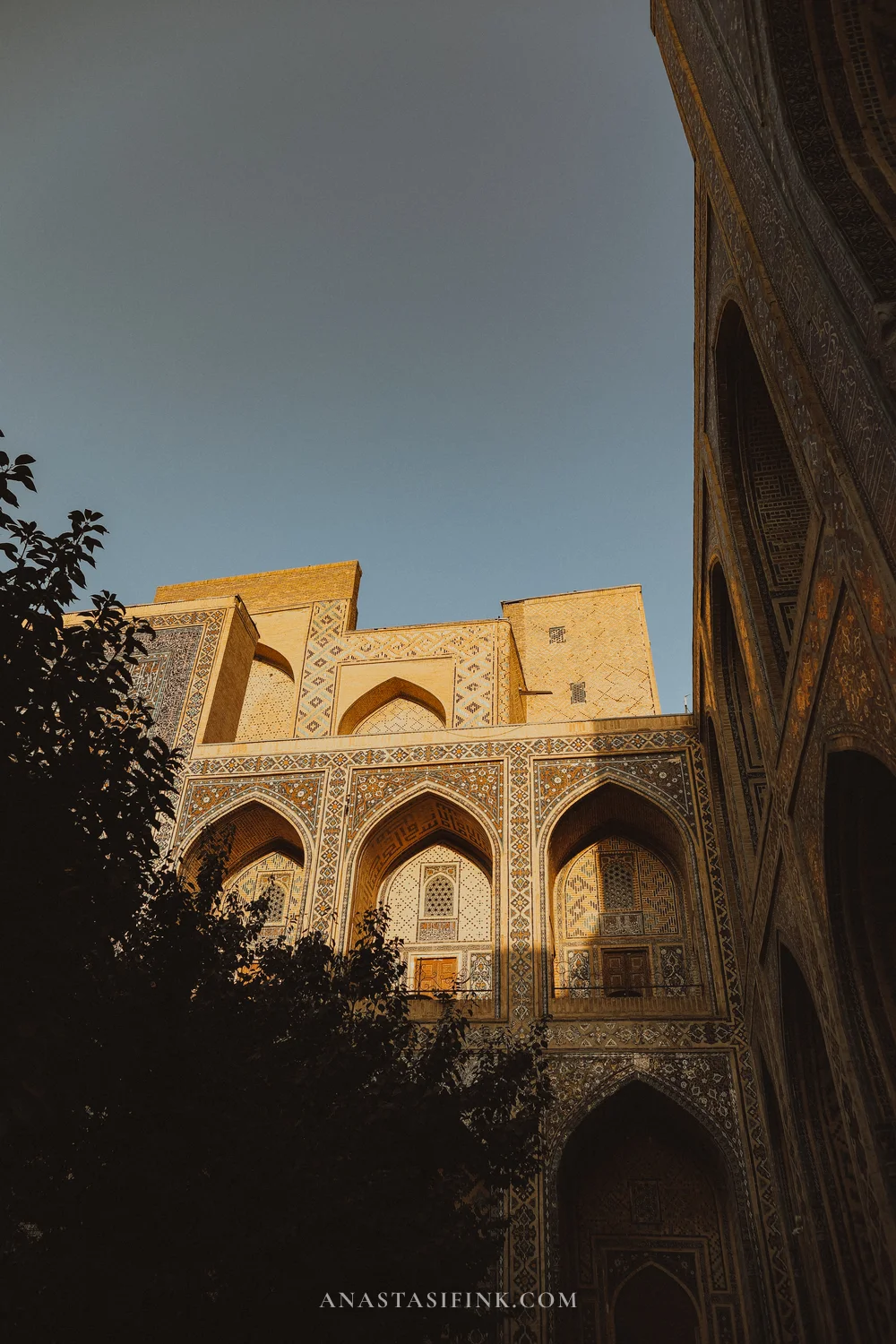
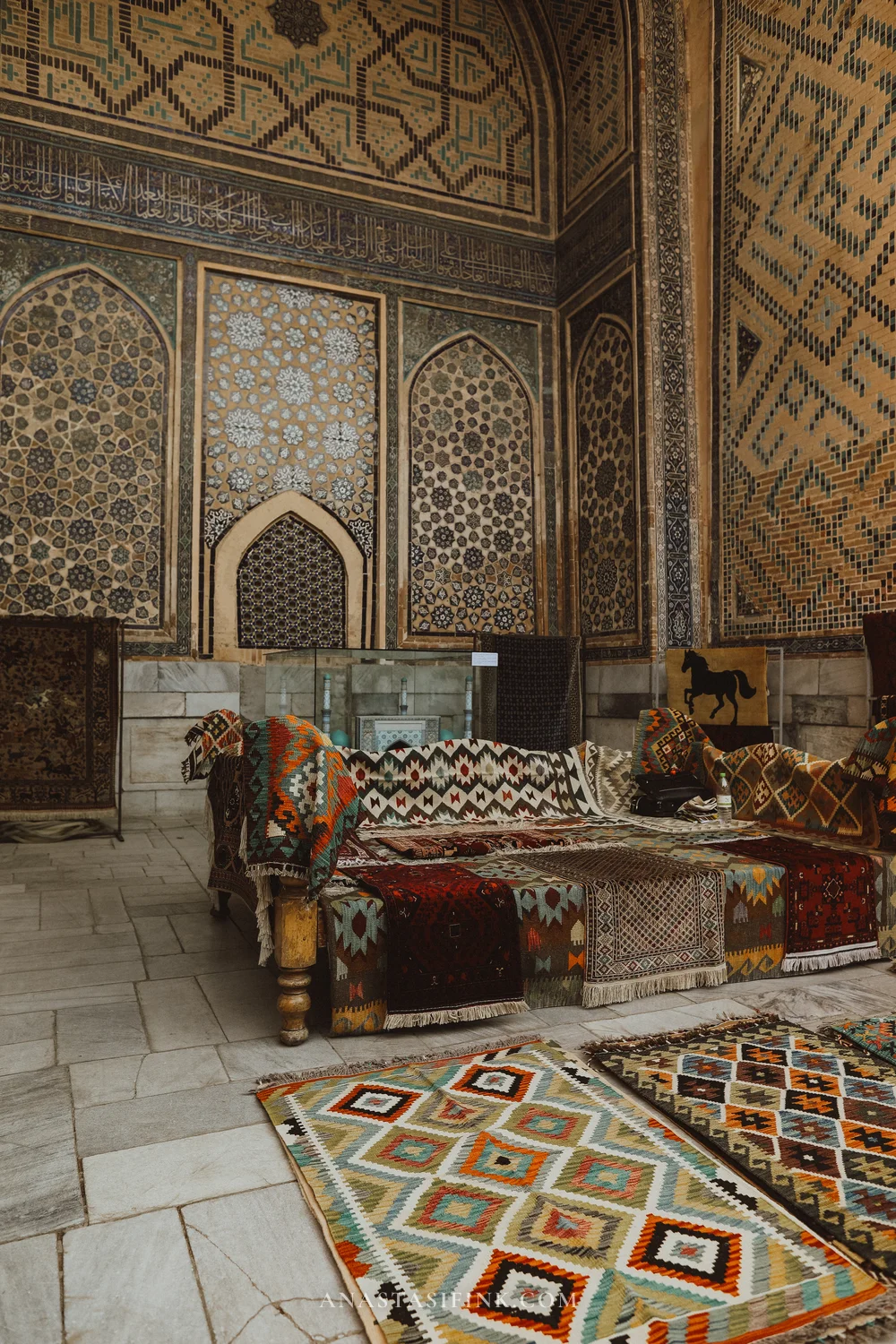
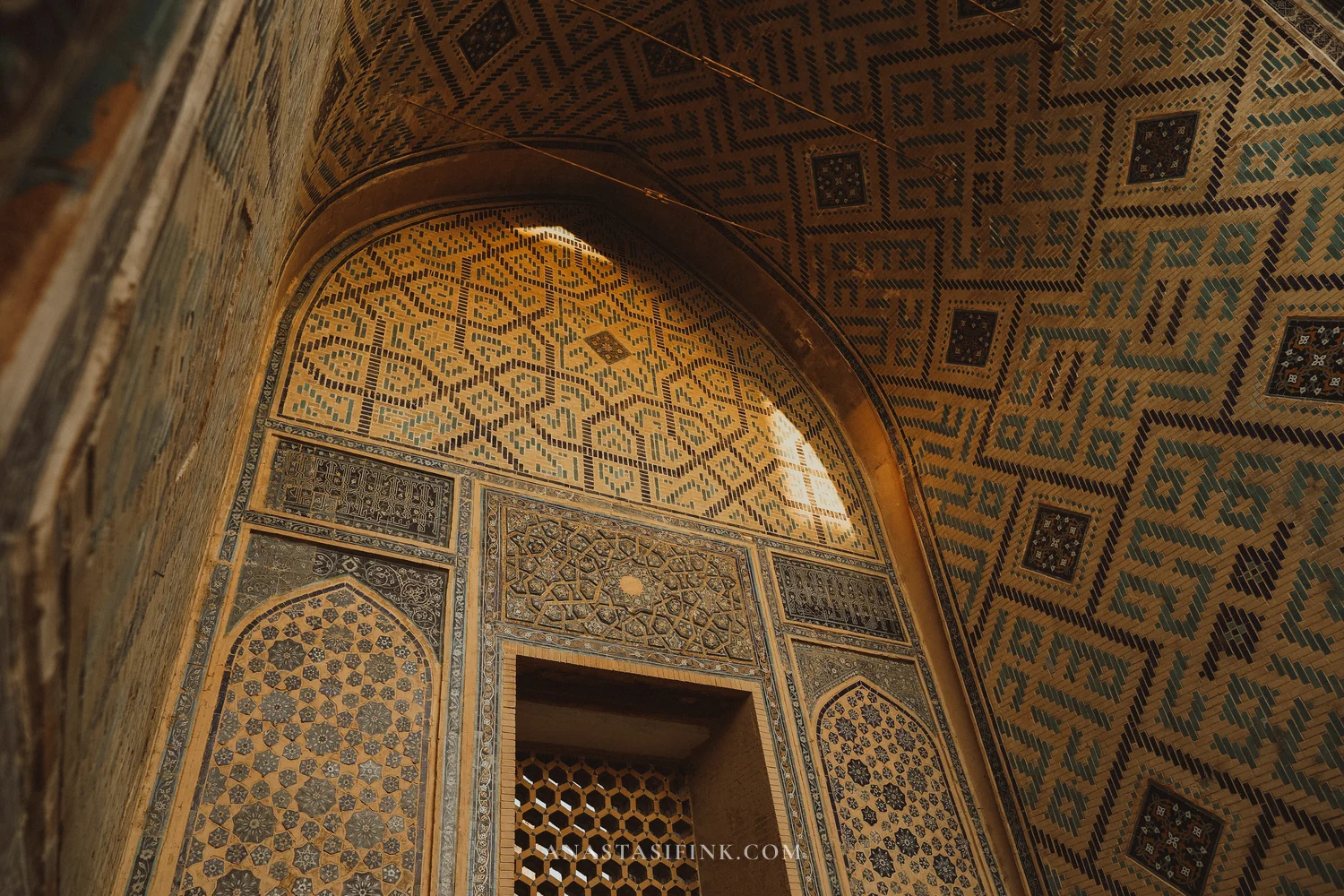
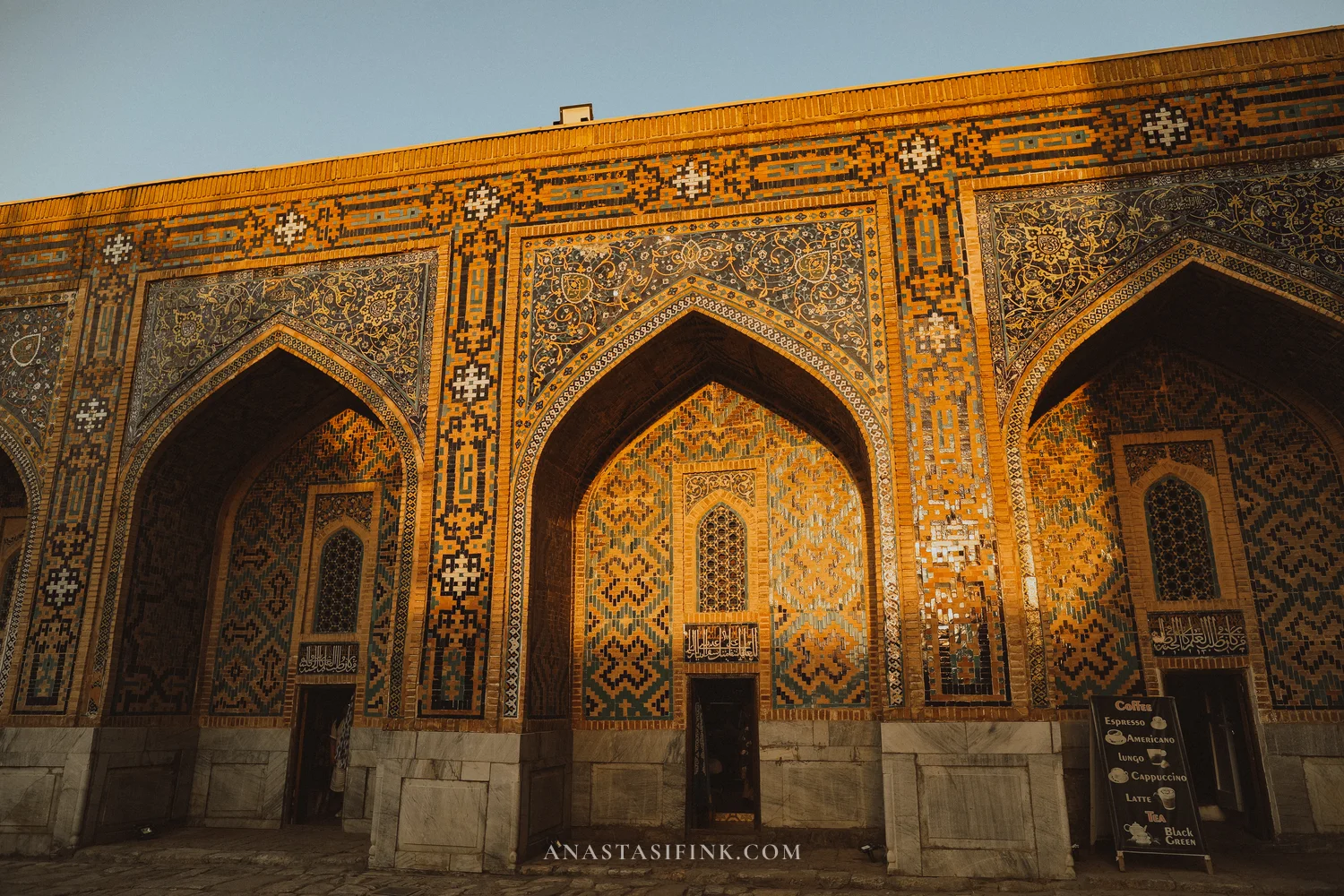
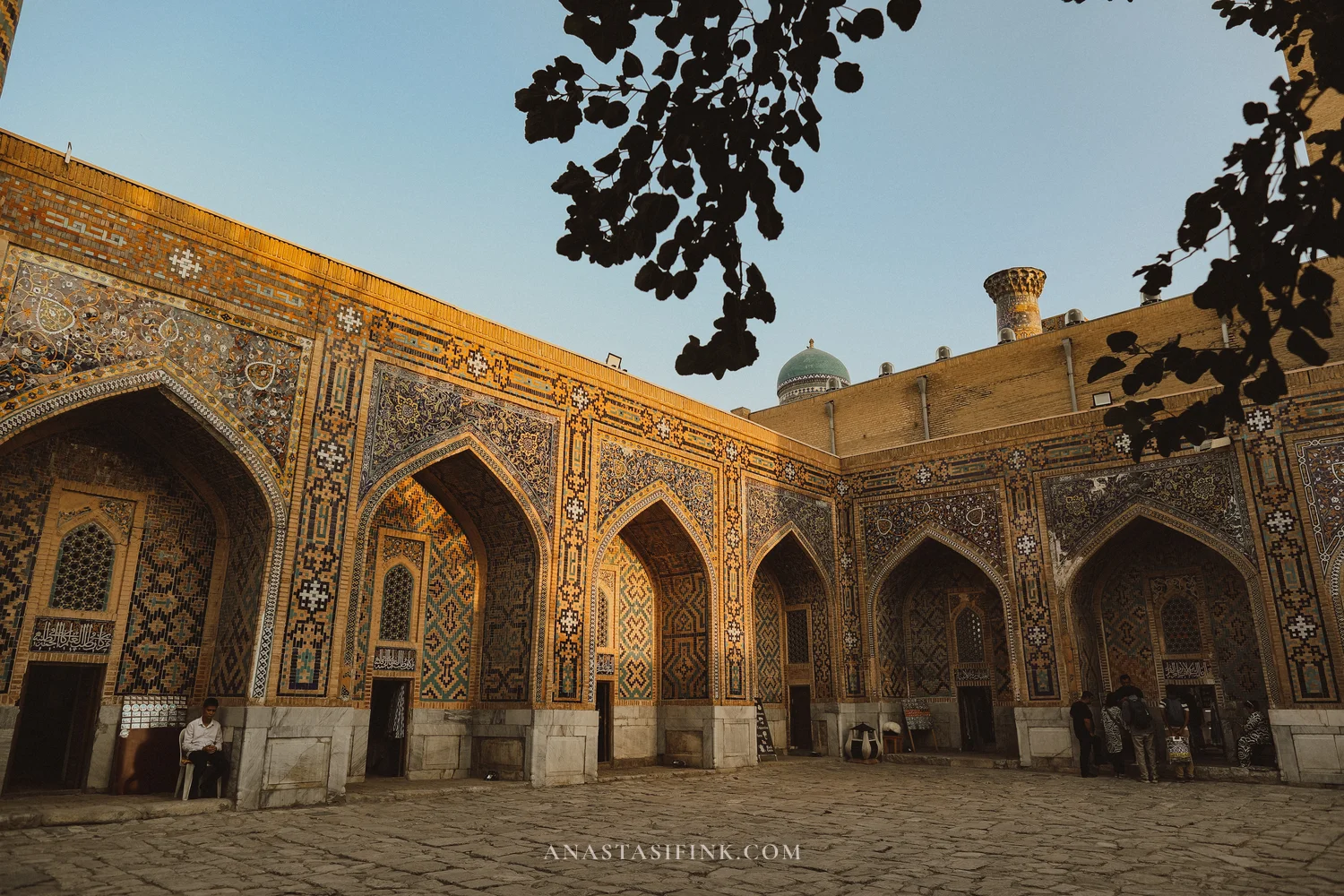
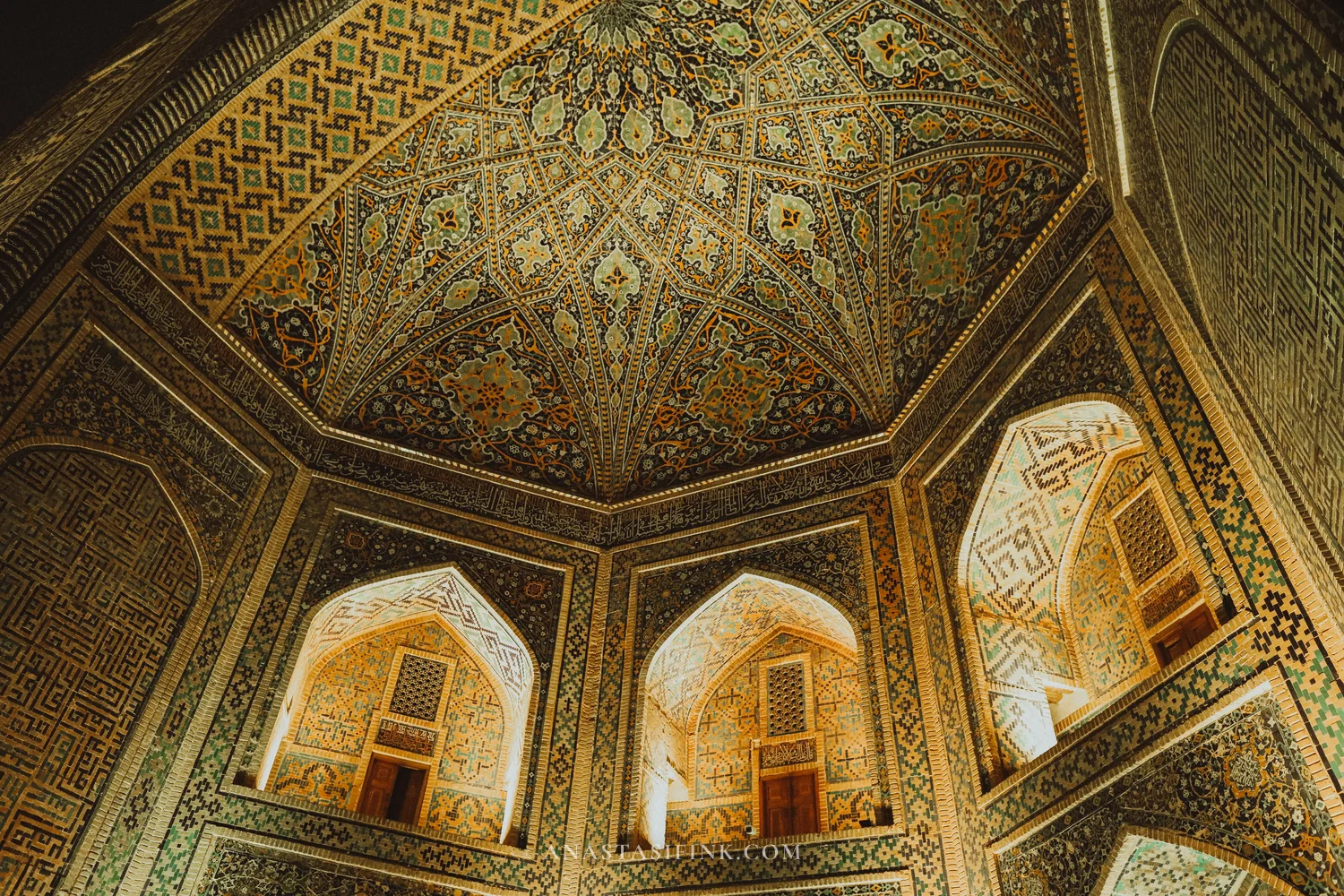
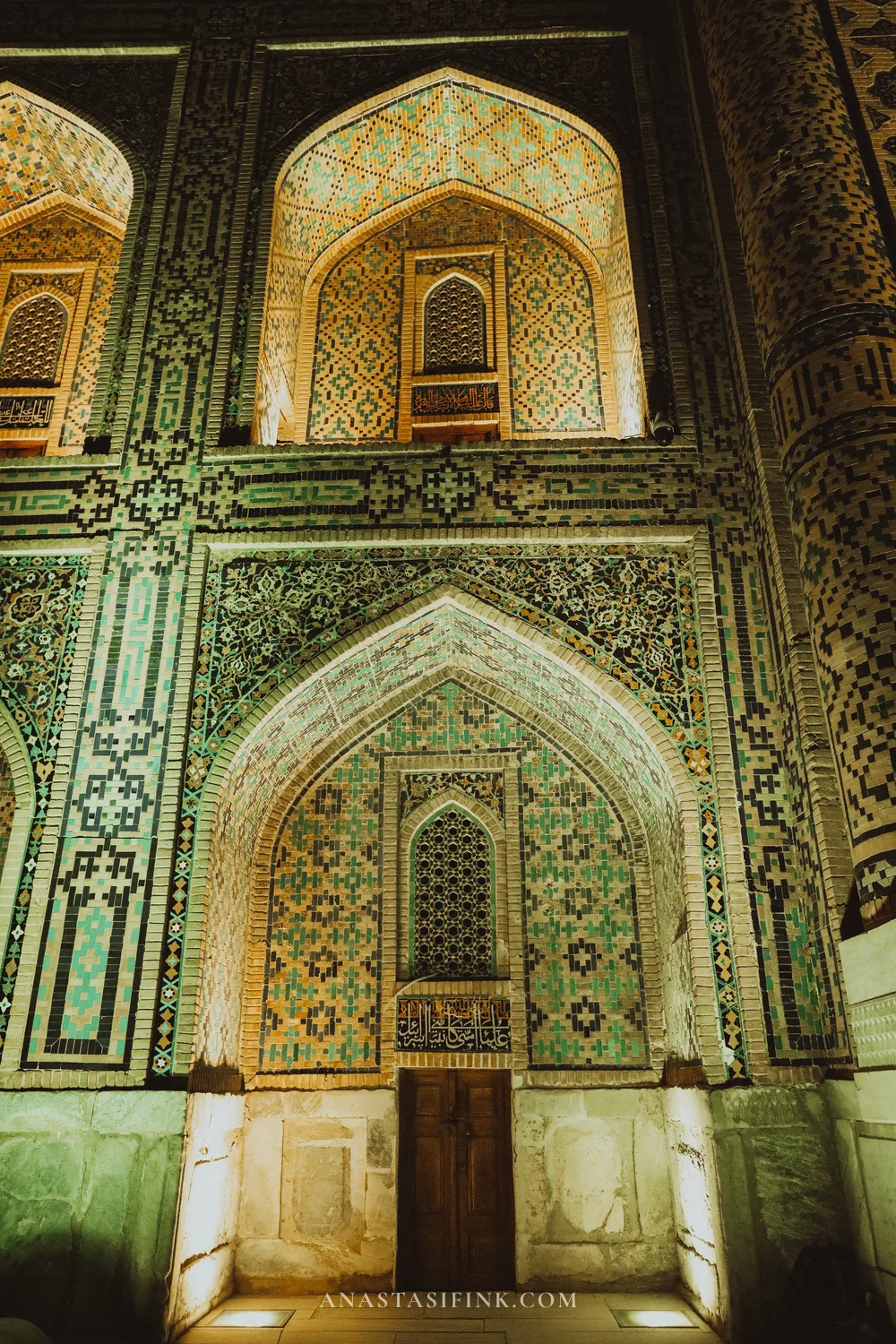
Each madrasah has a courtyard, arcades of hujras (student cells), iwans (covered portals), and dozens of small details that are easy to miss from the square. All the photos in this section are from Ulugh Beg, but the other two are laid out in a similar way.
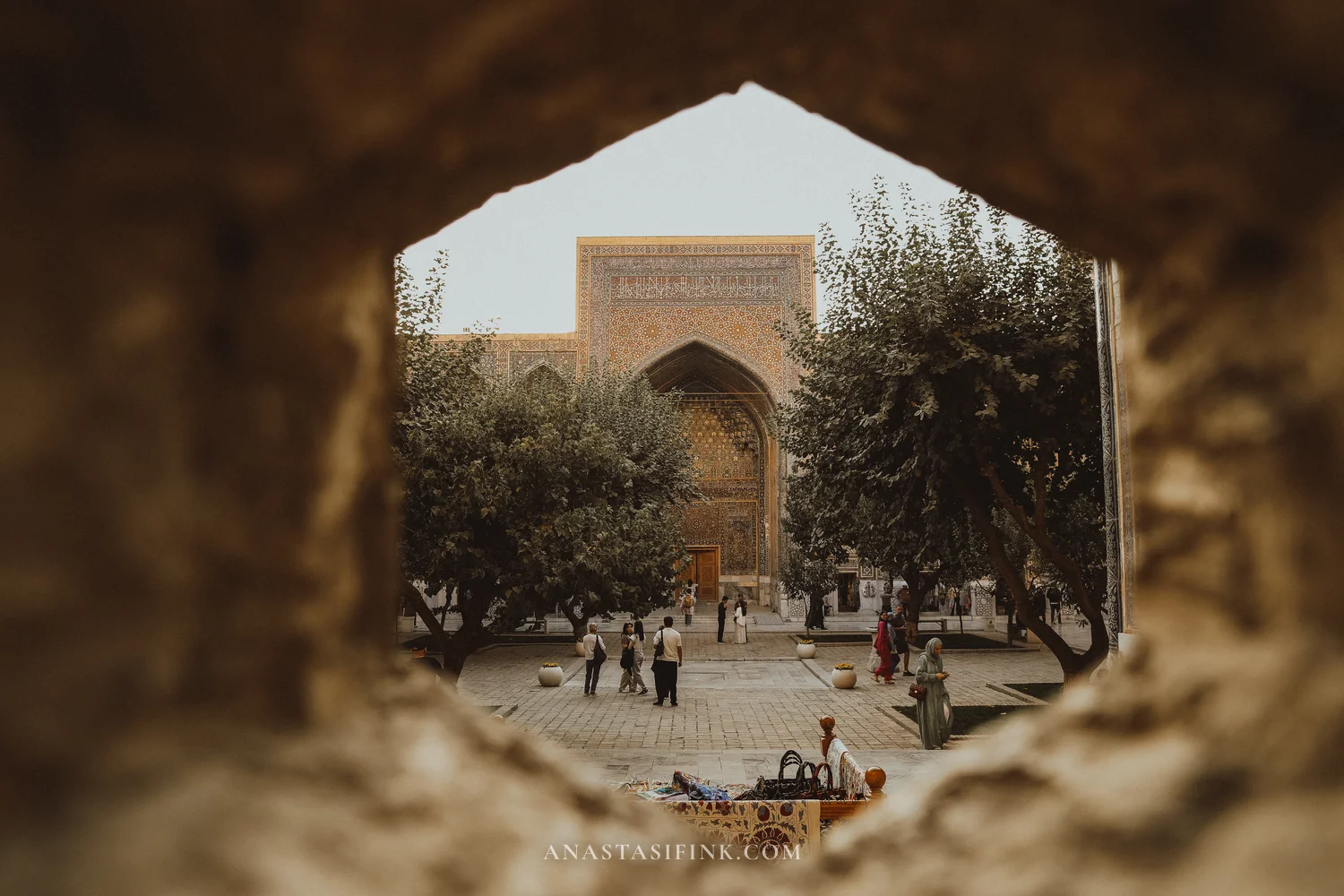
Sunset
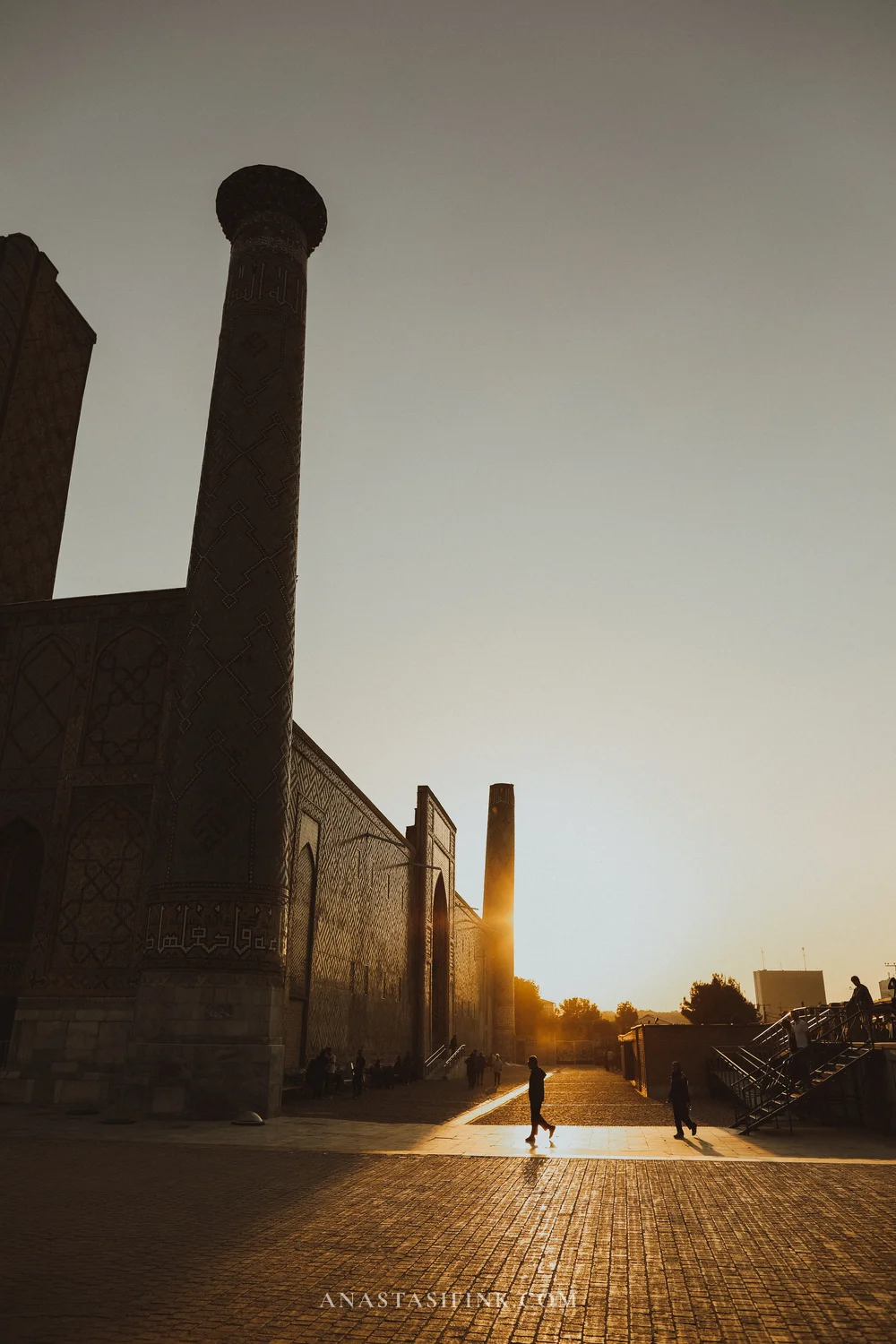
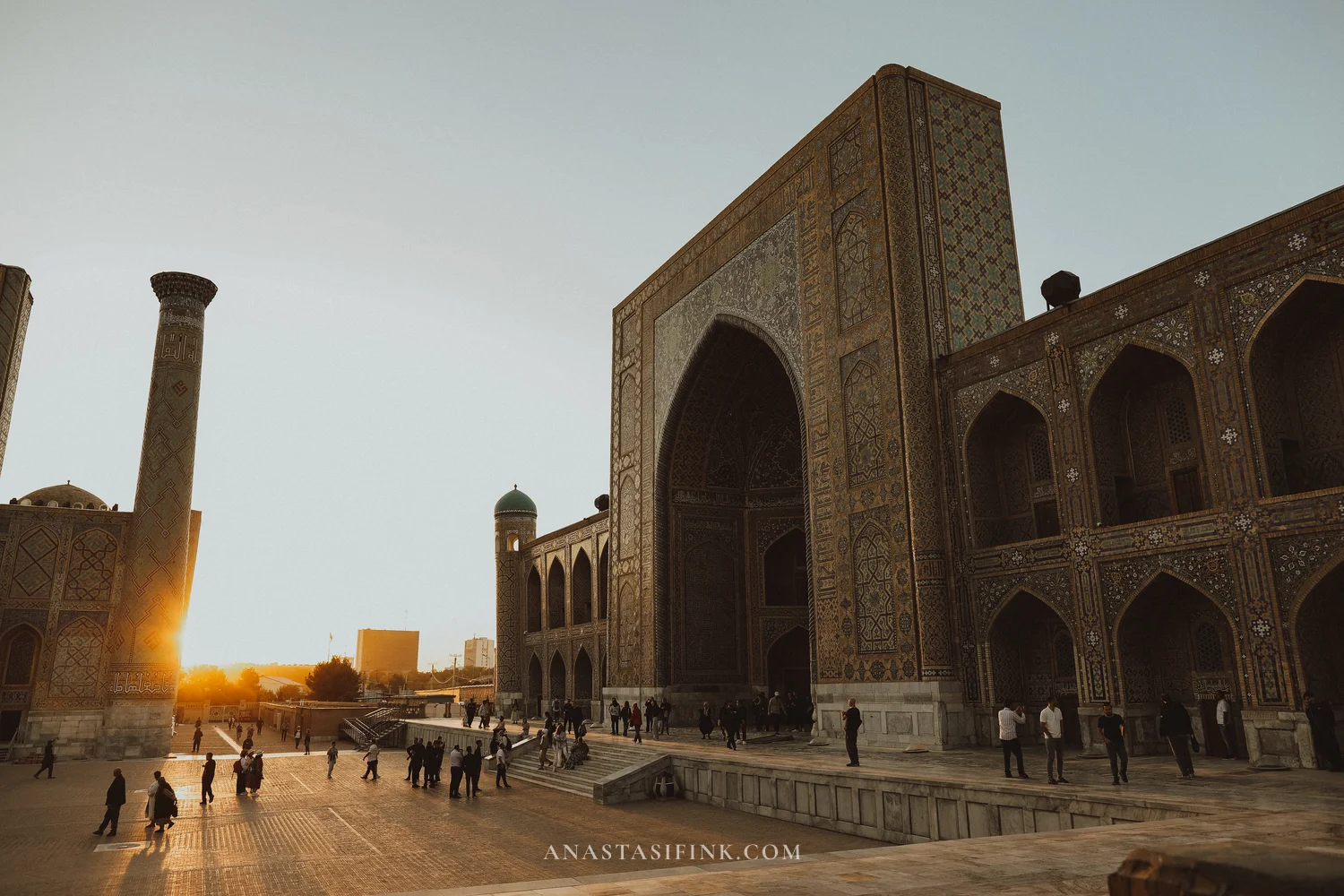
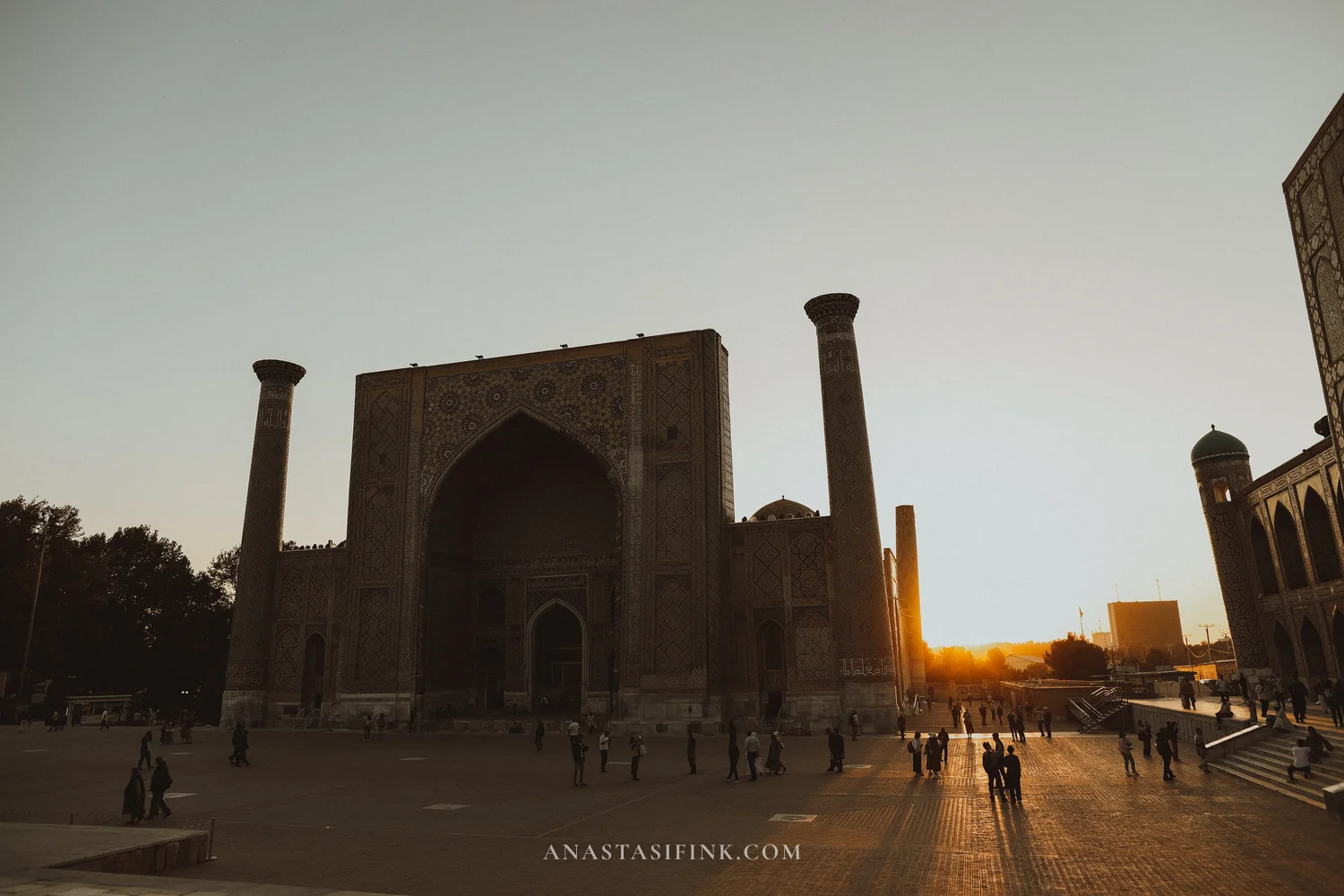
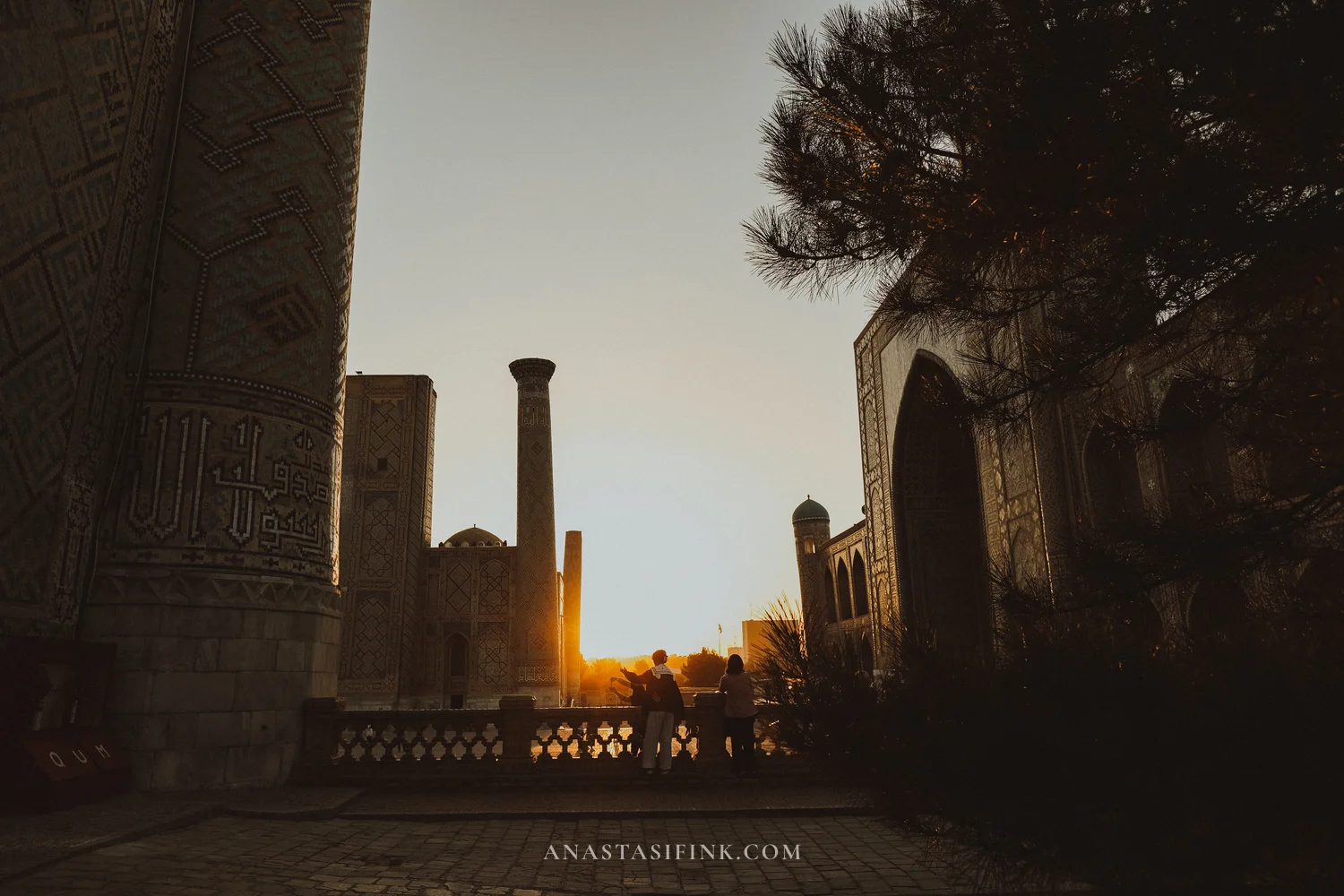
Here’s my single best tip: show up around 6 p.m. (earlier in winter, later in summer). With one ticket and one visit you get three completely different versions of the square: daytime, golden hour, and the night illumination. The midday crowd has thinned out by then, and the evening crowd hasn’t arrived yet.
Buy your ticket around 5 p.m., explore the interiors while there’s still good natural light, and by 6 p.m. the sun will be setting directly behind the Ulugh Beg madrasah. About an hour later, the floodlights switch on and the buildings transform — cool, saturated, almost theatrical.
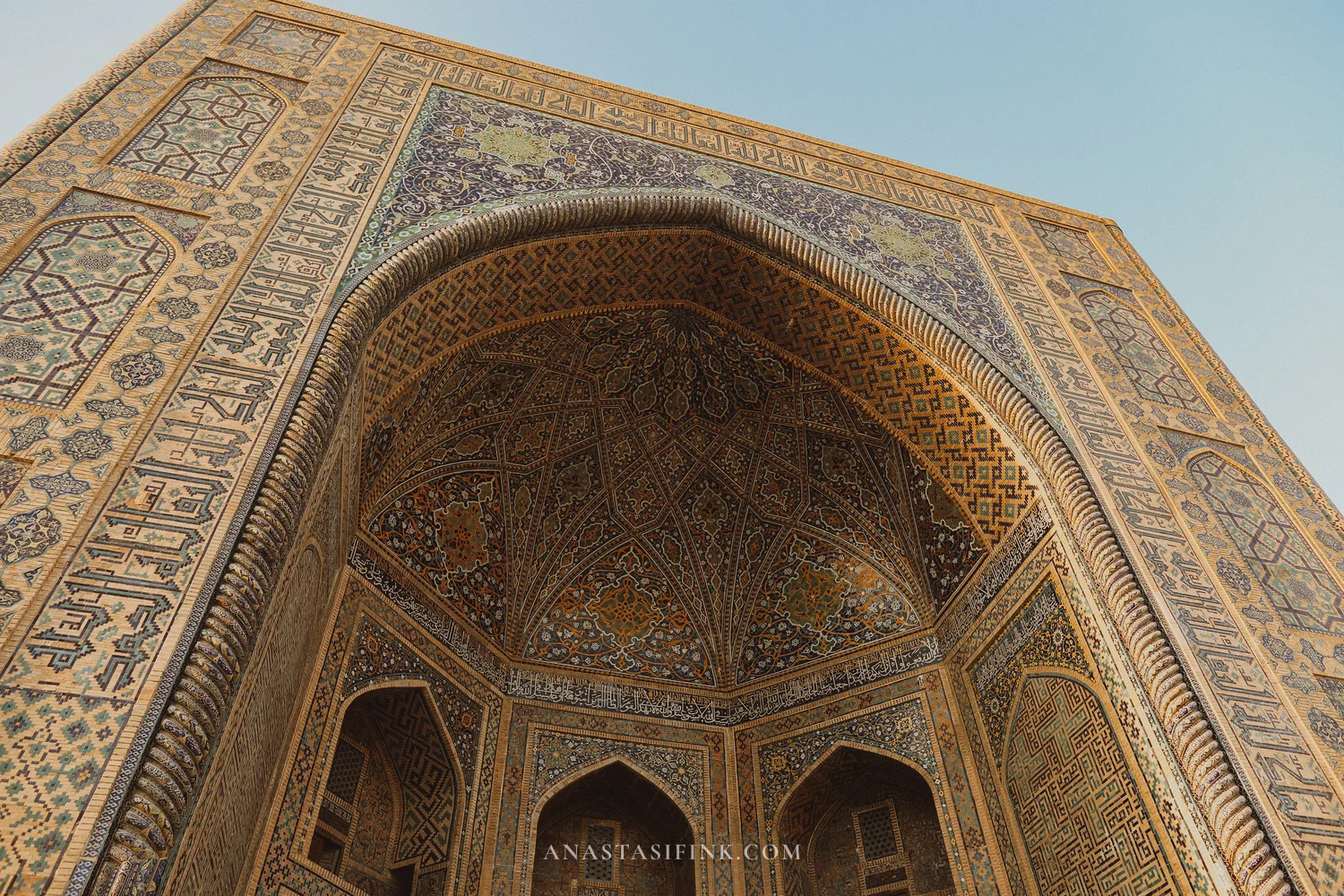
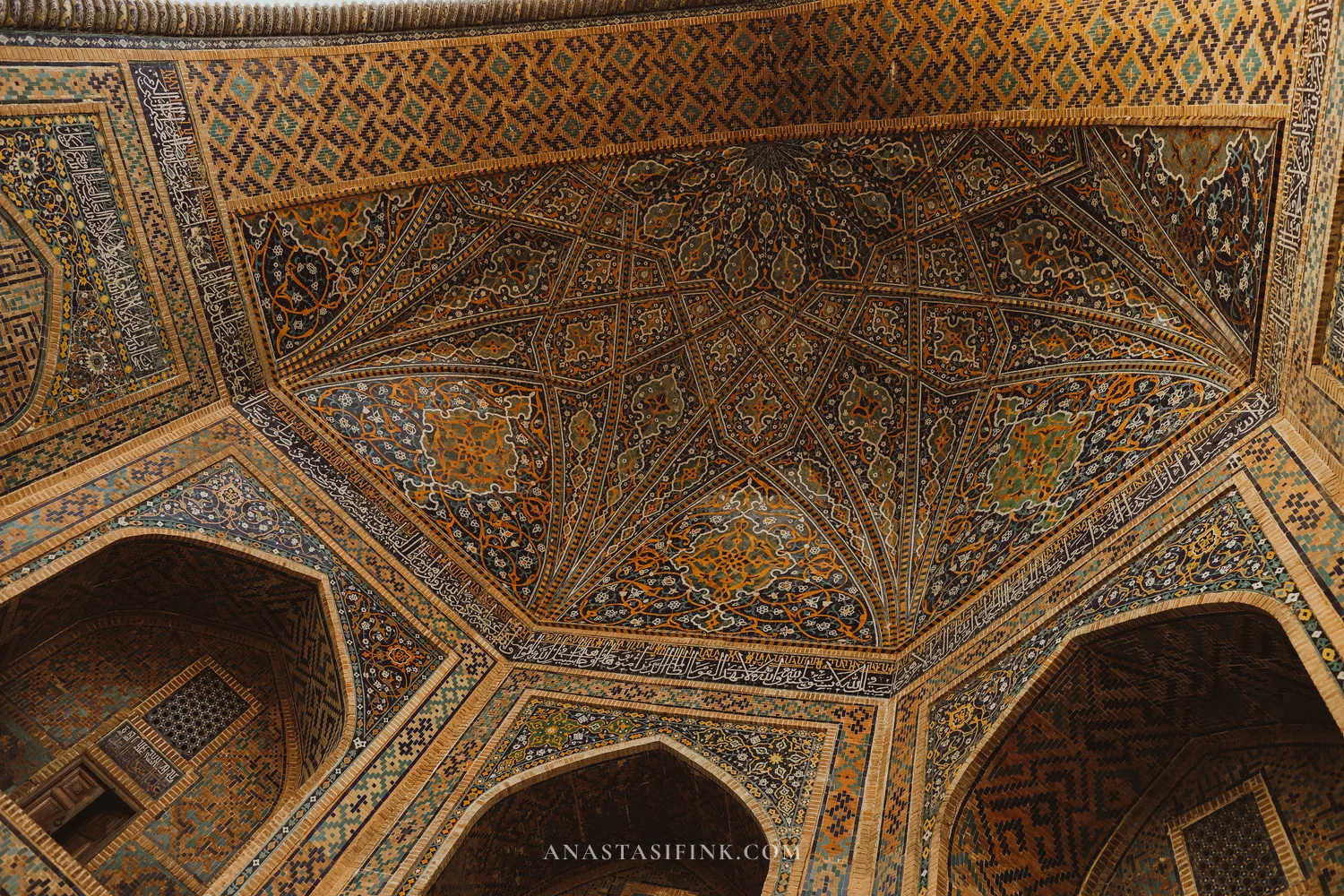
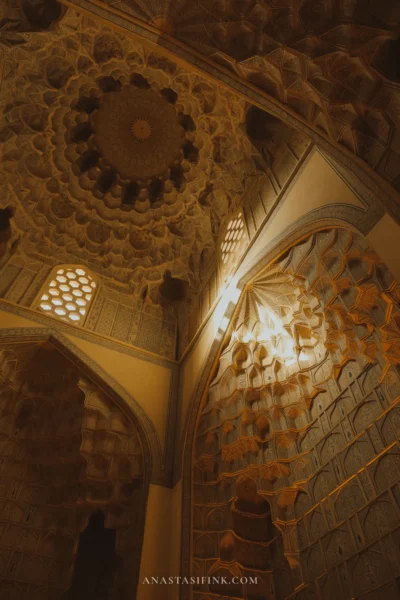
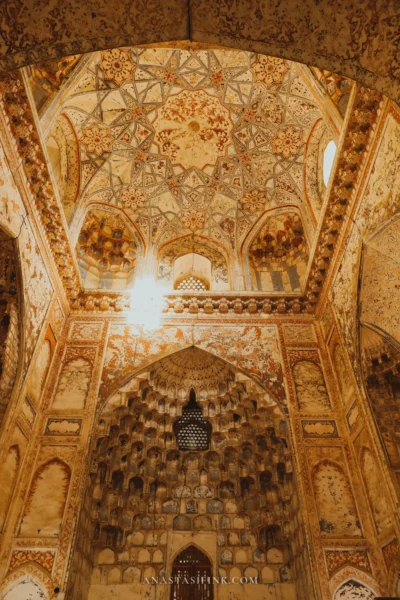
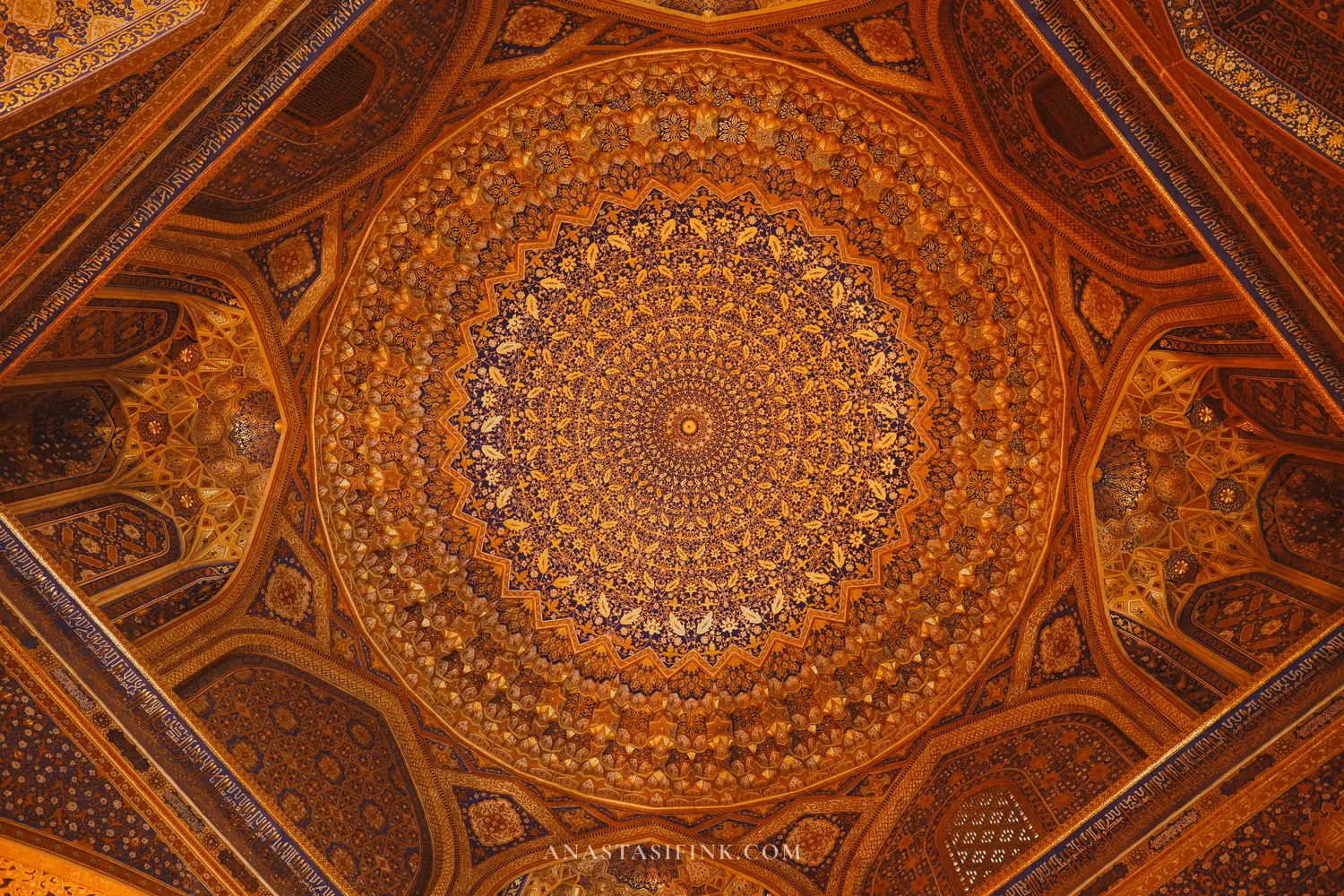
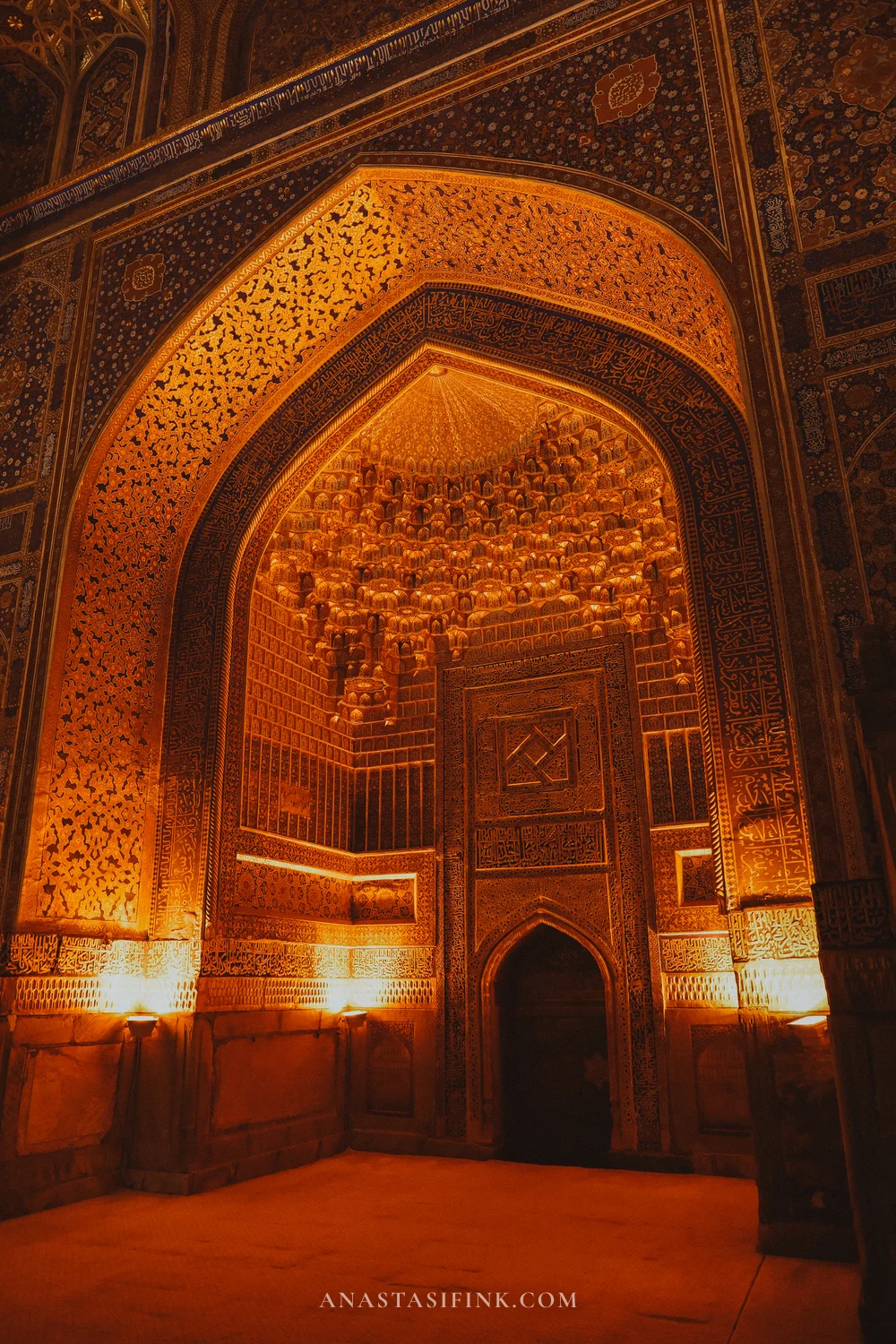
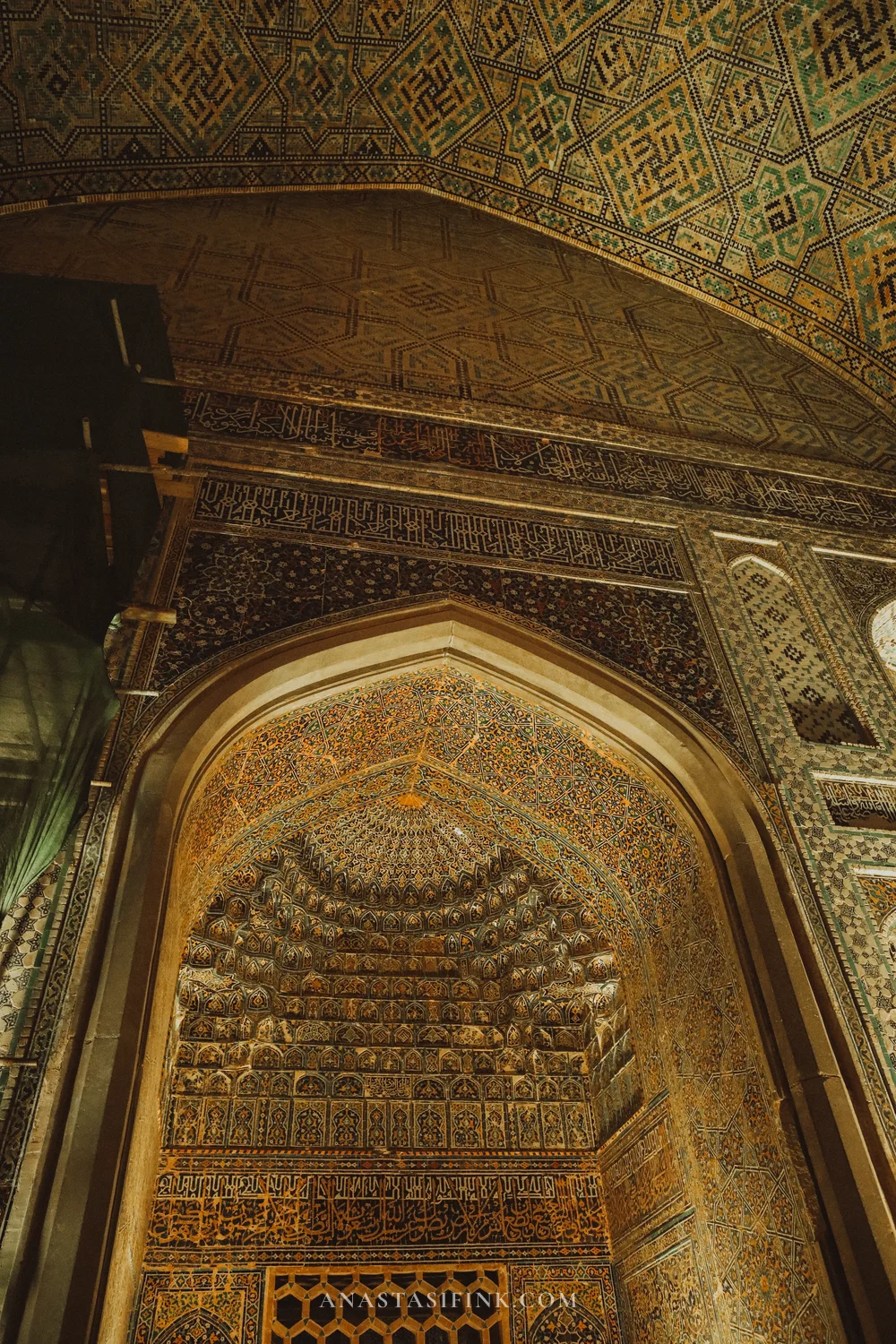
The iwan ceiling. The pattern is so dense that staring up at it for too long makes your head spin.
The Gold Mosque Inside Tilya-Kori
The mosque alone is worth the price of admission. The dome is painted so densely your eye gets lost in the pattern, and at the very center sits a giant gilded rosette. The mihrab, the niche pointing toward Mecca, is also covered in gold.
Twilight and the Night Lights
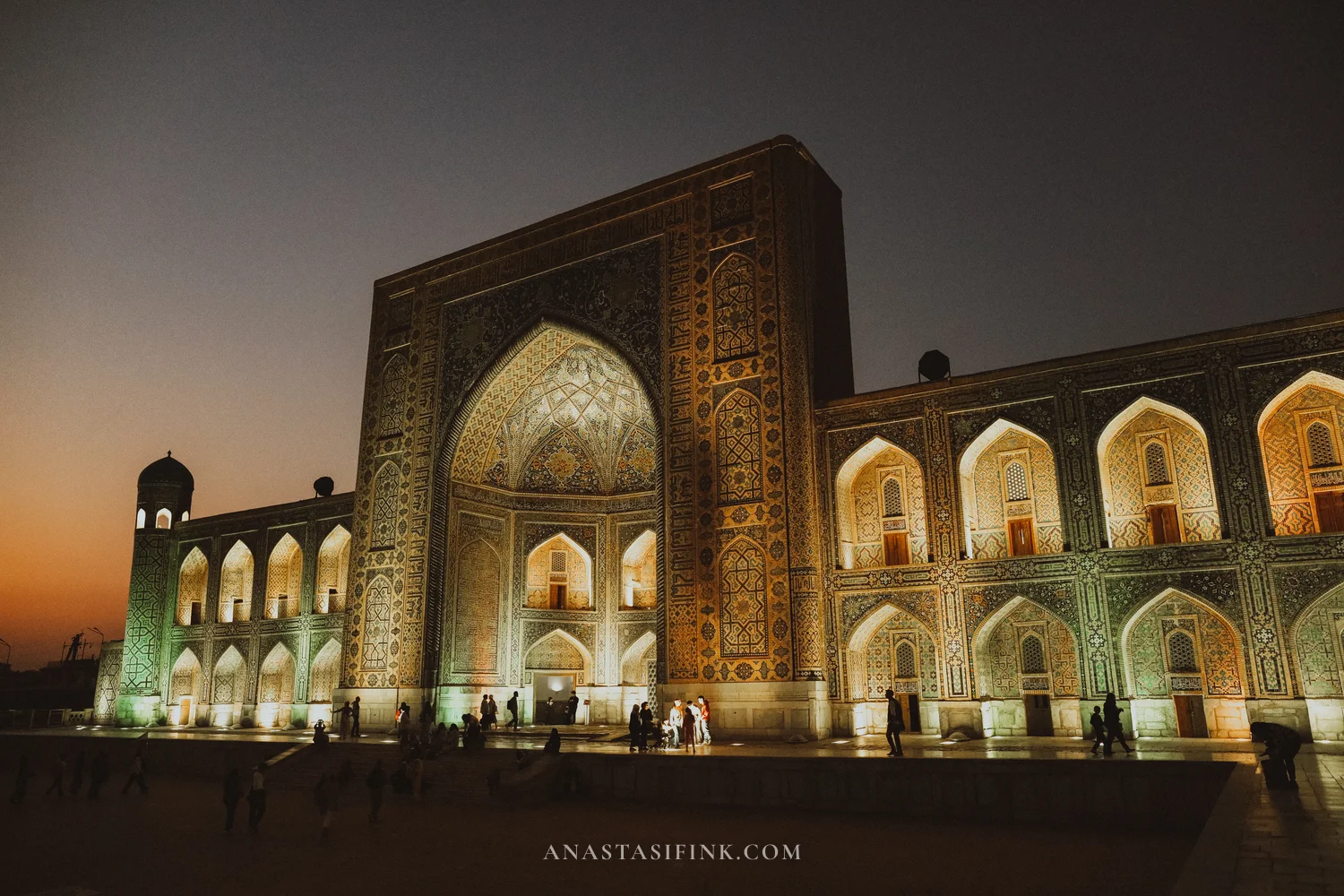
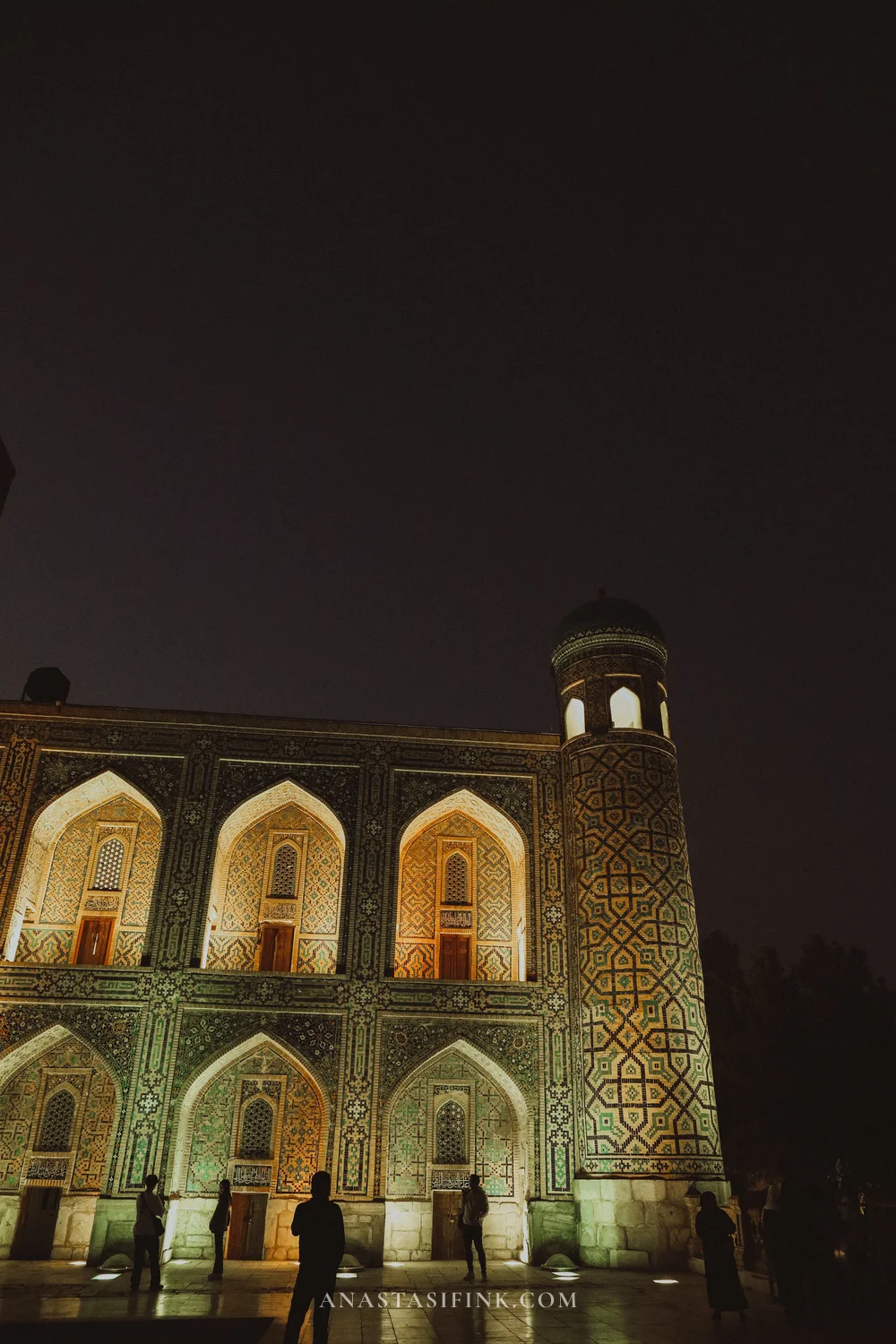
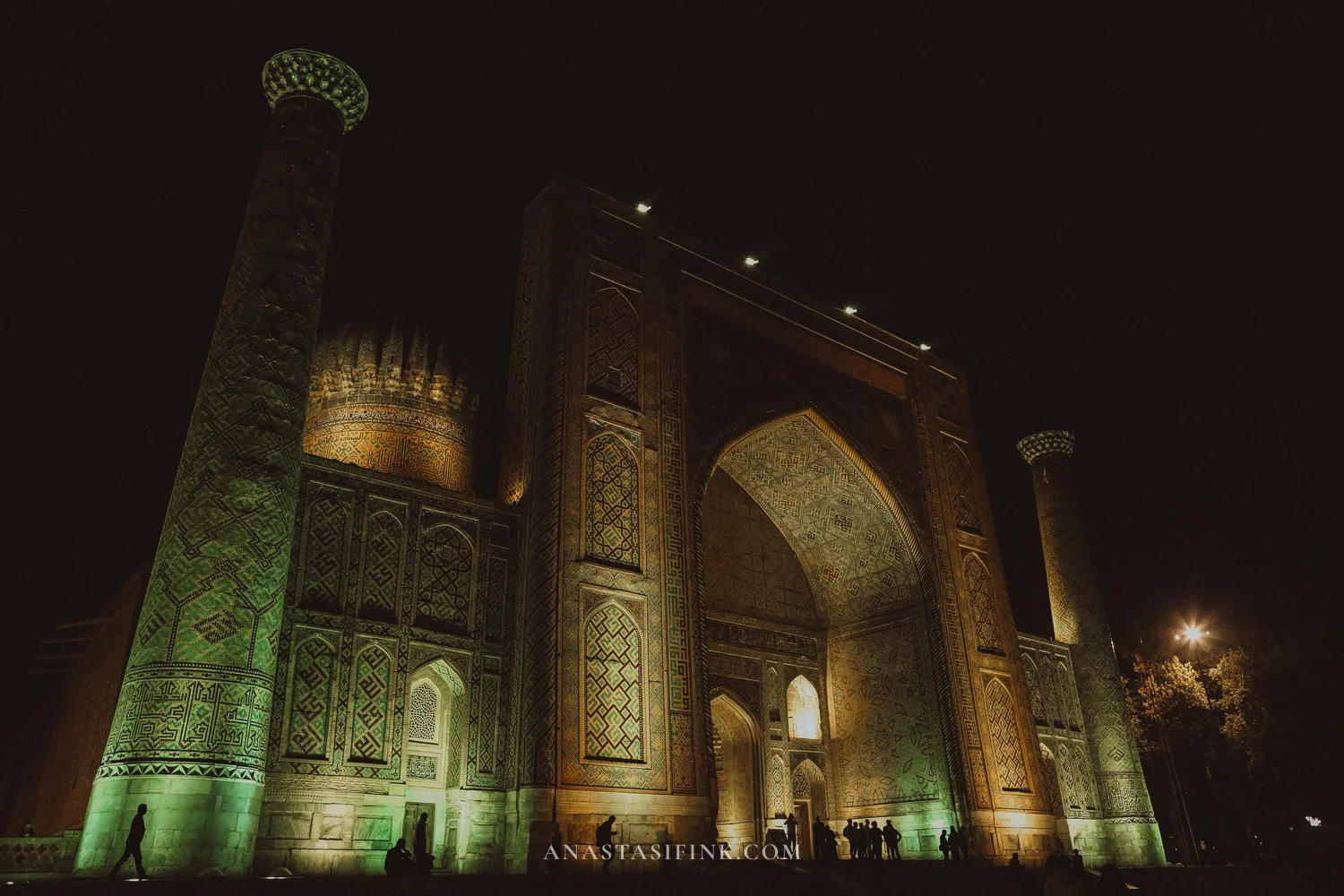
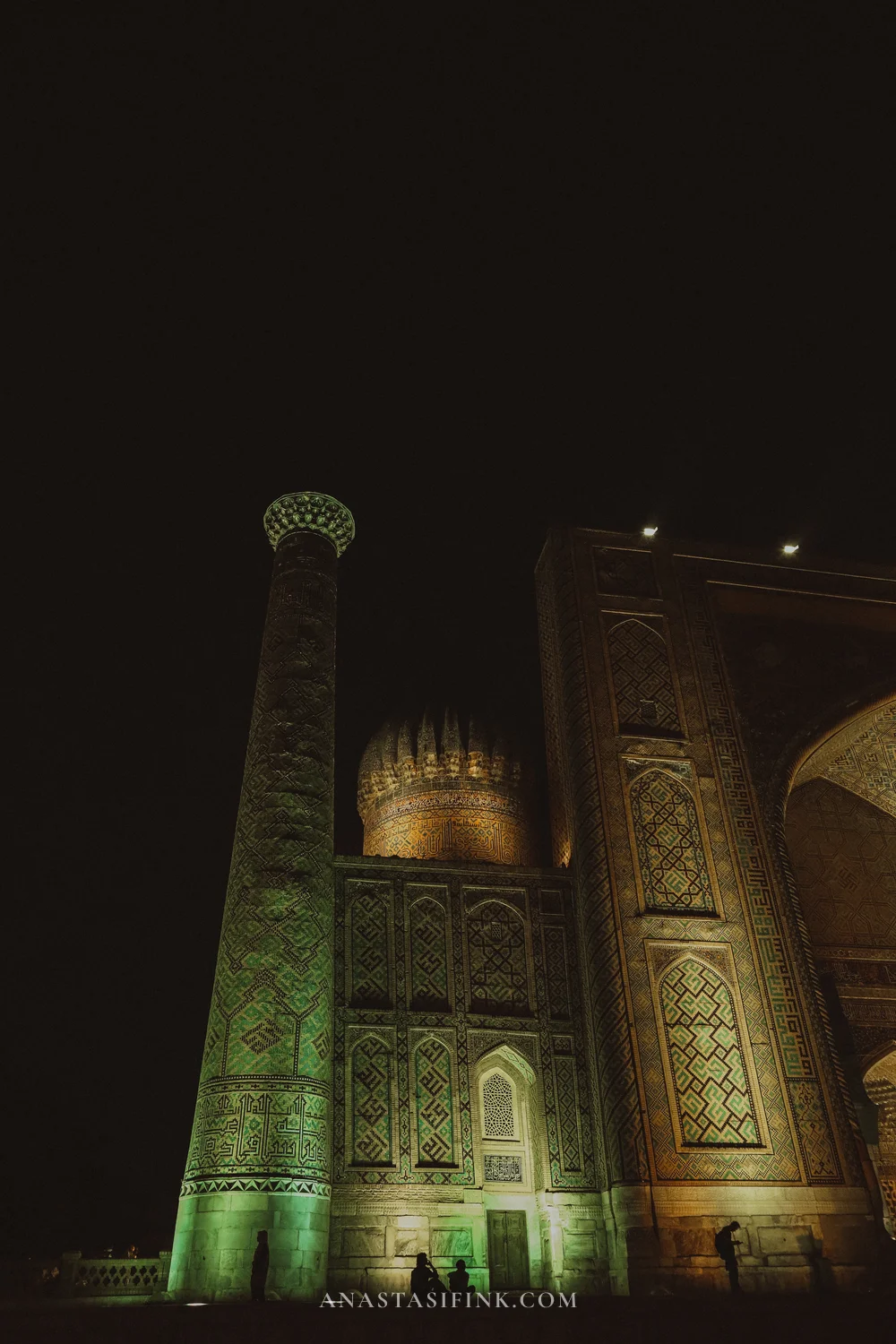
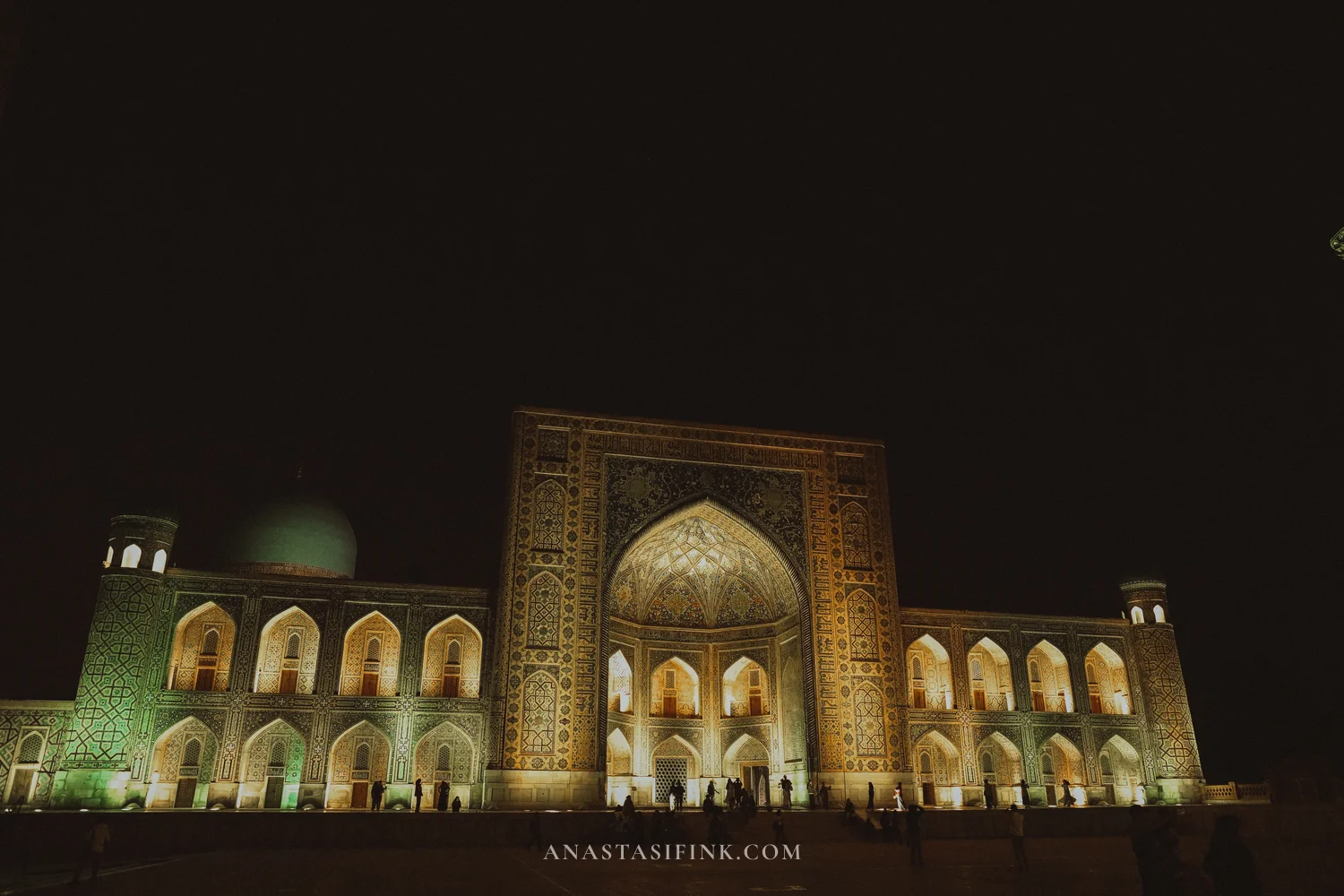
After sunset the square turns into something else entirely. Each building gets its own lighting, warm gold on the facades, green and turquoise accents picking out the domes.
In the warmer months, there’s a sound-and-light show on the square — images and text projected directly onto the facades. The schedule shifts around, so check at the ticket office or with your hotel reception.
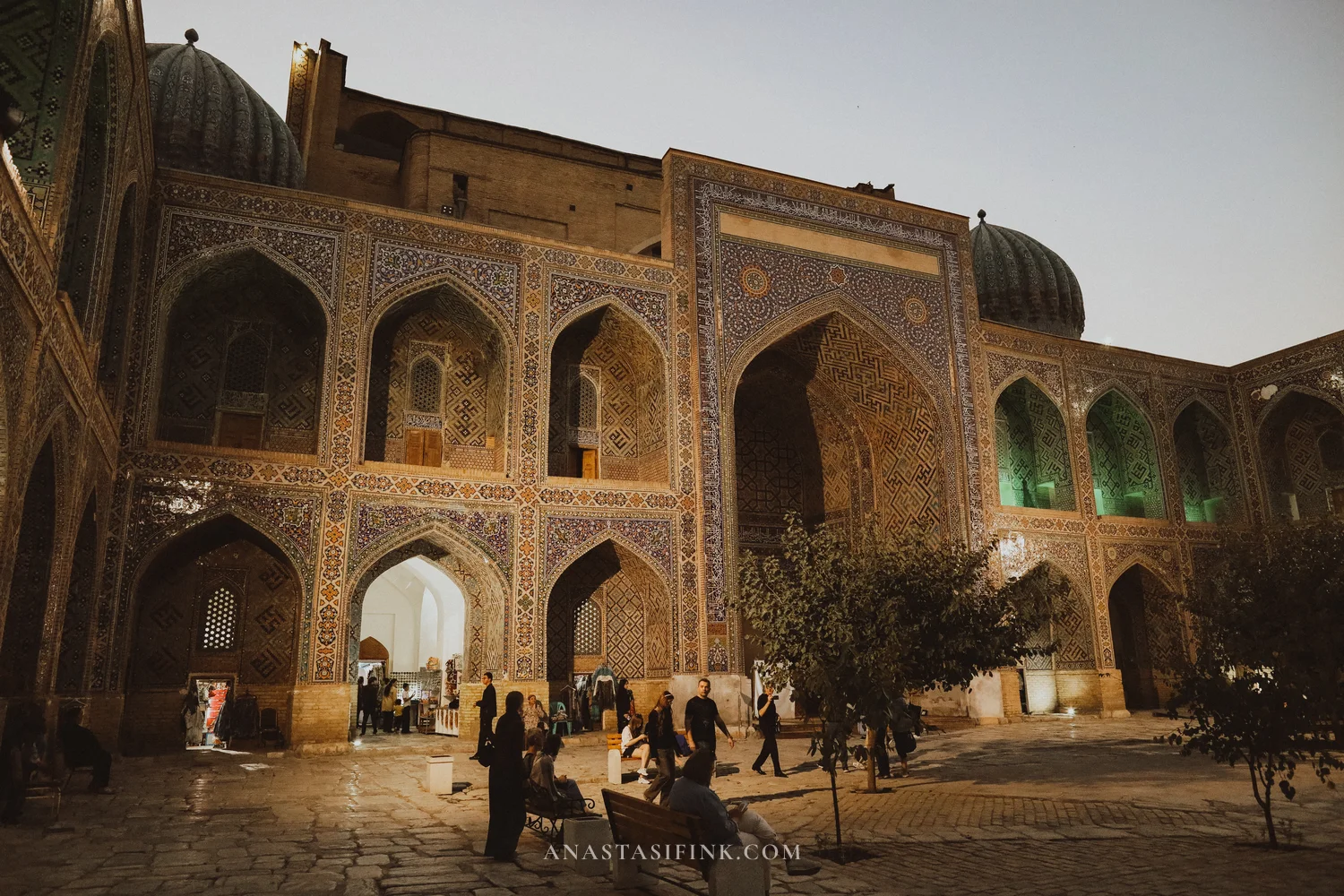
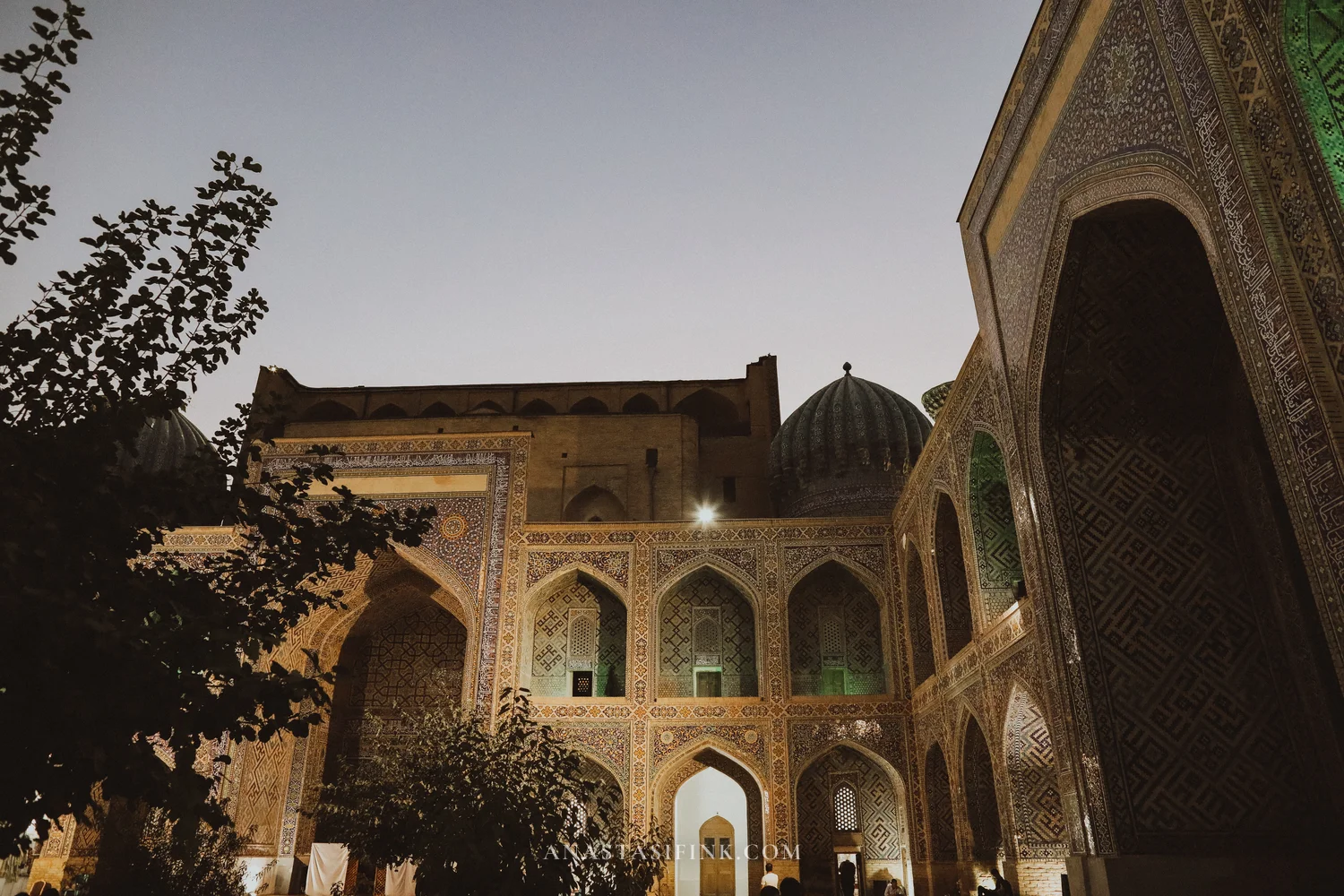
Left: those magic fifteen minutes between sunset light and night light. Right: full blue hour, the sky still deep blue while the buildings glow warm.
Practical Info
Practical Information
- Address: Registan Square, Islam Karimov Street, Samarkand
- GPS: 39.6552, 66.9756
- Hours: 8:00 a.m. to 8:00 p.m. for entering the madrasahs. The square itself is open around the clock. Photography from outside is unrestricted.
- Ticket: 65,000–100,000 UZS (roughly 5–8 USD), prices change. One ticket covers all three madrasahs.
- How long: at least 2 hours for the madrasahs themselves; better to plan 3 to 4 hours if you want to stay for sunset and the lights.
- Best time: about 2 hours before sunset.
- Visa note: most EU/US/UK citizens get visa-free entry for up to 30 days; check the current rules before you travel.
- Google Maps: Registan, Samarkand
Getting There
From Samarkand Airport (SKD): 6 km to the square. A taxi costs 30,000–50,000 UZS (around 2.50 USD) and takes 15–20 minutes.
From Europe or the US: most travelers fly via Istanbul or Dubai. Direct flights from Frankfurt and Istanbul to Samarkand also exist, which makes the trip shorter than people assume.
From Samarkand train station: also 6 km. A local taxi runs the same 30,000–50,000 UZS. Bus number 3 passes by Registan and costs almost nothing, but it’s slow.
From Tashkent: the Afrosiyob high-speed train takes 2 hours 10 minutes; tickets start at 150,000 UZS (about 12 USD) in economy. By far the most comfortable option, and Samarkand works well as a day trip from Tashkent or, better, an overnight stay.
From central Samarkand: most hotels in the old town are a 10–20 minute walk away. If it’s hot or your feet are killing you, A taxi within the city is 15,000–25,000 UZS.
Public transit: buses 1, 22, 23, 54, 77, and 92 all stop near Registan, with fares around 1,700 UZS. Honestly, walking and ride-hailing are easier in Samarkand.
Tips From My Visit
- Bring water. They sell it inside, but it’s pricier than the shop across the street.
- Dress code. Nothing strict, but if you want to enter the Tilya-Kori mosque it helps to cover your shoulders and knees. Scarves are sold at the entrance if you forget.
- What to combine it with. Bibi-Khanym Mosque is a 10-minute walk away, Gur-Emir mausoleum about 15, and Siab Bazaar around 15 too. I’d save Registan for the end of the day so you can ride the sunset and the lights.
- Payment. The ticket office takes both cash UZS and cards. Exchange your money at any bank or, for a slightly better rate, at the bazaar.
FAQ
Is Registan Worth It?
Short answer: absolutely. Registan is the kind of place that pulls you back. Give yourself plenty of time, and don’t leave before the lights come on.
Nearby: The Shah-i-Zinda necropolis is an avenue of tiled mausoleums with its own legend of the 40 steps. Tamerlane’s tomb in the Gur-e-Amir Mausoleum has a gilded interior under a fluted blue dome. For a wider route, my 7-day Uzbekistan itinerary spends 2 days in Samarkand and 3 in Bukhara. Find more in all my Uzbekistan travel guides.
A minimum of 2 hours to take all three madrasahs at a relaxed pace. If you want sunset and the night illumination, plan for 3 to 4 hours.
Two hours before sunset is the sweet spot. You’ll see the madrasahs in daylight, catch golden hour, and stay through the night lights. Mornings are also lovely — fewer people, soft light — but you’ll miss the illumination.
Tickets run 65,000–100,000 UZS (around 5–8 USD), and the price changes from time to time. One ticket gets you into all three madrasahs and the gold-ceilinged Tilya-Kori mosque.
From the airport or train station, take a taxi — it’s 15 to 20 minutes. From Tashkent, take the Afrosiyob high-speed train (2 hours 10 minutes). Within Samarkand, walking is easiest because the old town is compact.
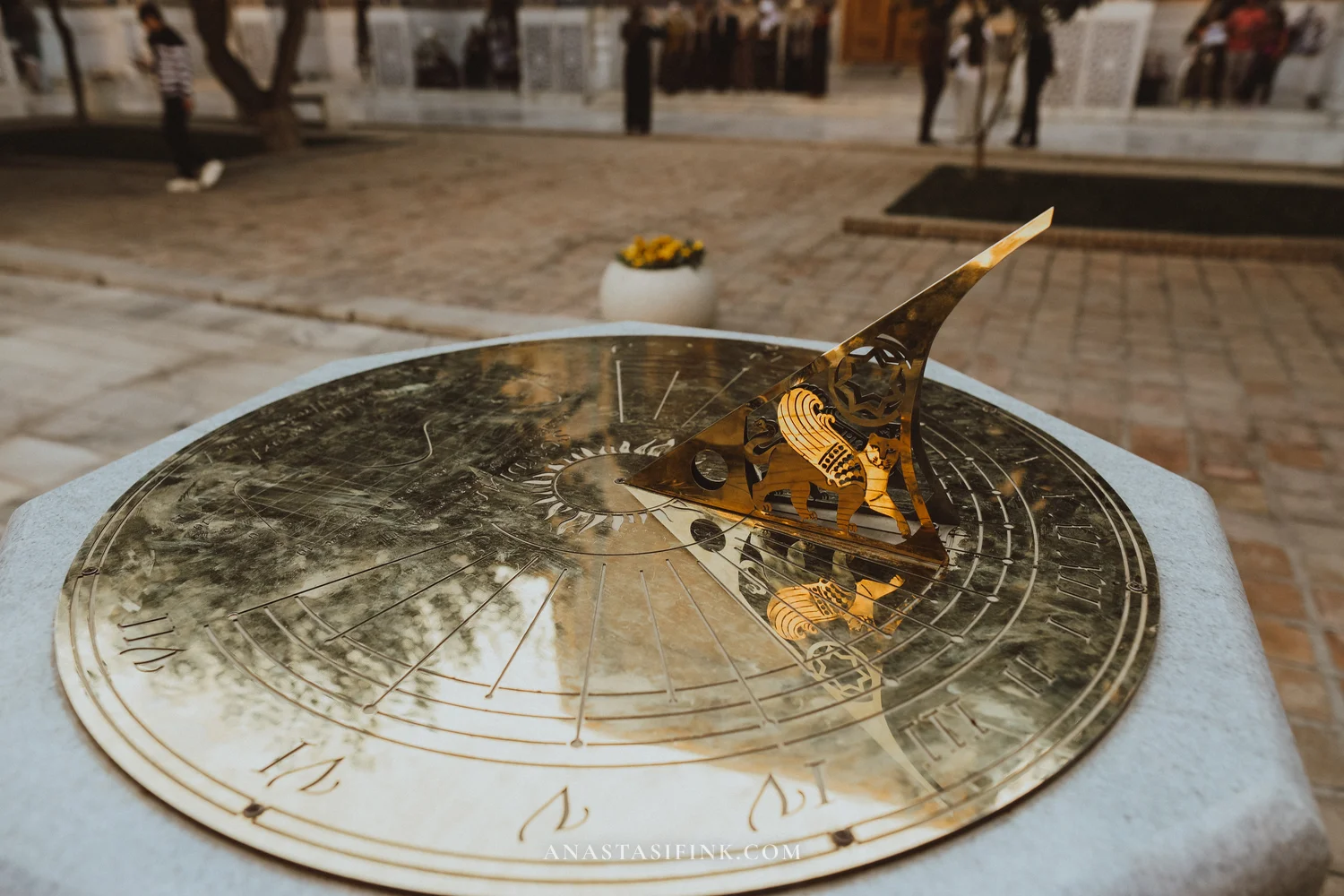
The gold-domed mosque inside Tilya-Kori is the single biggest reason to buy a ticket. Each madrasah also has an inner courtyard, iwans, and shops selling rugs and ceramics. Don’t skip the sundial in the courtyard or the muqarnas (stalactite ceilings) inside the iwans.
Just for Registan? Yes, honestly. But if you’ve already made it to Uzbekistan, don’t stop there: Samarkand also has Bibi-Khanym Mosque, Shah-i-Zinda, and Gur-Emir. Two full days will cover all of it without rushing.
Yes, freely and without any extra charge. Skip the flash — the old mosaic is fragile, and the existing lighting actually photographs better. Tripods and serious camera setups are welcome too.