Shah-i-Zinda: A Guide to Samarkand’s Avenue of Mausoleums

The Shah-i-Zinda necropolis in Samarkand is a narrow lane hemmed in on both sides by mausoleums wrapped in blue and turquoise tile. I turned up an hour before sunset and stayed until dark. First the tilework glows in the last of the sun, then the floodlights come on — and honestly, that evening light is the whole reason people time their visit for the end of the day.
About Shah-i-Zinda — Samarkand’s “Living King”
Shah-i-Zinda translates as “the living king.” The name comes from the legend of Kusam ibn Abbas — a cousin of the Prophet Muhammad who arrived in Samarkand in the 7th century to preach Islam. As the story goes, he was beheaded during an attack, but he simply picked up his own head and climbed down into a deep well, where he lives to this day. Hence the “living king.”
A necropolis is a cemetery, but this is nothing like the ones we’re used to. Along one narrow lane stand the mausoleums (tombs) of Samarkand’s nobility and the relatives of Tamerlane — the 14th-century conqueror who made this city the capital of his empire. The complex took shape over nearly eight hundred years: the earliest buildings date to the 11th century, the bulk to the 14th–15th, and part of the entrance area was added as late as the 19th. Today there are more than twenty structures here, split into three groups — lower, middle and upper — linked by arched passageways. Samarkand was one of the great crossroads of the Silk Road, and standing here you can feel how much wealth and ambition once passed through.
People often say Shah-i-Zinda has some of the finest tilework in the entire Muslim world. I wasn’t about to fact-check that, but I did end up parked in front of one mosaic wall a lot longer than I’d planned.
The staircase of 40 steps
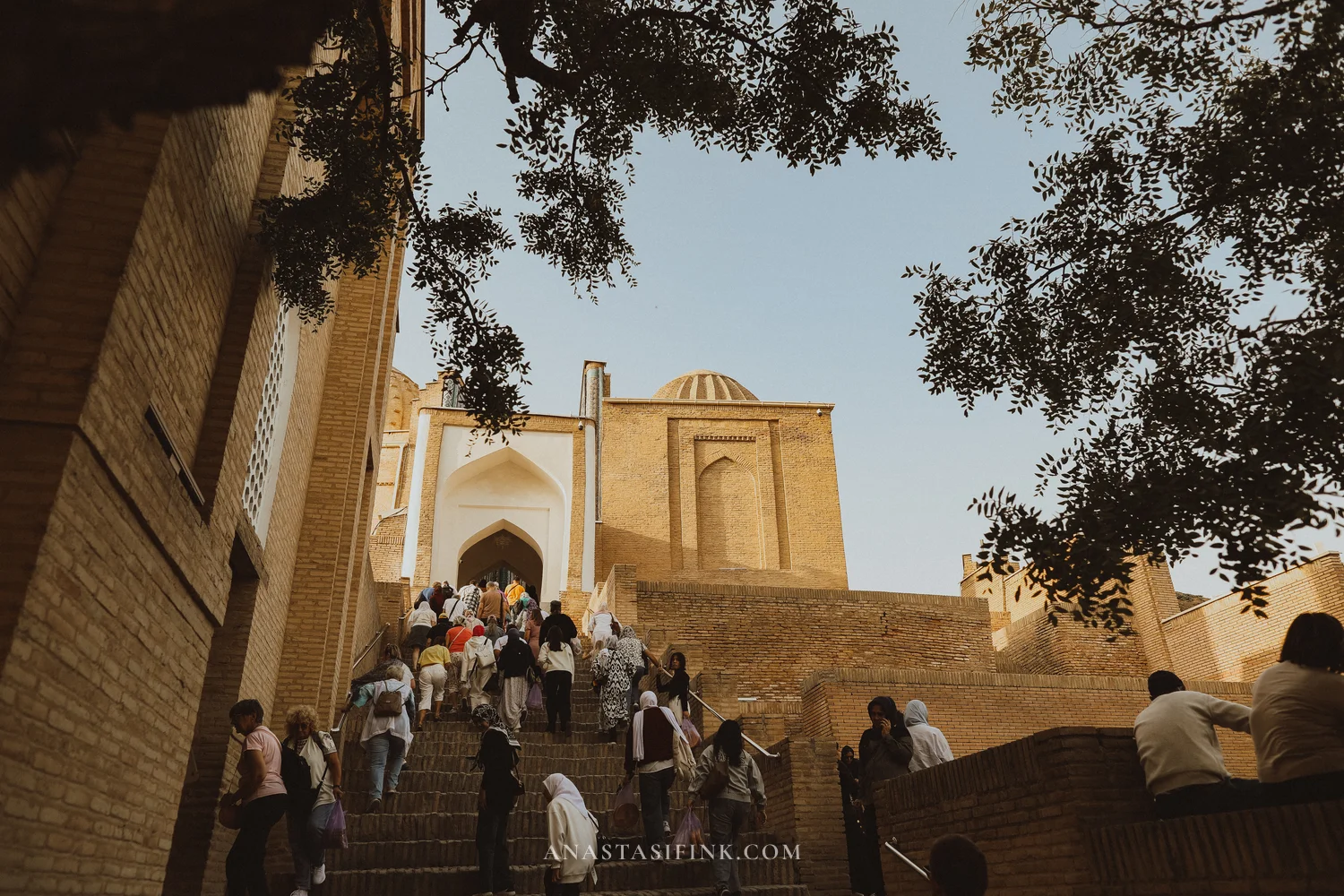
The climb up to the mausoleums begins with a staircase. It has 40 steps, and there’s a local tradition attached to it. You make a wish, count the steps on the way up, then count them again on the way back down. If you get the same number both times, your wish is supposed to come true. It sounds like a game, but it’s rather sweet to watch: people genuinely climb up muttering to themselves, losing count halfway.
Hazrat Khizr Mosque and the first building past the stairs
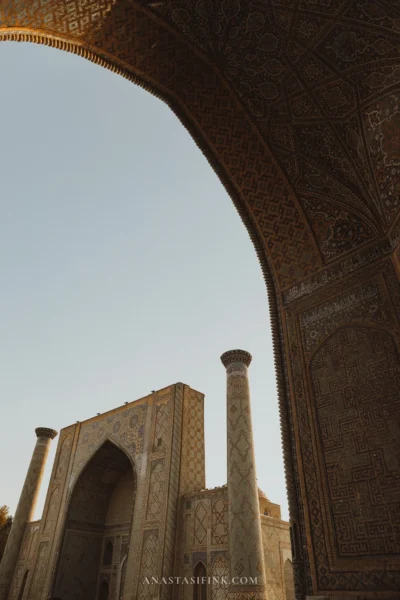
By the entrance, before you even start climbing, stands the Hazrat Khizr Mosque — with a tall tiled portal covered in Kufic script. Hazrat Khizr is the saint who, according to legend, saved Kusam ibn Abbas by giving him the water of immortality. From the little rise by the mosque you can already spot the turquoise domes of the complex.
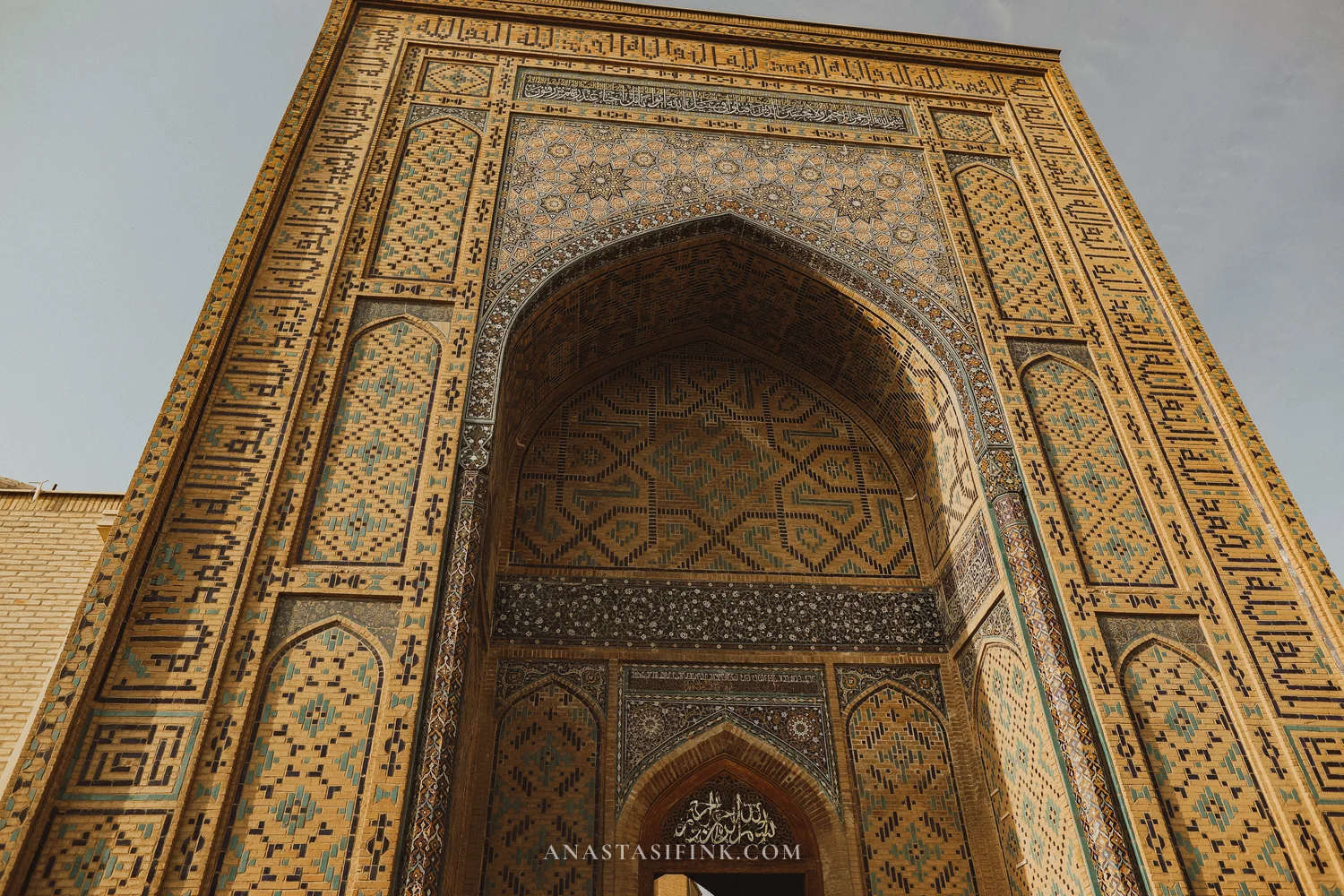
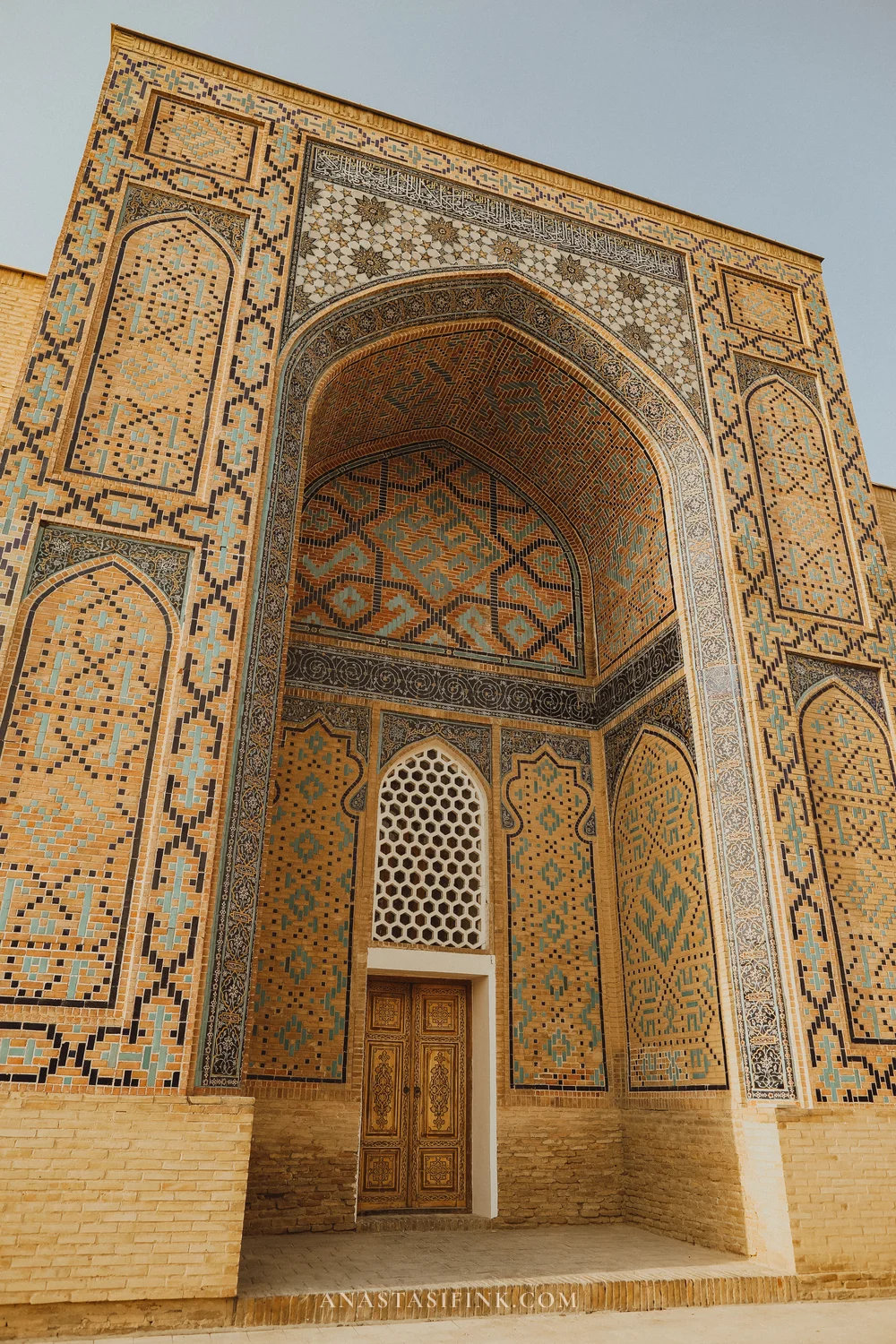
The Hazrat Khizr Mosque at the entrance to the complex
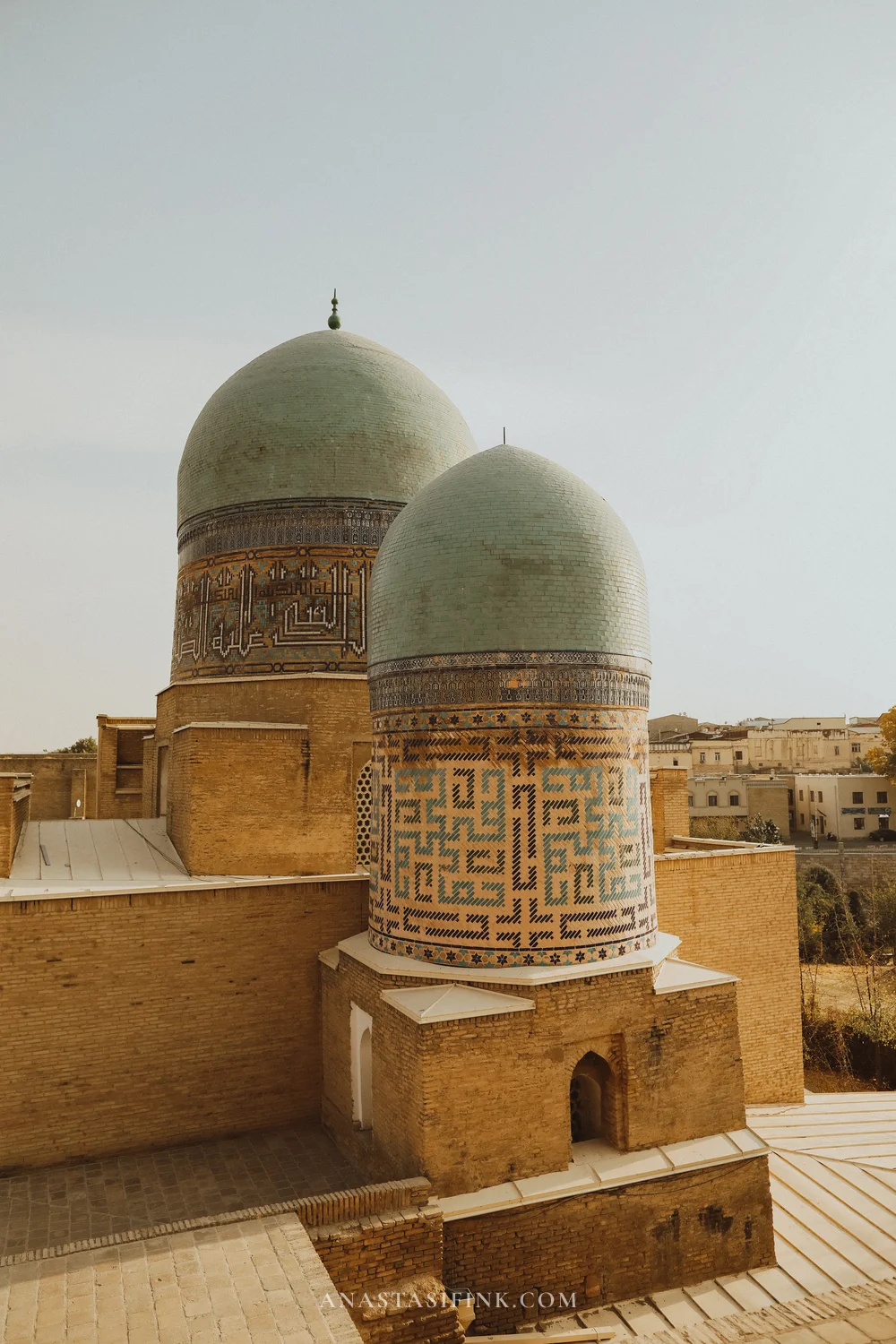
Once you’re up the stairs, you come out at a building with a carved wooden aivan (an open, columned terrace) and a fluted dome. It feels lighter and airier than the majolica-clad mausoleums around it.
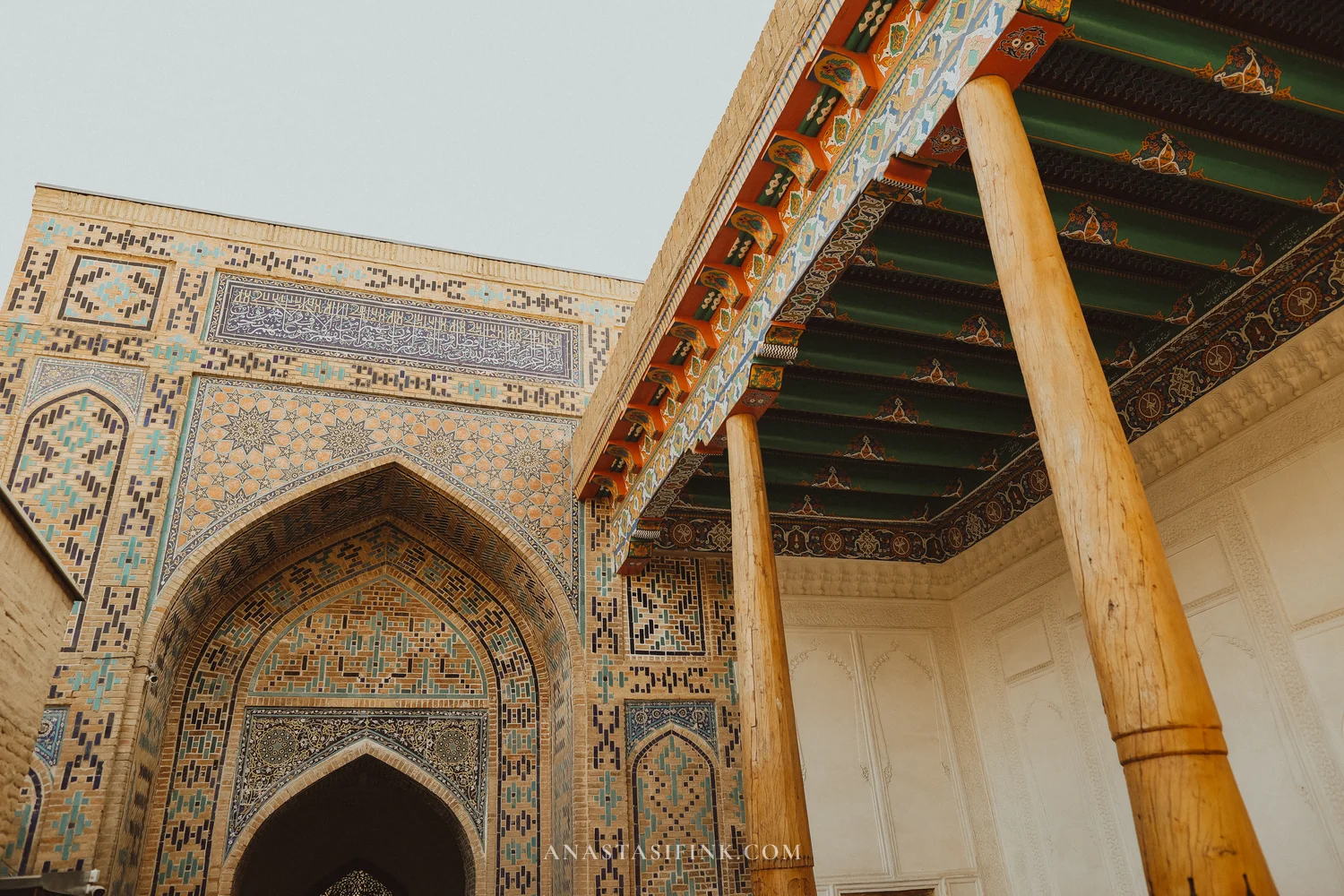
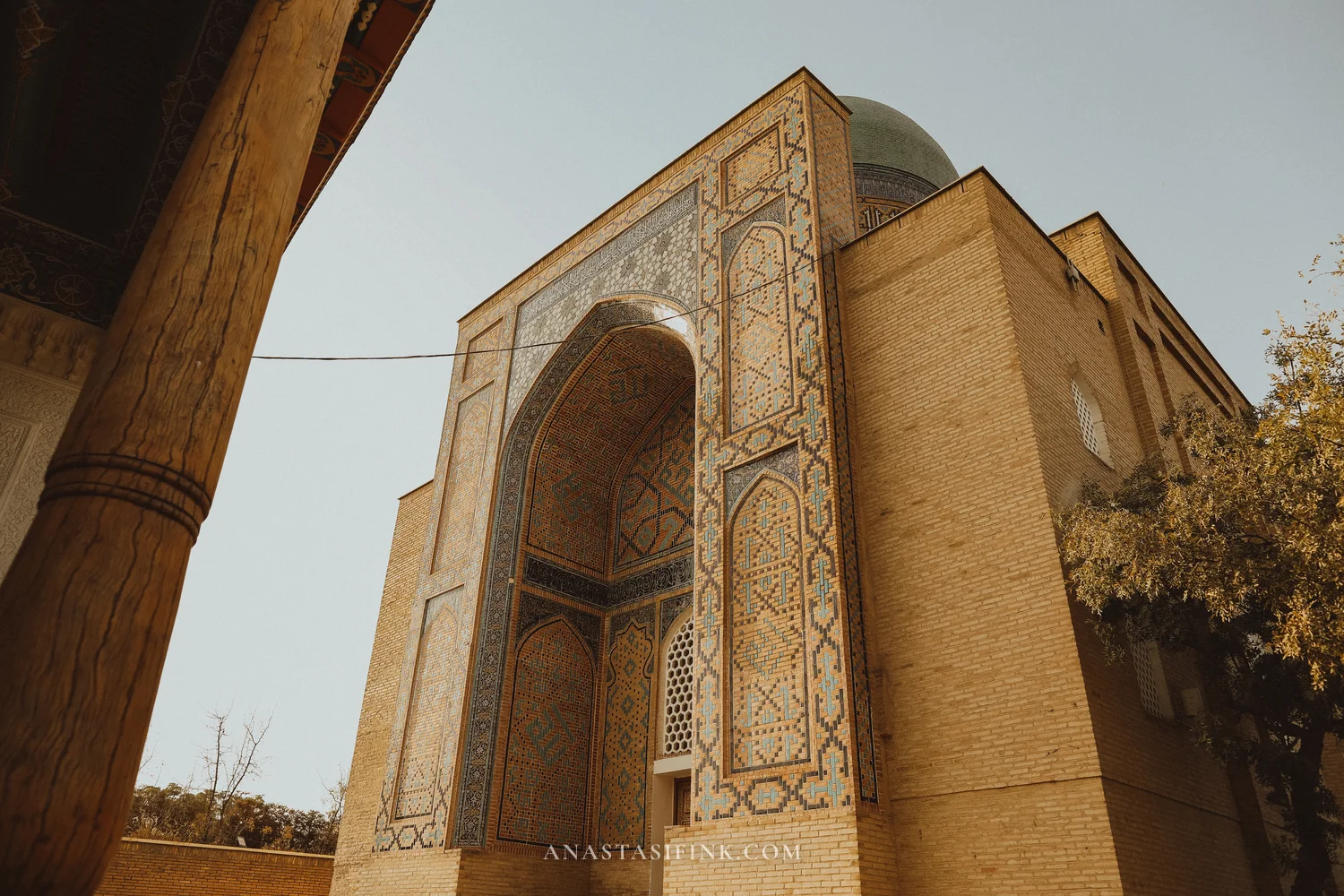
Just past the stairs: a wooden aivan and a turquoise dome
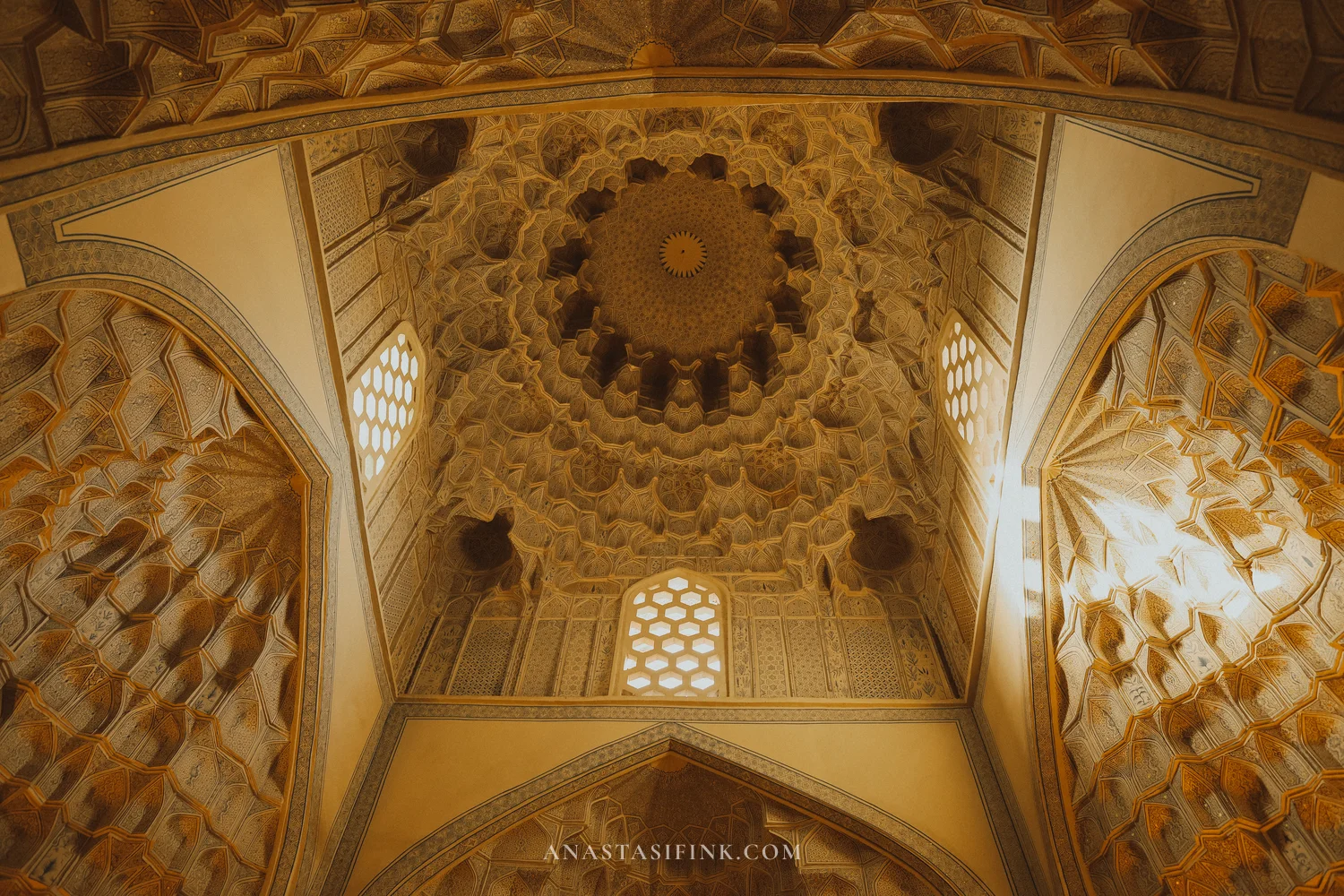
Inside there are two halls. One is bright, with whitewashed walls and delicate latticework over the windows. The other sits under a dome with a honeycomb muqarnas vault, and the light drops through it in thin shafts.
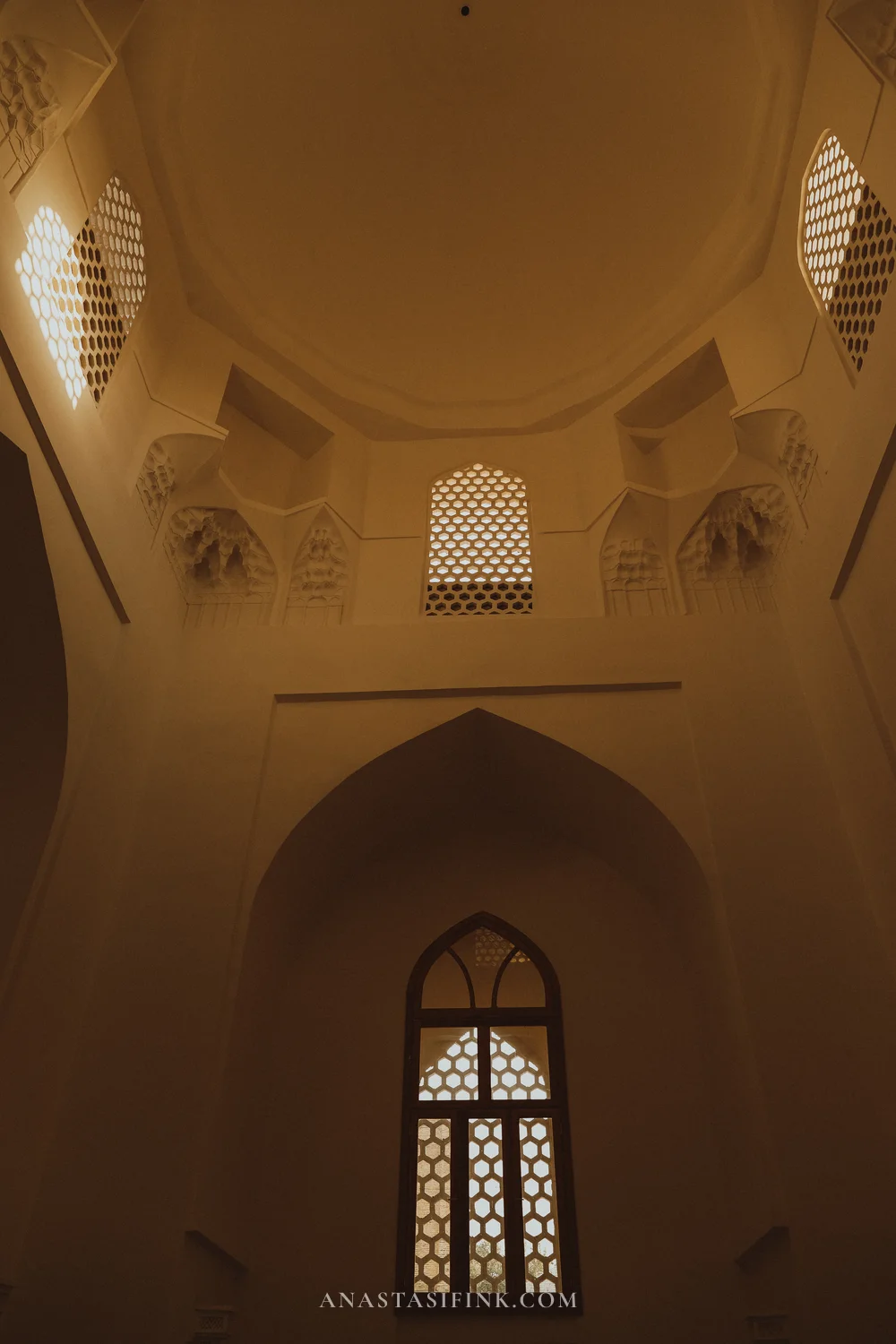
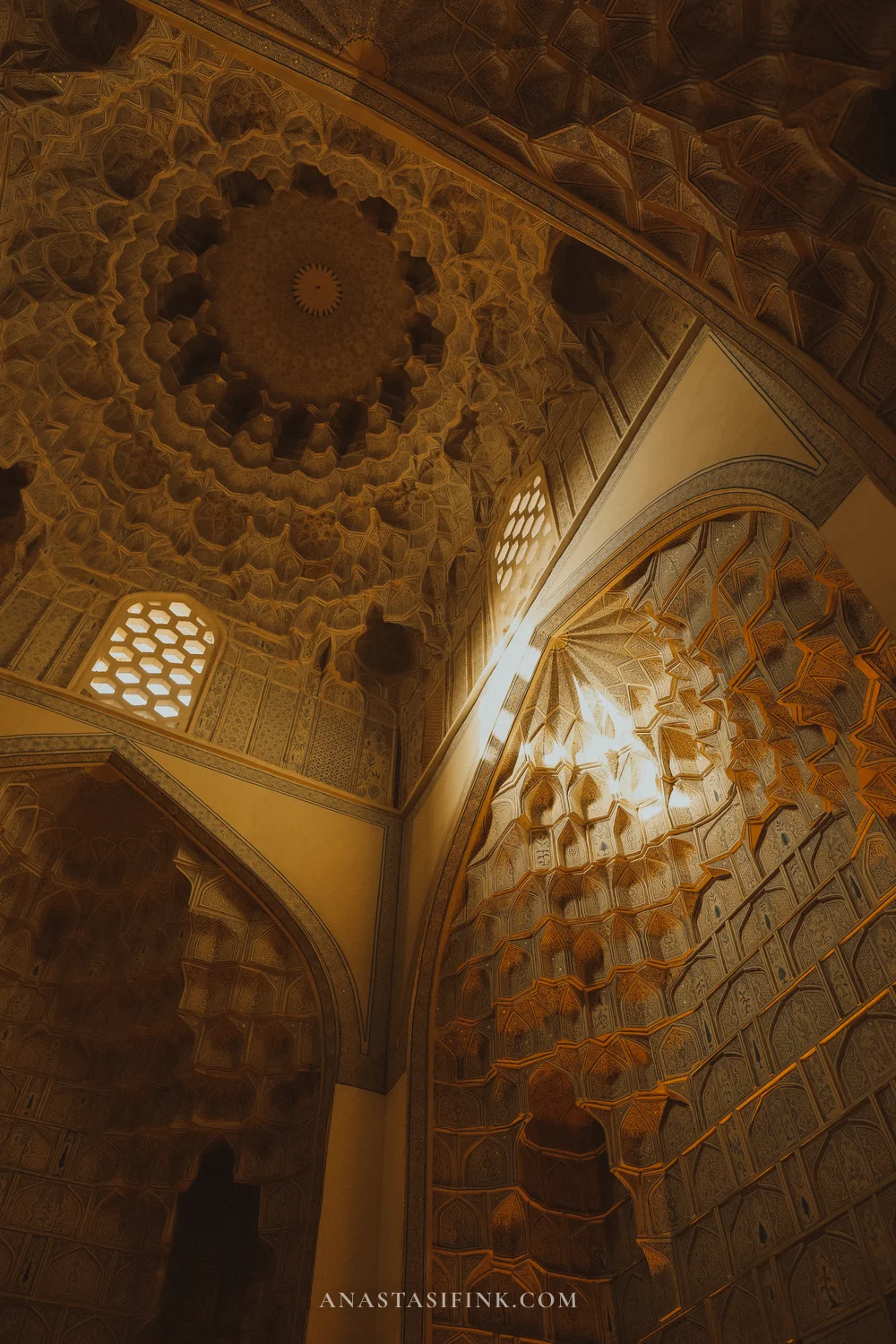
Two halls inside — one bright with lattice, one domed
The avenue of mausoleums
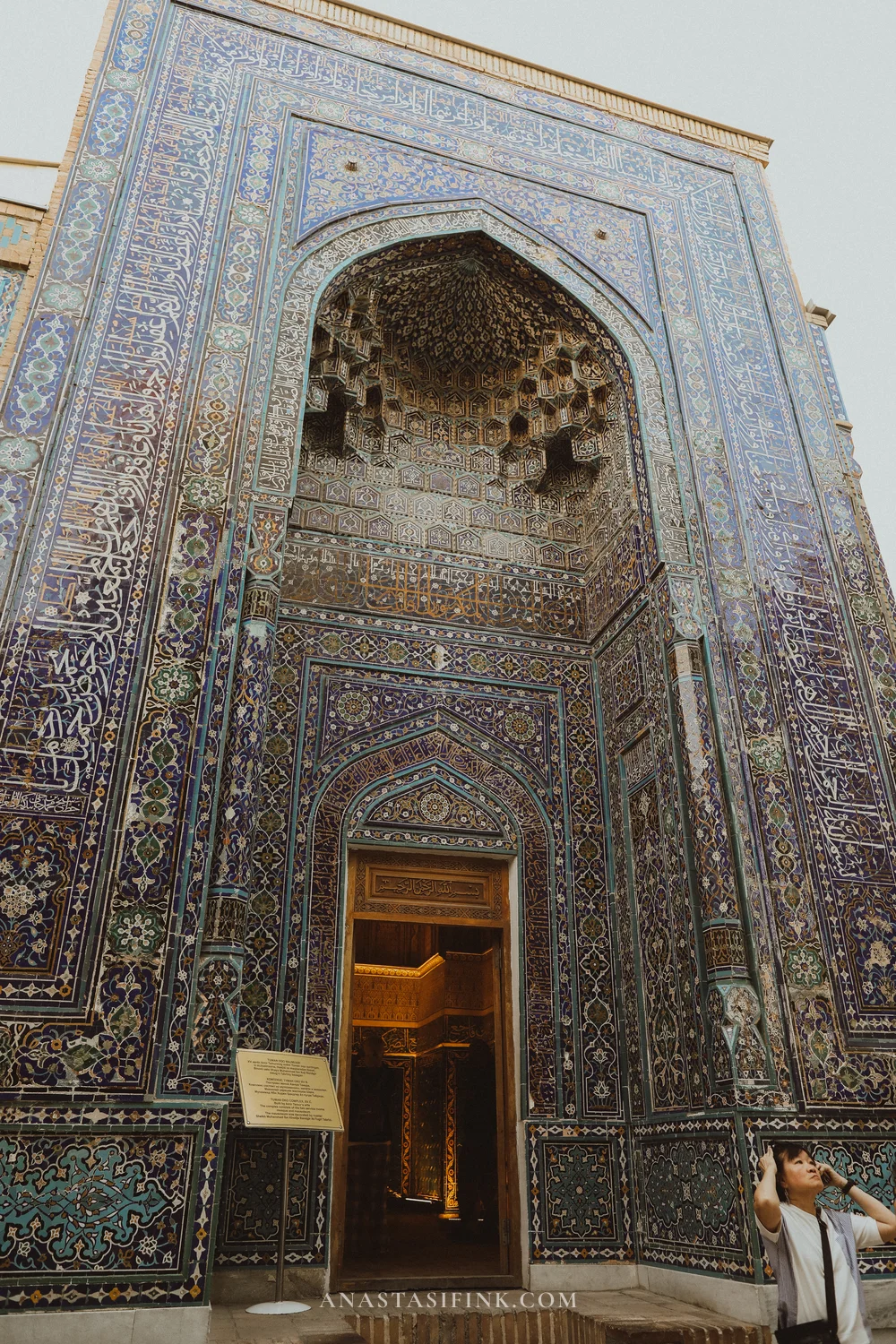
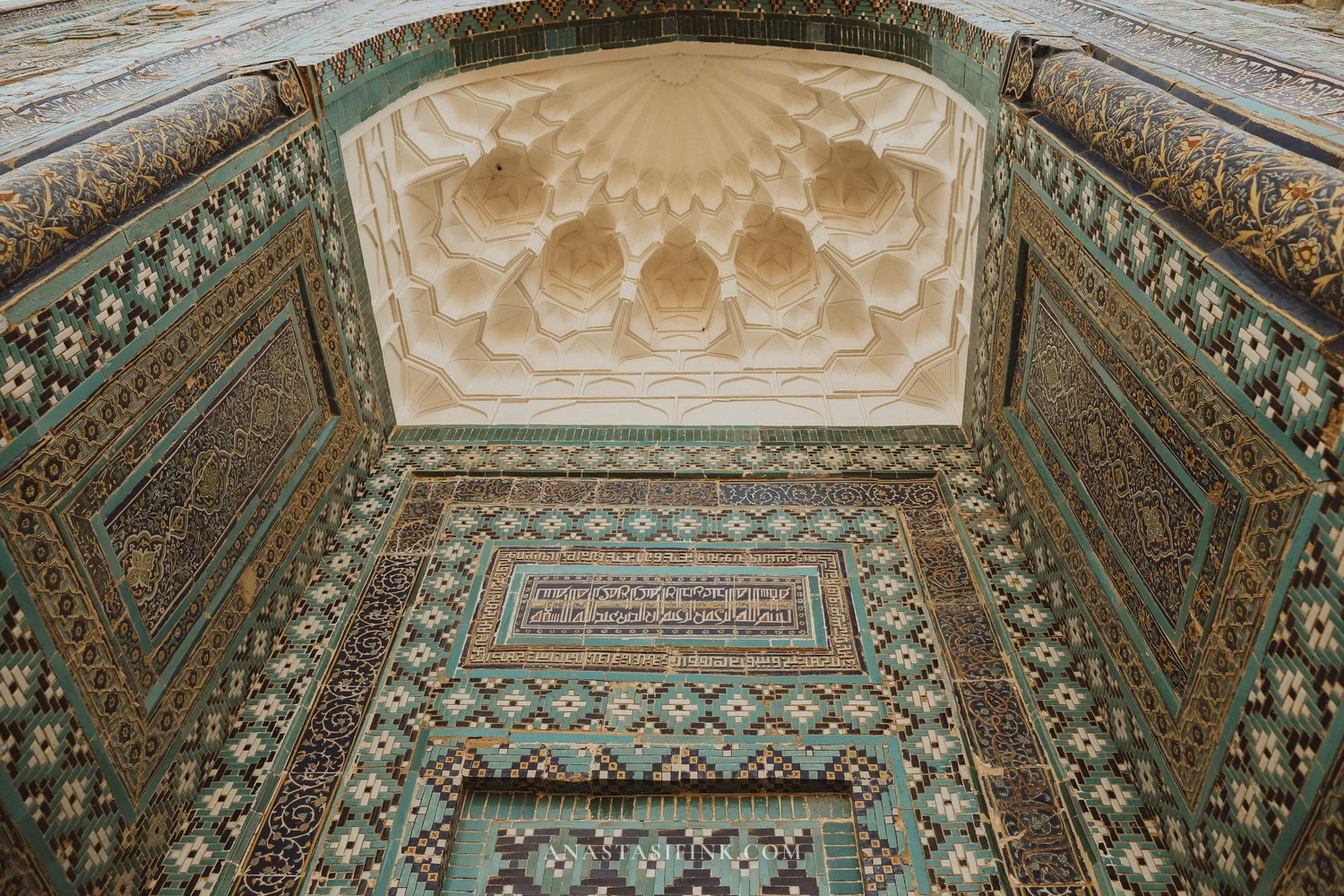
And then you reach the thing everyone actually comes for. A narrow passage, and on both sides the portals of the mausoleums, set close together, portal to portal. Right by the entrance it’s shoulder to shoulder: tour groups pack in and shoot the same frames, so sometimes you just wait for the passage to clear. Each mausoleum was built for a specific person — buried here are Tamerlane’s sisters, nieces and inner circle. The mausoleums of Shirin-Bika-Aka (Tamerlane’s sister) and Turkan-Aka (his niece), for instance, face each other across the lane.
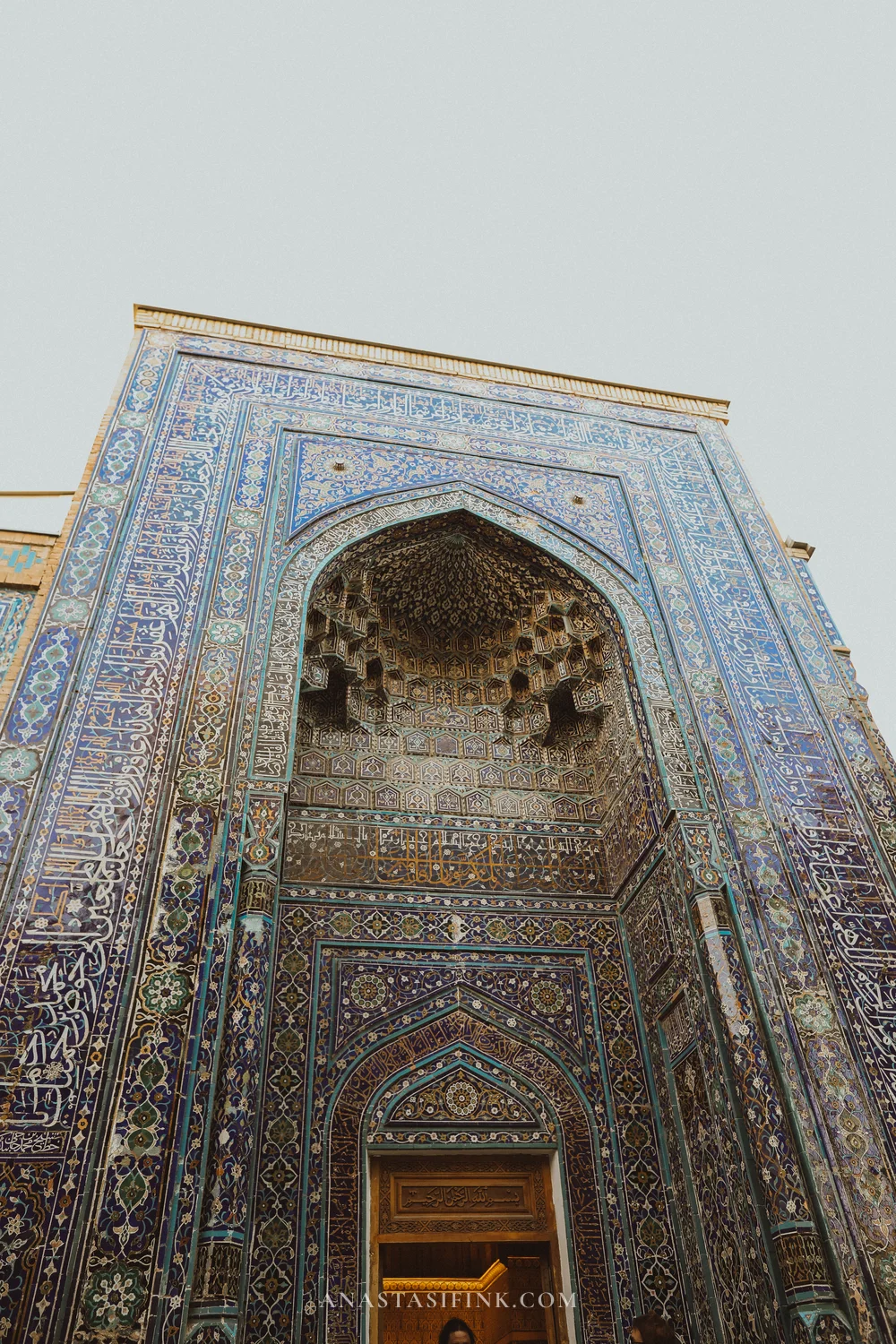
About ten minutes in, I caught myself no longer telling the mausoleums apart — they’d all blurred into one blue mass. And then it hit me: there aren’t actually two identical portals anywhere here. The craftsmen worked at different times and seem to have been quietly competing with one another — more turquoise here, a shift into deep blue there, a flash of green somewhere else.
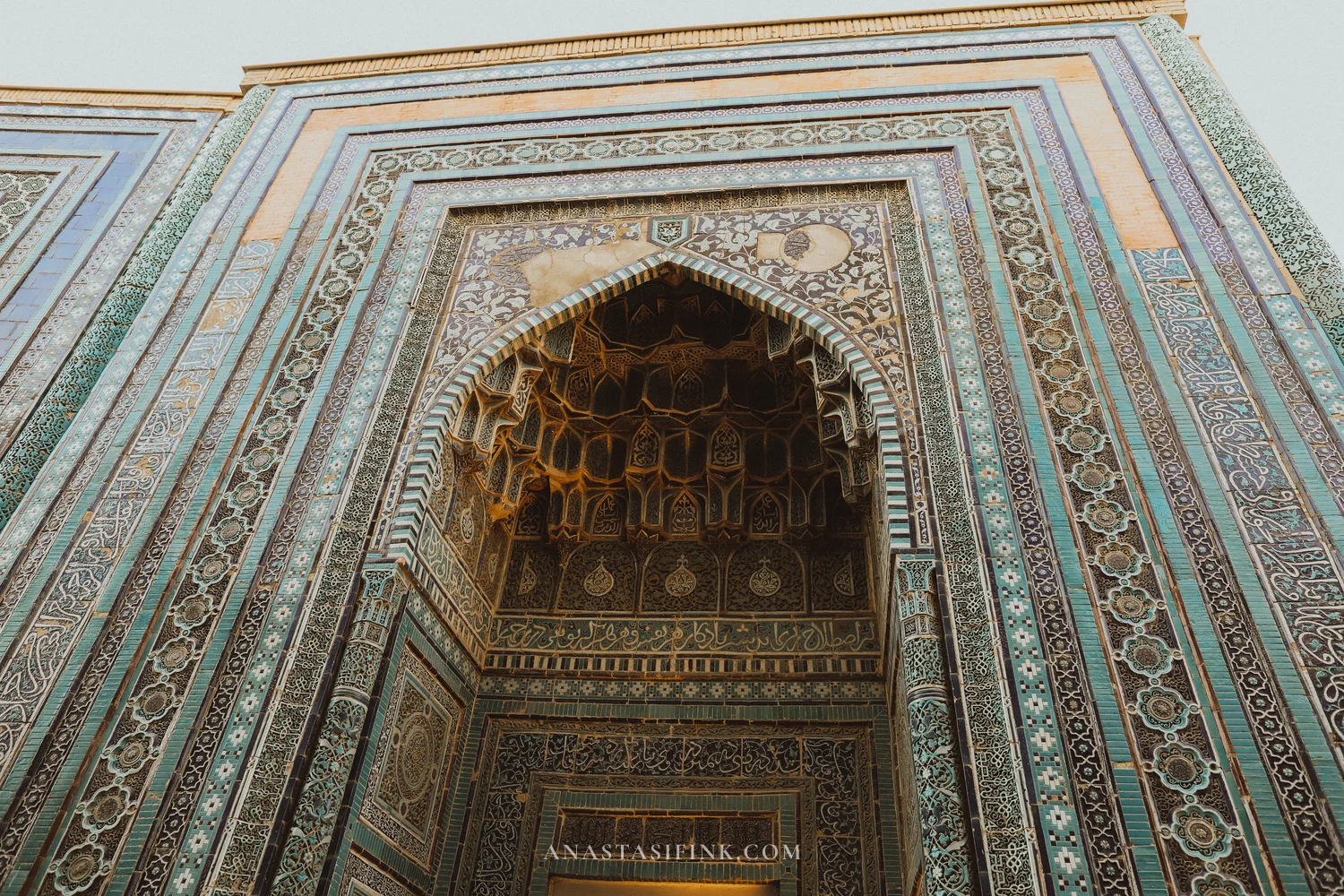
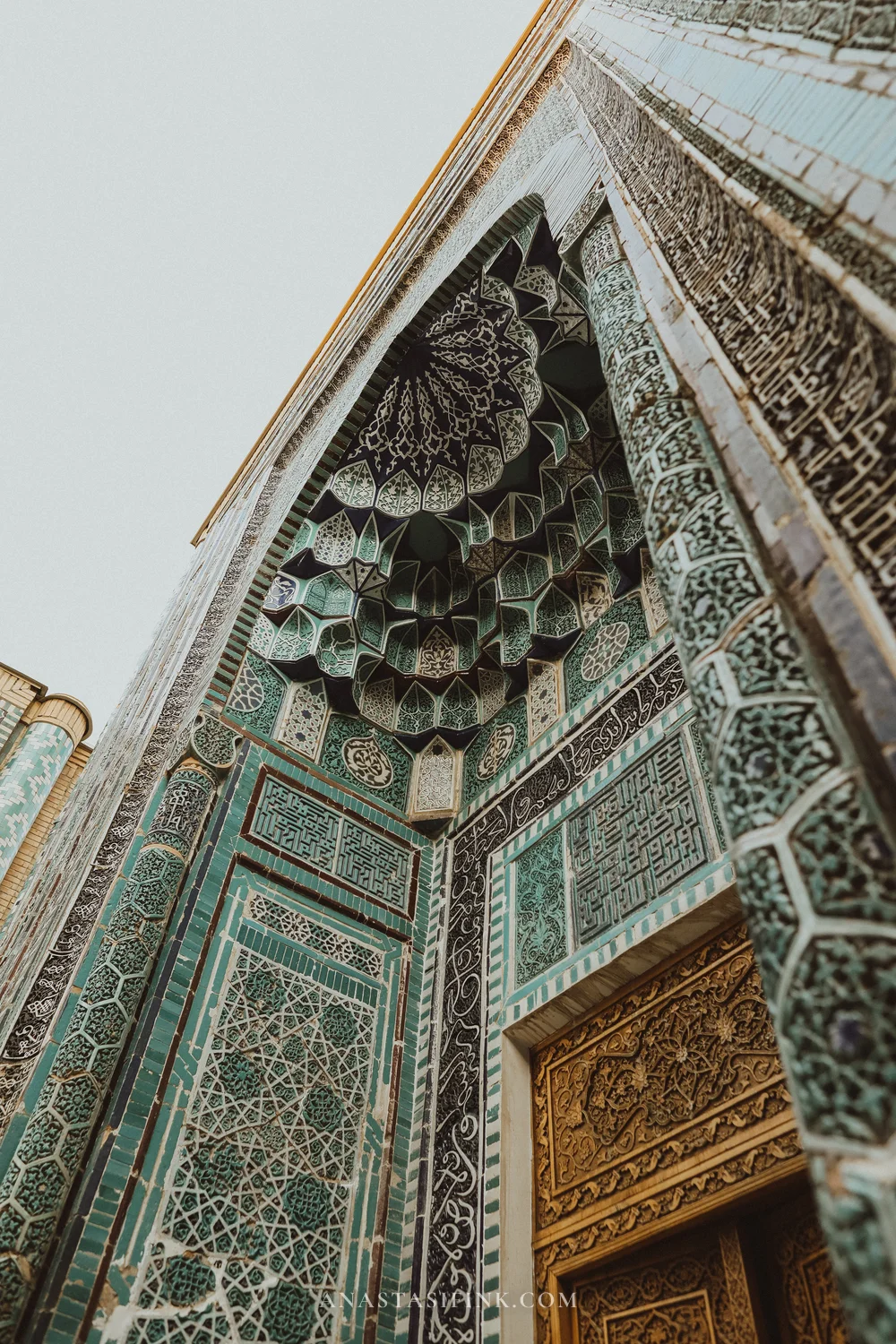
Green majolica, and a vault built from muqarnas cells
You can walk the whole avenue in about five minutes. But don’t rush it: peek into every opening, because behind many of the portals there are more little courtyards and walls waiting.
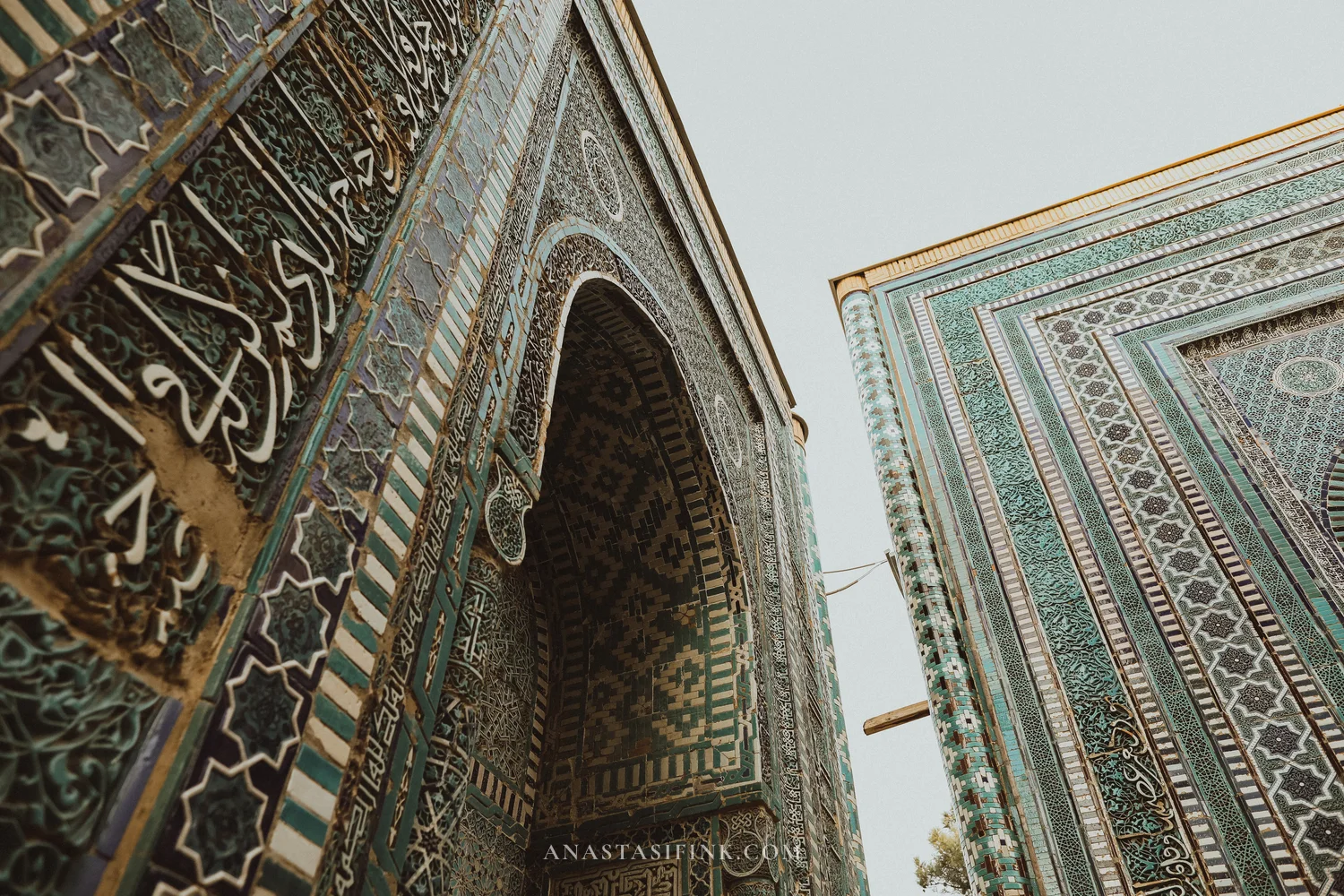
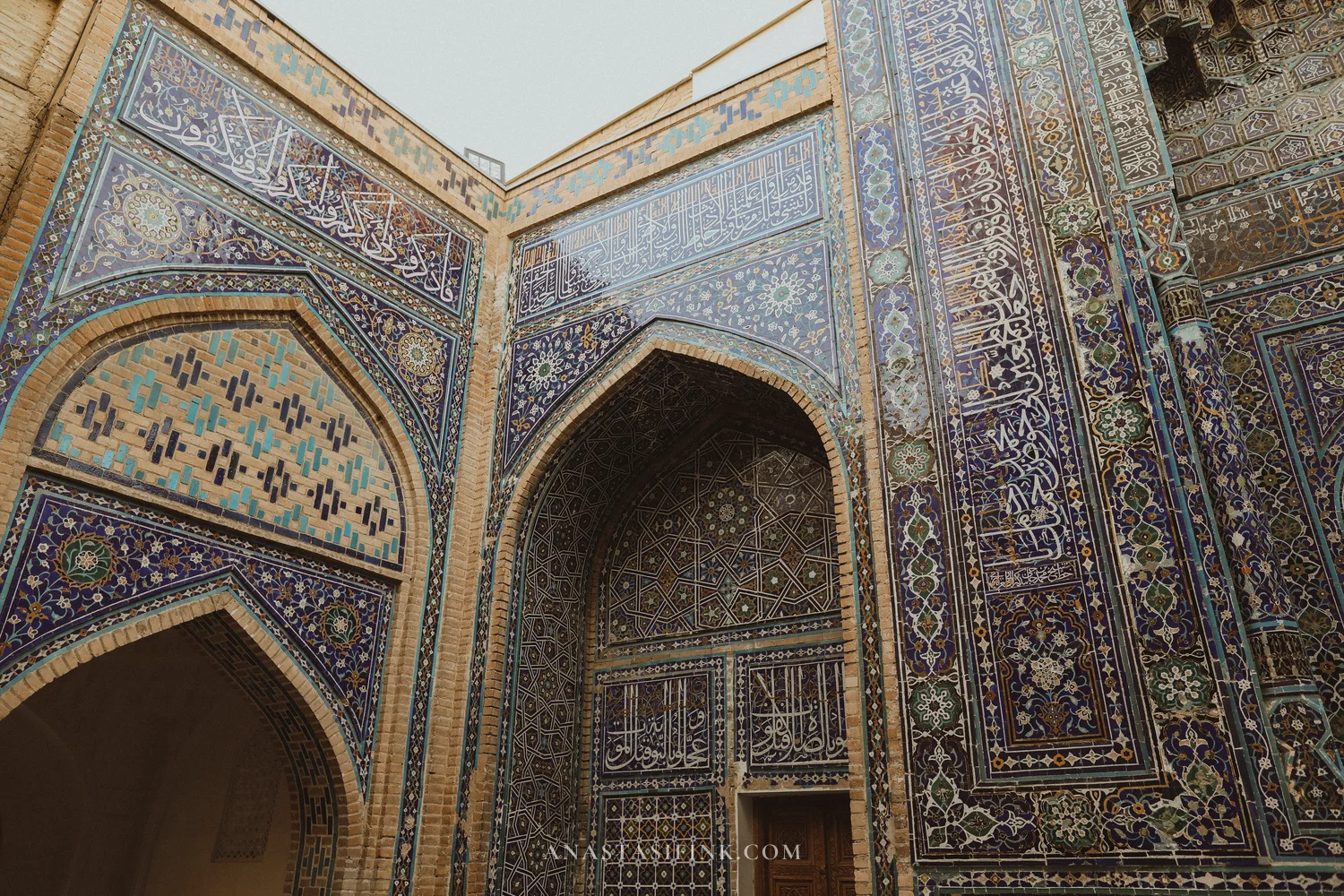
The passage barely squeezes between the mausoleums
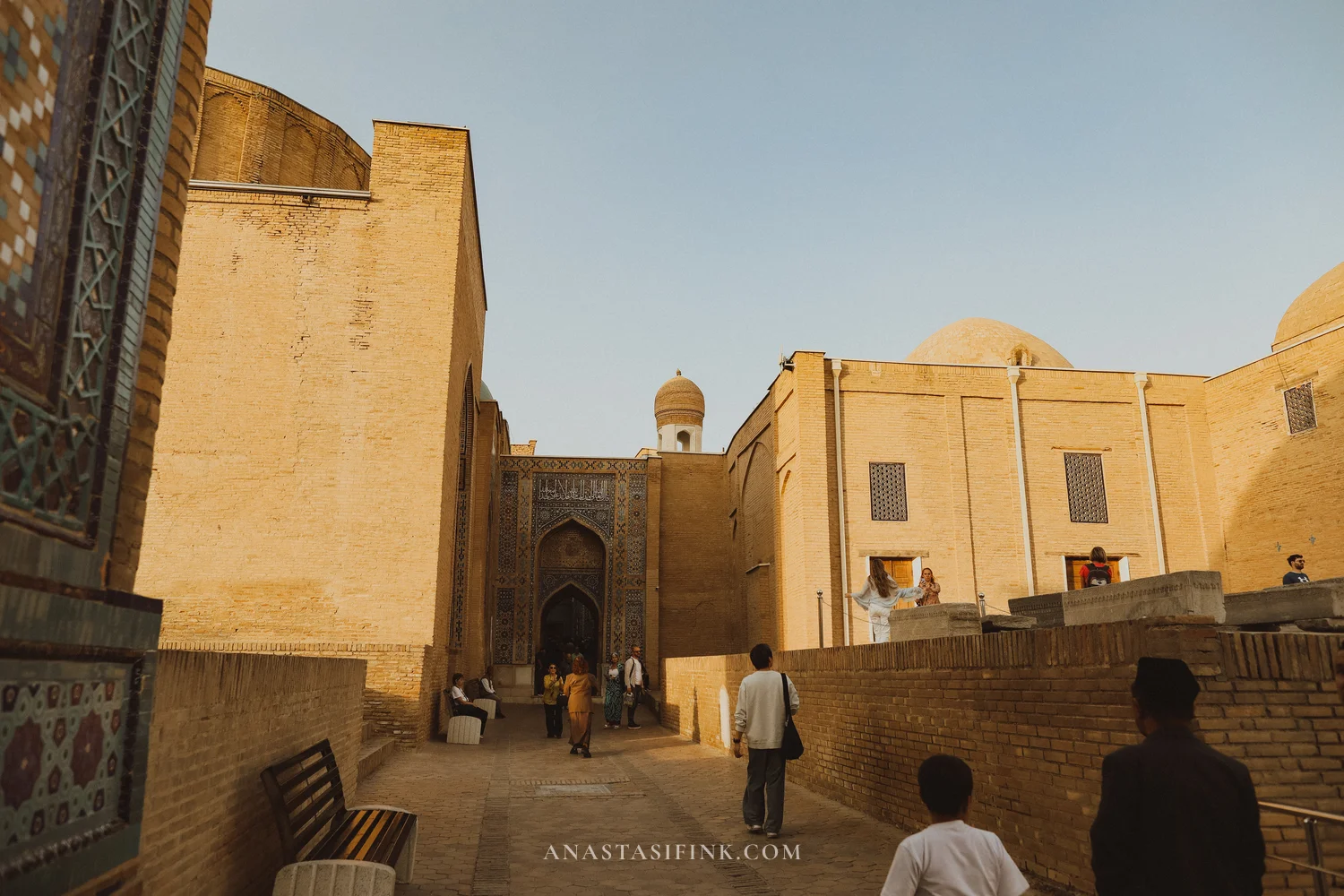
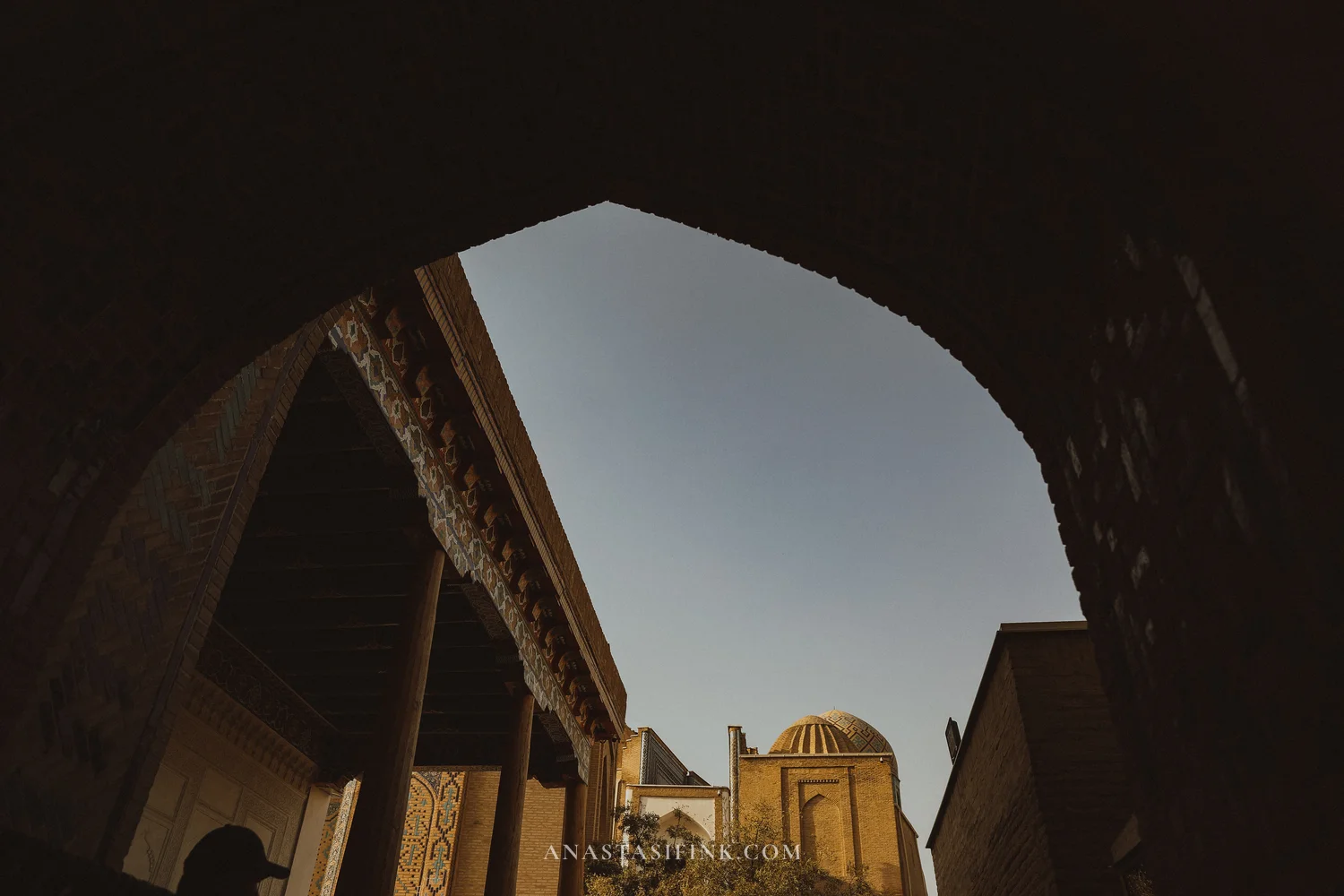
Through the arch, the next portal
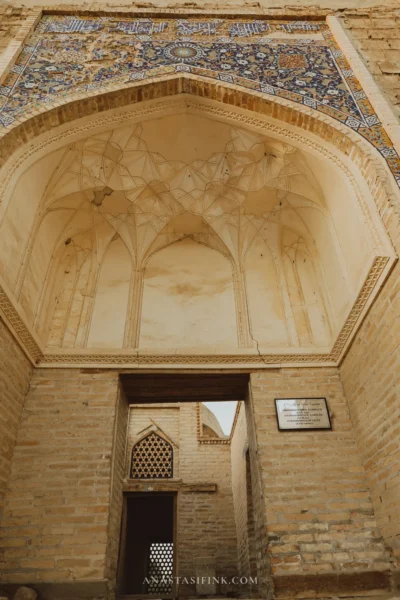
Not everything here is faced in tile. There are plain brick mausoleums too — blank walls, a modest door, a dome on top. Next to their tiled neighbours they look almost austere.
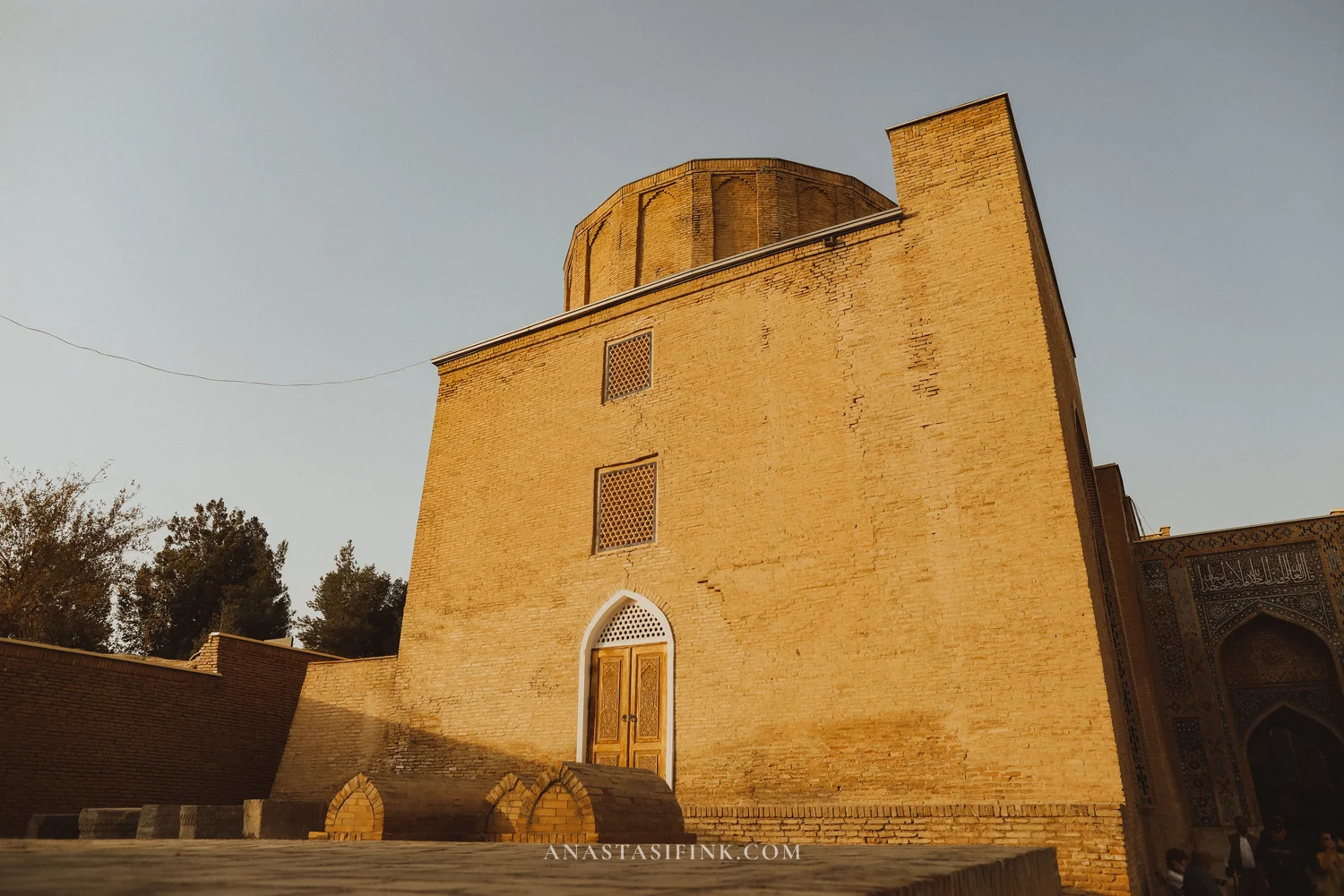
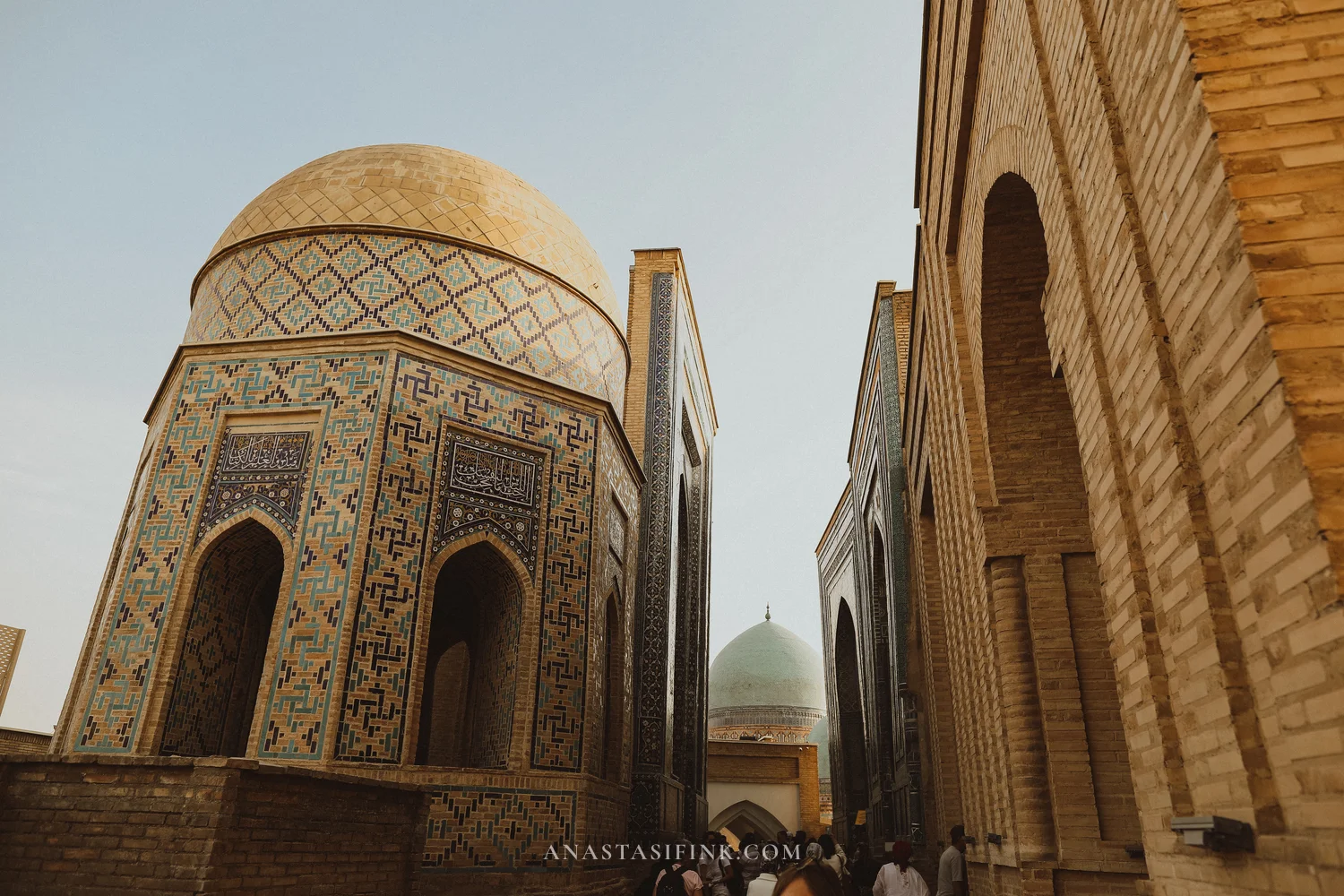
On the left, a brick mausoleum; on the right, a fluted dome
Tilework that’s six hundred years old
Get right up close to a wall and you can see what it’s all made of. Fine ceramic mosaic, relief carving in the glaze, inscriptions in Arabic script — all of it laid by hand, tile by tile. Majolica is clay tile coated in coloured glaze and fired, and it’s what gives that particular blue, the kind that doesn’t fade for centuries.
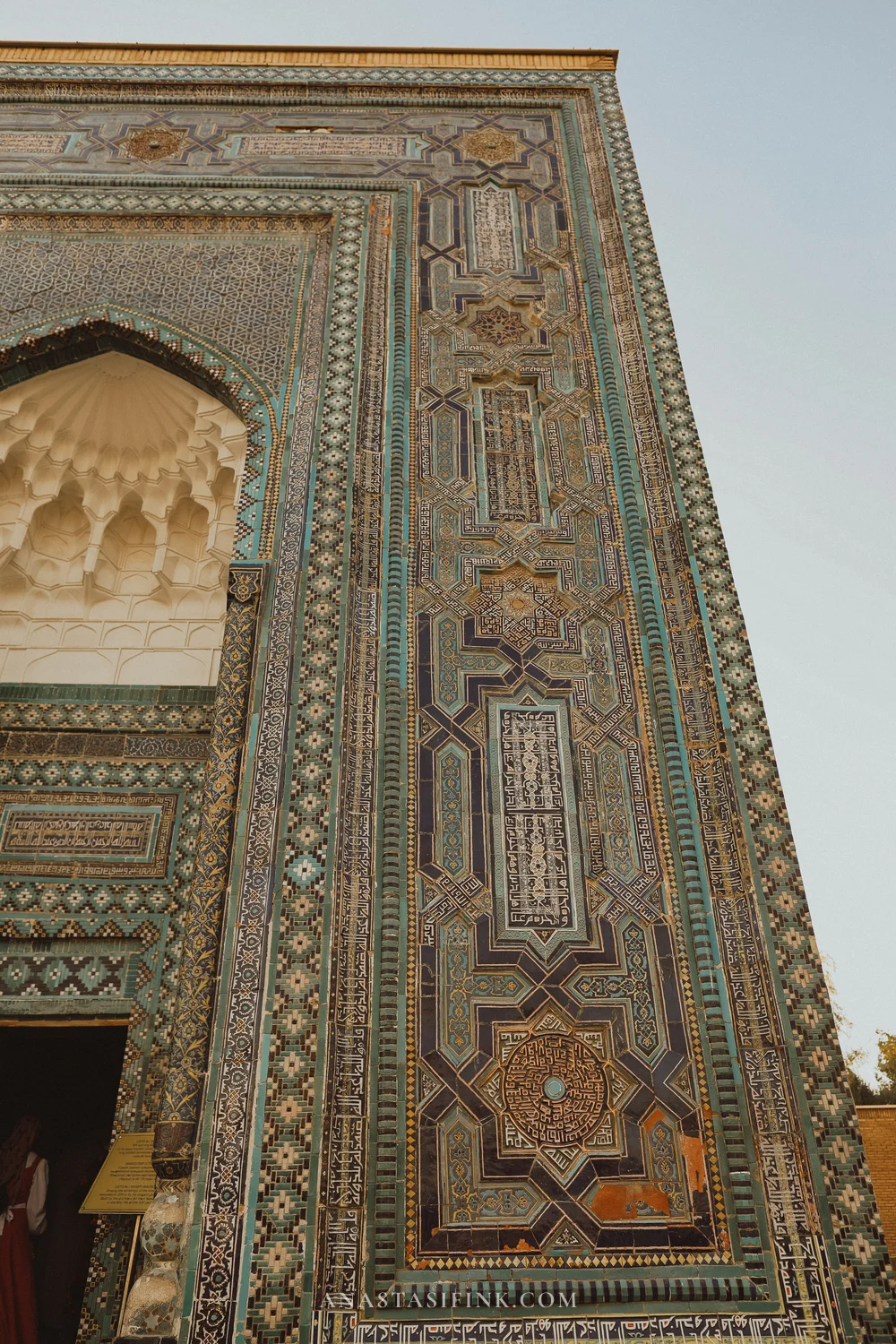
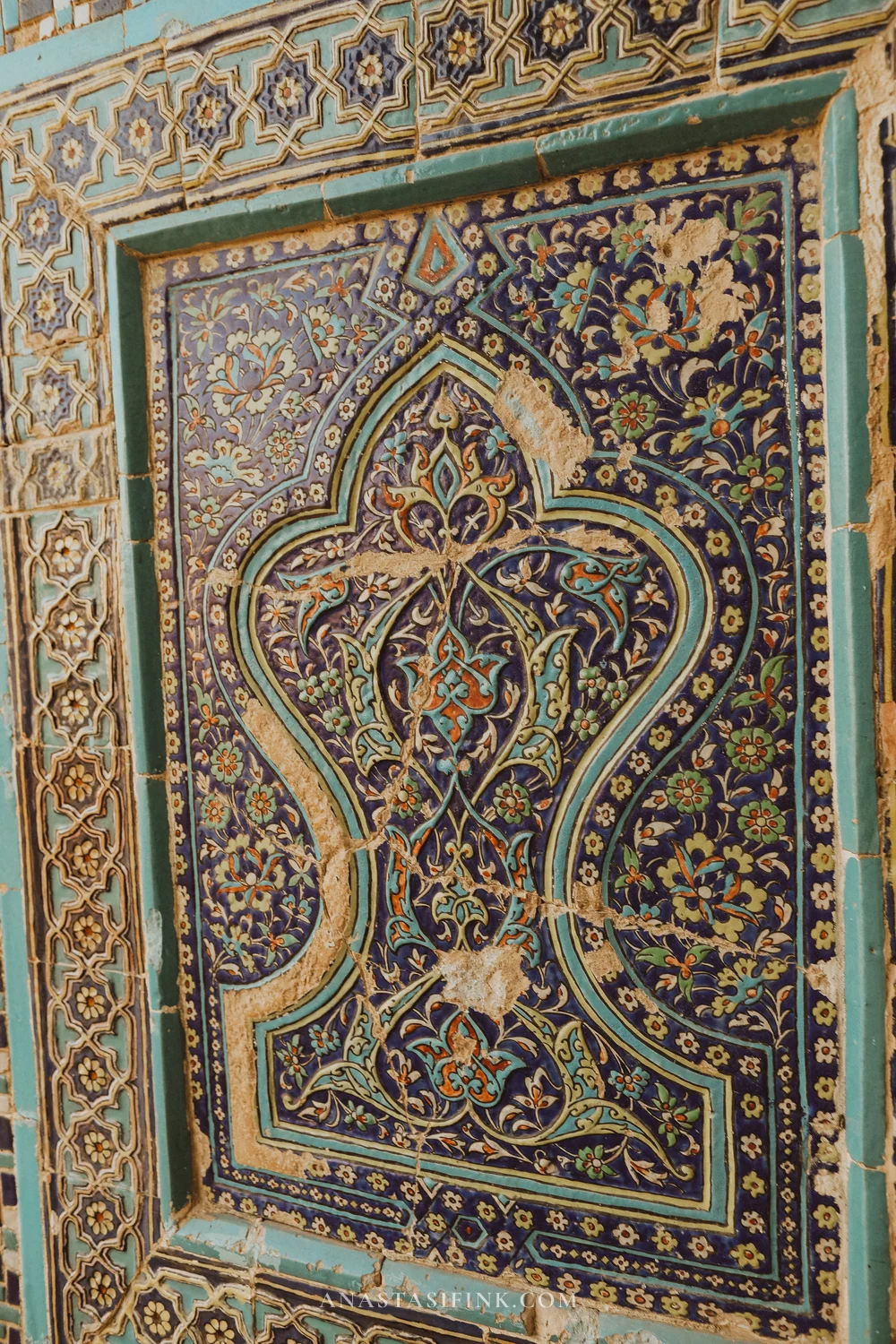
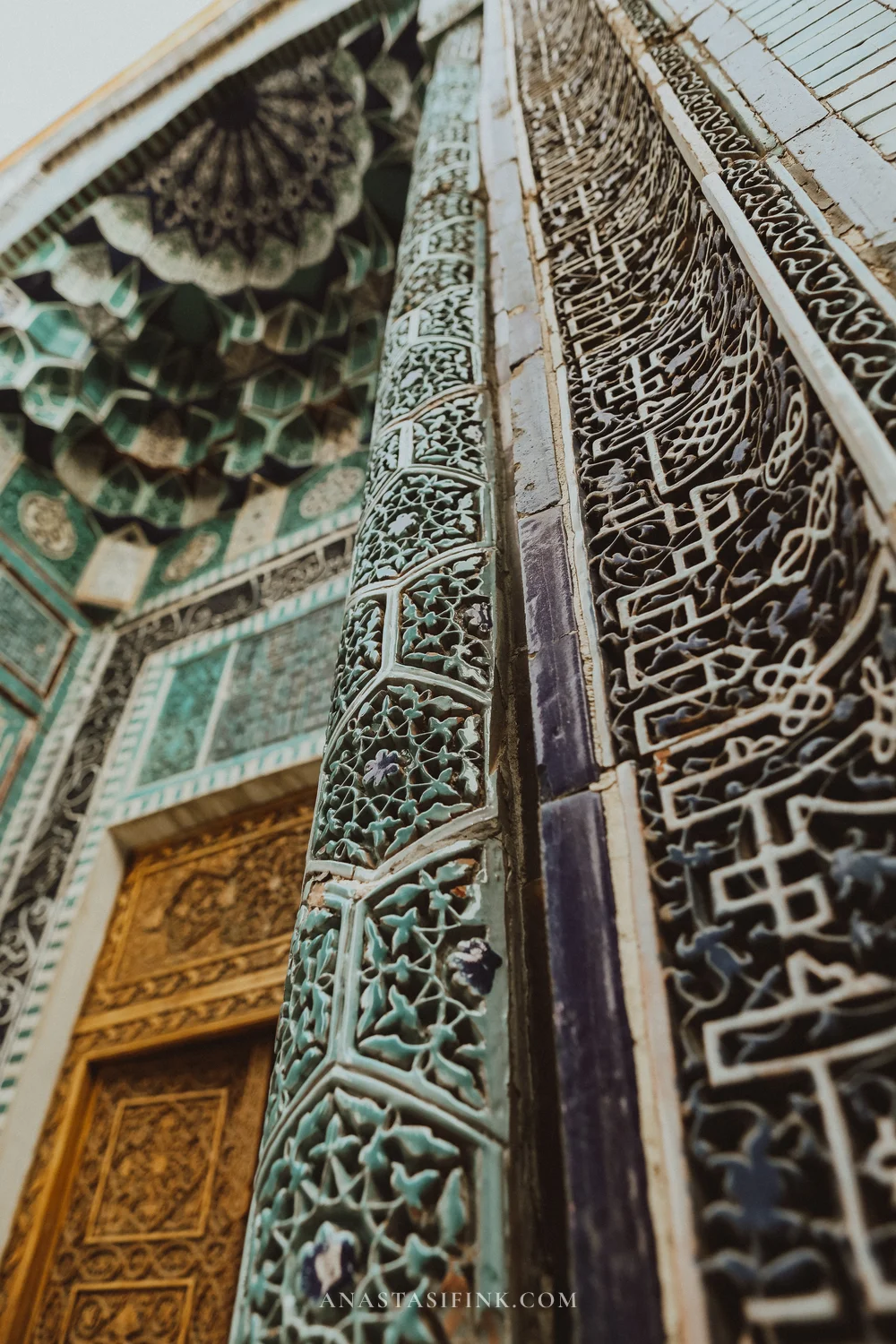
The pattern is assembled from individual pieces of glaze
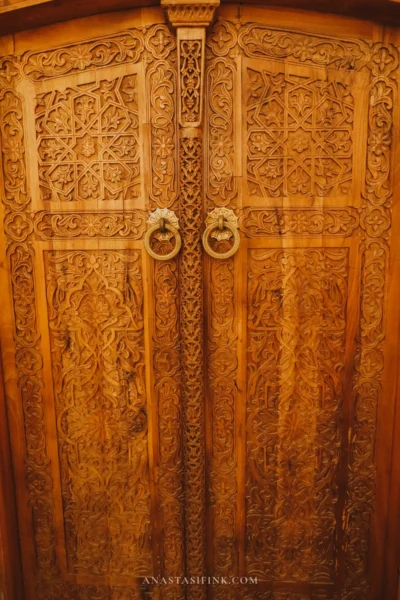
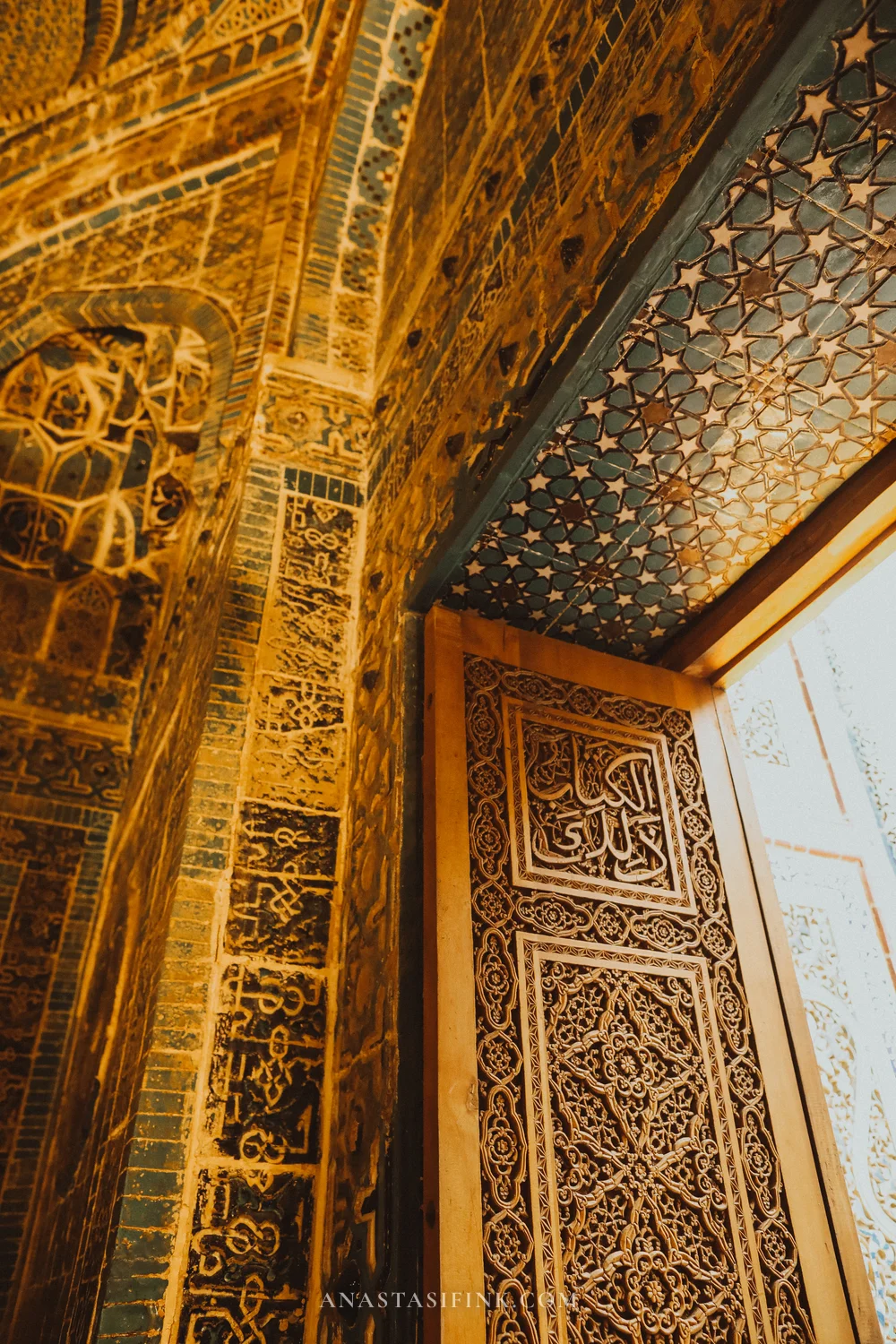
The carved wooden doors are a story of their own. They’re covered in the same dense carving as the walls, and here and there the old ring-handles have survived. Time has darkened the doors, but you can still read the pattern.
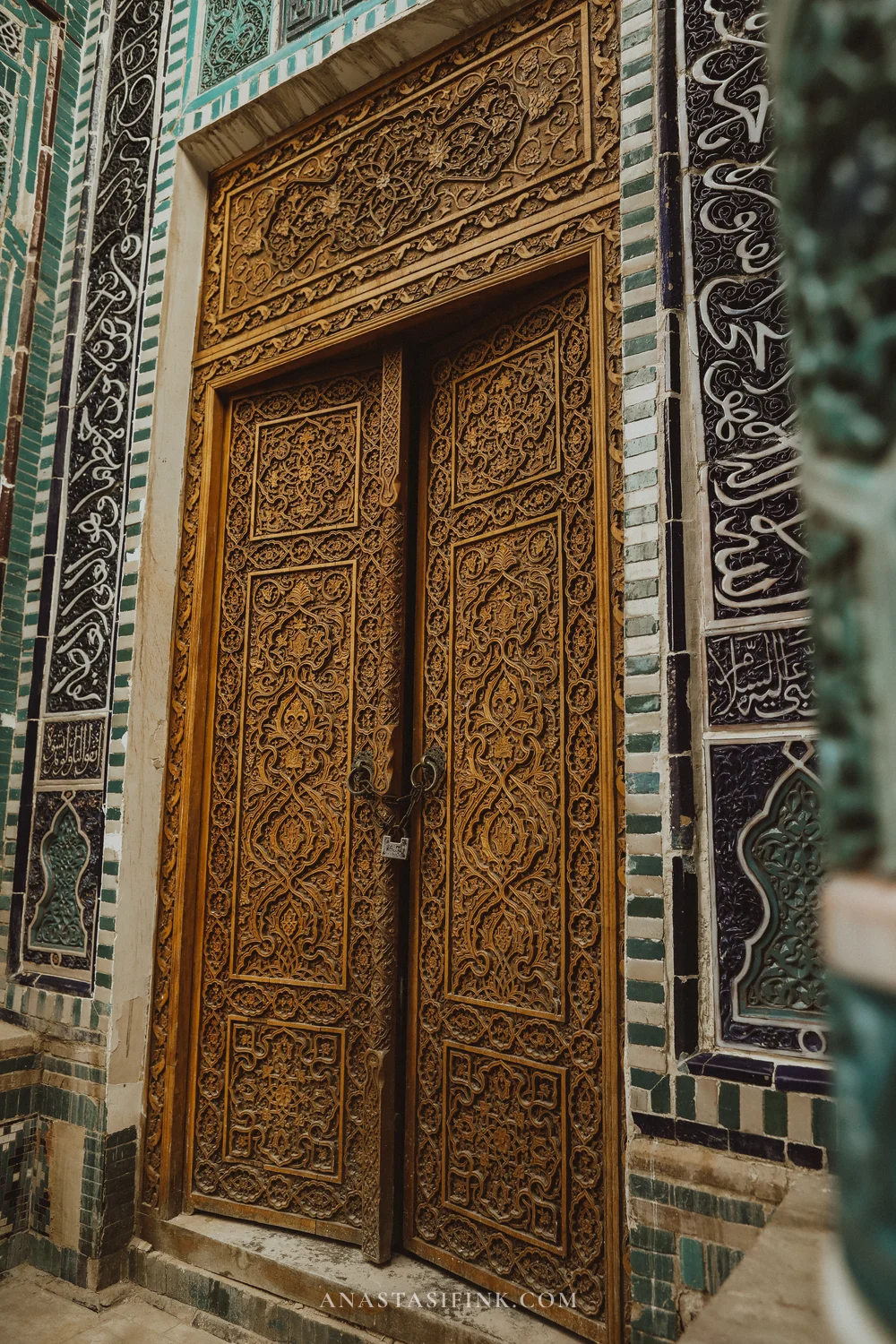
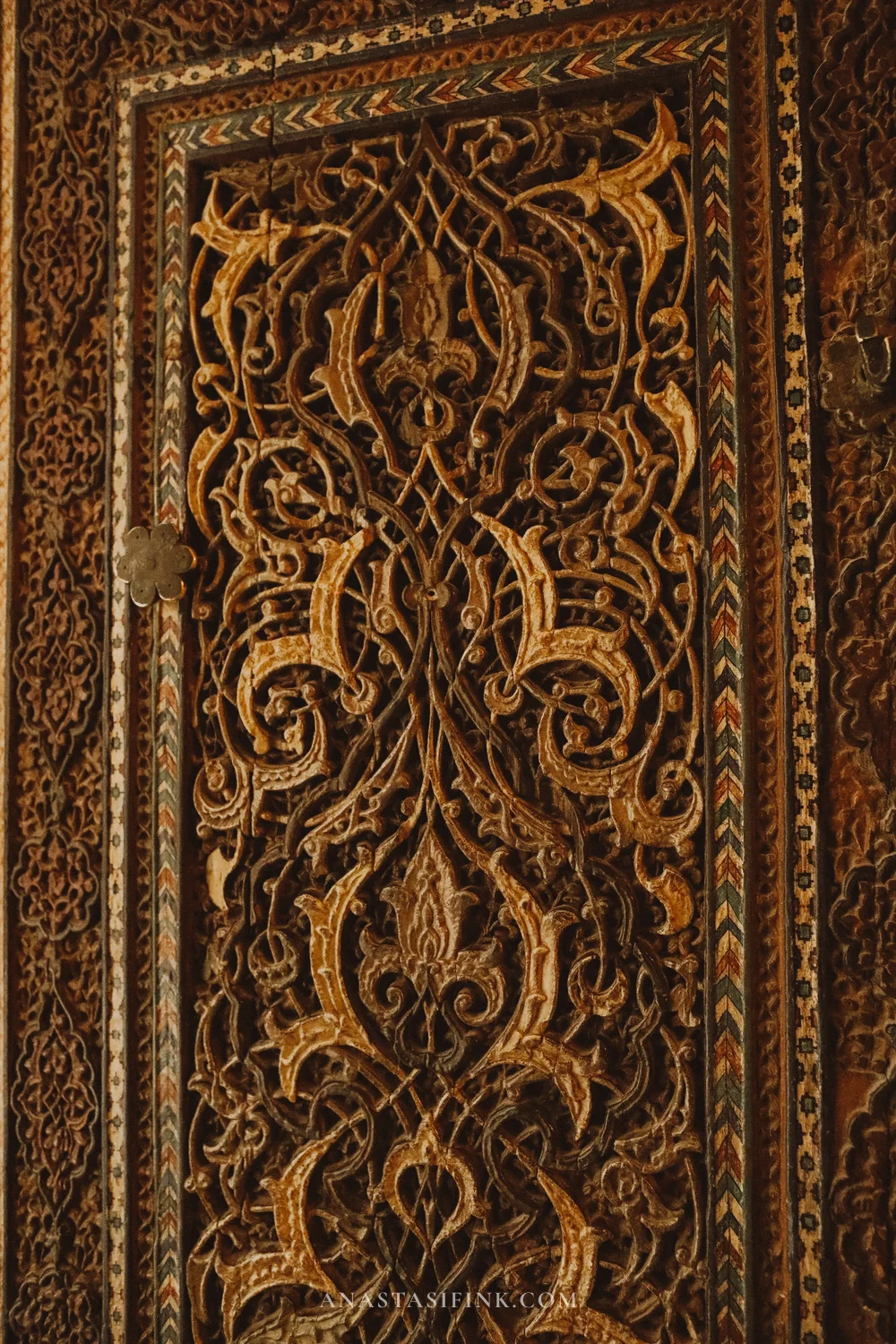
Carved wood, all by hand
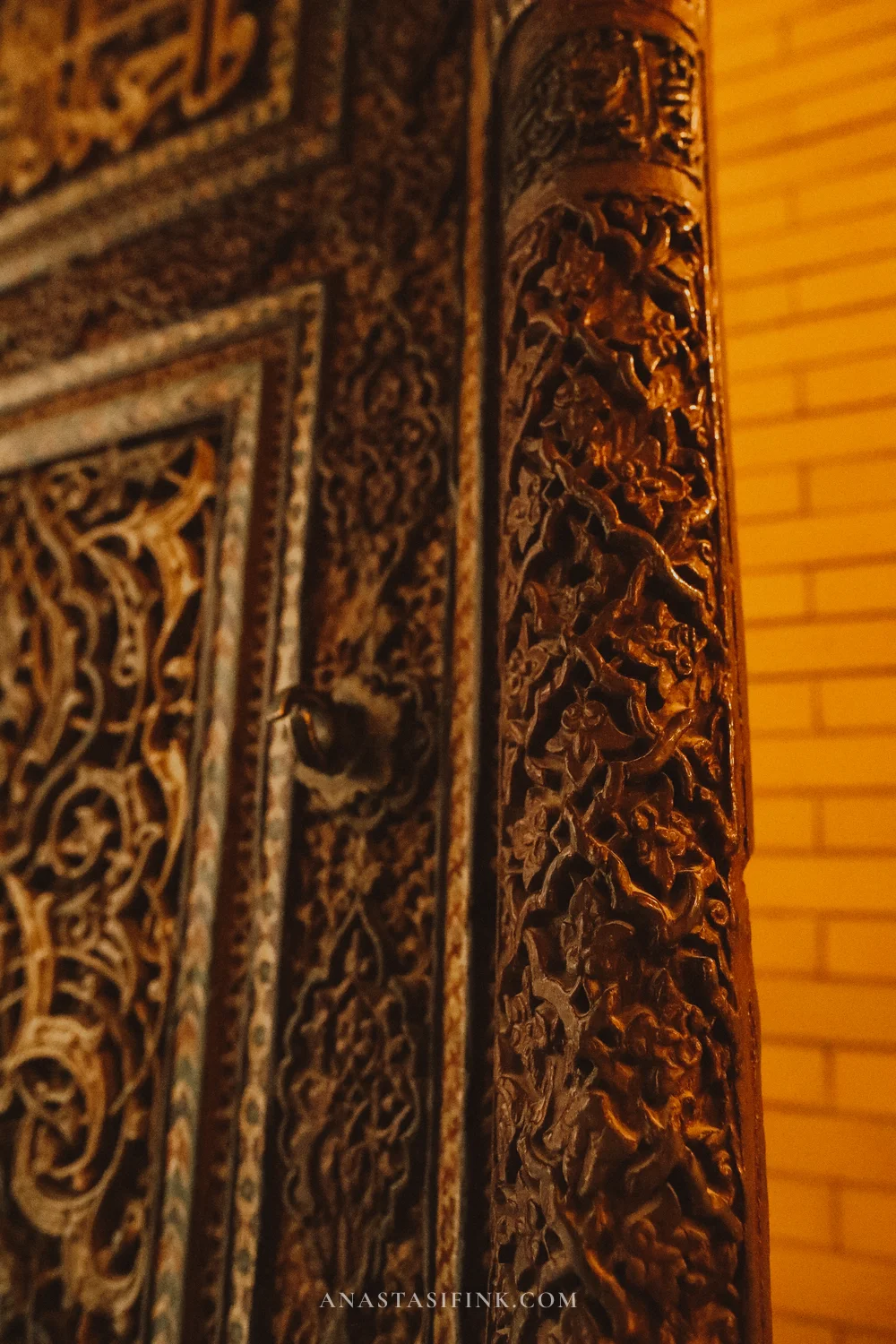
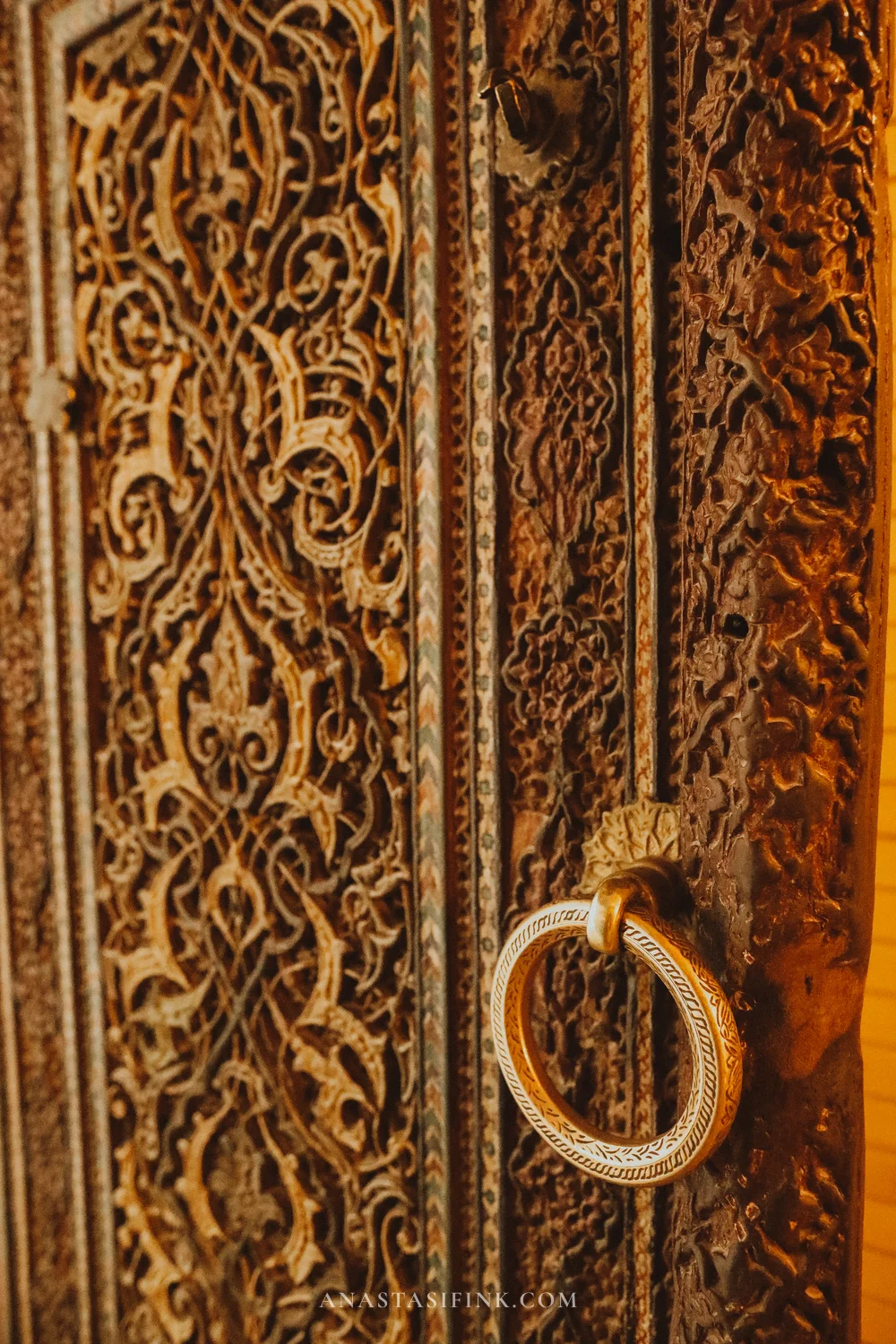
An old ring-handle
Inside the mausoleums and the Kusam ibn Abbas complex
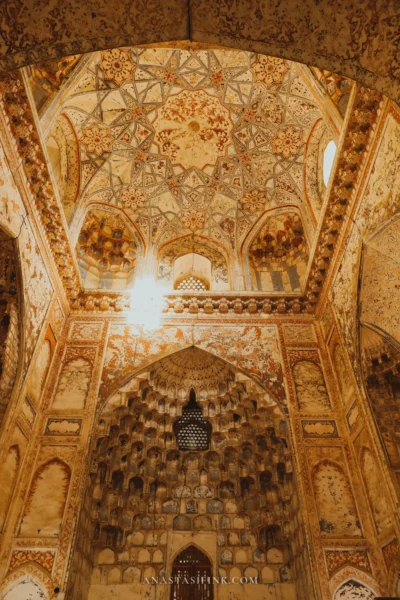
You can step inside some of the buildings. From outside you brace for more of that same tile, and inside — gold. The domes are painted in a fine gilded pattern, and in the half-light they seem to glow. The technique of painting over relief with gold is called kundal.
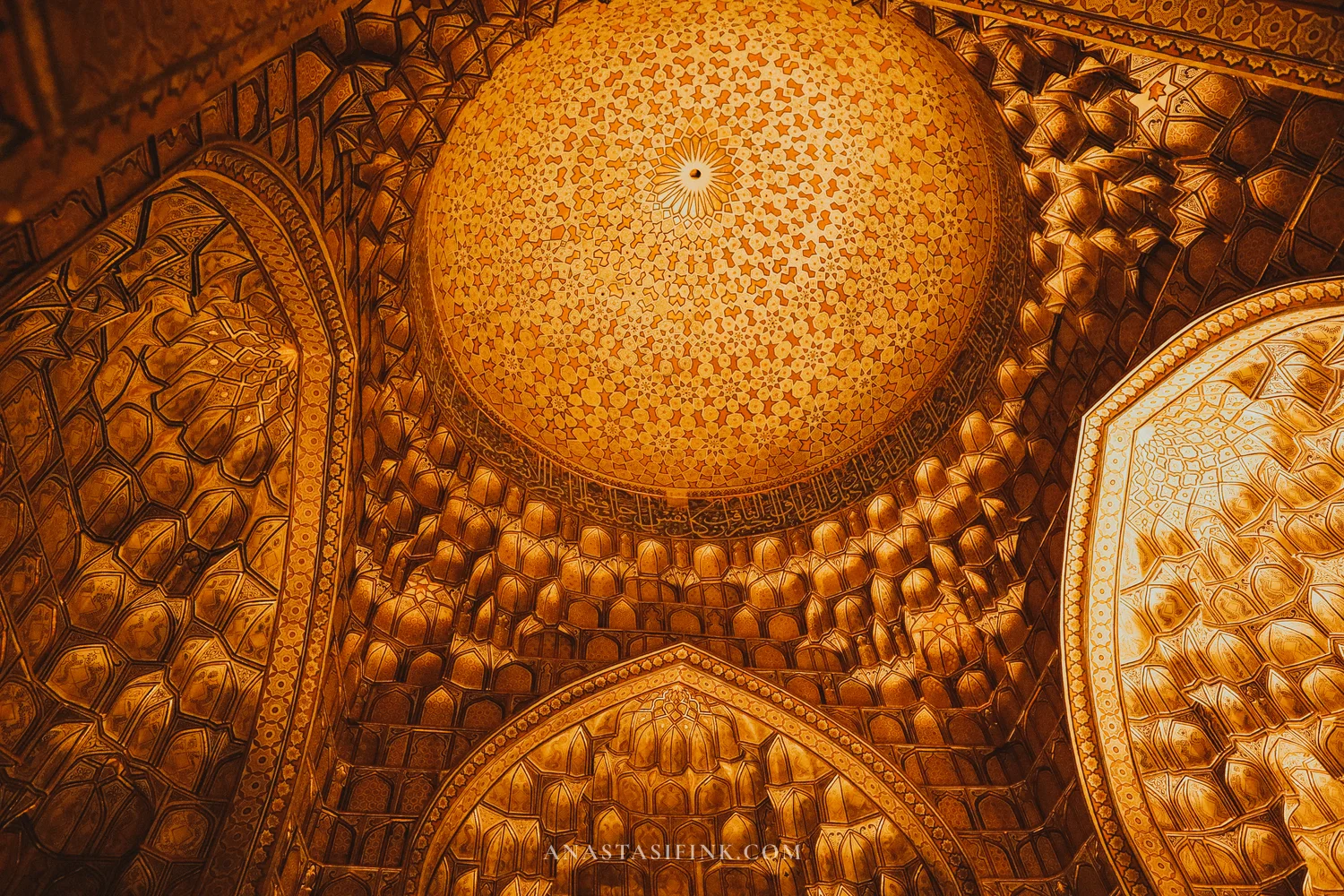
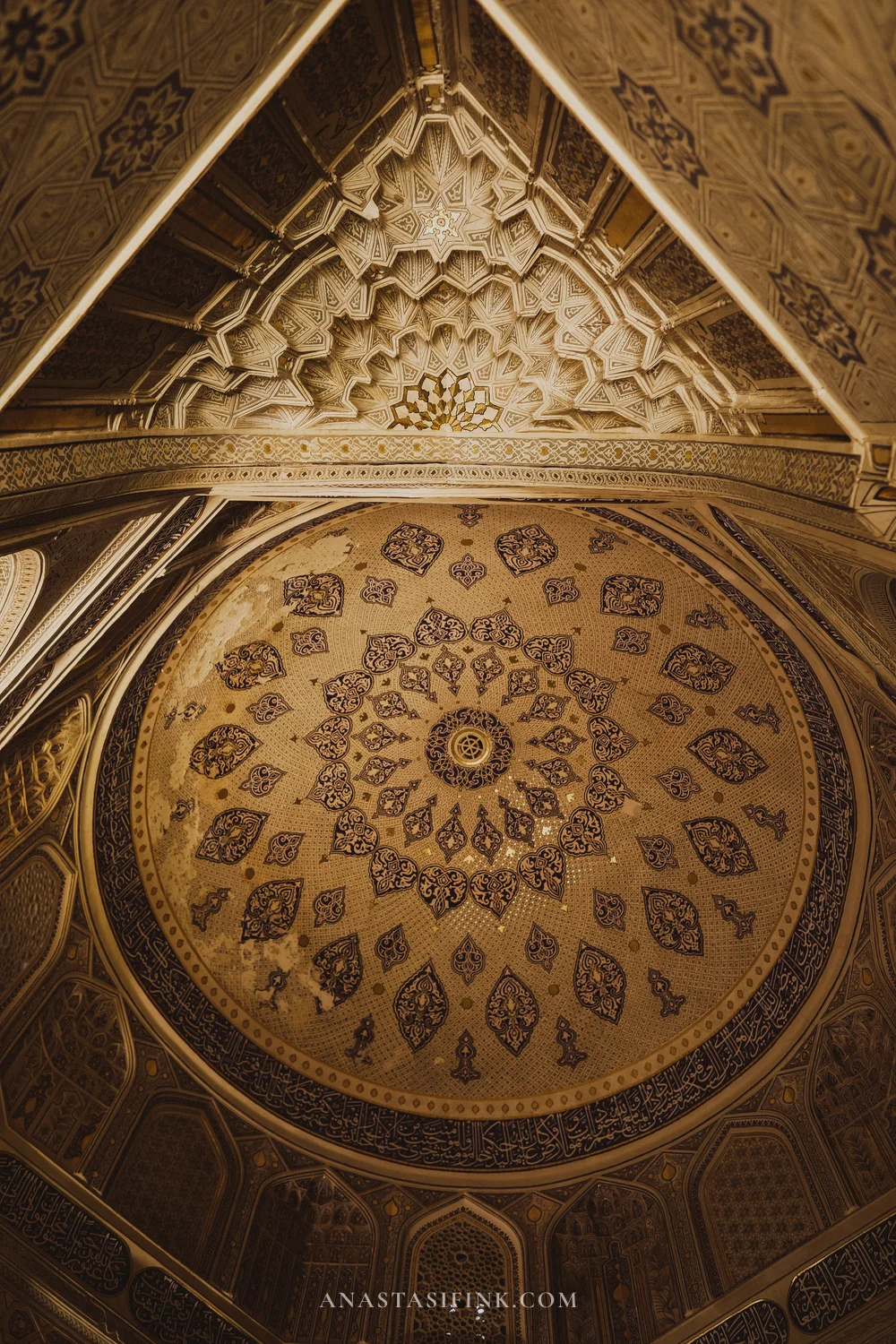
The domes are painted in gold
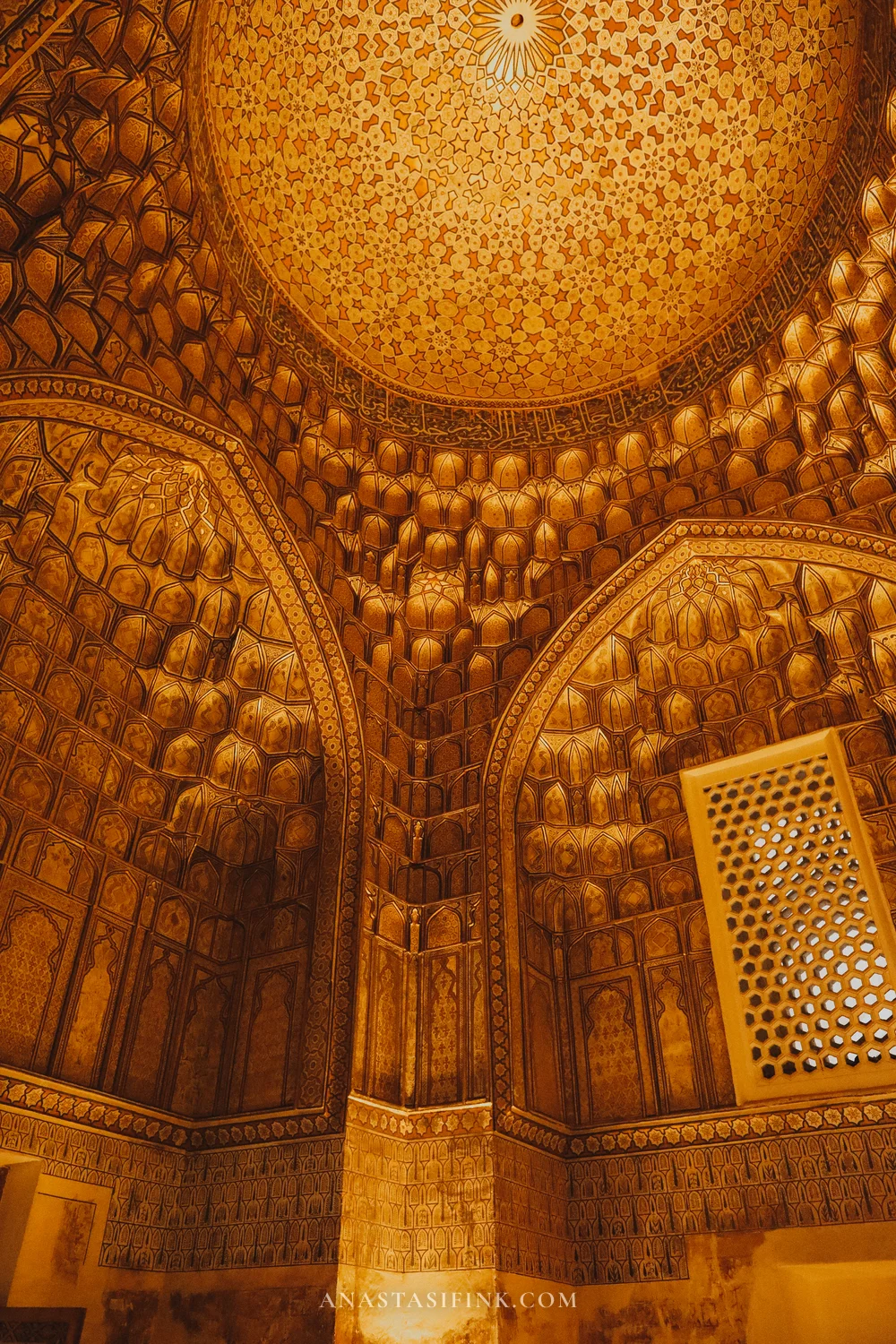
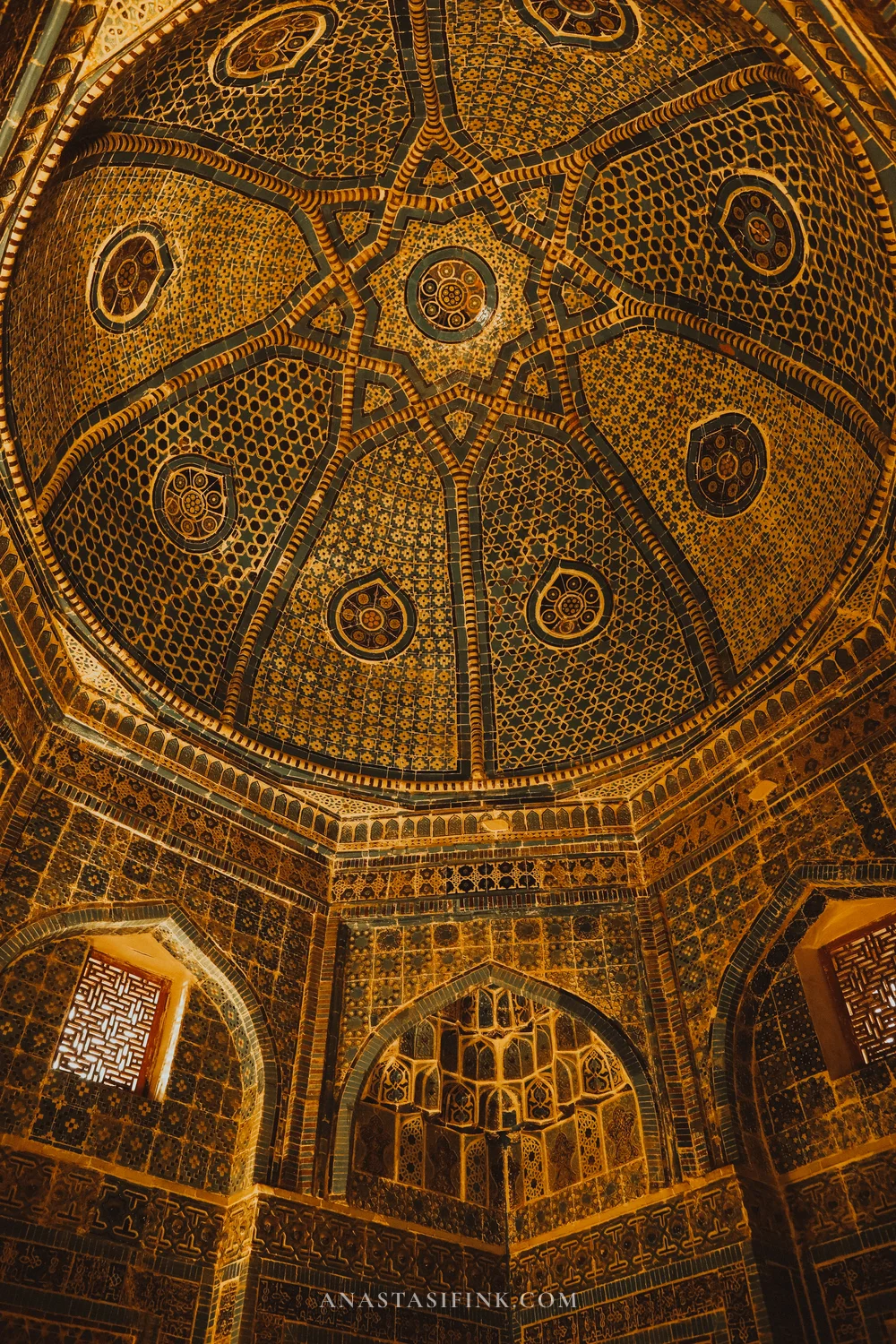
The same muqarnas, only in gold
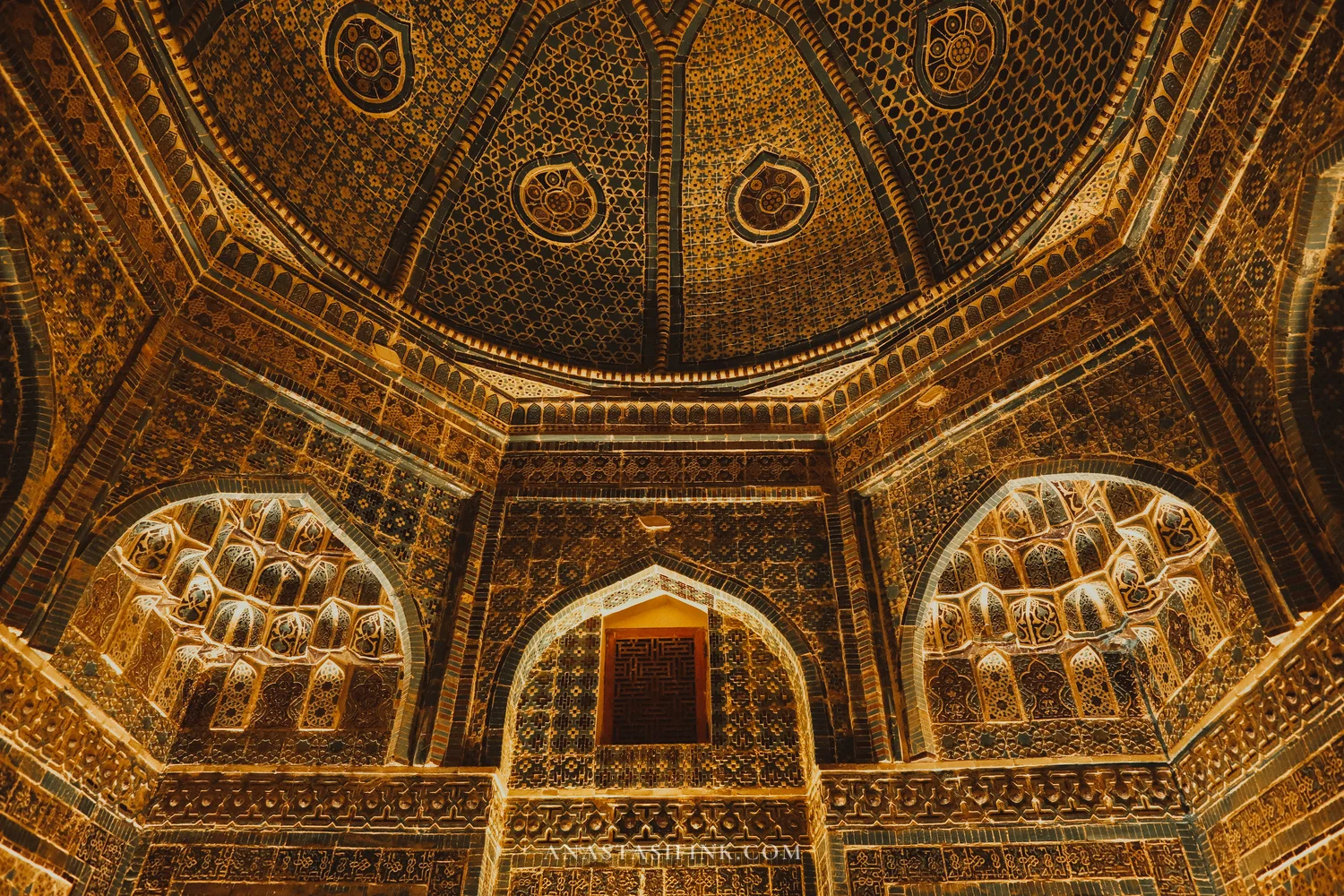
The north-eastern part of the complex is the oldest and the most revered. This is the mashhad of Kusam ibn Abbas — a memorial complex of several connected rooms, among them the prayer hall, the ziyarat-khana. Pilgrims have come here for centuries, and this is where, according to legend, the “living king” lives. Inside it’s quiet, someone is praying — and with a camera in your hands you feel a little out of place.
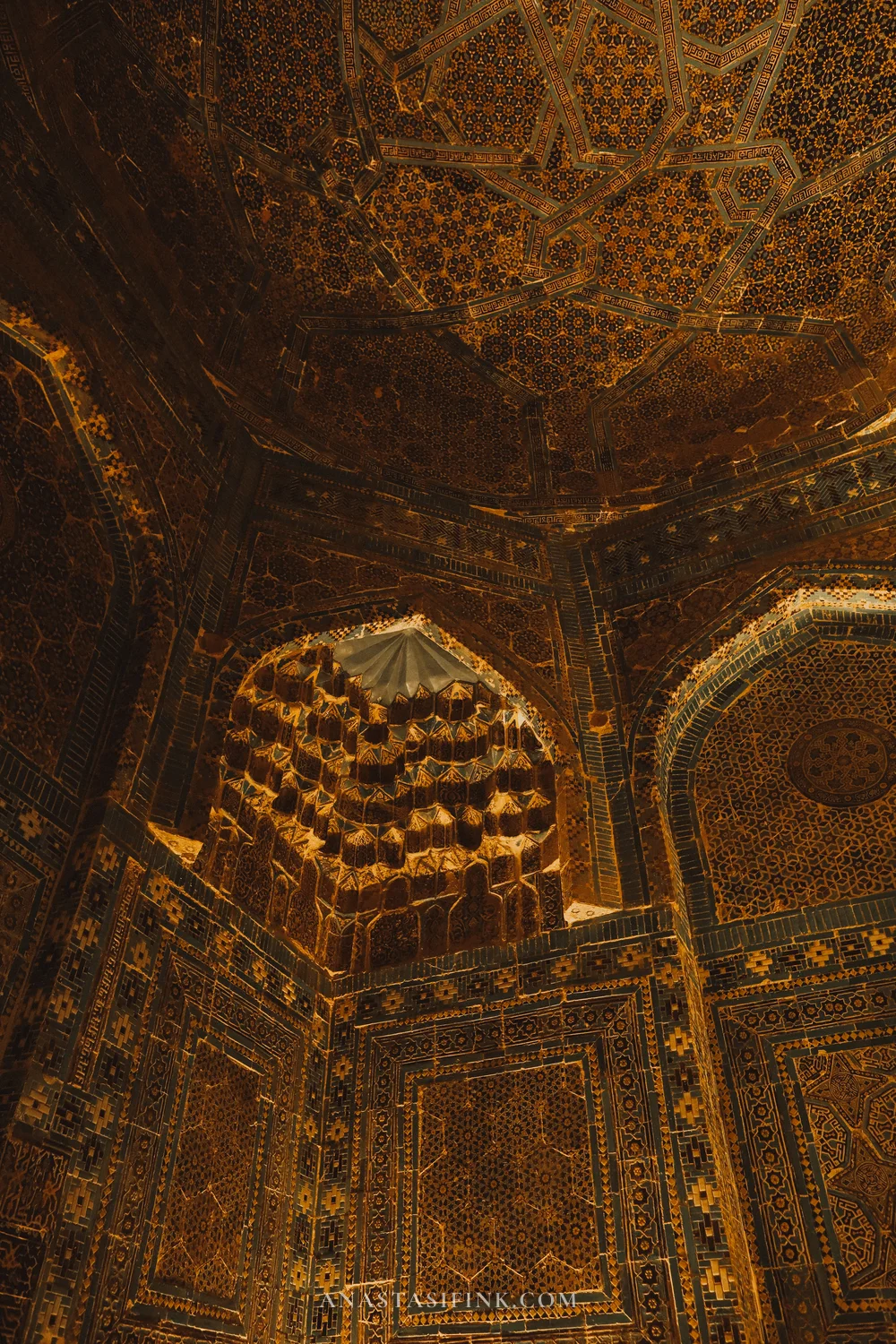
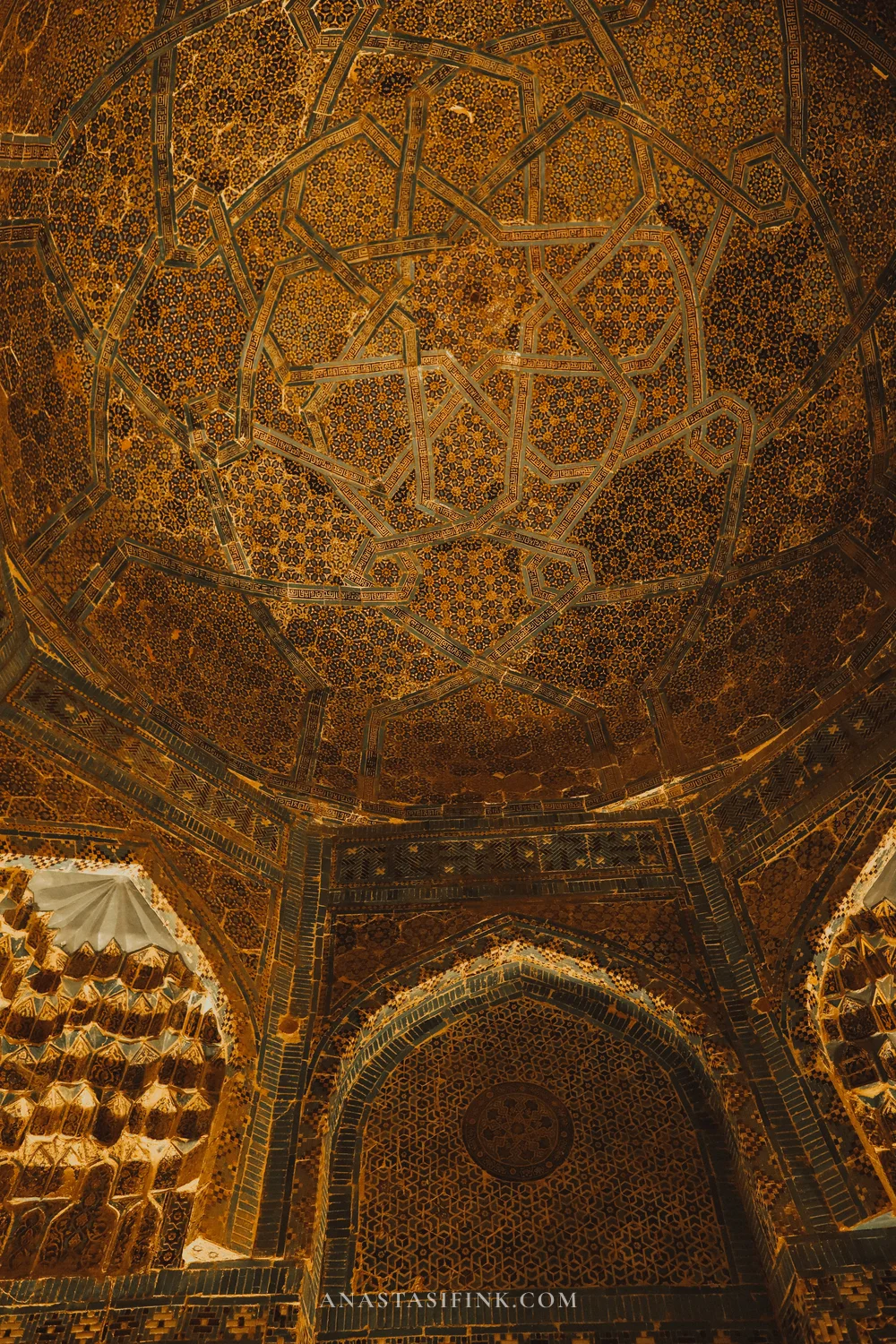
The only light comes through the lattice over the windows
There’s a tiled cenotaph here, with verses of the Quran picked out in gold. It isn’t the grave itself: the burial lies below, under the floor, and the cenotaph was placed on top as a marker.
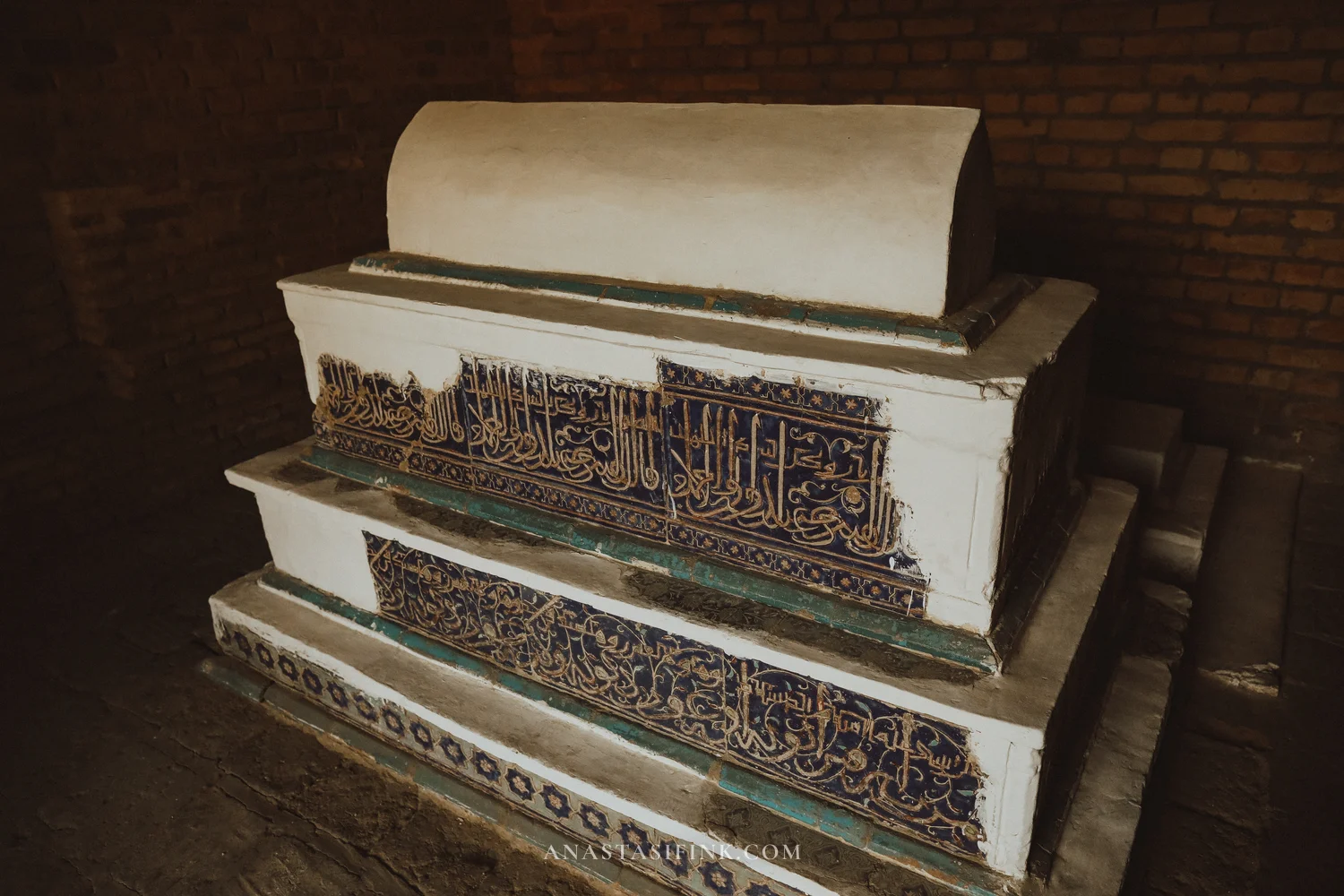
The largest building you actually walk into is Kusam’s ziyarat-khana, the pilgrims’ hall. It’s the oldest part of the necropolis: the first structures on this spot go back to the 11th century, and the hall took its present form under Tamerlane, in the 14th–15th centuries. The lower walls are laid with blue hexagonal 15th-century tiles, above them rises a painted dome, and a chandelier hangs in the middle — a later addition. Set into the wall is the mihrab, the niche that points the way to Mecca.
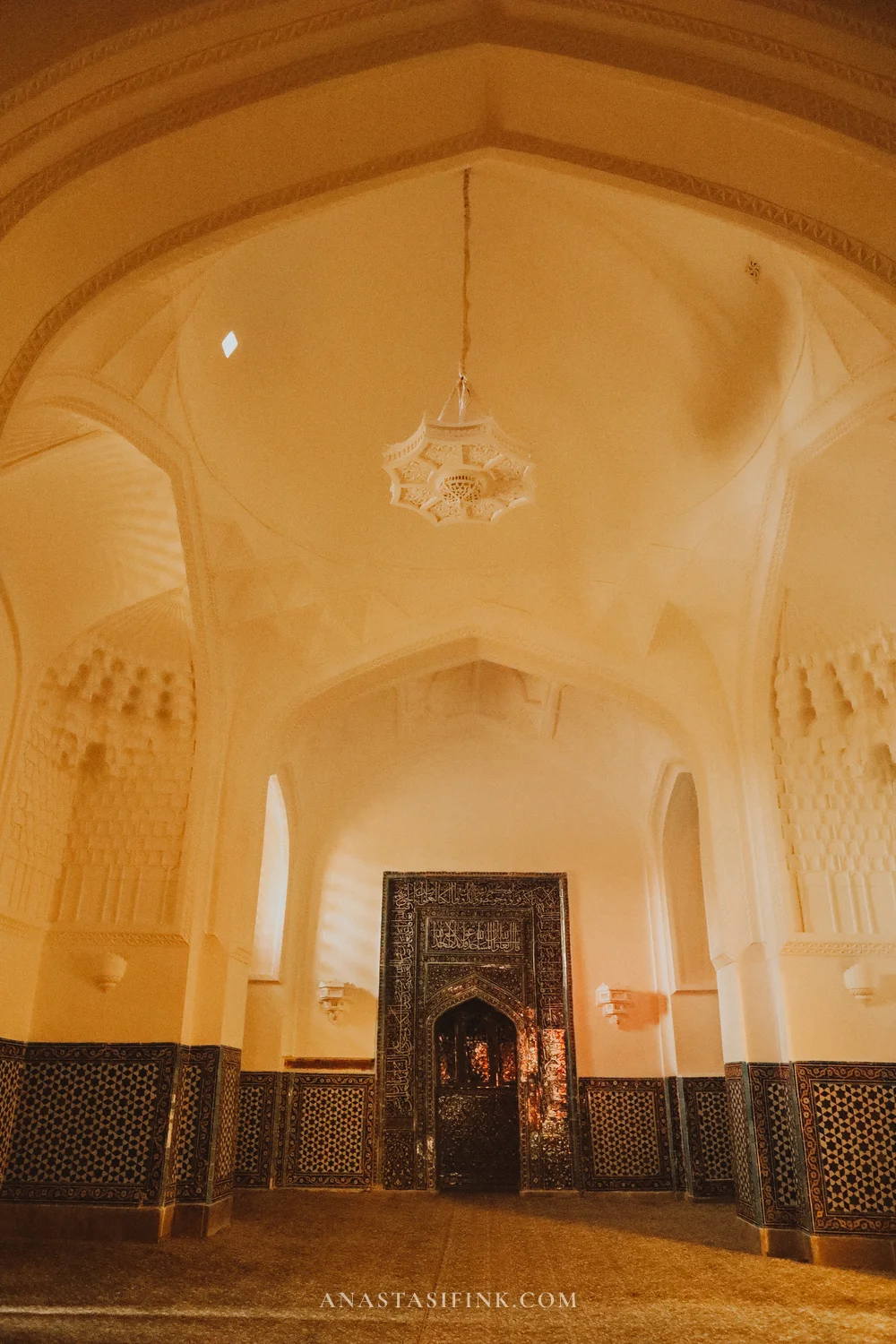
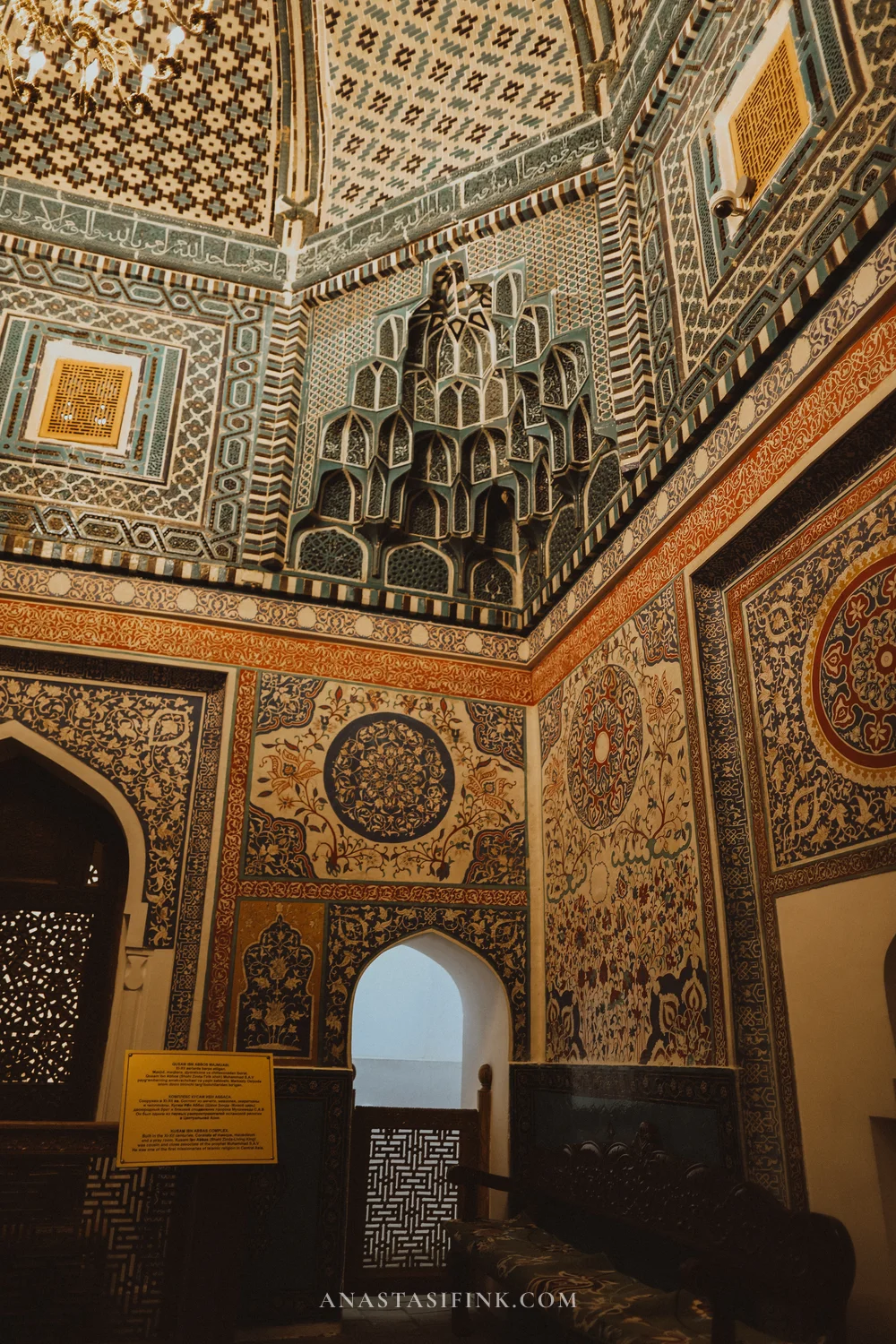
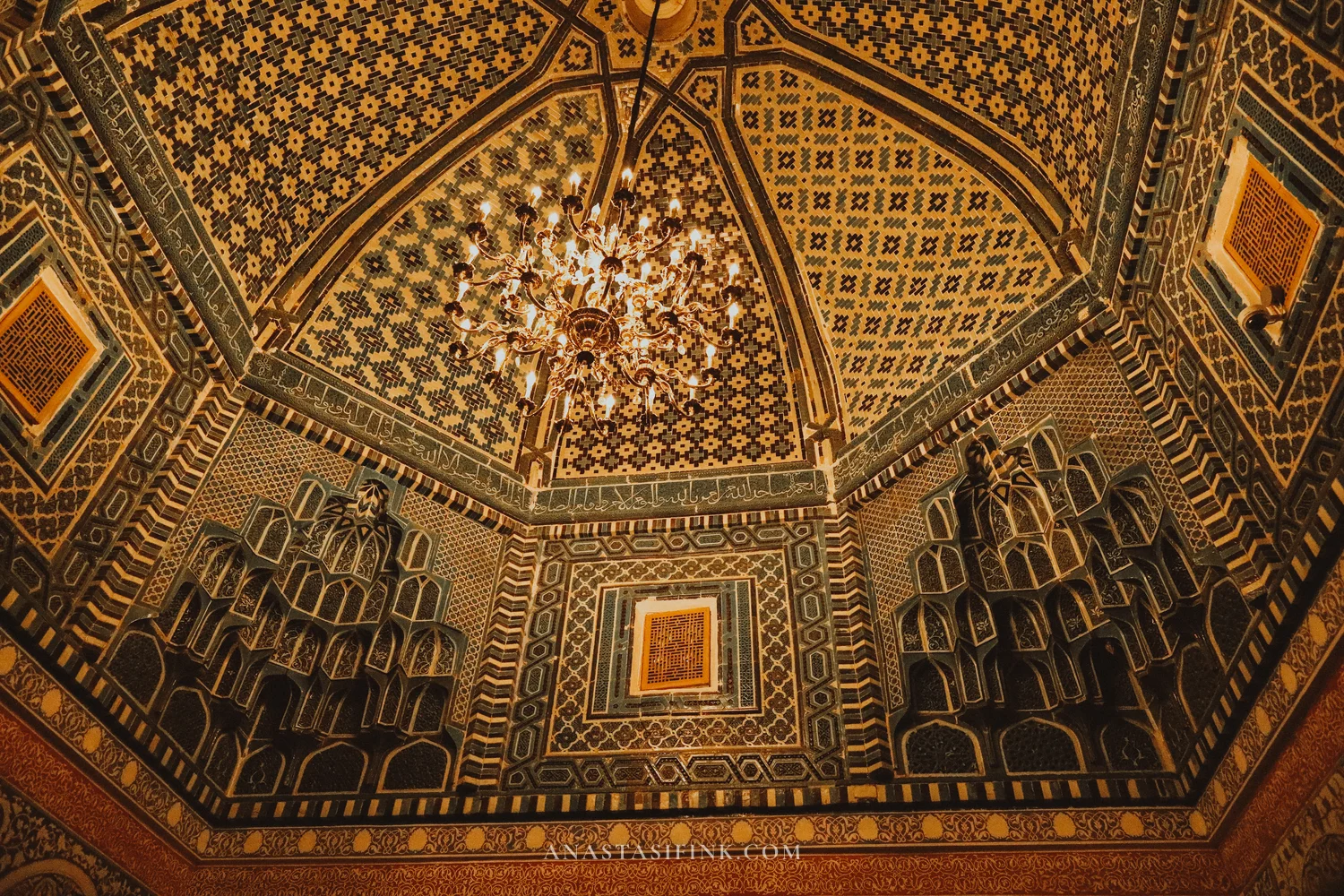
The ziyarat-khana — the hall pilgrims enter
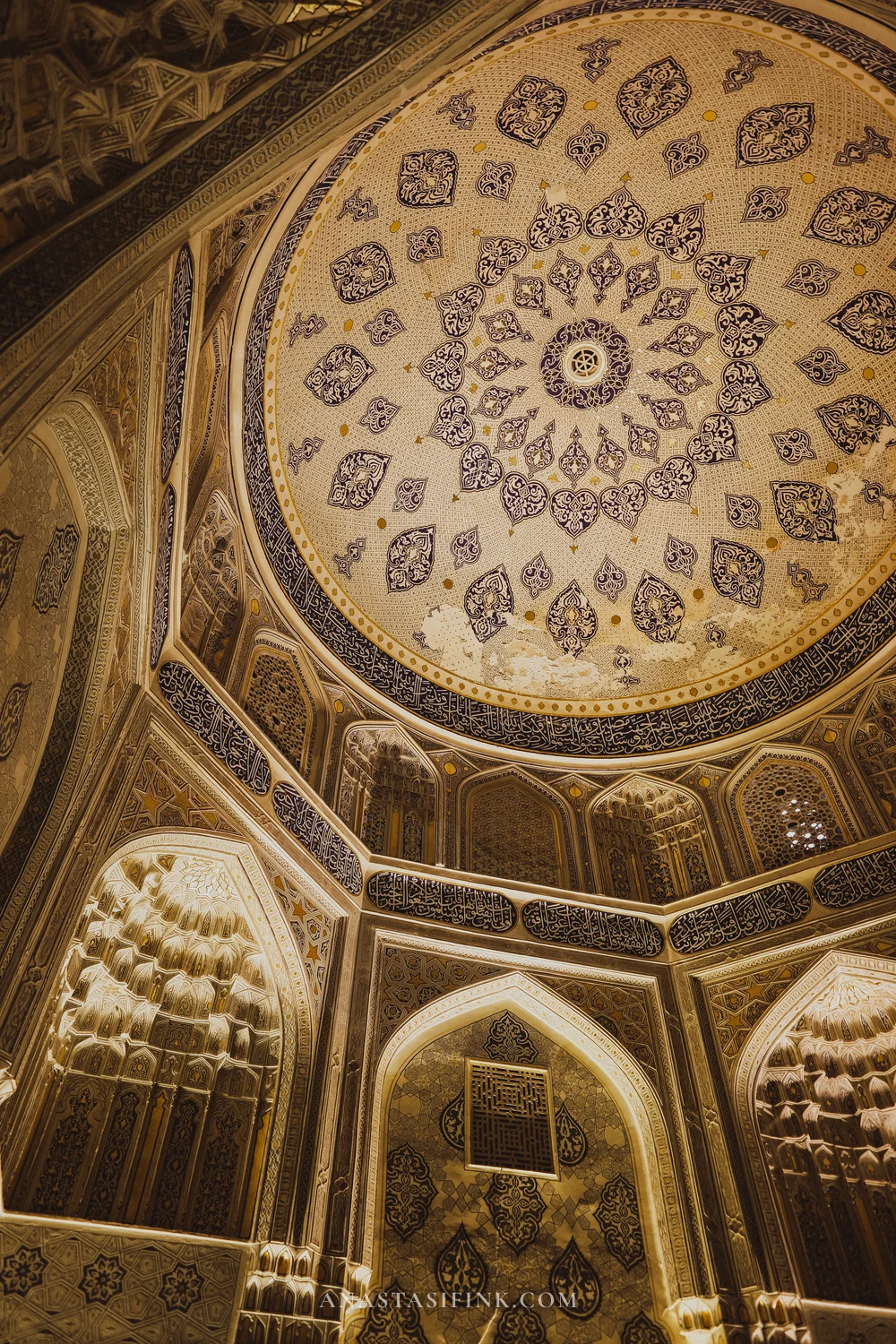
Shah-i-Zinda at sunset and after dark
By day it’s crowded and hot: there’s almost no shade in the lane, and a steady stream of tourists keeps flowing past. But hang around until sunset and the crowds thin, the light turns warm, and the brick walls take on a golden glow. It’s easily the best time to wander through.
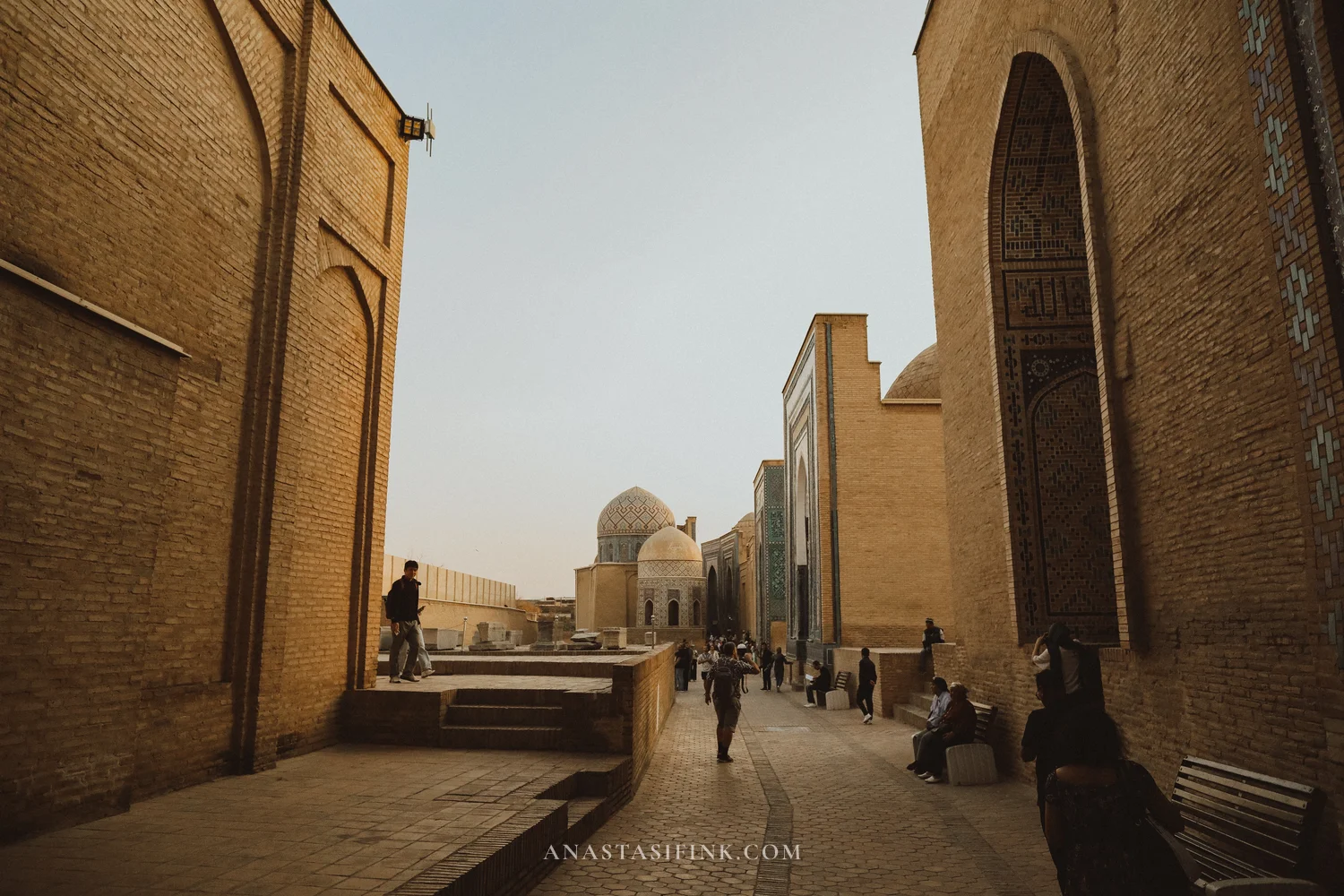
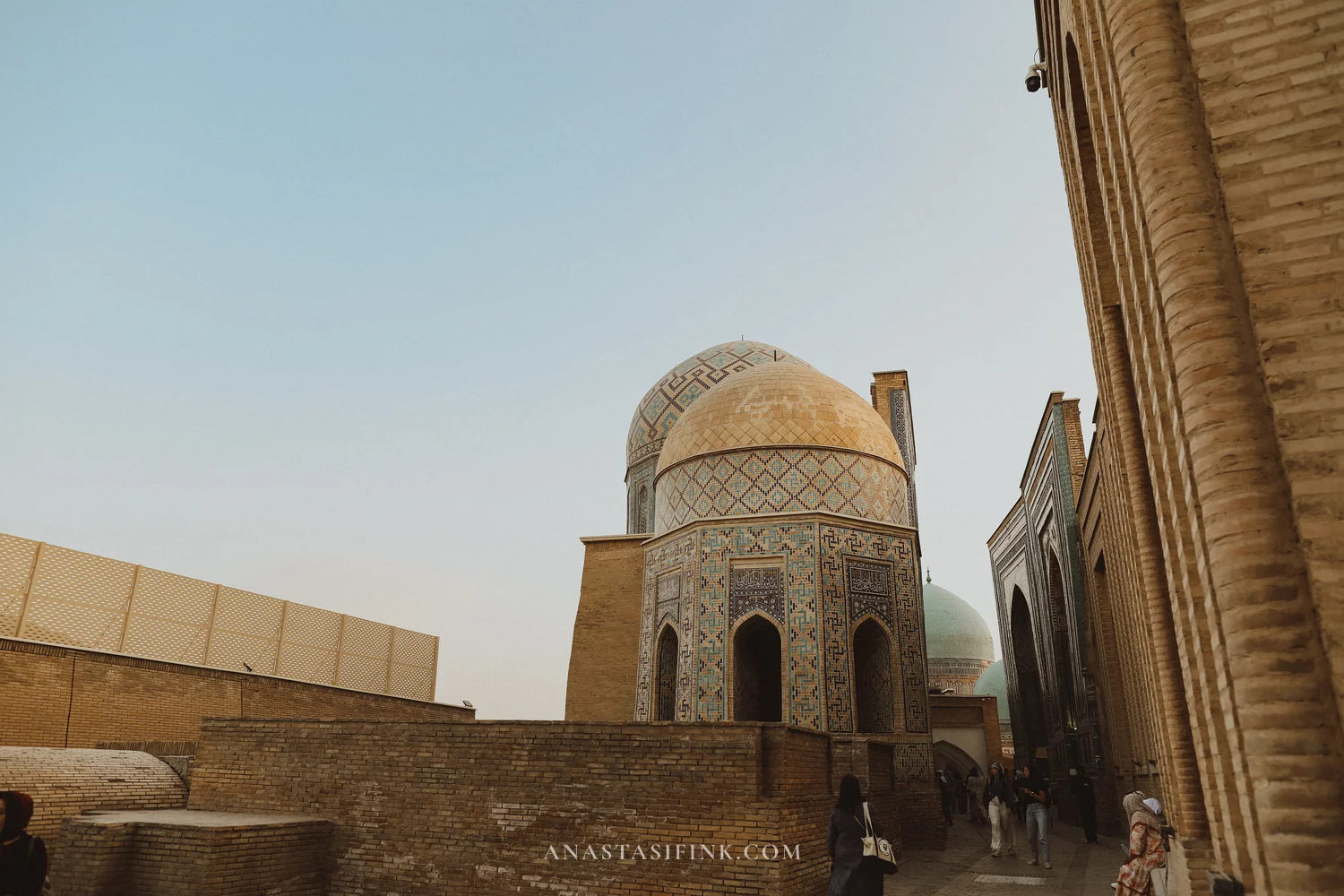
By sunset there are fewer people
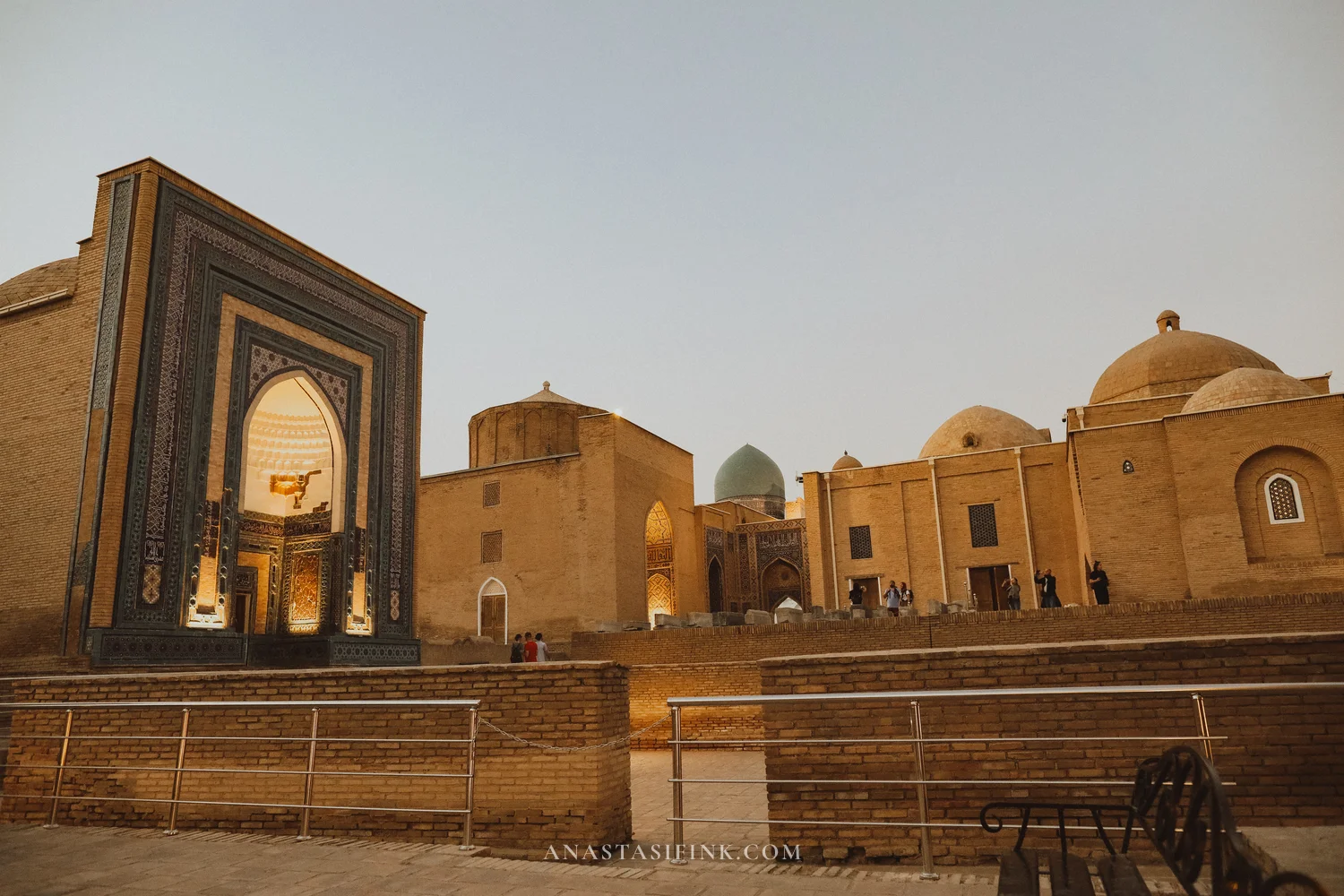
Once it’s fully dark, the floodlights come on and the lane transforms: the portals glow from below, the blue tile recedes into shadow, and warm light spills out of the mausoleum doorways. A lot of people come specifically for the lighting.
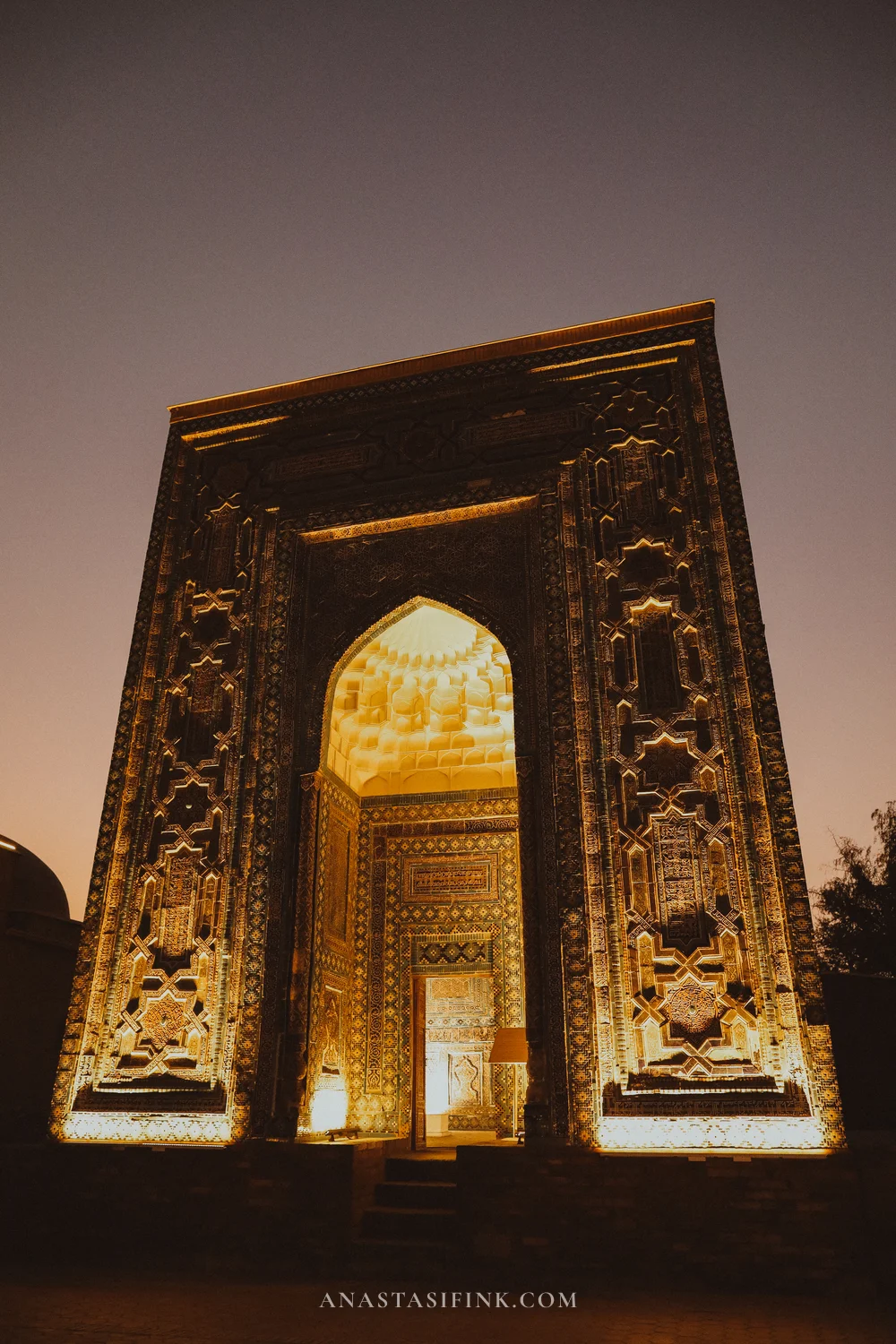
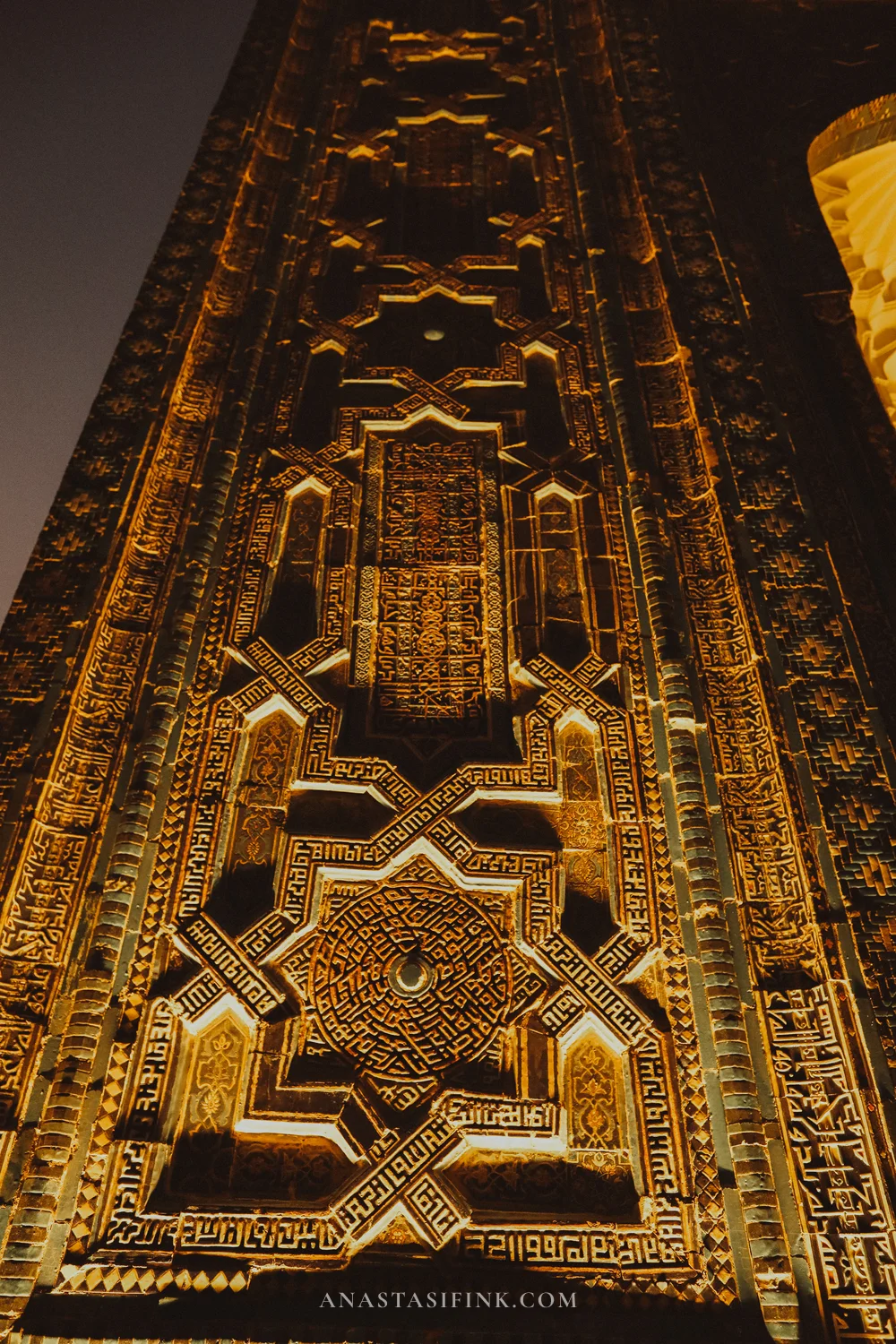
Facades under the evening floodlights
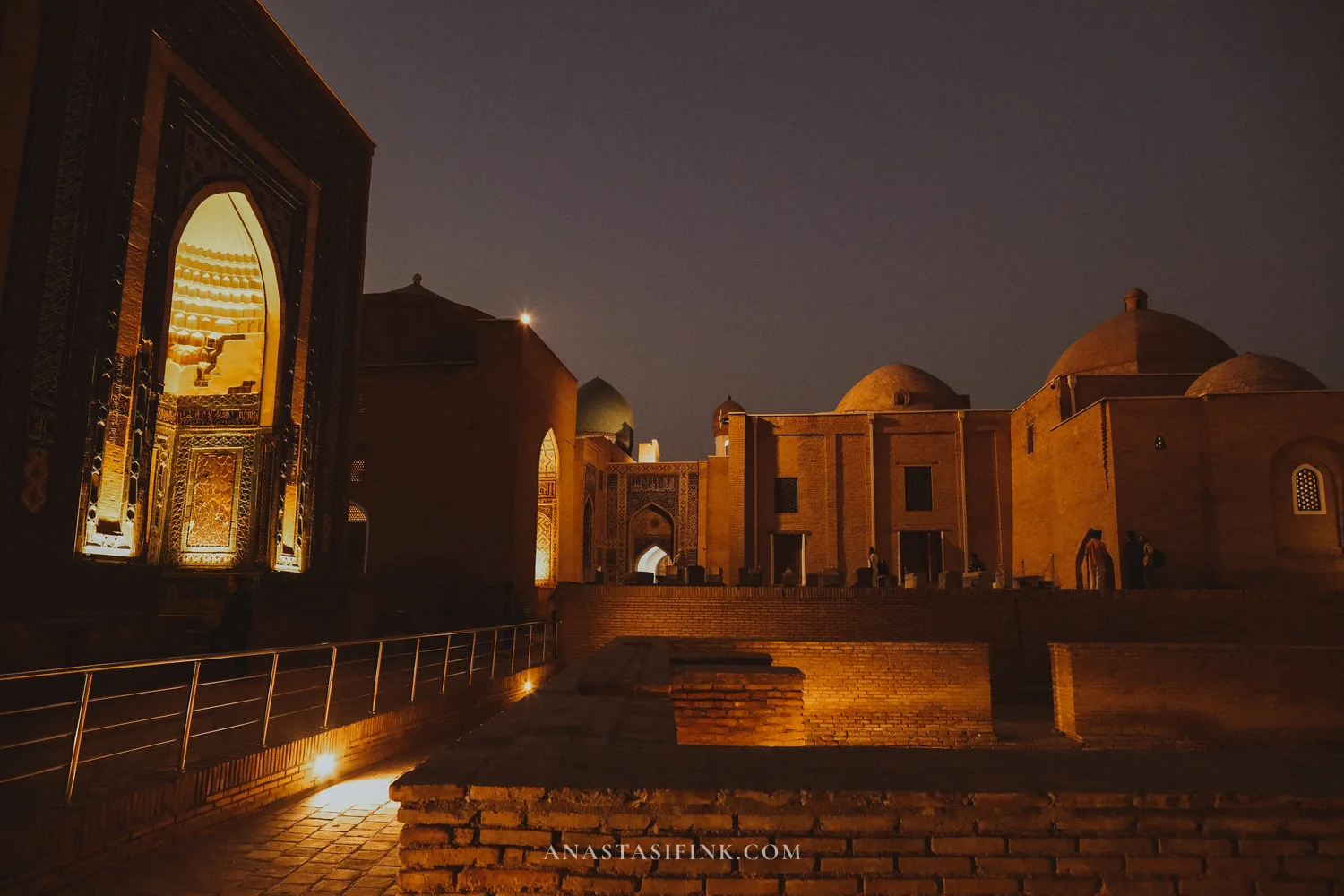
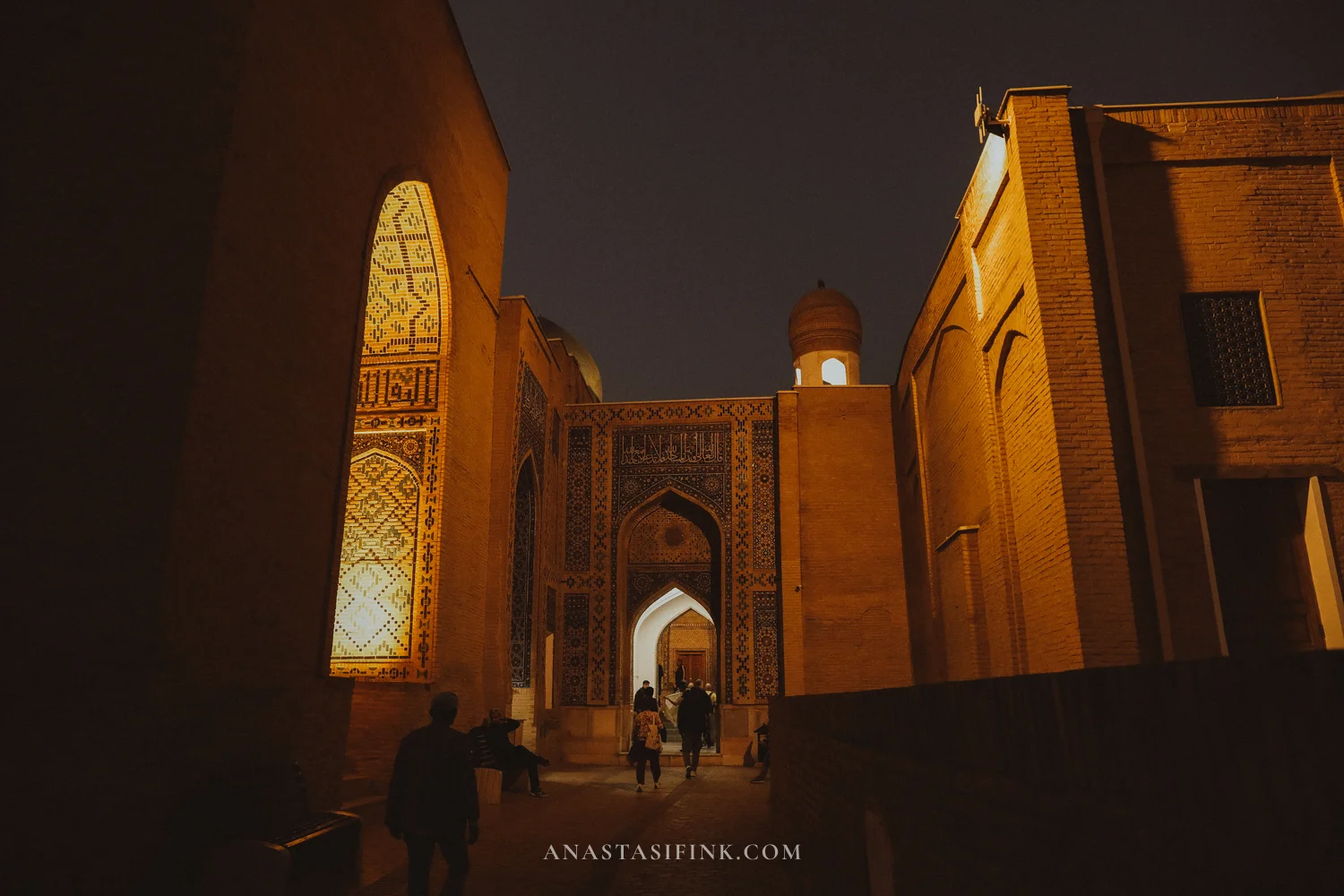
The sky’s still blue, but the lights are already on
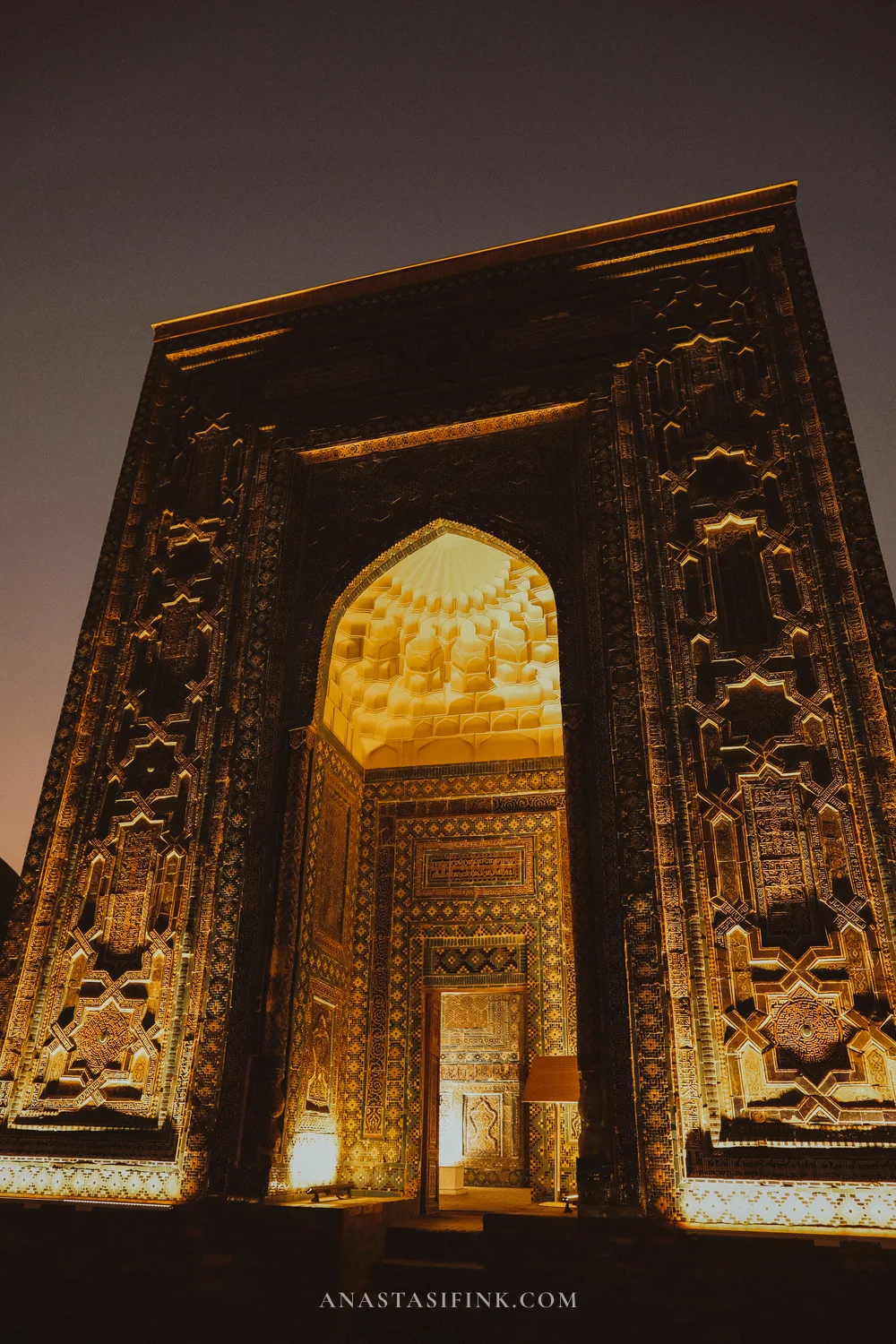
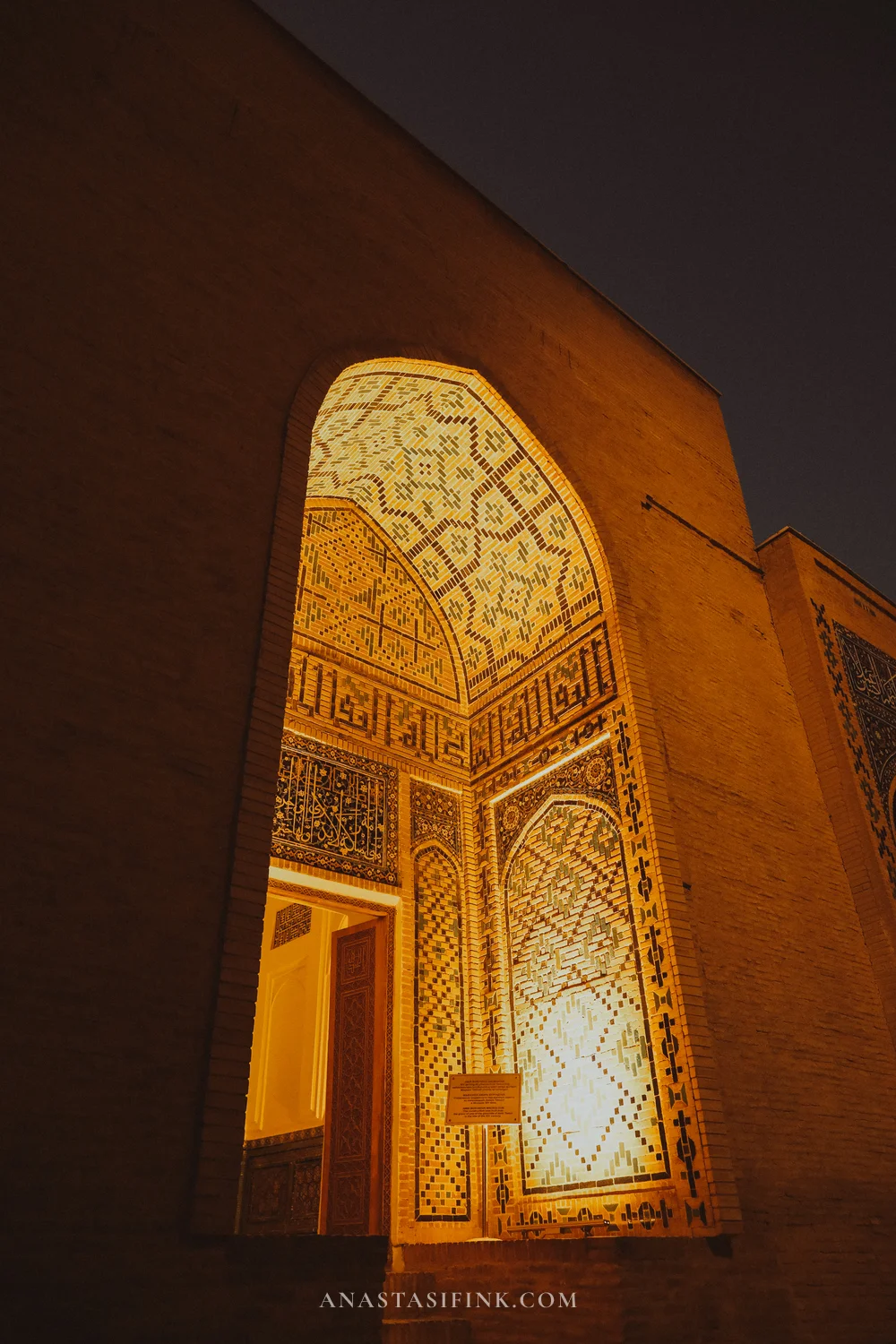
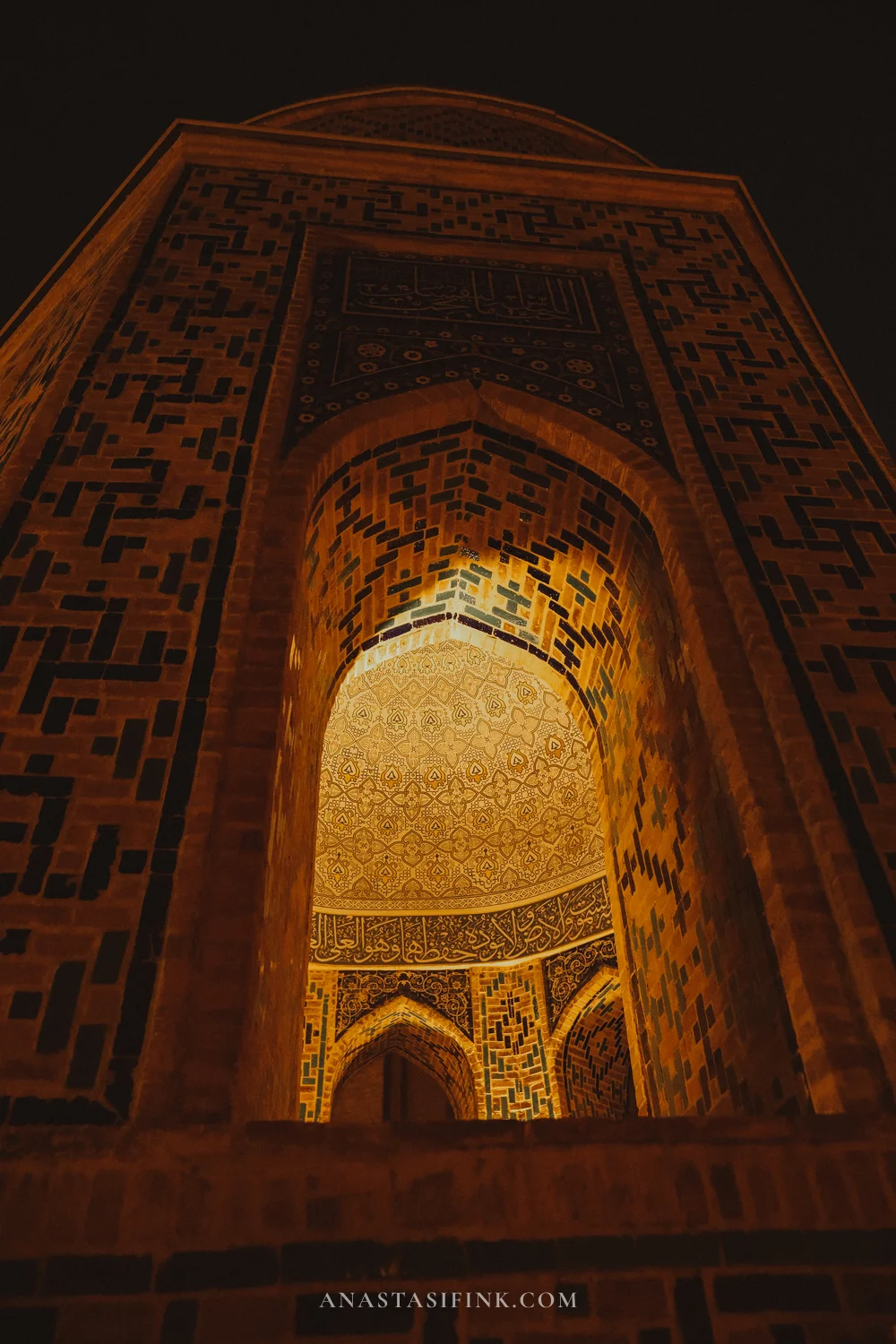
The light hits from below
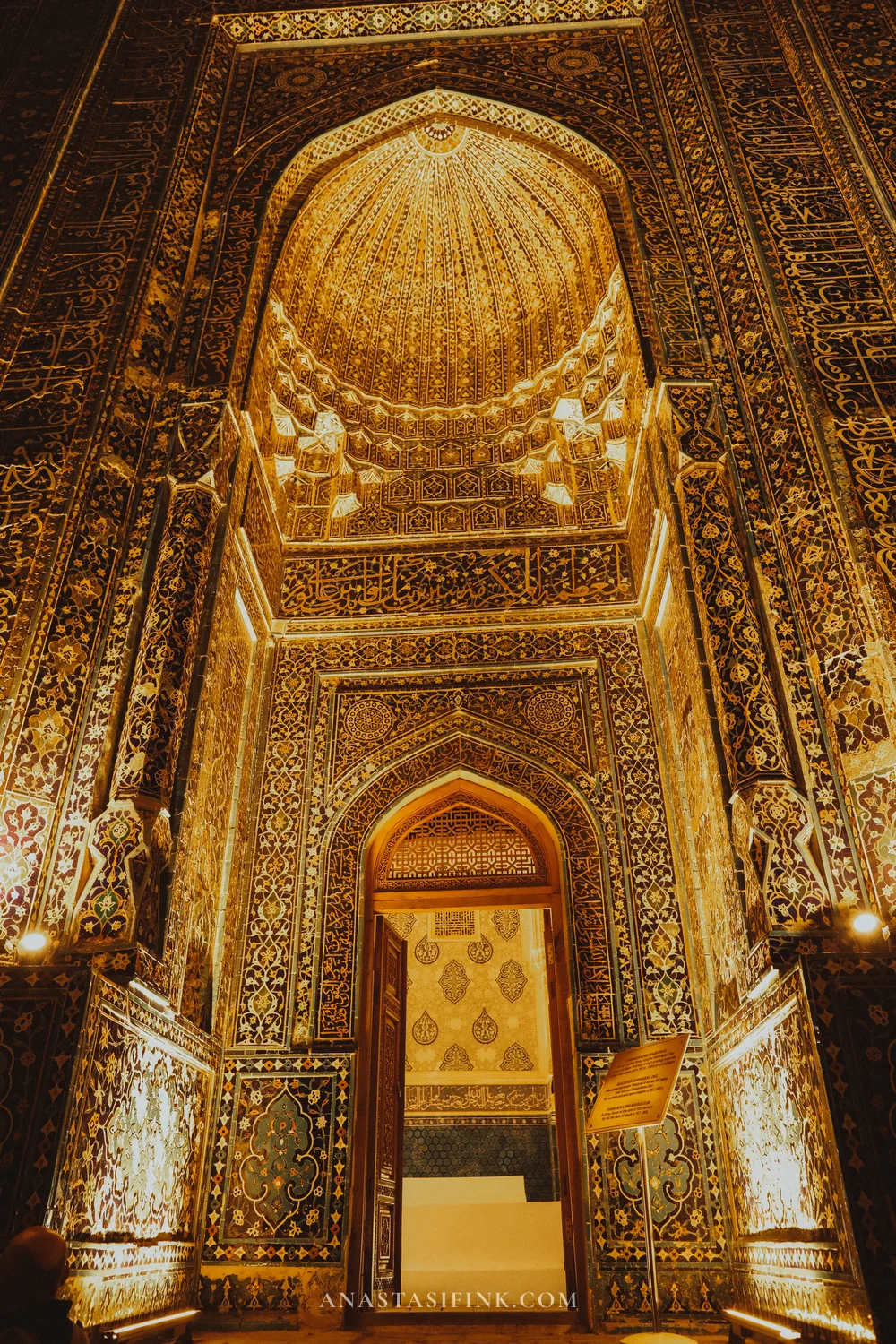
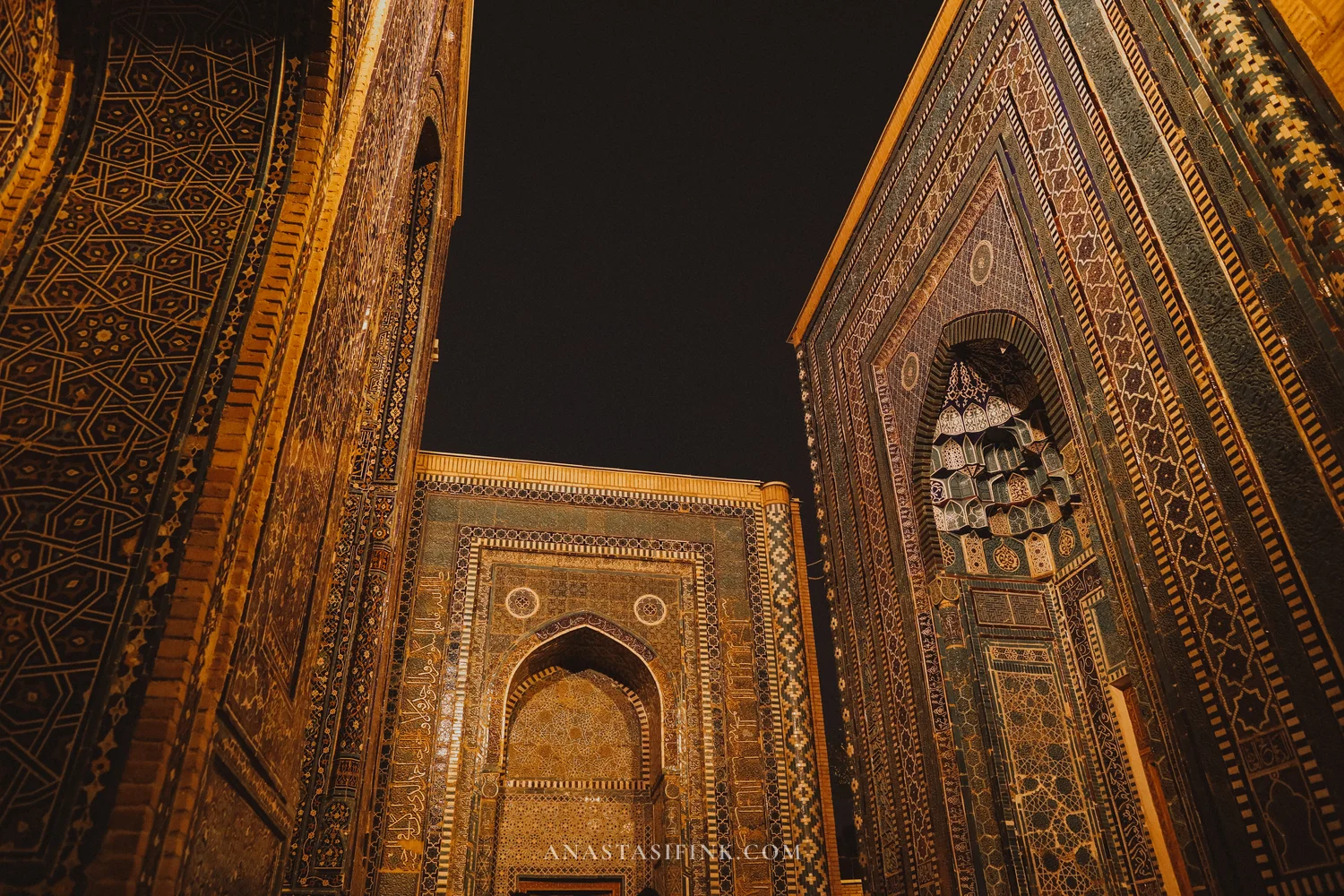
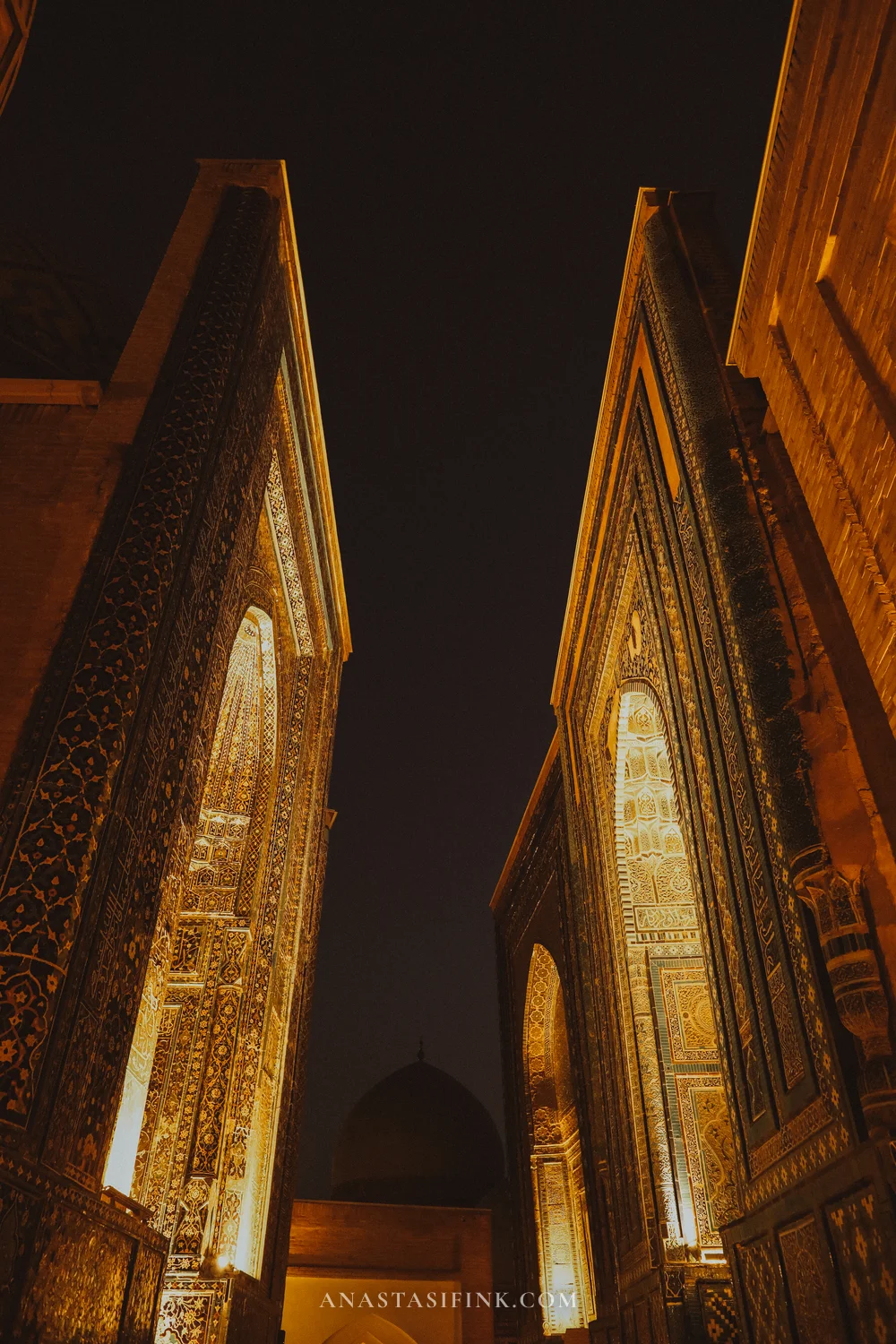
Deeper in, the dome of the next mausoleum
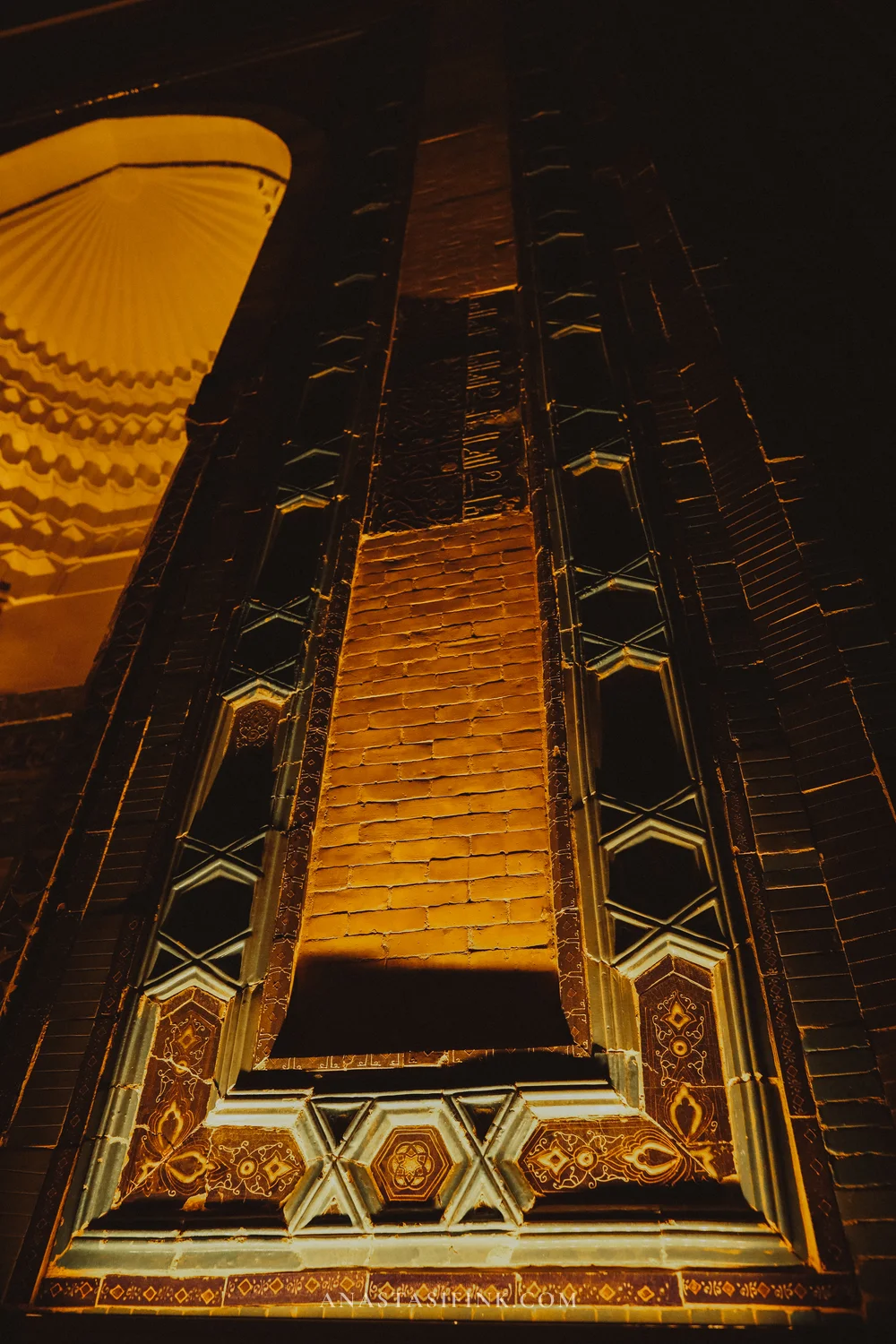
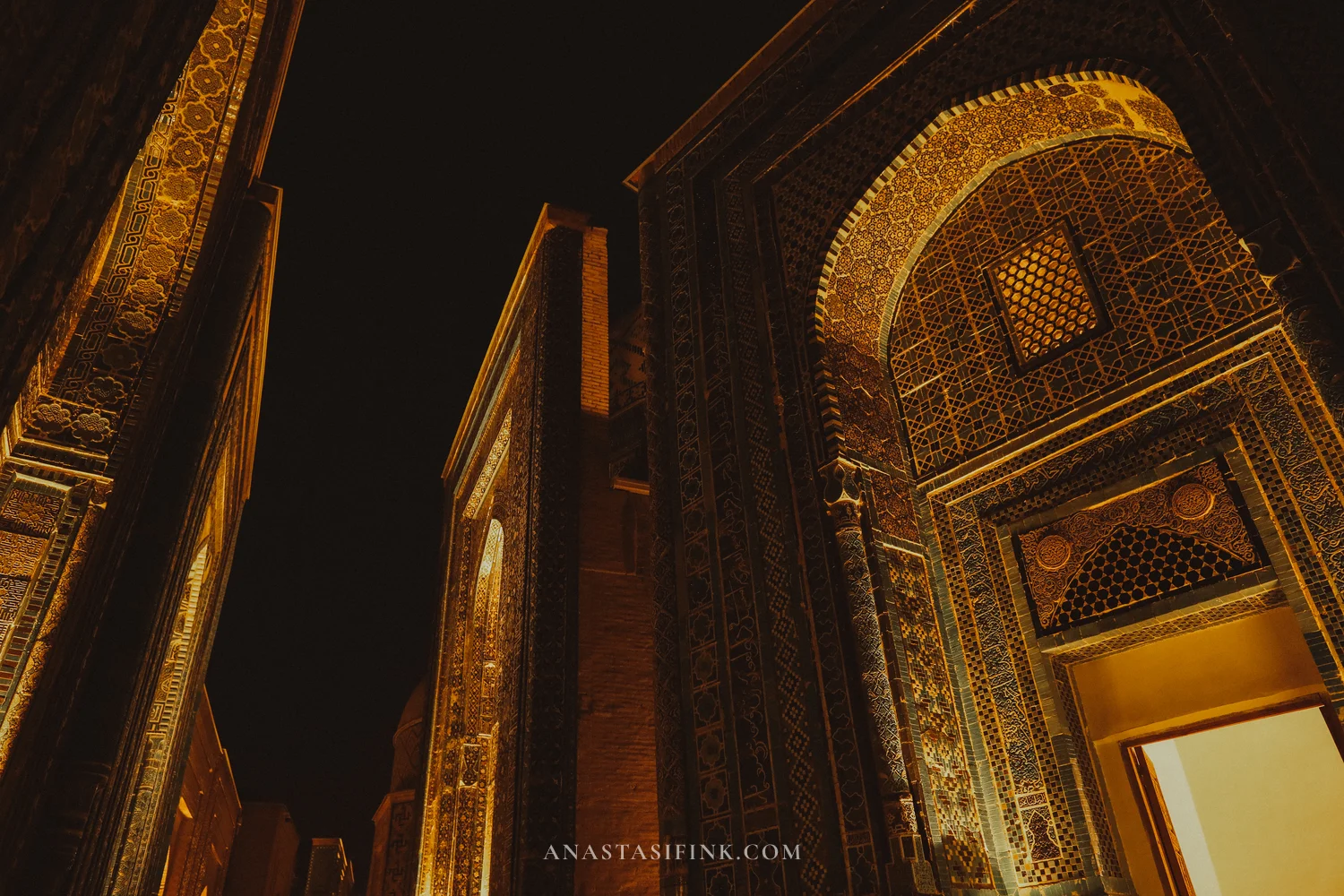
Under the floodlights the relief reads better than it does by day
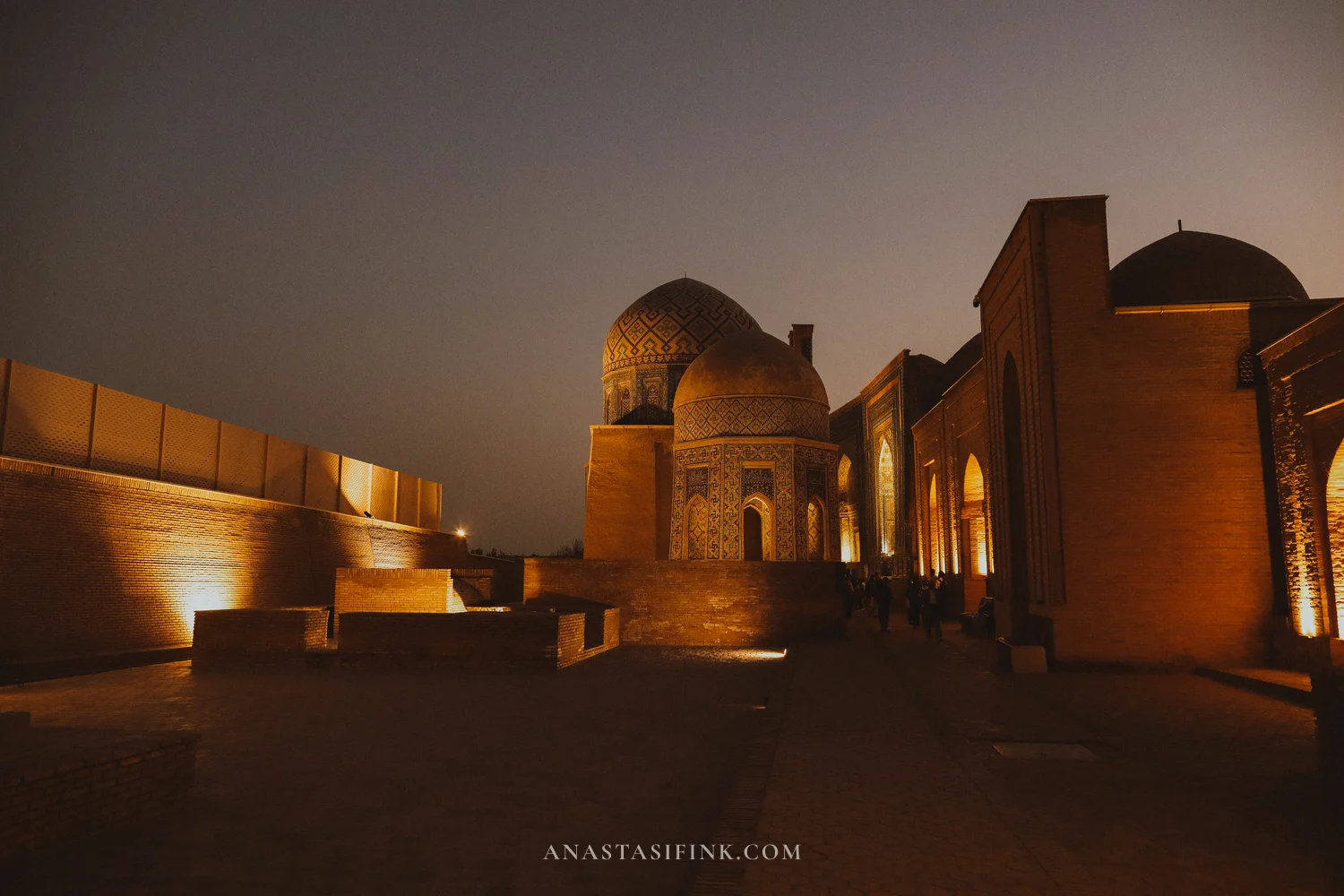
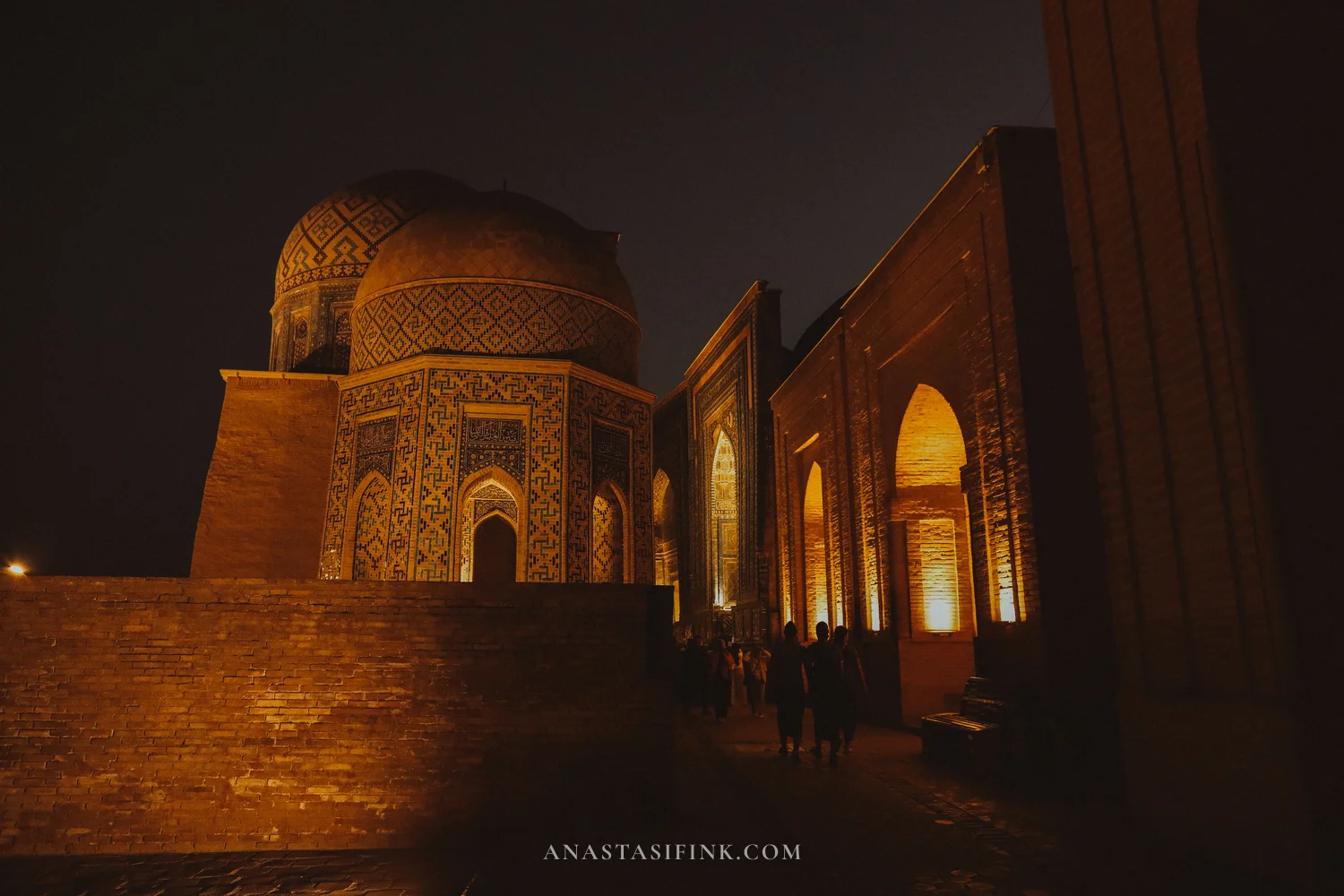
People come in the evening too — for the lighting
Practical information
- Address: Shohizinda ko’chasi (Shohizinda Street), Samarkand
- GPS: 39.6625, 66.9884
- Hours: 08:00–19:00 (April–October), 09:00–17:00 (November–March)
- Admission: around 50,000 som (~$4 / ~€3.70) for adults
- Time to allow: 1–1.5 hours during the day; to catch both sunset and the floodlights, arrive an hour to ninety minutes before sunset
- Nearby: Siab Bazaar and the Bibi-Khanym Mosque, a 10–15 minute walk away
- Visa: many nationalities (EU, UK, US, Japan and others) can visit Uzbekistan visa-free for 30 days — do check the rules for your own passport before you travel
How to get there
Shah-i-Zinda sits in the north-east of Samarkand, on the edge of the ancient Afrasiab settlement. Getting to it is easy:
- On foot from Siab Bazaar: 10–15 minutes. It’s worth combining — do the bazaar and the Bibi-Khanym Mosque first, then Shah-i-Zinda.
- By taxi: around town via the Yandex Go app — usually 10,000–20,000 som (~$1–1.7) from the centre.
- By tram: Samarkand has a tram that runs not far from the complex; ask the driver for the right stop.
Getting to Samarkand in the first place: most travellers come via Tashkent, then take the high-speed Afrosiyob train, which covers the distance in about two hours. Samarkand also has its own international airport (SKD), with flights routed via Istanbul.
Som is the local currency (the Uzbek som). The rate is roughly 12,500 som to $1 (summer 2026). It’s easiest to pull cash from an ATM or change money at an exchange office — cards aren’t accepted everywhere.
Tips
- Come either at opening or at sunset. In the middle of the day the groups pile up at the entrance. Mornings and evenings are calmer.
- Leave time for the floodlights. If you stay until dark, you’ll see the complex in two completely different moods — it’s worth it.
- Dress modestly. This is a working place of pilgrimage. Cover your shoulders and knees; women will find a light scarf handy.
- Combine it with the neighbours. Siab Bazaar and the Bibi-Khanym Mosque are within walking distance, so it makes sense to string them into one route.
- Bring water. There’s almost no shade on the avenue of mausoleums, and Samarkand summers are hot.
Nearby: Registan Square has three madrasahs with gold-leaf interiors and night lights. Tamerlane lies in the Gur-e-Amir Mausoleum under a fluted blue dome. To fit Samarkand into a longer trip, see my 7-day Uzbekistan itinerary with Bukhara and Tashkent. More in all my Uzbekistan travel guides.
FAQ
Most travellers arrive via Tashkent and then take the high-speed Afrosiyob train, which reaches Samarkand in about two hours. Samarkand also has an international airport (SKD), with flights connecting via Istanbul.
The complex is in north-eastern Samarkand, a 10–15 minute walk from Siab Bazaar. From the city centre it’s easy to take a taxi via the Yandex Go app for 10,000–20,000 som. There’s also a tram that runs nearby.
An adult ticket is around 50,000 som — roughly $4 or €3.70. Prices can change, but that’s the ballpark for 2026.
Early morning at the 8:00 opening, or closer to sunset — those are the quietest times. If you stay until dark, you’ll catch the complex under its evening floodlights.
During the day, 1–1.5 hours is plenty. If you want both the daytime and the illuminated evening view, allow more and arrive an hour to ninety minutes before sunset.
“The living king.” It comes from the legend of Kusam ibn Abbas, a cousin of the Prophet Muhammad, who according to tradition is still alive in a deep well on the grounds of the complex.
It’s a working place of pilgrimage, so it’s best to cover your shoulders and knees. Women should bring a light scarf. There’s no formal dress code at the entrance, but modest clothing is the respectful choice.
Within walking distance you’ve got Siab Bazaar (a great spot to try local bread and dried fruit) and the enormous Bibi-Khanym Mosque. It makes sense to fold all three into a single route.
Is Shah-i-Zinda worth it?
Of everywhere in Samarkand, Shah-i-Zinda is the place I’d most want to go back to — ideally in the evening. By day it’s a beautiful lane with unbelievable tilework. But at night, floodlit and free of the crowds, it feels like something else entirely. If Samarkand is on your itinerary, set aside more time for this place than you’d think it needs.