Bukhara, Uzbekistan – 8 Places to See: A Complete Guide

I spent several days in Bukhara during the very first Bukhara Biennial, and I came away with eight places worth flying in for: from the Ark Citadel to the Chor-Bakr necropolis on the city’s edge. Plus a separate note on where to find proper Bukhari plov, where to bargain for ikat, and where to track down a decent cup of coffee.
About Bukhara — what to know before you go
Bukhara is one of the oldest cities in Central Asia — over 2,500 years old. In the Middle Ages it was the capital of the Samanids, then of the Bukhara Khanate, and later the Bukhara Emirate. Sufis of the Naqshbandi order studied here, traders dealt in silk, copper and karakul, and until the early twentieth century the old town was ringed by a clay wall with eleven gates.
Today the historic center of Bukhara is a UNESCO site that people actually live in. Craftsmen still work inside the trading domes, and in the evening locals gather around Lyab-i-Hauz to play chess. If you fly in from Samarkand, brace yourself for the contrast: Samarkand is grand, with wide avenues and facades restored to a polish. Bukhara is narrow, dusty, with crooked alleys and cats on the rooftops.
To give you a sense of scale: the historic center alone has more than 140 architectural monuments. And that’s after the losses of the twentieth century.
1. Abdulaziz Khan Madrasa — the best muqarnas in Bukhara
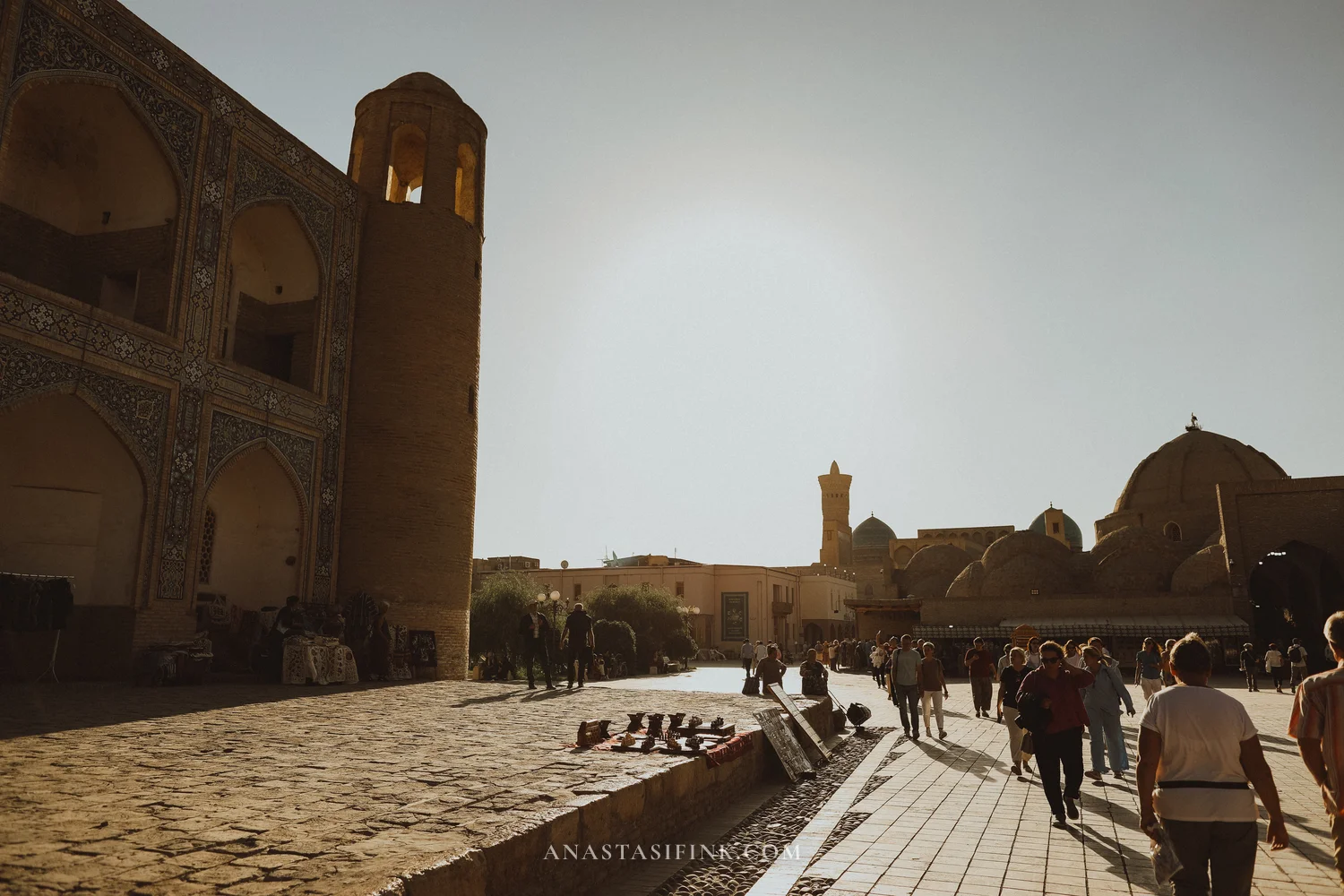
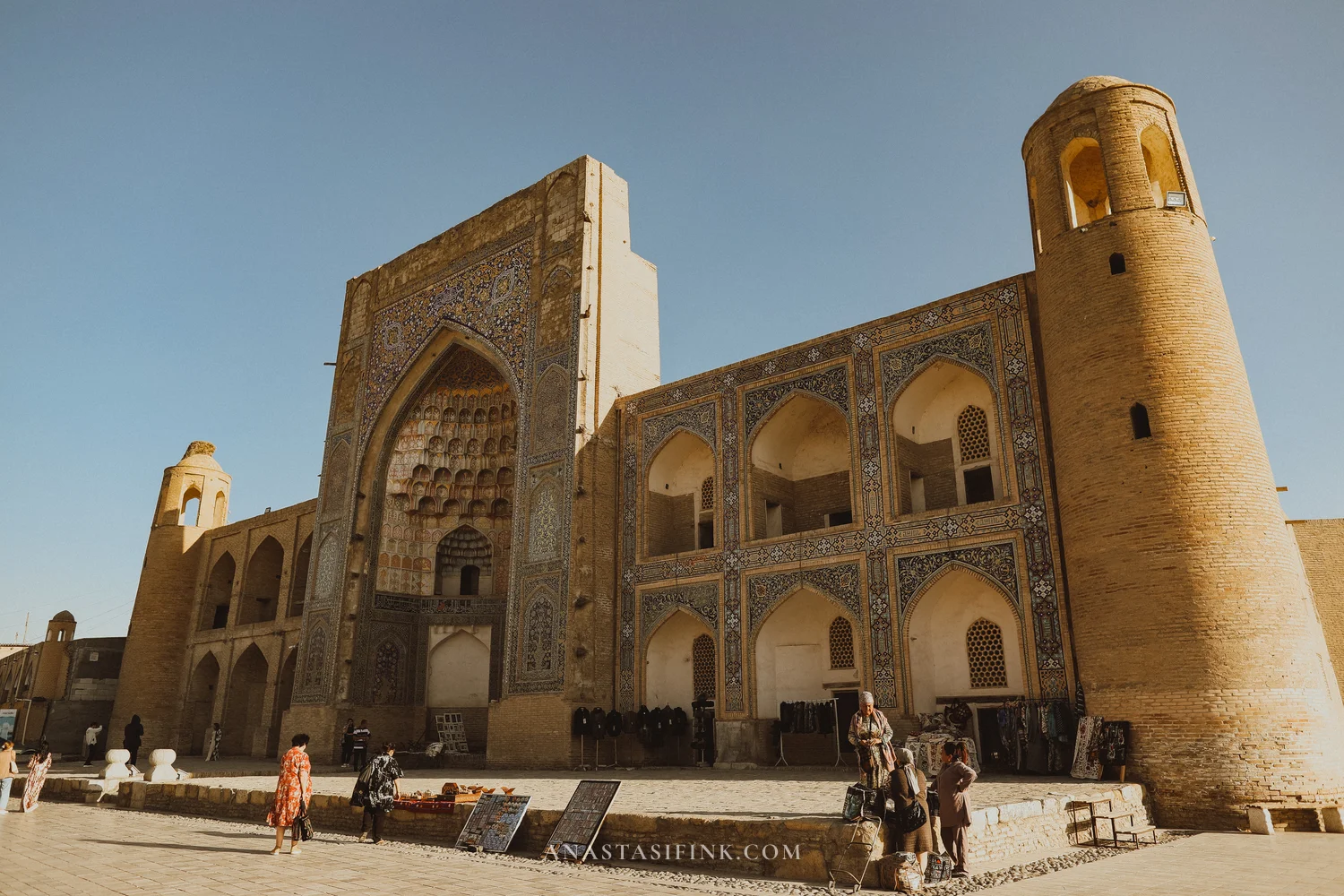
I’m putting Abdulaziz Khan first, even though most guides bury it in the middle of the list — and that, in my view, is a mistake. The madrasa was built in 1652, and its pishtaq (entrance portal) is considered one of the most intricate in all of Uzbekistan. It stands directly across from its older neighbor — the Ulugh Beg Madrasa (1417) — and together they form what’s called a “kosh madrasa” ensemble: a pair of madrasas facing each other.
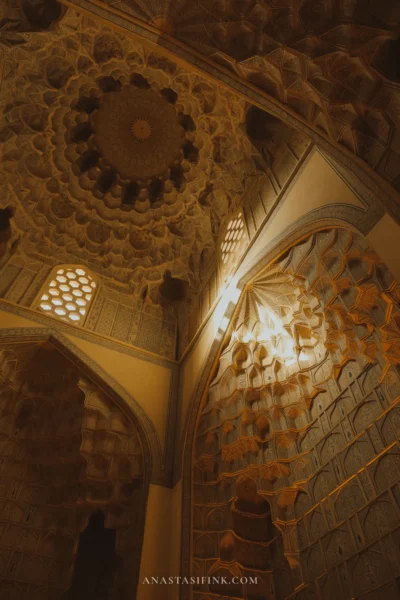
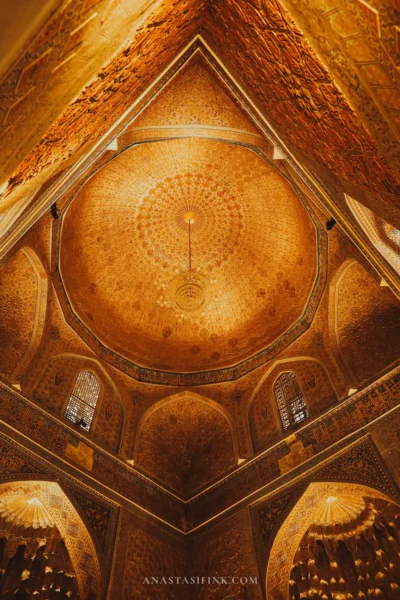
The main reason to step inside: muqarnas. These are stalactite vaults assembled from thousands of tiny cells. At Abdulaziz Khan they’re everywhere: above the entrance, on the ceilings of the corner rooms, above the mihrab in the mosque. The vault is technically demanding — each cell is calculated so that the overall outline stays circular, and each one is painted separately with flowers, leaves, and sometimes Indian-style landscapes (Abdulaziz Khan traded actively with the Mughals).
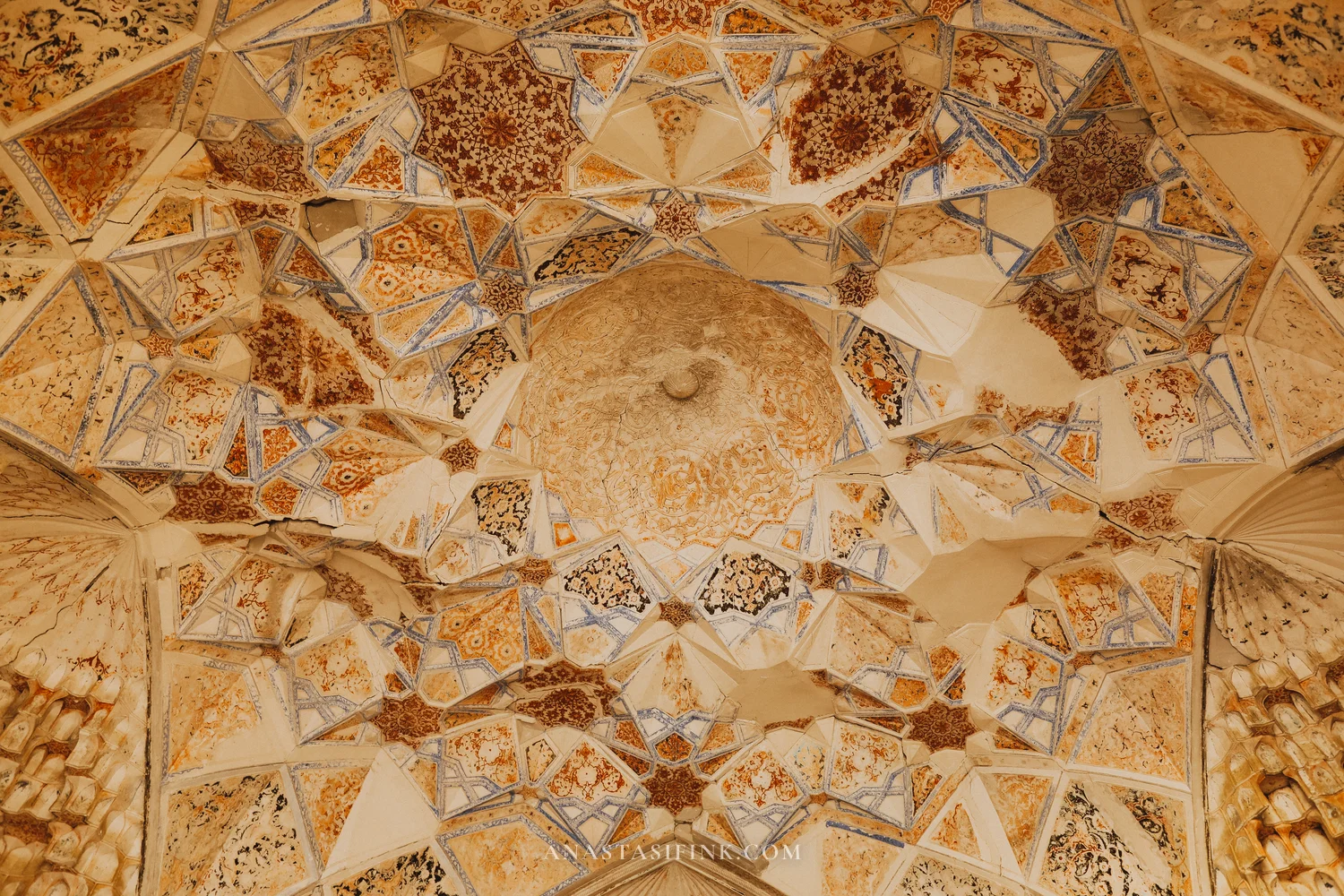
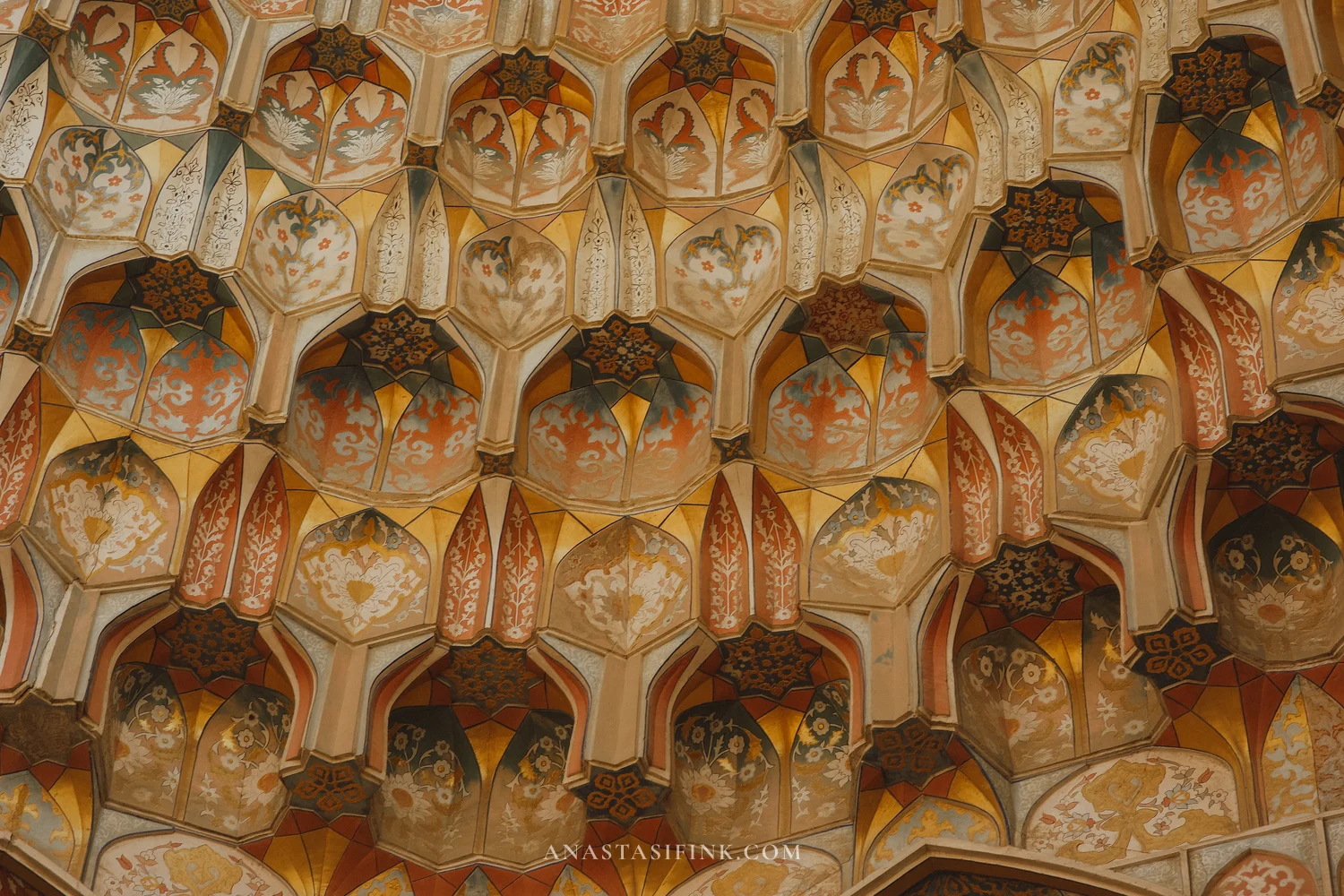
Left — muqarnas inside the woodcarving museum (paid section). Right — the vault above the main entrance, which you can stand under for free.
The woodcarving museum — the paid corner that’s worth the ticket
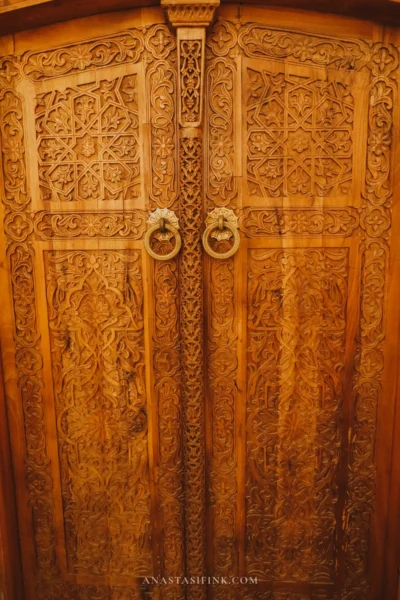
Deep inside the madrasa, behind the main pishtaq, there’s a separate ticket leading into a single small room. This used to be the darskhana — the prayer and study hall where students gathered for lessons. Today it’s a museum of decorative woodcarving: along the walls stand carved doors, shutters, columns, inlaid chests, mihrabs — everything the masters of Bukhara made between the seventeenth and nineteenth centuries.
The room really is tiny, maybe ten meters across. But that’s the point: every piece is at arm’s length, and you can lean in to see the shavings left by a knife, the relief of an islimi pattern, the tight weave of girih geometry. You stand in front of one door for twenty minutes, then move to the next. Entry is around 20,000 UZS, and it’s probably the most underrated ticket in Bukhara.
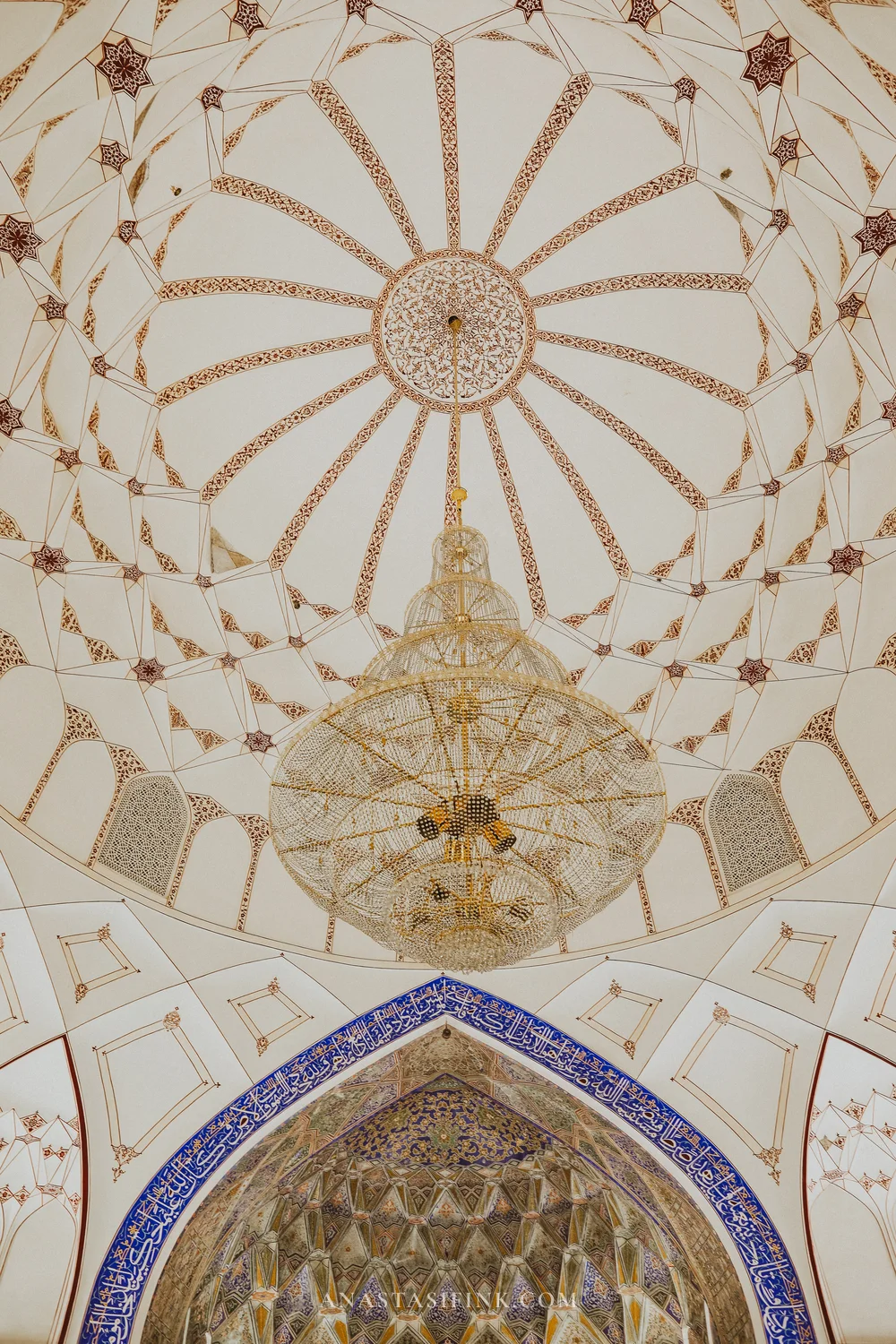
And then — the ceiling. Above the darskhana hangs muqarnas done in the kundal technique: relief plasterwork in ganch, hand-painted and gilded in places. It’s one of the best-preserved examples of seventeenth-century painted decoration in Bukhara — architectural historians come here specifically to see it. Above the mihrab, the muqarnas converge into a dome; in the morning hours sunlight enters through narrow windows, and the dome glows noticeably brighter than the rest of the room.
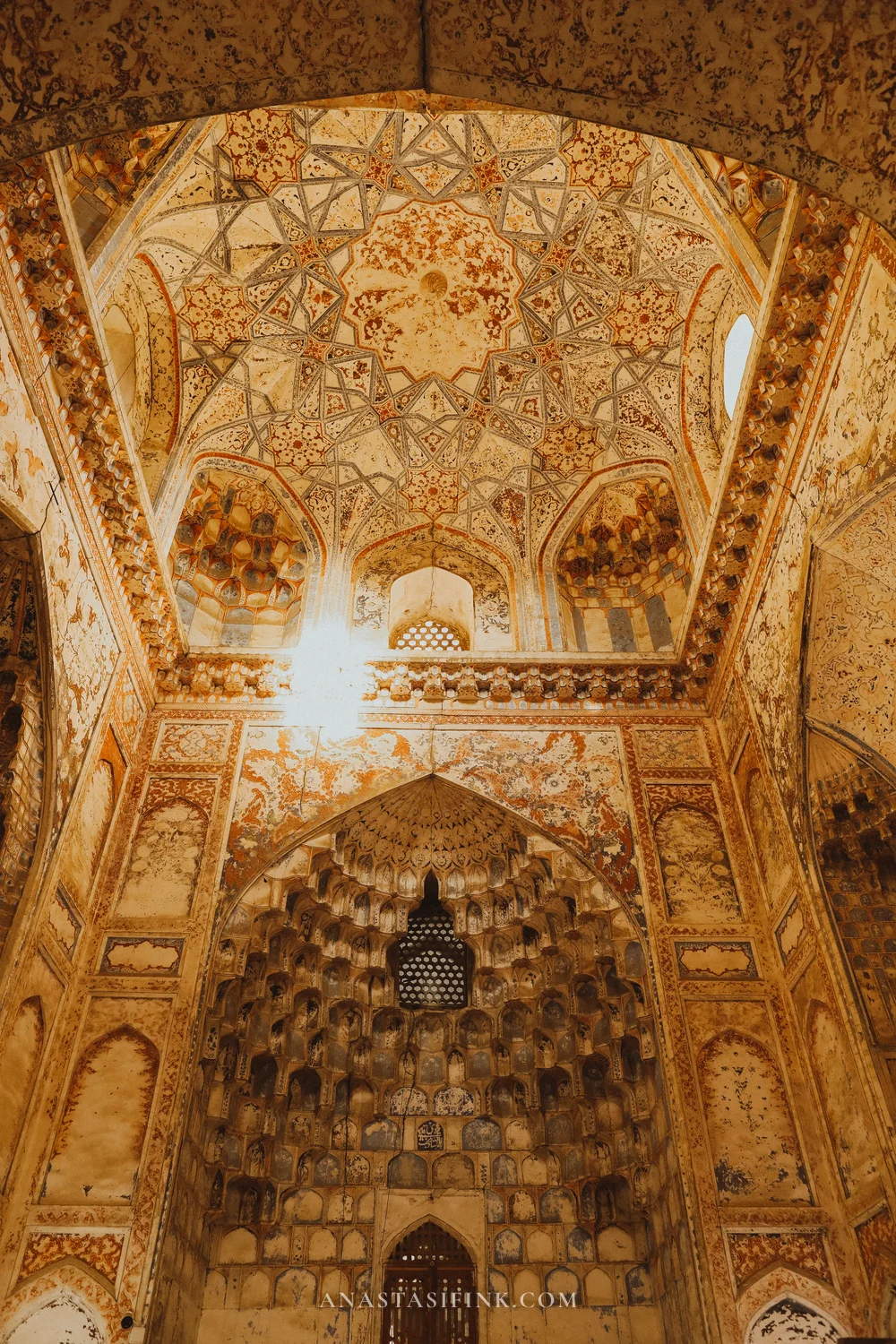
Tip: entry to the madrasa courtyard is free. The ticket (~20,000 UZS) is only for the woodcarving museum. Mornings (9:00–10:30) are the only time when the sun hits the windows directly above the mihrab — the muqarnas cast shadows across the entire ceiling. After 11:00 the light flattens out.
The courtyard, hujras, and details — what else to look at
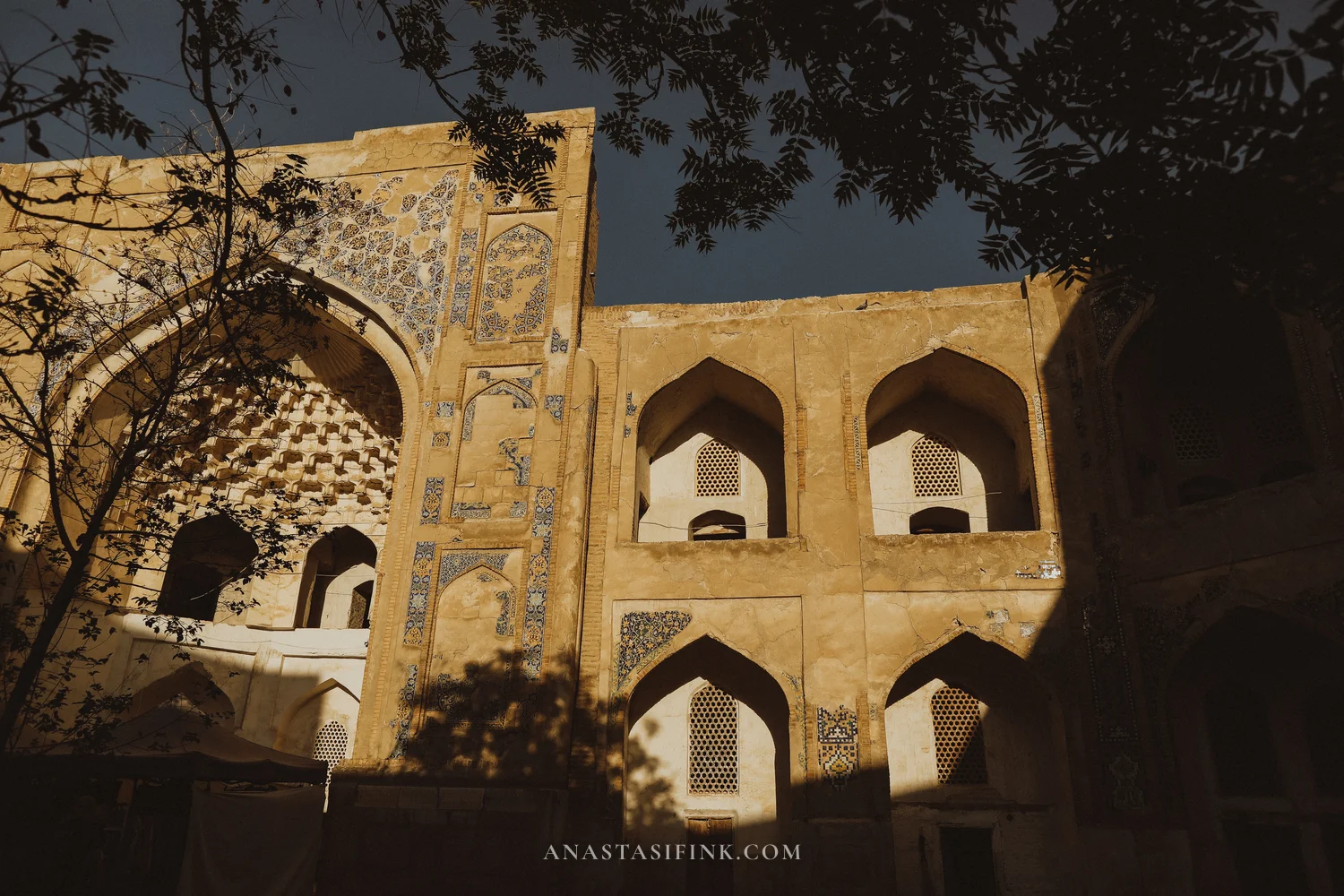
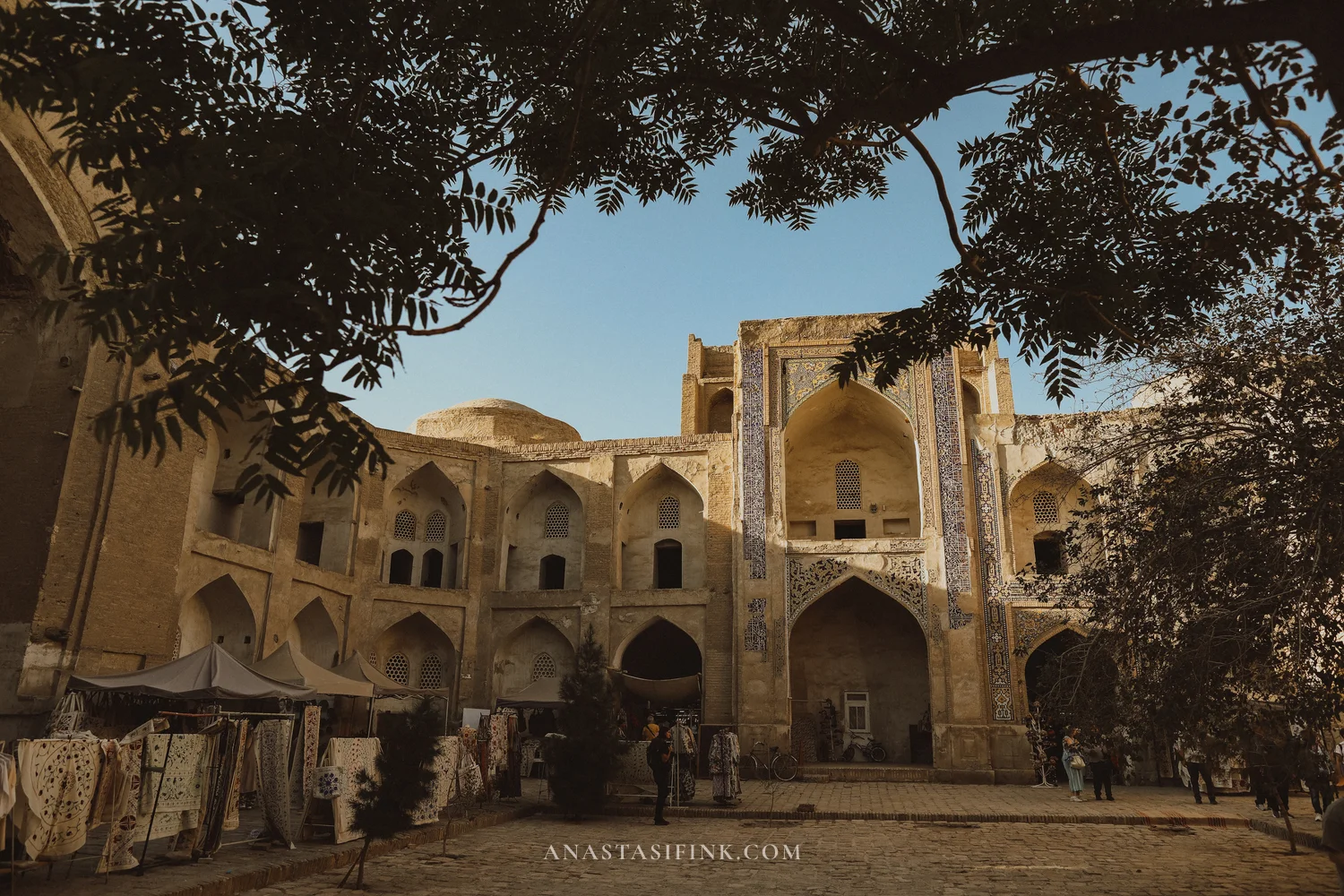
The free part of the visit is the courtyard itself, with its two-tiered hujras (student cells), side iwans, and carved wall details. Walk slowly — every niche is its own composition, every column carved.
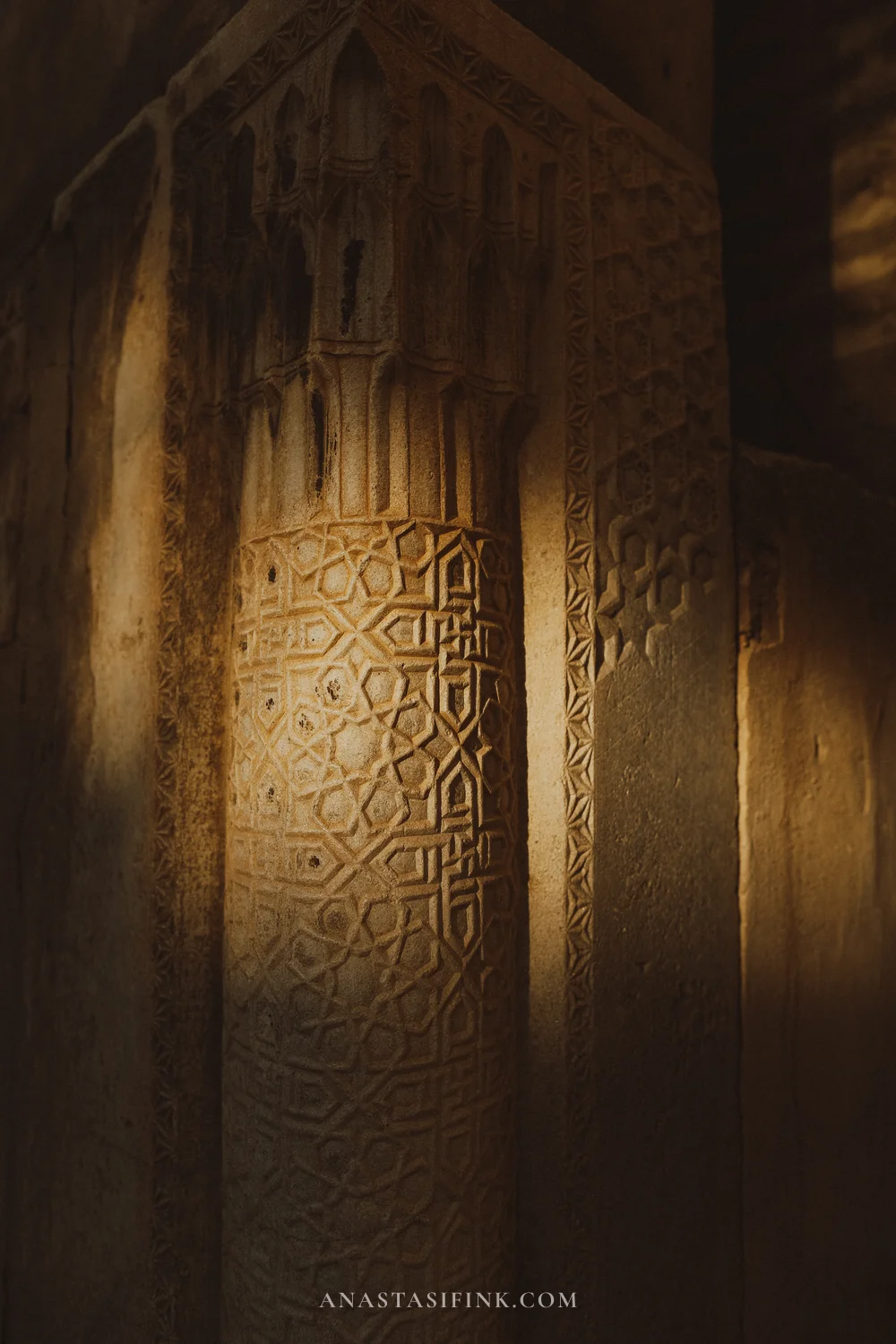
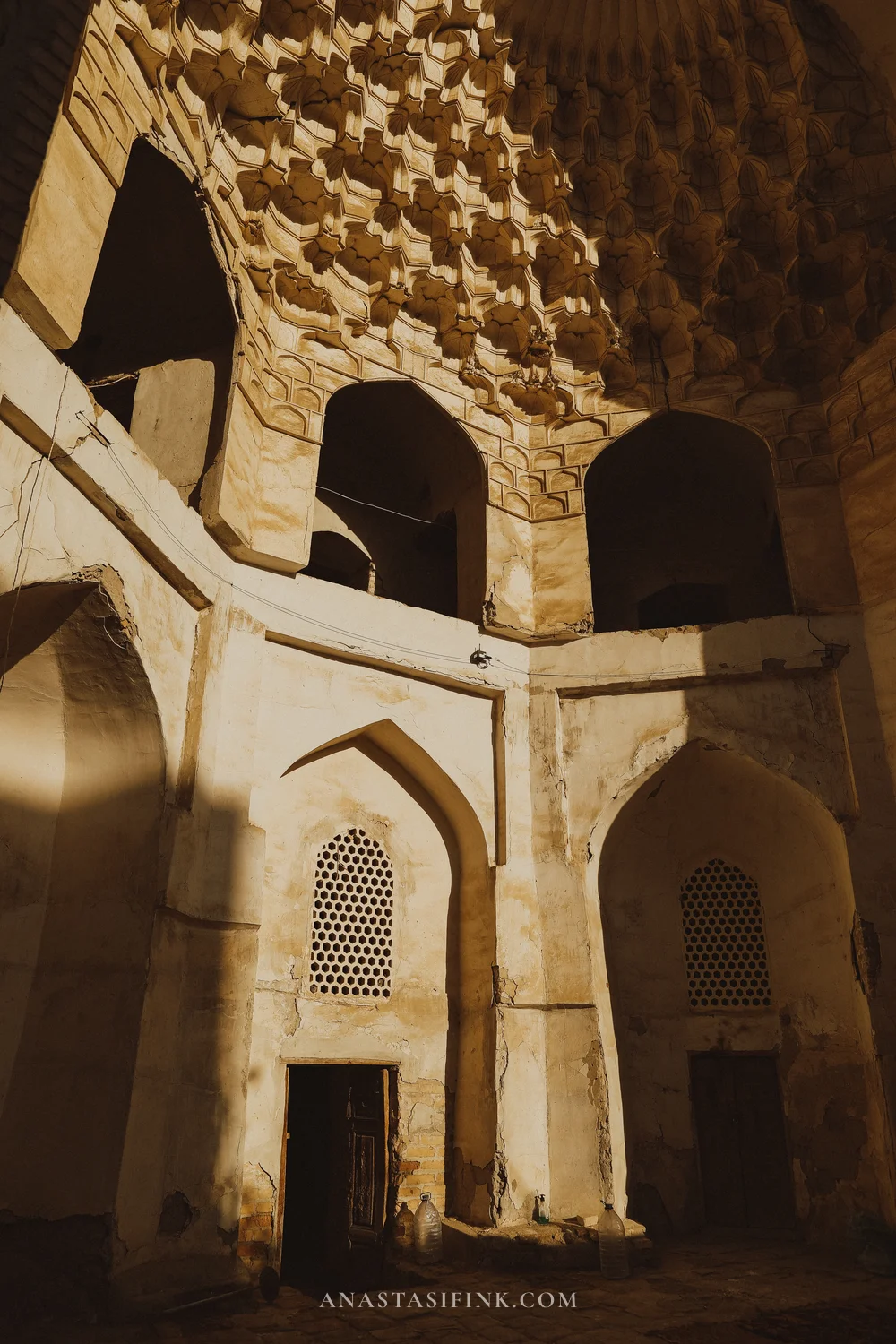
A carved column and a side vault. The pattern on the column is five-pointed stars assembled into a girih — a geometric grid.
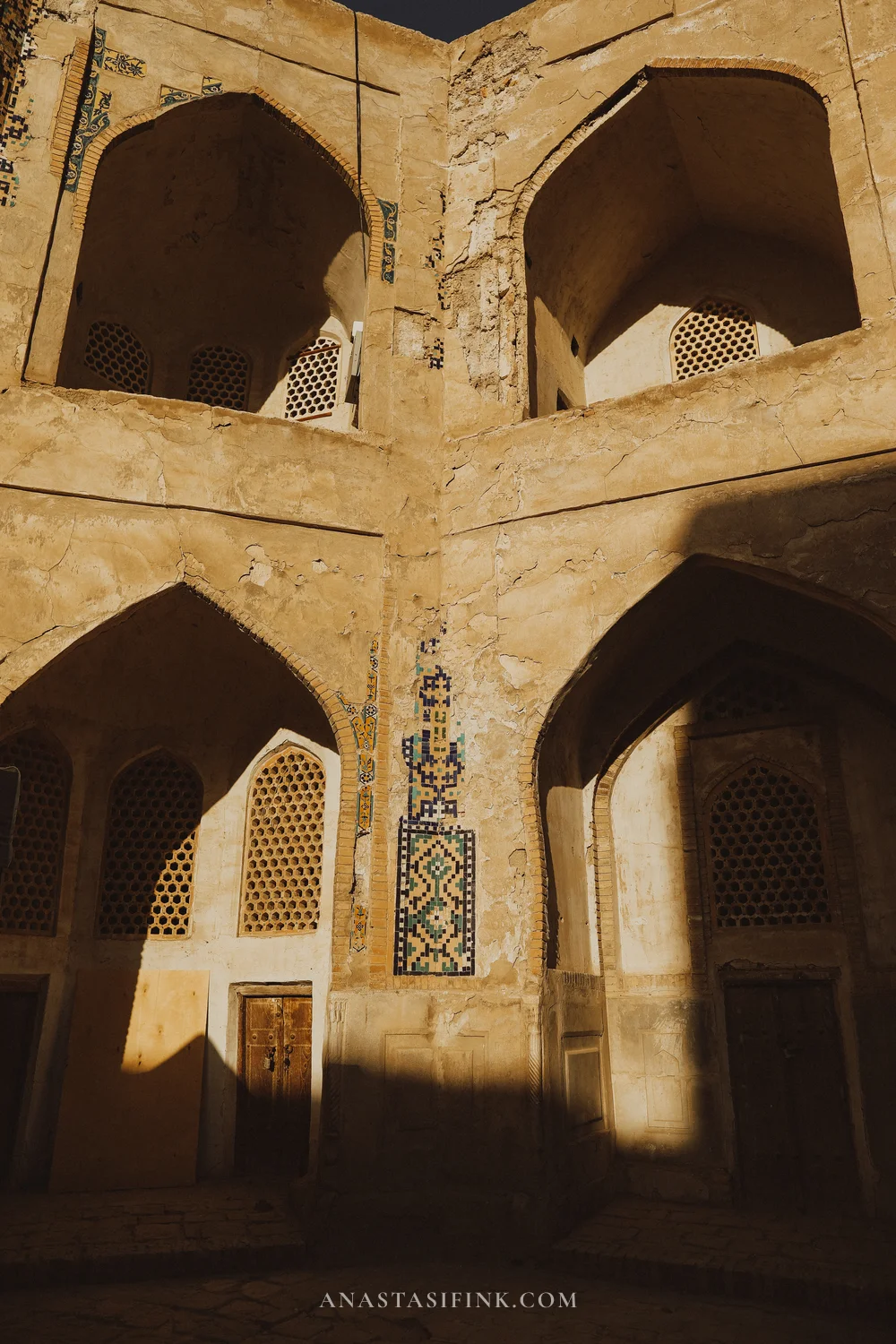
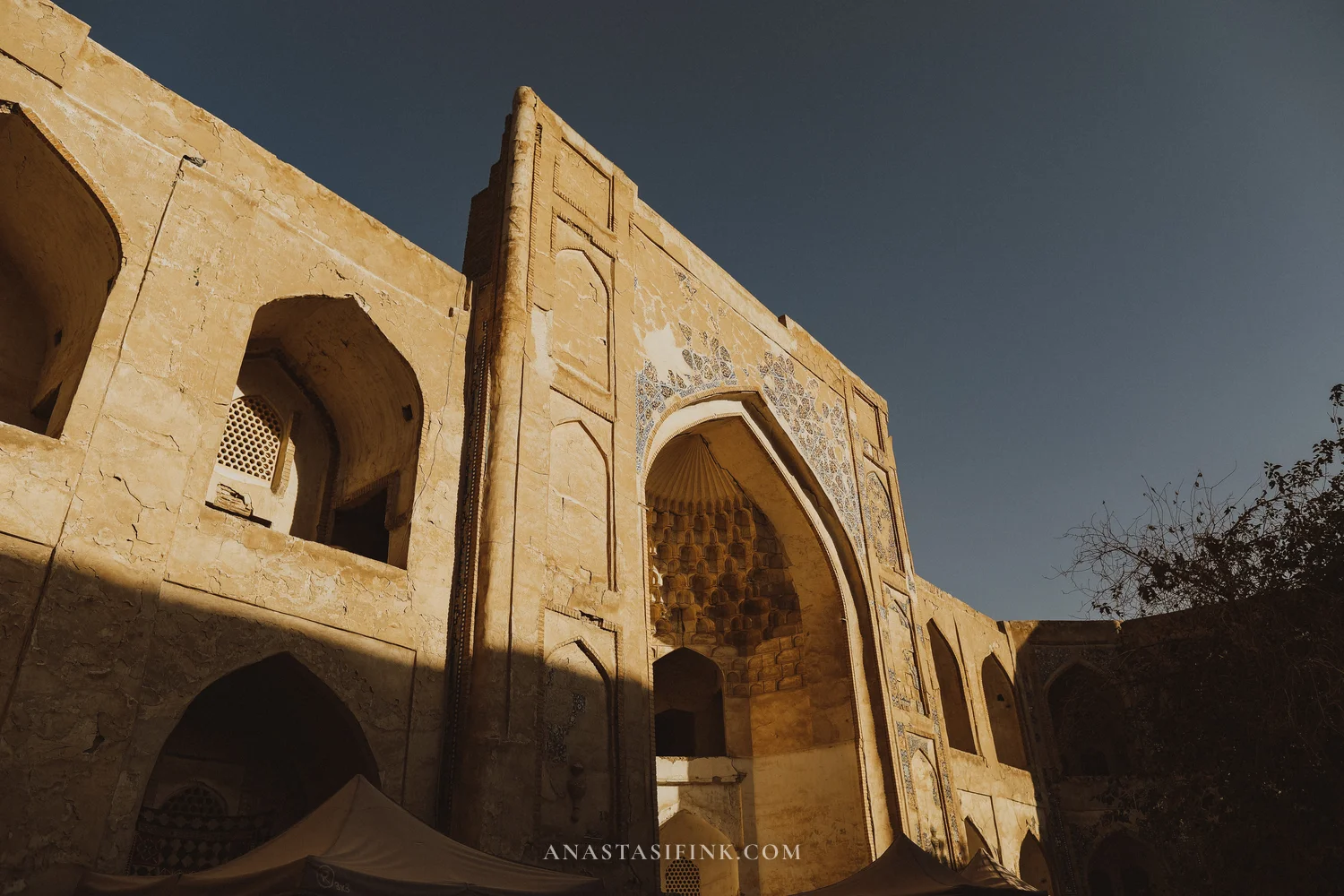
The courtyard and side facade. The hujras (student cells) have all been turned into souvenir shops.
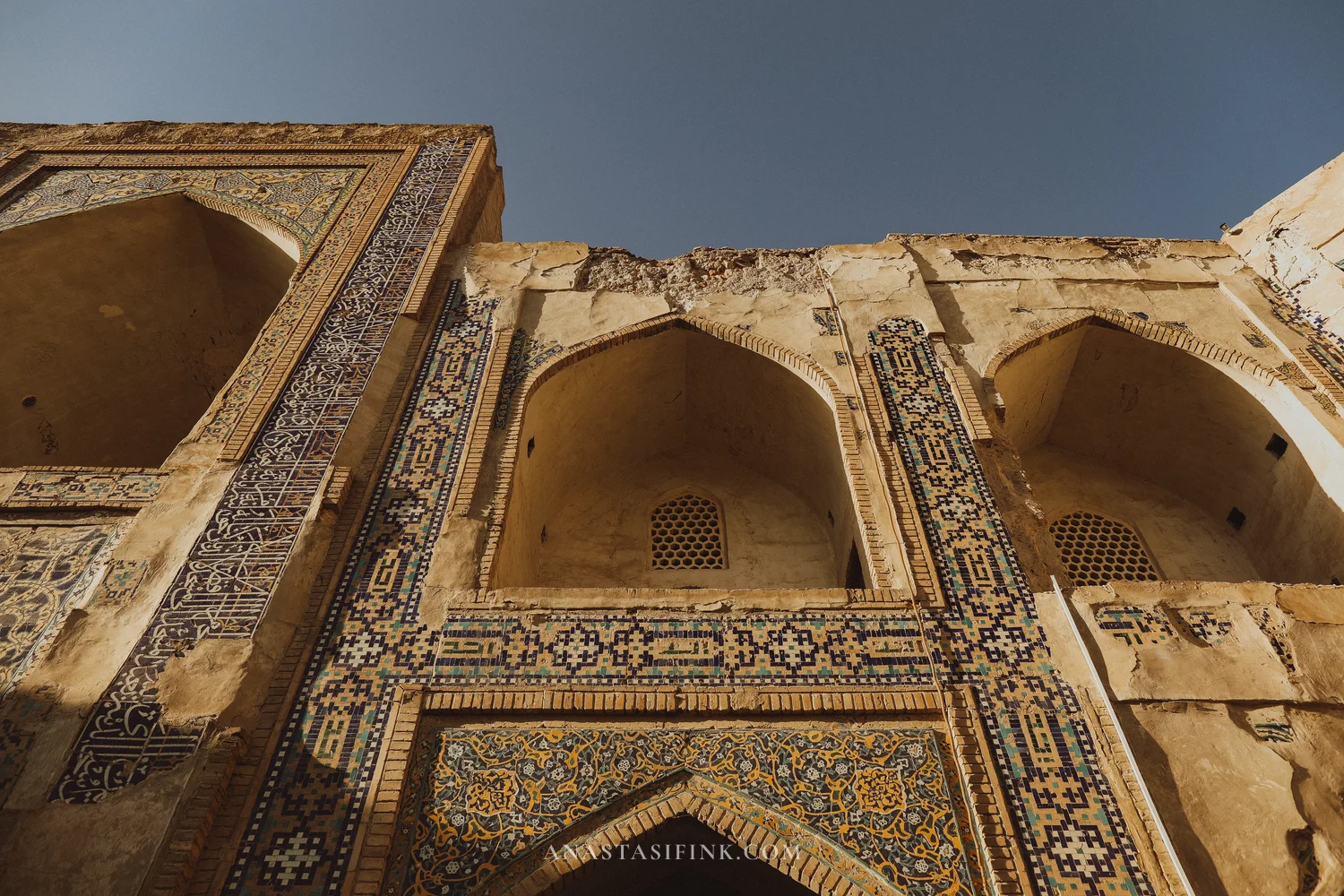
Majolica details on the main pishtaq.
Practical Information — Abdulaziz Khan Madrasa
- Address: Khoja Nurabad str., across from the Ulugh Beg Madrasa
- GPS: 39.7752, 64.4156
- Hours: 09:00–18:00
- Courtyard entry: free
- Woodcarving museum (former darskhana): ~20,000 UZS (~ €1.40)
- Time needed: 45–60 minutes for both madrasas plus the museum
- Best light in the museum: 9:00–10:30 in the morning
2. The Po-i-Kalyan Ensemble — minaret, mosque, madrasa
Po-i-Kalyan (literally “at the foot of the Great One”) is the main architectural square in Bukhara. Three buildings stand here that you can spot from any rooftop in the old city: the Kalyan Minaret, the Kalyan Mosque, and the Mir-i-Arab Madrasa. All three are made of fired brick, without bright tilework — and that’s exactly what makes the silhouette feel so unified.
The Kalyan Minaret was built in 1127 — meaning that by the time Genghis Khan arrived, it was already over a hundred years old. According to legend, Genghis tilted his head back to take in the top, and his hat fell off. The khan was so impressed by the height that he ordered the minaret left untouched while the rest of the city was destroyed. It’s 48 meters tall, 9 meters in diameter at the base. Until the early twentieth century the call to prayer was announced from the top; in the worst years, condemned prisoners were thrown from it — earning it the grim nickname “the Tower of Death.”
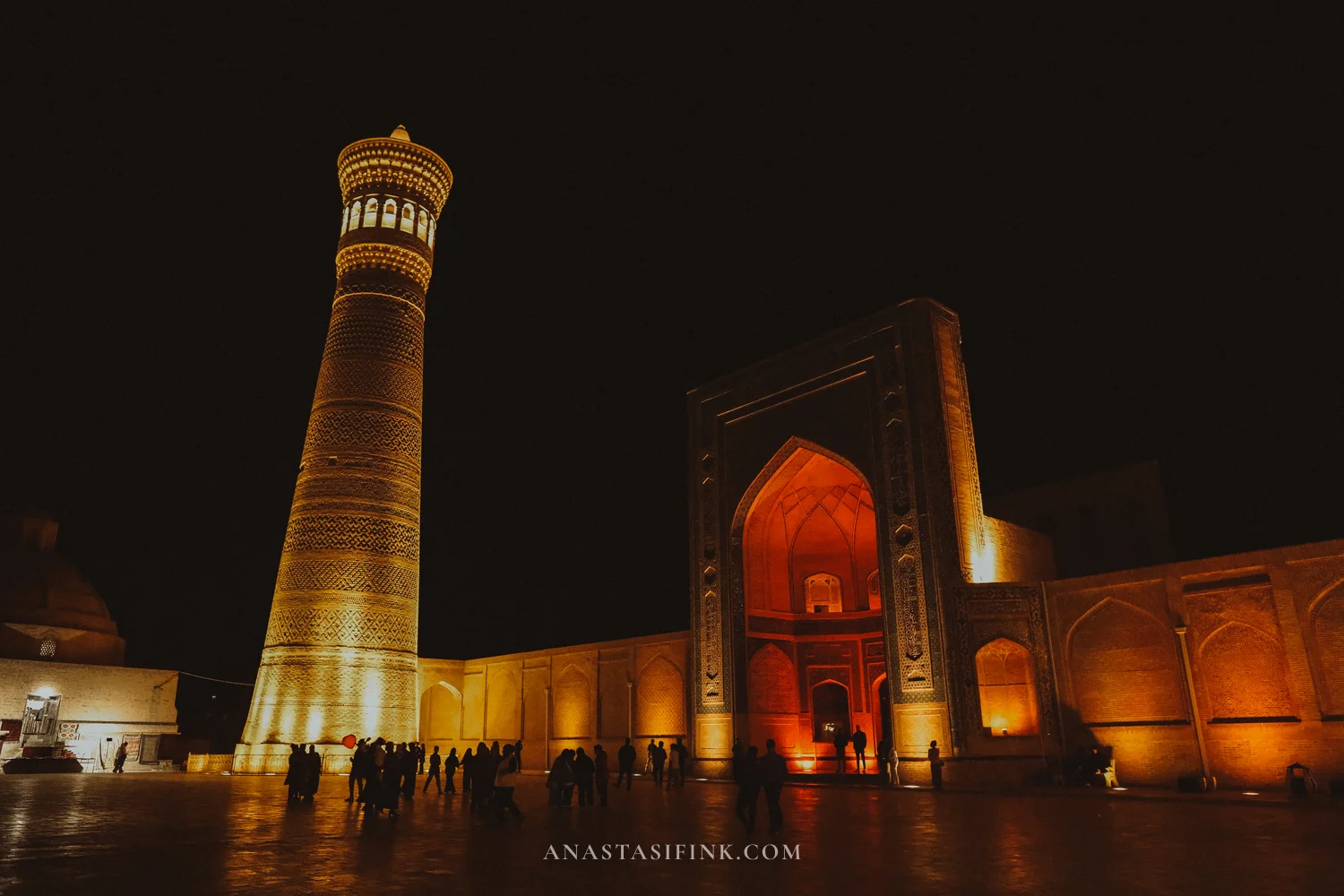
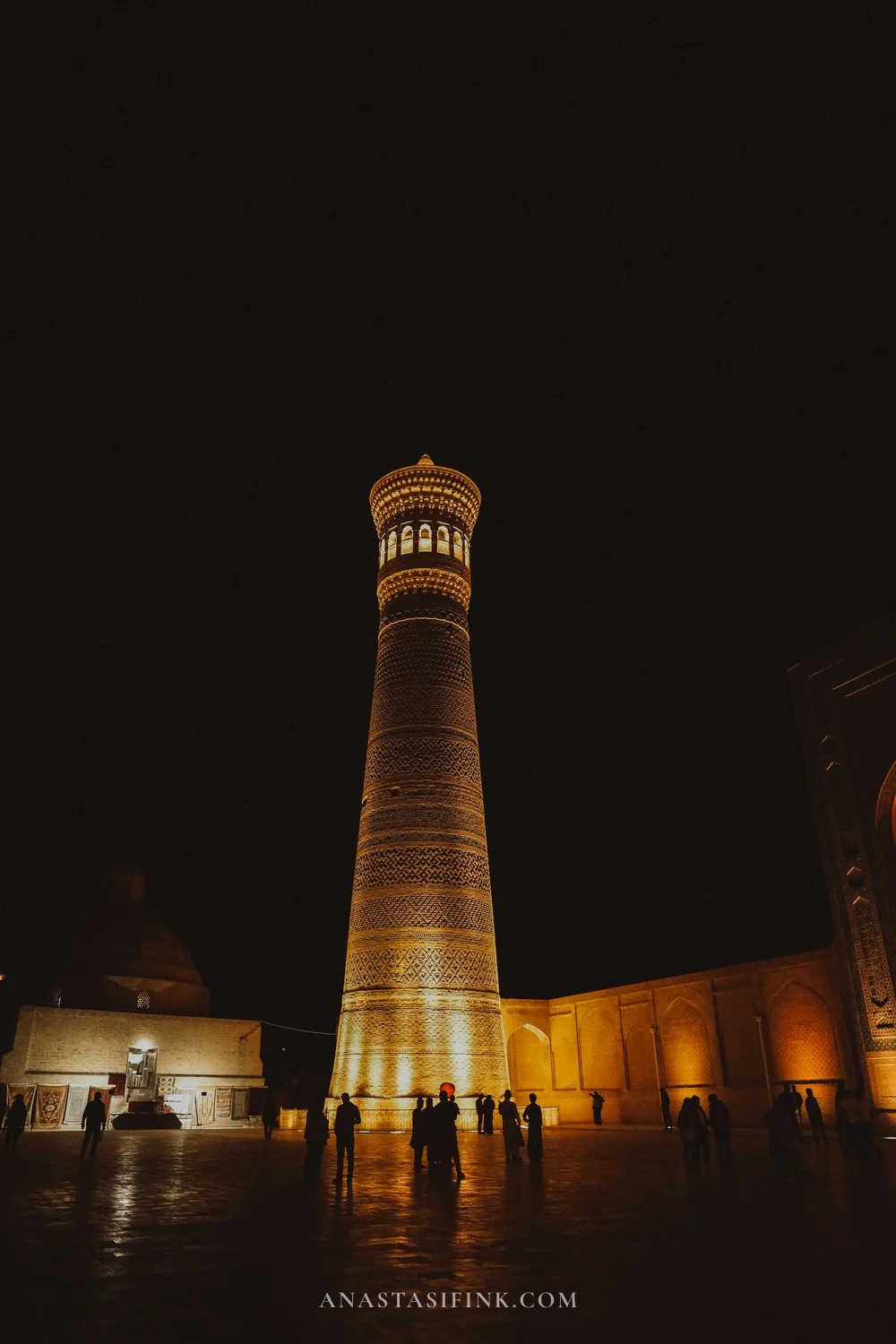
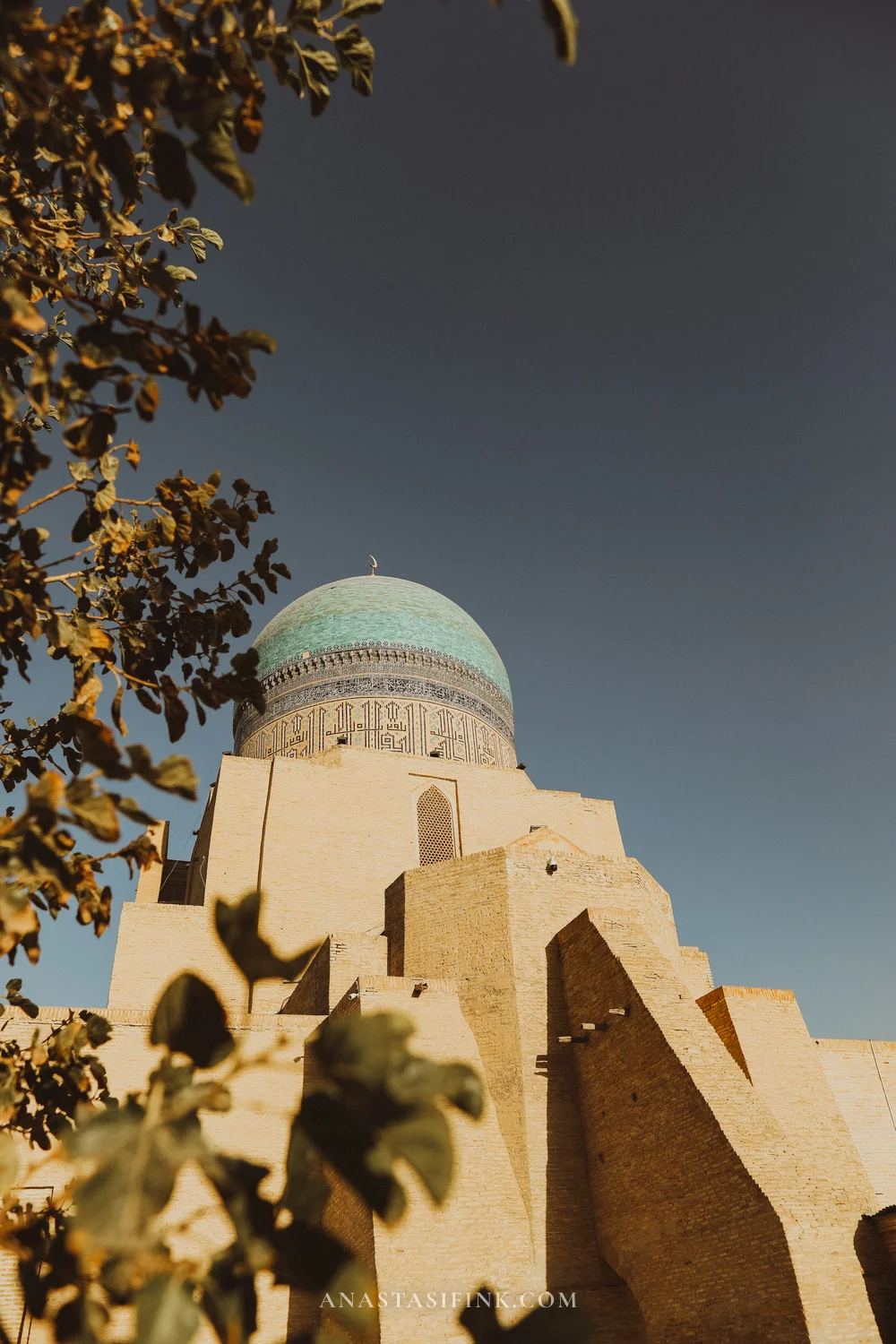
Left — the Kalyan Minaret. It has fourteen ornamental brick bands around it, no two of them the same. Right — the blue dome of the Mir-i-Arab Madrasa from the courtyard side.
Practical Information — Po-i-Kalyan
- GPS: 39.7757, 64.4143
- Square access: free
- Kalyan Mosque: 30,000 UZS (~ €2)
- Climbing the minaret: closed to tourists
- Tip: the Mir-i-Arab Madrasa can only be admired from outside — it’s a working madrasa, no entry inside
3. The Ark Citadel — ancient fortress and emir’s residence
The Ark is the oldest structure in Bukhara and was the residence of its rulers from the fifth century until 1920. Inside there was a throne room, a mosque, stables, a library, a harem, and a prison — up to 3,000 people lived inside its walls.
Today the Ark houses several museums: archaeology, local history, the throne room, the palace mosque. The walls themselves are as impressive as anything inside: up to 20 meters tall, with rounded buttress-towers at the corners, brickwork from the nineteenth century with visible layers of repairs.
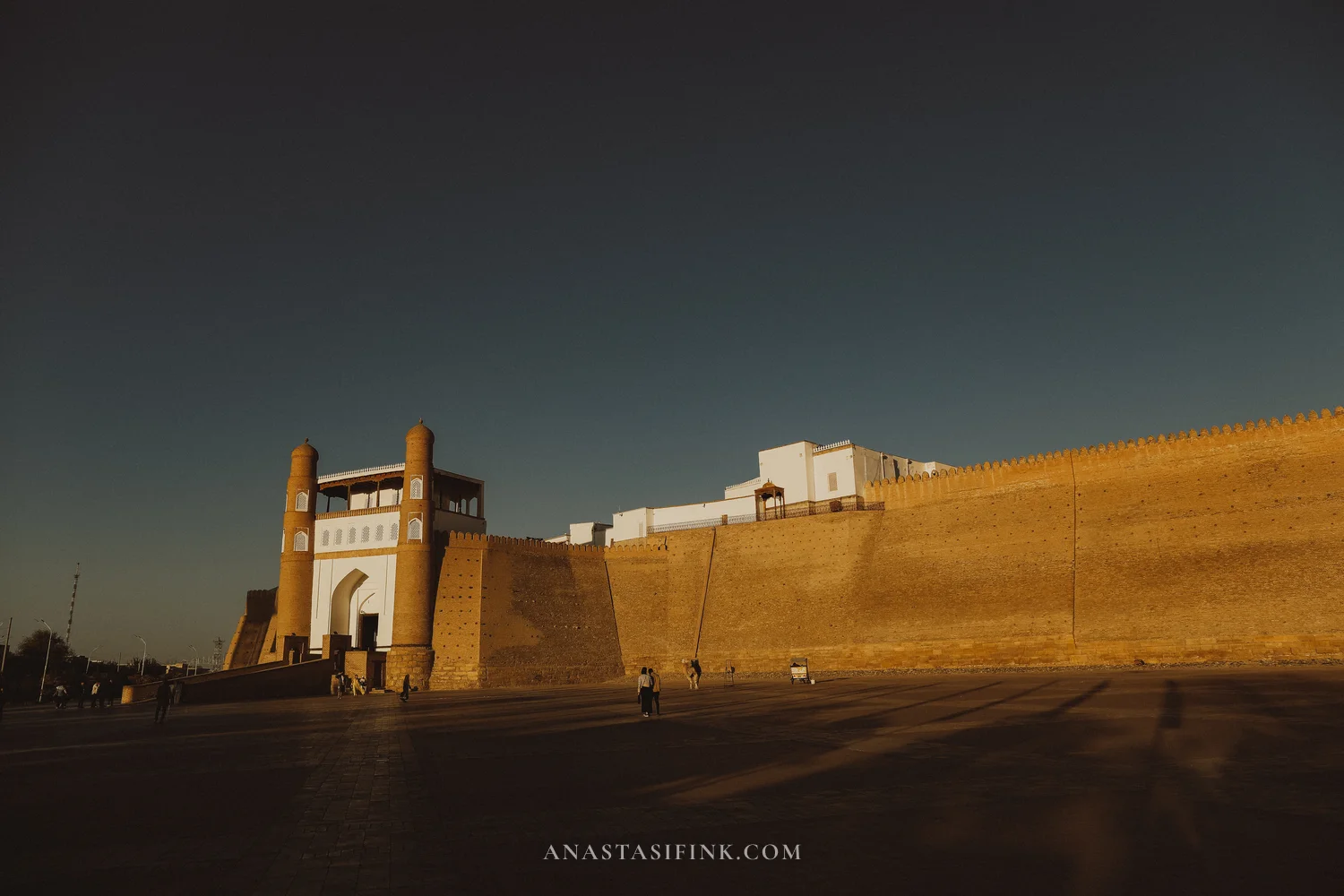
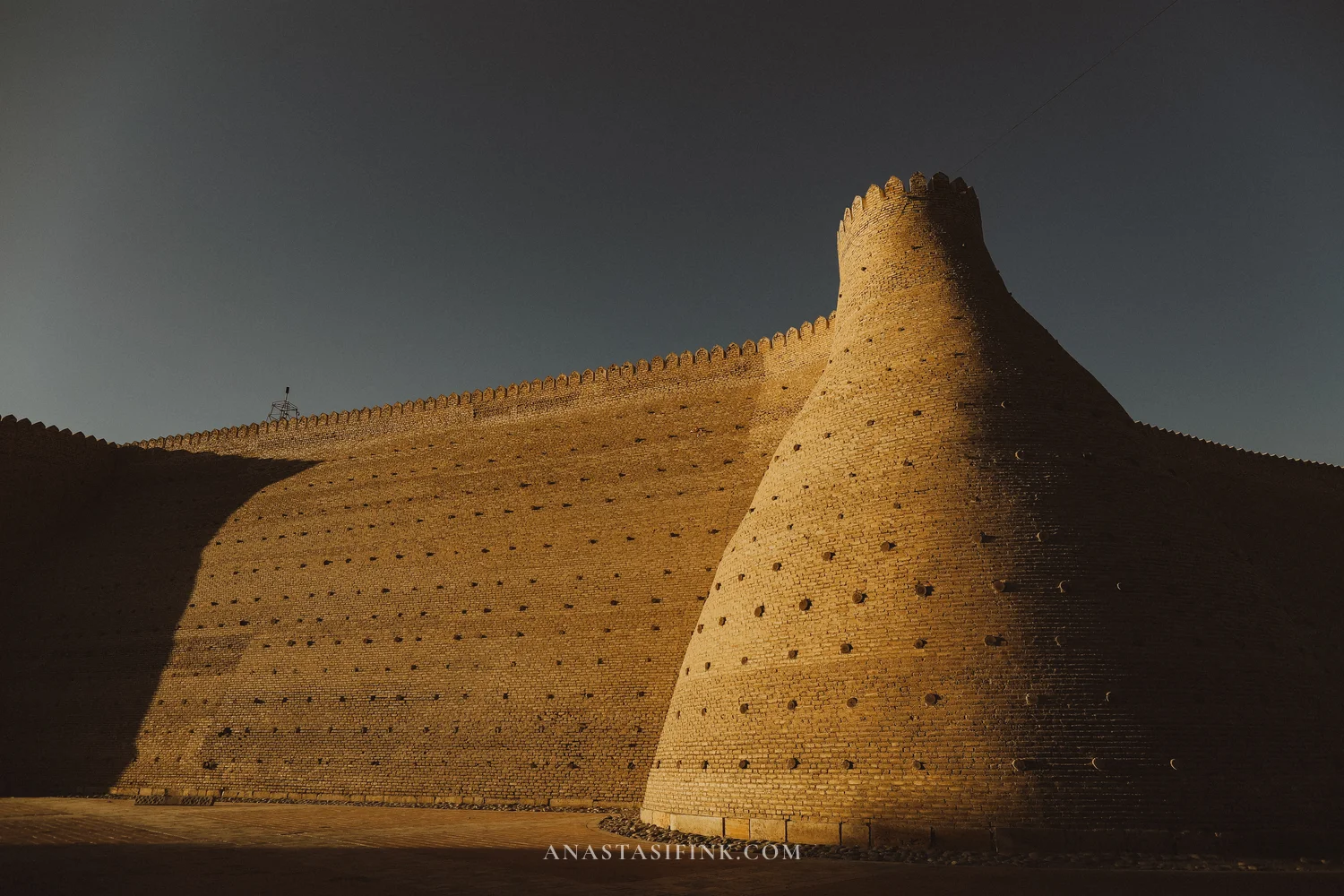
The Ark at sunset.
Practical Information — Ark Citadel
- Address: Registan Square, Bukhara
- GPS: 39.7777, 64.4148
- Hours: 09:00–18:00 daily (April–November until 19:00)
- Entry: 60,000 UZS (~ €4.20)
- Time needed: 1.5–2 hours
- Tip: come early morning (fewer people) or near sunset (best light on the walls)
4. The Bolo-Hauz Mosque — the “Mosque of Forty Columns”
Bolo-Hauz stands directly across from the Ark, on the other side of Registan Square. Its centerpiece is the iwan — an open gallery in front of the prayer hall — supported by twenty carved wooden columns. Local legend calls it the “Mosque of Forty Columns”: twenty real and twenty reflected in the pool out front.
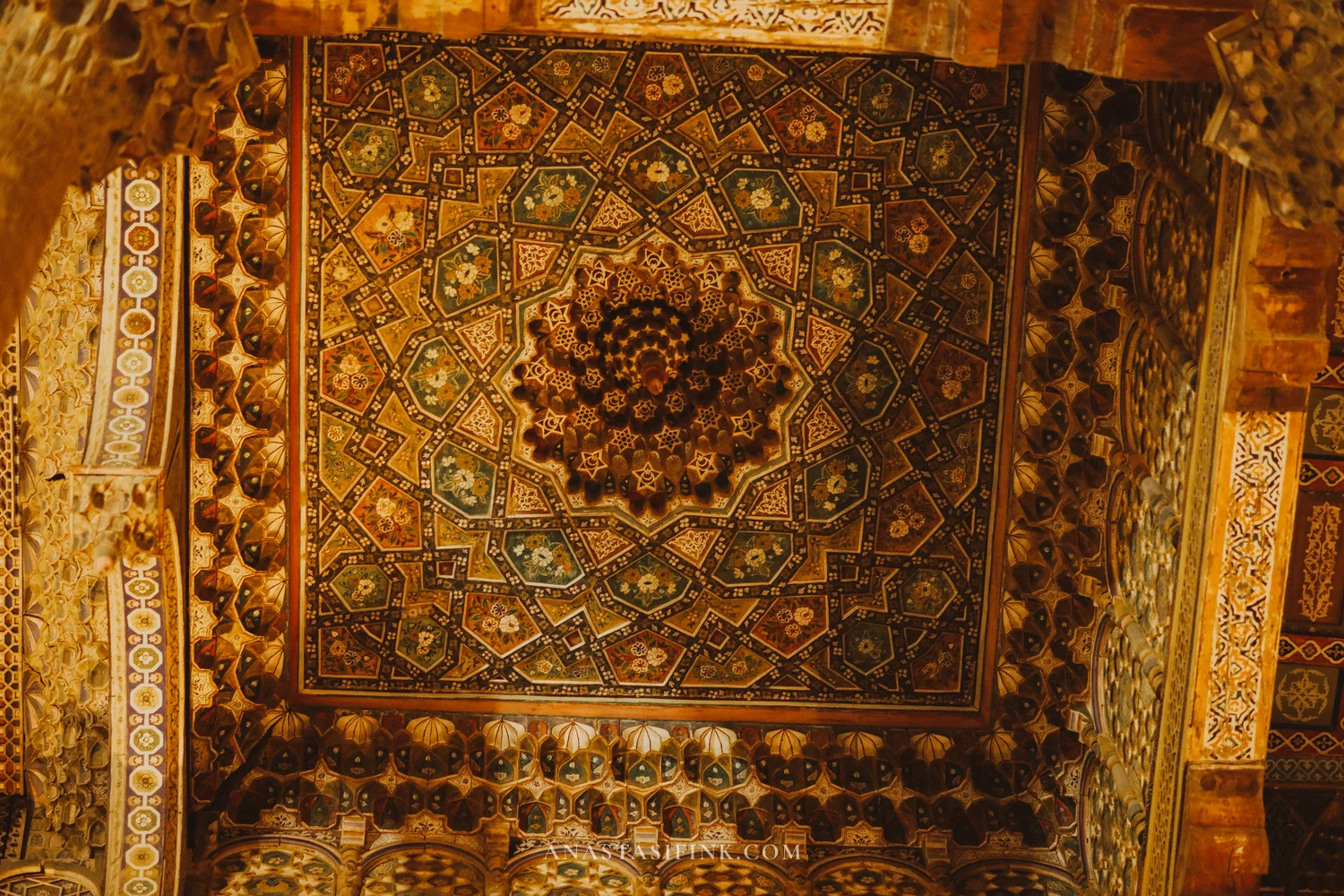
The columns are made of walnut, elm and poplar; the capitals are carved muqarnas, painted by hand. The slender front supports were only added in 1917, when the roof started sagging. Inside the iwan there’s a wooden coffered ceiling that struck me as the most beautiful in Bukhara — every coffer painted with its own pattern.
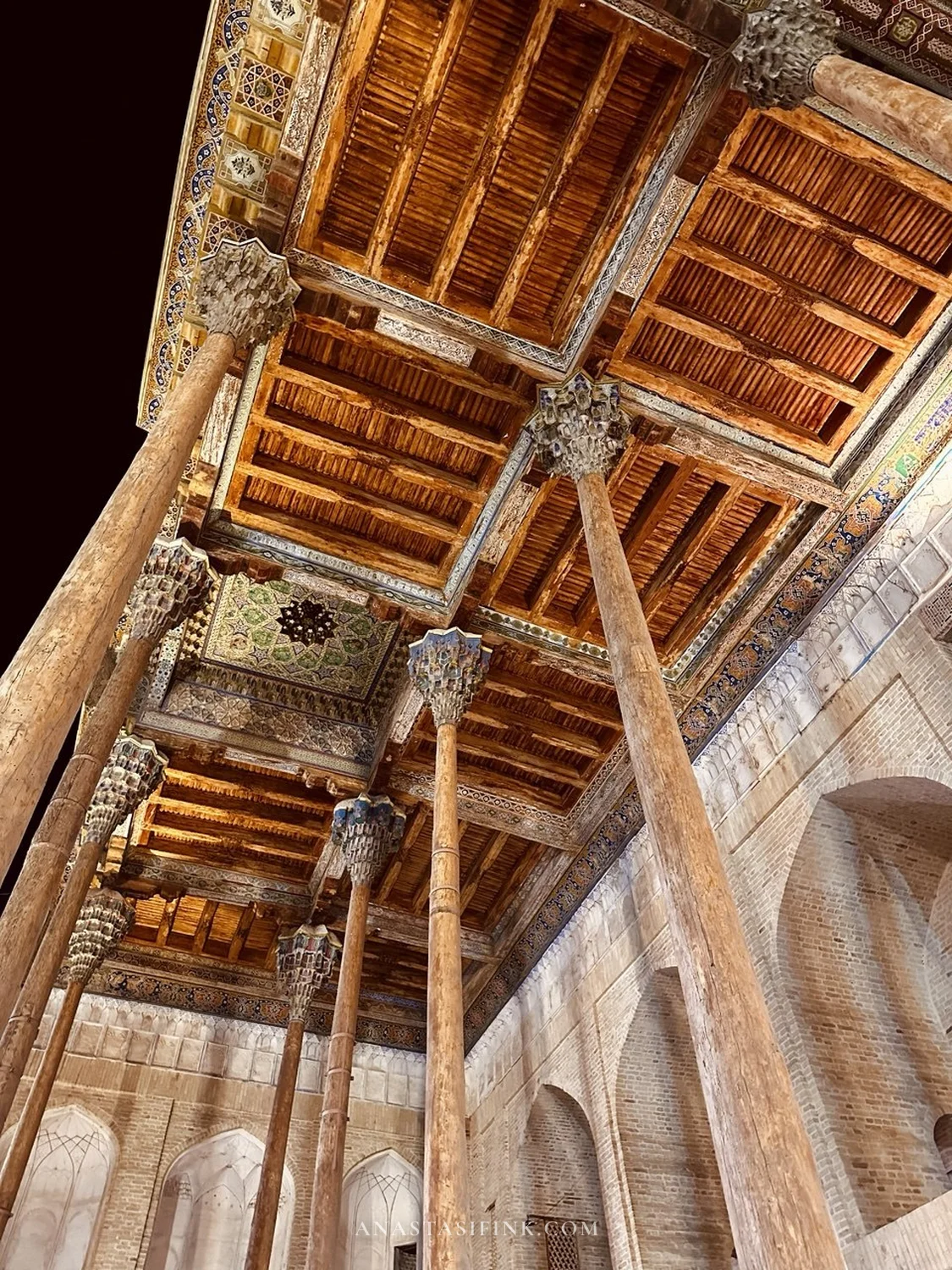
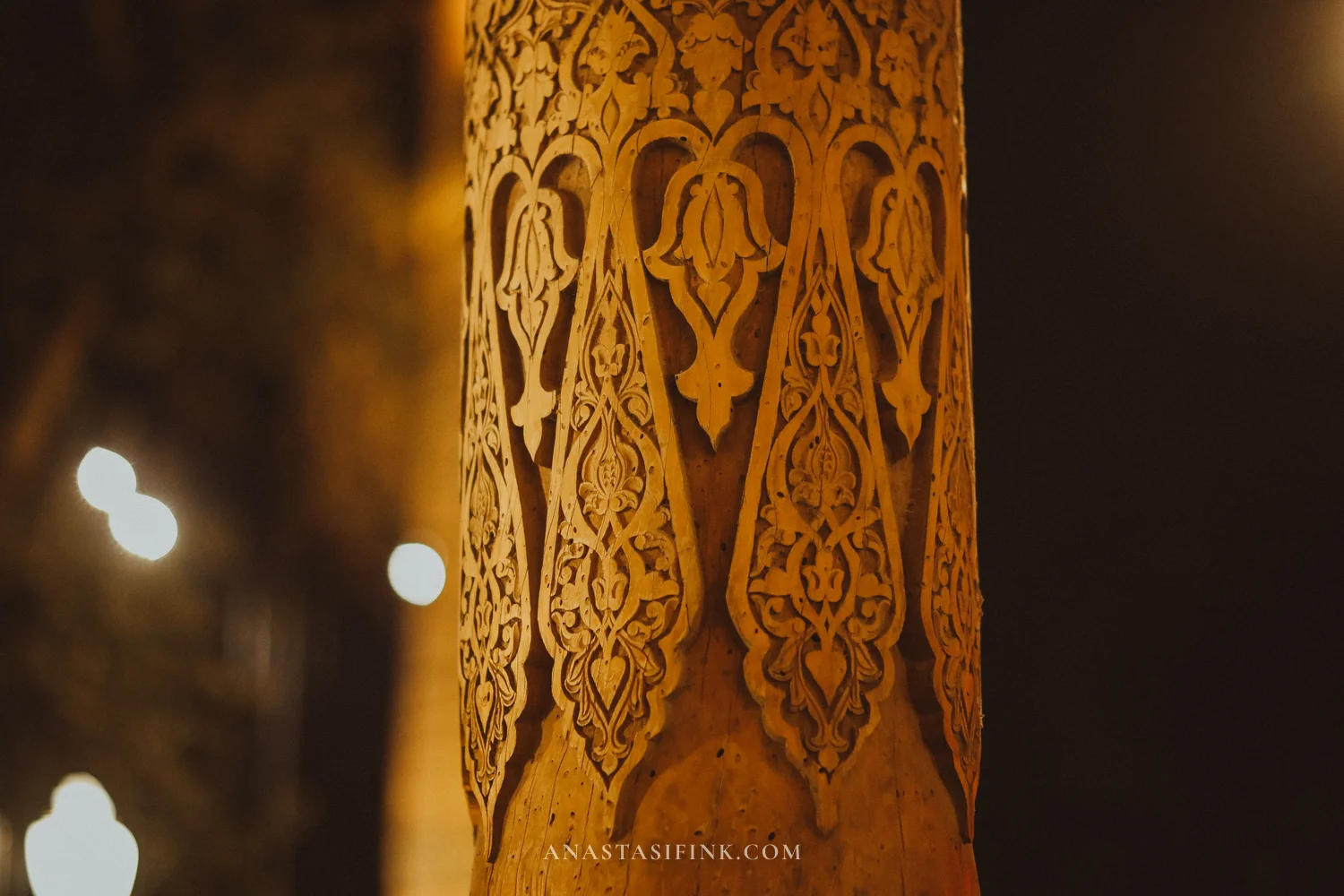
The Bolo-Hauz iwan at night, and a fragment of one of the carved columns. The columns are walnut, elm and poplar; the iwan is 12 meters high.
Practical Information — Bolo-Hauz
- Address: Registan Square, opposite the Ark
- GPS: 39.7780, 64.4138
- Hours: dawn to dusk (working mosque)
- Entry: free (donations welcome)
- Tip: best at sunset, when the columns reflect in the hauz
5. Chor Minor — four minarets instead of two
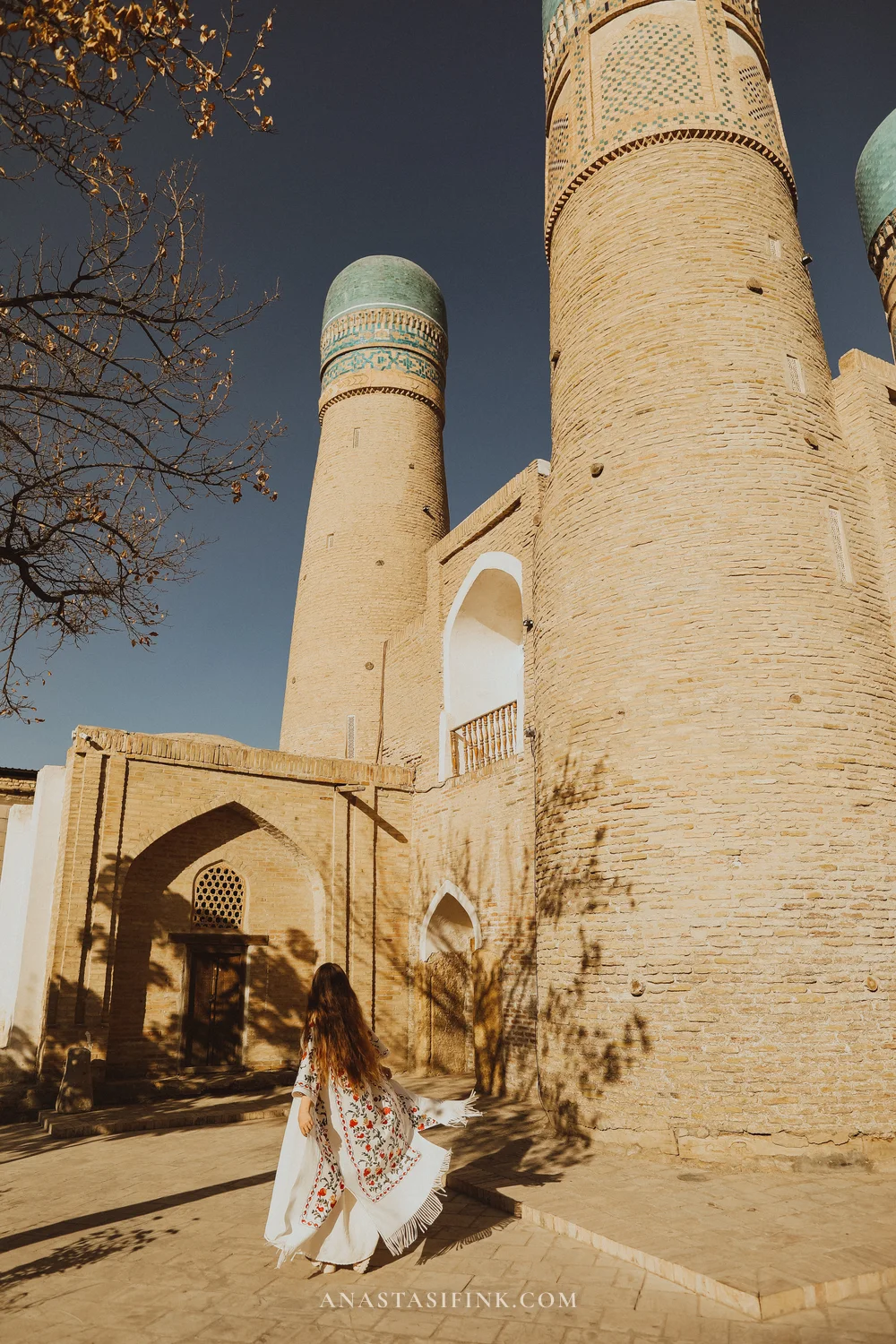
Chor Minor sits off the tourist trail, in an ordinary residential block east of Lyab-i-Hauz. It’s a small square building with four little minaret-towers at the corners — an unusual composition for Bukhara. It was built in 1807 by a wealthy Turkmen merchant, Khalifa Niyazkul, as a gift to his family. It used to be the gateway to a larger madrasa — the madrasa is gone, the gateway remains.
Each of the four towers is decorated differently. One theory is that the patterns symbolize the four world religions: you can pick out motifs that look like a Buddhist wheel and a Christian cross. Inside is a small Sufi hall with a dome — and excellent acoustics for zikr, the meditative chanting of dervishes.
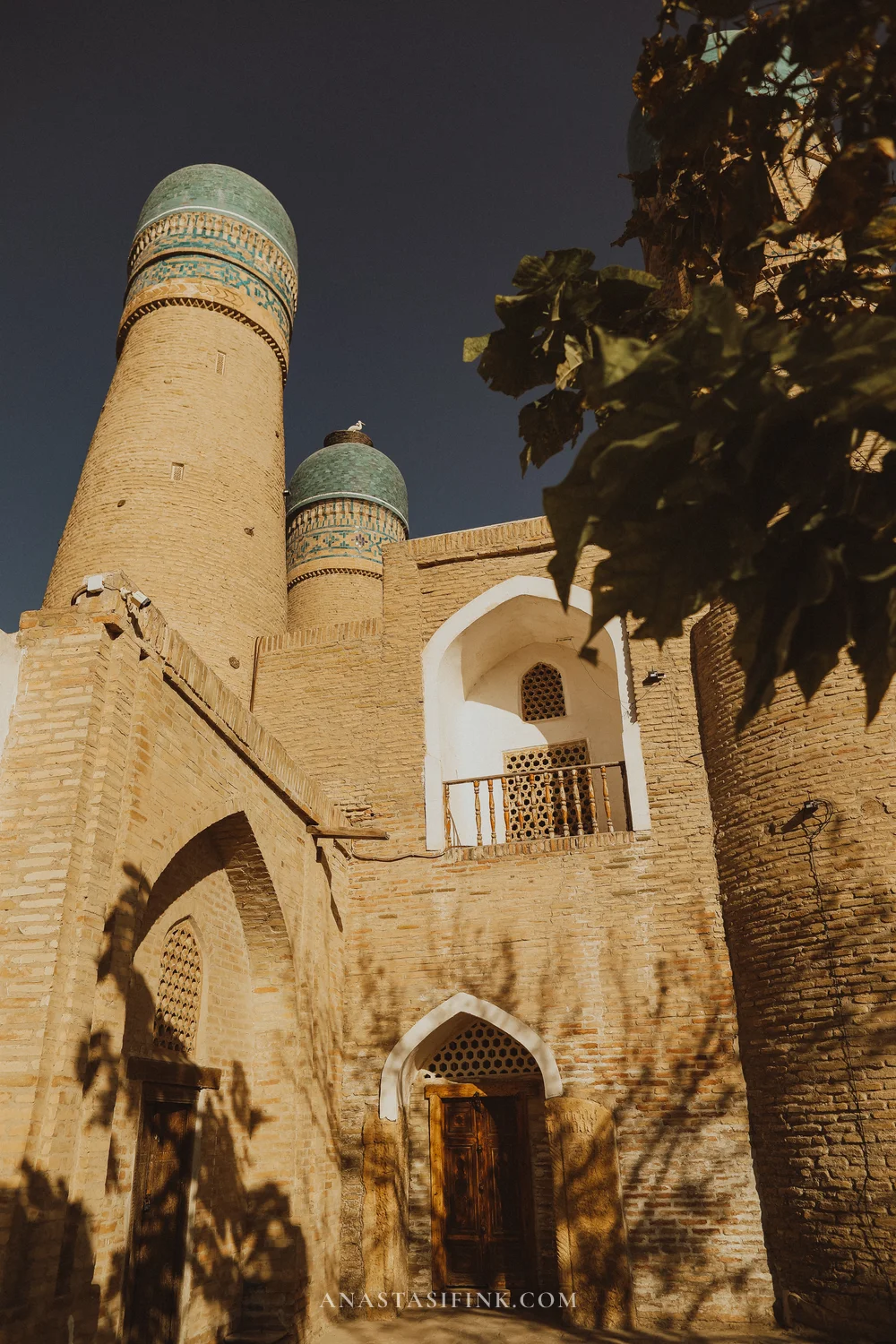
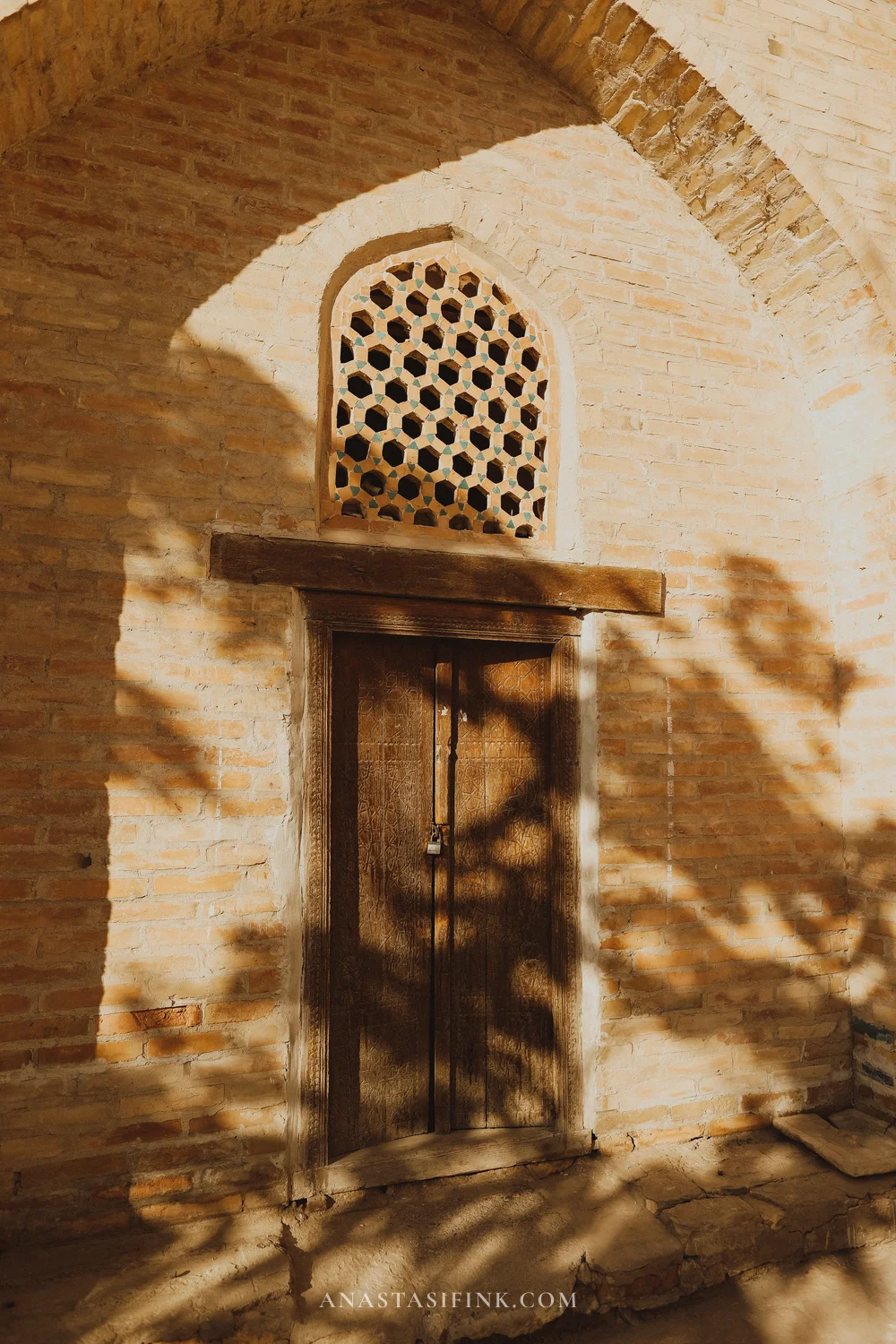
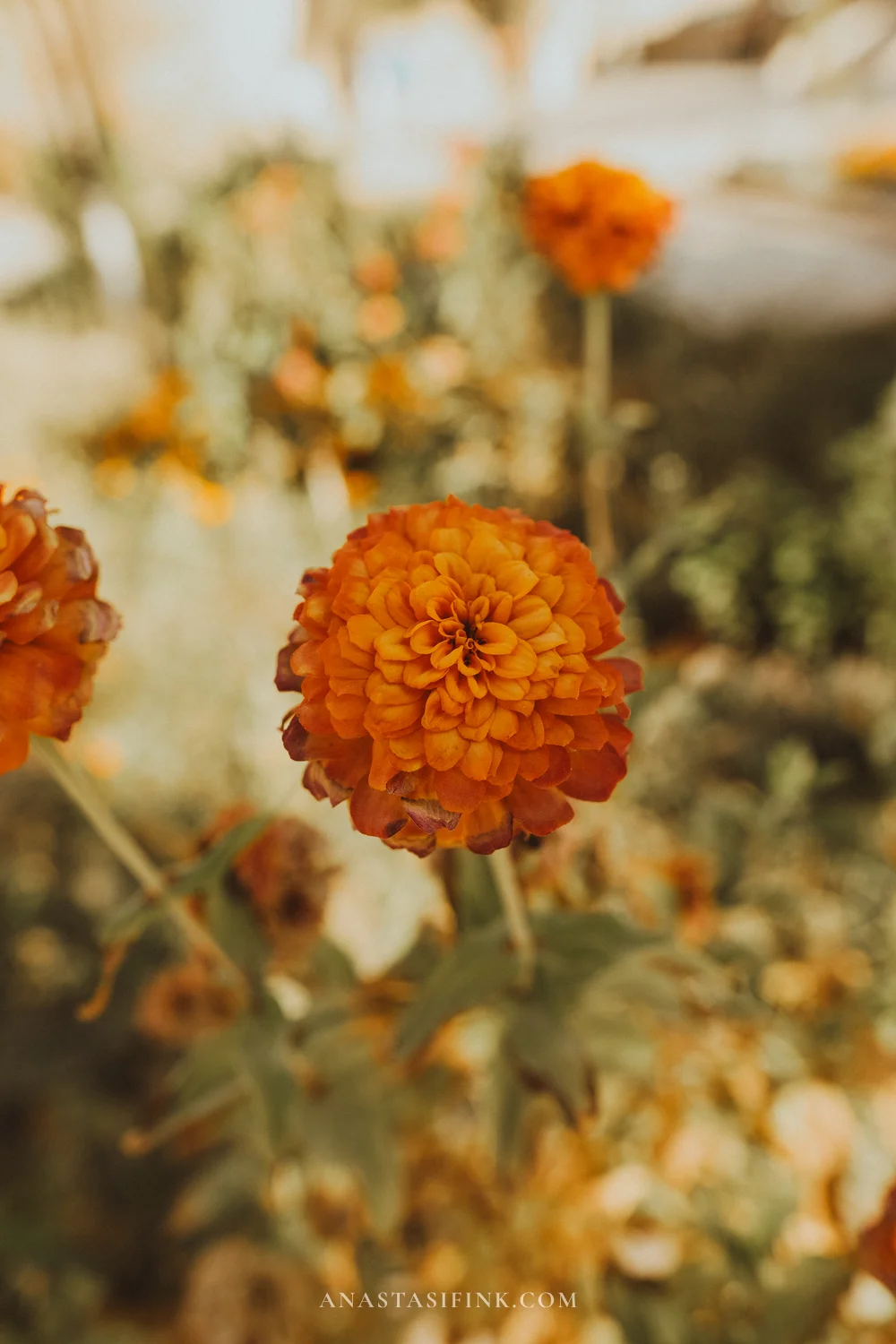
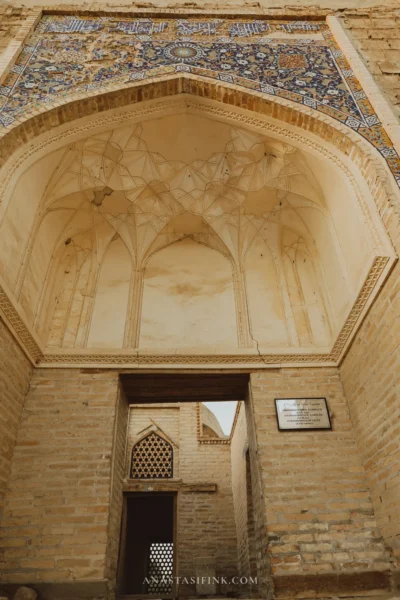
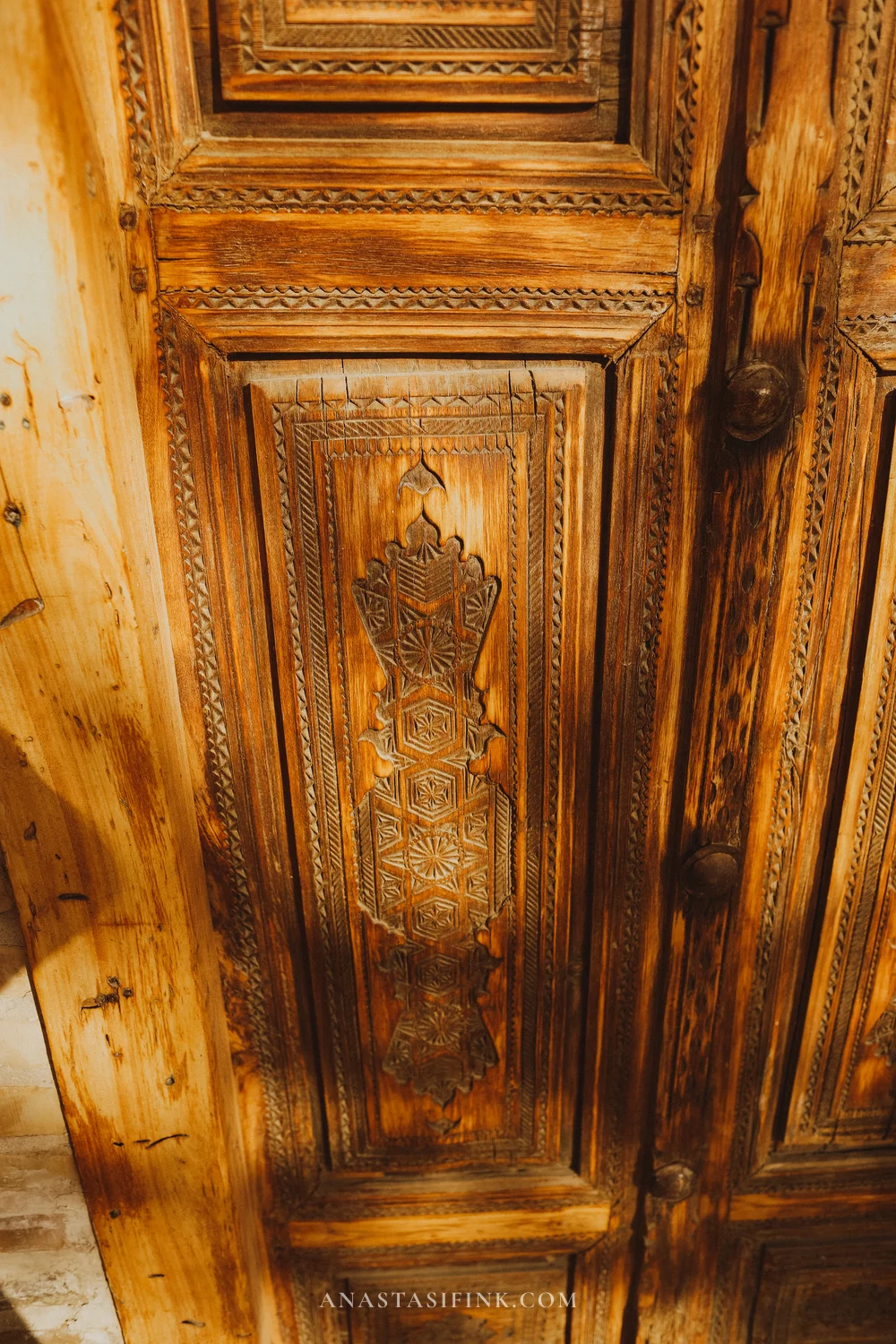
The door and the garden by Chor Minor. The honeycomb lattice in the window is a traditional panjara technique, made from ganch (alabaster) or fired clay.
Practical Information — Chor Minor
- Address: Mehtar Anbar Street, Bukhara
- GPS: 39.7770, 64.4256
- Hours: 09:00–18:00
- Courtyard entry: free
- Climb to the roof: ~10,000 UZS (~ €0.70)
- Time needed: 20 minutes
6. Sitorai Mokhi-Khosa — the last emir’s summer palace
Sitorai Mokhi-Khosa (“the Palace Like the Stars and the Moon”) was the summer residence of the last emir of Bukhara, Alim Khan, four kilometers north of the old city. It’s an eclectic east-meets-west collision: Russian tile stoves, Japanese vases, Bukharan muqarnas, and French mirror halls all in the same building. The emir built this palace in the early twentieth century — officially as a summer dacha, in practice as a showcase of the “new Bukhara.”
Peacocks live in the garden, chrysanthemums bloom, and on the edge of the pond there’s a carved wooden pavilion that doubles as a summer mosque. The whole compound is a museum today. For a deeper dive into each room and the full story of Emir Alim Khan, see the dedicated piece: Sitorai Mokhi-Khosa — the Last Emir of Bukhara’s Summer Residence.
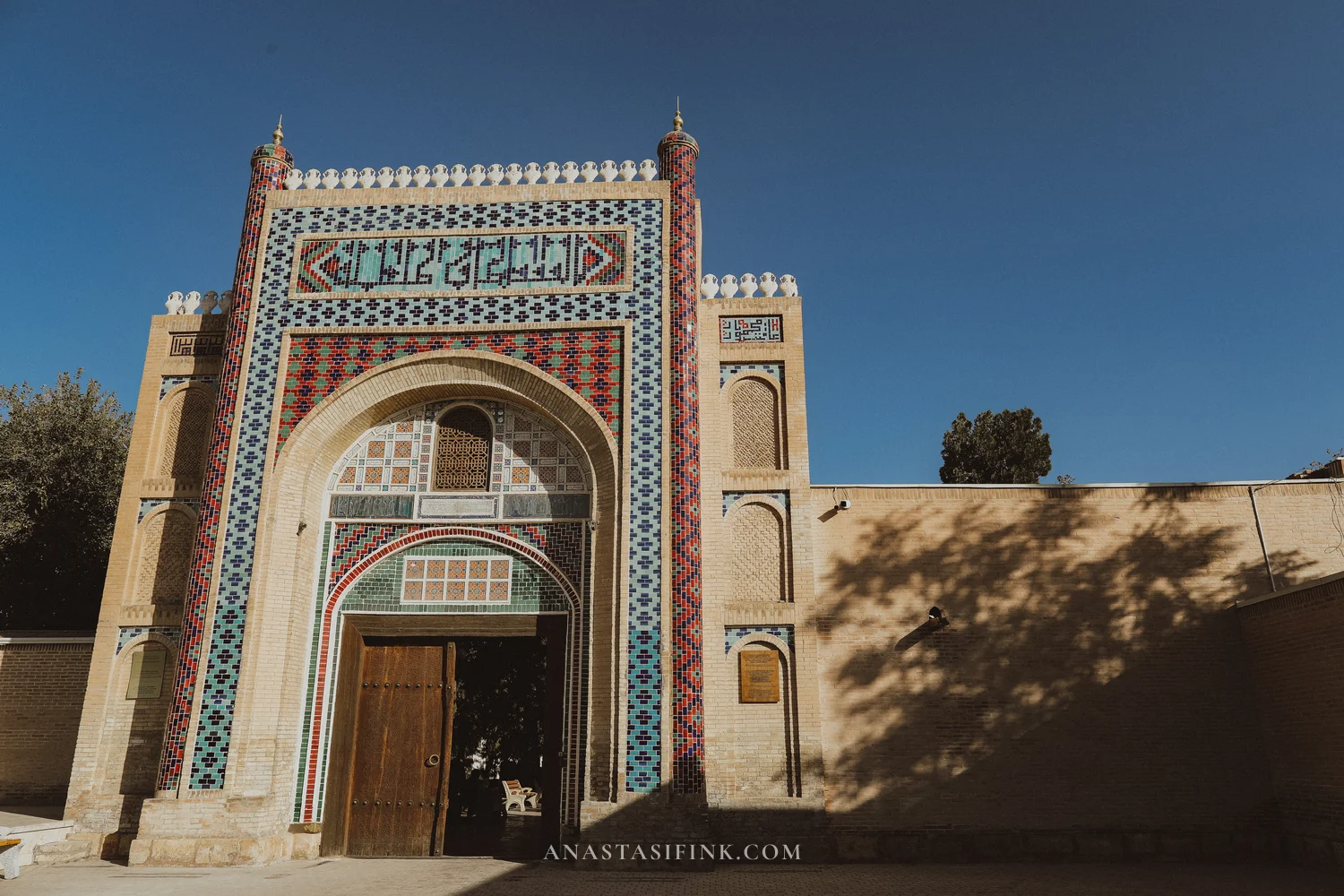
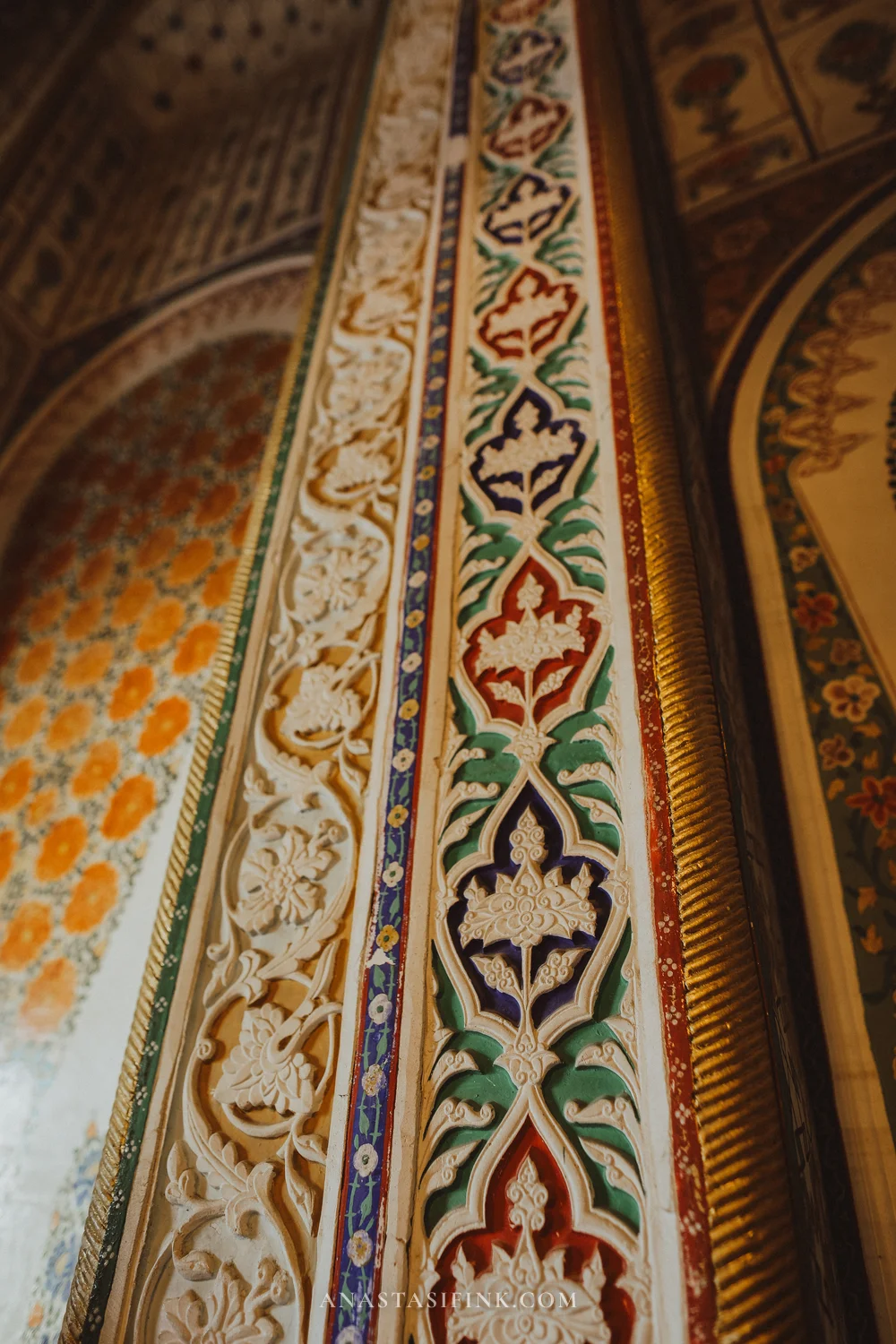
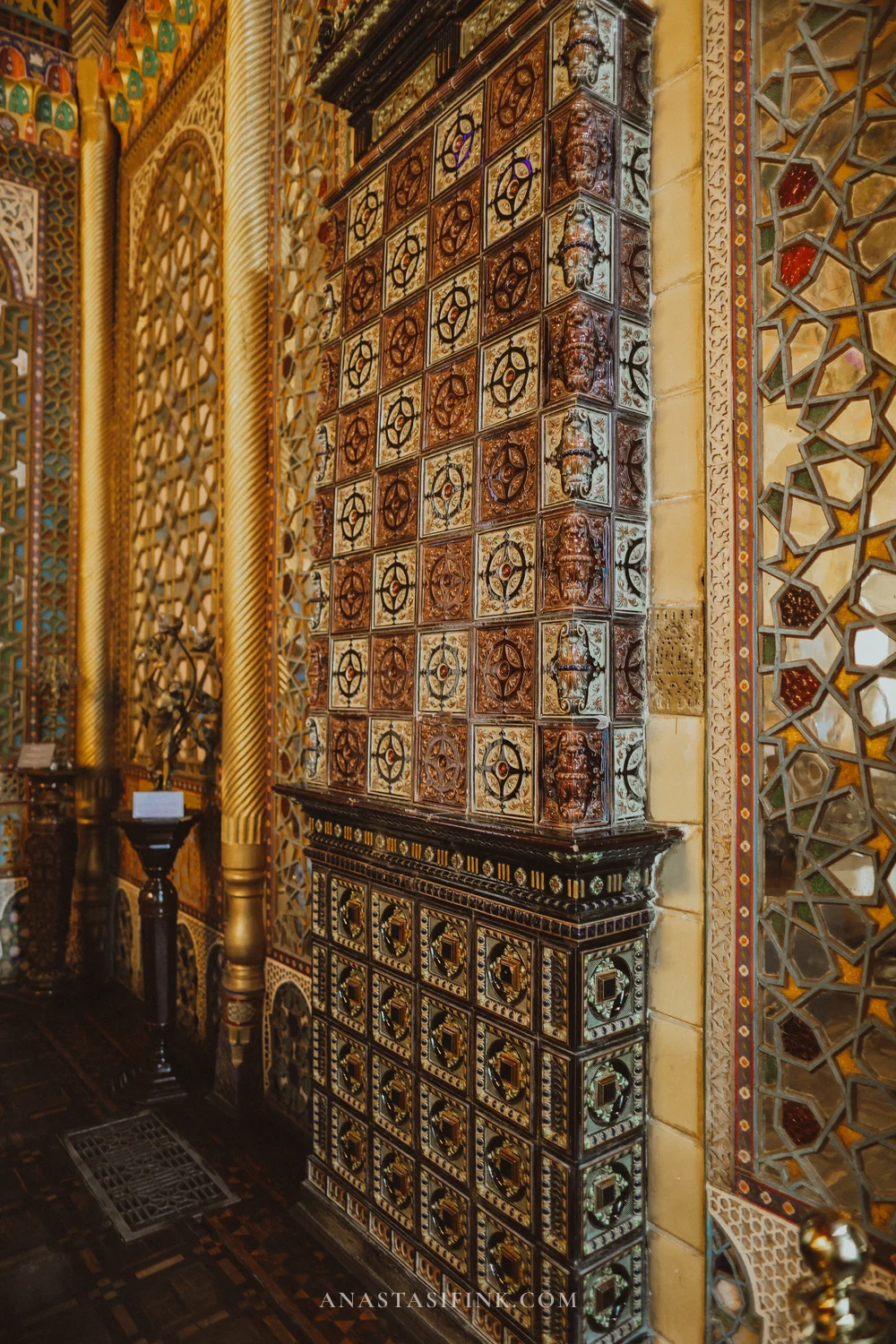
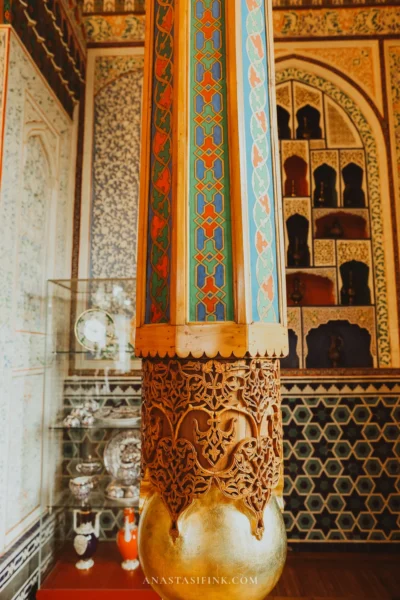
Carved ganch and a Russian tile stove.
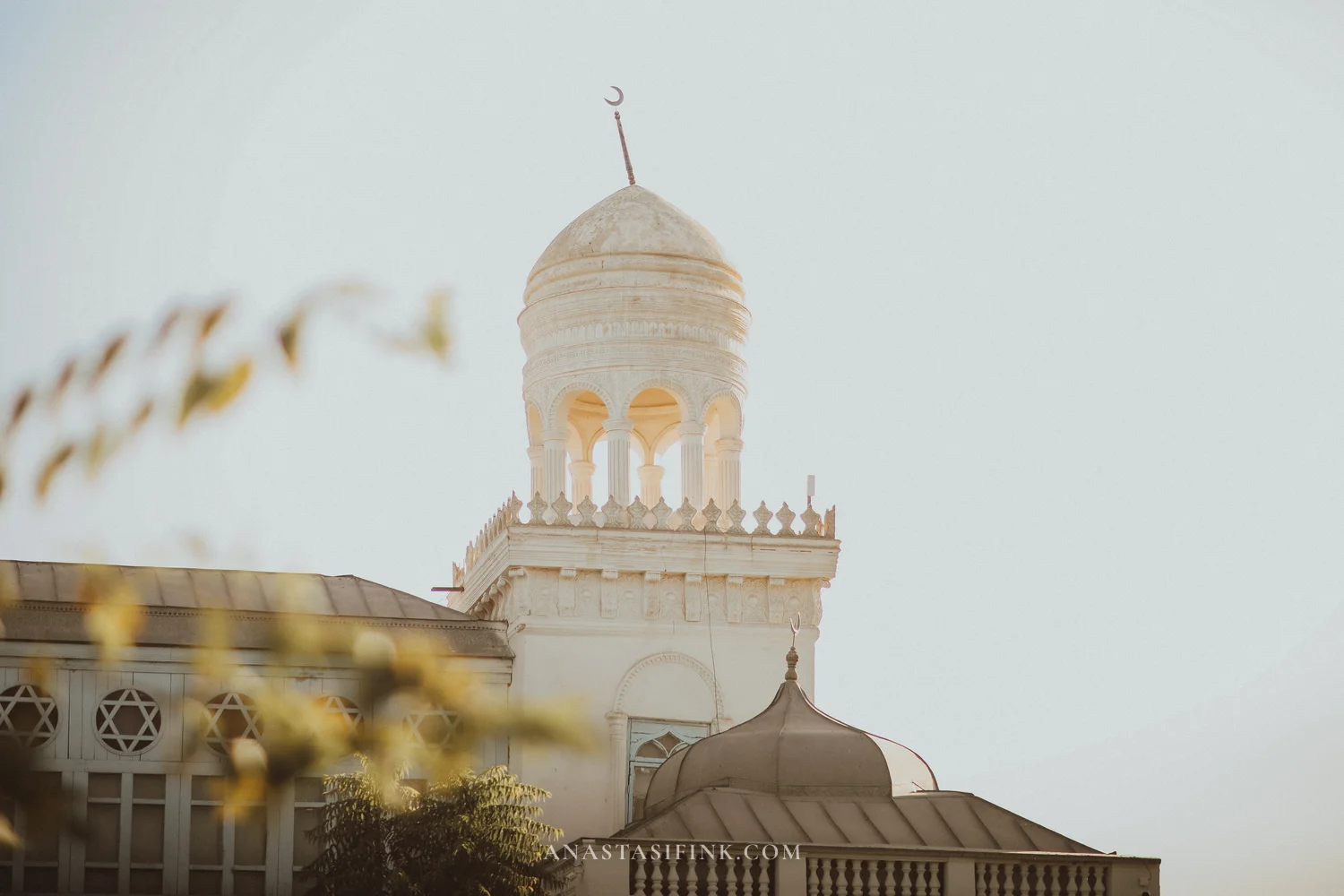
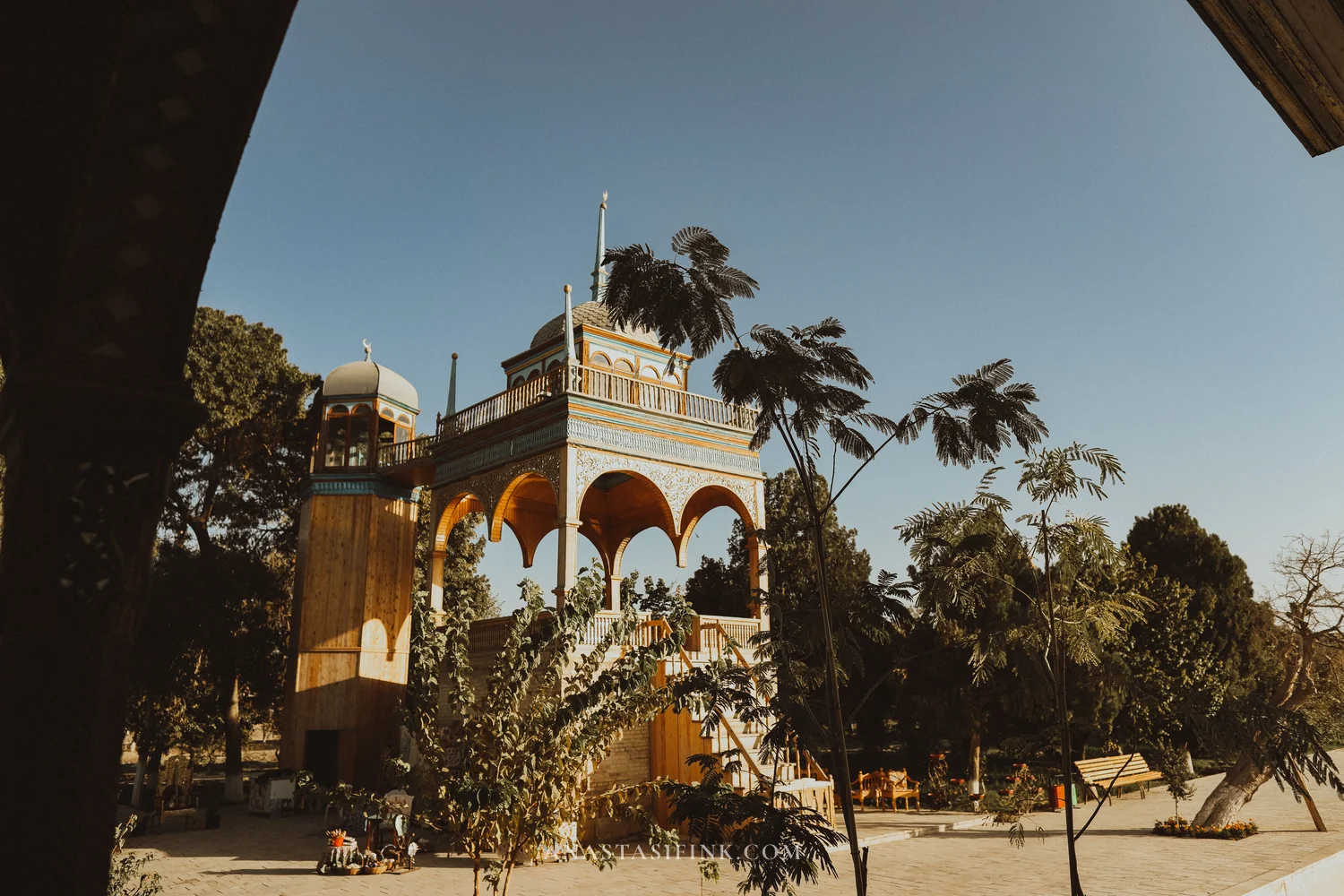
Left — the observation tower, where the emir could look out over the harem hauz. Right — a carved wooden pavilion on the edge of the pond. It’s not a tea pavilion, as a lot of guides claim: the crescents on the domes mark it as a summer mosque.
Practical Information — Sitorai Mokhi-Khosa
- Address: Gijduvan Road, 4 km from the center
- GPS: 39.8159, 64.4267
- Hours: 09:00–17:00
- Entry: 30,000 UZS (~ €2.10), photography fee charged separately
- Getting there: Yandex taxi (~25,000 UZS one way) or bus #9
- Full guide: Sitorai Mokhi-Khosa — the Last Emir’s Summer Residence
7. Chor-Bakr — the necropolis of the Juybar Sheikhs
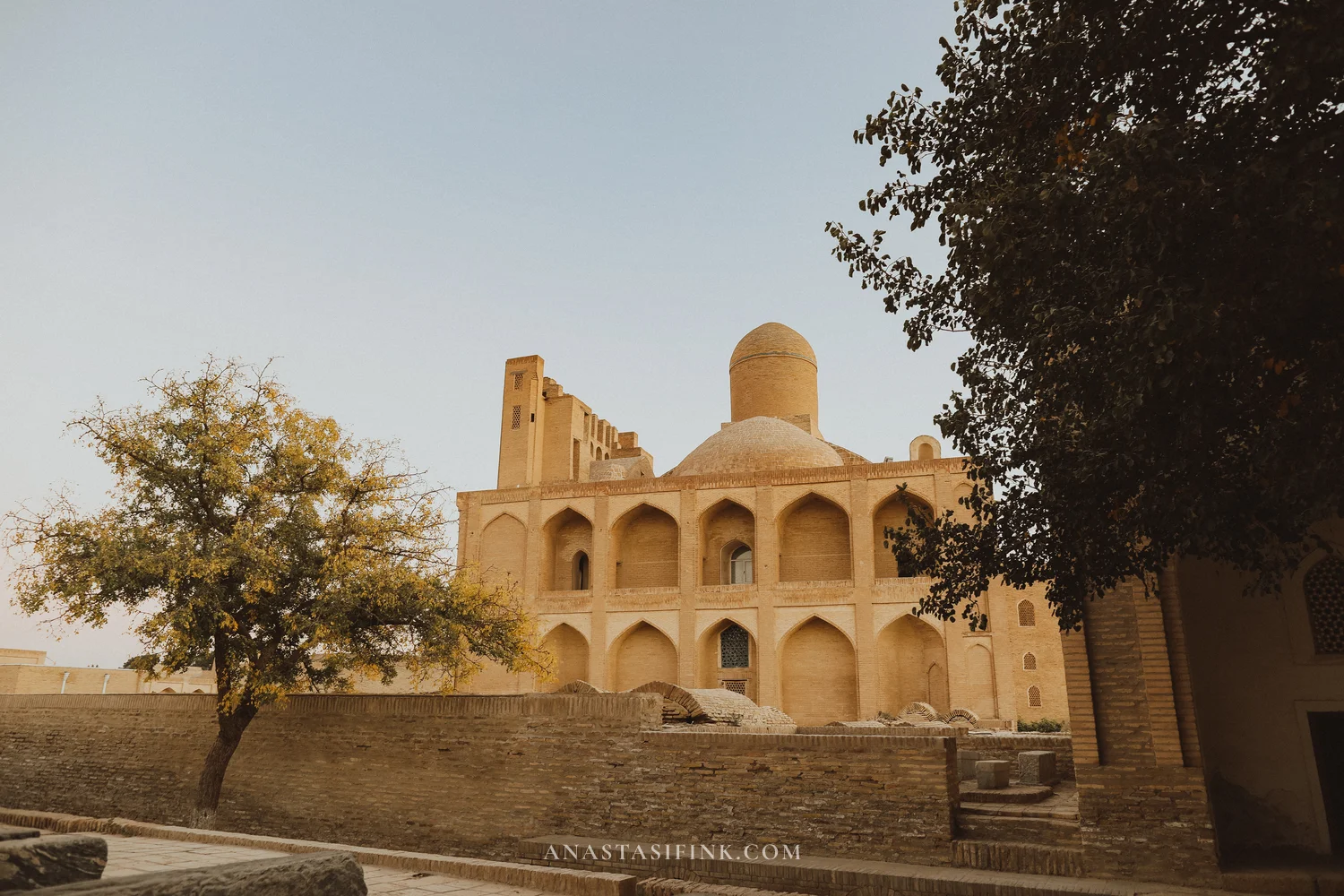
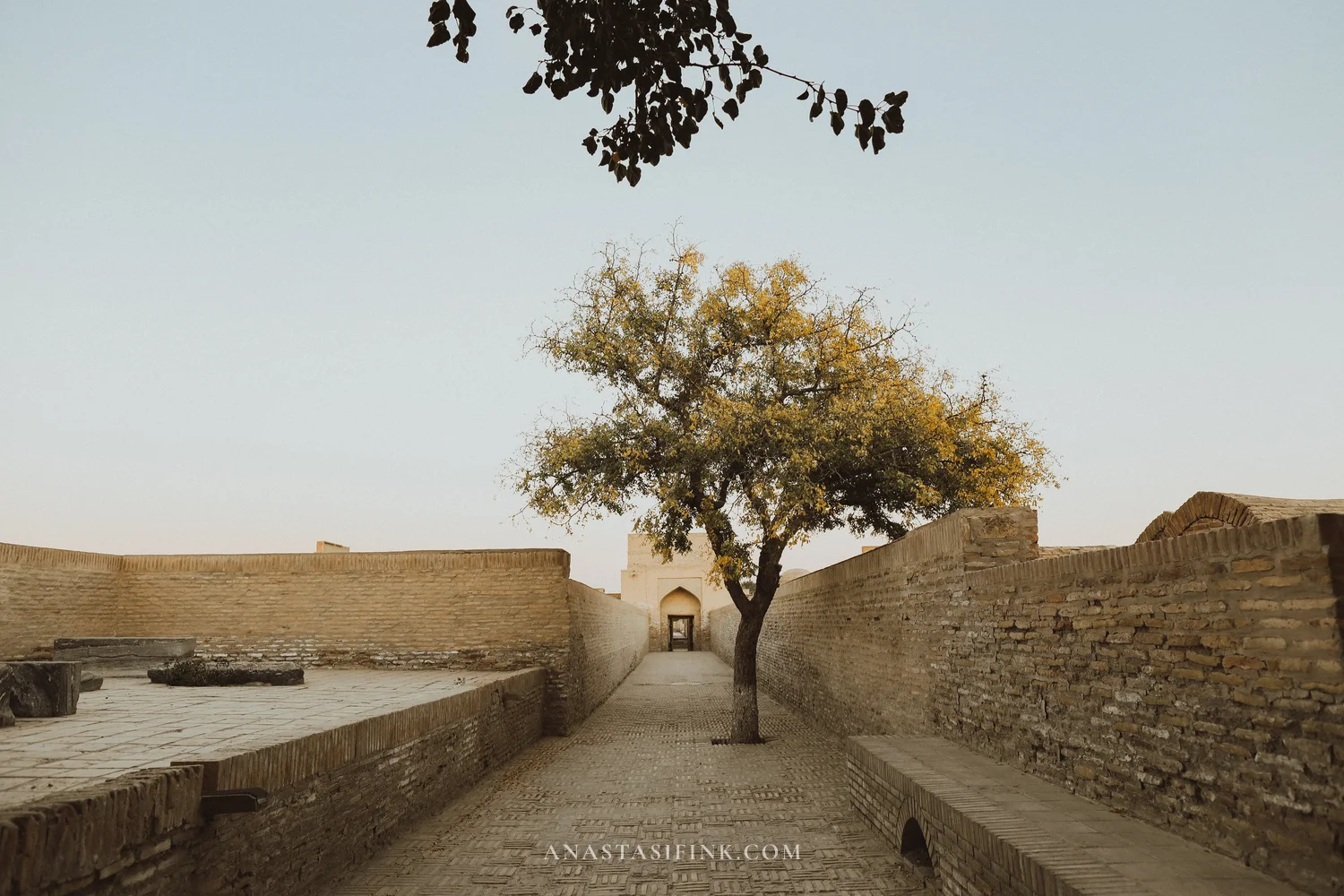
Chor-Bakr is a sixteenth-century memorial complex in the village of Sumitan, five kilometers west of Bukhara. It’s the family necropolis of the Juybar Sheikhs — Sufi masters who, under Khan Abdullah II, effectively governed Bukhara. The architectural ensemble (a mosque, khanaka, madrasa, and a minaret that mirrors the Kalyan) was built in 1560, and around it a “city of the dead” grew — a labyrinth of hazira, roofless family burial enclosures.
Come for the silence and the scale. There are fewer tourists here than anywhere else in Bukhara — in half an hour you might cross paths with a single caretaker and a couple of cats on the wall. The full write-up is in a separate piece: Chor-Bakr — the Necropolis of the Juybar Sheikhs near Bukhara.
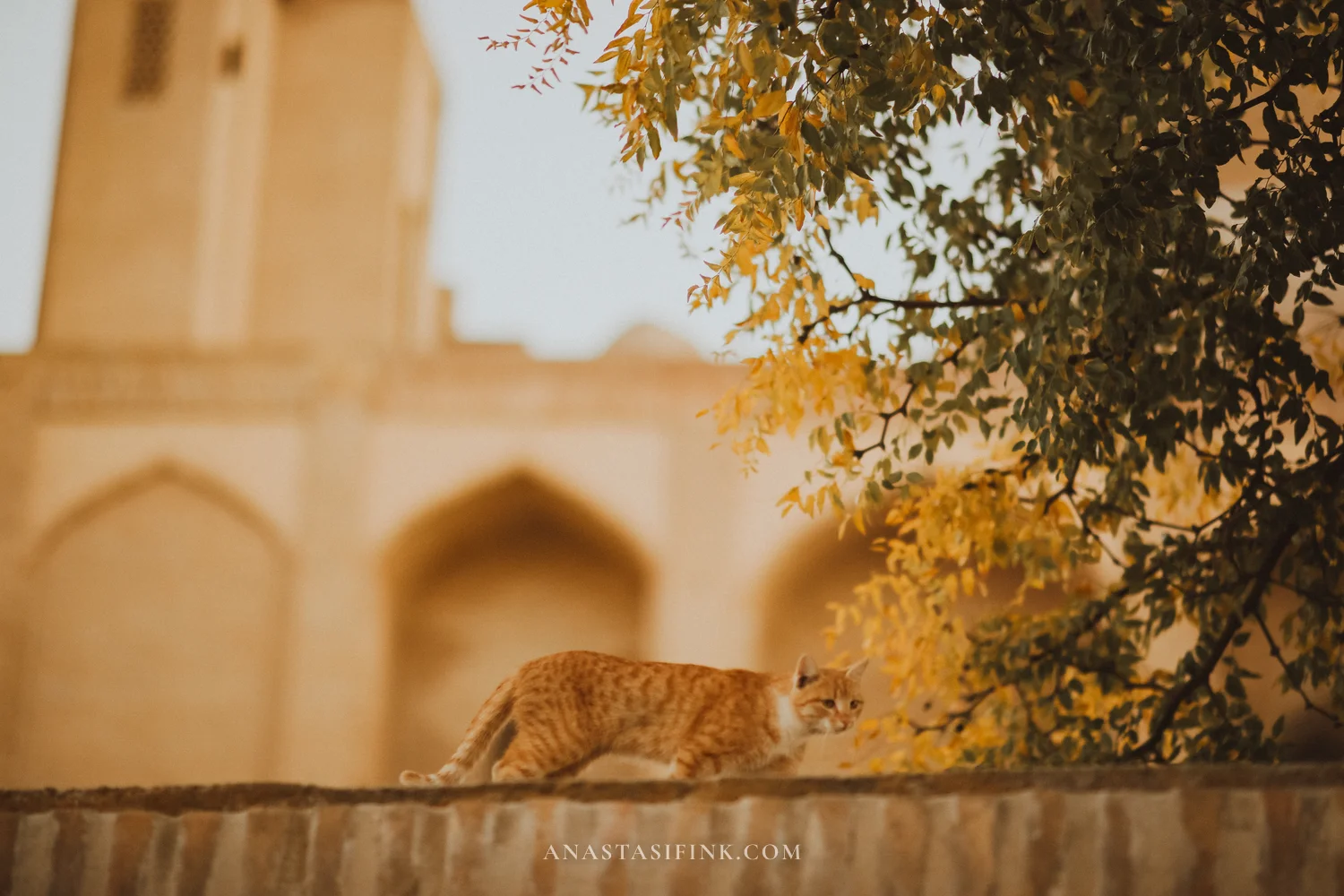
A ginger cat passed by.
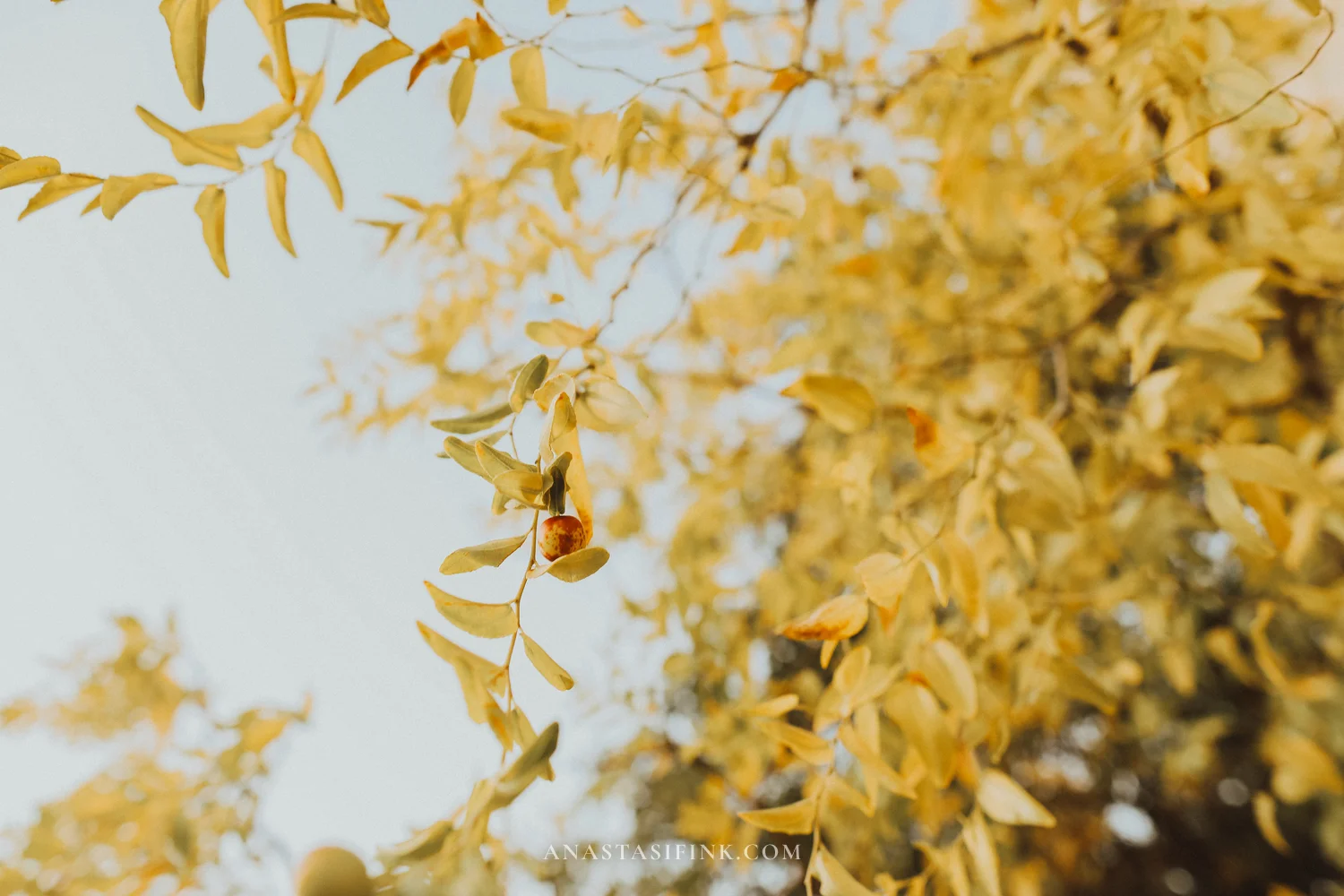
Chor-Bakr in autumn. If you have a choice — come at the end of October or the beginning of November.
Practical Information — Chor-Bakr
- Address: village of Sumitan, 5 km from Bukhara
- GPS: 39.7549, 64.3556
- Hours: 08:00–18:00
- Entry: 15,000 UZS (~ €1)
- Getting there: taxi (~30,000 UZS round trip with waiting time)
- Full guide: Chor-Bakr Necropolis — Guide to the Juybar Sheikhs’ Burial Complex
8. Samanid Park — a ninth-century mausoleum and the Spring of Job
Samanid Park is a green square west of the Ark with two important mausoleums and a small modern memorial. I save it for the end of the route, because it makes the perfect last-day stop near sunset — slow loop, sit in the shade, let the impressions of the old town settle.
Ismail Samani Mausoleum
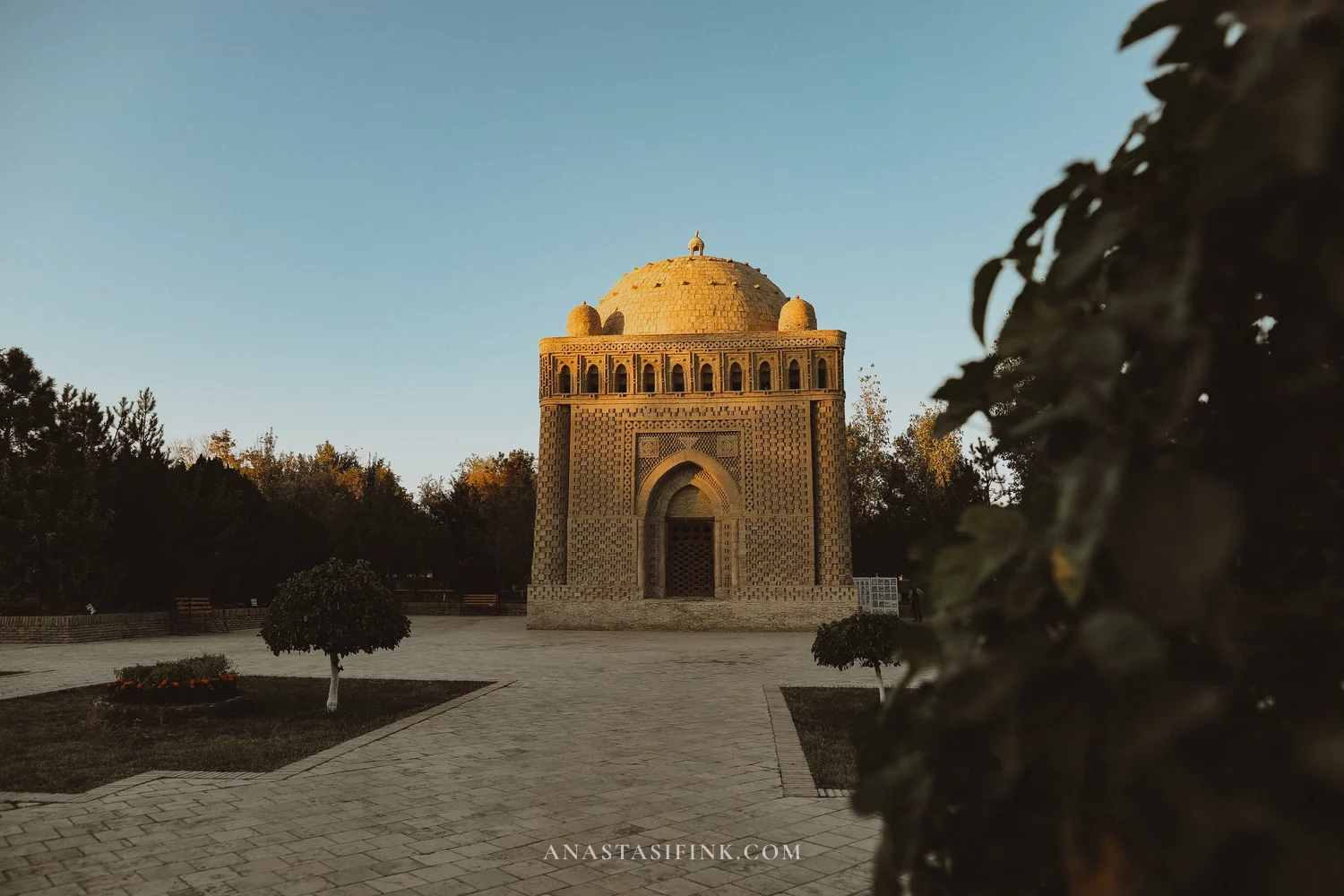
The oldest surviving building in Central Asia — built around 905. A cubic structure under a dome, made of fired brick with no plaster. The pattern is all in the brickwork itself: each wall reads differently depending on the angle of the sun. By the time Genghis Khan’s Mongols reached Bukhara, the mausoleum was already buried in sand and looked like a hillock — which is how it survived. It was only excavated in the 1930s.
Chashma-Ayub — the Spring of Job
Chashma-Ayub (“the Spring of Job”) is a twelfth-to-fourteenth-century mausoleum with a conical dome that’s unusual for Bukhara. Legend says the biblical prophet Job struck the ground here with his staff and a spring burst forth, healing him of his sores. The spring is still preserved inside, and locals come to fill bottles. One of the rooms holds a small museum on Bukhara’s water supply — the karizes, hauzes, and the centuries-long battle with drought that shaped life in the region.
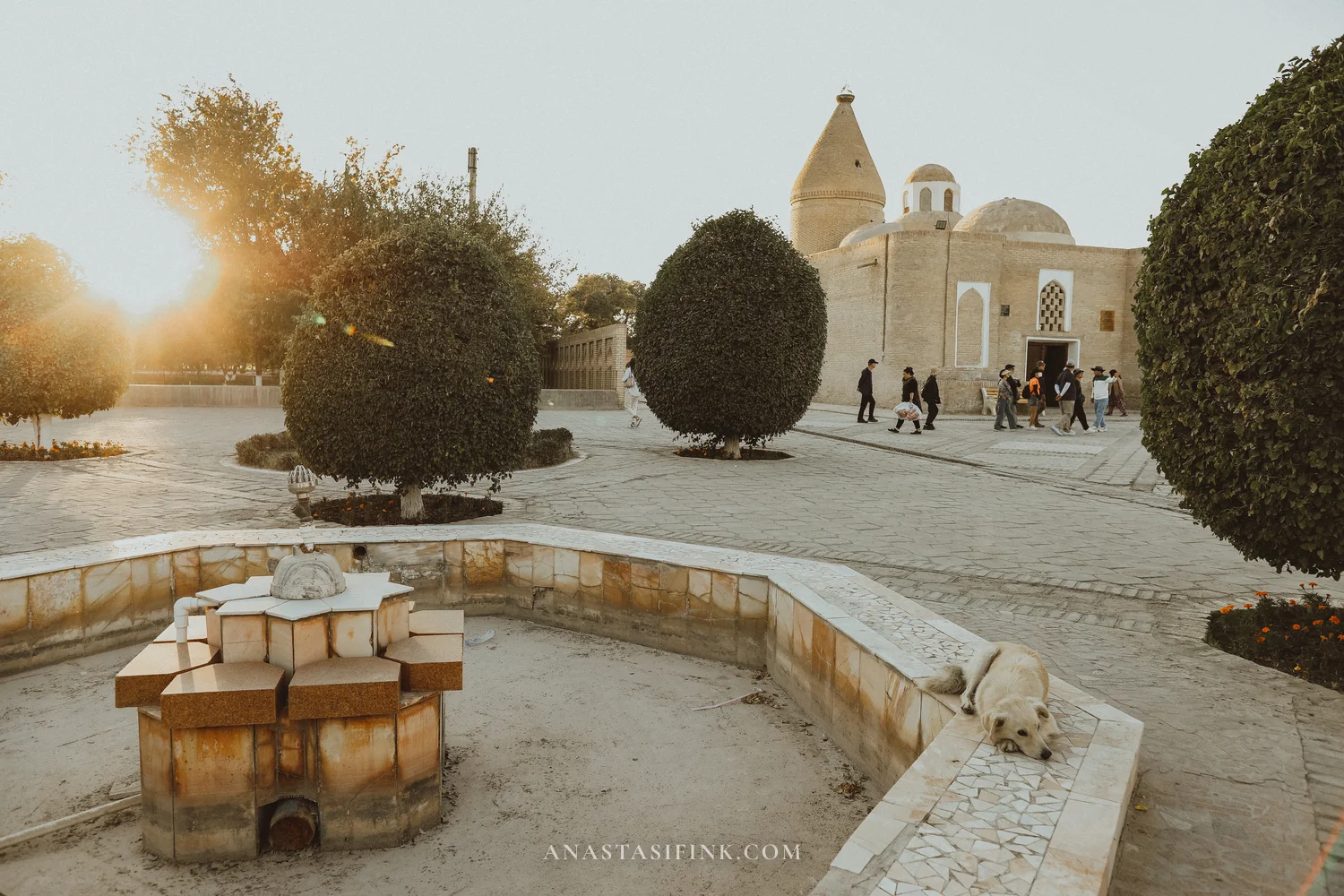
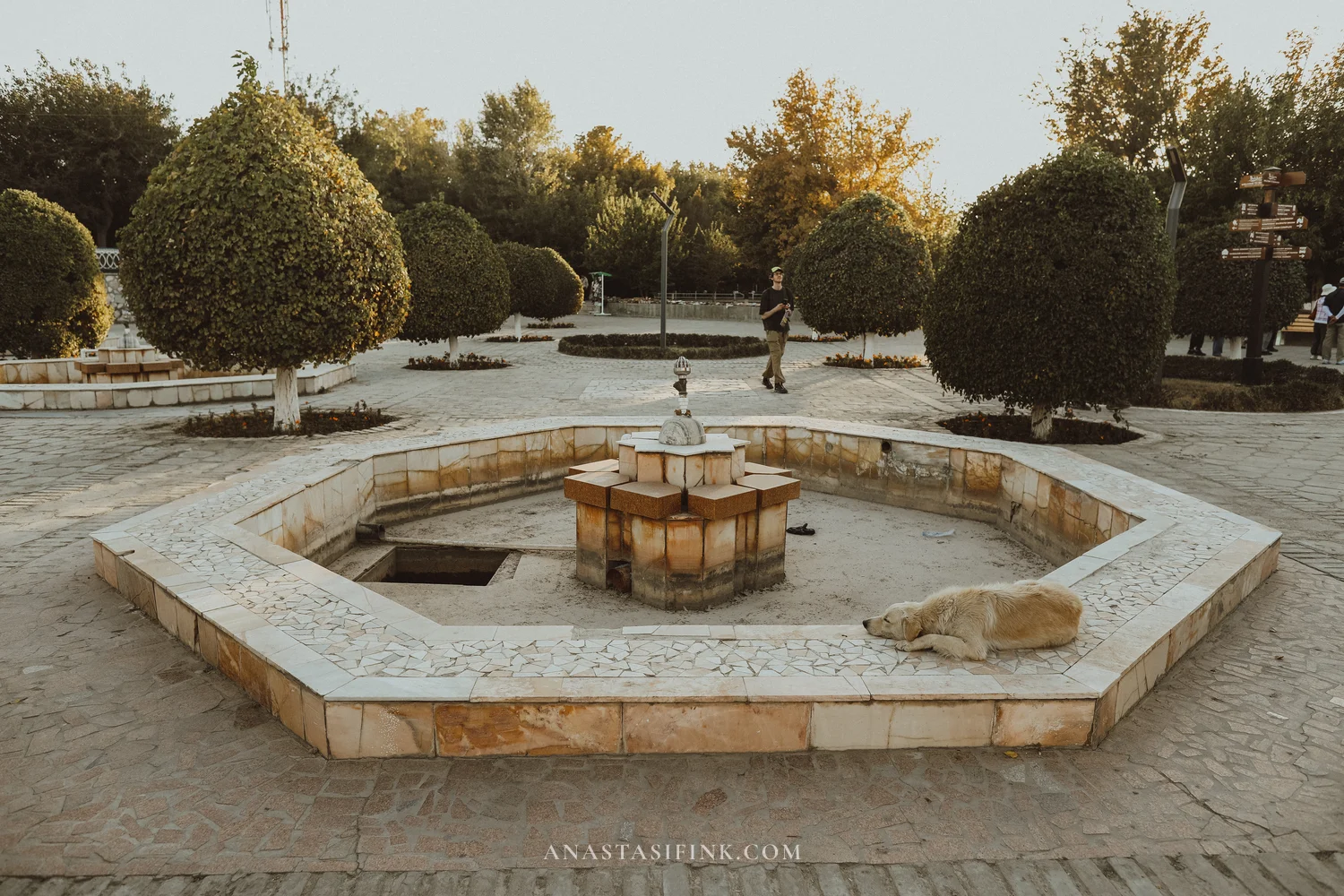
Chashma-Ayub (left) and a fountain in the park (right).
The modern memorial
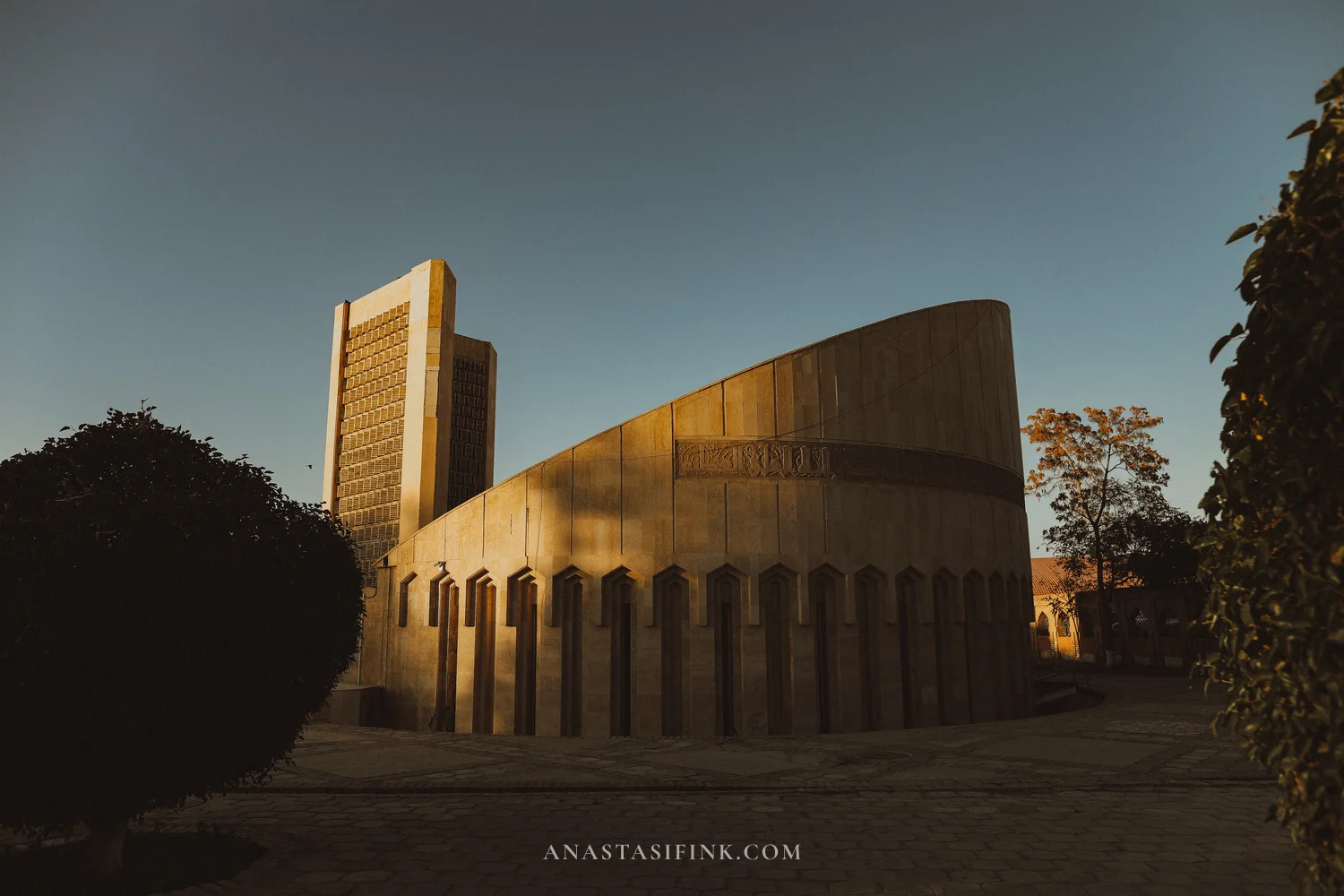
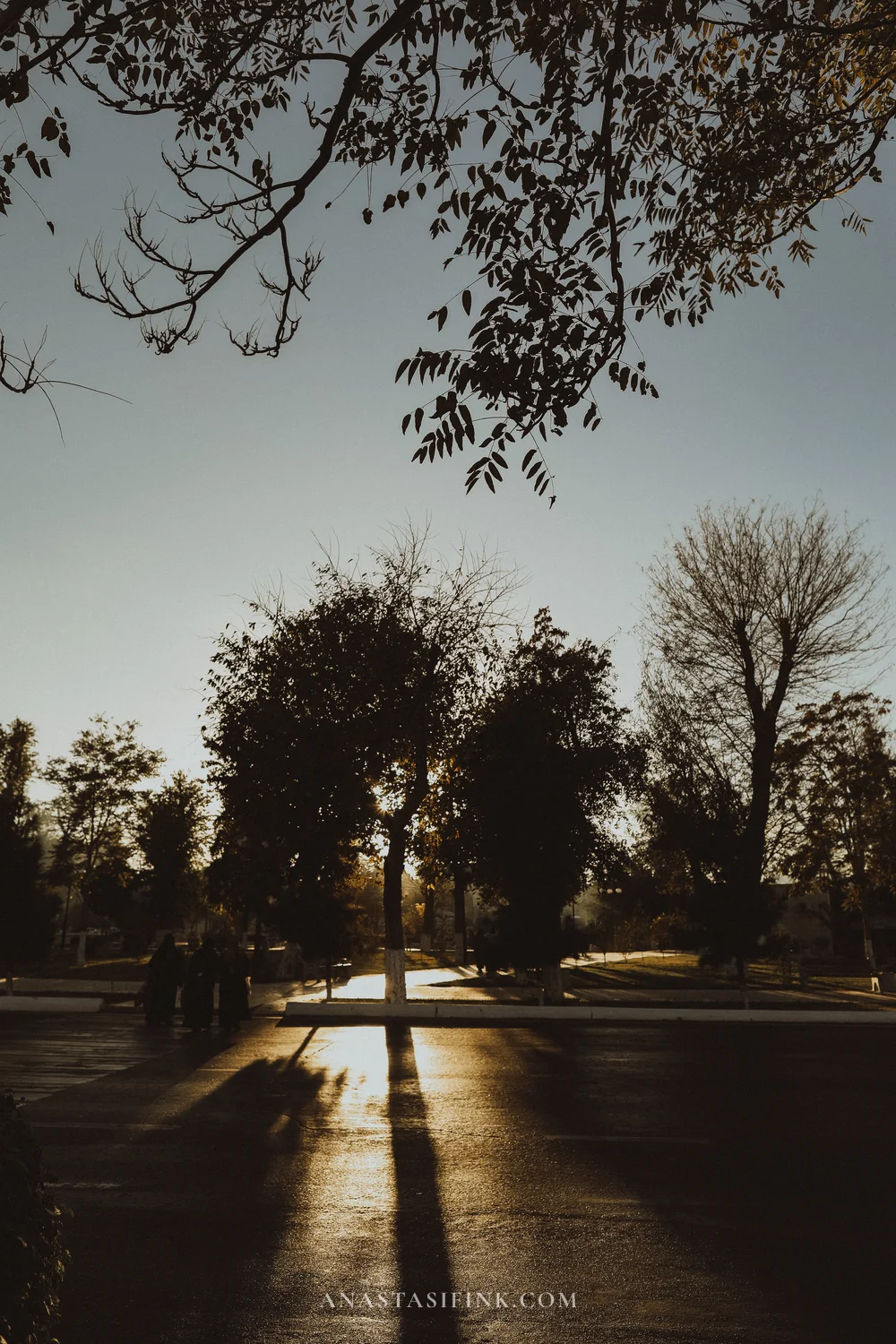
The park also holds a modern memorial pavilion — a semicircular colonnade with a central tower, built in the 2000s. It’s aligned on the same axis as the Samani Mausoleum, and at sunset the two cast a long chain of shadows between them.
Practical Information — Samanid Park
- Address: Saiidjon Bobo str., free entrance
- GPS: 39.7770, 64.4087
- Hours: park — open 24/7, mausoleums — 09:00–17:00
- Park entry: free
- Mausoleum entry: 15,000 UZS each (~ €1)
- Time needed: 60–90 minutes
Where to eat in Bukhara: plov, achichuk, samsa
Bukhara has plenty of restaurants, but my top pick is the one simply called “Bukhara” — set in an old house with ikat tablecloths, hand-painted tableware, and a view of the trading square. The menu is classic Uzbek, but without the dumbed-down tourist version: they cook what they actually eat.
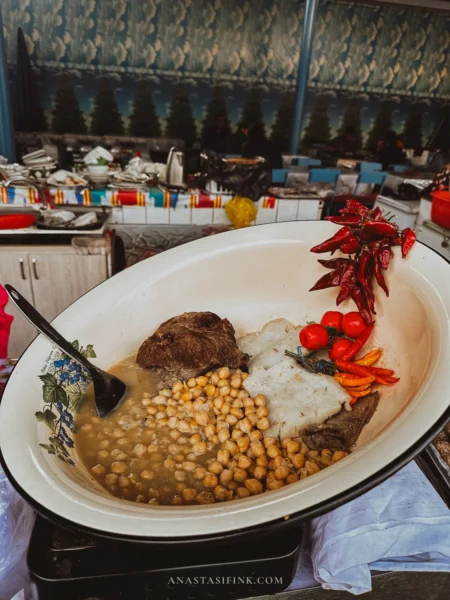
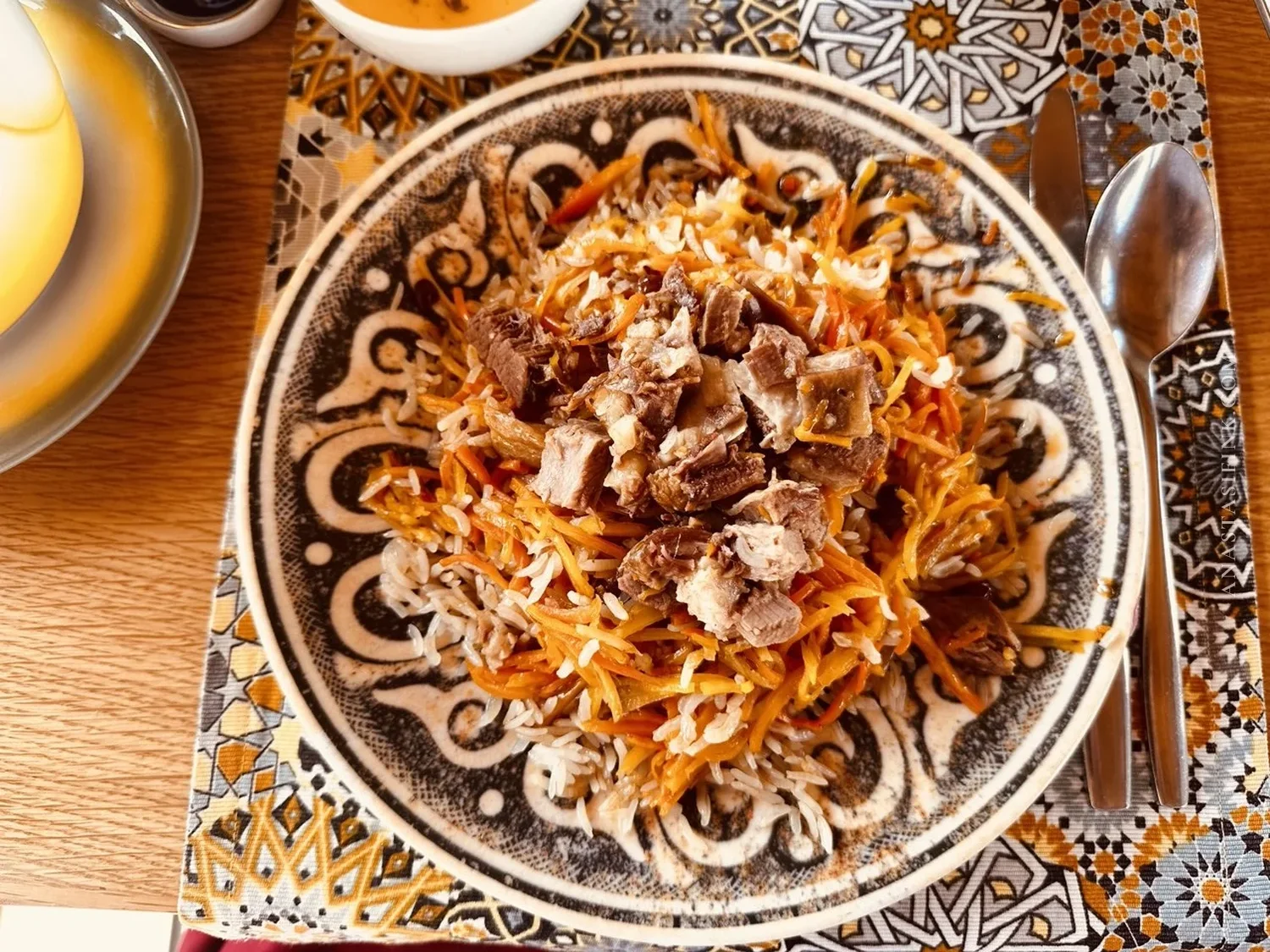
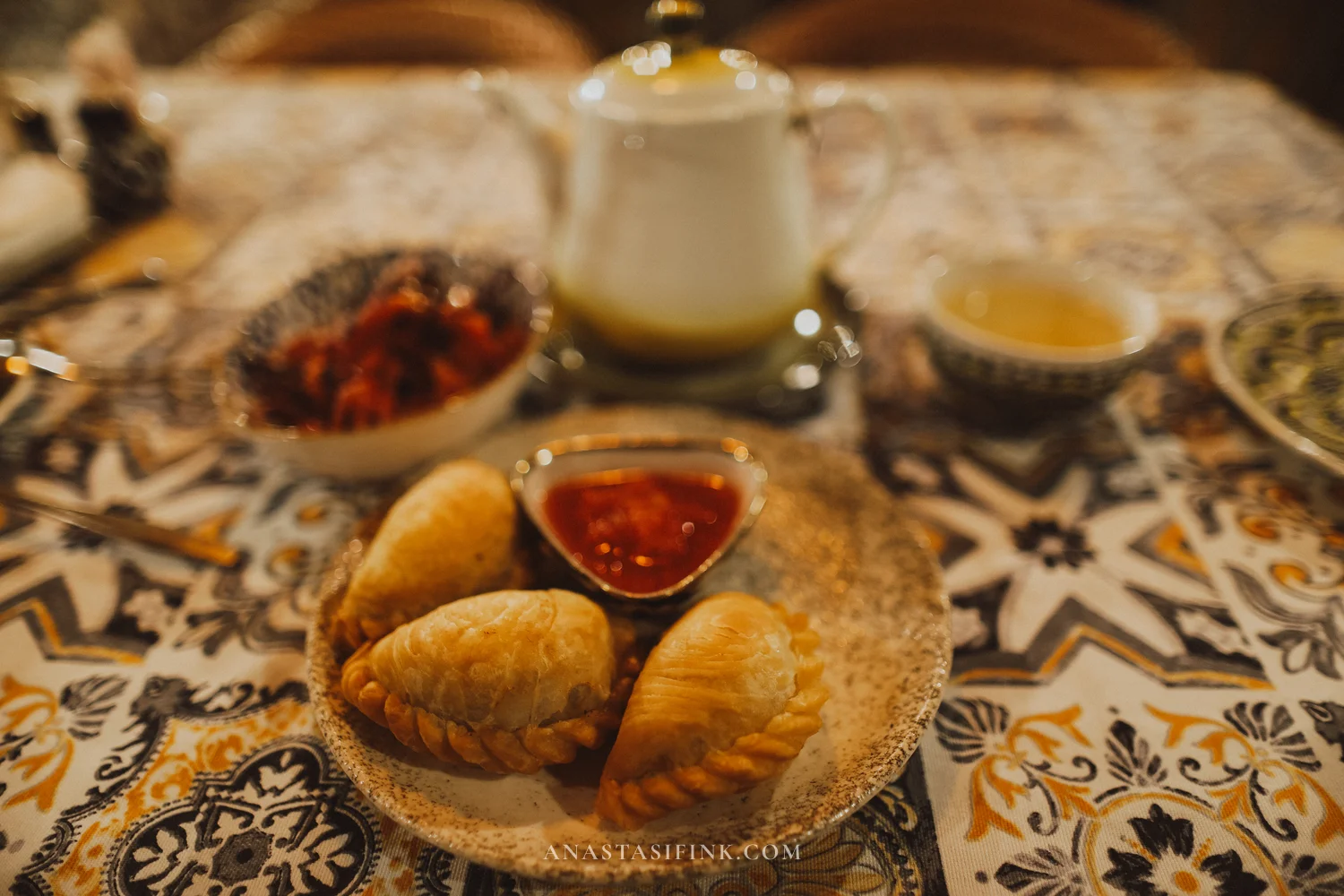
You have to order Bukhari plov — it’s different from the Fergana version: the rice is cooked separately, not together with the zirvak; the carrots are cut thinner; the lamb sits on top in big chunks. The result is loose, not greasy, and gentler in flavor. Pair it with achichuk salad (tomatoes, onion, basil, black pepper) and tea. The black tea with lemon comes in a porcelain pot.
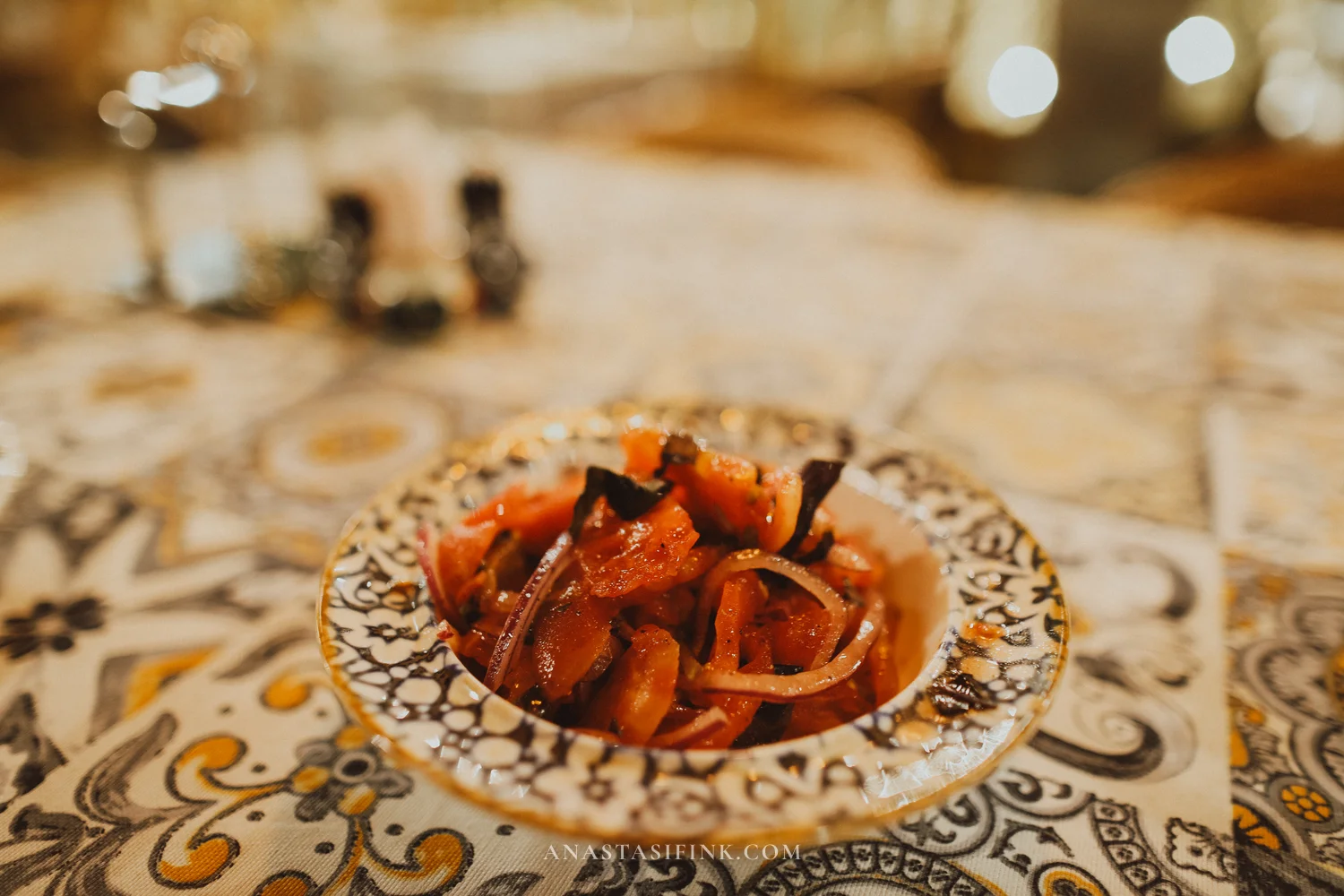
Achichuk — the simplest Uzbek salad you have to eat in Bukhara
Achichuk is just tomatoes, red onion and basil. Salt, black pepper, sometimes a tiny bit of vegetable oil — that’s it. No mayo dressing, no flourishes. Which means the entire dish lives or dies on the vegetables: there’s nowhere to hide a mealy tomato or a bitter onion.
I ate achichuk everywhere I went in Uzbekistan — Tashkent, Samarkand, Khiva, roadside tea houses. But the best one was here, in Bukhara. Tomatoes ripe to the point of sweetness, onion sliced thick and always the sweet red kind (never sharp), basil — rayhan, the purple variety, added a minute before serving. Order it as a starter to your plov: heavy rice paired with this light, sharp-sweet, slightly tangy salad — it resets your palate between bites.
Samsa and tea — the obligatory follow-up
Practical Information — Bukhara Restaurant
- Address: search for “Bukhara Restaurant” on the map
- GPS: ~39.7723, 64.4197
- Hours: 11:00–23:00
- Average bill: 100,000–150,000 UZS (~ €7–11) per person
- Tip: book a dinner table — the place fills up
Where to find coffee — a quick note
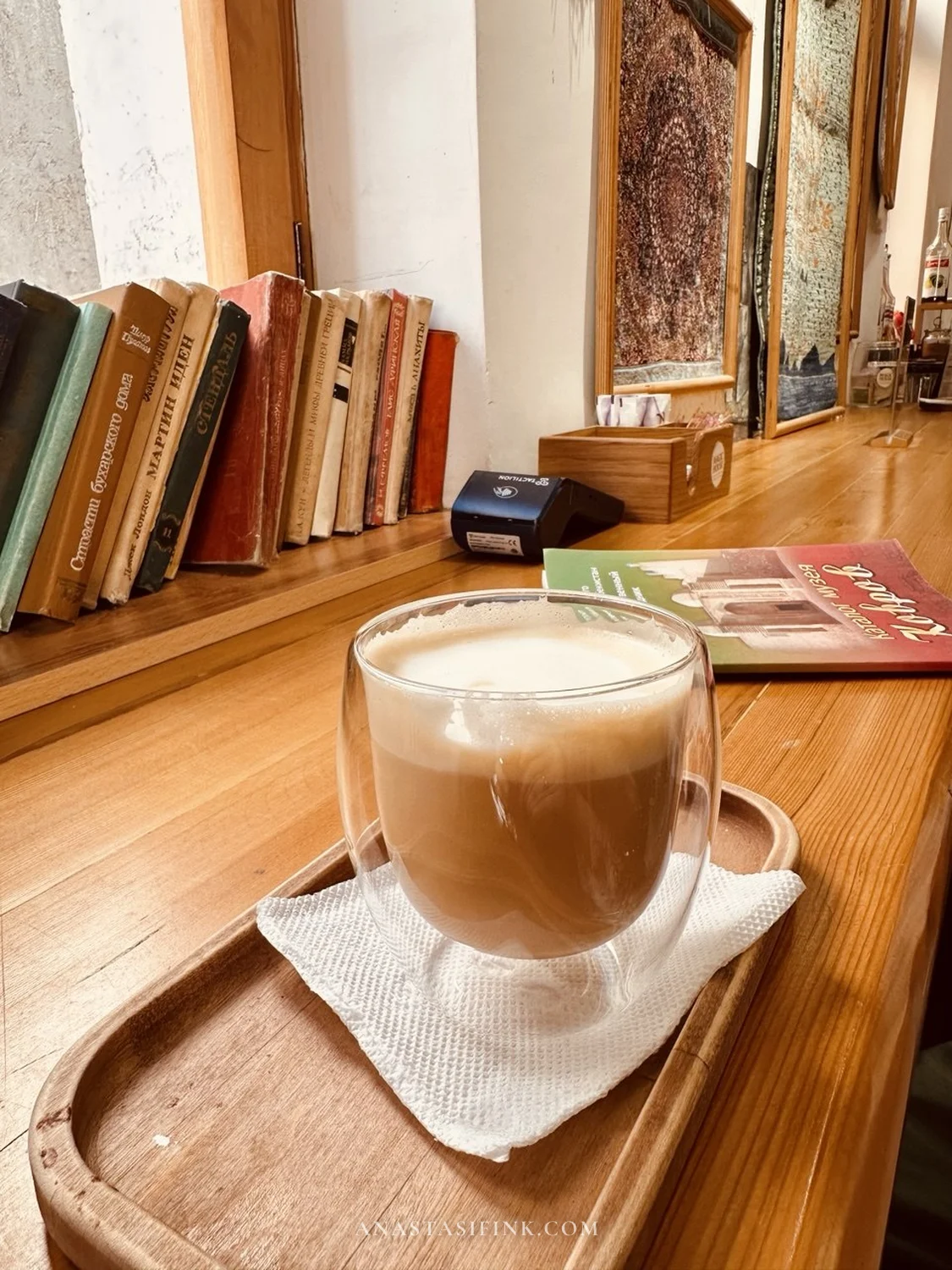
Coffee in Bukhara is harder than tea. Most tea houses don’t make coffee at all, and the ones that do tend to use instant. The one place I found that pulls a proper latte or flat white is a small café right in the old town — bar counter, a stack of old books along the window, and a very quiet vibe.
Bonus: the Bukhara Biennial — contemporary art in a medieval city
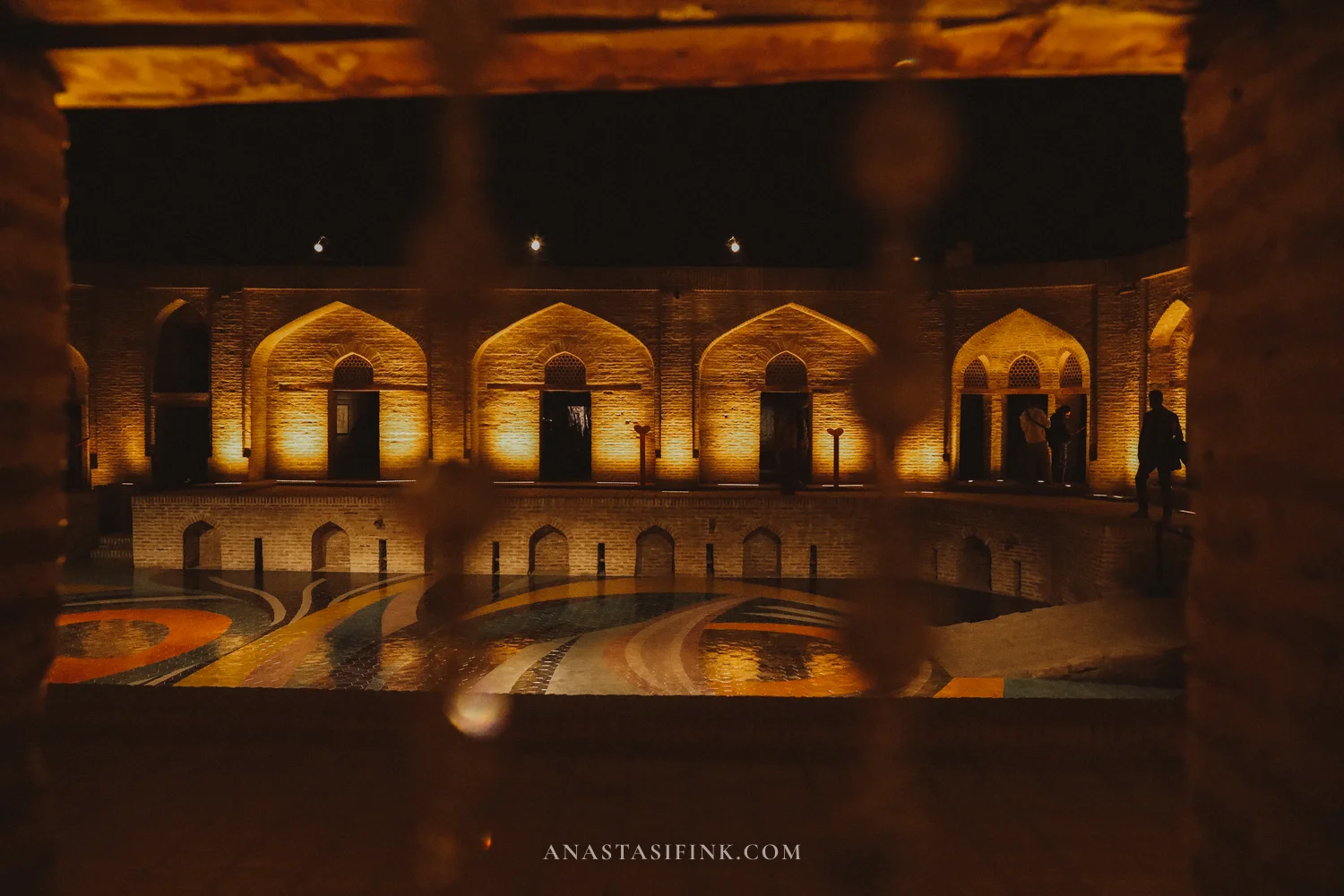
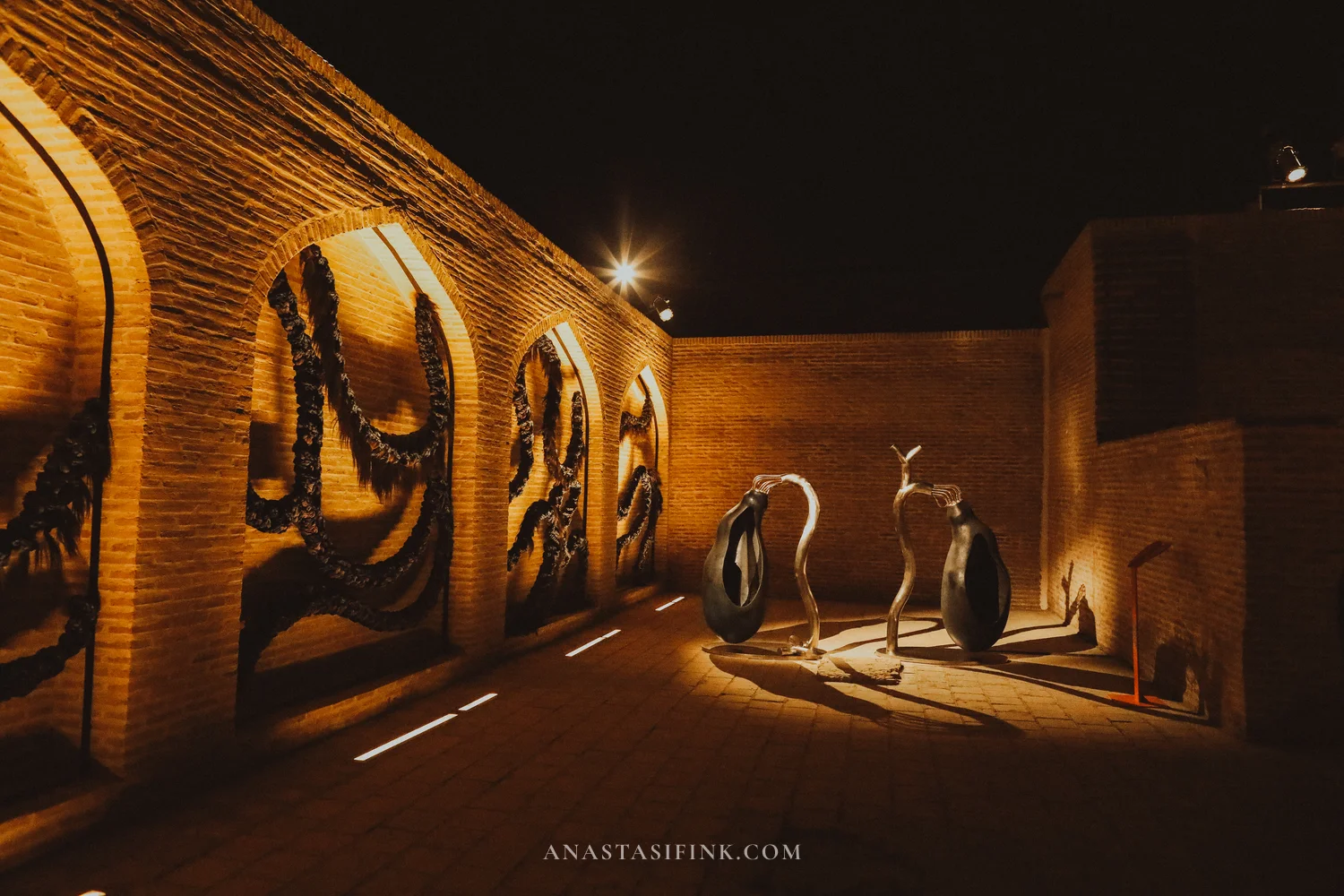
I happened to be in Bukhara during the very first Bukhara Biennial. The theme of the inaugural edition was Recipes for Broken Hearts — a nod to the legend that Avicenna invented plov as a remedy for a young man dying of heartbreak. Across the historic center they staged 70 site-specific installations from 200+ artists — inside caravanserais, madrasas, restored hauzes. Some of the installations only come alive after dark.
Where to shop in Bukhara: trading domes, madrasas, Pavillon Kalon
The short version: Bukhara is the best city in Uzbekistan for shopping. In Samarkand and Tashkent the souvenir shops are scattered — you have to seek them out, head to a bazaar, ask for directions. In Bukhara it’s the opposite — there’s literally a shop or workshop on every corner of the old town. You don’t need a special trip: while you’re walking around Po-i-Kalyan, the Ark, Chor Minor and Lyab-i-Hauz, the shopping just happens.
The sixteenth-century trading domes — the main souvenir cluster
The main shopping cluster is the three medieval covered markets between Lyab-i-Hauz and Po-i-Kalyan. They were built in the sixteenth century as specialized bazaars for different guilds, and the original names have stuck:
- Toki Zargaron (“the jewelers’ dome”) — silver, gold, jewelry
- Toki Telpak Furushon (“the cap-makers’ dome”) — textiles, chapans, skullcaps, suzani, ikat
- Toki Sarrafon (“the money-changers’ dome”) — the smallest of the three; historically the place for currency exchange, now souvenirs as well
All three are still working bazaars. You step inside and a whole street of shops unfolds under the brick vaults: textiles, copper, miniatures, lacquer boxes, Rishtan ceramics, silk scarves. The domes block the heat in summer and the wind in winter — which is why you can spend hours rummaging.
Most important rule: bargain — prices are usually inflated.
What to buy: Bukhara’s signature crafts
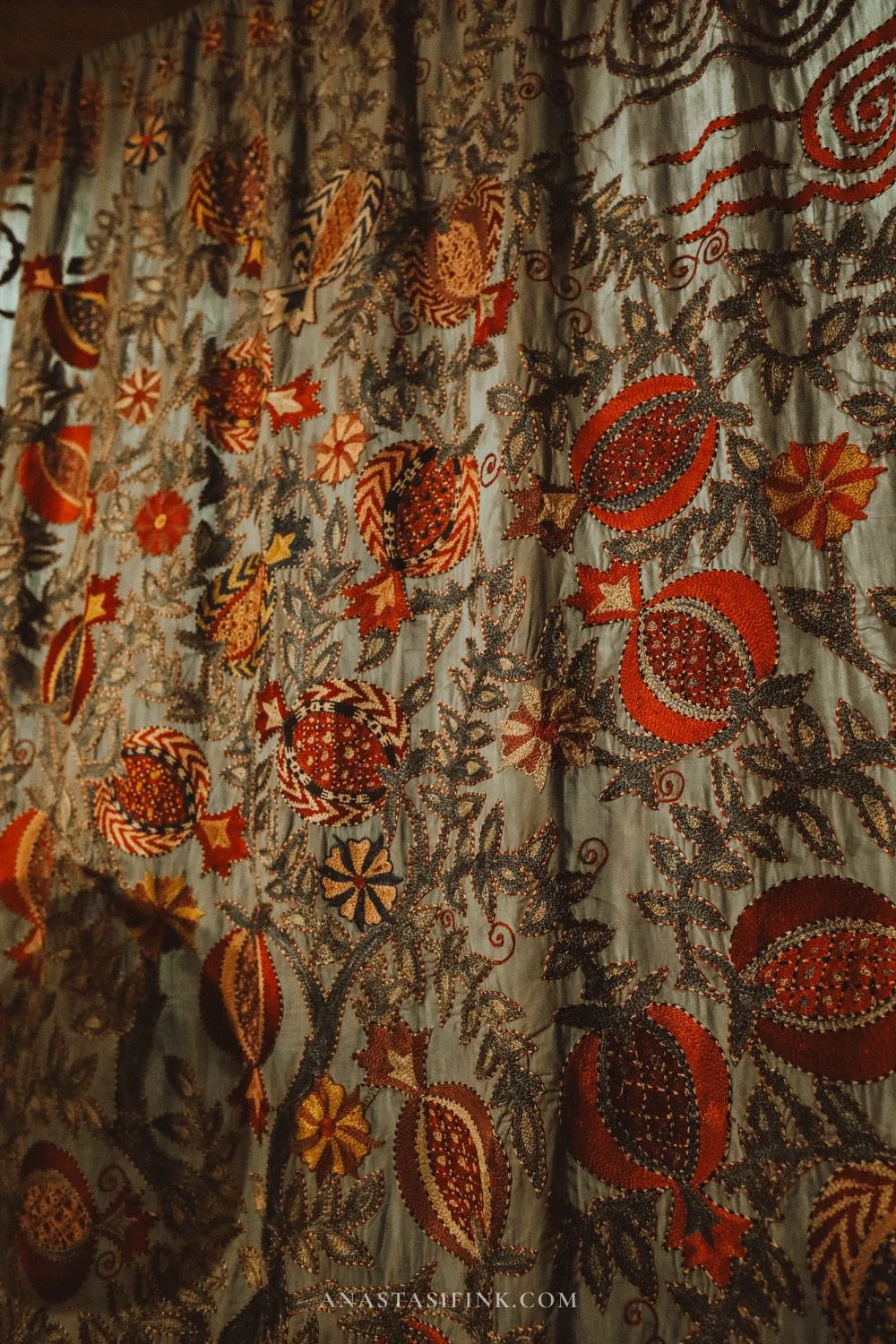
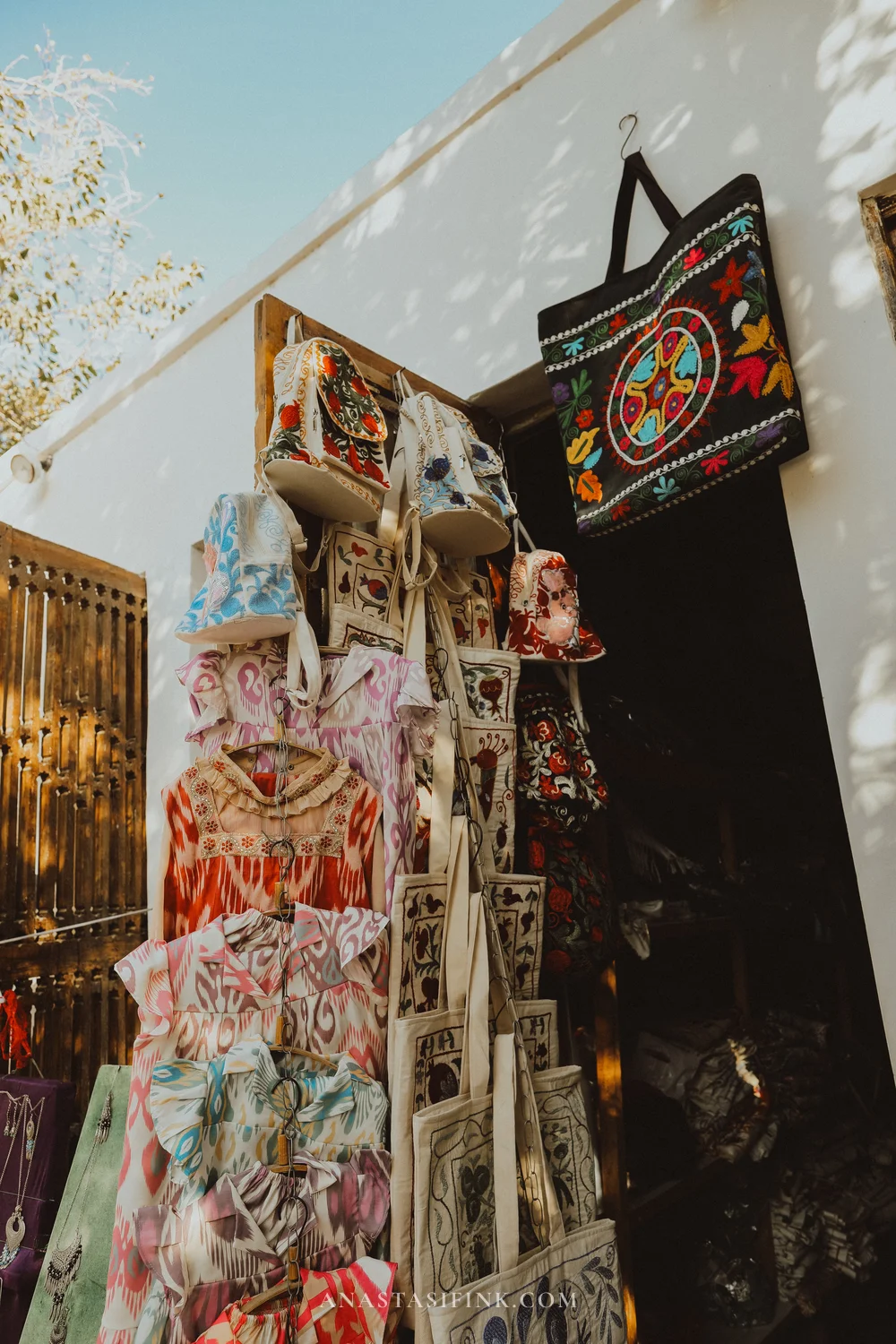
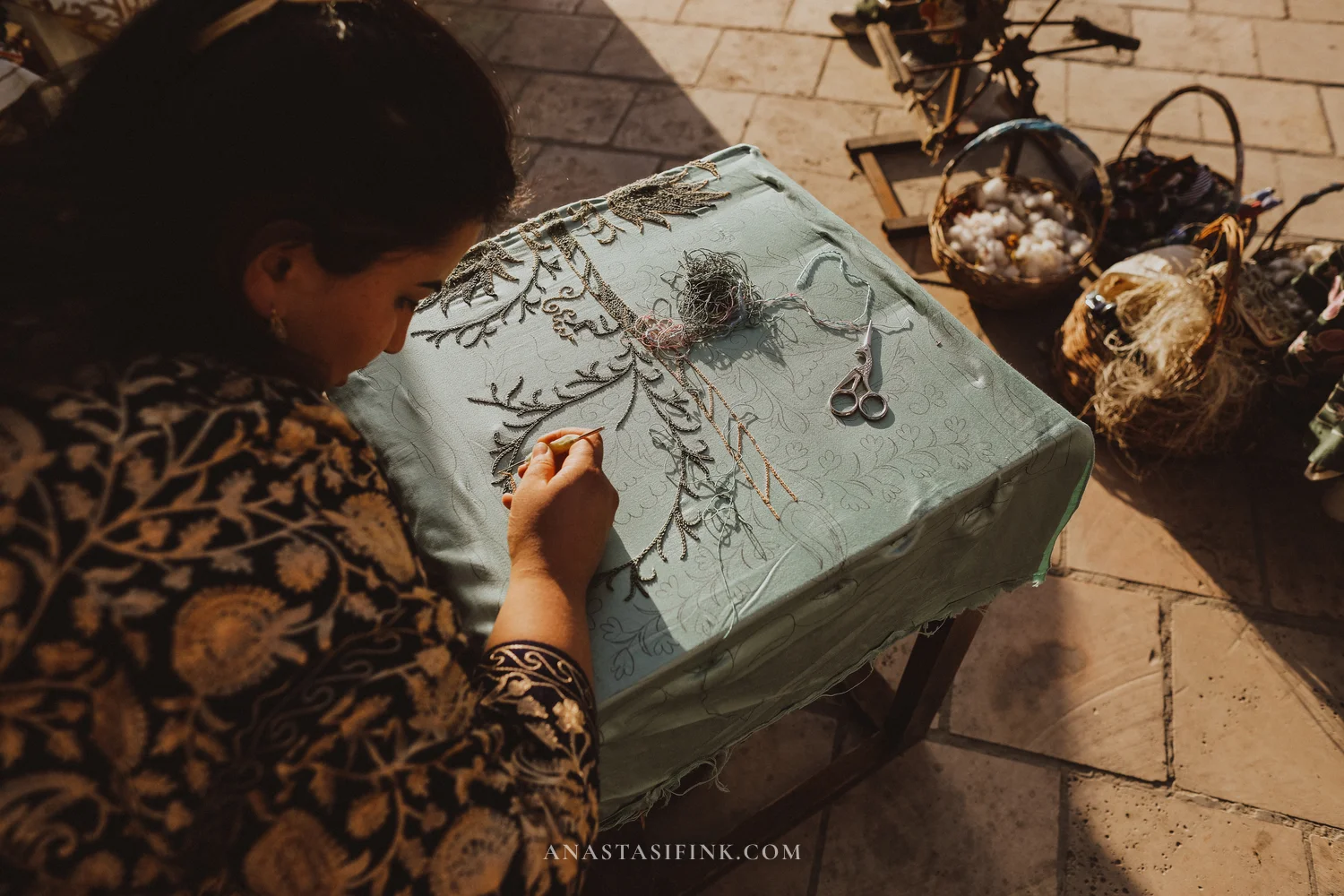
Suzani — large embroidery on cotton or silk. The most recognizable Uzbek craft. A good twentieth-century suzani starts around €200; antique ones go from €500. A large piece can take a craftswoman up to six months.
Ikat — a technique where silk threads are dyed before weaving, producing those characteristic blurred patterns. Ikat by the meter starts at €30; a chapan (robe) starts at €150.
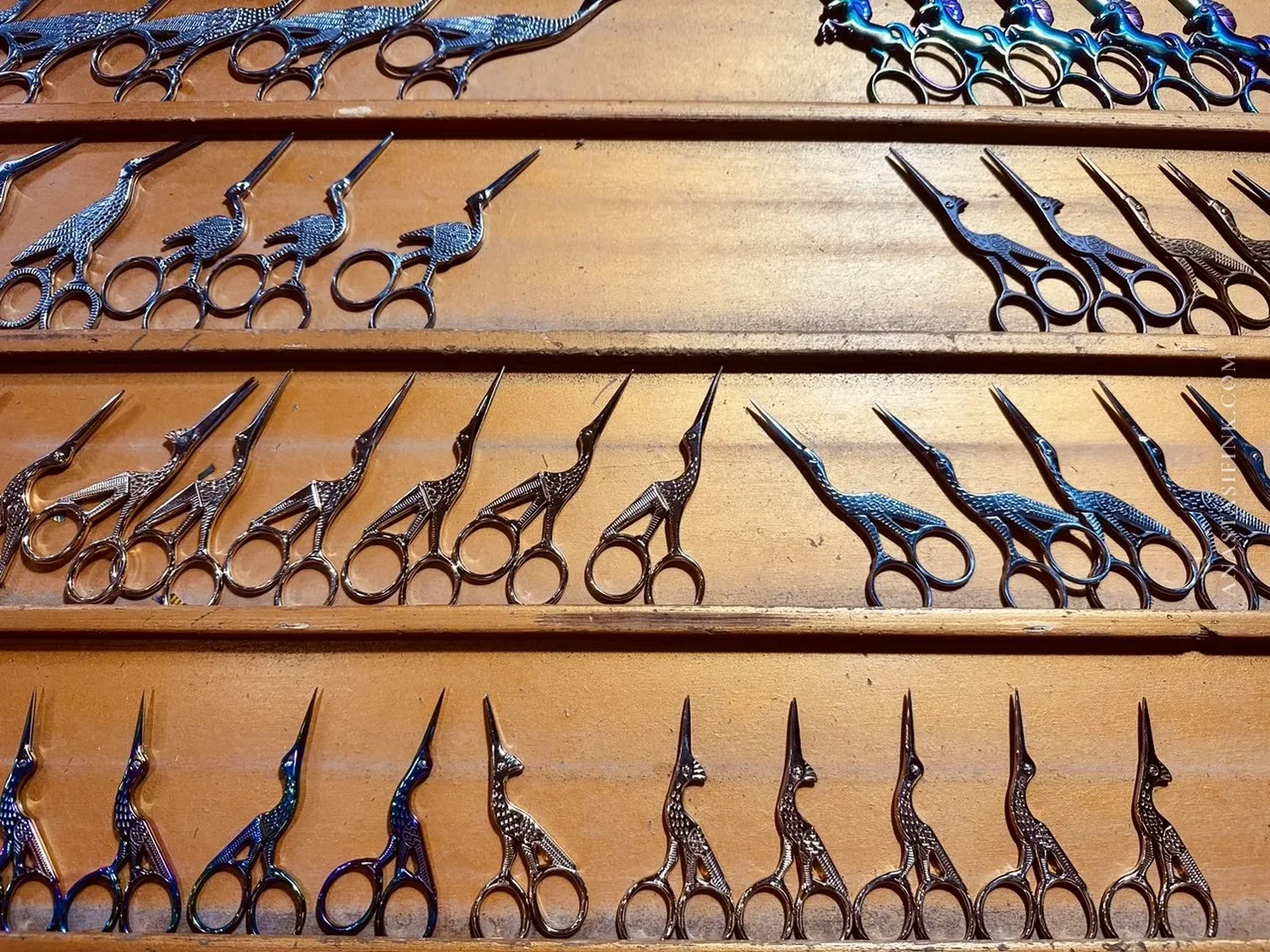
Stork scissors — forged scissors shaped like a bird. In Bukhara, only one family forge still makes them (the Ataulov dynasty). A pair runs 50,000–100,000 UZS (~ €4–7) — and it’s the most authentic souvenir you can find: nowhere else in Uzbekistan are these still being forged.
Carved copper and enamel — a tradition that’s barely surviving in places. Old trays beat new ones every time.
Pavillon Kalon — the premium alternative to the bazaar
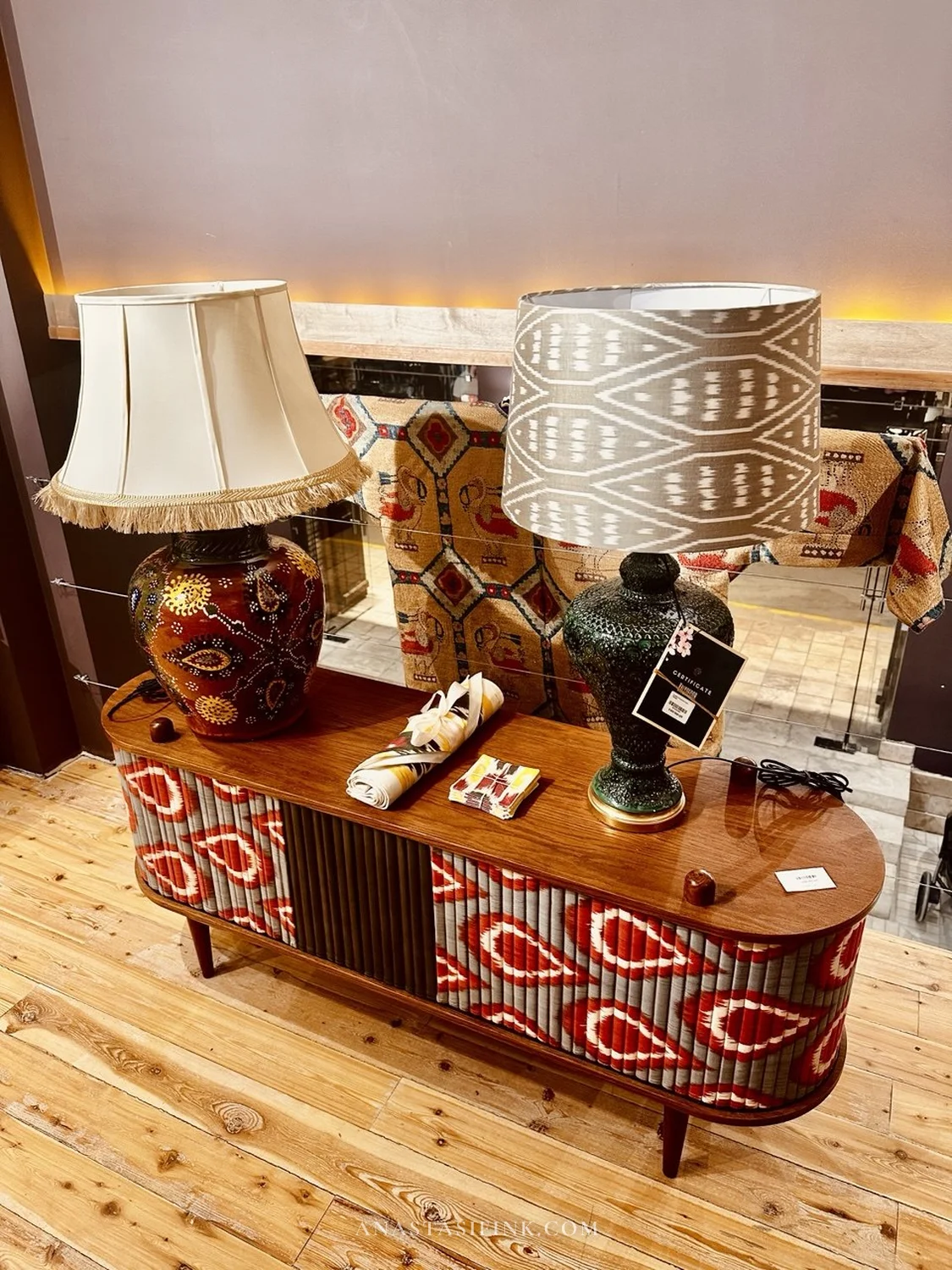
If the bazaar starts to wear you down (and after two hours under the domes, it really does), there’s a quiet alternative — Pavillon Kalon, a small concept store in an old house right next to the Kalyan Minaret. No haggling, no pressure. A small gallery of local textile brands — ikat, suzani, ceramics, lamps with fabric shades, Bukharan jewelry. Prices are higher than at the trading domes, but the presentation is on a different level: every piece labeled with the maker, everything laid out like a showroom.
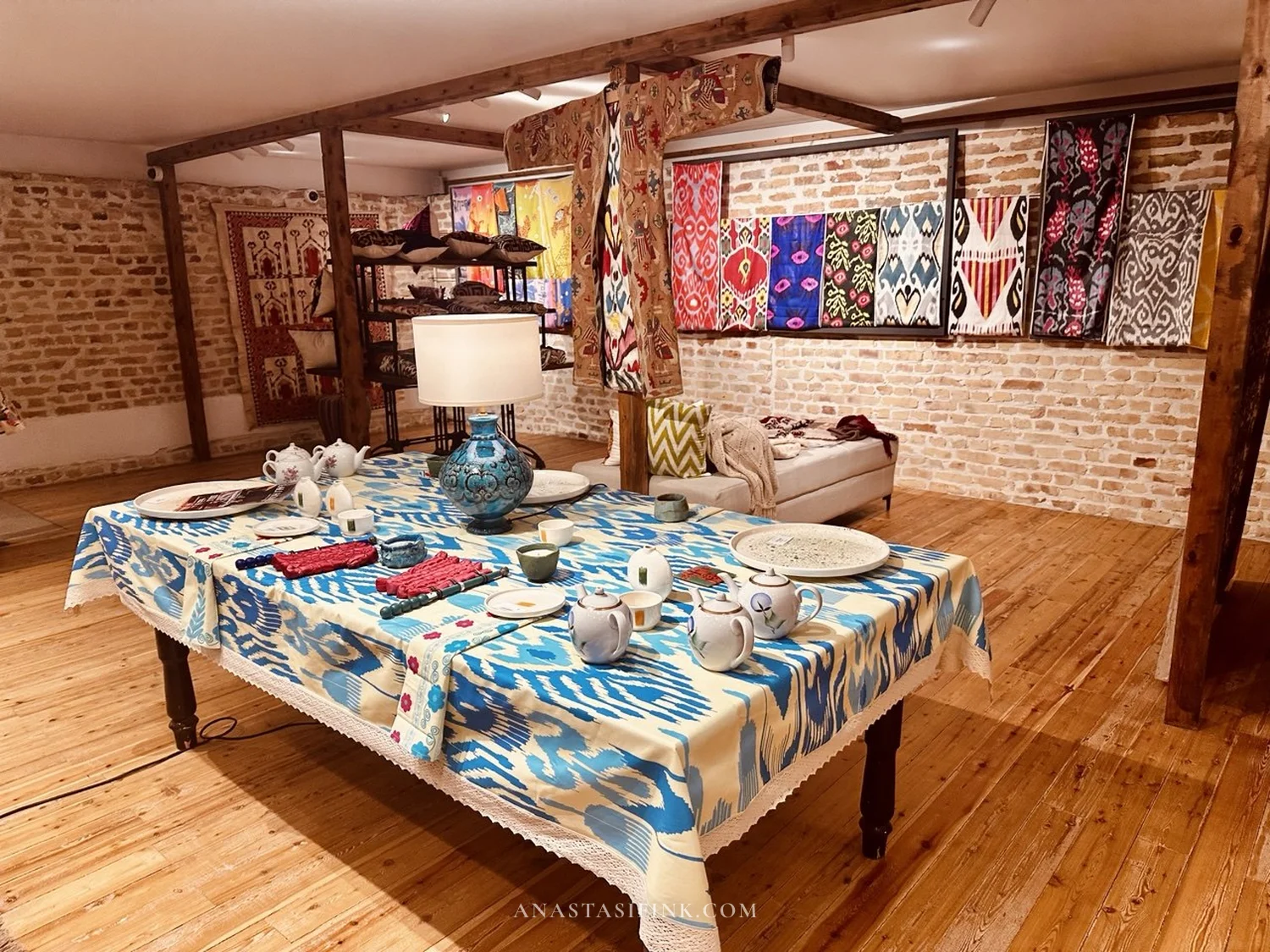
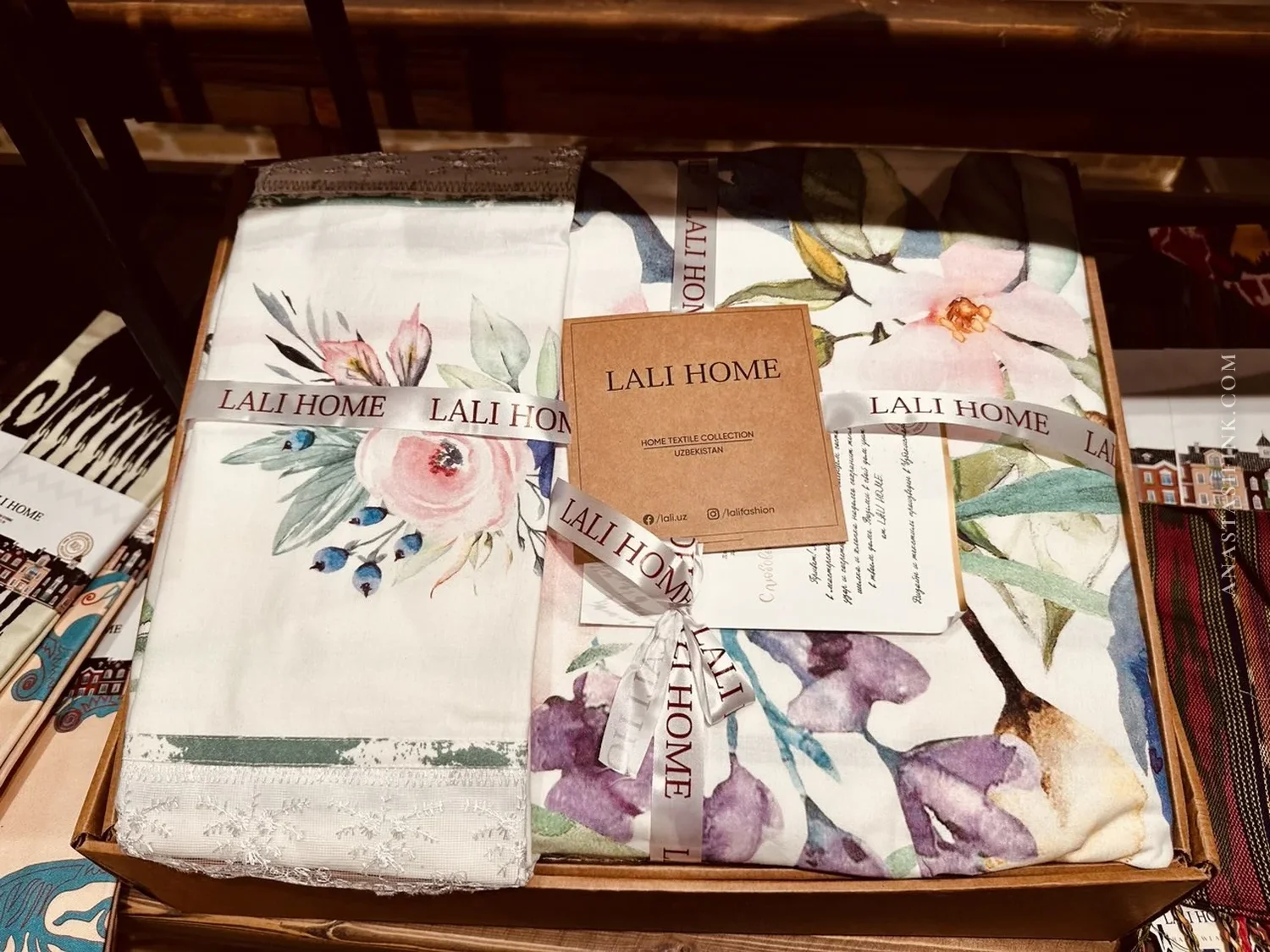
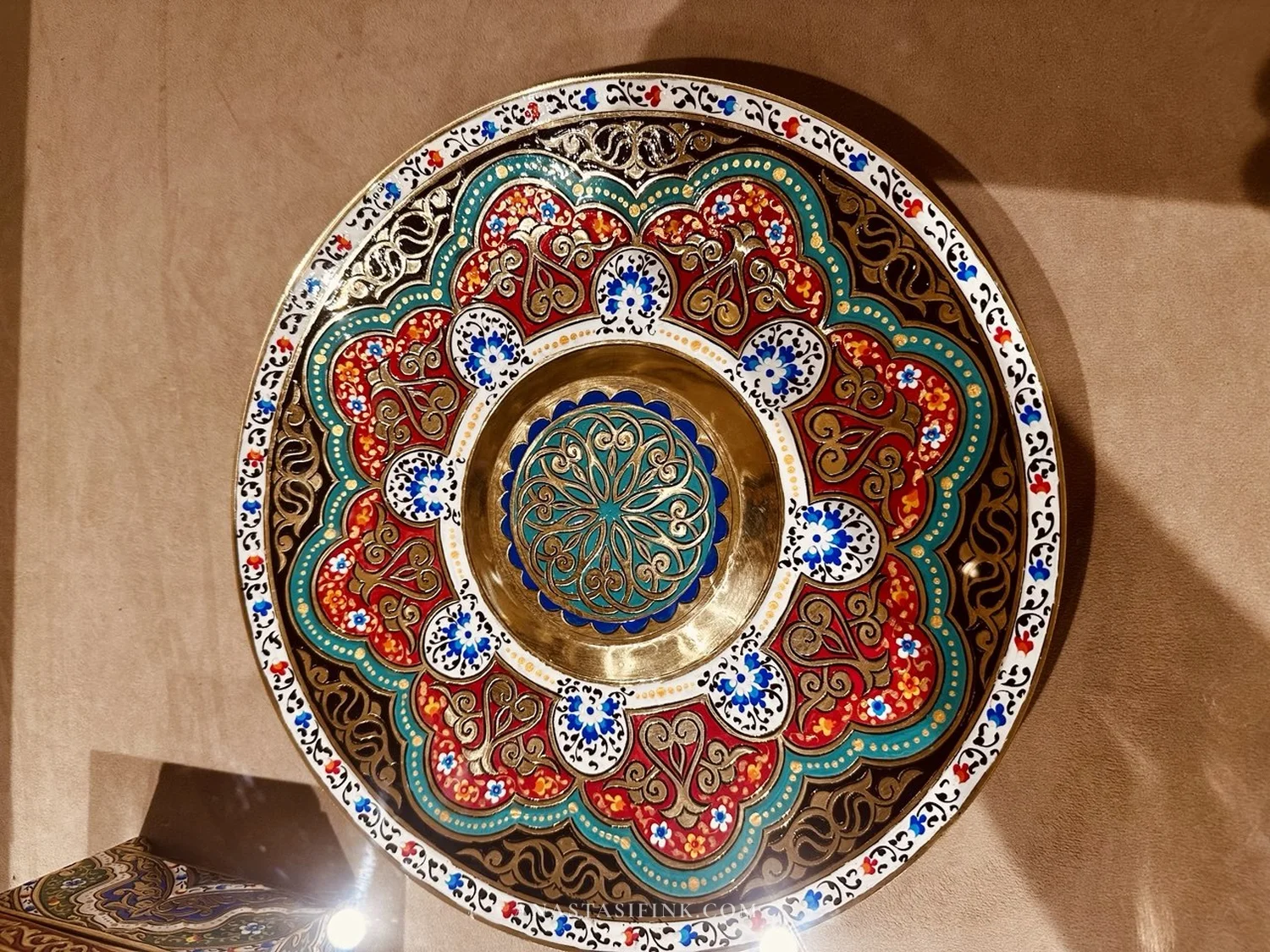
Lali Home and a hand-painted brass enamel plate.
When to visit Bukhara
The best windows are April–May and mid-October to early November. Summer is brutal (up to 40–45°C, dry winds), winter is cold (down to –10°C at night). In May the roses and apricots bloom; in October the leaves turn yellow. The next Bukhara Biennial is scheduled for 2027 — check the dates closer to the time.
How to get there from the US/UK
US and UK passport holders can enter Uzbekistan visa-free for 30 days — no paperwork in advance, just an immigration stamp on arrival. There are no direct flights from North America, but the most efficient routings go through Istanbul on Turkish Airlines, or via direct service from London to Tashkent on Uzbekistan Airways (a few times a week). From Tashkent, the easiest hop to Bukhara is the Afrosiyob high-speed train (about 3h 20m) or a 1-hour domestic flight.
Getting there and where to stay
Flights: there are direct flights to Bukhara from Tashkent — about an hour in the air, operated by Uzbekistan Airways, Centrum Air, and Silk Avia.
Train: the Afrosiyob high-speed train connects Tashkent, Samarkand and Bukhara. From Tashkent to Bukhara it’s about 3 hours 20 minutes with a connection in Samarkand; Samarkand to Bukhara is about 1 hour 20 minutes. Book tickets in advance, especially in high season.
Where to stay: I’d say stay in the old city — within 500 meters of Lyab-i-Hauz or the Kalyan Minaret. There are lots of small boutique hotels in historic houses with inner courtyards and iwans, and from a base like that you can walk to all the main sights.
Nearby: Bukhara gets 3 days in my 7-day Uzbekistan itinerary, alongside Samarkand and Tashkent. In the capital, the Tashkent Museum of Applied Arts occupies the 1907 Polovtsev house with its painted halls. More places are in all my Uzbekistan travel guides.
FAQ
The ideal months are April, May and the second half of October. Summer is hot (up to 45°C), winter is cold. May brings apricot blossoms; October brings yellow leaves.
A minimum of two full days for the old city. Add half a day each for Sitorai Mokhi-Khosa and Chor-Bakr. Three or four days is the sweet spot.
Ark Citadel — 60,000 UZS, the mausoleums in Samanid Park — 15,000 each, the Bolo-Hauz Mosque — free, Chor-Bakr — 15,000, Sitorai Mokhi-Khosa — 30,000. Around 150,000 UZS total (~ €11) for the headline sights.
Technically yes, but there's no point. Bukhara is about atmosphere, not ticking boxes. In a single day you can really only cover Po-i-Kalyan, the Ark, and Bolo-Hauz.
In smaller restaurants, not the big tourist places. Bukhari plov differs from the Fergana version: rice cooked separately, carrots cut thinner. Order it for lunch, not dinner — locals eat plov before 14:00.
Ikat, suzani, and stork scissors. The scissors are the most authentic souvenir — you can't find them anywhere else.
Yes, if you can handle the cold. There are no tourists in winter, the mosques are empty, and you can photograph without queues. But the days are short, and a lot of sites close at 16:00.
One of those places I want to come back to
Of all the cities in Uzbekistan, Bukhara is the one I’d come back to first. You can spend three days walking the same streets and still notice something new every time — a carved door, a cat, the bend of an alley. Don’t come for a single day: carve out three or four, and make sure to actually sleep inside the old town.