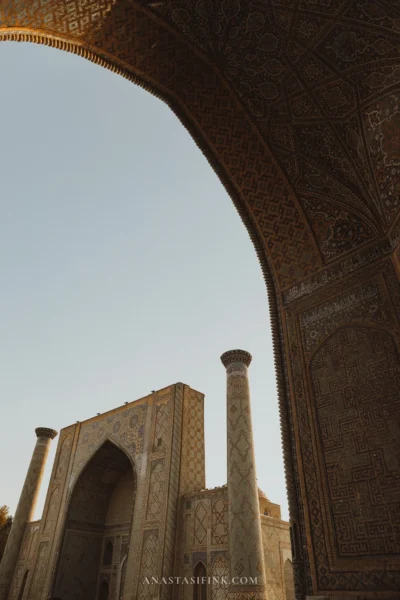
Chor-Bakr Necropolis, Bukhara — Complete Guide to the City of the Dead

Ten minutes by car from central Bukhara, and instead of the crowds at Poi-Kalyan you find yourself walking through an entire 16th-century complex with almost no one in it. This is Chor-Bakr — the family necropolis of the Juybar sheikhs, built in 1560.
What Chor-Bakr is and why it’s called “four brothers”
Chor-Bakr literally means “four brothers” — after four descendants of the Prophet Muhammad from the Abu Bakr lineage, buried at this site. The most important of them, Abu Bakr Saad, settled in the village of Sumitan near Bukhara back in the 10th century and died here in 970. Pilgrims started coming to his grave, and that’s how the place began — long before any of today’s buildings stood here.
The architectural complex you see today was built in 1560–1563 by Khan Abdullah Khan II — as a gift to his mother. A mosque, a madrasah and a khanaqah were raised on the pilgrimage site, surrounded by a garden of cypresses, plane trees, willows and roses. After Sheikh Khoja Juybari died in 1563, Chor-Bakr became the family burial ground of the Juybar sheikhs — Sufi masters of the Naqshbandi order who effectively governed Bukhara during Abdullah Khan’s rule.
The Juybar sheikhs owned entire towns and quarters, controlled caravan trade and served as spiritual mentors to the khans. In terms of influence, they’re often compared to what the Jesuits were in 17th-century Europe — a religious order with real political and economic power.
The film-set decorations at the entrance
Right after the central entrance, before you reach the actual mosque and khanaqah, you’ll see some odd structures that you might mistake for part of the complex. A brick wall with round towers and crenellations, a wooden gate, a couple of traditional ox-carts under canvas roofs, baskets, clay storage jars. None of this is from the 16th century. They’re film-set decorations — left over from a historical movie shoot.
Chor-Bakr has long been a favourite location for Central Asian filmmakers: several historical dramas about the Bukhara Khanate and the Silk Road have been shot here. Some of the sets (designed to look like the gates of a caravanserai and a merchant convoy) were never dismantled — they now stand as a kind of open-air prop museum. They’re conveniently set apart from the main complex: tourists photograph them and move on, while the necropolis itself stays almost empty.
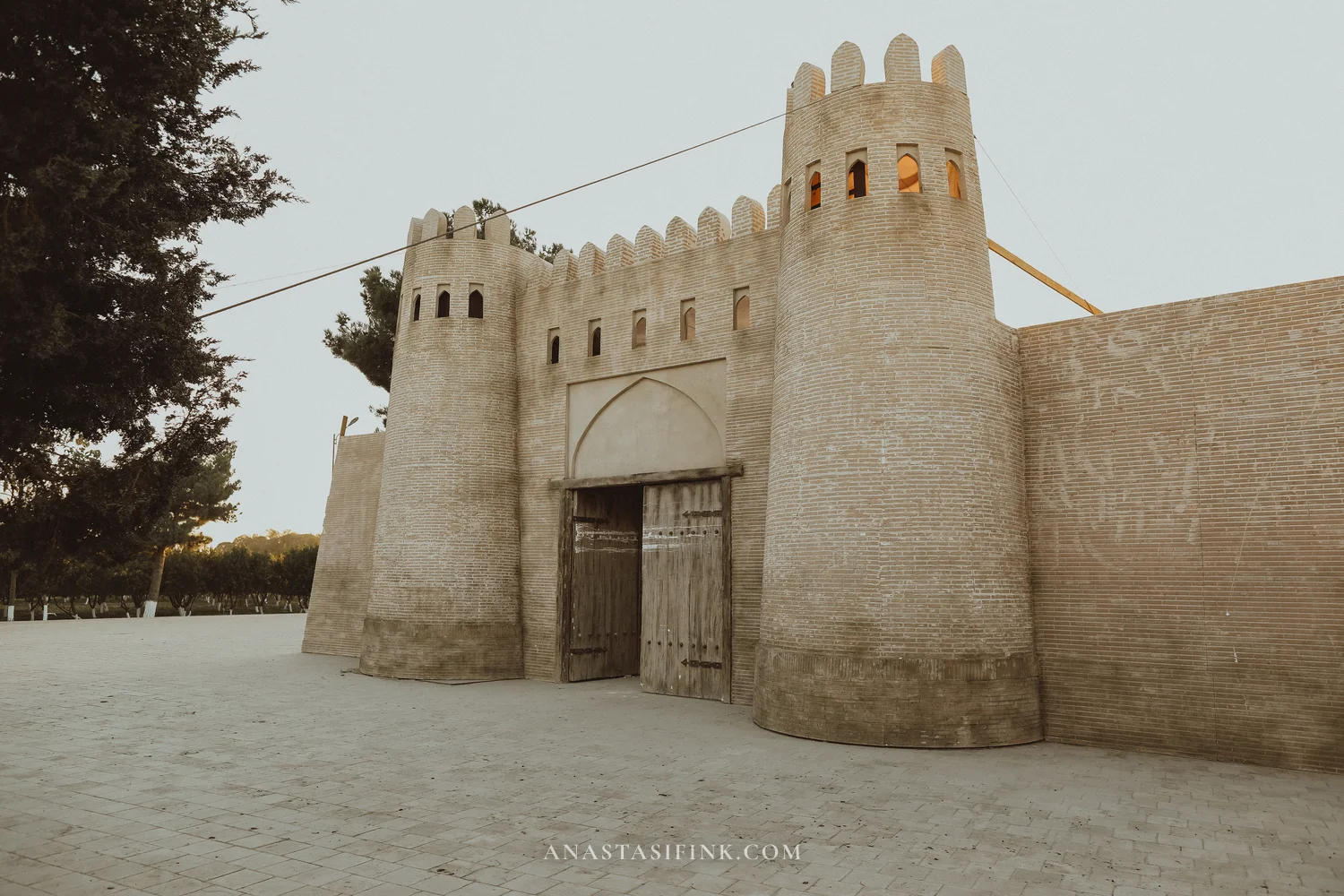
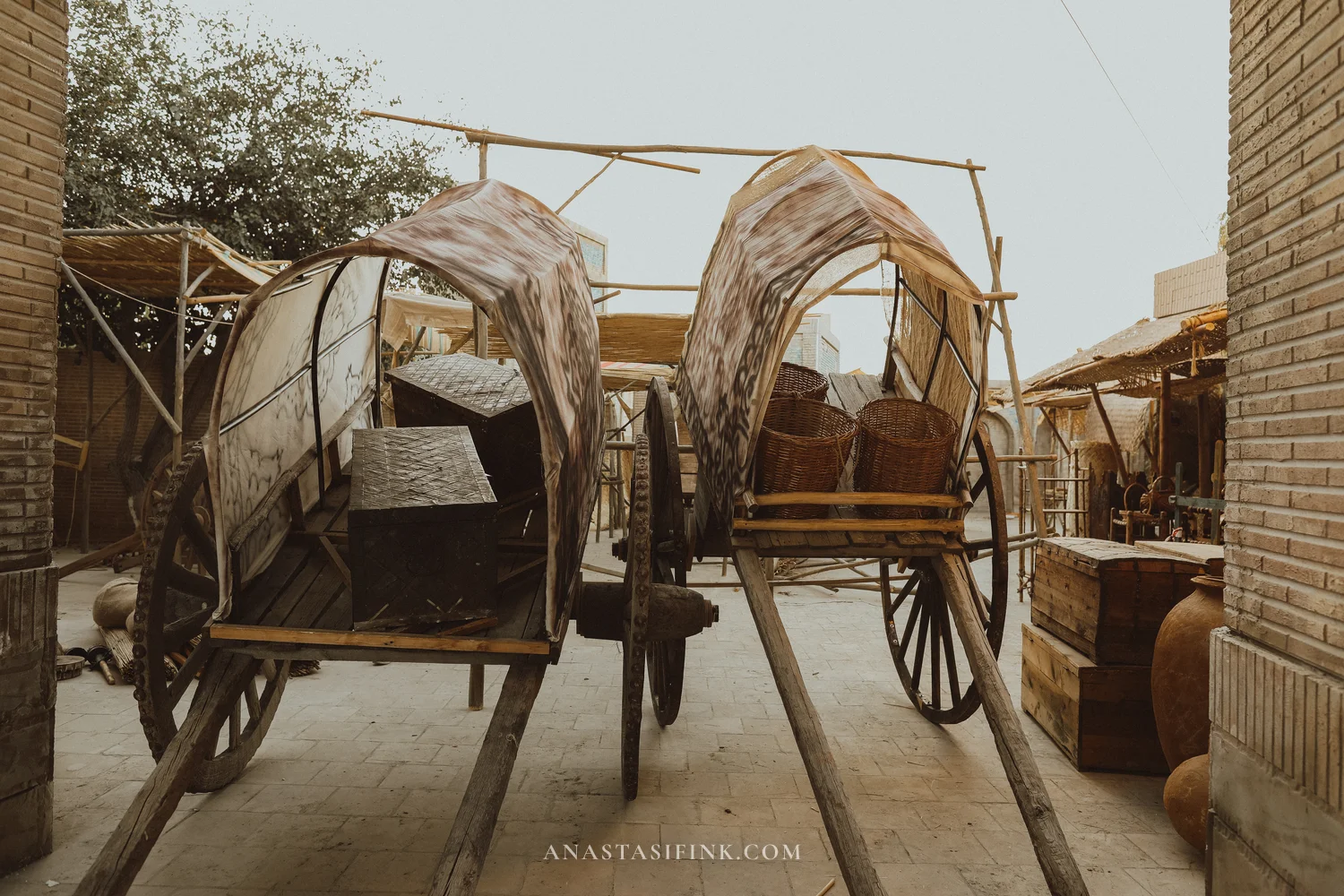
Decorations right after the main entrance. The brickwork looks “old”, but it’s only a couple of decades old, not 16th century. Locals say several films have been shot here — I couldn’t pin down the exact title, ask the caretaker on site
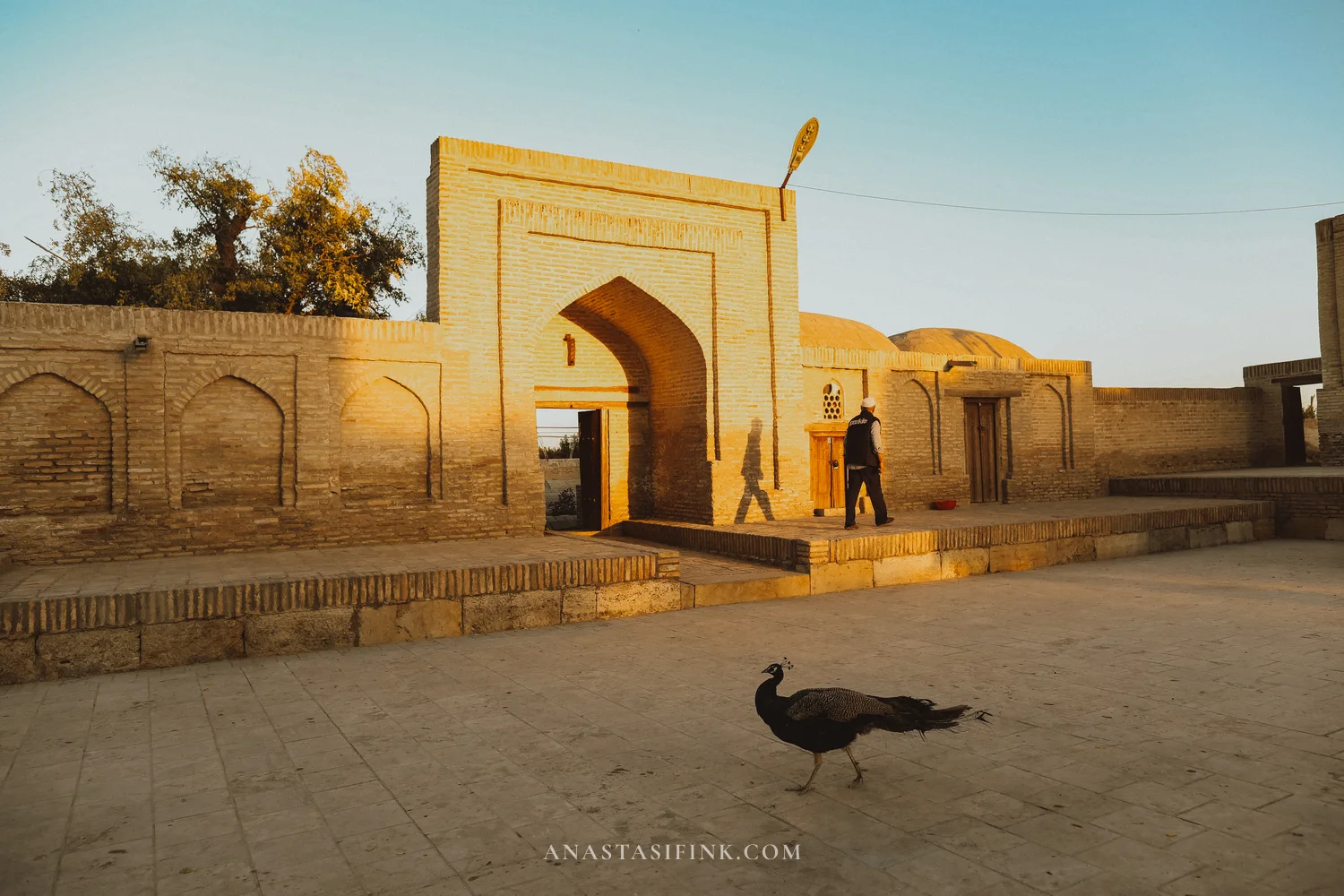
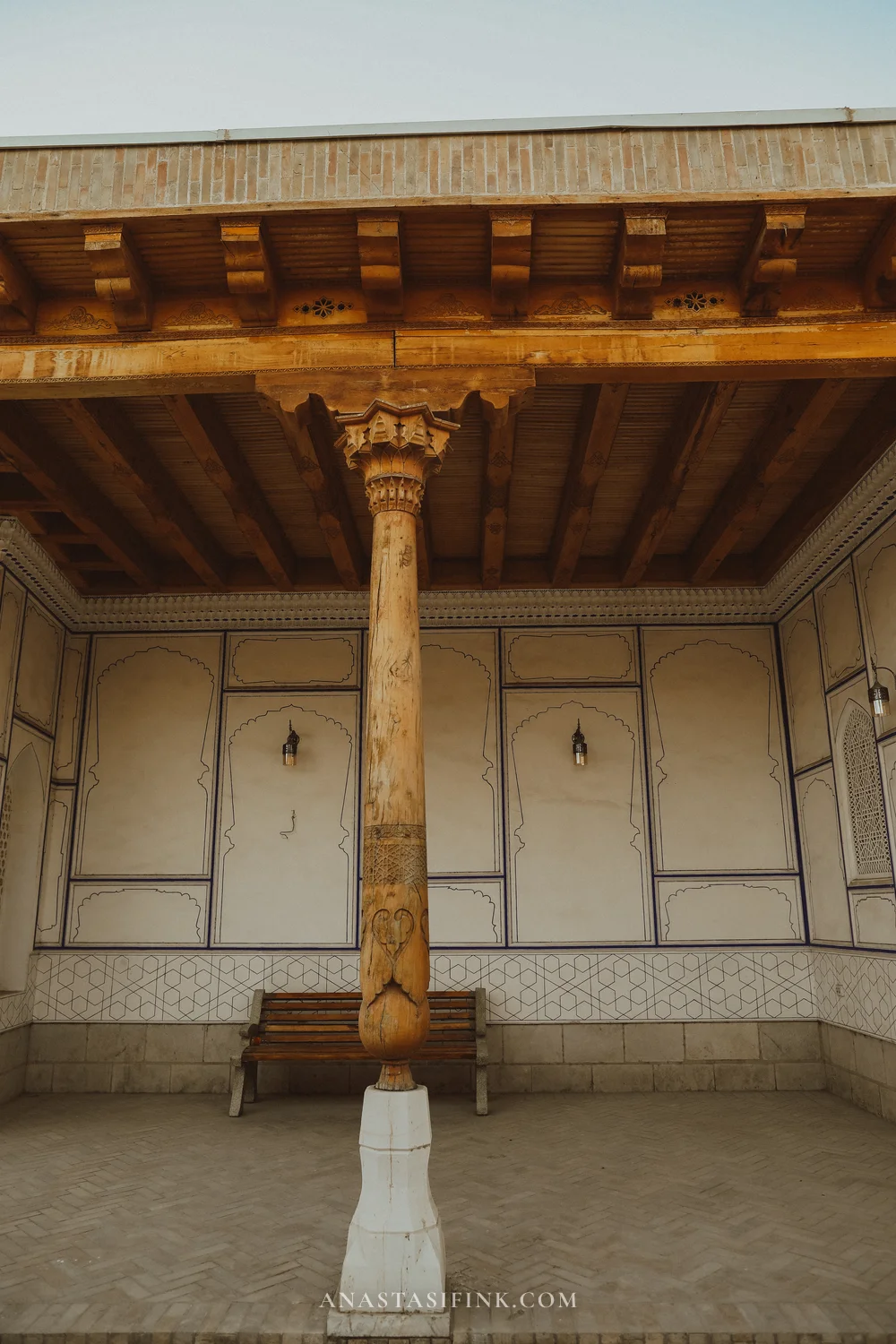
The architectural ensemble: khanaqah, mosque, madrasah
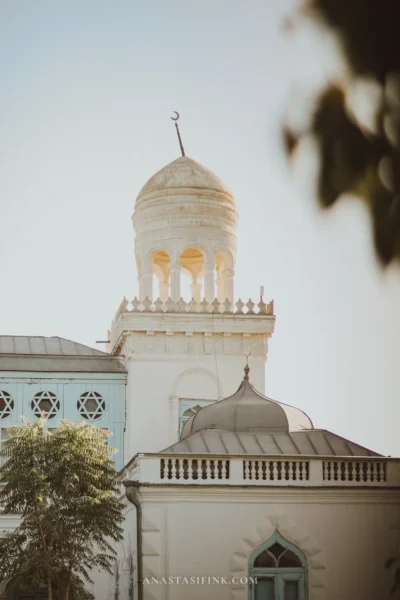
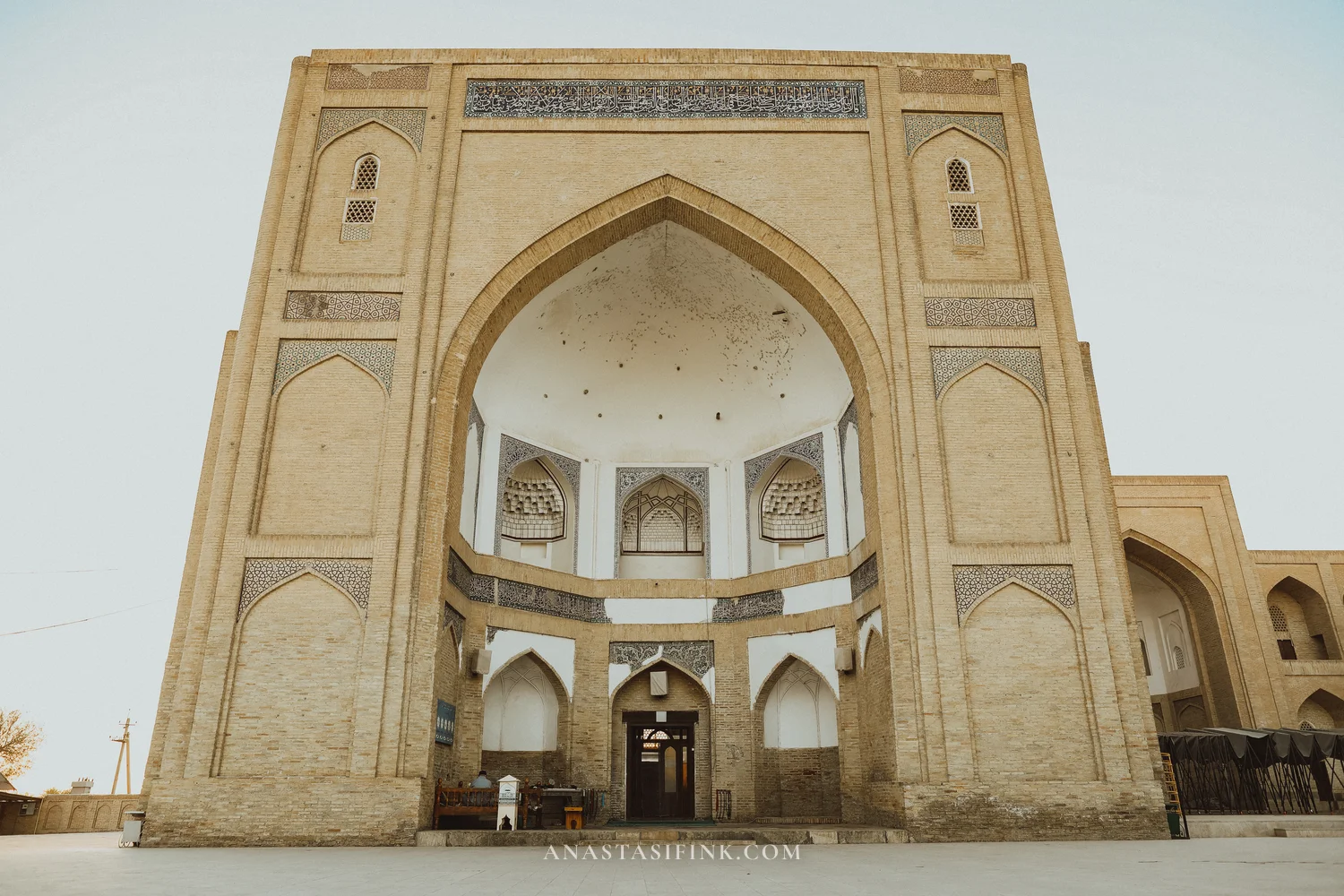
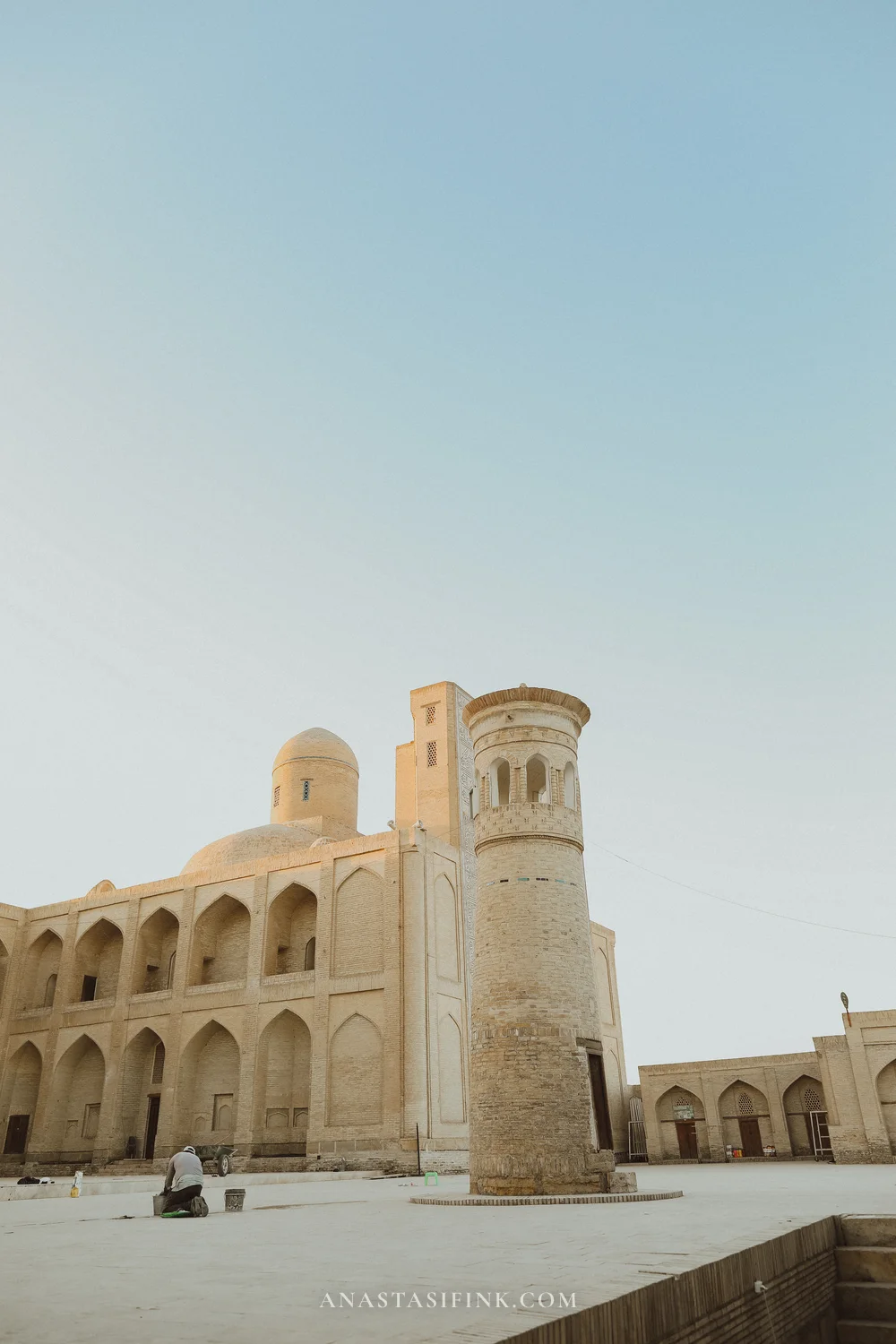
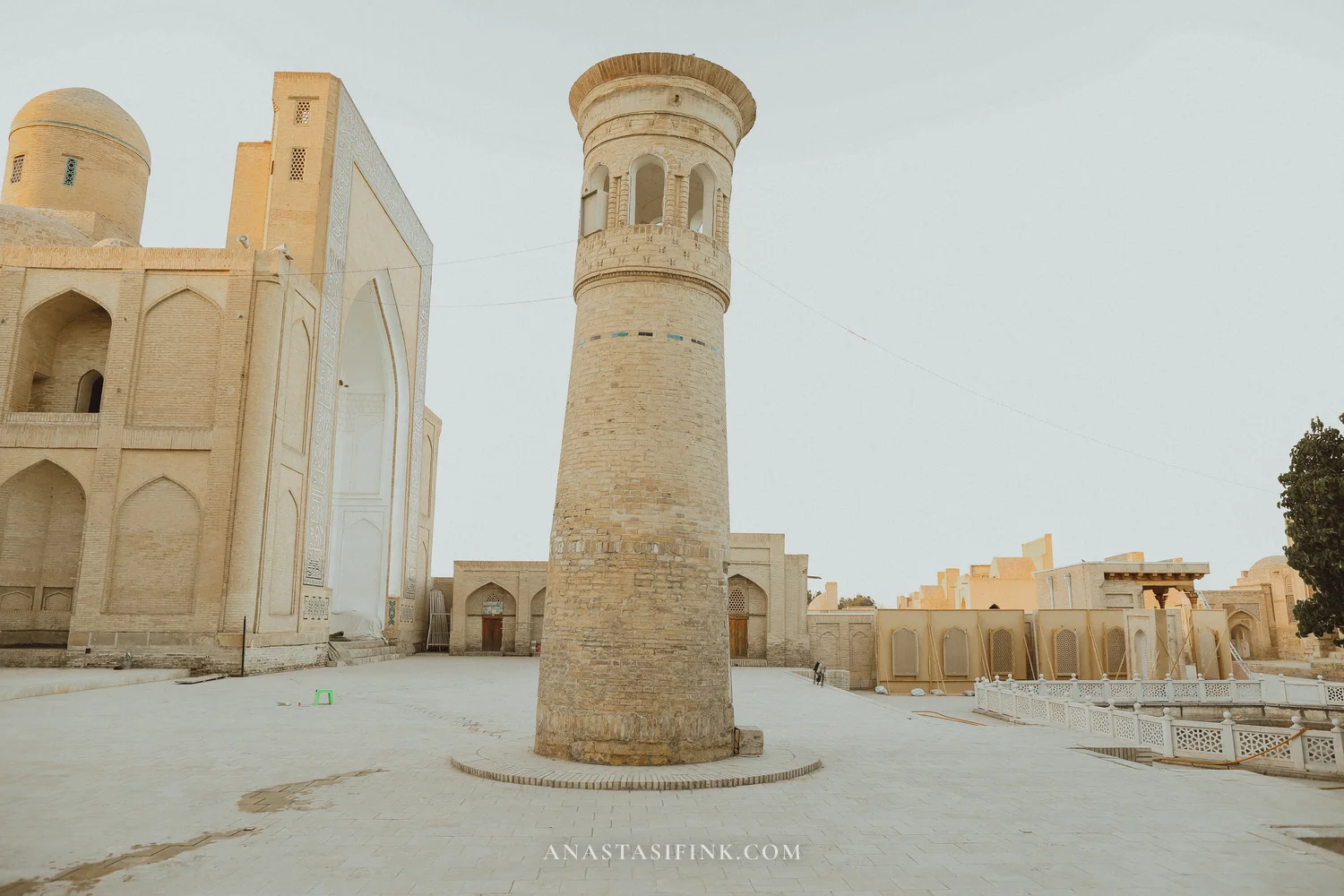
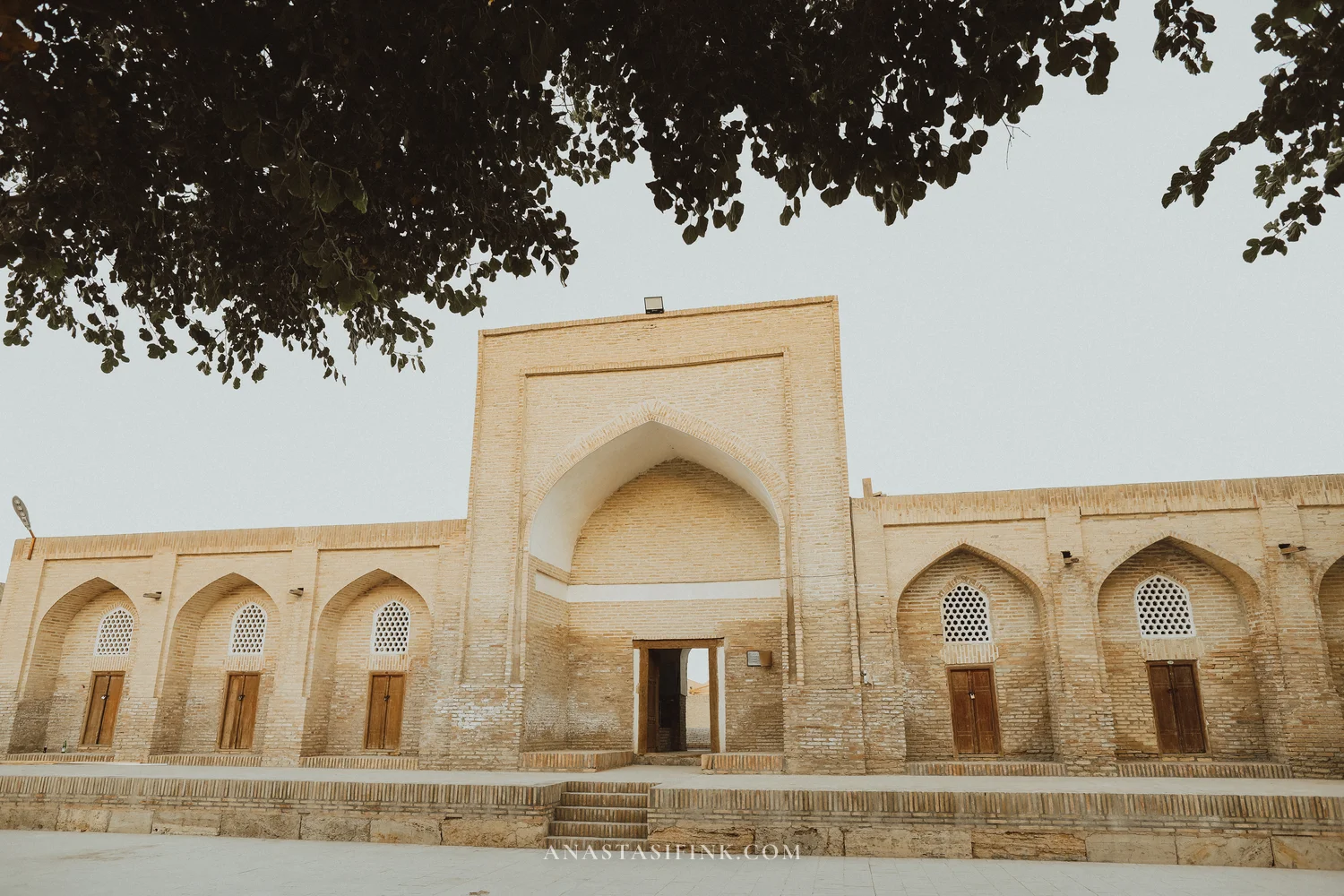
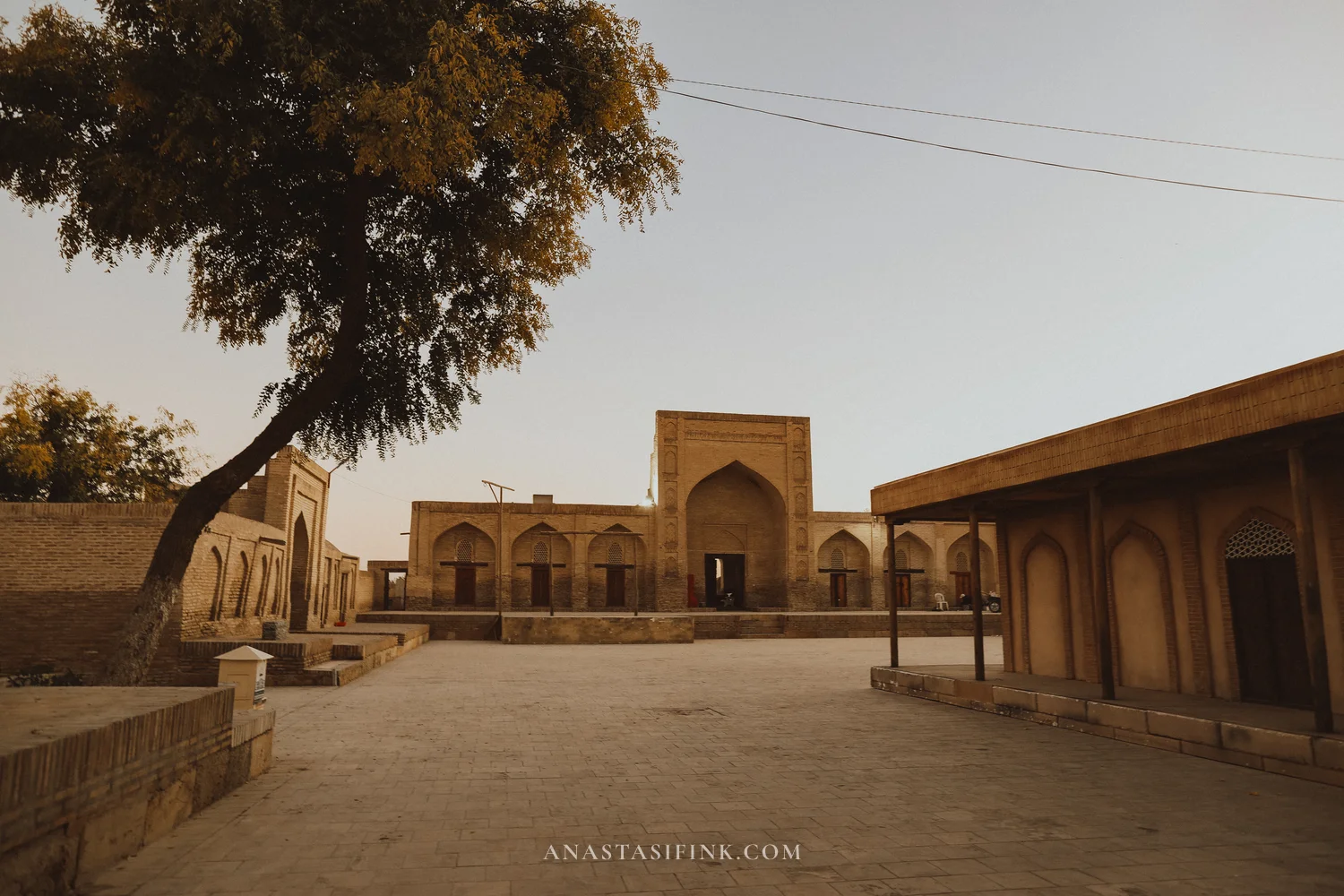
The main buildings of Chor-Bakr line up along a single axis and form a tight ensemble. In the centre stands the large khanaqah (a Sufi lodge) with a portal you can see from far away. To the right — the Friday mosque with white painted interiors. To the left — the madrasah. Between them is a small square and the minaret that half the visitors come here to see.
The minaret — a mini-Kalyan
This round brick minaret is a scaled-down copy of the famous Kalyan Minaret in Bukhara itself. It’s about 18 metres tall, with a spiral staircase inside (closed to visitors). From the right angle, the minaret, the madrasah and the khanaqah dome line up into a classic Bukhara photo — but without the crowds at Poi-Kalyan.
Inside the khanaqah and the mosque
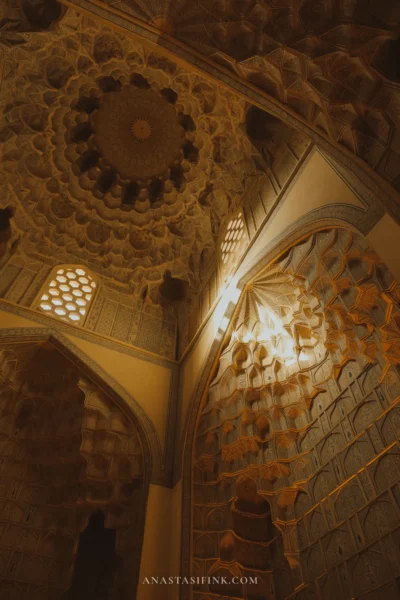
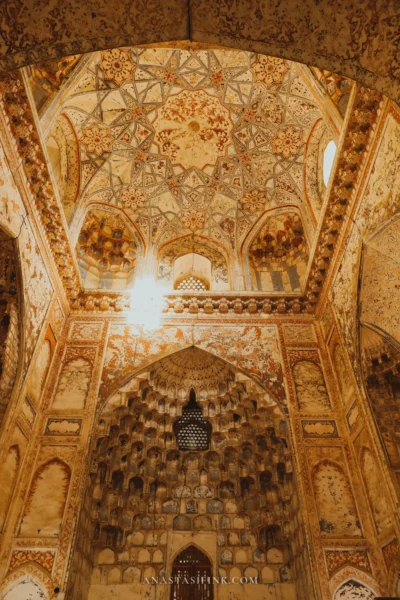
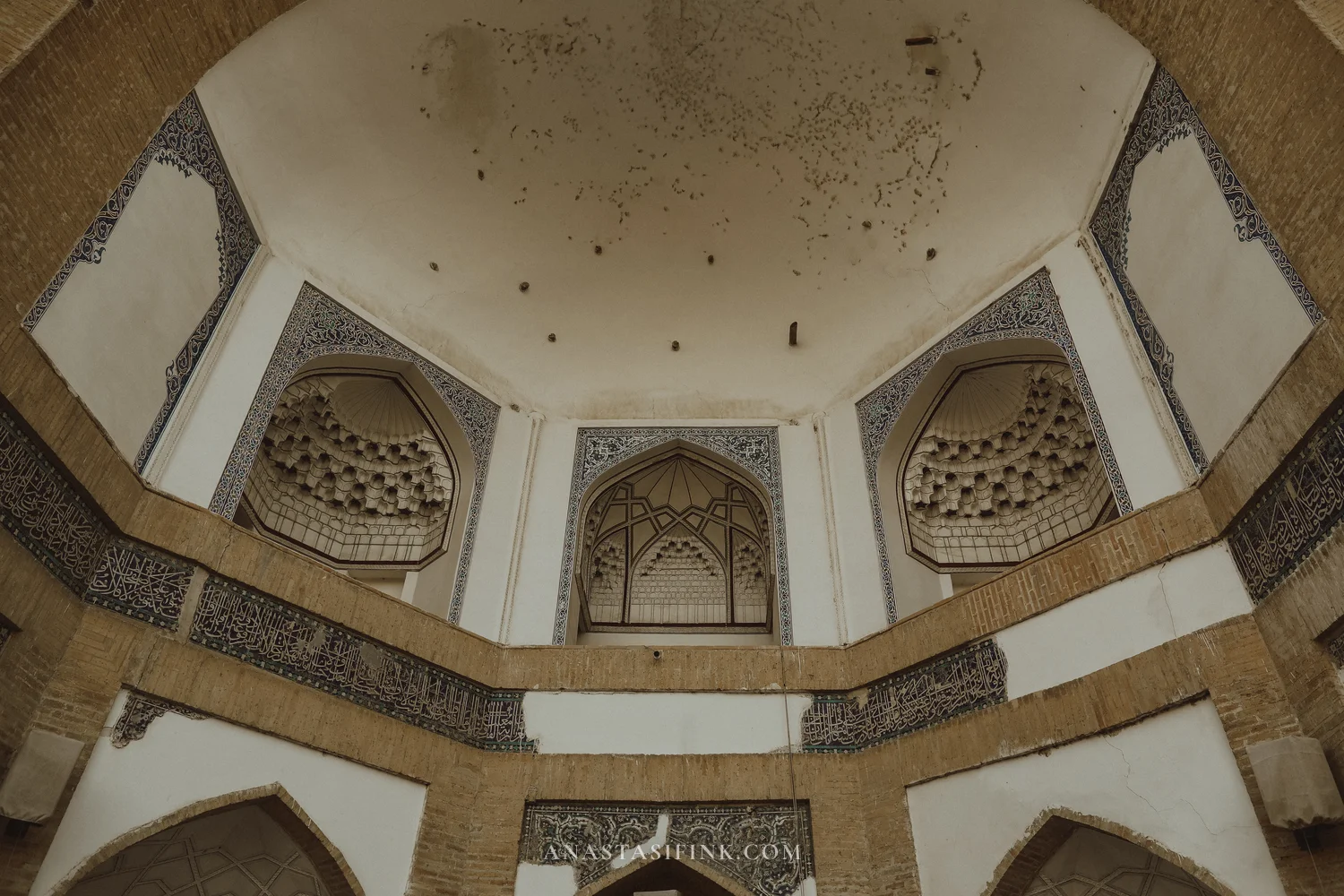
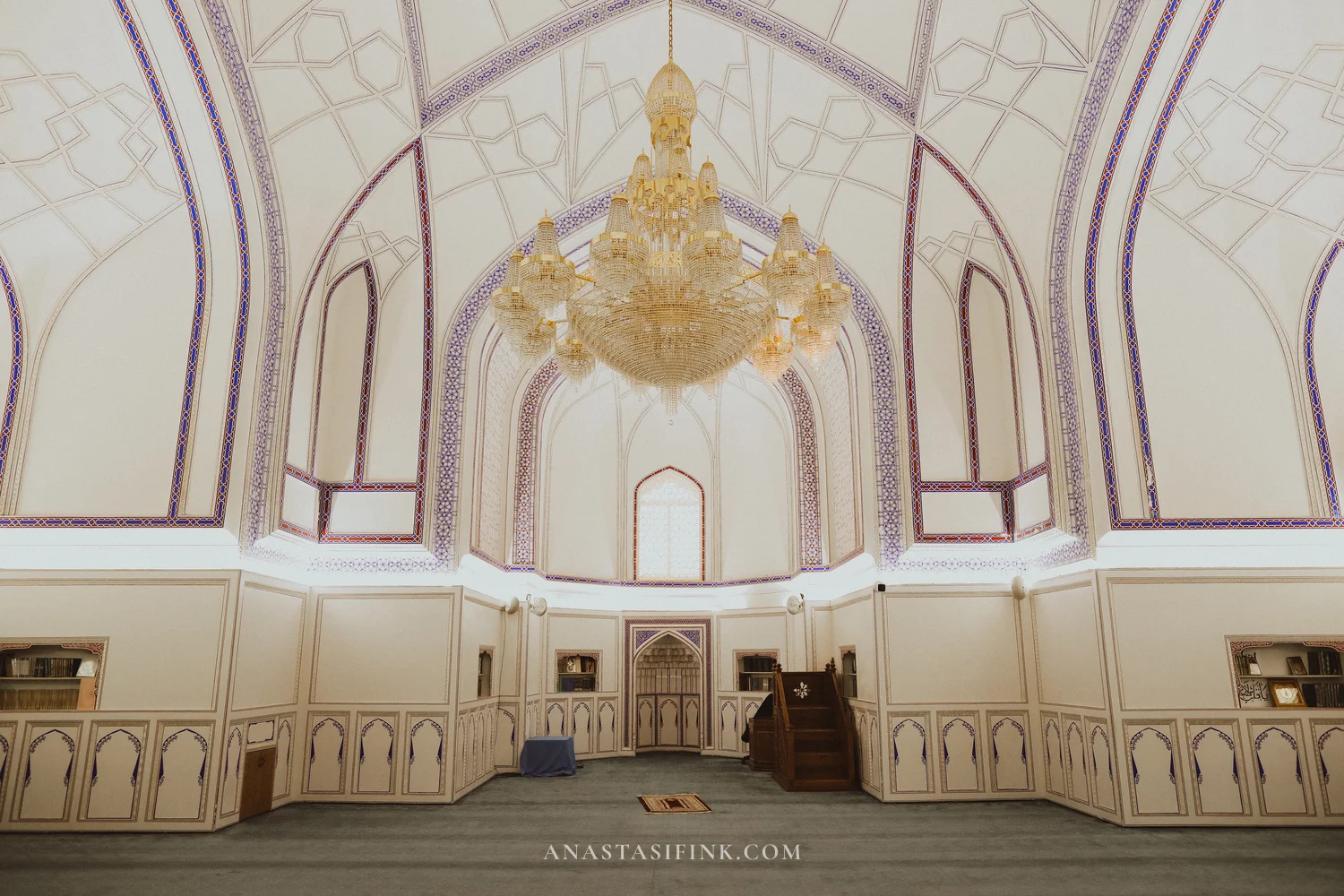
The khanaqah preserves a huge octagonal hall with a honeycombed muqarnas dome. The plaster has come off in places, the walls are blotchy — but it’s exactly this rough state that makes the hall feel alive, not museum-perfect. The mosque is the opposite: fully restored, with white walls, fine ornamental painting in burgundy and grey, a huge gilt chandelier. The mosque is active — people come to pray here on Fridays.
City of the dead: the necropolis of the Juybar sheikhs
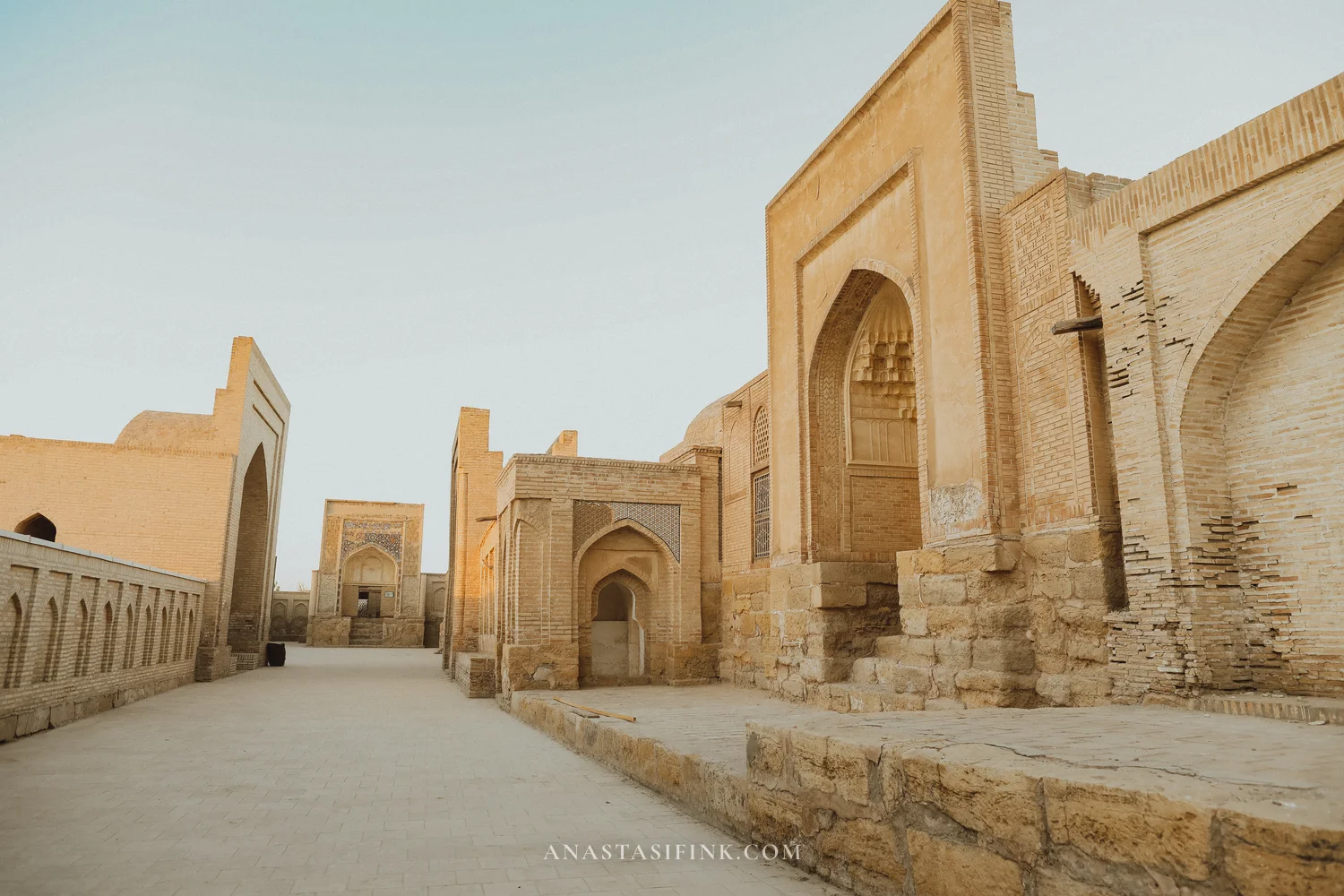
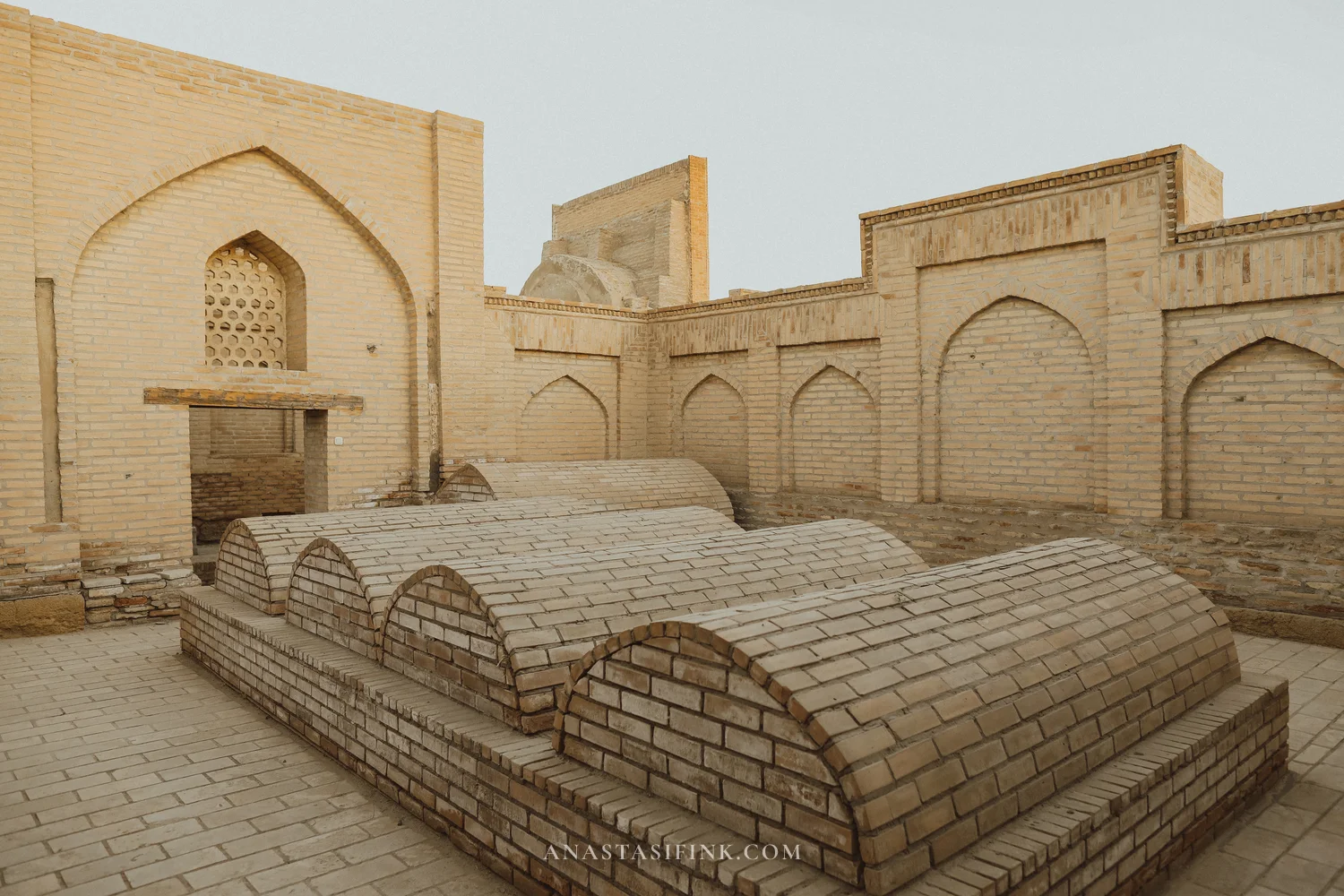
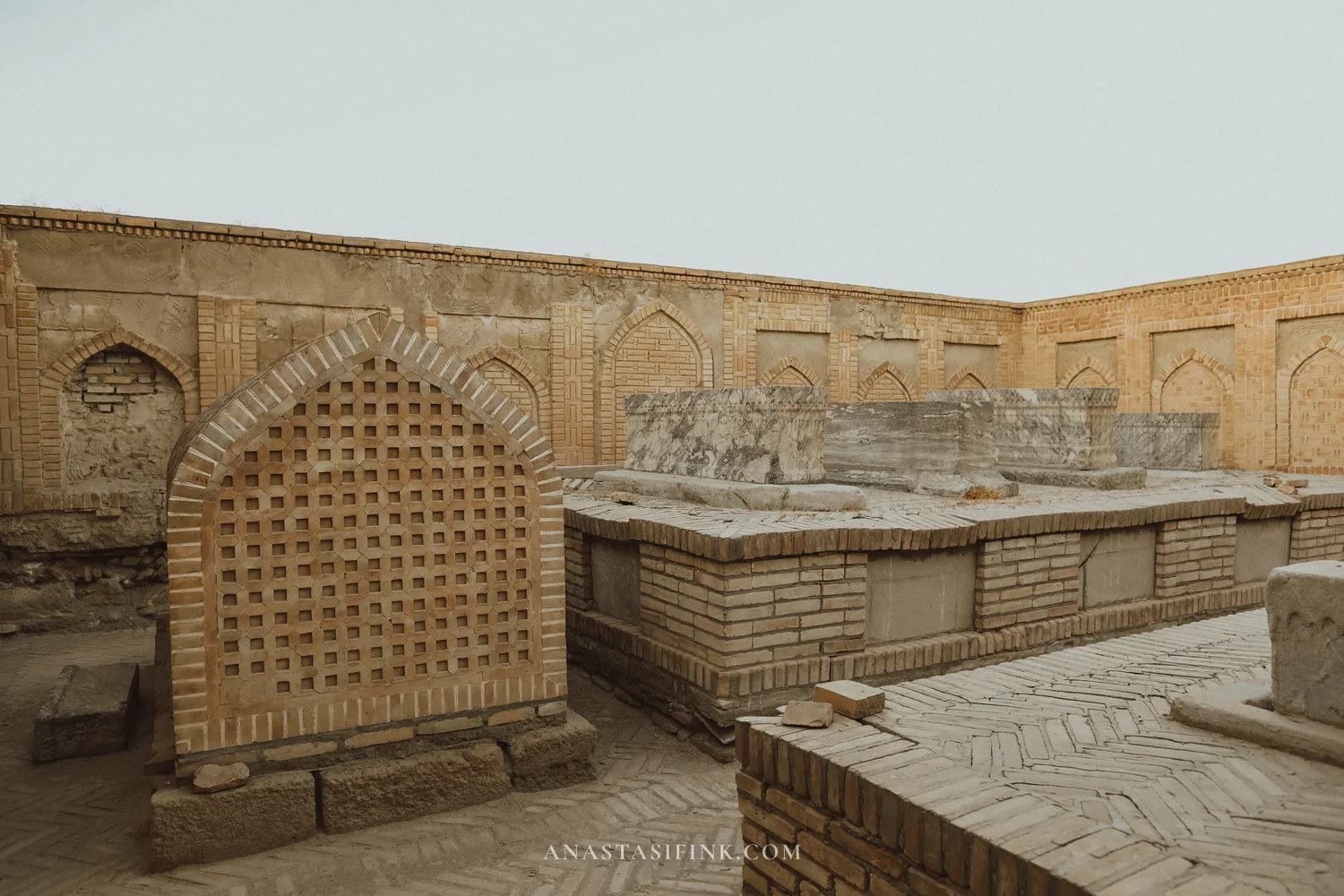
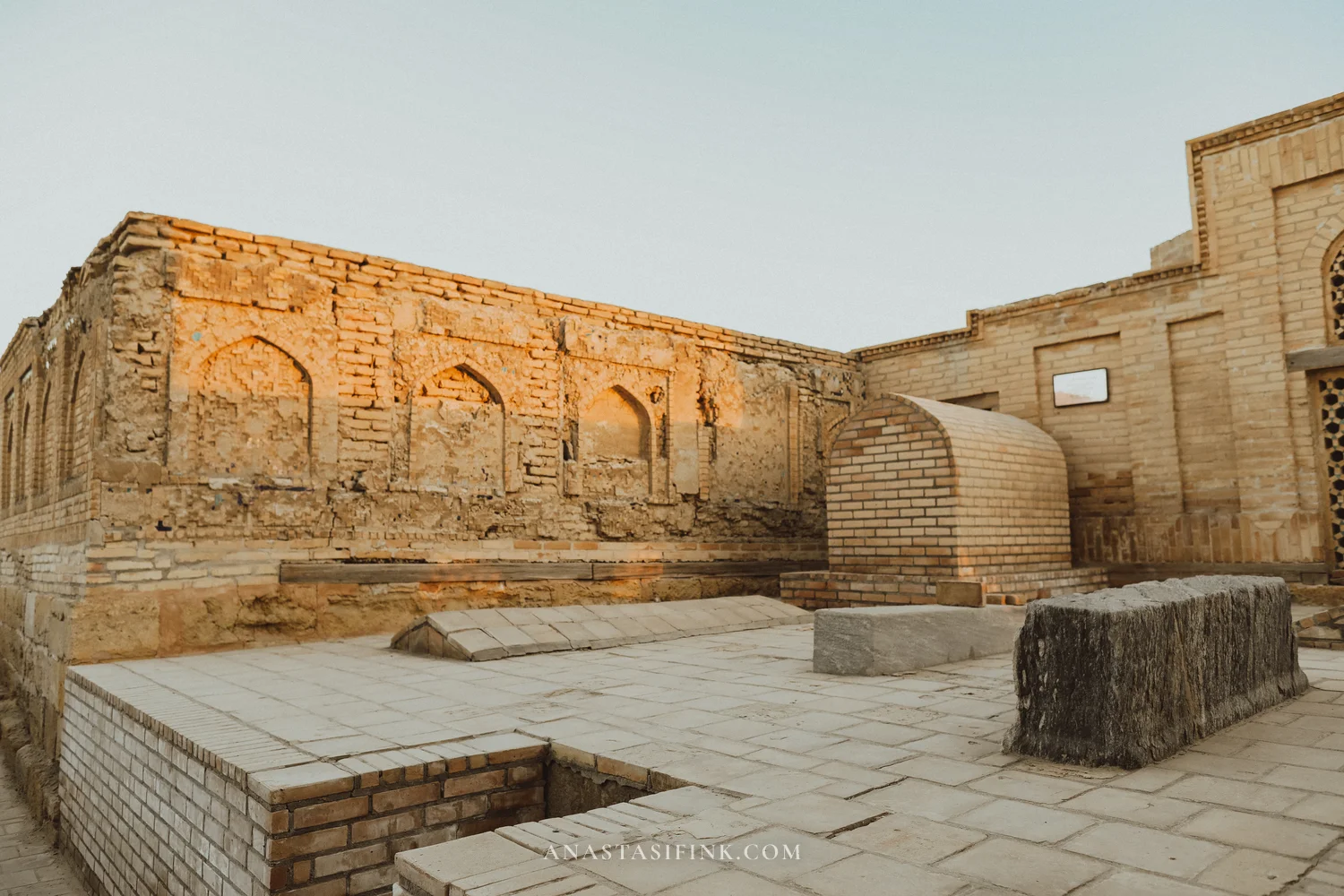
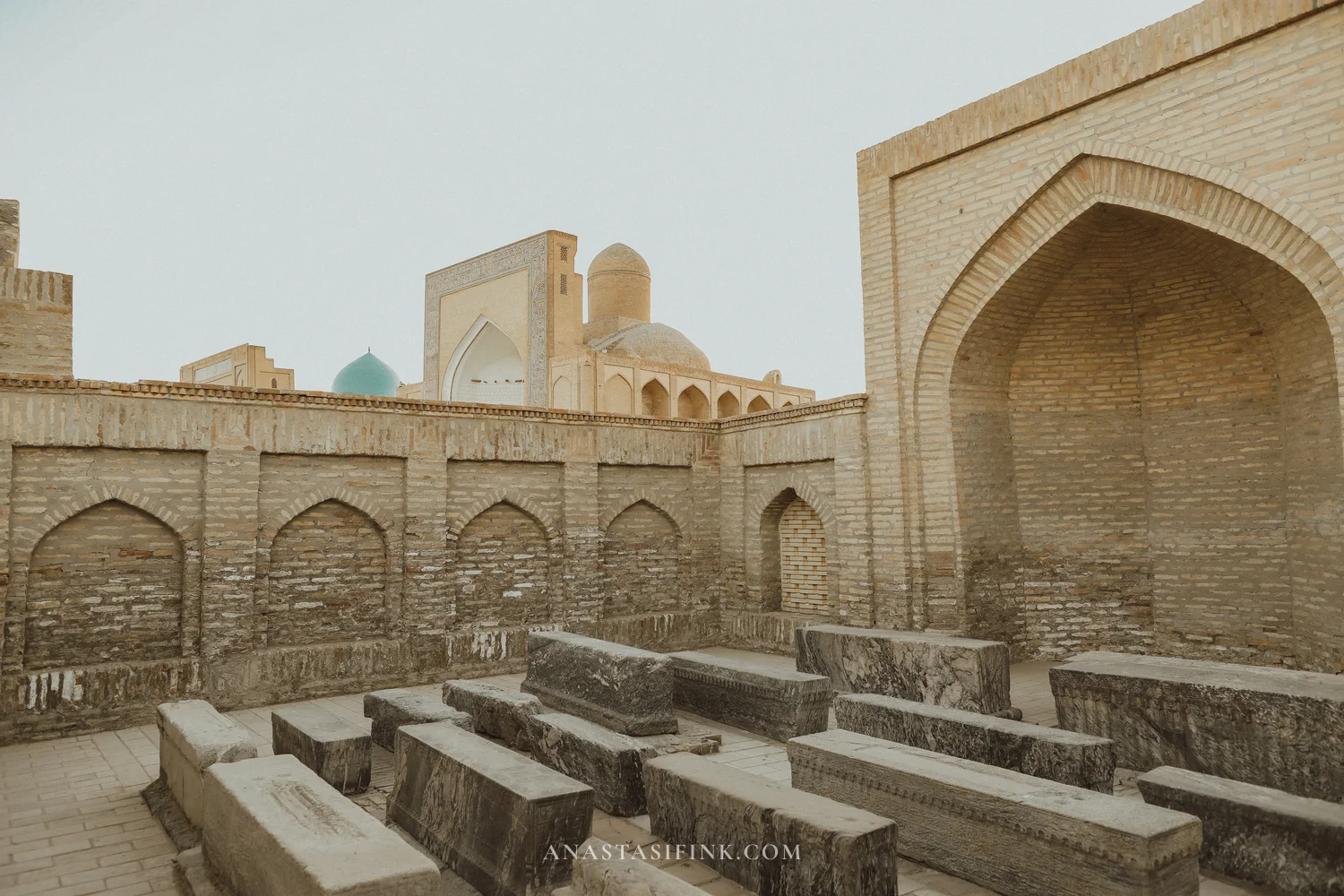
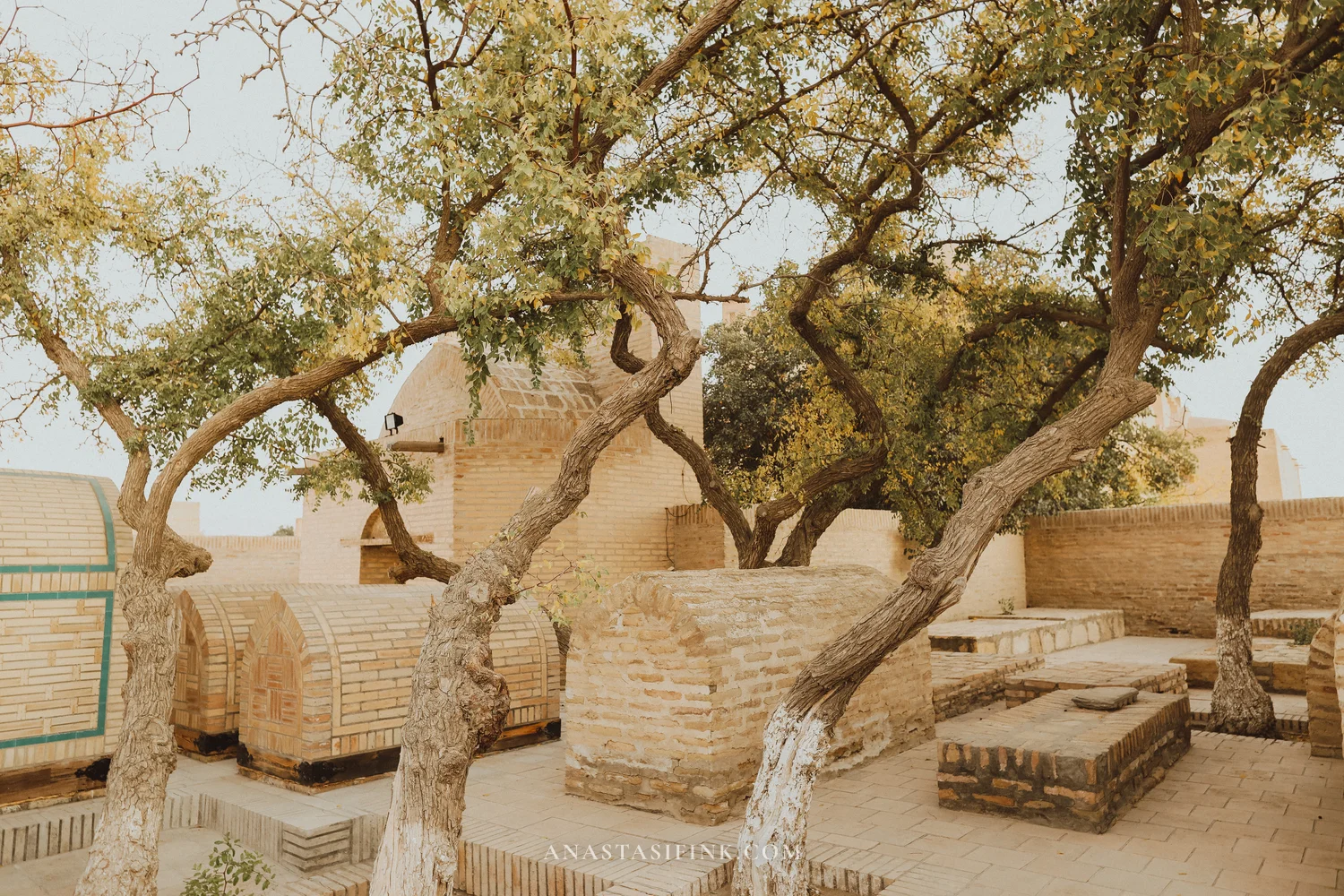
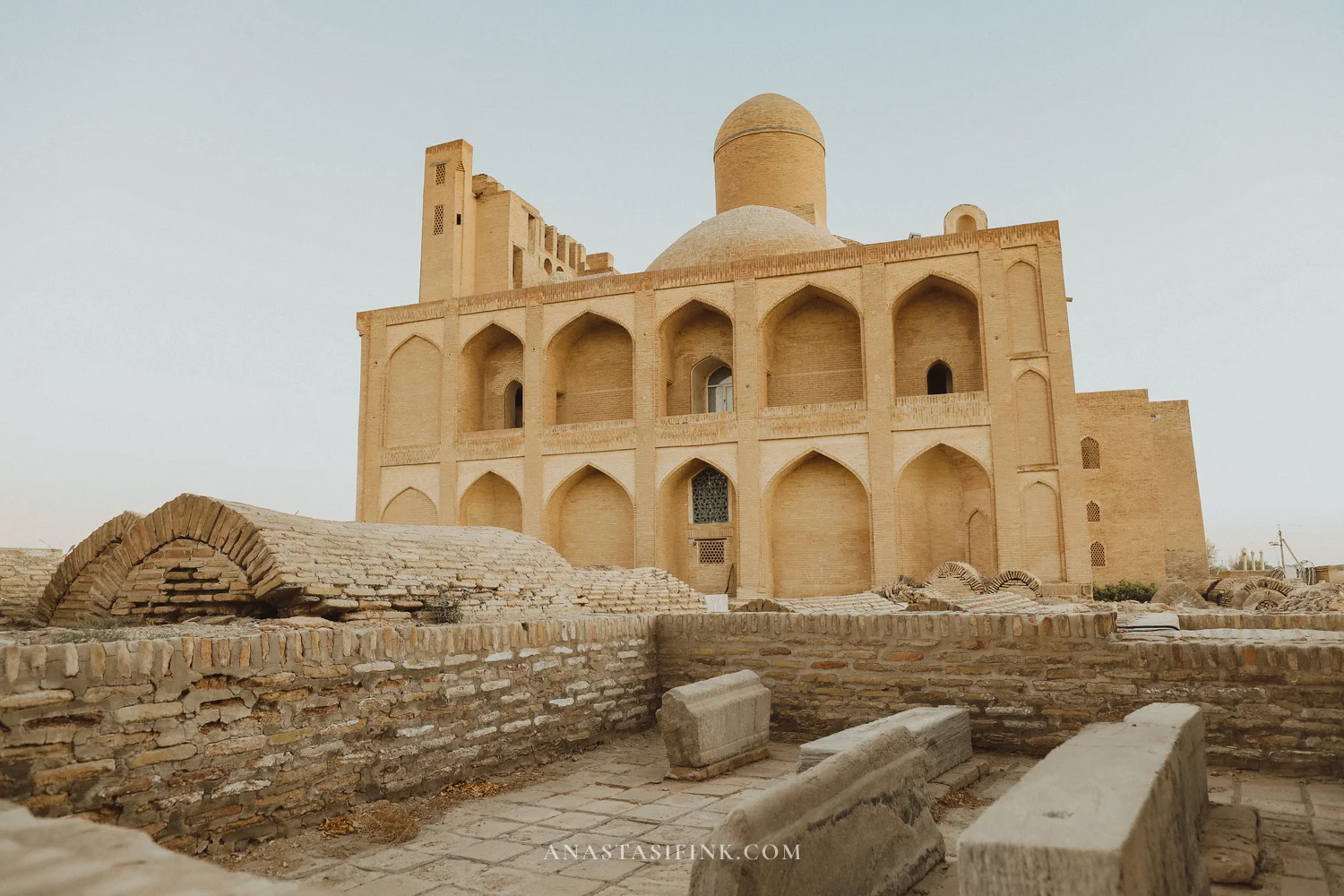
Beyond the main ensemble, the heart of Chor-Bakr is the necropolis itself. It’s a maze of streets and courtyards, with khazira — walled family burial enclosures with no roof — scattered throughout. Inside the khaziras, stone sarcophagi sit either in rows or one by one. The paths are paved with herringbone brick and twist between buildings so unpredictably that you’ll need a map to keep your bearings.
This is the famous “city of the dead” structure that earned Chor-Bakr its place on the UNESCO tentative list: the necropolis literally mirrors the layout of a residential neighbourhood in Bukhara — except instead of houses there are khaziras, and instead of residents there are the Juybar sheikhs and their descendants.
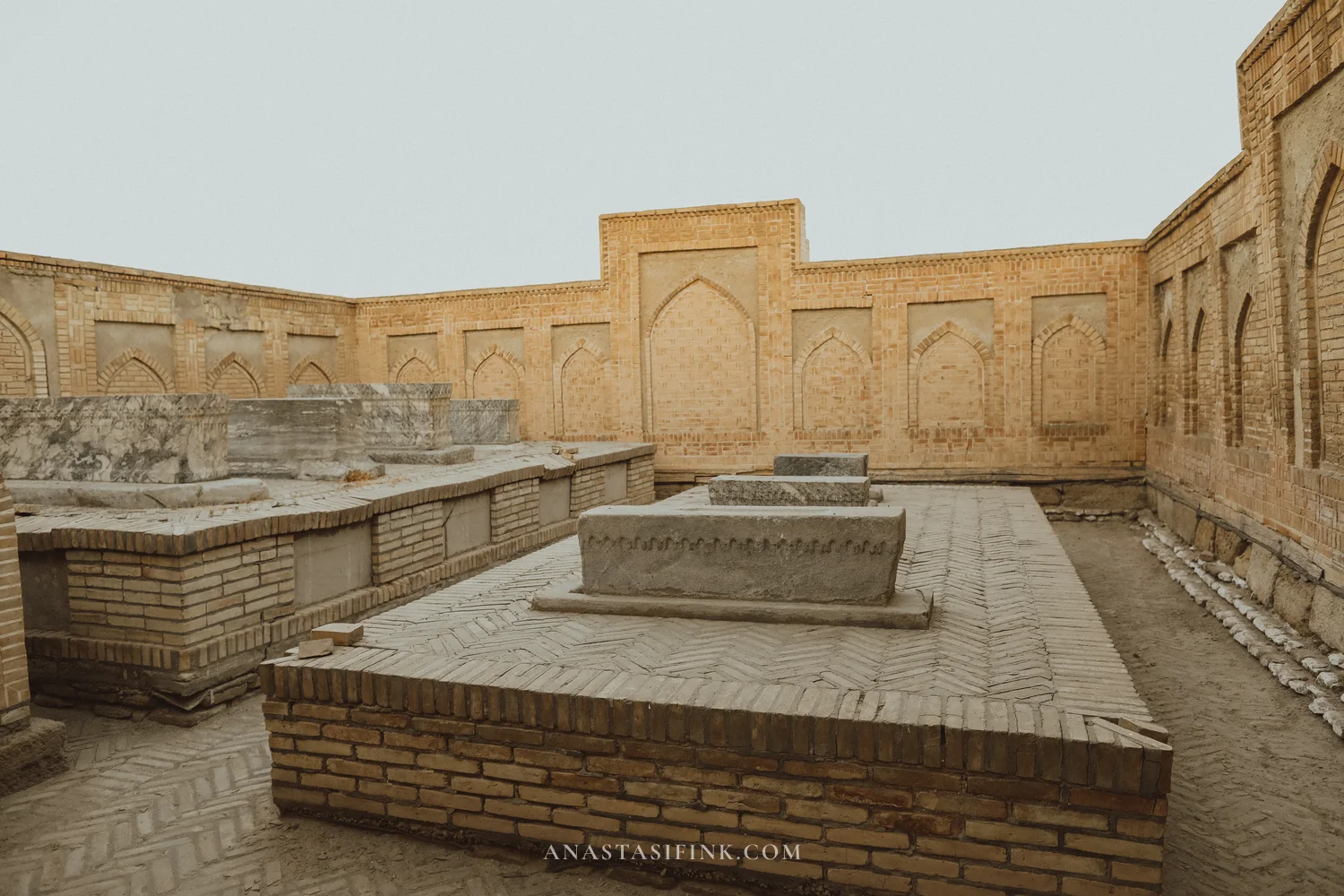
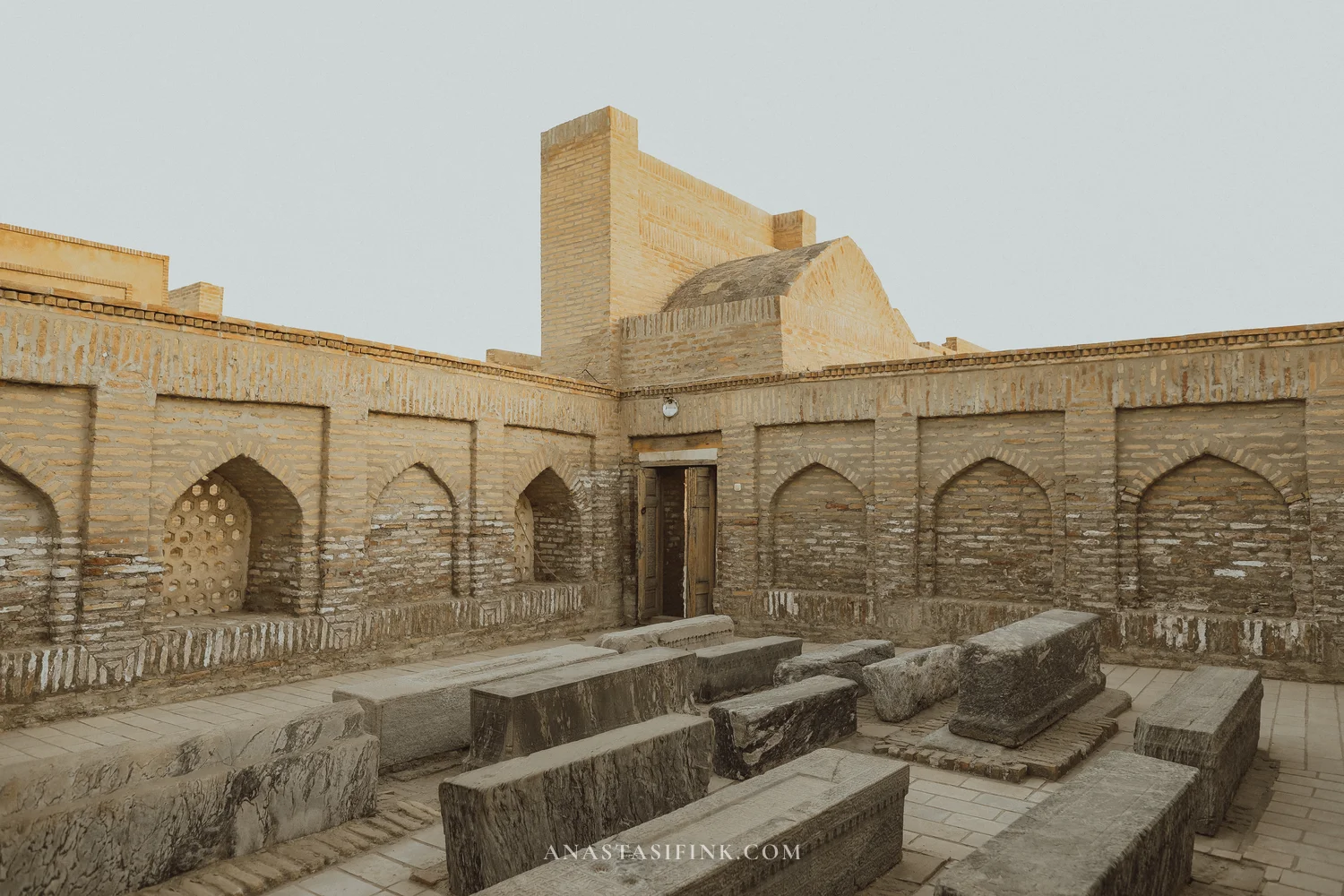
Inside a typical khazira. The gravestones are called “sagana”: stepped blocks of marble and dressed stone, with no roof above them
Architectural details
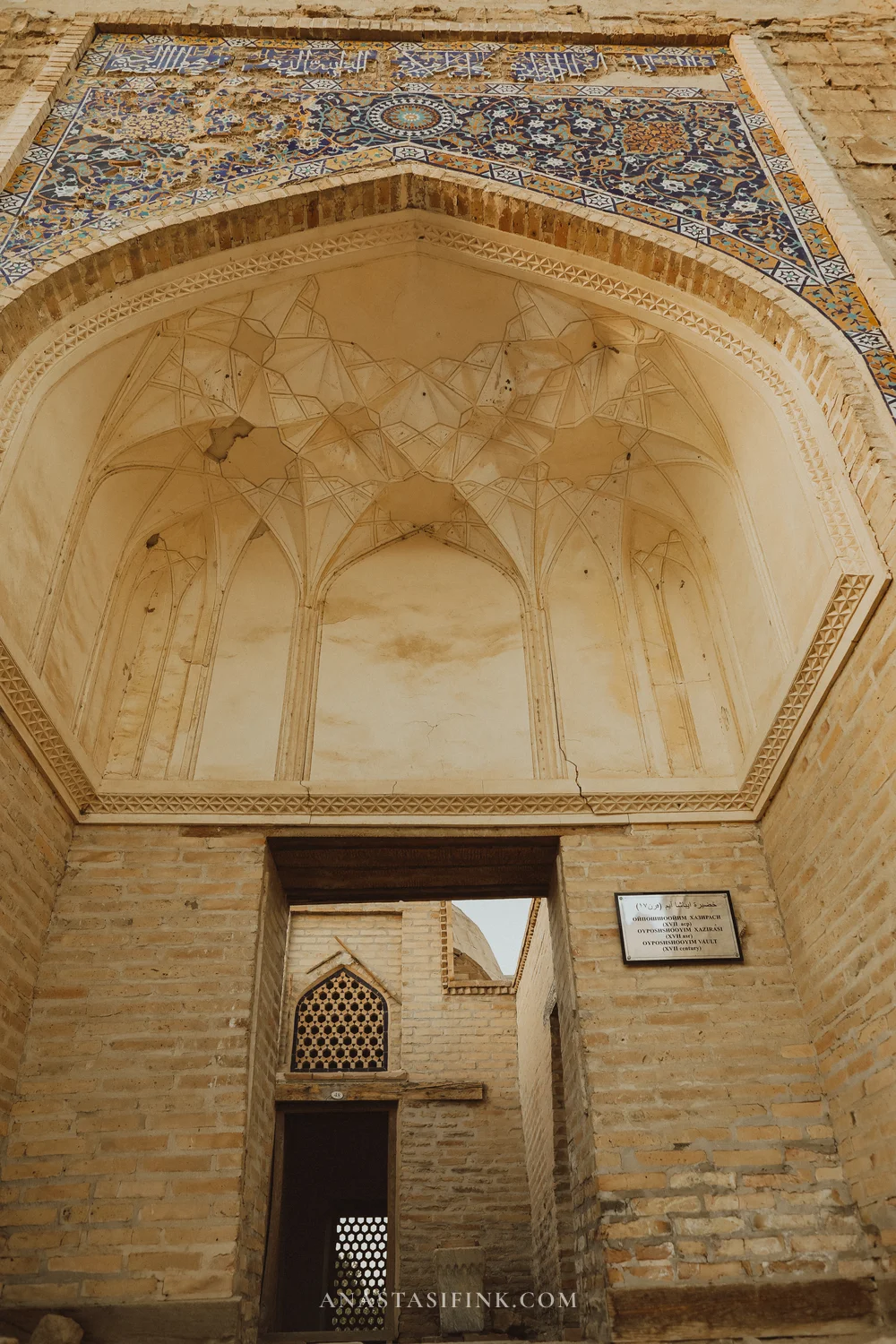
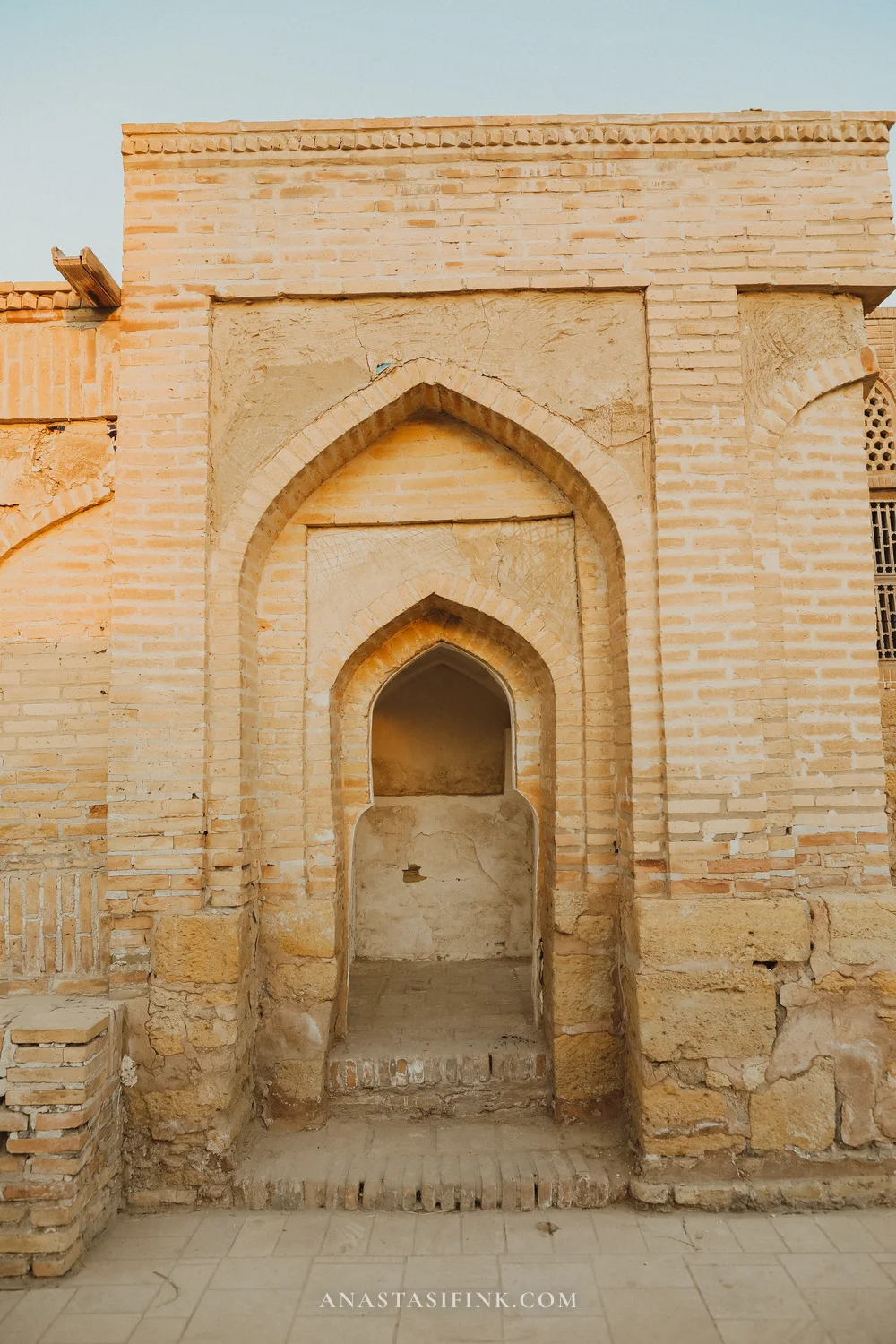
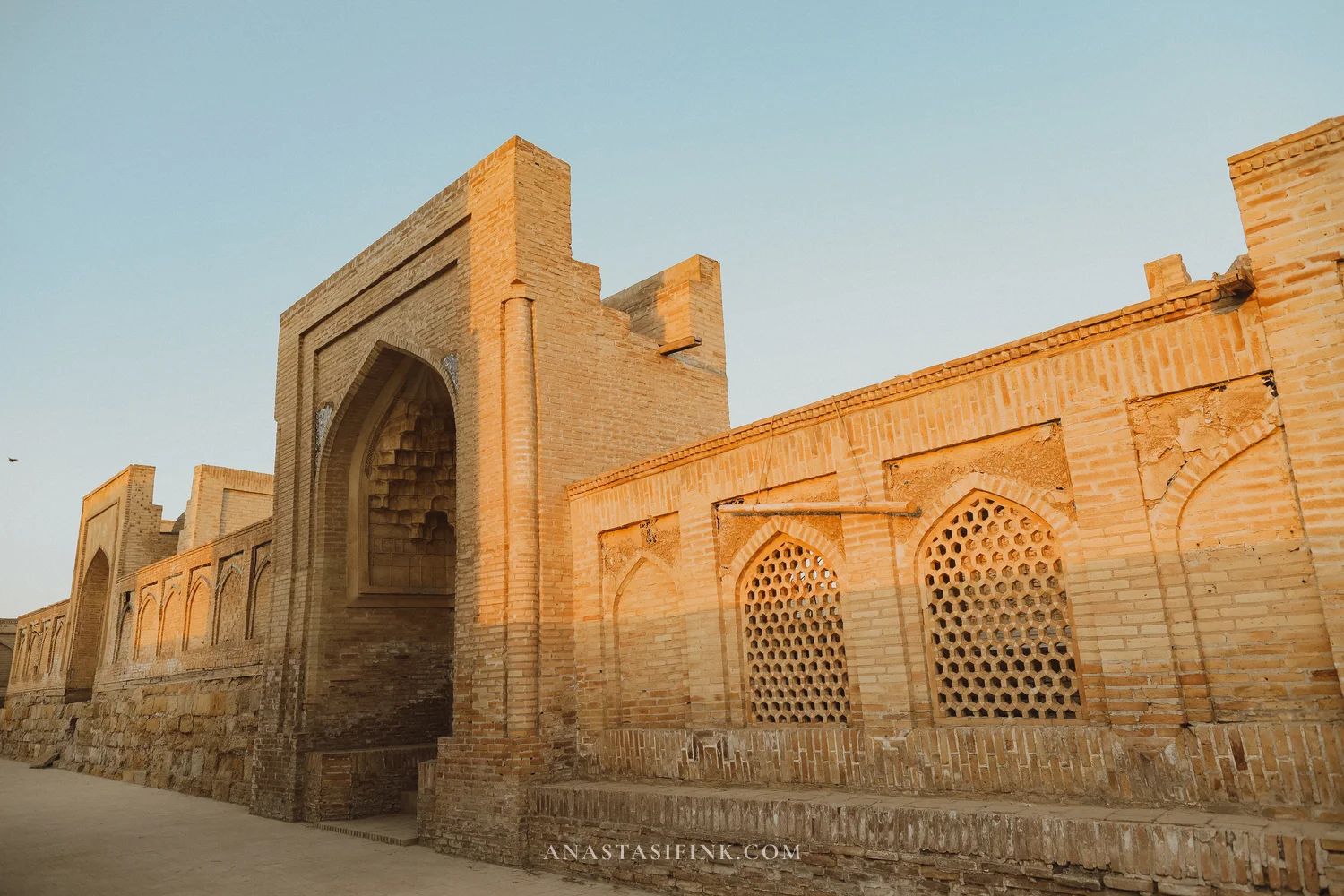
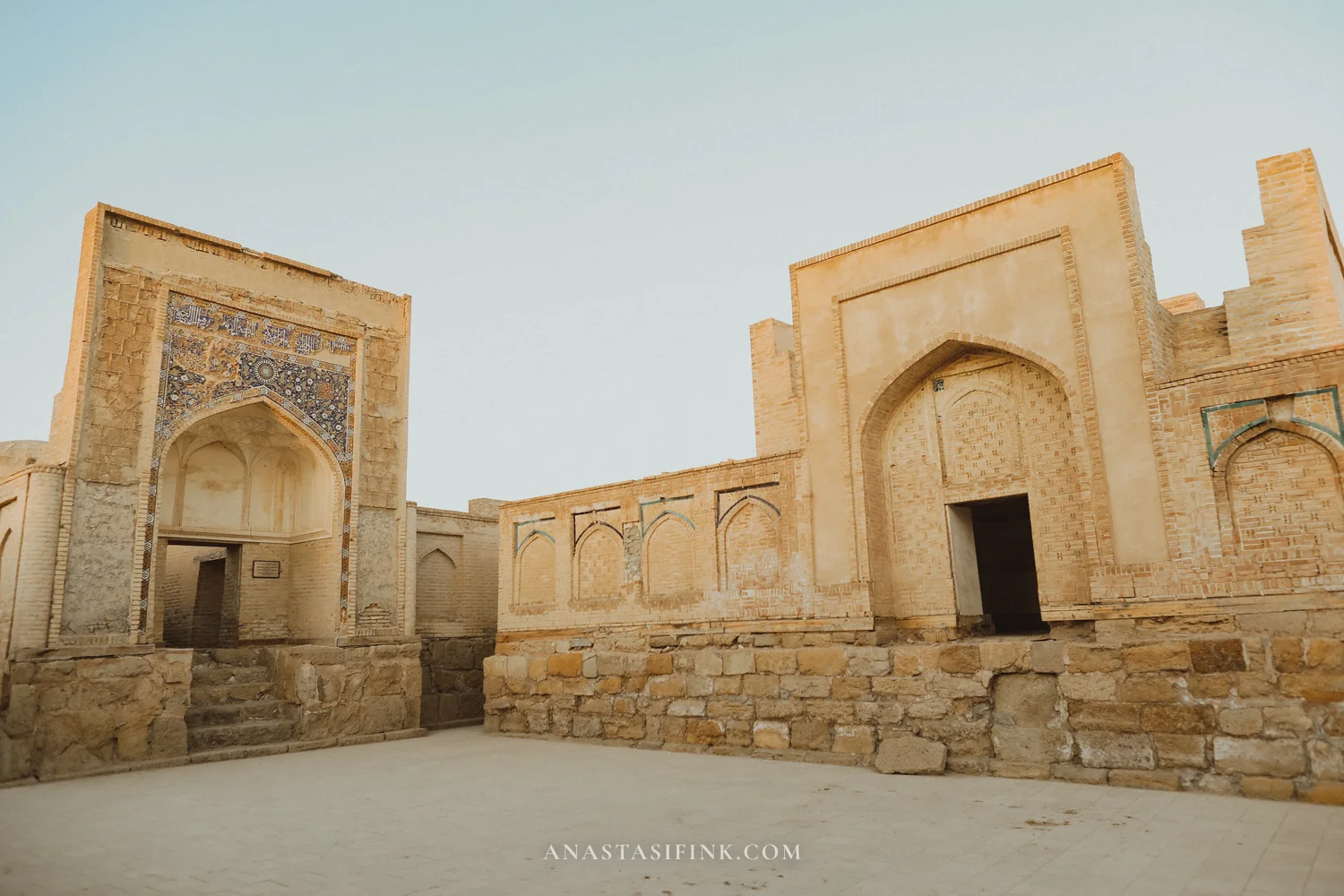
Chor-Bakr rewards slow walking and looking up. Every khazira portal is its own architectural puzzle: in some, the muqarnas are tightly packed into a strict honeycomb; in others, a mosaic band with Kufic script runs along the edge; in others again, it’s just a plain brick iwan with no decoration but perfect proportions. Much of the original tilework is lost and hasn’t been restored — and that, perhaps, is the most valuable part: what you’re looking at isn’t a museum reconstruction, it’s living 16th-century architecture wearing four centuries of patina.
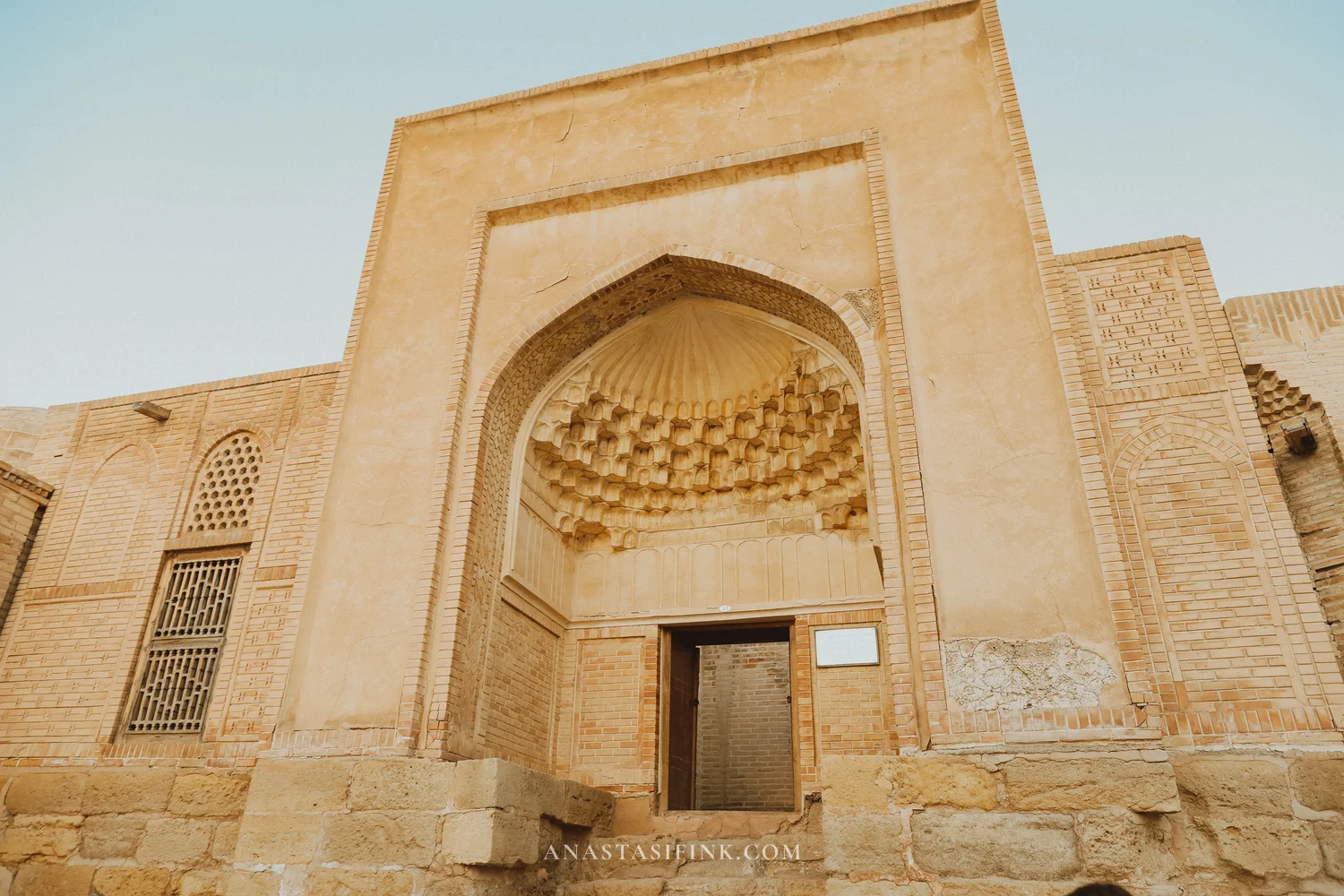
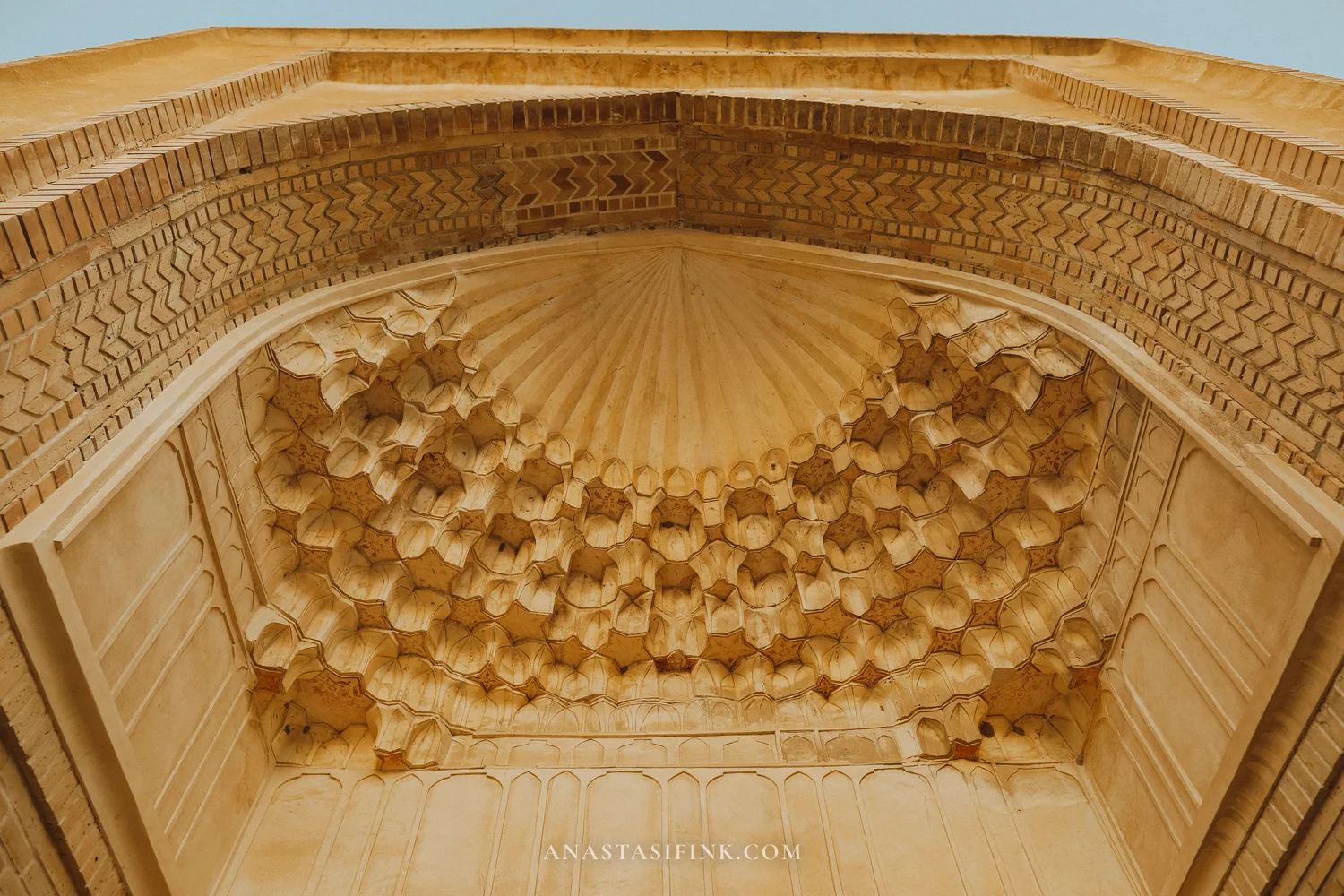
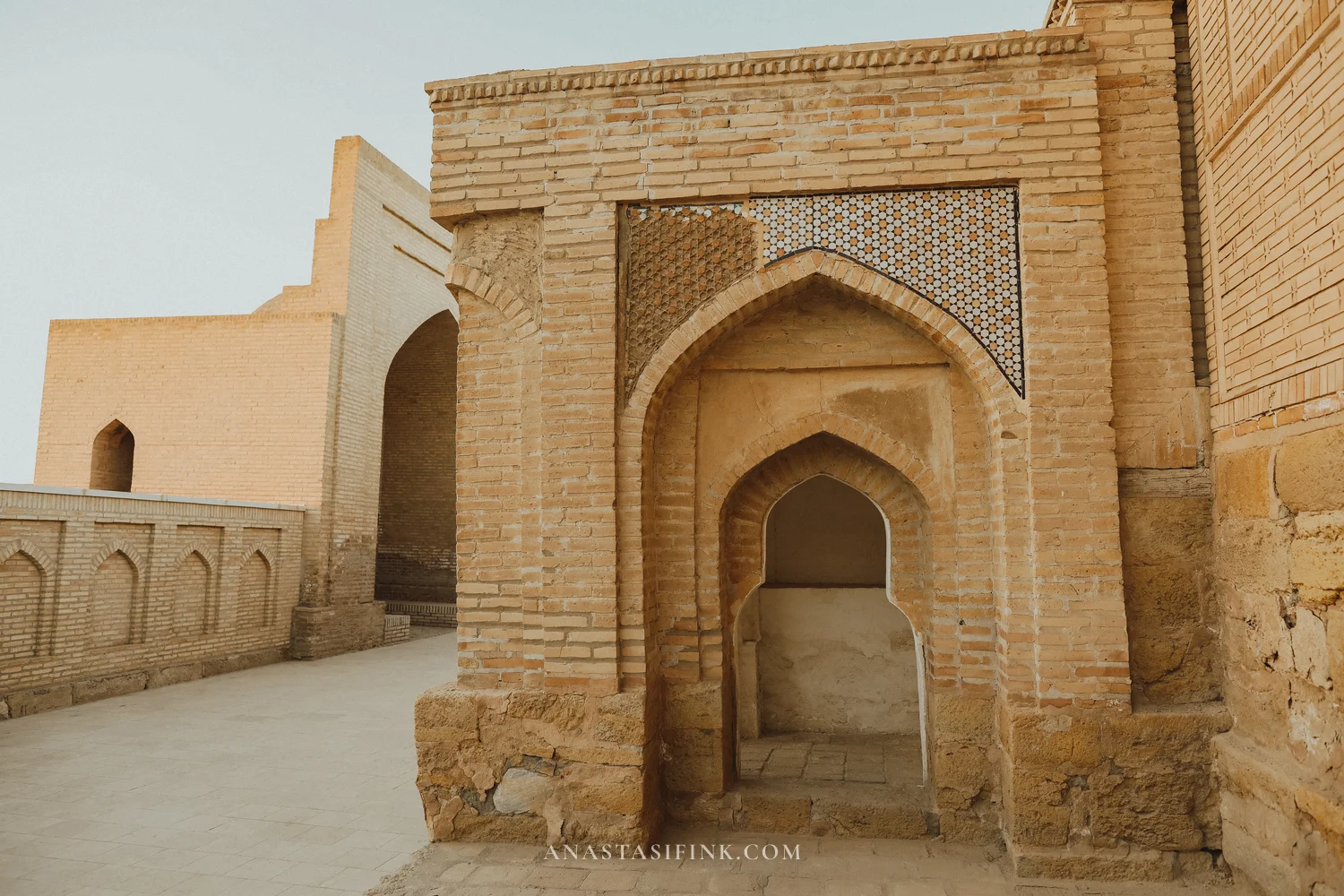
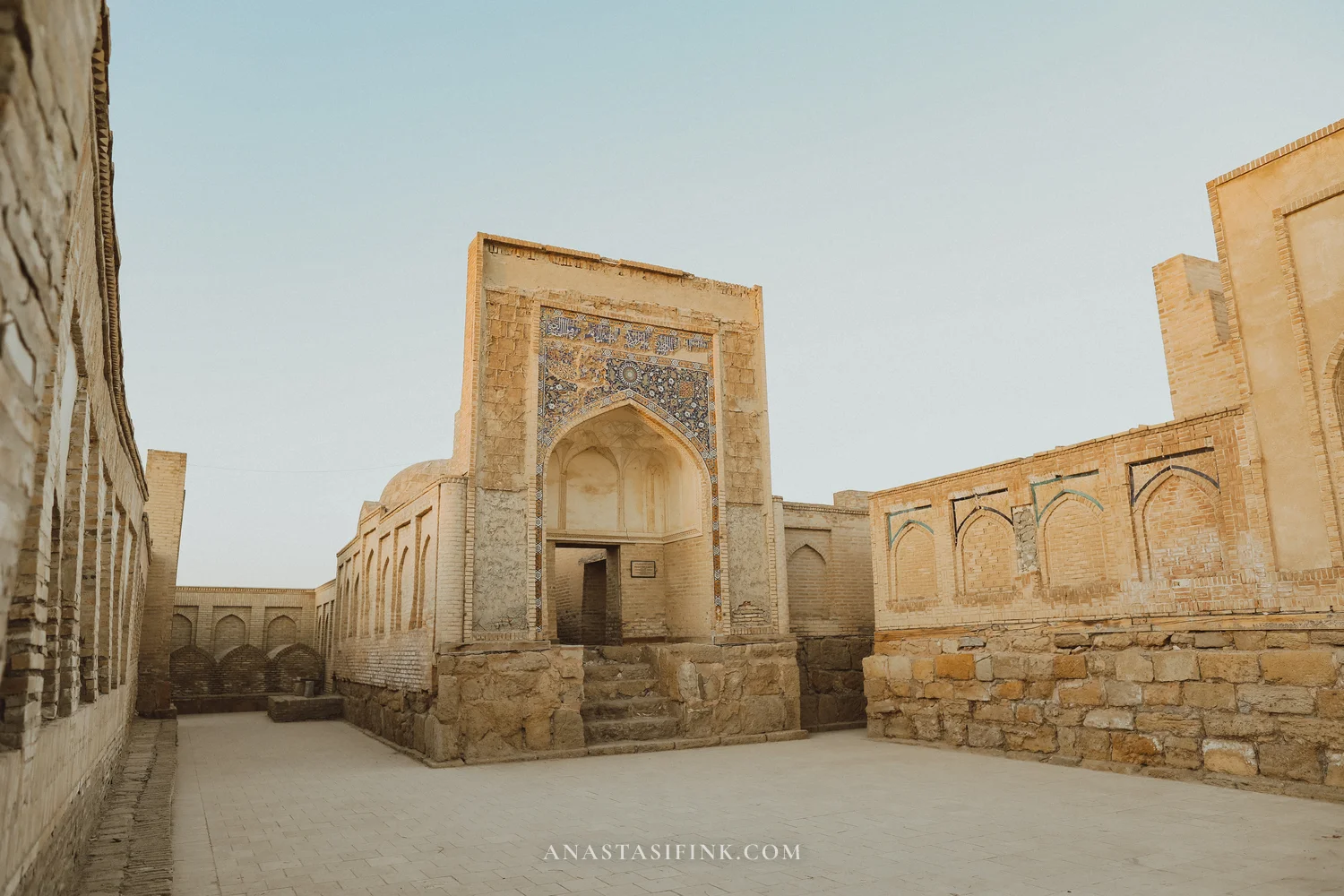
The surviving fragments of tilework give you an idea of how the portals once looked. On most of them, only traces of mosaic remain
Gravestones and old doors
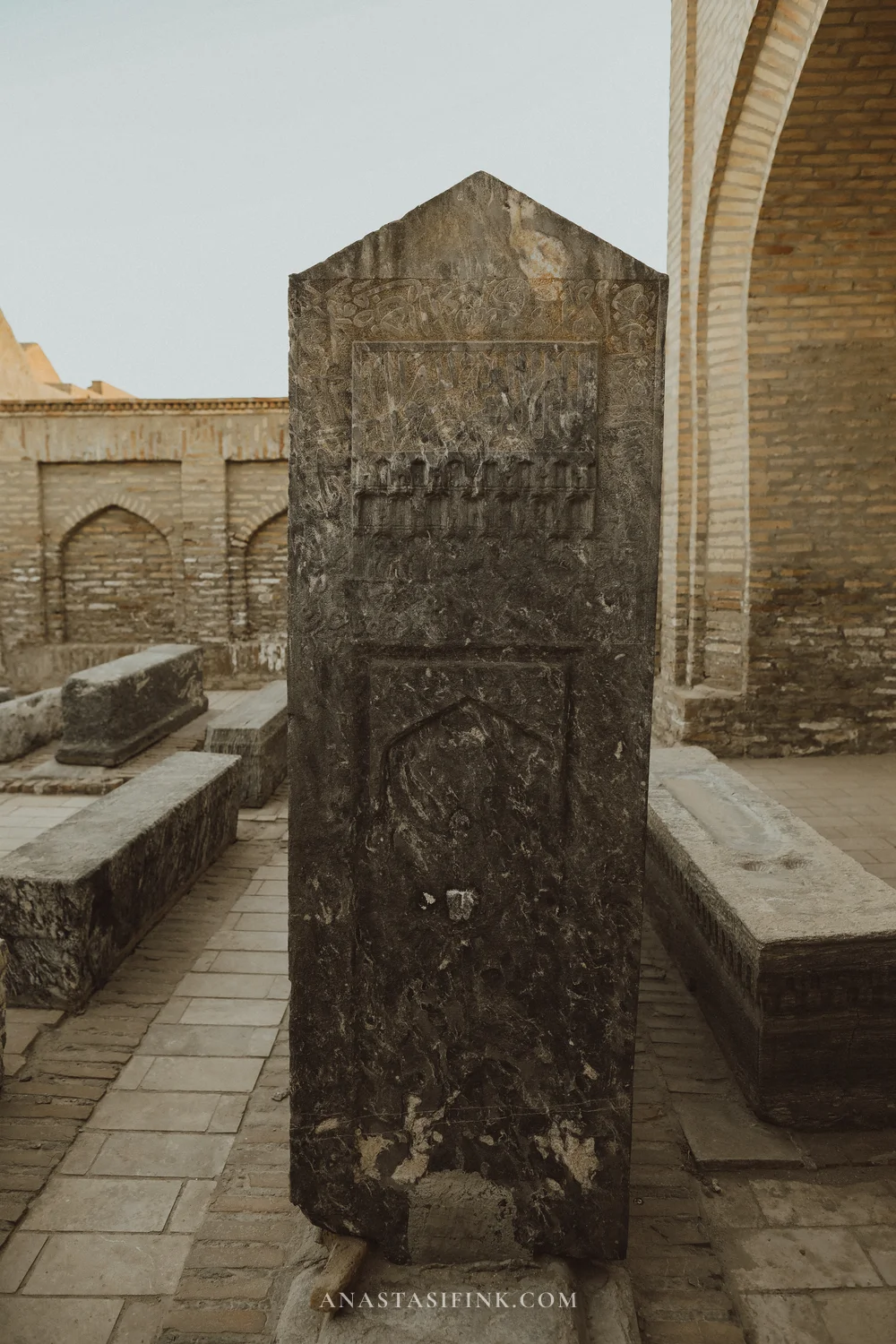
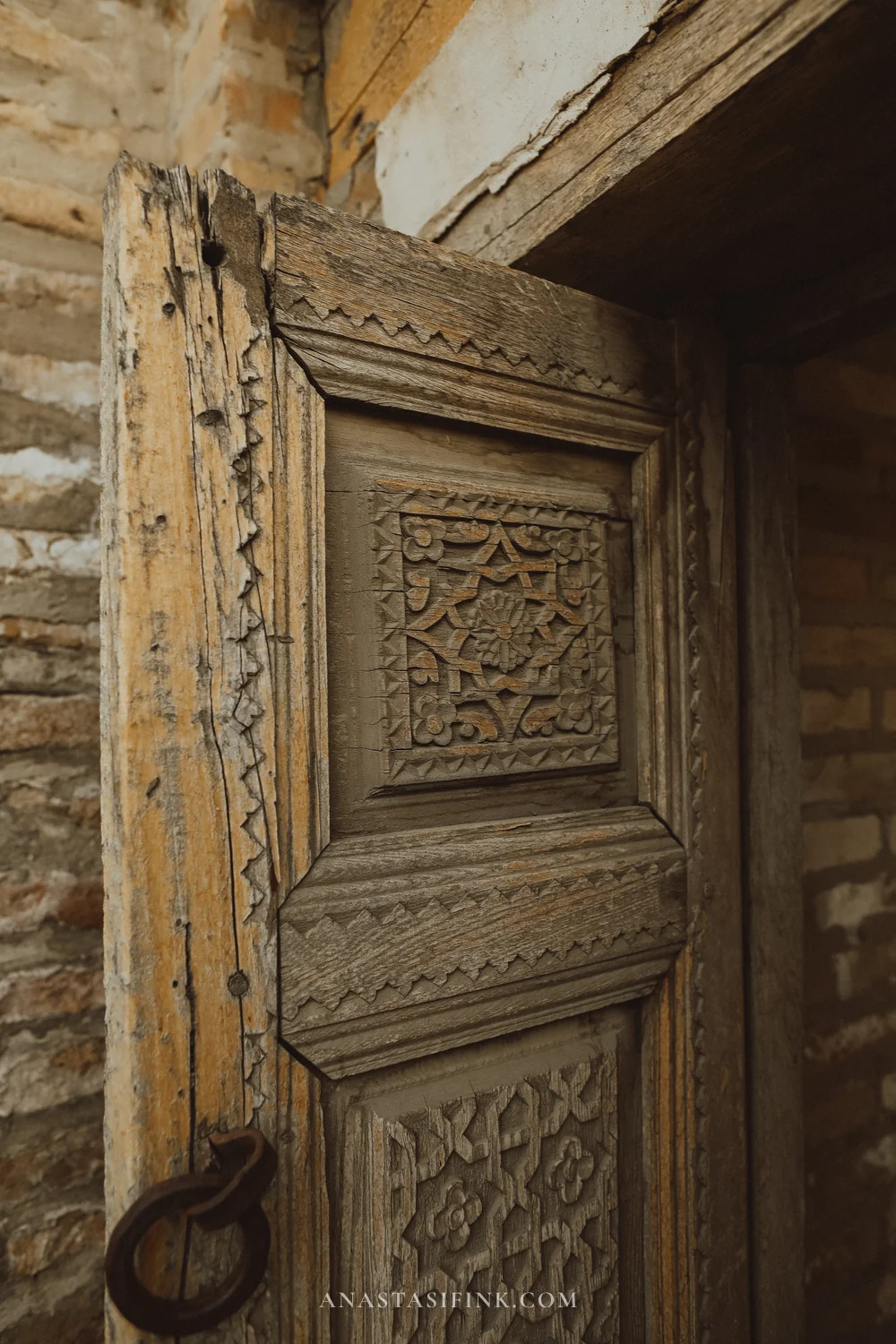
The gravestones deserve their own paragraph. There are hundreds of them in Chor-Bakr — from plain stone slabs to tall black steles covered in carving and calligraphy. The oldest ones have been polished by time to a mirror shine. Some portals still have original wooden doors from the 17th–18th centuries: forged iron rings, hand carving, dried-out boards.
Views of Bukhara and the garden
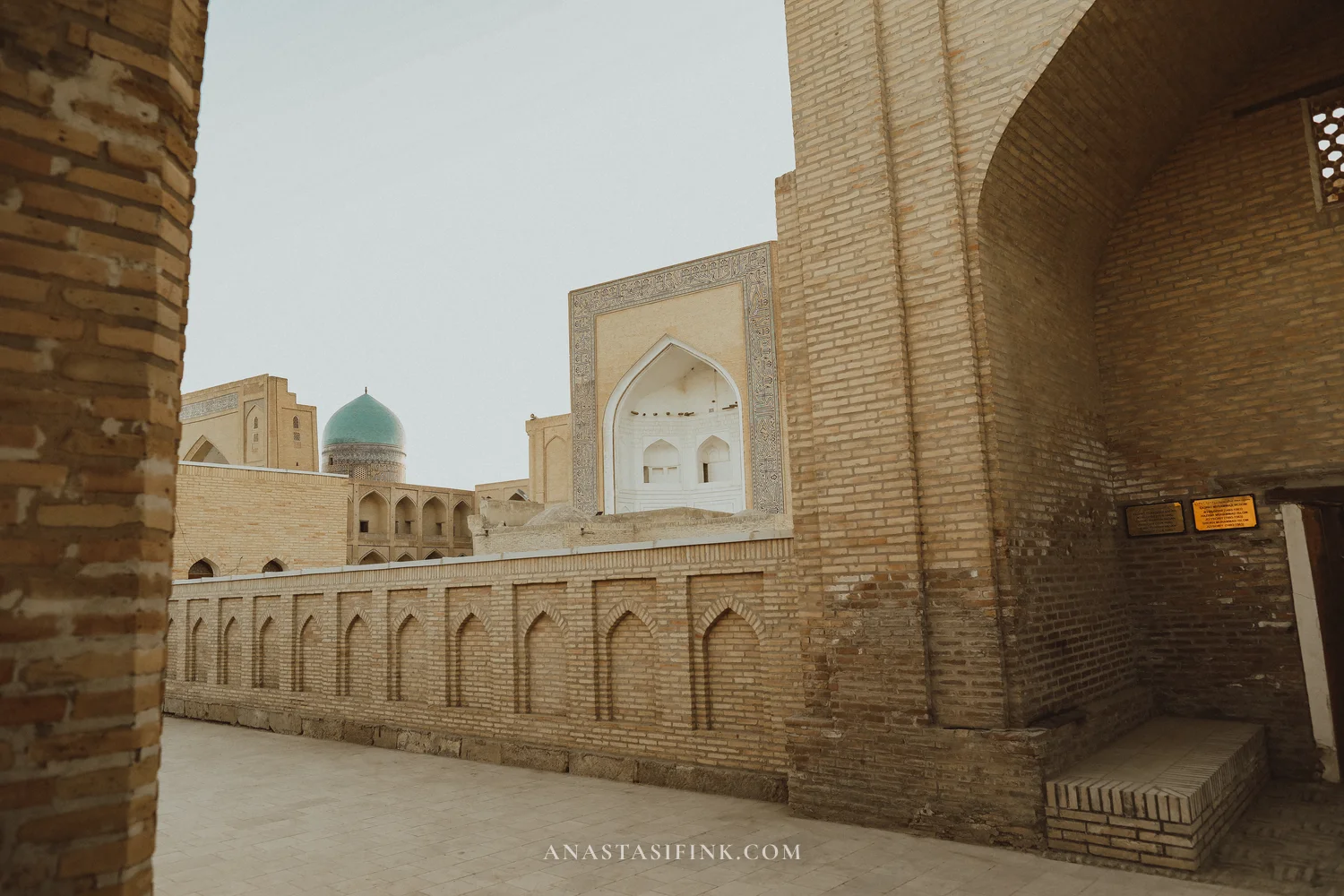
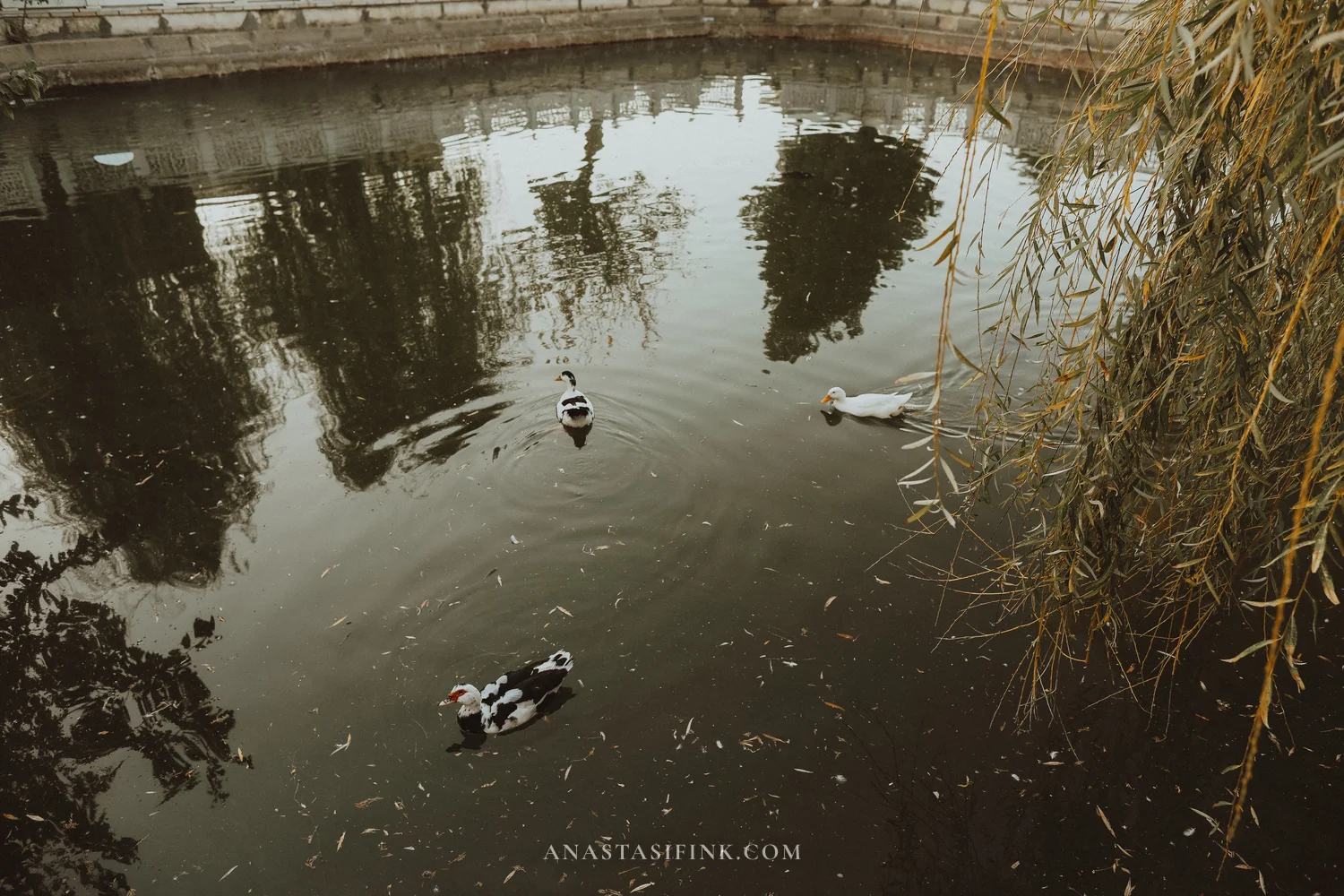
From a few elevated khaziras you get a view over the old city — a turquoise dome of one of Bukhara’s mosques rises above the rooftops. It’s a useful reminder that Chor-Bakr is a suburb, not the middle of nowhere. Part of the territory is a garden: plane trees, mulberries, elms — in autumn the leaves turn gold. Right by the outer wall there’s a duck pond — a good place to sit for ten minutes before you leave.
Sunset light and autumn details
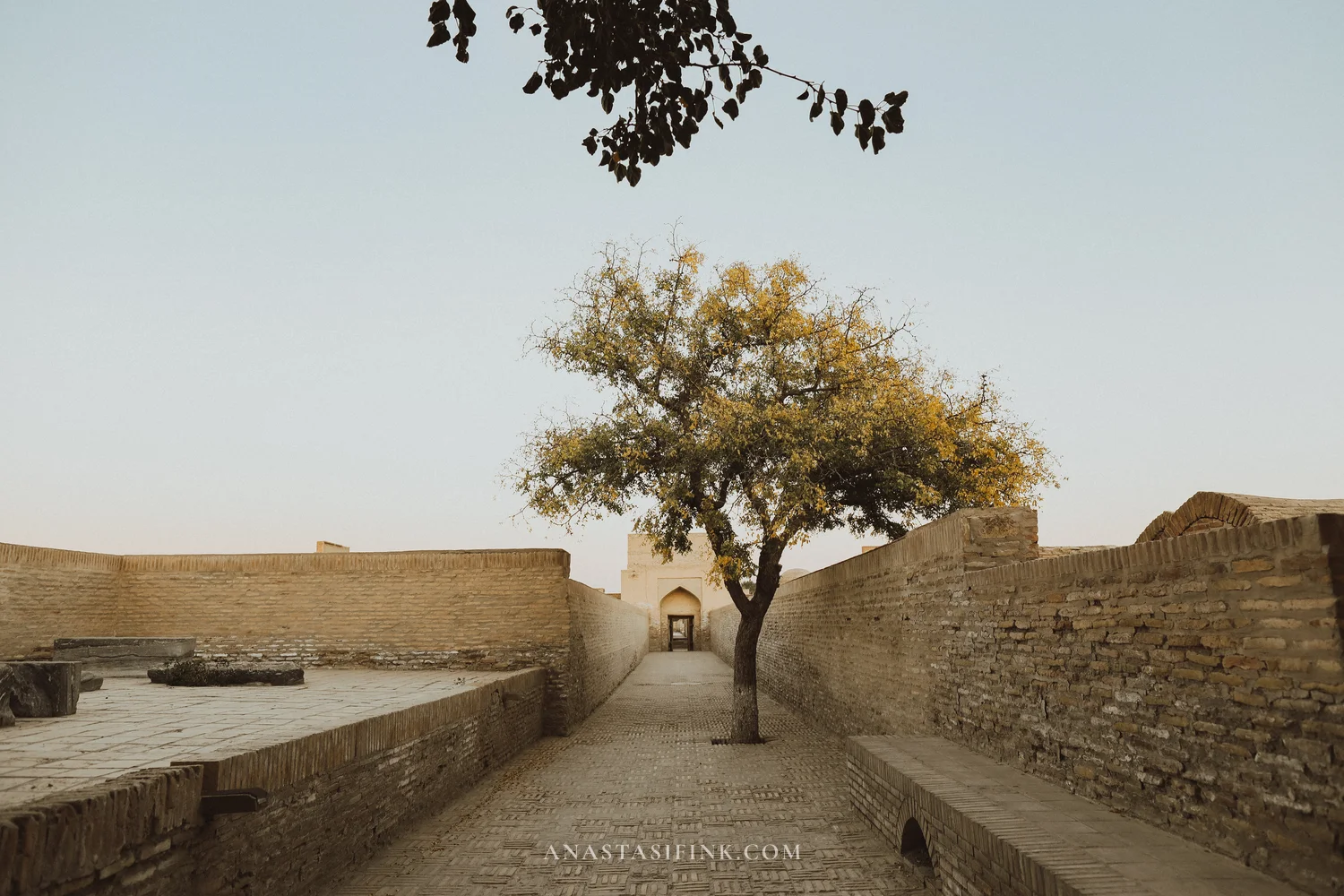
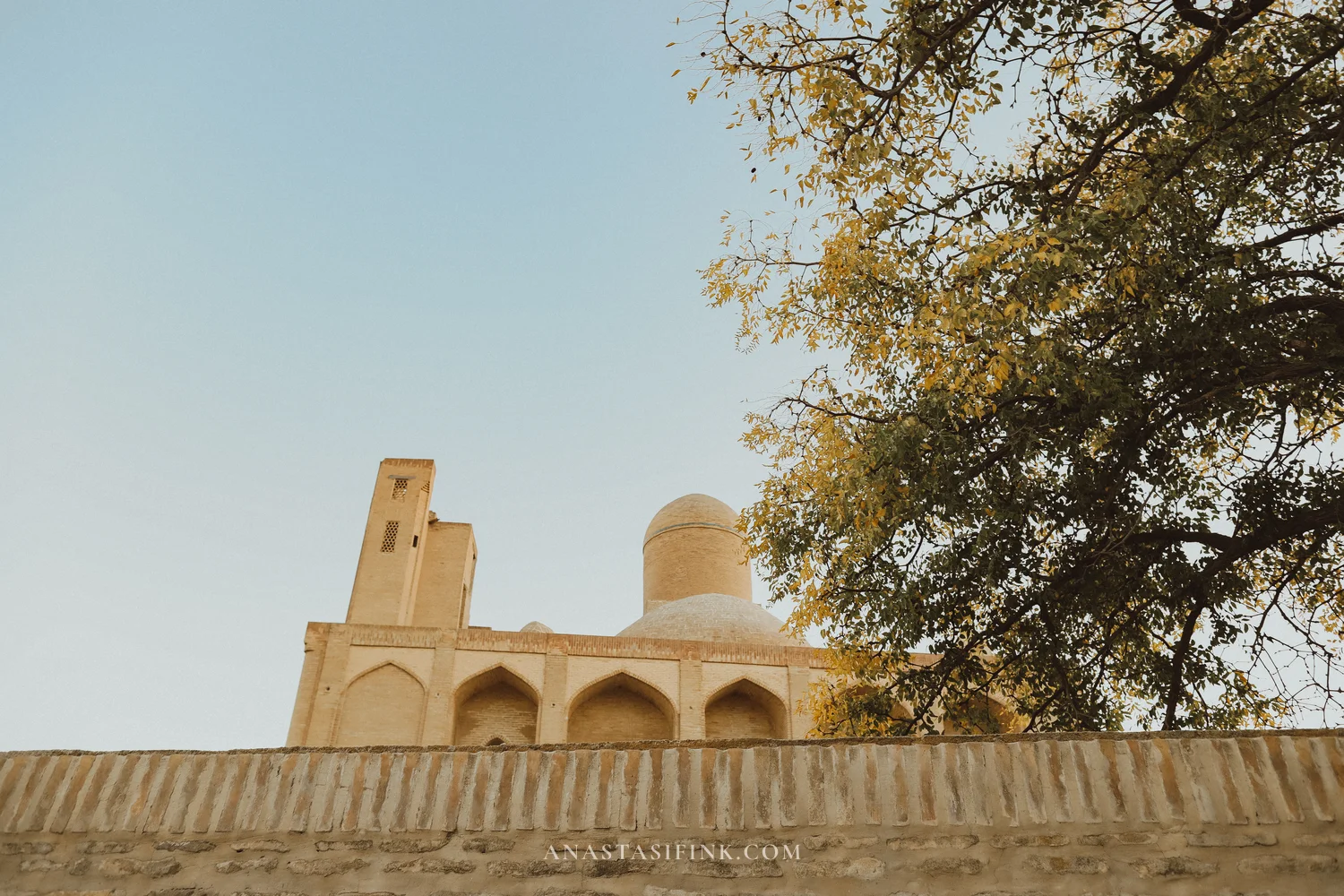
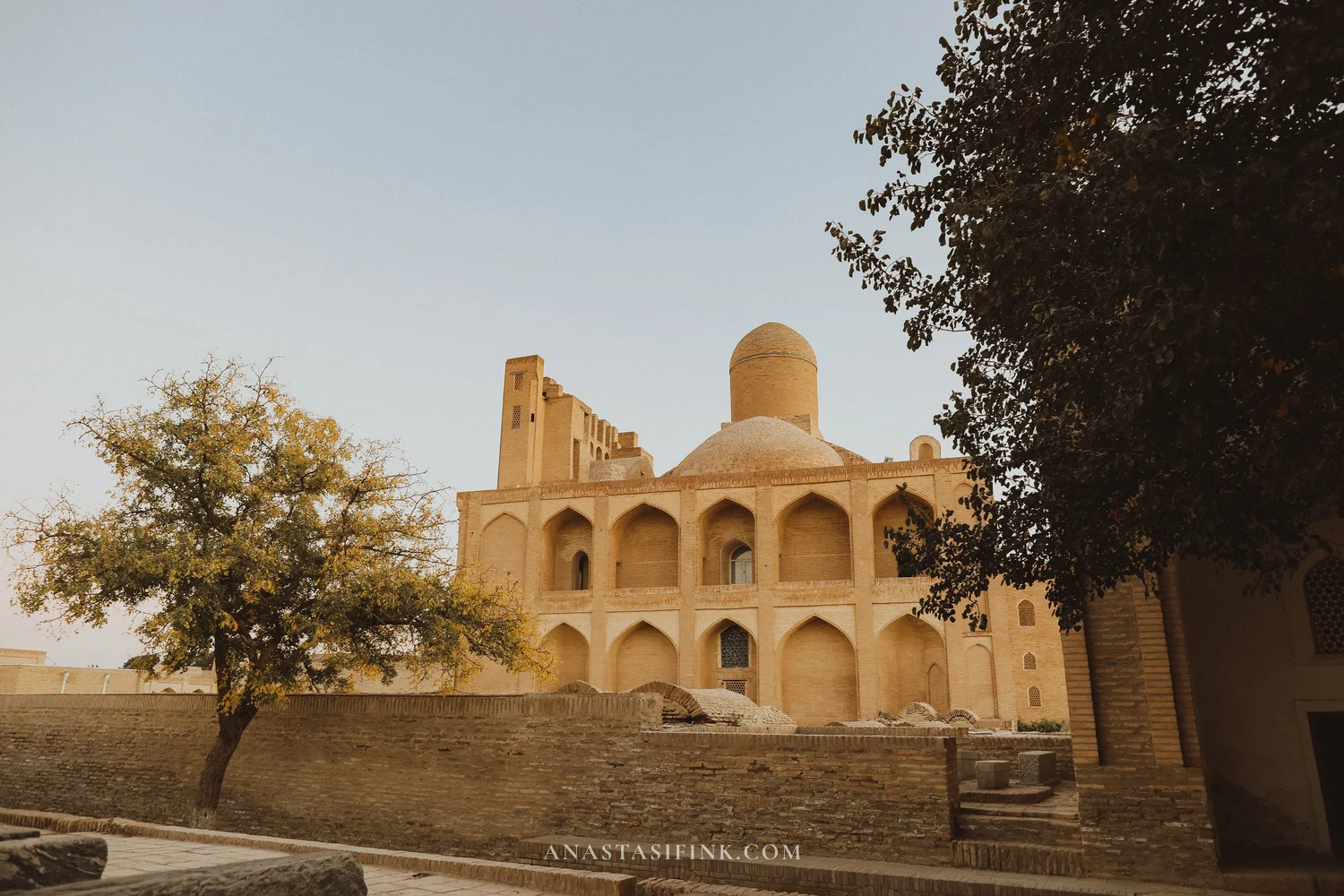
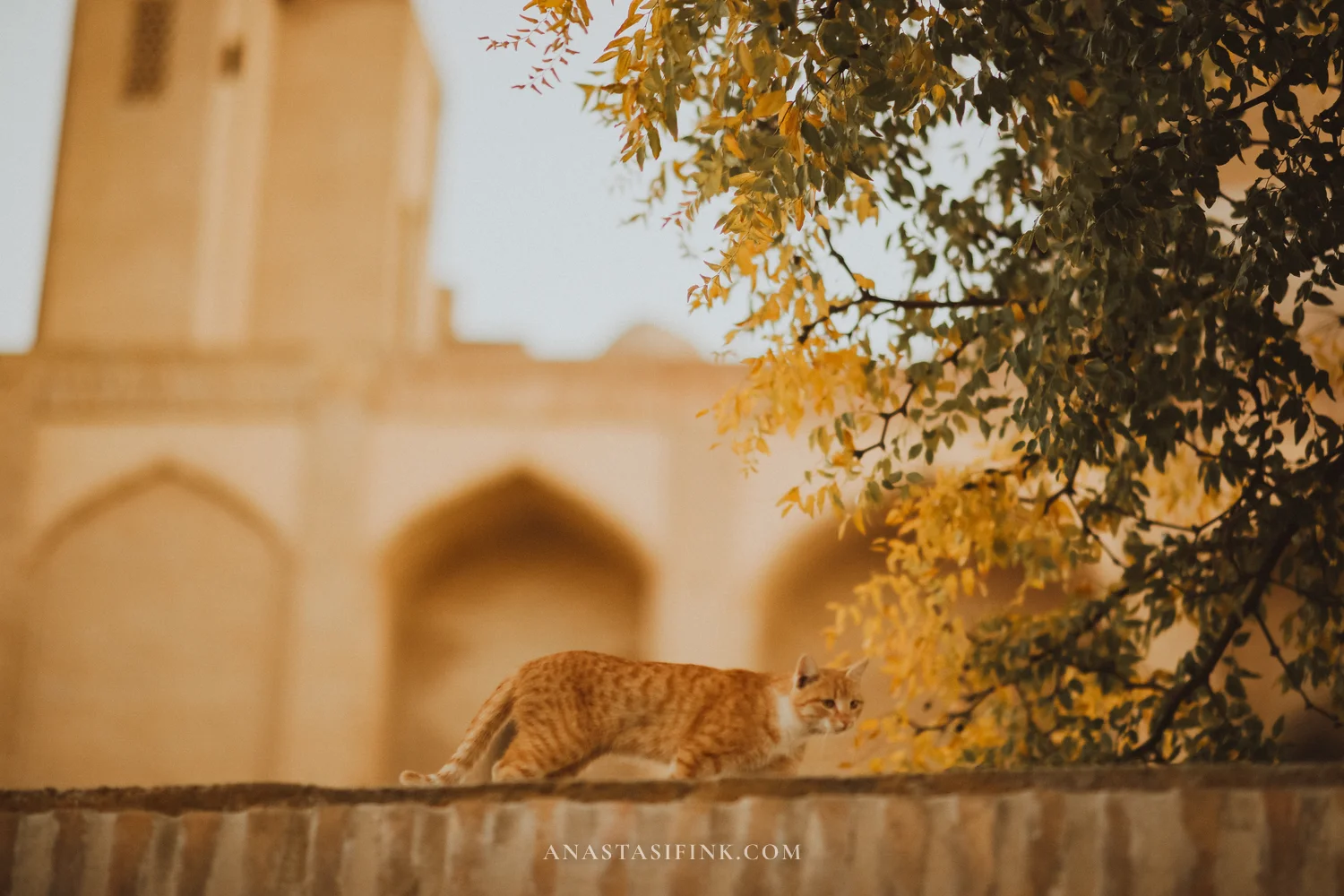
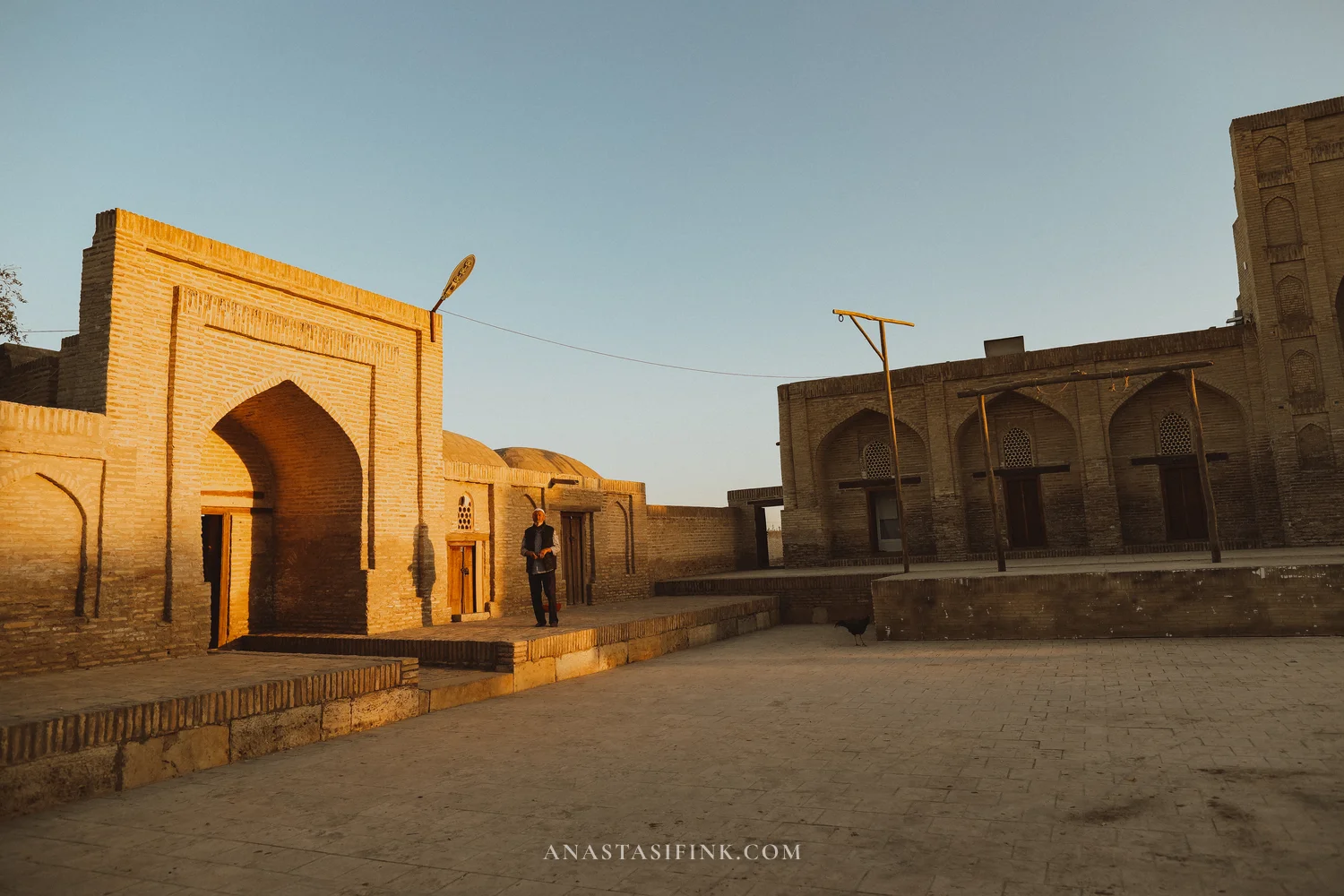
I came in October, and Chor-Bakr caught me in autumn: yellow leaves on the plane trees, warm honey-coloured brick, low sunlight. It’s not the most famous place in Bukhara, but at this time of year it’s one of the most photogenic. Vertical tree trunks against portals, foliage close-ups, a cat on a wall — the shots assemble themselves.
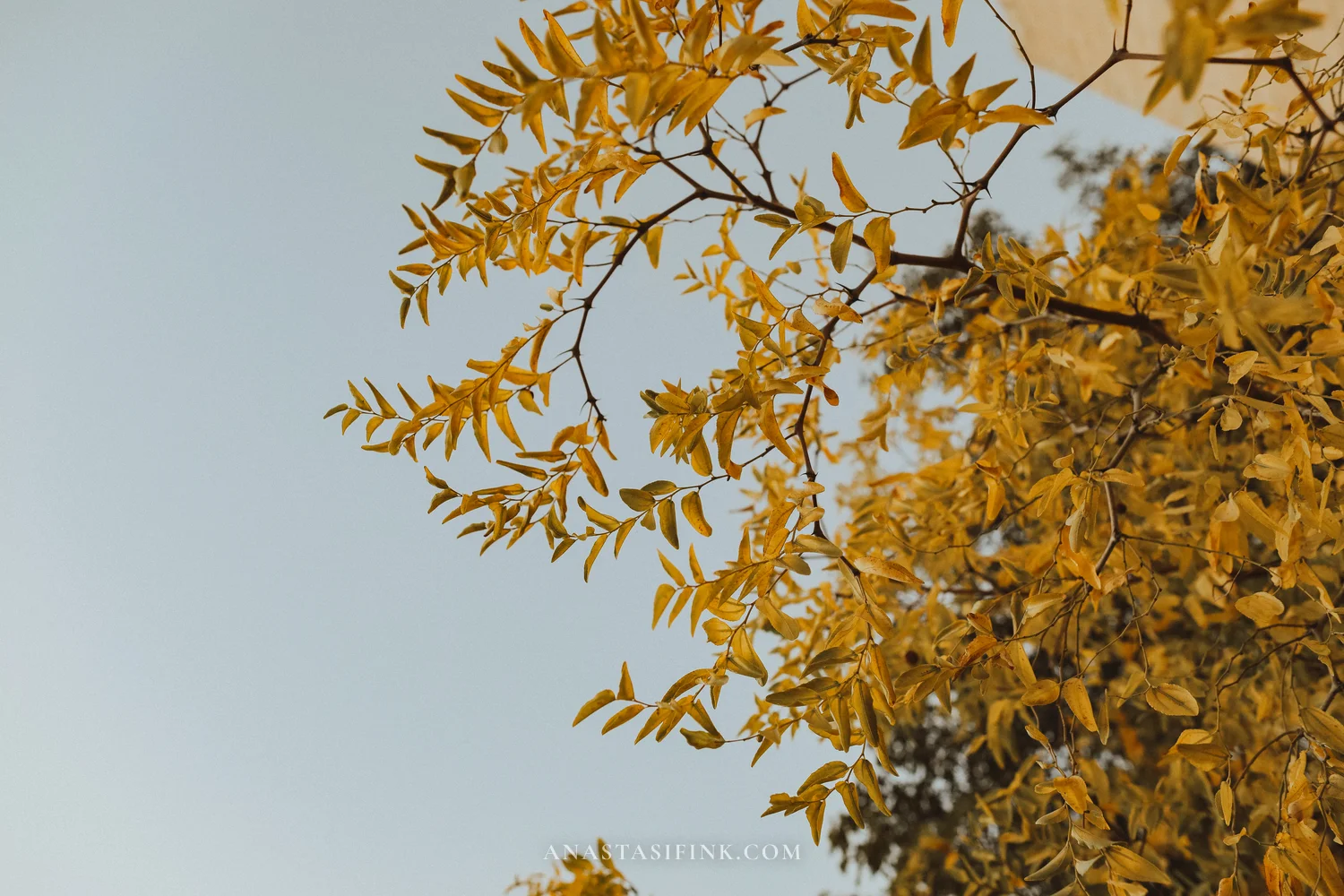
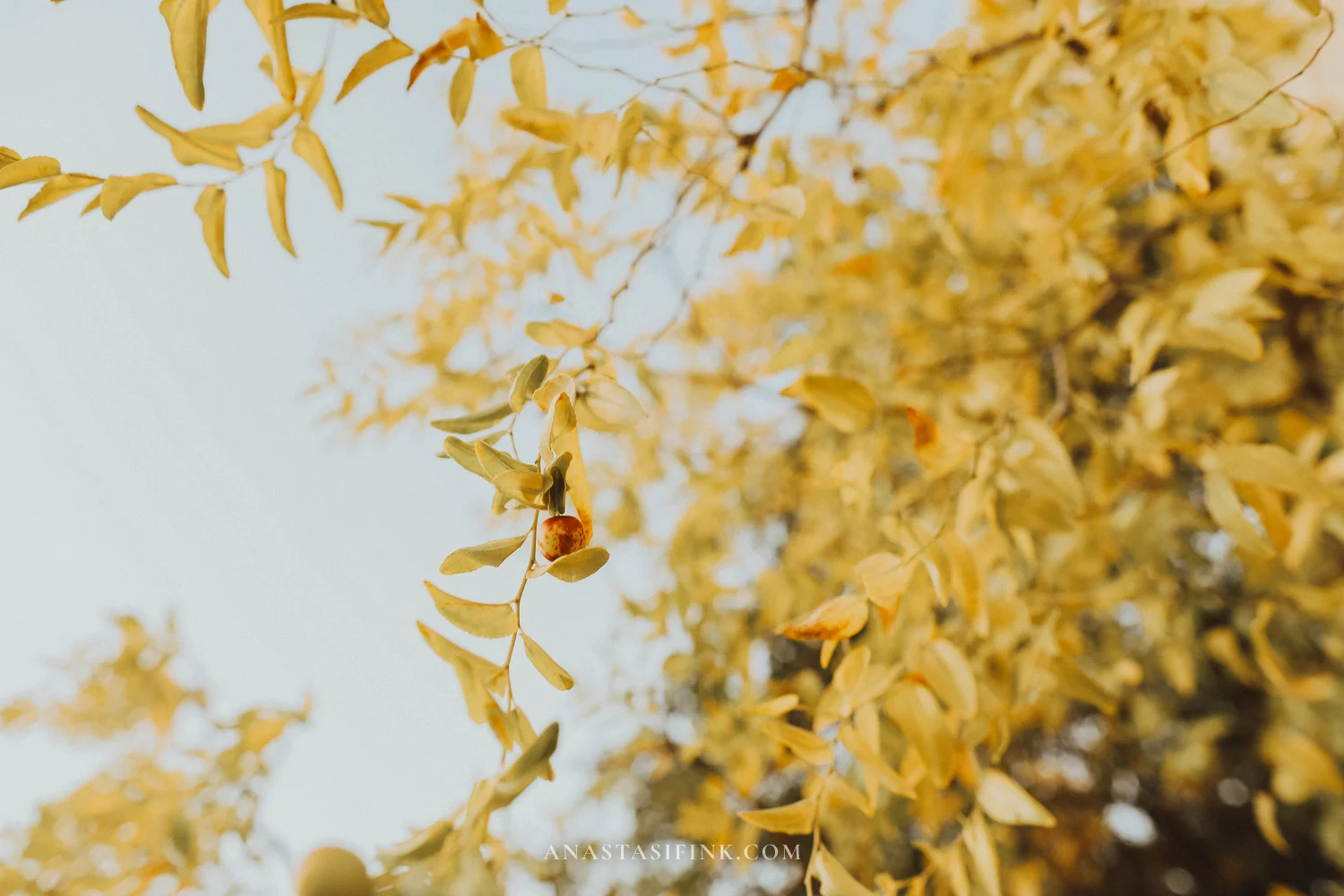
October at Chor-Bakr is its own genre of photography. Yellow on ochre — my must-have shot
Practical Information
Chor-Bakr — what you need to know
- Address: Sumitan village, 5 km west of central Bukhara, Uzbekistan
- GPS: 39.7549, 64.3556
- Hours: 09:00–19:00 (summer), 09:00–17:00 (winter), open daily
- Entrance: 25,000 UZS (~2 USD / ~1.85 EUR) for foreigners, cheaper for Uzbek citizens
- Time needed: minimum 1.5 hours, ideally 2–3
- Toilets: yes, on site, basic
- Food: nothing on site, nearest cafés are in central Bukhara
- Google Maps: Chor-Bakr Necropolis
How to get there
- Taxi from central Bukhara: 30,000–50,000 UZS (~2.5–4 USD / ~2.3–3.7 EUR) one way, 10–15 minutes. The most convenient option
- Yandex Go / Uklon apps: both work in Bukhara, often the same price or cheaper than a hailed taxi
- Marshrutka (shared minibus): from the Registan area towards Sumitan village, about 5,000 UZS (~0.4 USD). It stops on the main road, then it’s a 5-minute walk to the entrance
- Bicycle: bike rentals are available in central Bukhara, the road is flat — but in summer heat, not a great idea
- Ask the taxi to wait: it’s hard to catch a ride back from Chor-Bakr. An hour of waiting costs about 50,000 UZS (~4 USD / ~3.7 EUR)
Getting to Bukhara from abroad
There are no direct flights from Western Europe to Bukhara — most travellers fly to Tashkent (regular flights from London, Frankfurt, Paris with Uzbekistan Airways, Turkish Airlines via Istanbul, or Lufthansa) and then take a domestic flight, fast train (Afrosiyob, ~3.5 hours from Tashkent) or overnight sleeper to Bukhara. The fast train is the most popular option — comfortable, scenic and easy to book online via the Uzbekistan Railways site. From Samarkand, the train to Bukhara takes about 1.5 hours.
When to come
The best time is 1.5–2 hours before sunset. The light is golden, the shadows are deep, and there are almost no visitors (most tour groups come in the morning). Sunrise also works well, especially if you want crowd-free shots — the turquoise dome of old Bukhara on the horizon glows in the early light. Midday is the worst time: harsh shadows and heat.
What to combine it with
Chor-Bakr pairs well with the Bahauddin Naqshband mausoleum (12 km east of central Bukhara) — the second main Sufi pilgrimage site in the region and the spiritual “home” of the same Naqshbandi order. You can build a full day out of it: morning at Bahauddin, lunch in Bukhara, evening at Chor-Bakr.
Visa
Citizens of the EU, UK, Switzerland, Japan, US, Canada, Australia and most other developed countries can enter Uzbekistan visa-free for 30 days as of 2025. A passport valid for at least six months is enough — no e-visa needed for short tourism trips.
Photography tip: bring a wide lens for the interiors (24–35 mm) and a short telephoto (50–85 mm) for the carving details and portals seen in perspective along the streets. No tripod needed. Don’t fly a drone without official permission — Chor-Bakr is still a religious site and locals don’t take kindly to it.
What to keep in mind
Chor-Bakr is an active religious site. Pilgrims still come on Fridays to pray at specific gravestones. It’s not a turnstile museum, it’s a living complex — so you should:
- dress modestly: long trousers or a skirt, shoulders covered (a headscarf for women is recommended on site, and required inside the mosque)
- take off your shoes when entering the mosque or khanaqah
- don’t climb on the gravestones or sit on the khazira walls
- don’t photograph people who are praying without asking
- keep your voice down — even when the place is empty
If you want more depth, ask the caretaker at the entrance: for a small fee (negotiate on the spot, usually 50,000–100,000 UZS) he can give a quick tour in Russian or Uzbek. You won’t find an English-speaking guide here — better to hire a guide in Bukhara and arrange to include Chor-Bakr in your itinerary.
FAQ
The easiest option is a taxi from the city centre — 10–15 minutes and around 30,000–50,000 UZS (~2.5–4 USD) one way. The marshrutka from the Registan area is cheaper but only takes you to the main road. Ask your taxi to wait, because catching a ride back from Chor-Bakr is hard.
1.5–2 hours before sunset is ideal — warm light and almost no other visitors. Sunrise also works well if you want empty frames. Avoid midday, especially in summer: harsh shadows and serious heat.
At least 1.5 hours to walk through the necropolis and step inside the mosque and khanaqah. If you’re into architecture or photography, plan for 2.5–3 hours. The complex is compact, but the maze of khaziras inside is bigger than it first looks.
Yes — it’s a completely different Bukhara: quiet, crowd-free, with 16th-century architecture in nearly original condition. If you have two or more days in Bukhara, Chor-Bakr is a definite yes. For a one-day trip, only if you like quieter, less touristy places.
For foreigners: 25,000 UZS (about 2 USD). For Uzbek citizens it’s noticeably cheaper. Add the optional caretaker-guide fee (50,000–100,000 UZS) and a parking taxi (around 50,000 UZS per hour of waiting) if needed.
Absolutely. Signage is minimal but you can’t really get lost: the main ensemble lines up with the entrance, and the necropolis is a maze you’re meant to wander. A guide only helps if you want the full story of the Juybar sheikhs and the Naqshbandi order — without it, it’s still a beautifully quiet ruin to walk through.
They’re props left over from a historical film shoot — fortress-style gates with towers and old ox-carts under canvas. Chor-Bakr is sometimes used as a film location for Central Asian historical dramas, and not all of the sets get dismantled. They’re set apart from the main complex, so you can easily skip them if you only care about the genuine 16th-century buildings.
No — citizens of most Western countries (EU, UK, US, Canada, Australia, Japan) can enter Uzbekistan visa-free for up to 30 days as of 2025. You just need a passport with six months of validity. No e-visa, no airport queues for stamps.
Chor-Bakr is one of those places you want to come back to when you’re tired of central Bukhara. Quiet, almost no people, and you actually get to see 16th-century architecture without the back of someone else’s head in the frame.