Ogoh-Ogoh in Bali: The Monster Parade Before Nyepi — Full Guide

Once a year, on the night before the Balinese New Year, the whole island takes to the streets with giant demons made of bamboo and papier-mâché. I spent that day on the road between Ubud and Denpasar — and it turned out to be one of the most powerful festivals I’ve ever seen in Asia.
What Ogoh-Ogoh Is — a Night of Monsters Before the Day of Silence
Understanding someone else’s culture without living inside it for years is always hard. It’s like listening to music in a foreign language: the melody pulls you in and fills you with feeling, the words weave through it like one more instrument — but the meaning stays out of reach, and it often turns out to be nothing like what the sound alone suggests. And yet sometimes the sound matters more than the words. For me, Ogoh-Ogoh is exactly that kind of experience. You can “hear” this festival without translation: through the frenzy that ignites on parade night; through months of painstaking work and the team effort that pulls in an entire neighborhood, from master craftsmen to kids; through the shared drive that unites people around their monster; through symbolism that needs no knowledge of Hinduism at all. One look at the figure in front of you is enough.
Ogoh-ogoh are giant demon effigies that the Balinese spend months building, then carry through the streets for one single night. The parade happens on the eve of Nyepi — the Balinese New Year by the Saka lunar calendar. The evening itself is called Pengerupukan, and that’s where the festival’s central contrast lies: a night of noise, fire, and crowds — and the next morning the entire island falls completely silent for 24 hours. Even the airport shuts down.
The figures represent bhuta kala — the negative forces and human vices of Balinese Hinduism: greed, anger, envy. The logic of the ritual is simple: shape everything bad into a visible form, carry it through the streets so the evil spirits move into the effigies — then burn them. The island enters the new year cleansed.
Funny enough, the tradition in its current form is fairly young. Building ogoh-ogoh on a mass scale only started in the 1980s, when Bali’s governor Ida Bagus Mantra made the parade an official part of the New Year ceremonies. In forty years it has grown into the biggest event of the year for Balinese youth — imagine Mardi Gras crossed with Halloween and an art competition, with a finale straight out of Burning Man.


When the Parade Happens: Dates Until 2029
Nyepi follows the Saka lunar calendar, so the date shifts every year — usually falling in March. The Ogoh-Ogoh parade always takes place on the evening before.
- 2026: parade — March 18, Nyepi — March 19 (year 1948 of the Saka calendar)
- 2027: parade — March 7, Nyepi — March 8
- 2028: parade — March 25, Nyepi — March 26
- 2029: parade — March 14, Nyepi — March 15
The processions kick off around 6–7 pm and run until midnight. But the whole preceding day is part of the celebration too: the figures go on display in the streets from the morning, and in the afternoon the children’s and village processions begin.
Nyepi starts at 6 am and lasts exactly 24 hours. The main rules: don’t leave your hotel or villa, keep quiet, and don’t turn on bright lights — and yes, they apply to tourists too. Denpasar’s airport closes completely. Mobile service may be restricted, but Wi-Fi will most likely keep working — check with your hotel before you check in.
How the Monsters Are Made
Inside every figure is a frame of bamboo and rattan, tied into the shape of the future monster. It gets covered with layers of paper, papier-mâché style, then filled, painted, and dressed. The hair is made of dyed plant fiber, fabric, and feathers. On the best figures, the skin is detailed down to wrinkles and veins — up close, you can see it’s handcraft on the level of theatrical prop-making.
In the 2010s many teams switched to styrofoam — it’s easier to carve. But since 2015, Bali’s authorities have banned styrofoam in competition ogoh-ogoh: it’s toxic when burned, and the festival is, at its core, about purification. So bamboo, paper, and natural materials are back in use.


The details up close: skin with wrinkles and folds is layered papier-mâché; crowns and ornaments are carved and gilded
The figures are built by the young people of each banjar — the neighborhood community that’s the basic unit of Balinese life. The youth associations are called sekaa teruna, and for them ogoh-ogoh is a matter of pride: whose monster is cooler is the talk of the whole neighborhood. The work takes anywhere from one to five months, with the money raised by the entire community. In a way, those months of working together are already part of the festival — the parade is just the finale.

The finishing touches happen right on parade day: touching up paint, fixing the hair, attaching ornaments. Ladders and scaffolding go up next to the figures — there’s no other way to reach the head of a five-meter monster.


The morning before the parade: ladders, scaffolding, and last-minute fixes
The competition is seriously fierce: in Denpasar alone, 223 figures entered the city contest in 2026, and 16 finalists were selected for the closing Kasanga Festival at the Catur Muka statue. The prize pool is 50 million rupiah (about $3,000) for first place, plus every finalist gets 30 million (about $1,800) toward construction costs.

Who the Figures Depict: Gods, Demons, and Fairy-Tale Heroes
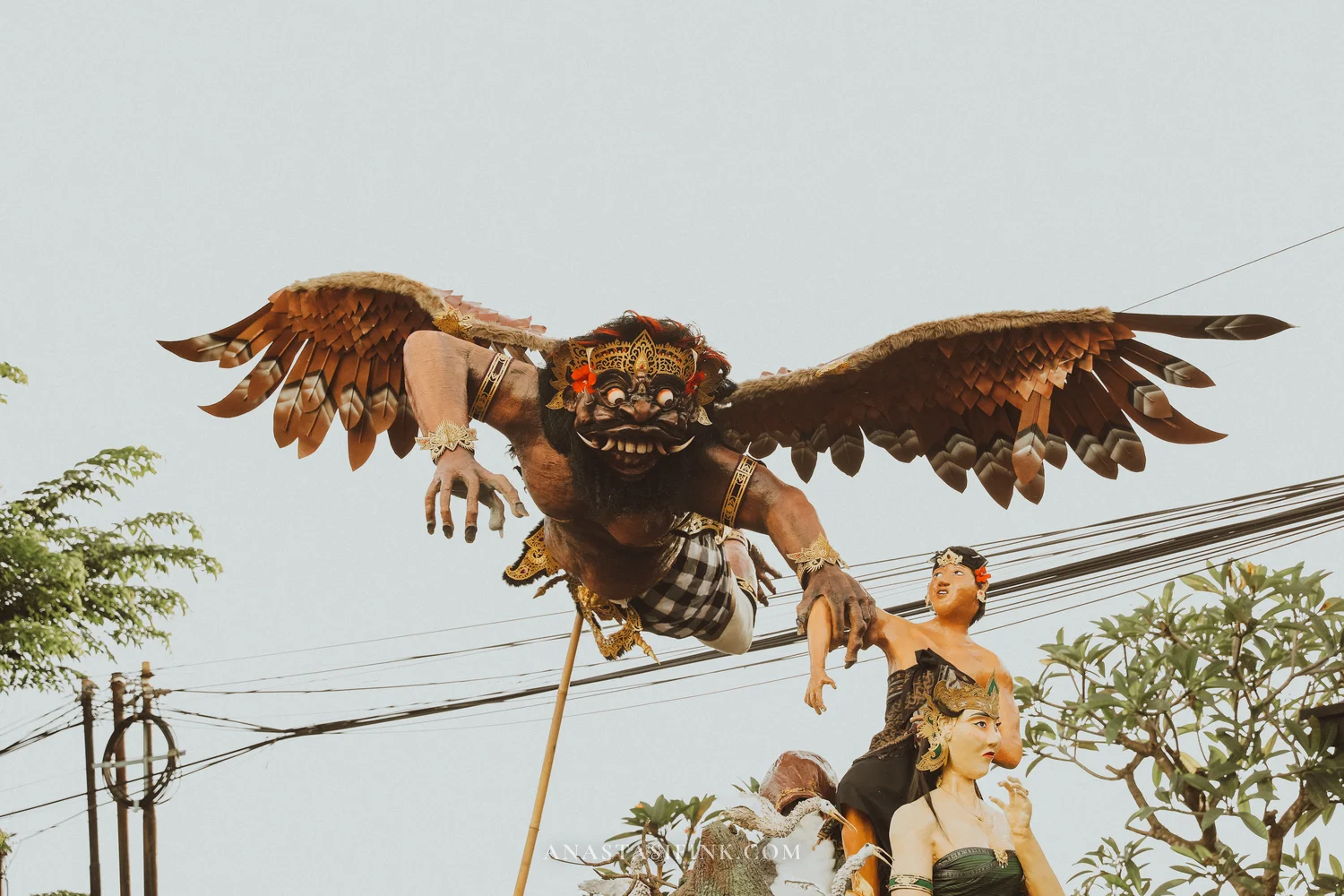
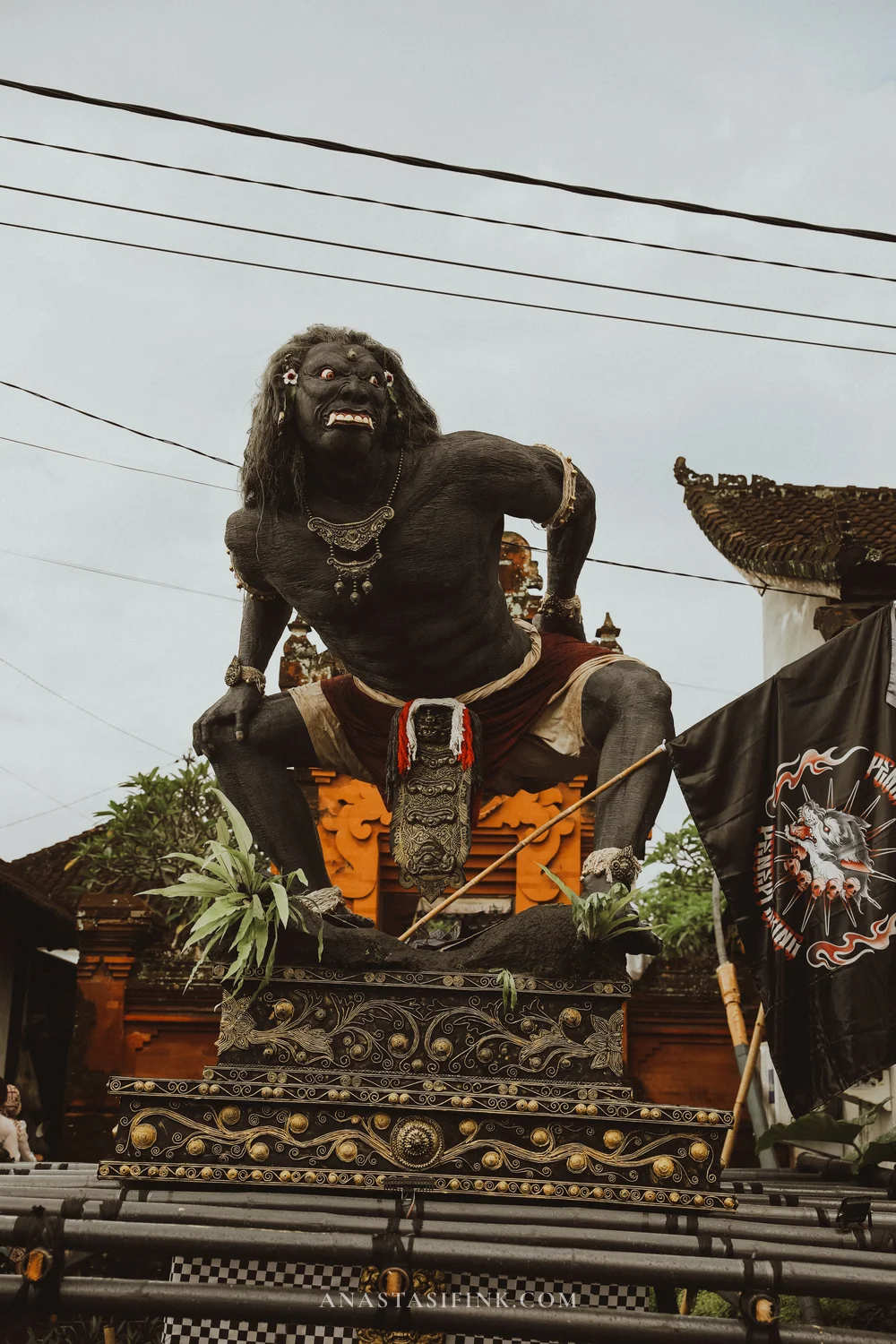
The classics are characters from Balinese mythology. Rangda, the queen of the leyak witches, with fangs, bulging eyes, and a lolling tongue. Rakshasas — the man-eating giants of the Ramayana. Nagas, monkey warriors, and Garuda — the mythical bird honored in Bali with Indonesia’s tallest statue. Nearly all the figures are frozen mid-motion: a leap, a swing, an attack — even though inside there’s only bamboo and paper, and the whole construction weighs hundreds of kilograms.

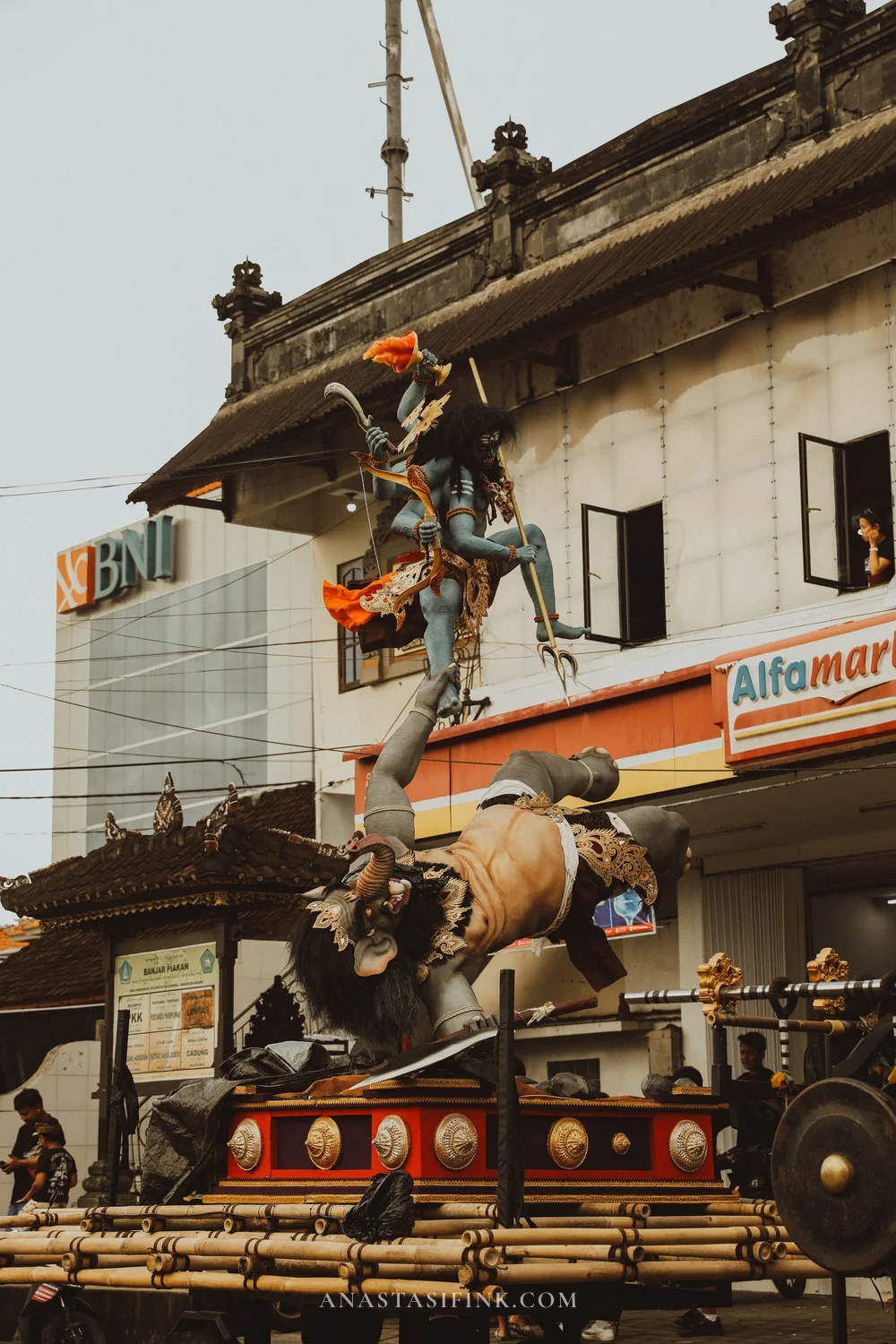
Behind most figures is a specific story, not just the maker’s imagination: the team picks its theme before construction even begins, and at the contests the judges score not only the execution but the philosophy behind the piece. You don’t need to know these stories to feel the festival — but knowing them makes the watching richer. There are gods, too. A multi-armed figure with a trident and bow, poised on one leg above a defeated buffalo-headed opponent, is Durga vanquishing the demon Mahishasura — one of Hinduism’s great tales of good triumphing over evil, depicted from India to Java long before ogoh-ogoh existed.
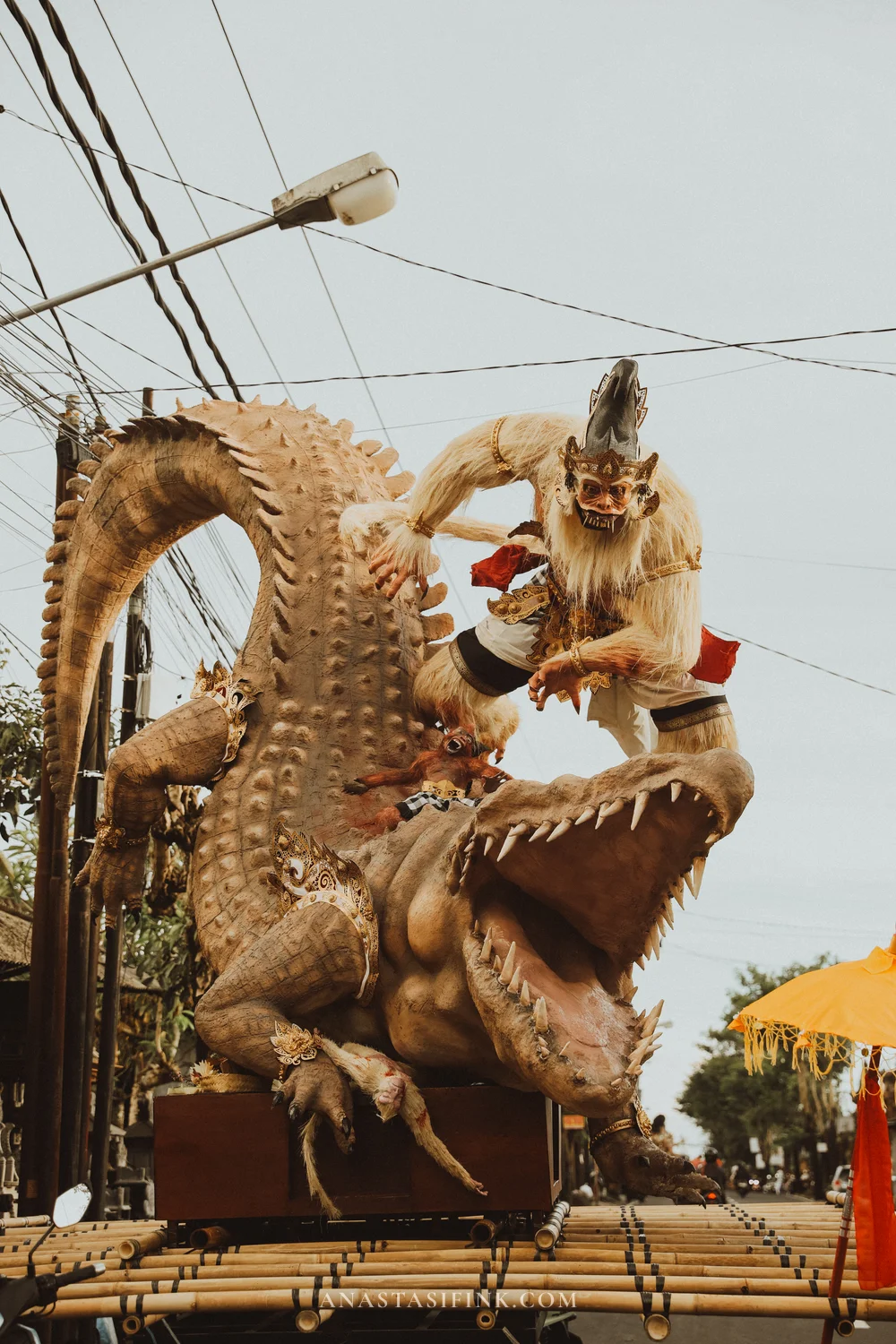
Another layer is folklore. The Balinese grew up on the Tantri tales, the local version of India’s Panchatantra, and the heroes of these fables regularly become ogoh-ogoh. The crocodile-and-white-monkey scene — the one on this article’s cover — comes straight from them: in the tale, the crocodile looks fearsome but gets outwitted by the monkey.
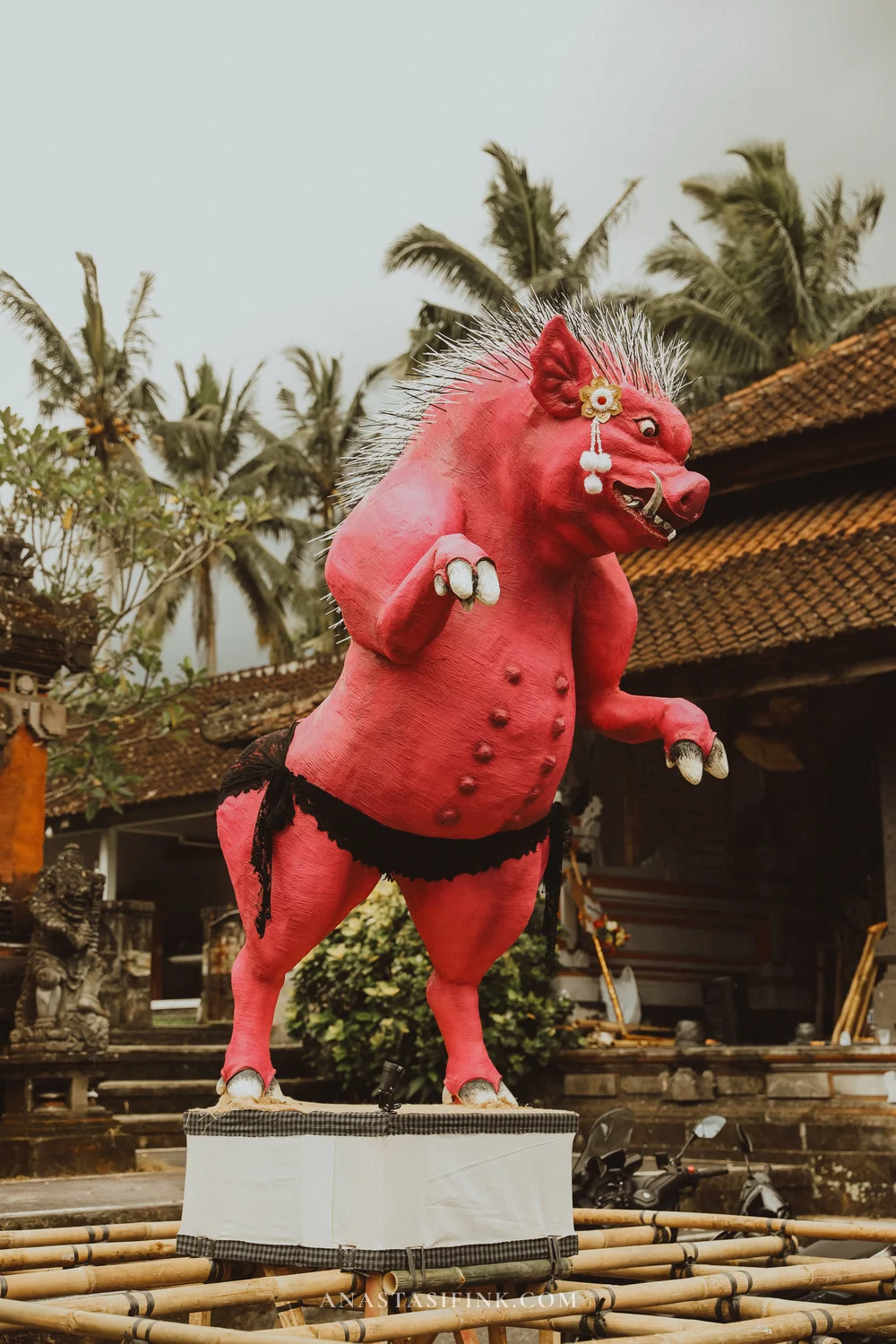
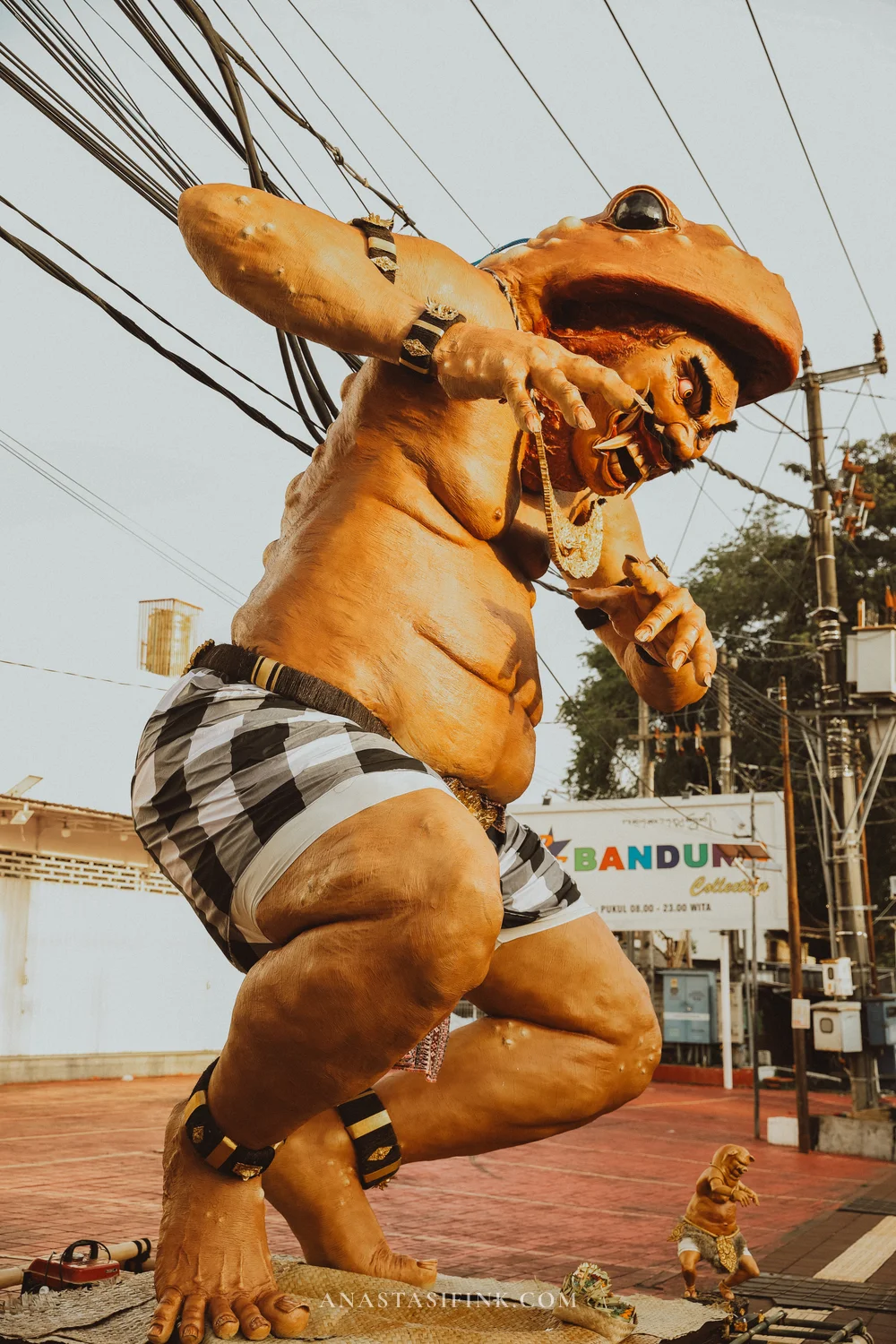
The pink boar with porcupine quills is most likely Bawi Srenggi, the boar demon of Balinese myth. According to the legend, he was a celestial guardian who pursued the rice goddess Dewi Sri, was cursed, and turned into a boar that ravages the rice fields. And the giant wearing a toad as a headdress is a nod to the tale of Godogan — a magical frog born by Shiva’s blessing, who turns into a prince at the story’s end. Frog ogoh-ogoh are no joke but a respected theme: a figure based on this tale won the contest for the entire Badung regency in 2025.
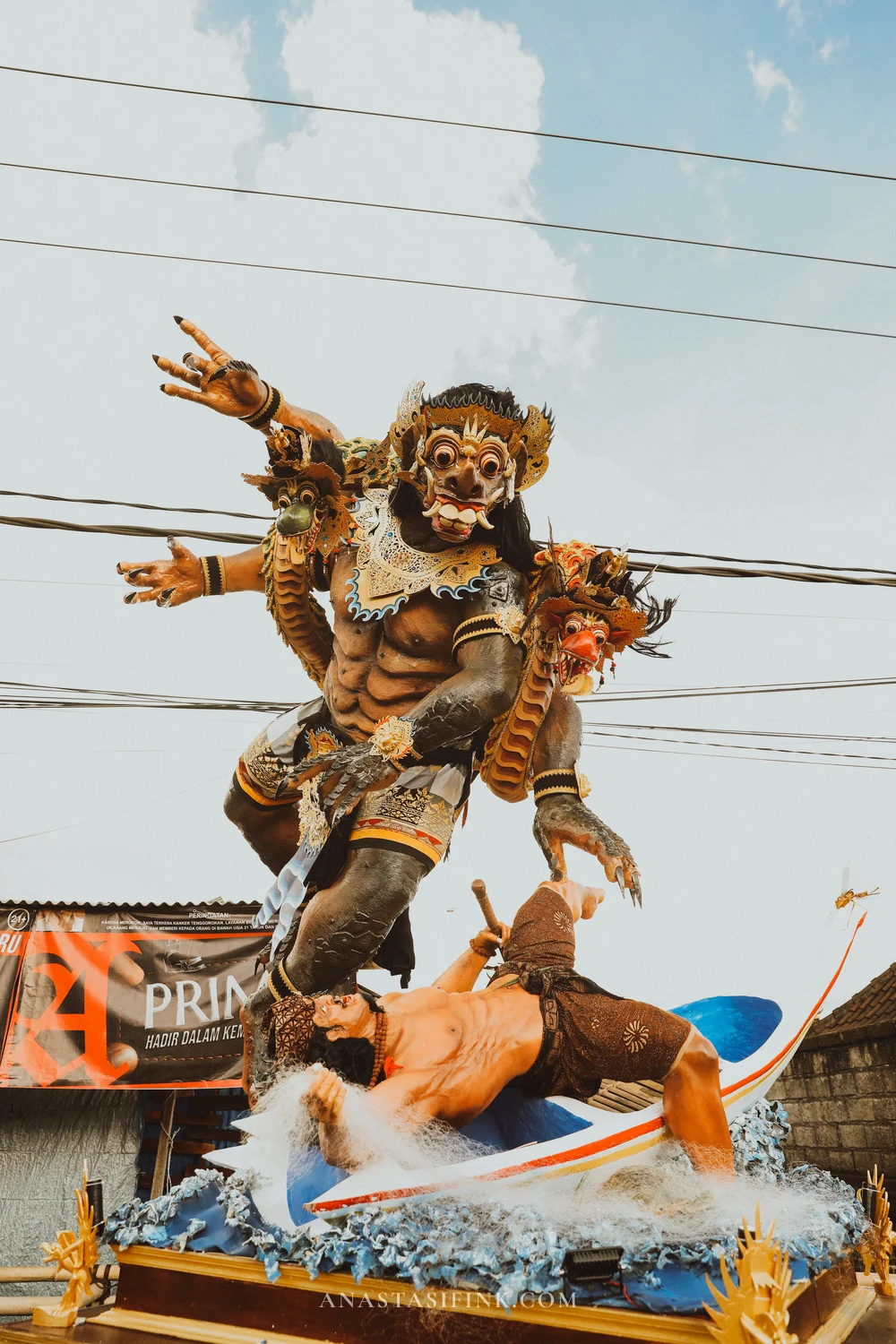
Then there’s satire, a genre of its own. To the Balinese, human vices are bhuta kala too — evil forces, just in human form. A pot-bellied grandpa sprawled in a chair with rolled-back eyes and his tongue hanging out is a caricature of laziness and drunkenness. The most unexpected scene I saw: a six-armed demon with nagas on his shoulders, bearing down on a surfer riding a wave — the power of the ocean versus man, a thoroughly Balinese theme in its most modern form.



The Day Before: Villages Put Their Monsters on Display From the Morning
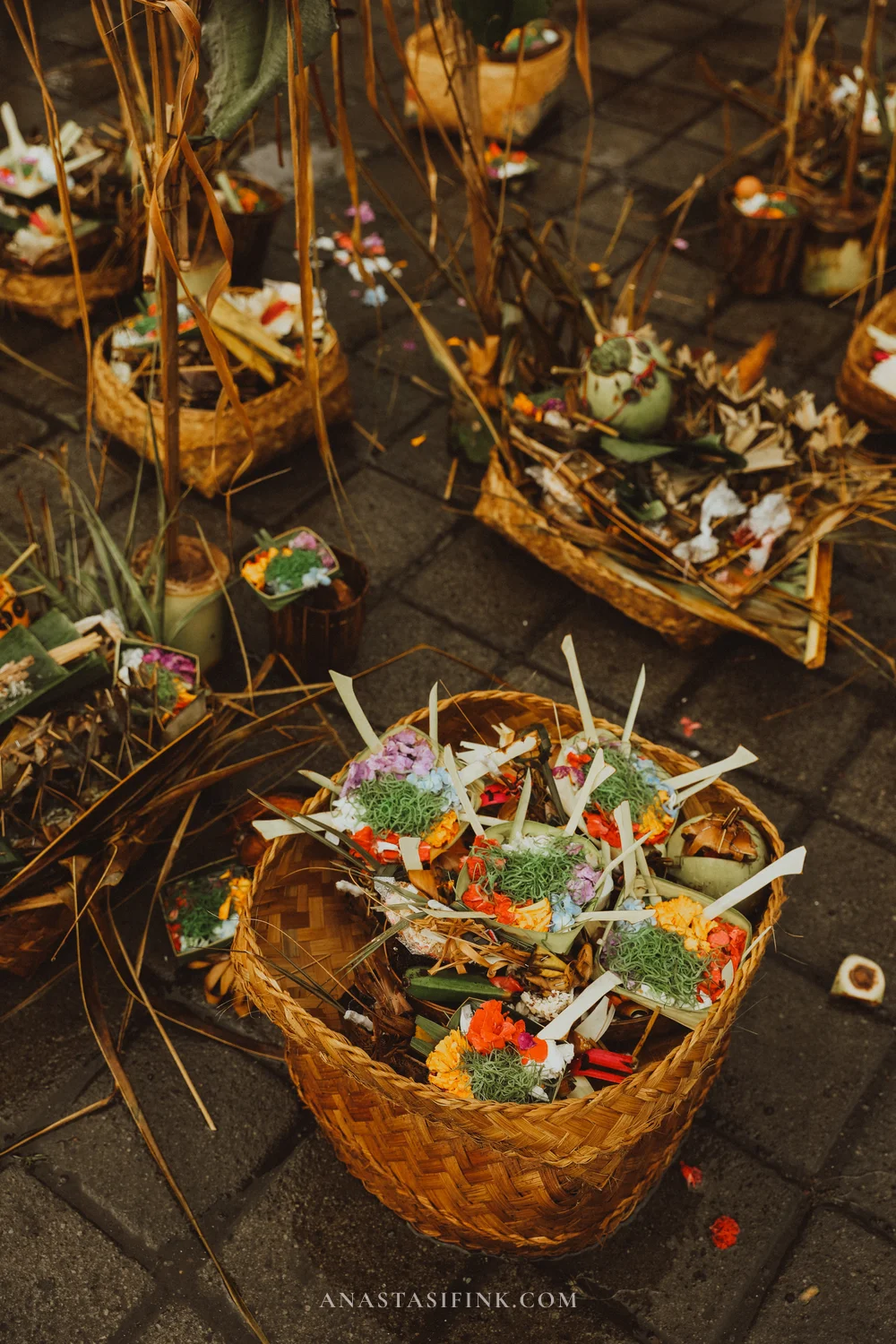
If you drive into any village on the morning before Nyepi, the ogoh-ogoh are already standing at the crossroads and by the temples — mounted on bamboo lattices, the same ones they’ll be carried on that evening. Around them, people touch up details and lay out offerings while women carry baskets of fruit. It’s a peaceful window to study the figures up close, without the crowds.
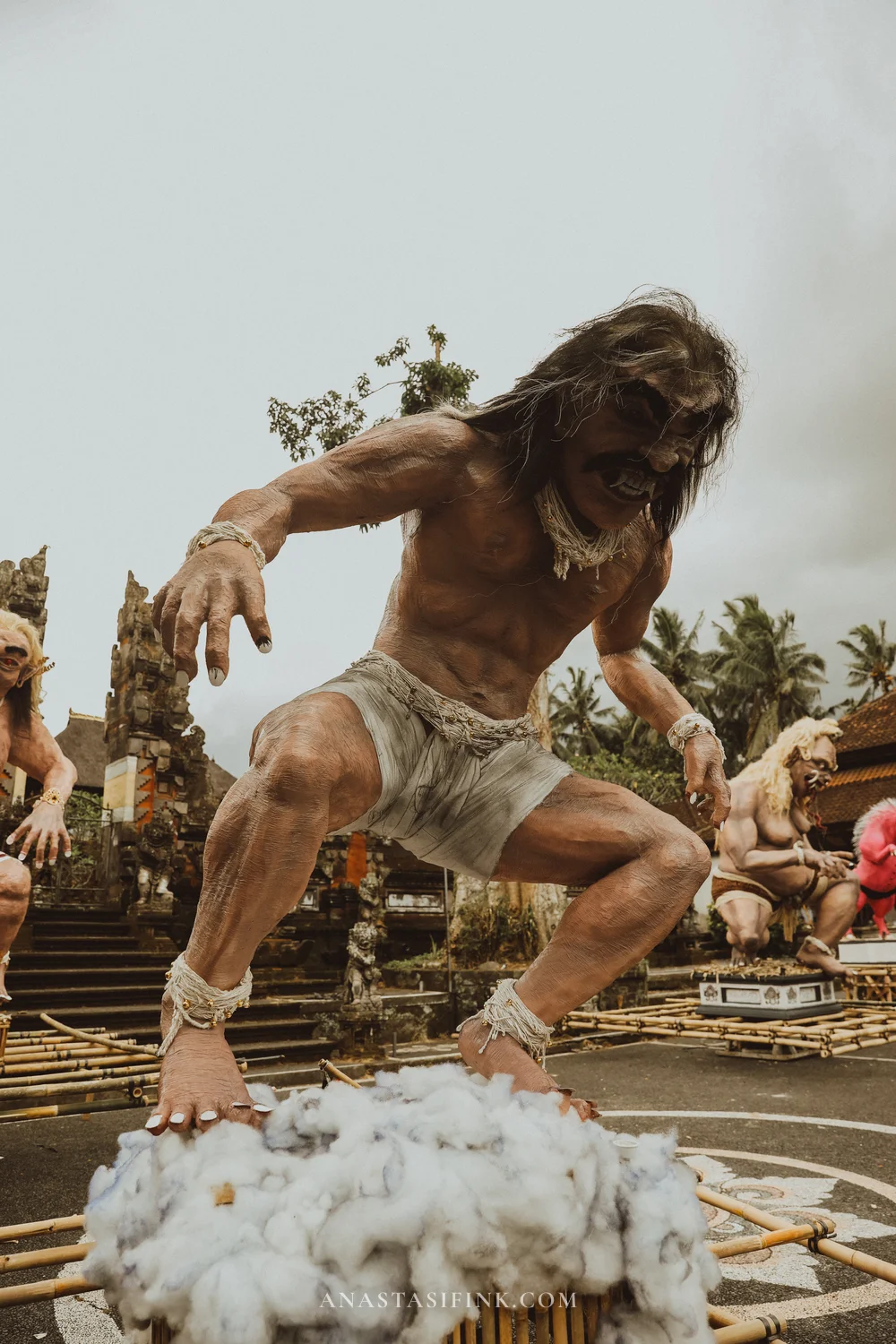

In the temple courtyards the figures line up in whole groups — each with its own bamboo carrying lattice


The morning before the parade: figures already on their bamboo stretchers. The black-and-white checkered poleng cloth symbolizes the balance of good and evil

From Ubud to Denpasar: A Procession in Every Village
I was staying in Ubud but decided to head to Denpasar for the main evening parade — and the drive turned out to be every bit as fascinating as the parade itself. We set out around 5 pm, and already on the way out of Ubud the streets were charged with anticipation of something big. Here and there along the roadside stood enormous monster figures — the very ones that had spent months hidden in temples and behind dark curtains, finally out in the open. In some places they were being lifted onto platforms to be carried toward the main streets of their neighborhoods. Music played from every direction; the crews were resting up before the parade.
The road from Ubud toward Denpasar runs through a string of villages — Mas, Batuan, Sukawati, Celuk, Batubulan — and in the afternoon every single one holds its own procession. I was on a scooter and found myself stopping every ten minutes: around one bend, kids carrying a small demon; around the next, adults maneuvering a five-meter giant under the power lines.
That said, you don’t actually have to go anywhere. Ubud has its own big parade: columns from the surrounding banjars converge on the Puri Saren Agung royal palace in the town center, and Ubud’s figures are considered among the finest on the island — it is Bali’s artistic capital, after all. If you’re staying in Ubud, just walk out to the main street in the evening. I chose Denpasar for the sheer scale, but along the way I got to watch Ubud and the villages in between getting ready — so I ended up seeing the festival in every format in a single day.
The figures are often taller than the power lines, so a man walks ahead of each procession carrying a long bamboo pole with a fork at the end — he uses it to lift the sagging wires so the monster can pass underneath. Sometimes they tilt the figure instead, or the whole crew crouches down in unison. It’s done this way all across the island — in the villages and in central Denpasar alike.
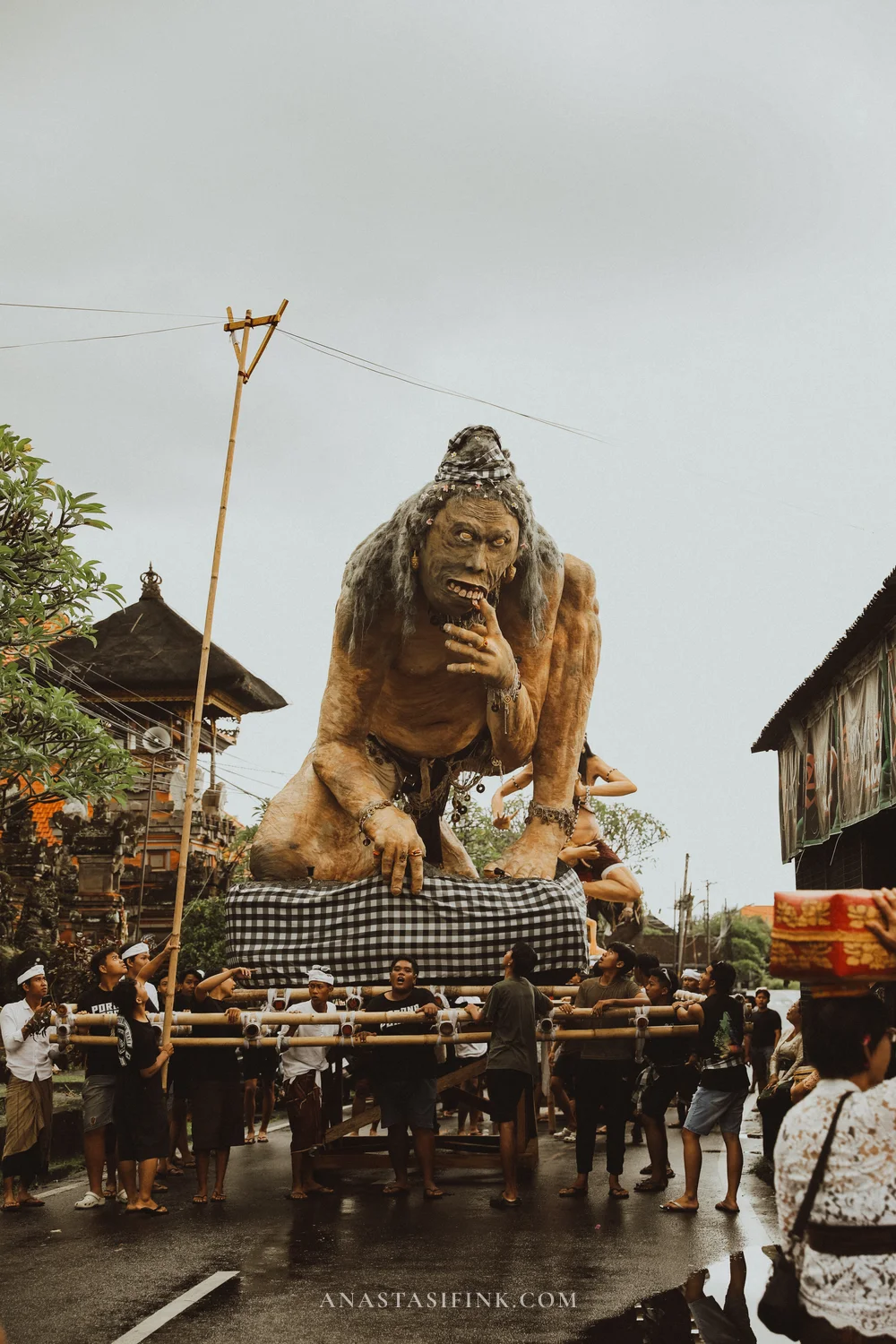

A forked bamboo pole lifts the wires above the road while the bearers carry the figure through
The children’s processions are a delight of their own. The kids have their own ogoh-ogoh — smaller and simpler, but carried strictly by the rules: on bamboo stretchers, with shouting and total seriousness. The parents walk alongside.
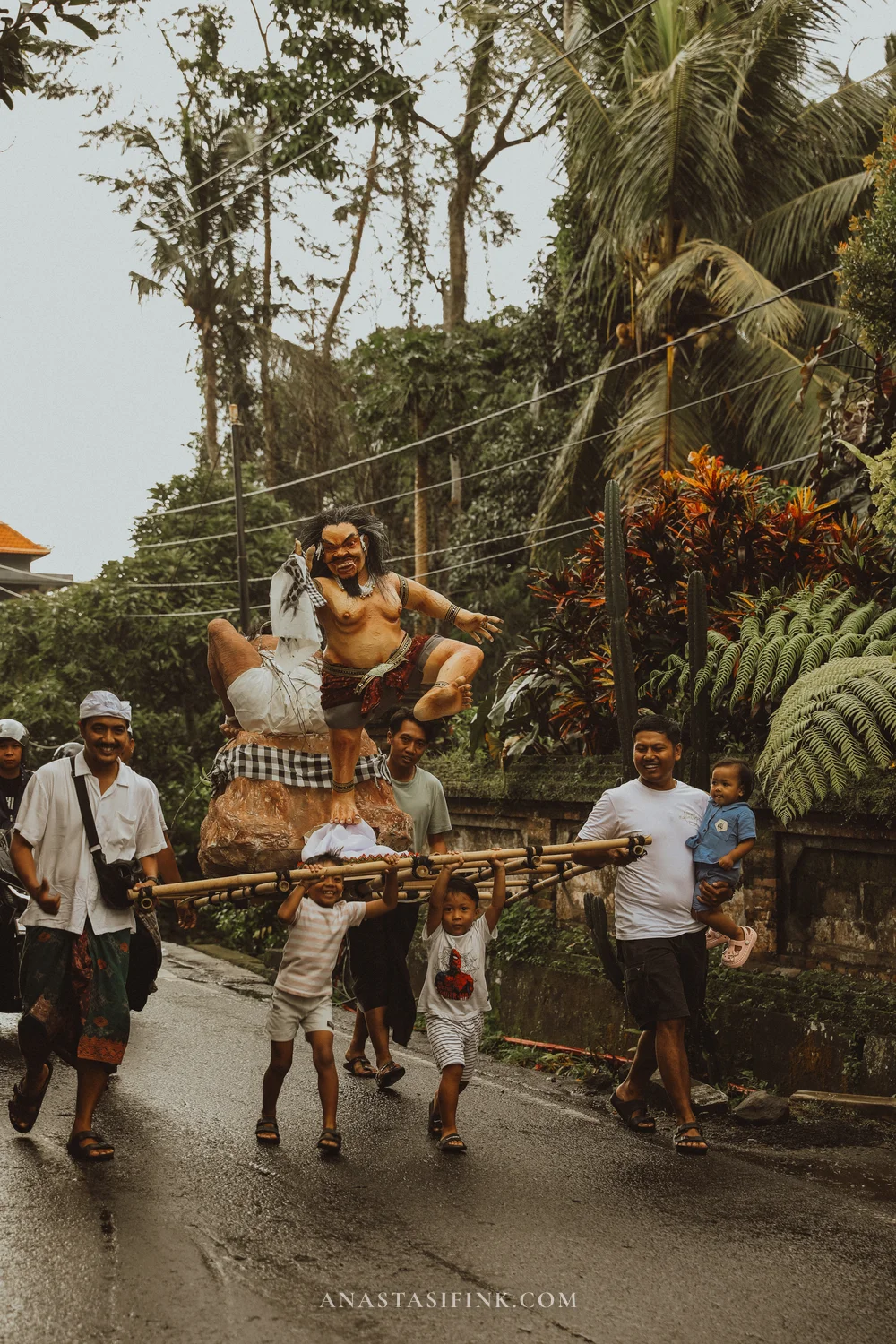

The children’s processions start earlier than the adults’, while it’s still light. The figures are smaller, but the passion isn’t
If you’re making your own way from Ubud to Denpasar, I recommend routing through Jl. Raya Sibanggede — it runs through the villages of the Abiansemal district. Along the way you’ll pass plenty of figures and little local mini-parades. Then again, whatever route you pick, you won’t miss out on ogoh-ogoh: on this night, more than a thousand processions happen across Bali simultaneously — every banjar holds its own.
Jl. Raya Sibanggede through Abiansemal — my recommended route from Ubud to Denpasar on parade day
Night in Denpasar: The Main Parade
By evening we reached the center of Denpasar — the intersection with the Catur Muka statue by Puputan Square. This is the island’s main stage: the city’s best figures all come here. Each one is carried by a crew of dozens, accompanied by a beleganjur orchestra — drums and cymbals that set the rhythm as the bearers rock and spin their monsters.
The route works like this: the figures enter from Jl. Gajah Mada, then Jl. Veteran joins in — that’s where the most spectacular figures came from. They all circle the Catur Muka statue, and after a few laps they move off along Jl. Udayana and onward through the city’s other streets. A living river of people flows behind the figures along these streets — and you can simply merge into it: walk behind the monsters and round the statue at the intersection together with them.

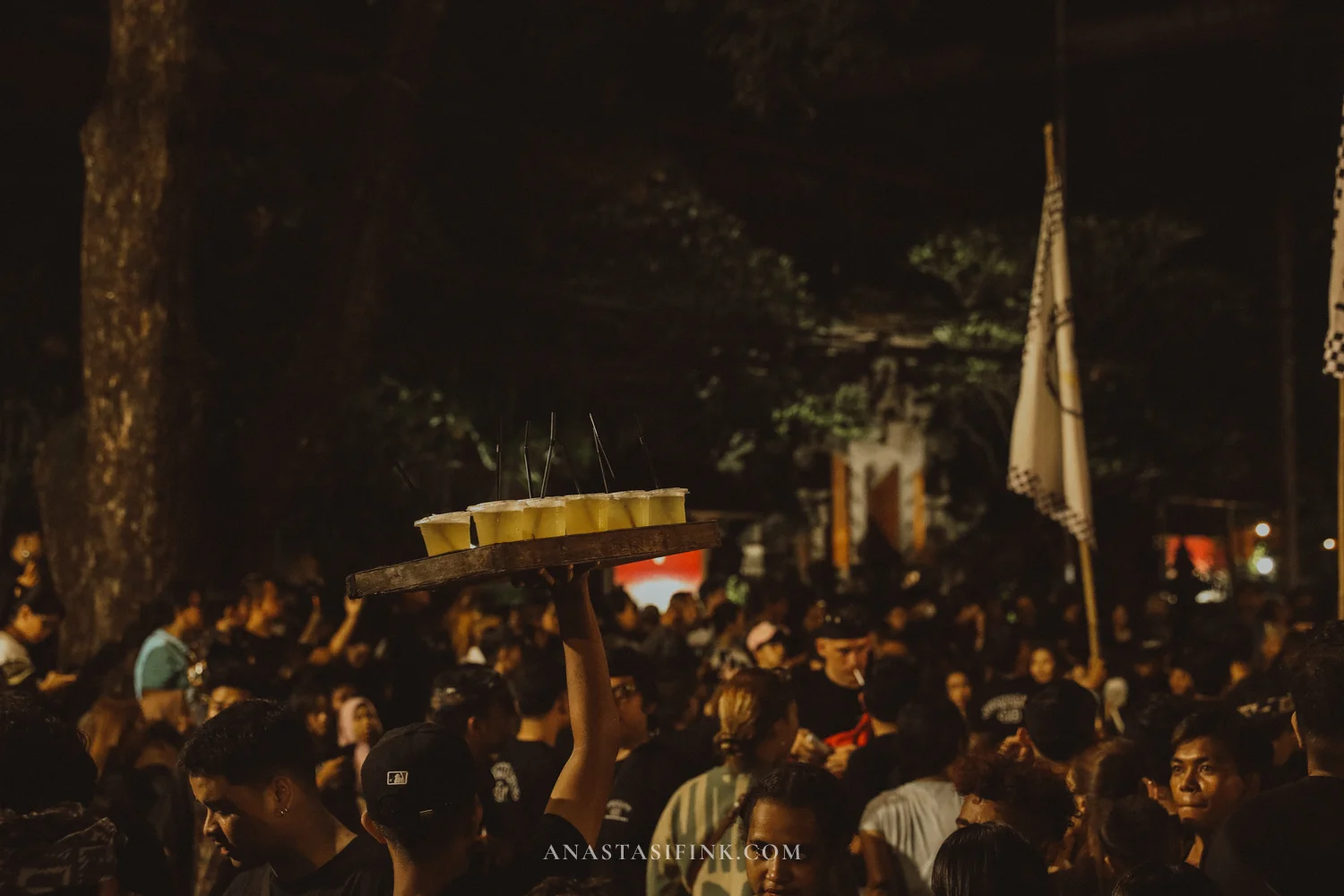
Timing in Bali is a loose concept: in 2026 the start was announced for 7 pm, but the columns didn’t really get moving until closer to 8. Still, it’s worth arriving by 7 pm or earlier — the crowds are huge, and the best roadside spots go fast. The boldest sit right at the statue: the figures are carried in circles around them, and it’s the epicenter of everything. Stalls and tents along the streets sell light snacks, water, and drinks.
Once things begin, the figures approach the circle one by one, and at first it all unfolds at an easy pace. About an hour in, closer to 9 pm, the biggest and mightiest figures start entering from Jl. Veteran. Processions with Balinese gongs and drums come in with them, the music swells, someone lights flares — and the action grows wilder and wilder. Figures spin on their axis; the carrying crews break into runs and sprints, then stage what look like battles, all but crashing their monsters into each other. You can see all of it from any spot with a view of the main intersection. But be warned: by this point the crowd gets even denser — the stream of people following the figures piles onto those already standing. Watch yourself; crushes can happen in a mass like that.
At every intersection, each figure is spun around three times counterclockwise — this is believed to confuse the evil spirits so they lose their way back to people’s homes. The enormous construction tilts over the crowd, everyone screams — then an explosion of applause.


Multi-figure compositions: battles of gods and demons right above the spectators’ heads

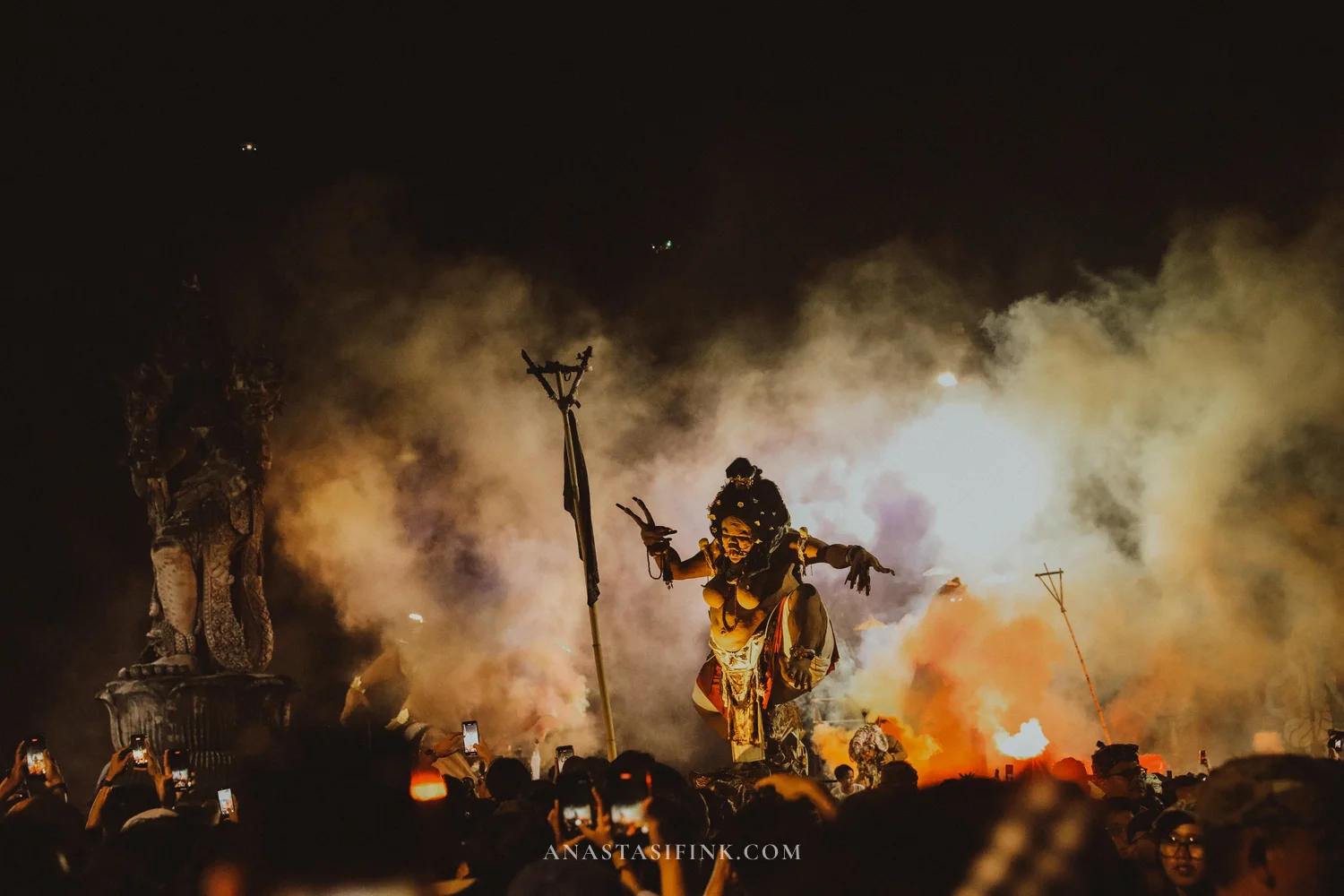
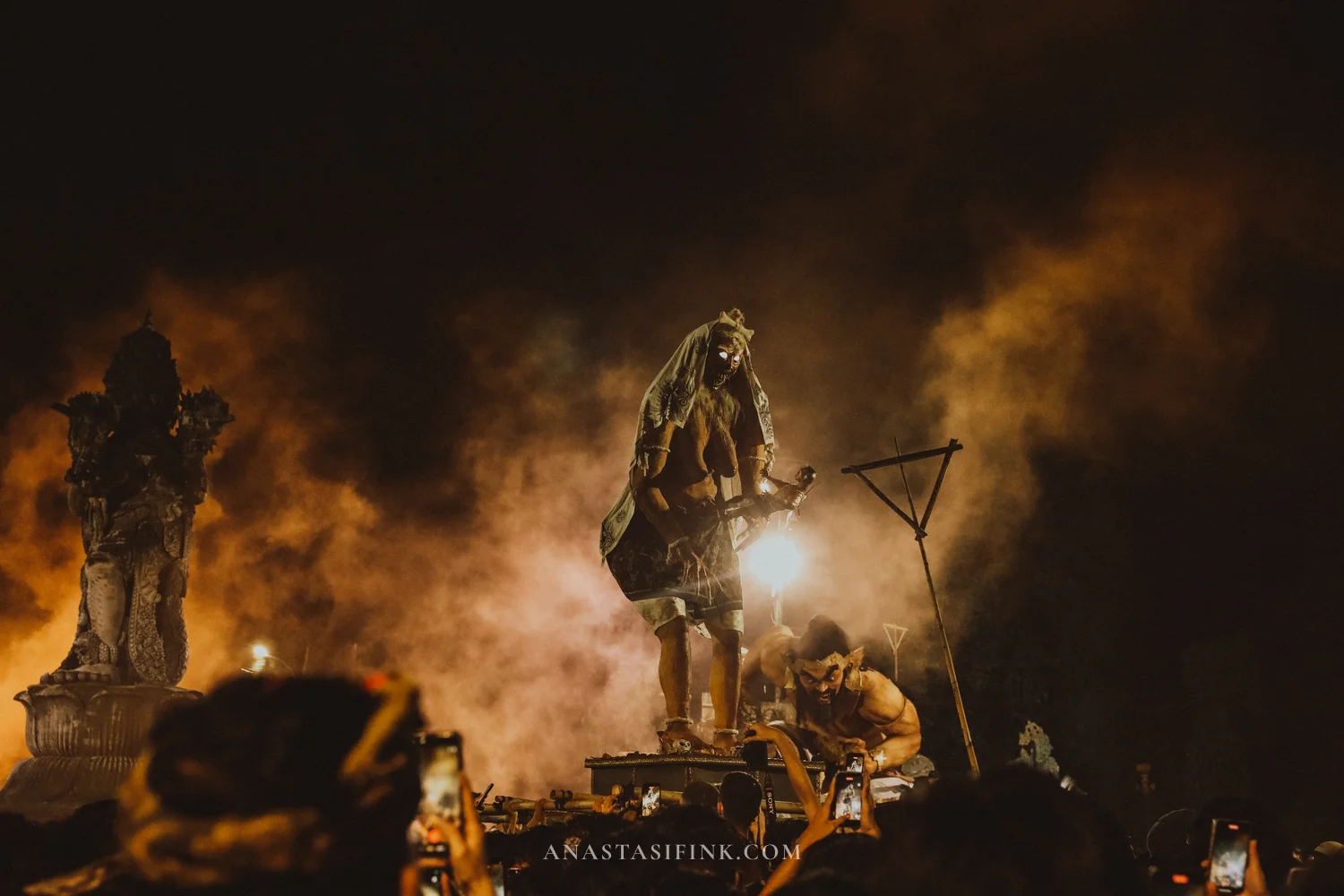
Rangda and a veiled ghost. Colored lights and smoke machines are standard kit for the big crews

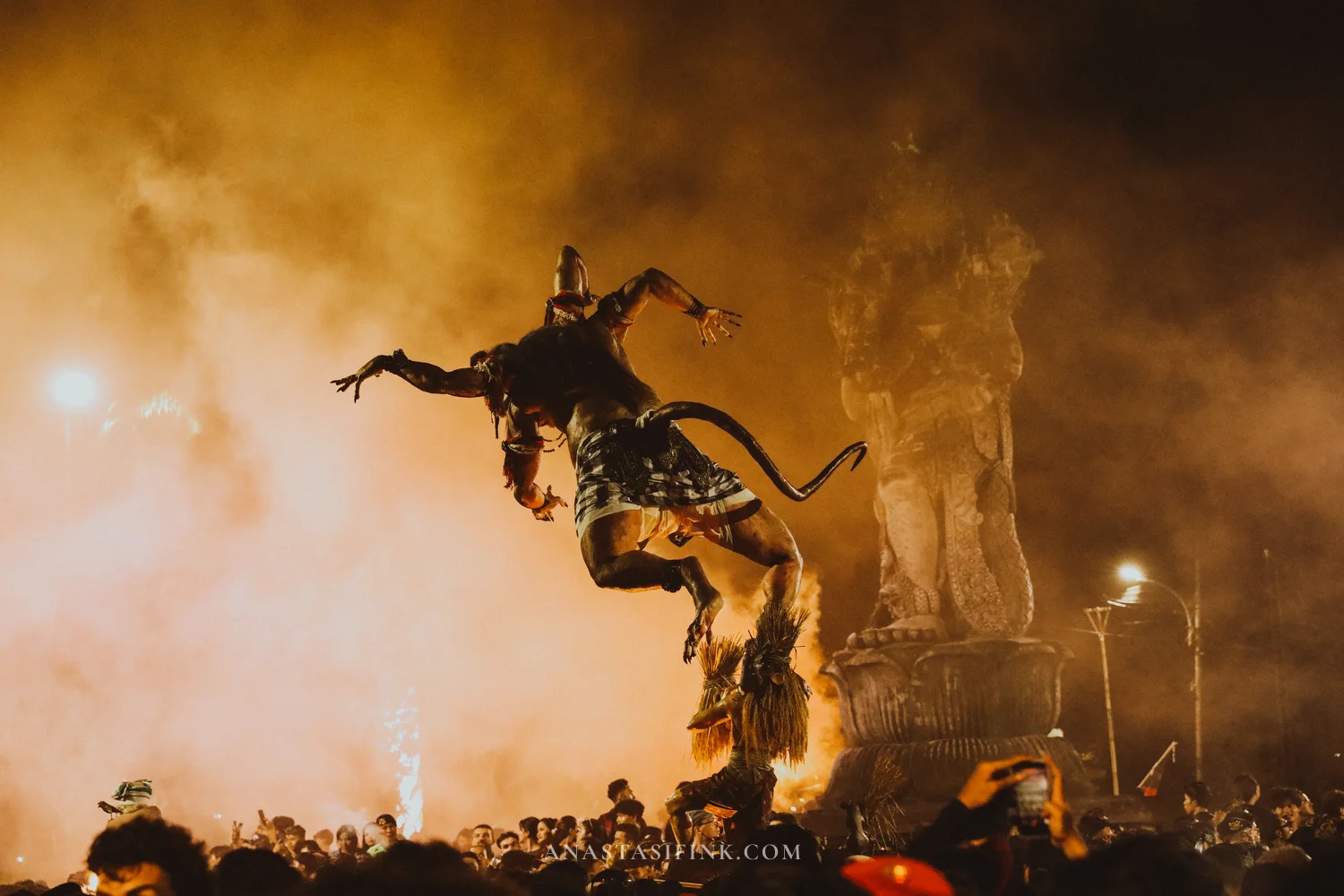
Figures frozen mid-leap or mid-strike — with nothing inside but bamboo and papier-mâché
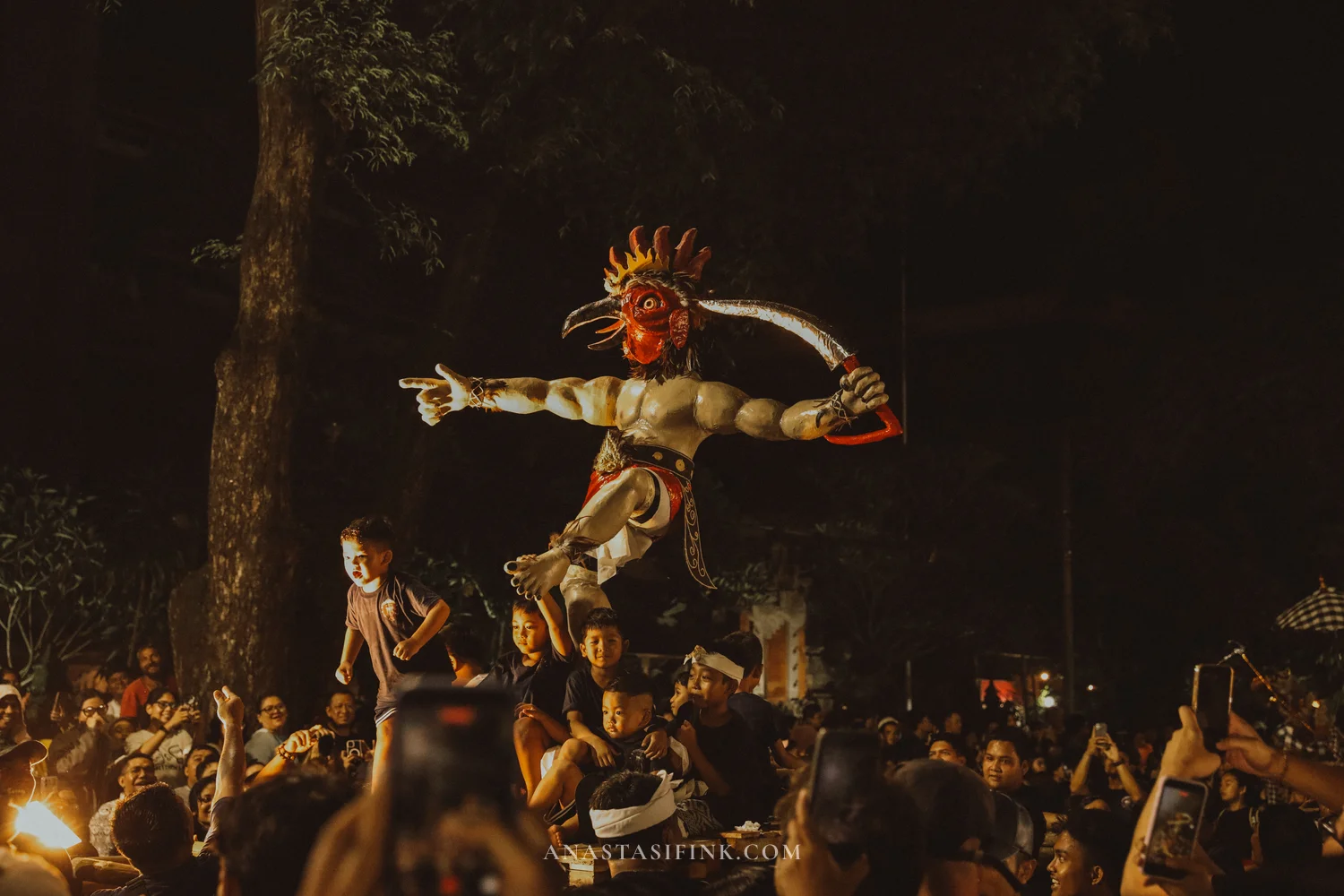
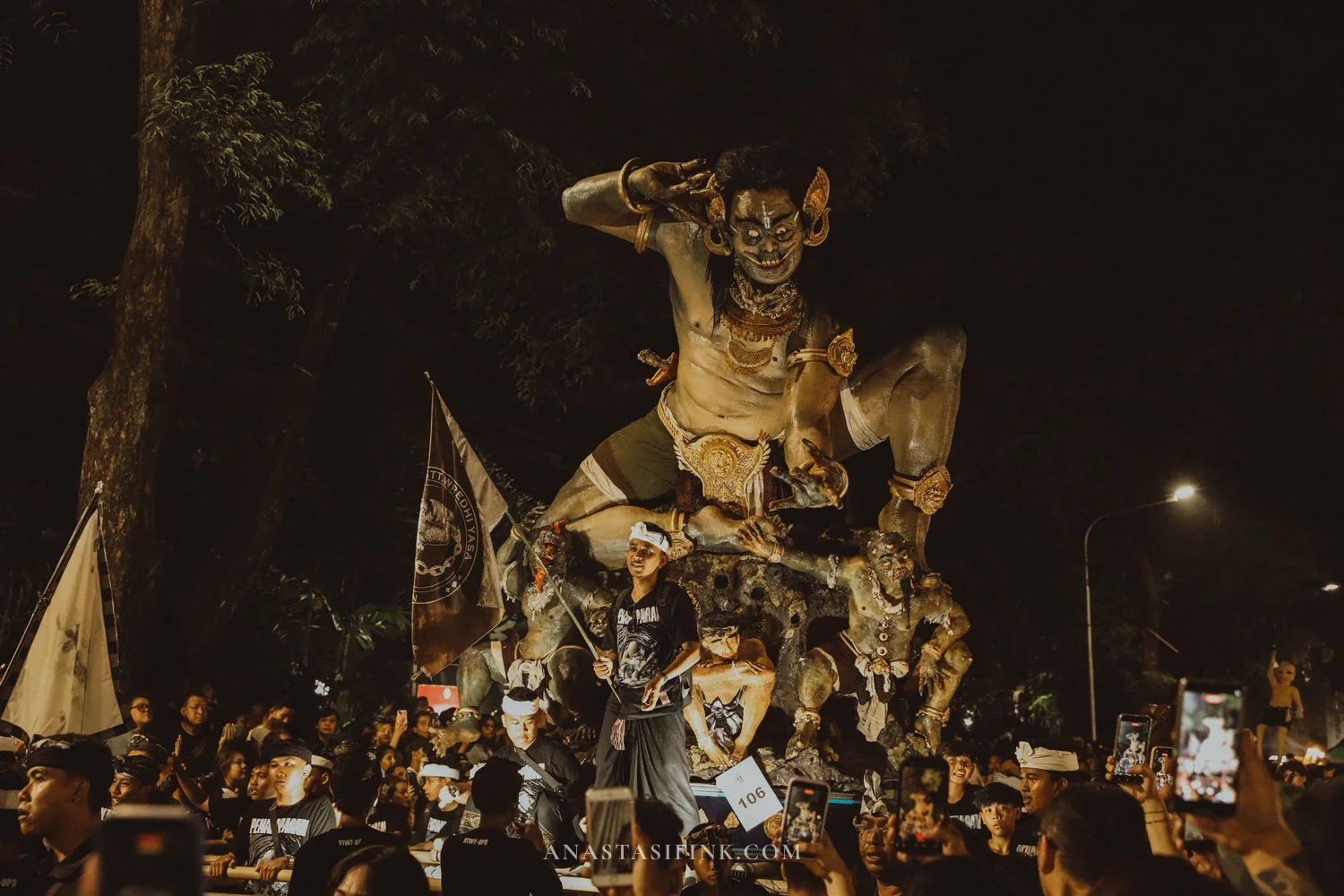
A rooster-headed warrior wields a giant blade shaped like a taji — a cockfighting spur. Next to him, a silver giant with a contest number
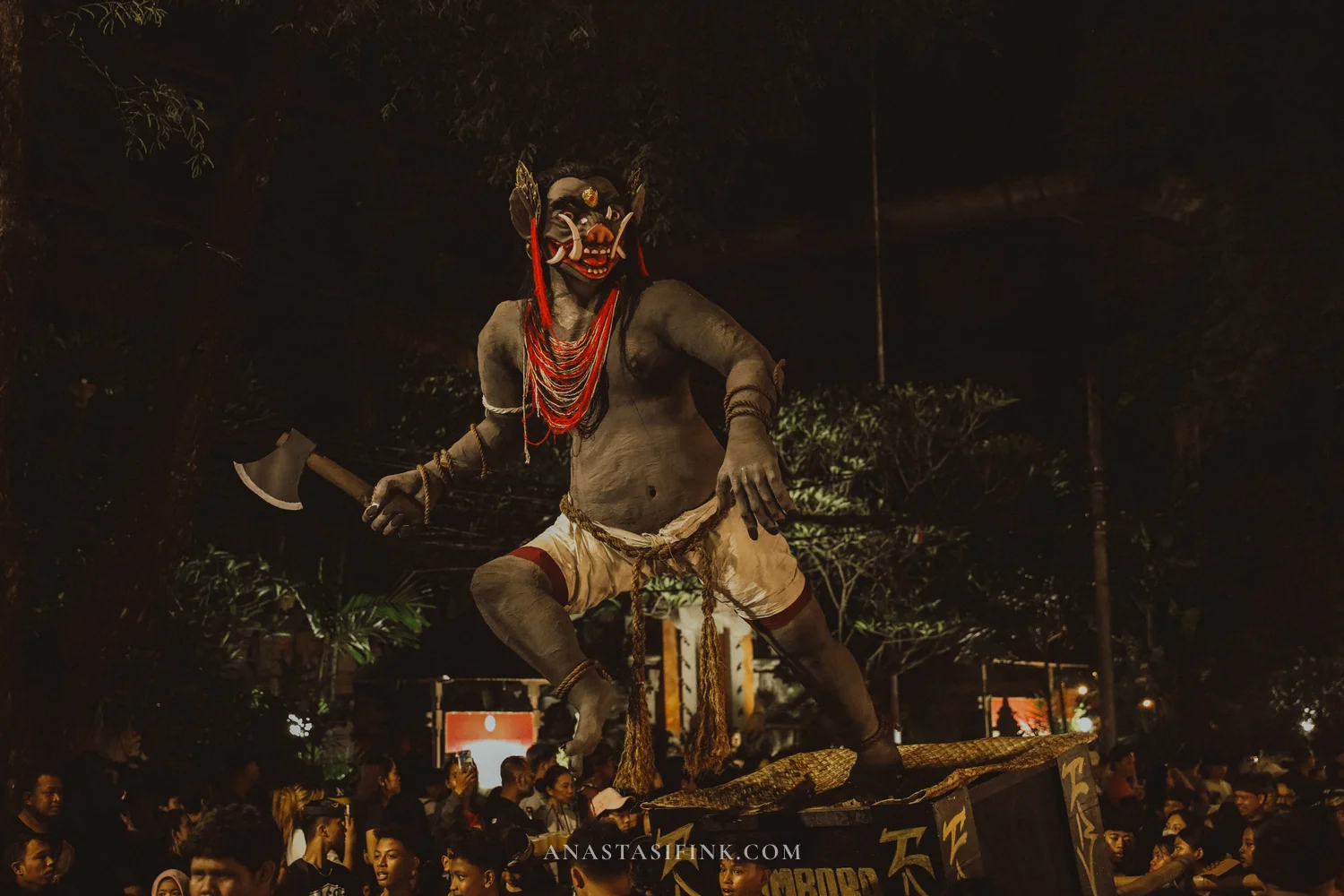
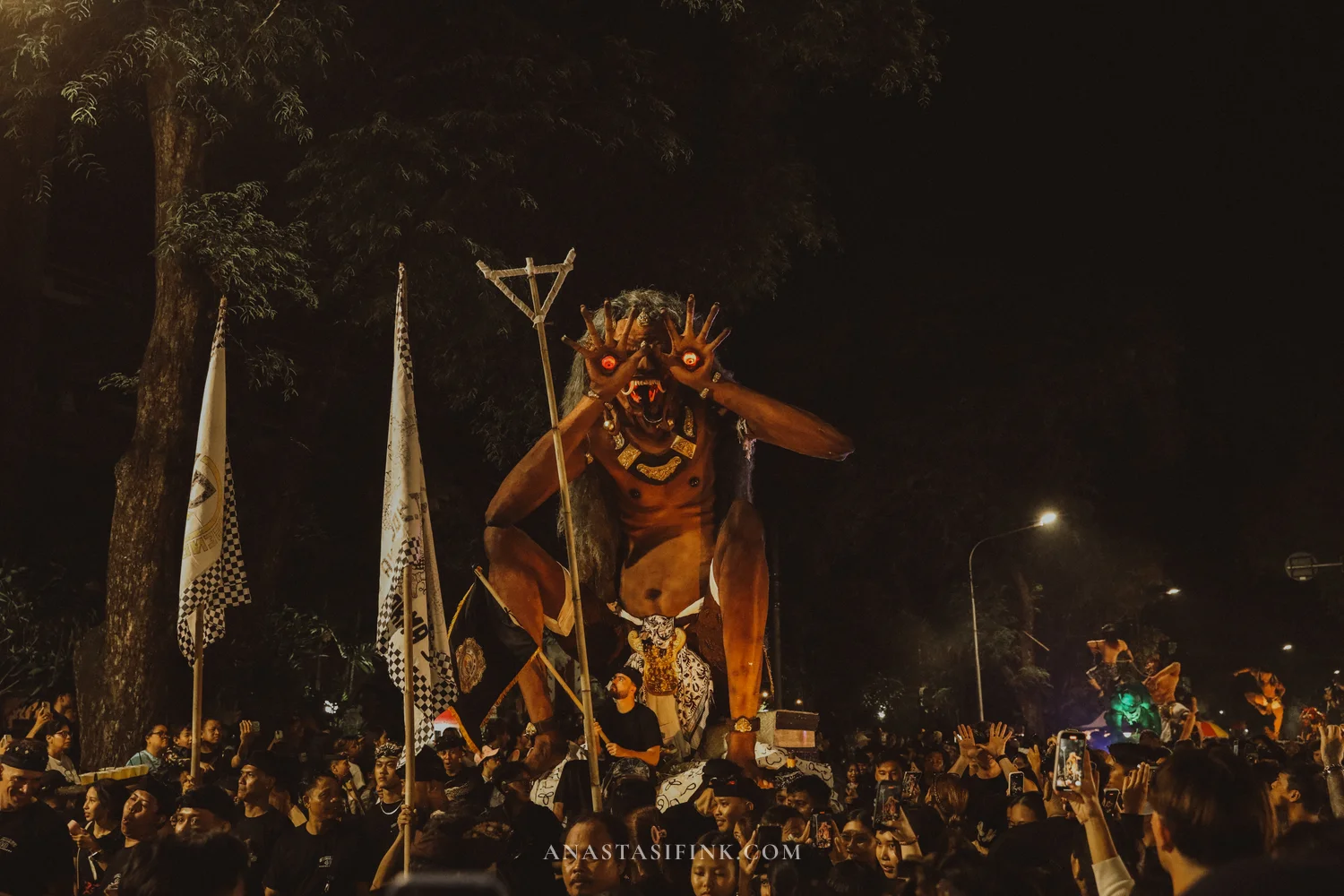
A boar-faced demon — and his neighbor with glowing red eyes
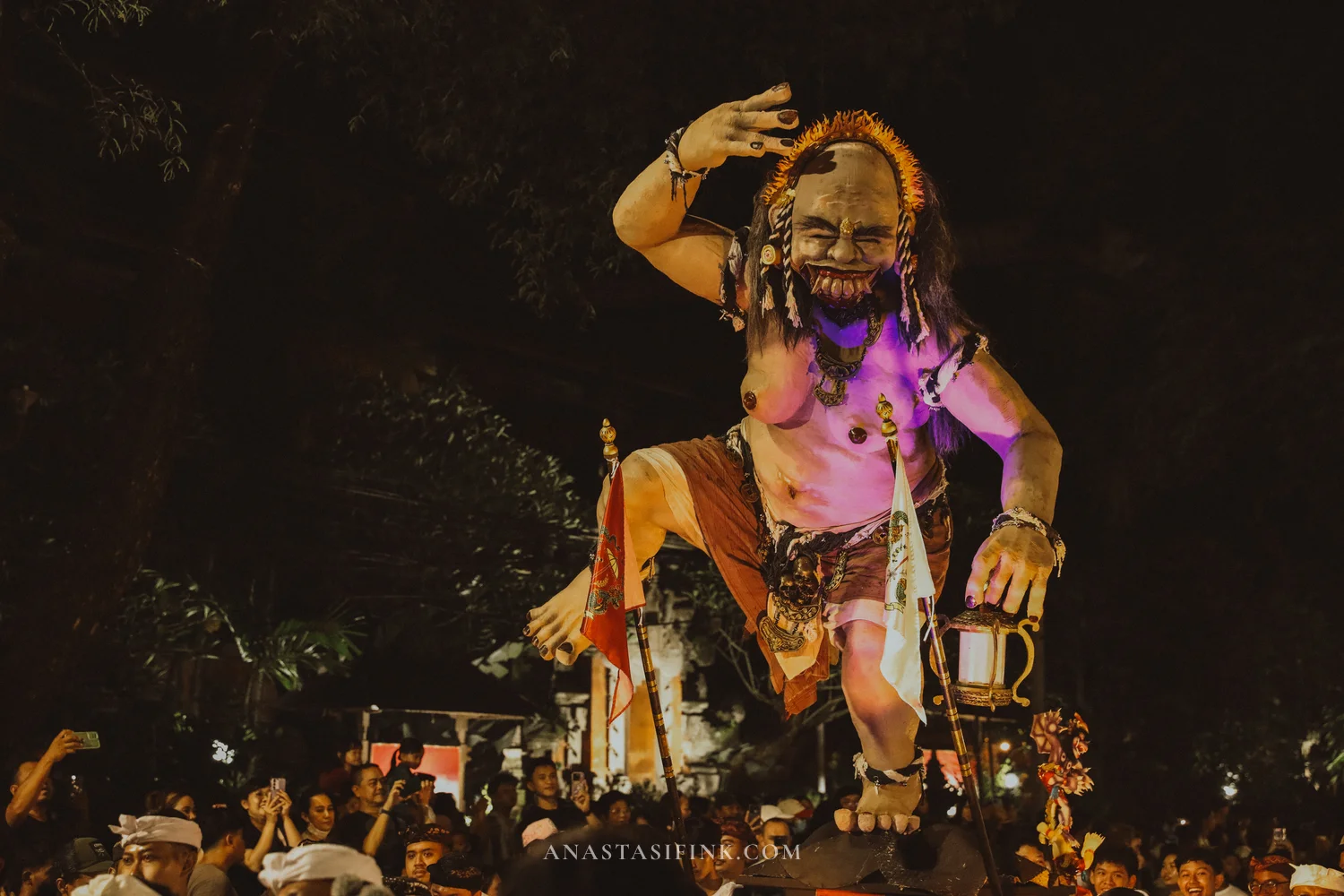
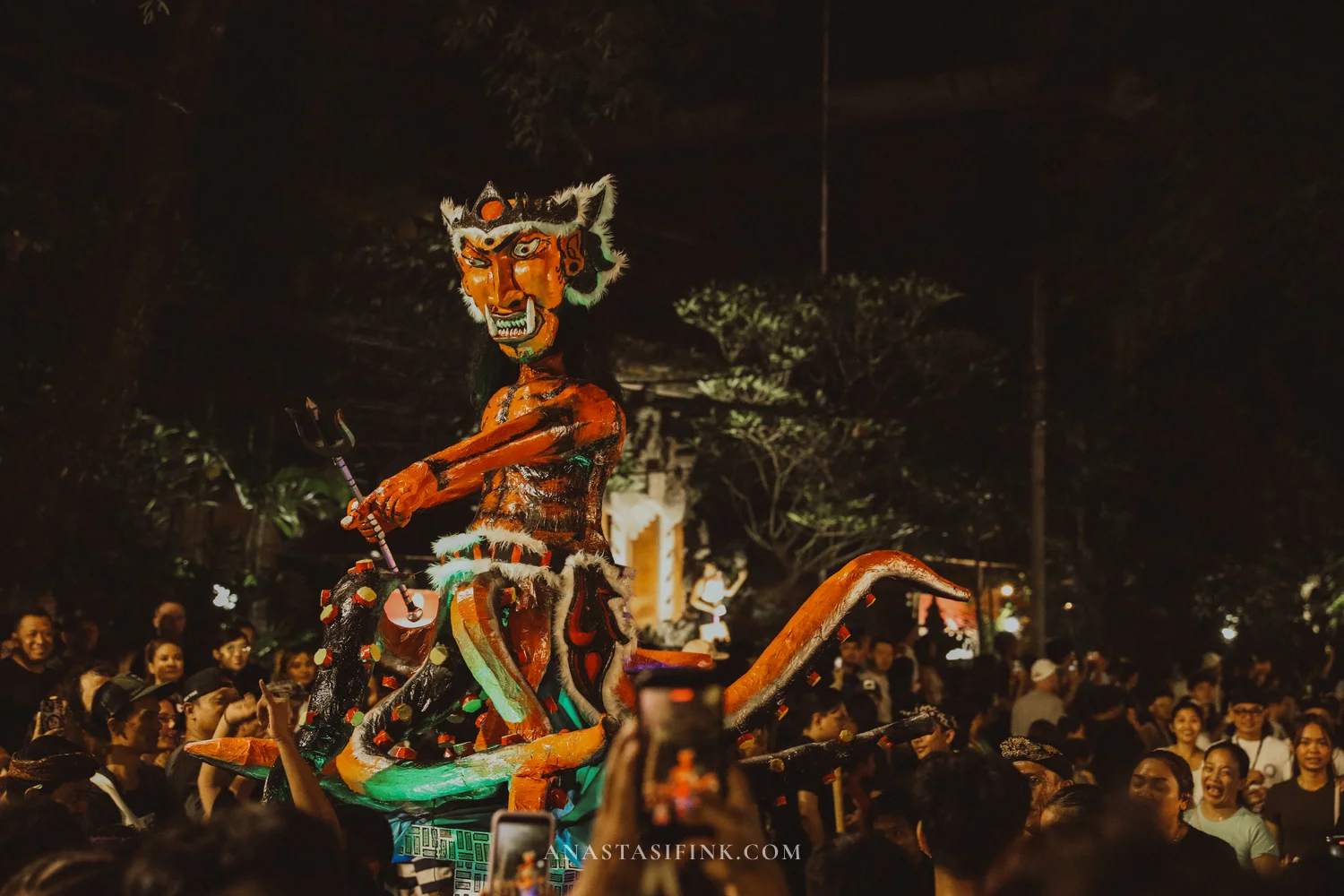
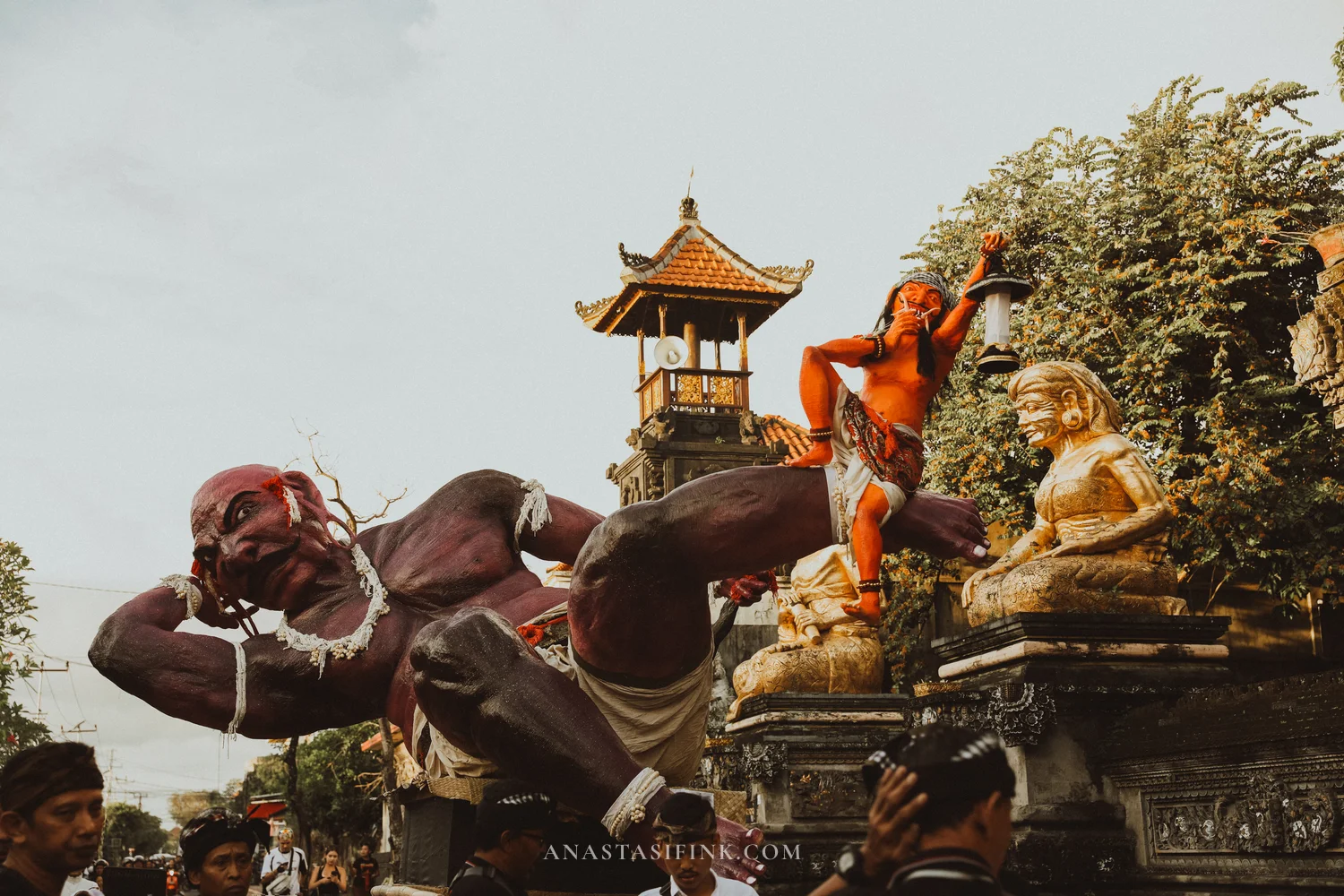
A bald demon with a lantern and a tiger monster with orange tentacles
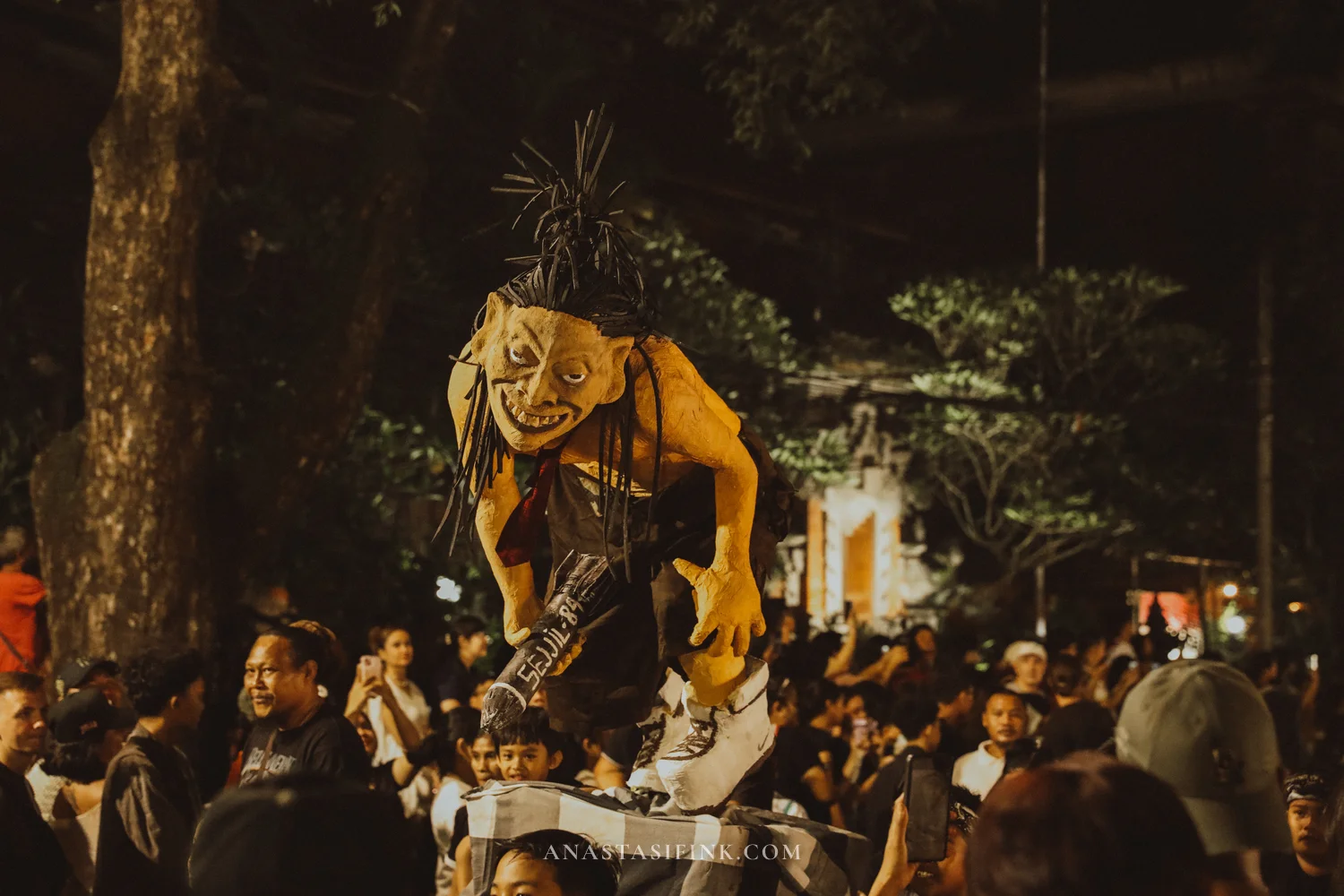
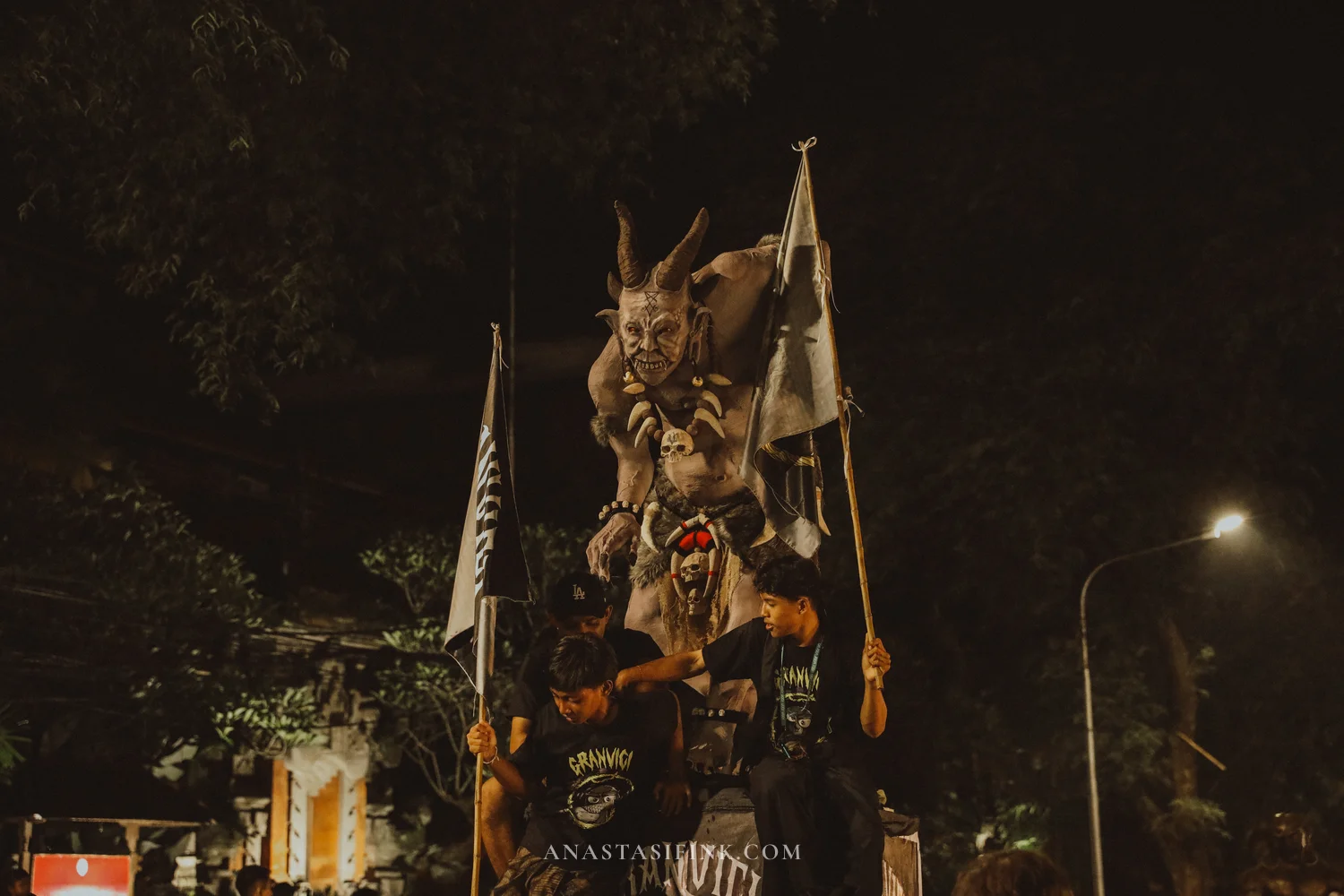
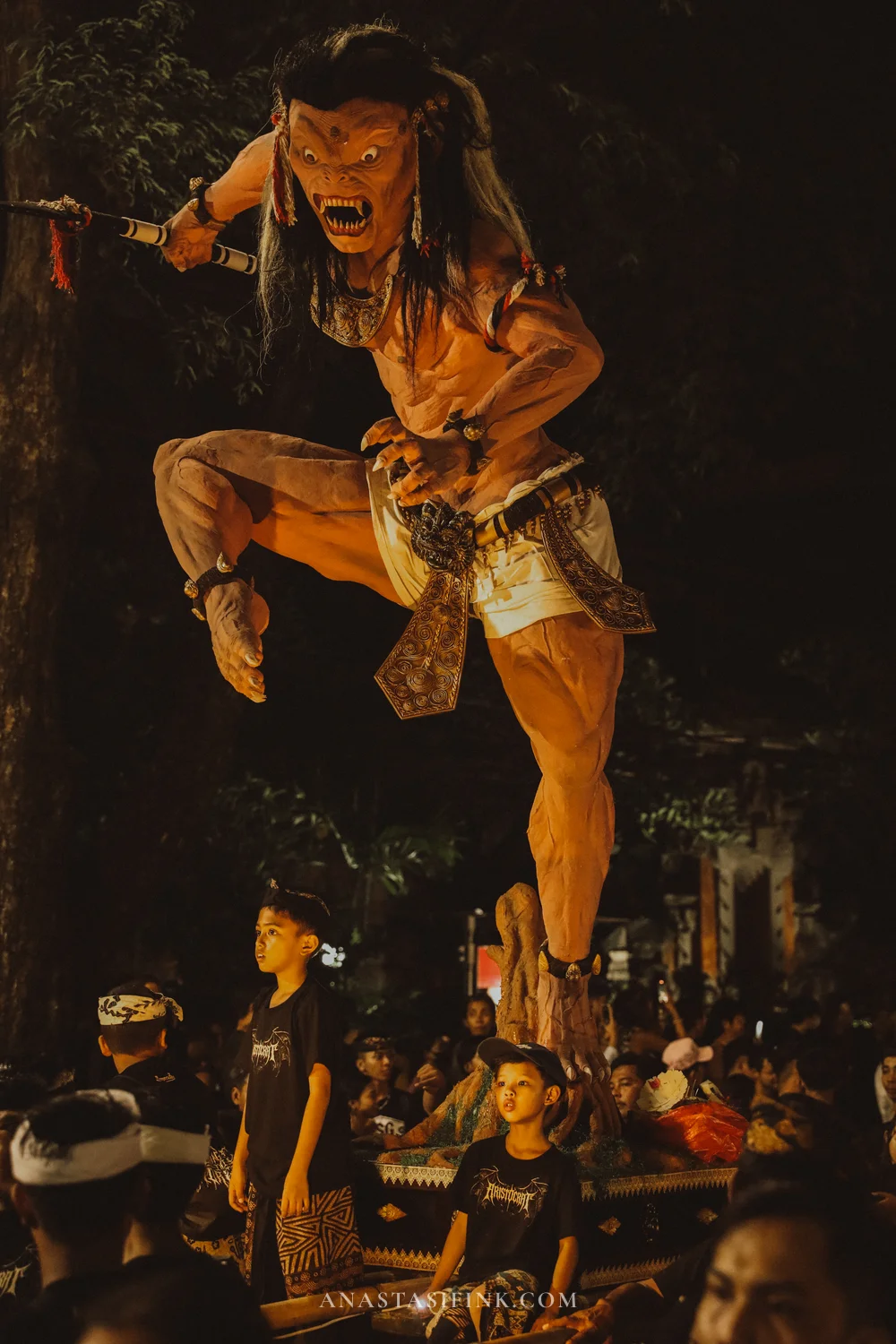
For all that, the atmosphere isn’t creepy in the least — it’s festive: families with kids on their shoulders, sate and drink vendors weaving through the crowd, everyone filming on their phones. This is the night the whole city is out on the streets.
What Happens to the Monsters After the Parade
It all goes on for a long time: in Denpasar the parade runs until around 11 pm and can easily stretch later. And here’s an important thing almost nobody warns you about: getting out of the center is hard. If you’re on a scooter and planning to ride back to Ubud, say — half of Denpasar’s streets will be closed, and you’ll keep running into processions everywhere, not just on the main circle. The road toward Ubud gets closed off after the celebration too, so you’ll have to detour.
With taxis it’s even worse: I strongly advise against coming to Denpasar by taxi unless you’ve arranged in advance with a specific driver who will pick you up. Simply hailing a ride after the parade won’t work — all the roads in the center are blocked, and no car can get through. The sensible plan is a hotel in Denpasar for a couple of nights. Keep in mind that the next day is Nyepi: you’ll spend it inside the hotel, nothing will be open — including food delivery — so stock up on everything beforehand. From what I saw, on Ogoh-Ogoh day itself the main supermarkets stayed open until evening, and at night even some Indomarets — the chain mini-marts you’ll find on every corner — were still open. So if you forgot to buy something, you’ll get a chance to fix it. But don’t count on anything during Nyepi: everything will be closed.
By tradition, the ogoh-ogoh are burned after the procession — usually at the village cemetery or on a vacant lot. The fire destroys all the negativity the figures have “collected” over the evening. In practice, not all of them burn: the best figures are too good to lose, so they’re kept in community halls, entered in exhibitions and contests, or sold. In Denpasar, the year’s finest works are shown at the Kasanga Festival before Nyepi.
Missed the Parade? There’s a Festival at GWK Park
If your dates don’t line up with Nyepi, you still have a chance to see ogoh-ogoh. GWK Cultural Park (Garuda Wisnu Kencana) — the one with the 121-meter statue of Garuda and Vishnu — holds its own Ogoh-Ogoh festival after Nyepi: youth crews bring figures from all over the island, parade them through the park grounds to gamelan music, and compete for prizes. In 2026 the festival took place in late March and drew thousands of participants, with the best figures staying on display in the park for several more weeks. There’s a full write-up of the park itself in my separate GWK guide.
The parade itself sits in the middle of a whole festive week: three or four days before Nyepi, the Balinese hold Melasti, a purification ceremony by the sea, with sacred objects carried out of the temples. So monsters by the roadside aren’t the only thing you’ll catch if you visit on these dates.
And at six in the morning, the island switches off. Nyepi is 24 hours of total silence: empty roads and a closed airport. The main rule for a tourist is not to leave your hotel or villa, not to make noise, and not to turn on bright lights — don’t plan any outings for that day. Mobile service may be restricted, but Wi-Fi will most likely keep working — check with your hotel or villa before check-in. Compliance is watched over by the pecalang — the traditional village guards in checkered sarongs. After sunset the island goes dark — and a starry sky opens up over Bali like on no other night of the year.
The next morning is Ngembak Geni, “the return of fire”: the Balinese visit each other’s homes and ask forgiveness for old grievances. The new year begins.
Practical Information
Practical Information
- What: the Ogoh-Ogoh parade (Pengerupukan) — the eve of the Balinese New Year
- When: 2027 — March 7, 2028 — March 25, 2029 — March 14; processions from ~6 pm until midnight, village and children’s parades from noon
- Main spot in Denpasar: the Catur Muka intersection by Puputan Square (GPS: -8.6563, 115.2166), next to the Bali Museum
- Ubud: columns converge on the Puri Saren Agung royal palace and the football field in the town center
- Entry: free — it’s a street festival, not a ticketed show
- Getting there: arrive early — by 4–5 pm the streets in the centers are already closed off; a scooter beats a car
- Where to stay: book a hotel in advance and for at least two nights — the next day (Nyepi) all movement around the island is prohibited
- Airport: fully closed on Nyepi itself, no flights operate — double-check your ticket dates
Tips
- Plan for two days. The parade is only half the experience. Nyepi the next day is the other half: stock up on food and don’t plan on leaving your hotel. Internet may be limited — check with your hotel in advance.
- Start the day on the road from Ubud. Village and children’s processions in Mas, Batuan, and Sukawati by day; the big parade in Denpasar or Ubud by night.
- Claim your spot early. In Denpasar, the best vantage points at Catur Muka are gone by 4–5 pm. After 6 pm the roads in the center are impassable.
- Bring water and cash. Street food and drinks are sold all night, but cards won’t get you anywhere.
- Kids — absolutely. The Balinese come as whole families, and the monsters delight children more than they scare them. Just protect your ears: the orchestras play loud.
- Dress code is casual. No sarong needed — this is a street festival, not a temple ceremony. Do respect the processions: don’t dart across the road in front of the bearers.
Instead of a Conclusion
I still don’t know Hinduism well enough to read every figure the way a Balinese person can. But on parade night, that didn’t get in the way — not for me, not for the thousands of people around me: this is music you understand without words. Ogoh-Ogoh is that rare case where the island’s biggest event of the year isn’t built to sell tickets — it’s made by communities for themselves: months of work for a single night and a bonfire at the end. If you can time your Bali trip to these dates, I wholeheartedly recommend you do: it might just turn out to be the highlight of your year.
On the evening of March 7, 2027, the day before Nyepi (March 8). The processions start around 6 pm and run until midnight; village and children’s parades begin from midday. In 2028 the parade falls on March 25, and in 2029 on March 14.
The biggest parade is in Denpasar at the Catur Muka intersection next to Puputan Square, where the city’s finest figures come out. In Ubud, the columns converge on the royal palace. During the day it’s worth driving through the villages between Ubud and Denpasar — Mas, Batuan, Sukawati: each one holds its own procession.
Nothing — it’s a folk street festival, not a ticketed event. You’ll only need money for street food and drinks, so bring cash.
Yes — there are plenty of tourists at the parade, and locals are welcoming toward them. There are no special rules: regular clothes and respect for the processions. The next day, however, on Nyepi, leaving your hotel is forbidden for everyone, tourists included.
Nyepi is the Balinese New Year — 24 hours of complete silence right after the parade. The airport is closed, the roads are empty, and you cannot leave your hotel; mobile service may be restricted, though hotel Wi-Fi usually works. Plan your flights to avoid this day, and book your hotel for at least two nights.
A frame of bamboo and rattan is covered with paper, papier-mâché style, then filled, painted, and dressed. Styrofoam has been banned from the contests since 2015 — it’s toxic when burned. A neighborhood crew spends one to five months building a figure.
Traditionally, yes: after the procession the figures are burned to destroy the negativity they’ve collected. In practice, the best works are often spared — entered in contests or kept in community halls until the following year.