Leshan Giant Buddha, China: Complete Route Guide

The world’s largest stone Buddha — 71 metres, carved straight into the cliff above the meeting point of three rivers. But the Leshan Buddha isn’t a single photo spot; it’s a half-day route: caves, temples, a steep descent right down to the statue’s feet, boats on the river, and a quiet island temple at the end. Here’s how to walk the whole thing.
What the Leshan Giant Buddha Actually Is
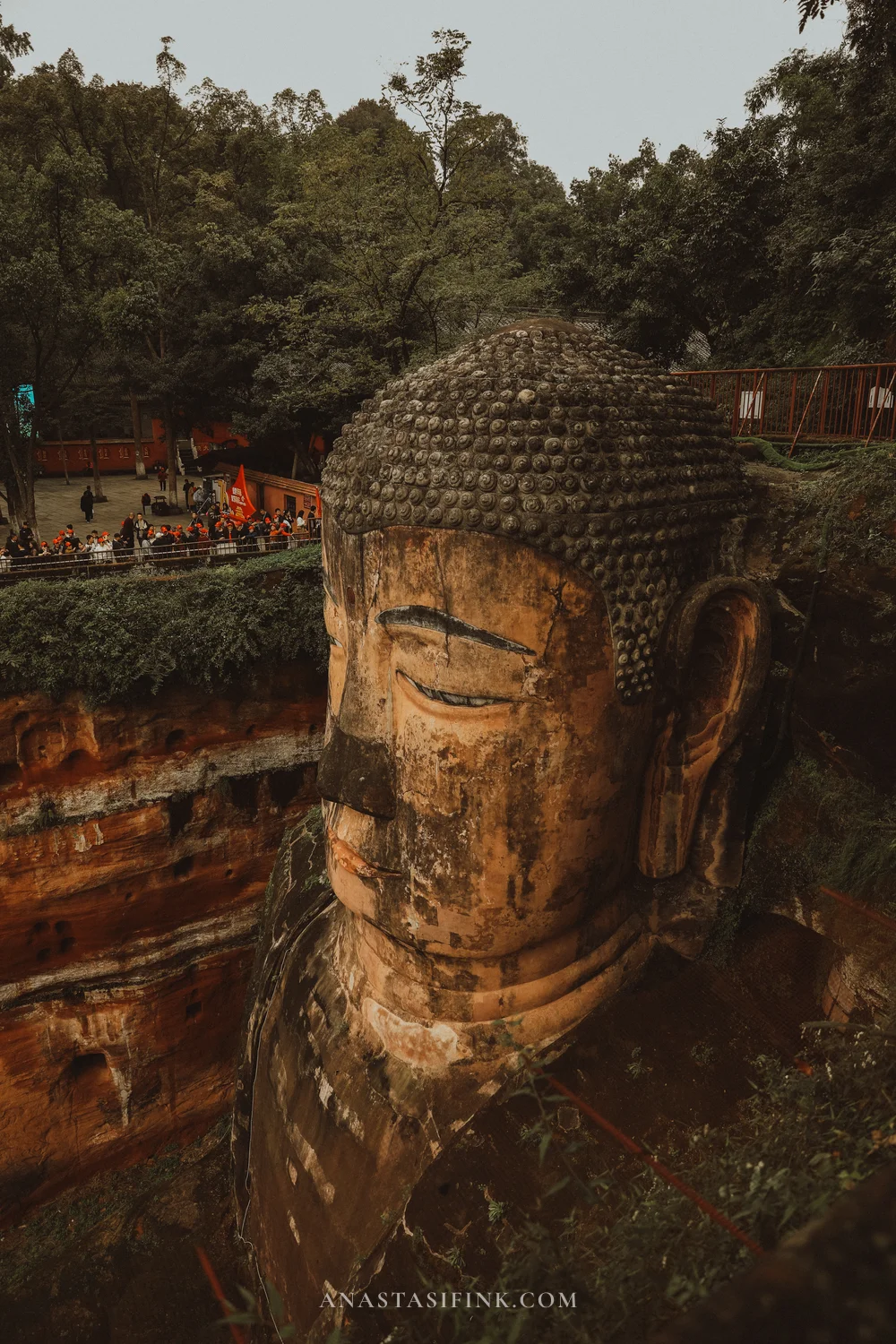
The Leshan Giant Buddha (乐山大佛, Leshan Dafo) is the largest stone Buddha statue in the world. It’s a seated Maitreya Buddha, 71 metres tall, carved directly into the red sandstone of Lingyun Mountain, at the point where three rivers — the Min, the Dadu, and the Qingyi — come together. Its shoulders are 28 metres wide, its ears are 7 metres each (made of wood coated in clay), and an adult can sit on its smallest toenail.
Work began around 713 AD, during the Tang dynasty. It was the idea of a monk named Haitong: the river confluence was dangerous for boats, and he believed a giant Buddha would calm the turbulent water. He didn’t live to see it finished — his disciples carried on, and the statue was only completed around 803 AD, almost 90 years later. Since 1996 it has been a UNESCO World Heritage Site, together with Mount Emei.
The route through the park works as a loop: in at the top and down to the head, a steep staircase down to the feet, back up on the other side, and finally a bridge to a neighbouring island with the quiet Wuyou Temple. I walked the whole thing, and I’ll take you through it in order — exactly the way it unfolds.
The Entrance and the Walk to the Buddha
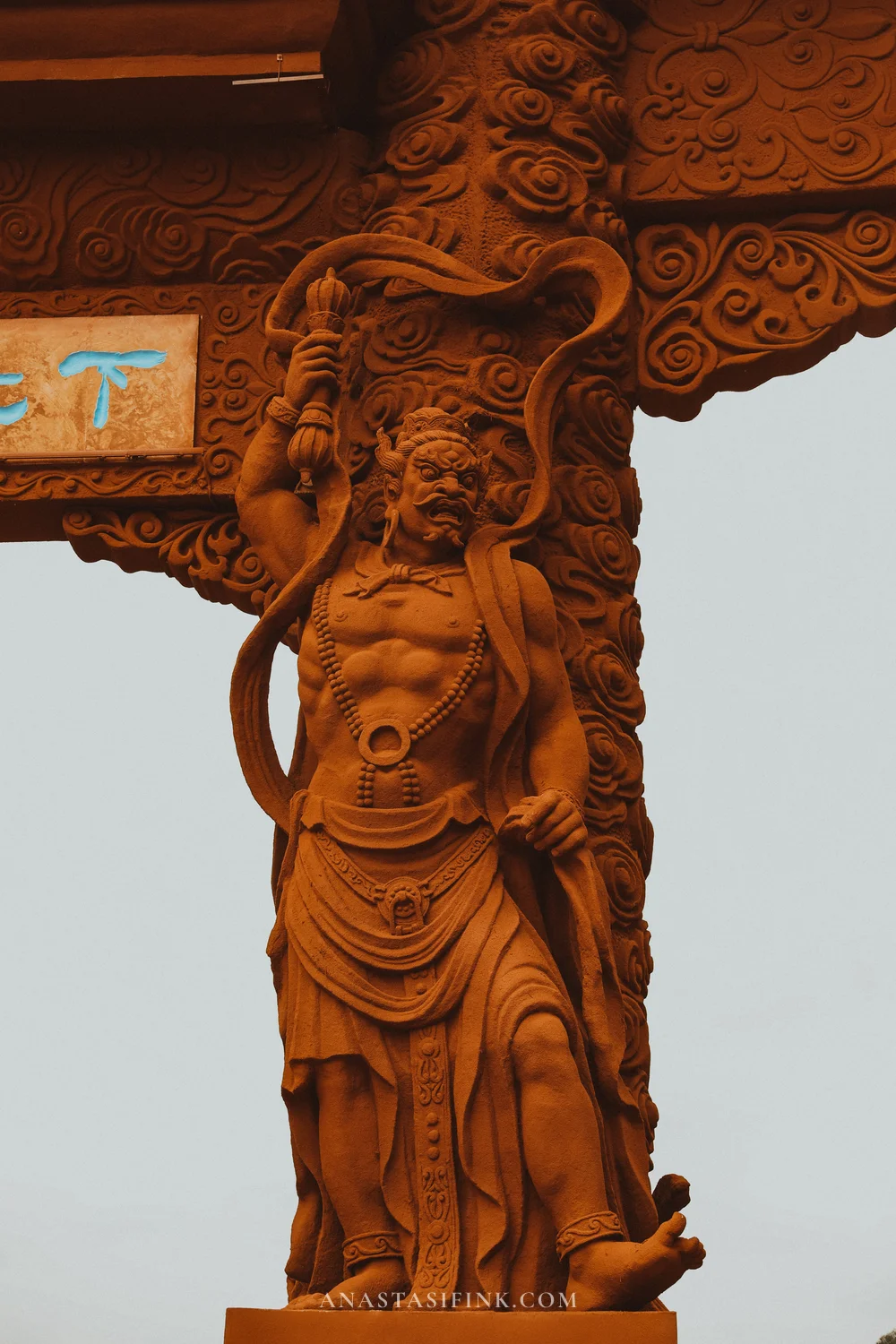
The park starts well before the Buddha itself. From the gate, a wide plaza opens up with a dragon-shaped fountain and flowerbeds — in winter they plant red and white poinsettias here. Then come the huge honey-coloured stone paifang gates, completely covered in carving: guardian figures stand on the columns, detailed and striking.
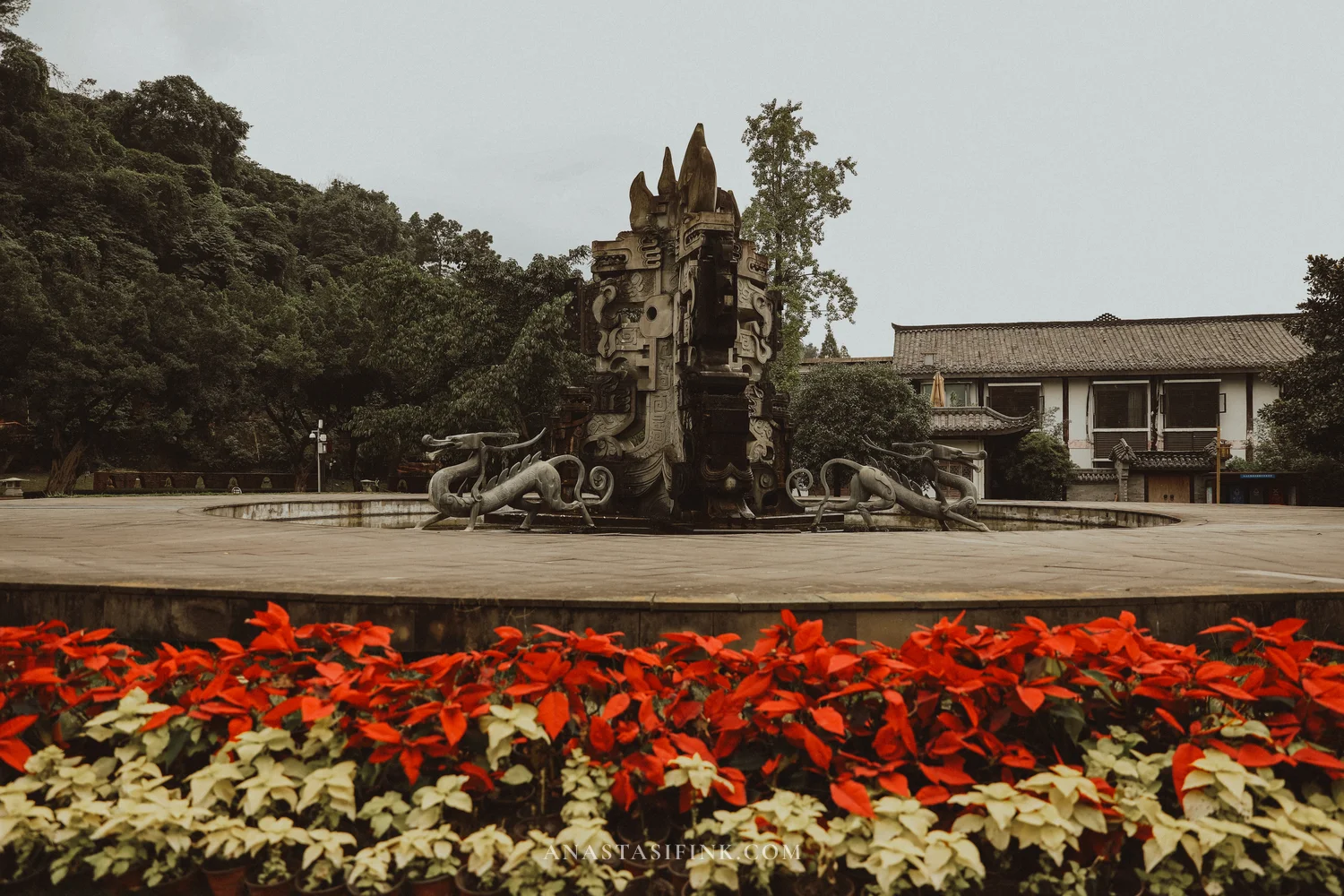
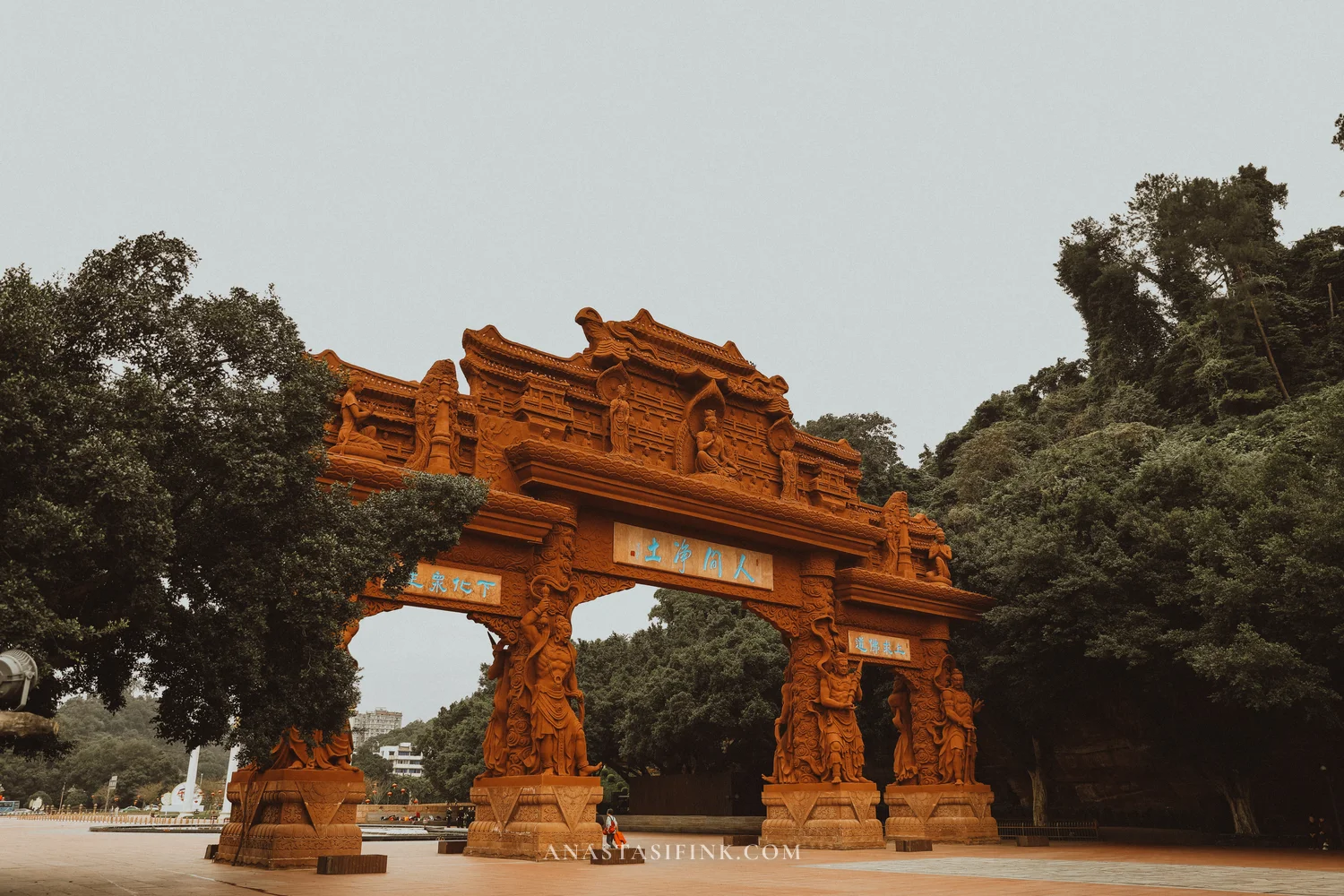
The entrance plaza with its fountain and the main paifang gate. In the morning it’s almost empty
From the gate to the actual park checkpoints, there’s still a walk — about 15–20 minutes. If you’d rather not walk, or you’re with kids, electric mini-carts (golf-cart style) run across the plaza and take you to the start of the route.
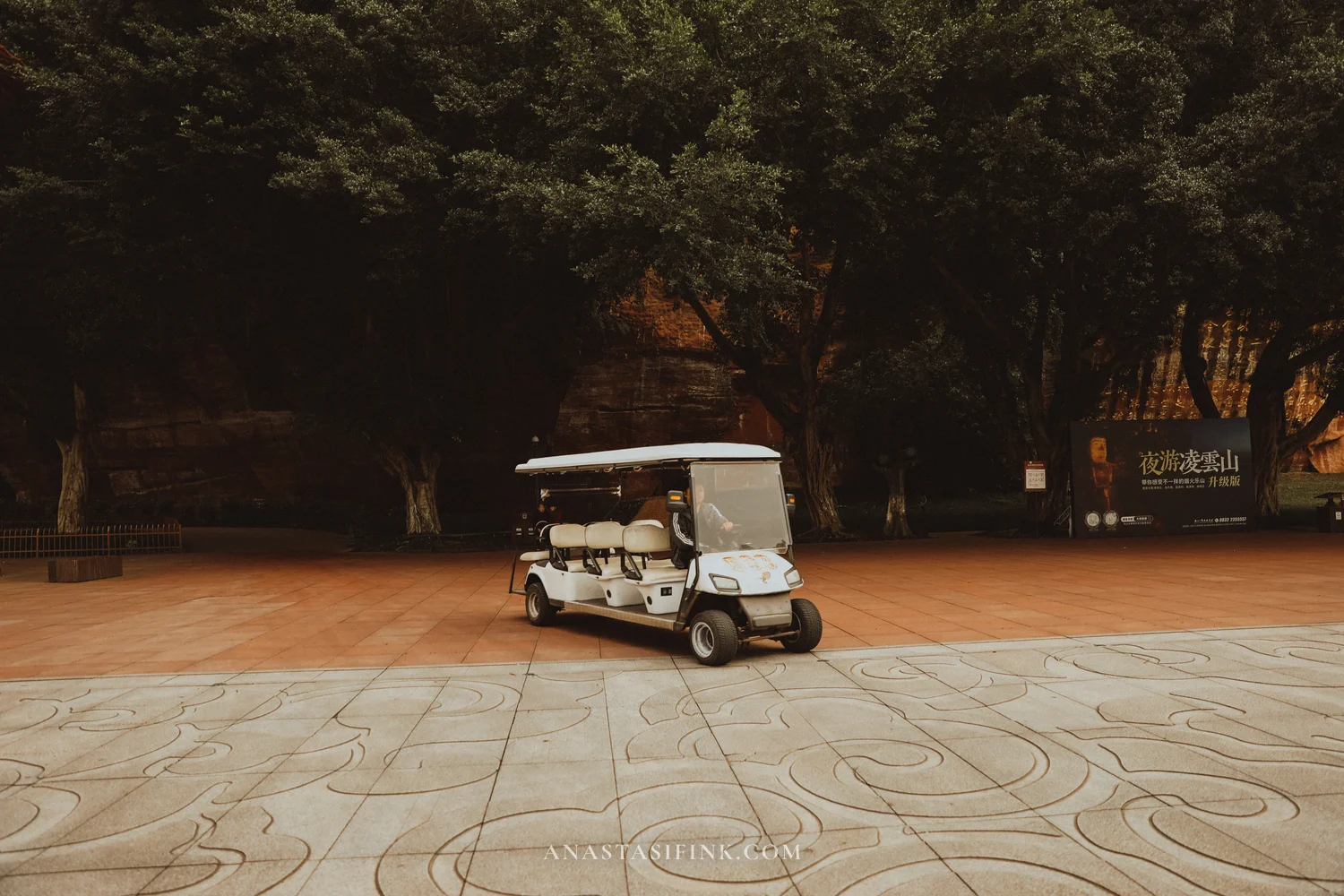
If you don’t feel like walking, these carts run across the plaza
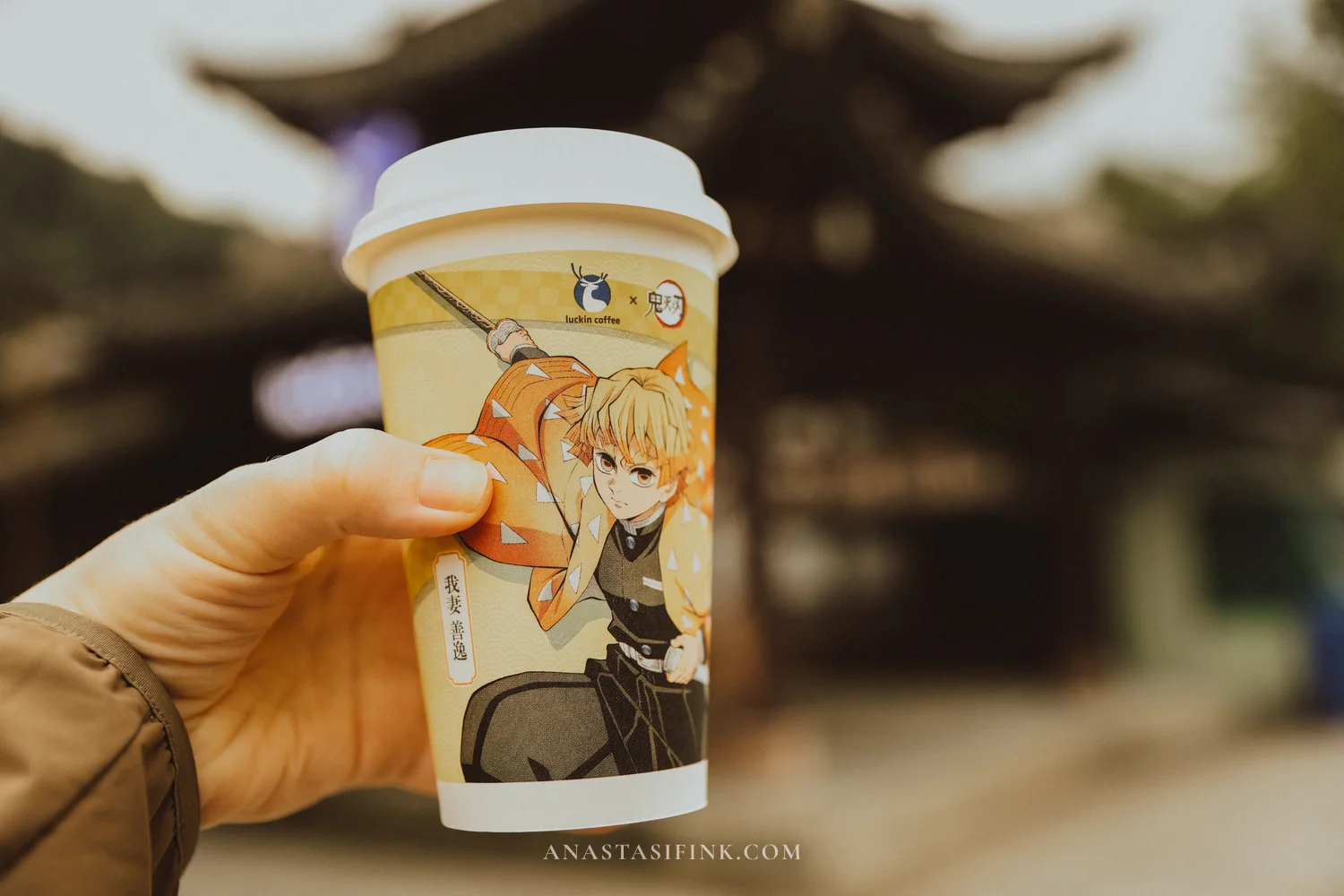
Right by the entrance there’s a Luckin Coffee — a huge Chinese chain, cheap and genuinely good. I’d get their coconut latte. One thing to keep in mind: this is a tourist spot, so prices here are noticeably higher than at a regular Luckin in town.
Before the climb, look for the big park maps — they stand near the entrance, labelled in English as “Guide Map of Leshan Giant Buddha Scenic Area.” They show the whole route: the mountain with the Buddha, the river, the boat pier, and the neighbouring island. Take a photo of one — it helps you not get lost.
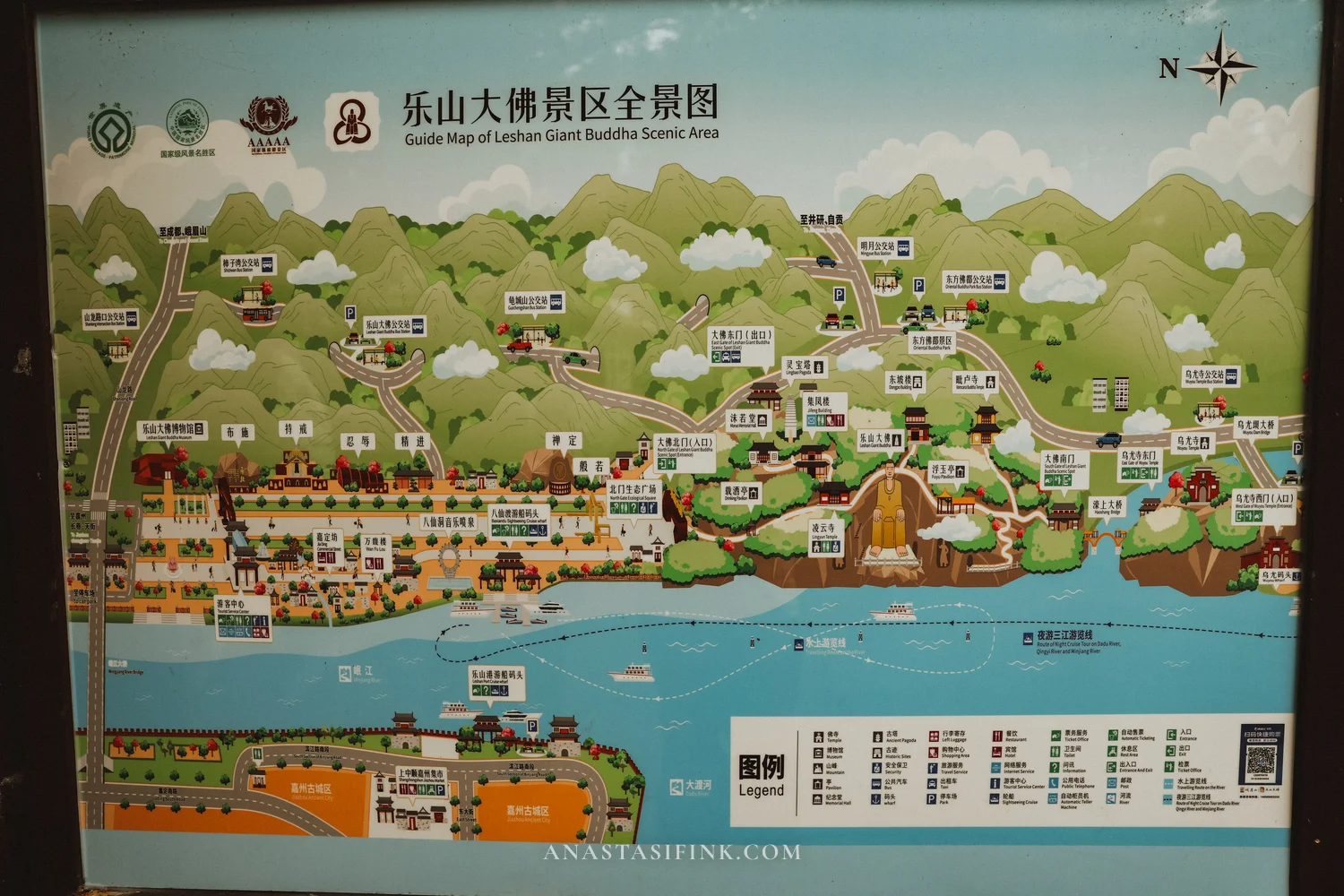
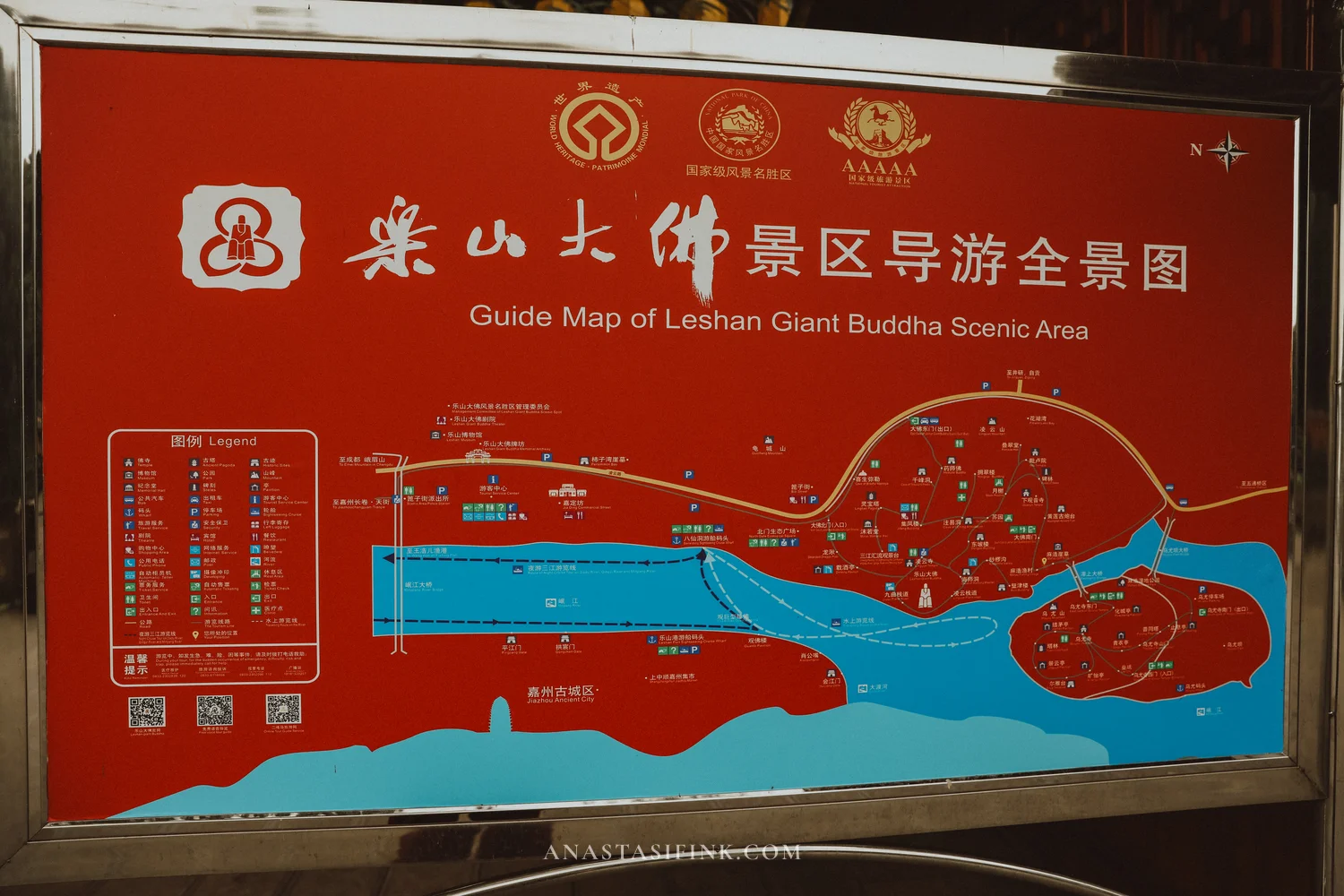
Photograph the map at the entrance — it’ll come in handy
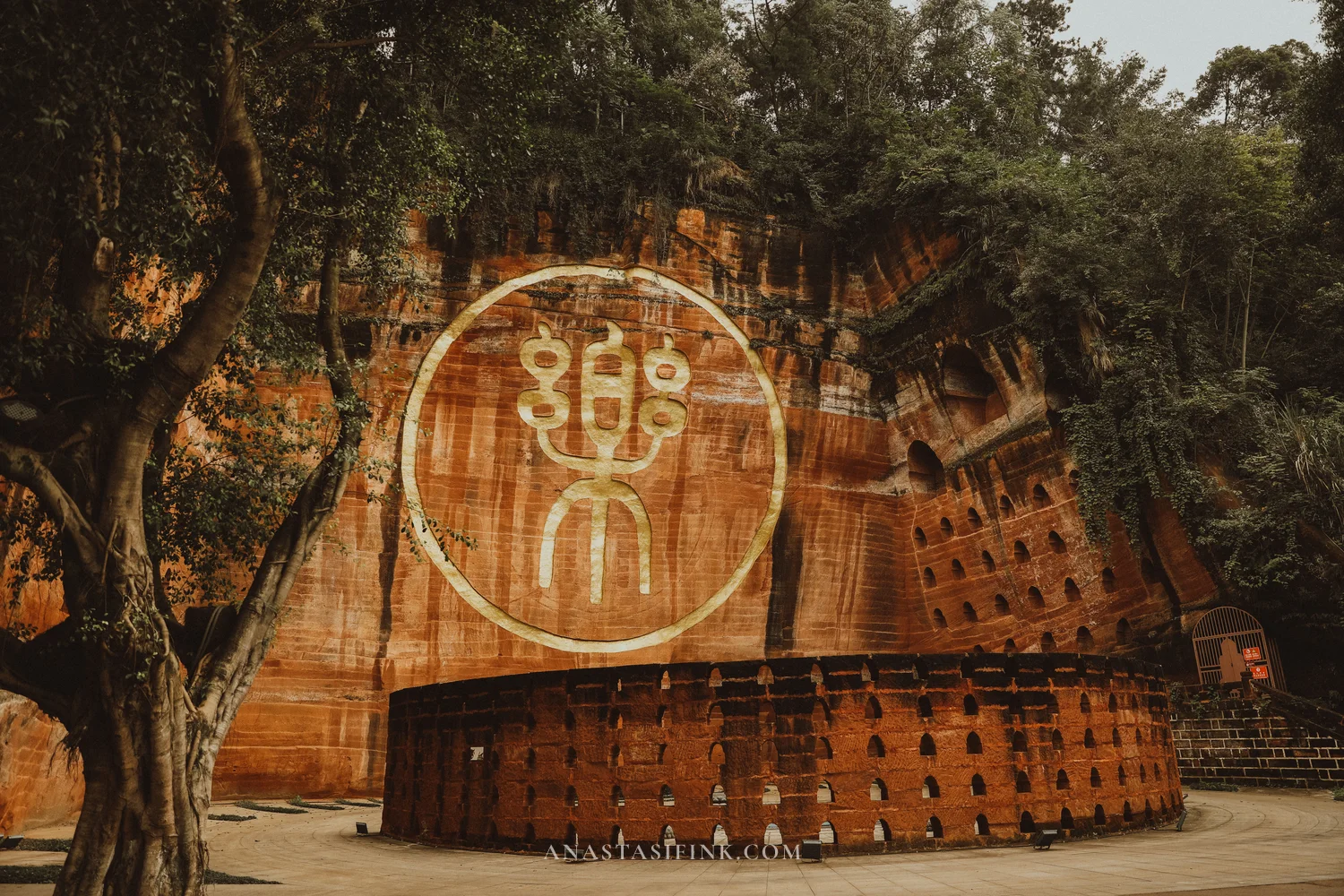
A little further along, a large golden seal-like symbol appears on the cliff, set into a semicircular brick wall whose niches are also covered in carving.
The Maitreya Cave and the Climb up the Mountain
Before the staircase climb begins, the route leads into a small cave cut into the rock. Inside, in the dim light, sits a stone Maitreya Buddha — the Buddha of the future, who, in Buddhist belief, will come into the world after the present age. In China he’s usually shown plump and smiling, and that’s how he’s carved here.
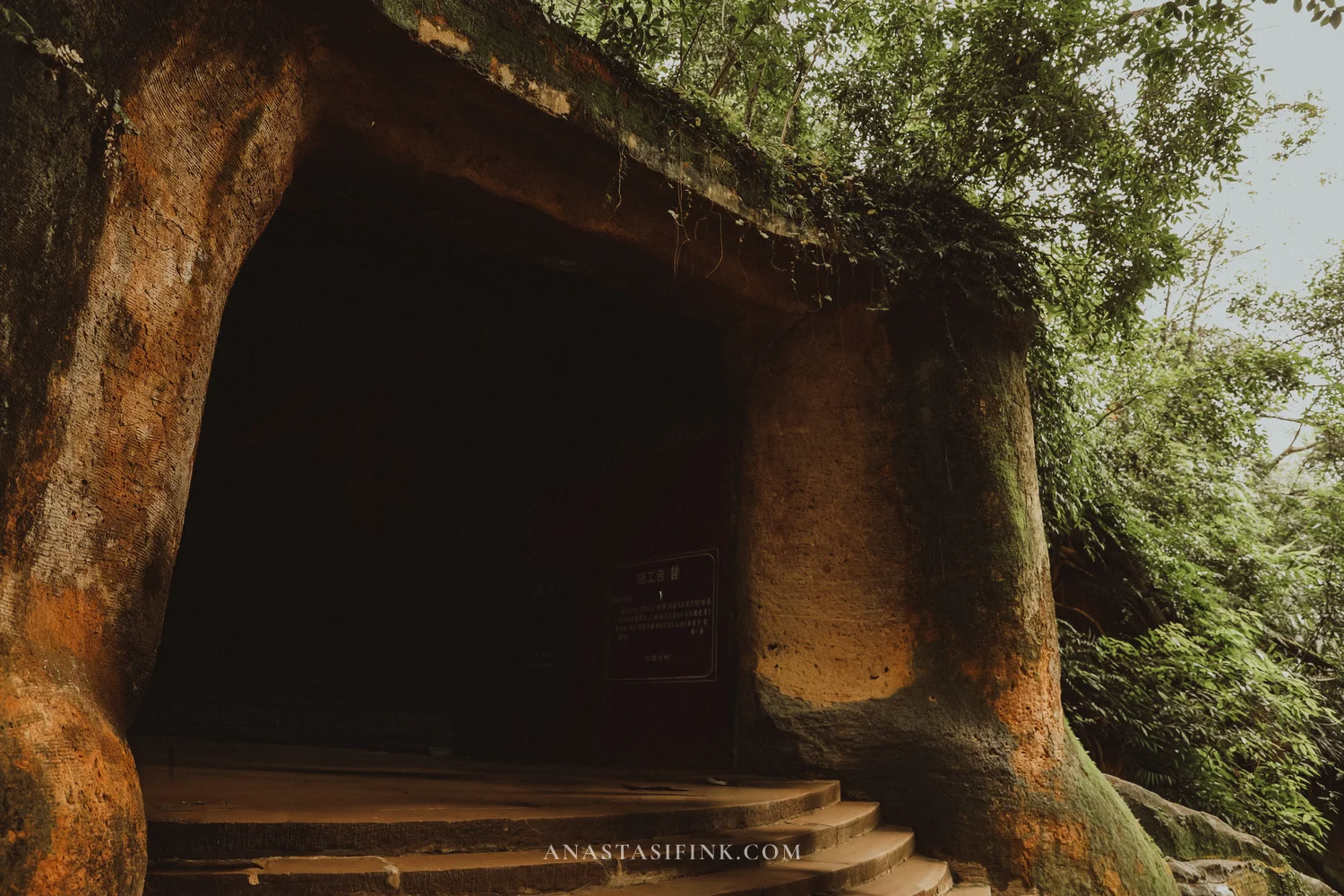
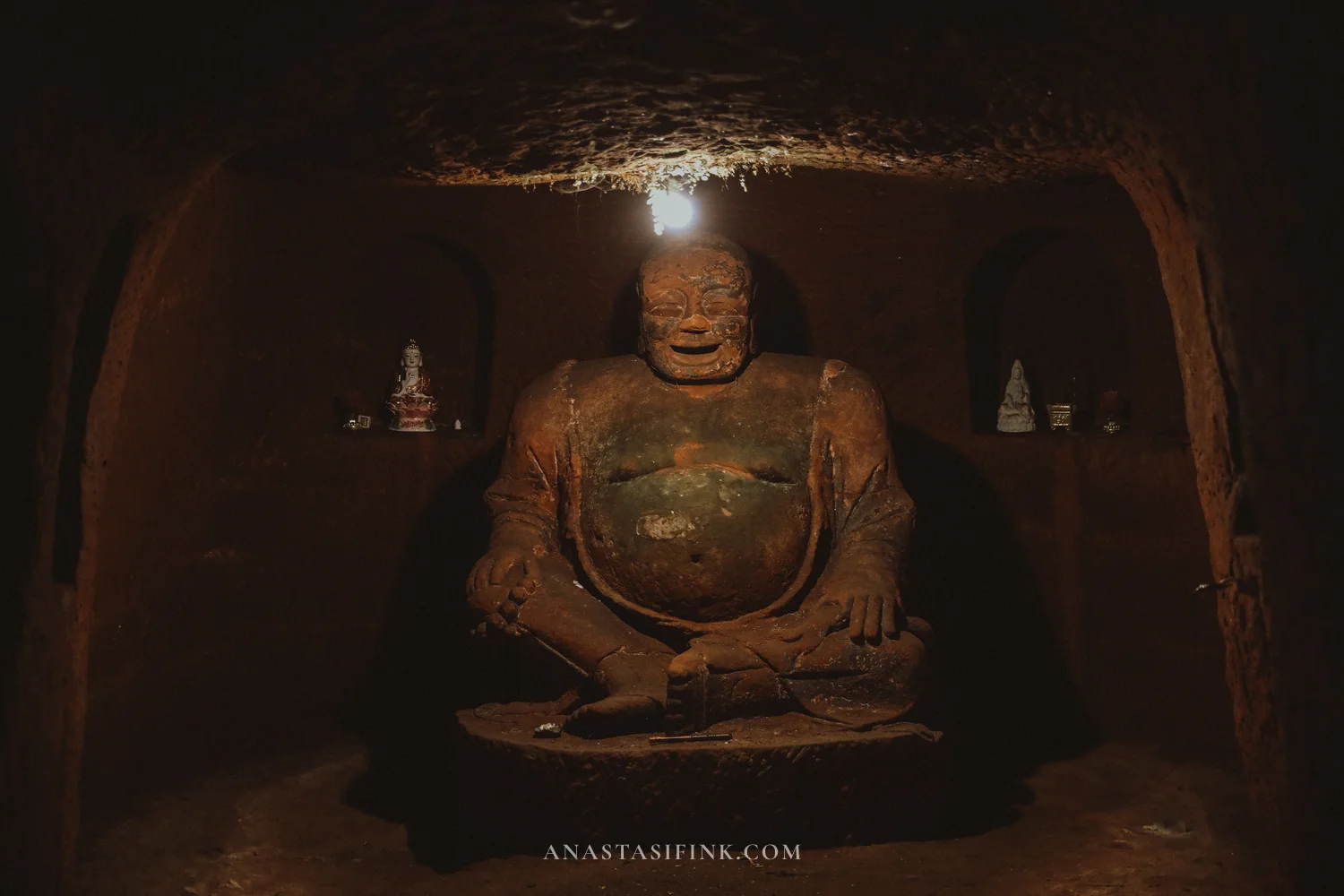
The Cave of Blissful Maitreya. The statue is easy to miss — it’s almost dark inside
There’s an information board beside it. They’re all duplicated in English along the route, so it’s easy to work out what you’re looking at. This one is the “Cave of Blissful Maitreya” (喜生弥勒洞): it sits on the site of an old temple and is dedicated to the future Buddha Maitreya.
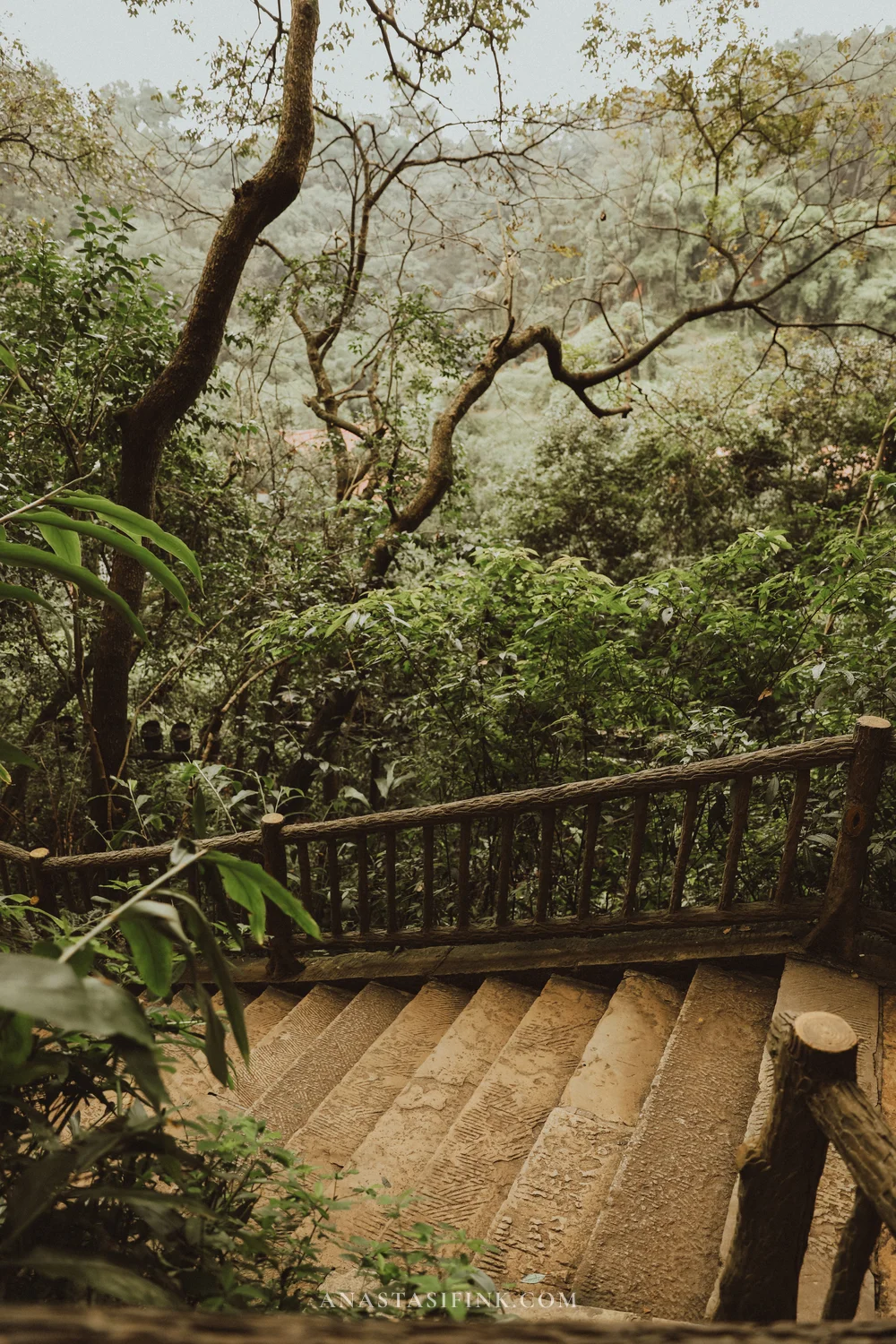
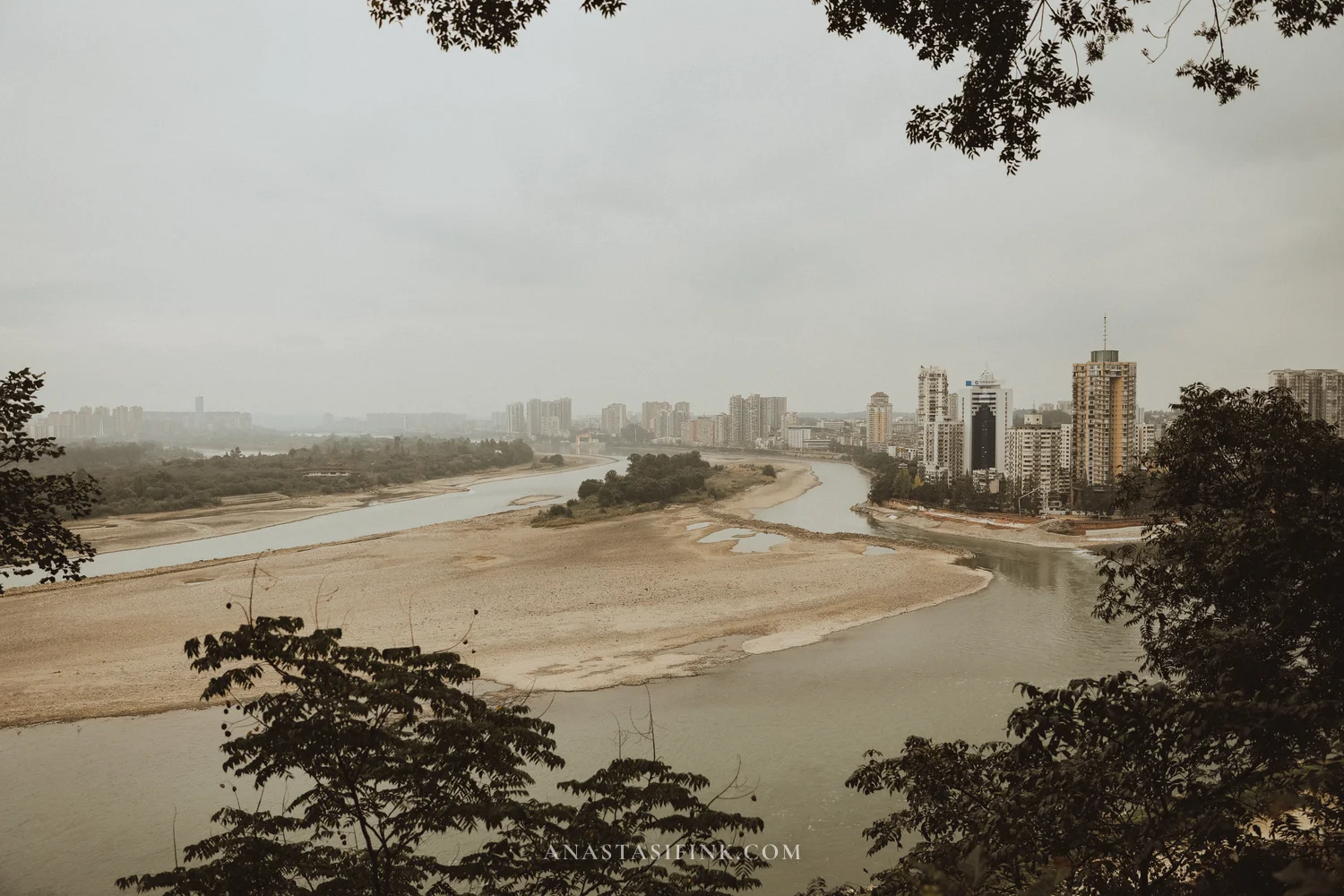
Then comes a stretch of up-and-down stone staircases through dense green forest. From the upper landings you get a view of the river and the city of Leshan on the far bank — a wide channel with sandbars and high-rises in the distance.
The Museum, the Caves, and the Carvings of Lingyun Mountain
Along the way there’s a small museum — halls with calligraphy, old documents, and paintings behind glass. Leshan is the hometown of Guo Moruo, a well-known 20th-century Chinese writer and historian, and much of the display is devoted to him and to local culture. If you’re tired of the stairs, it’s a good reason to pause in the cool.
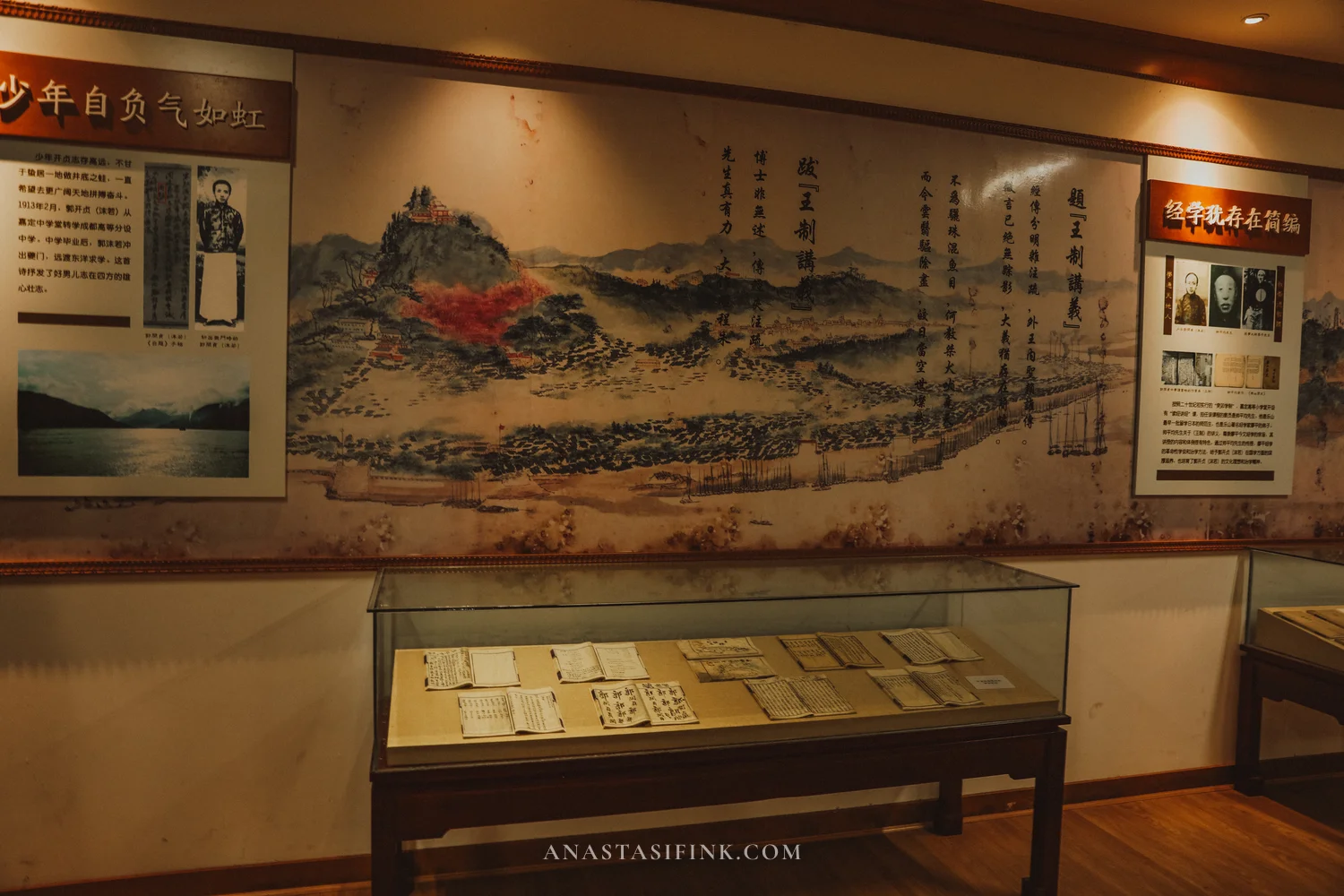
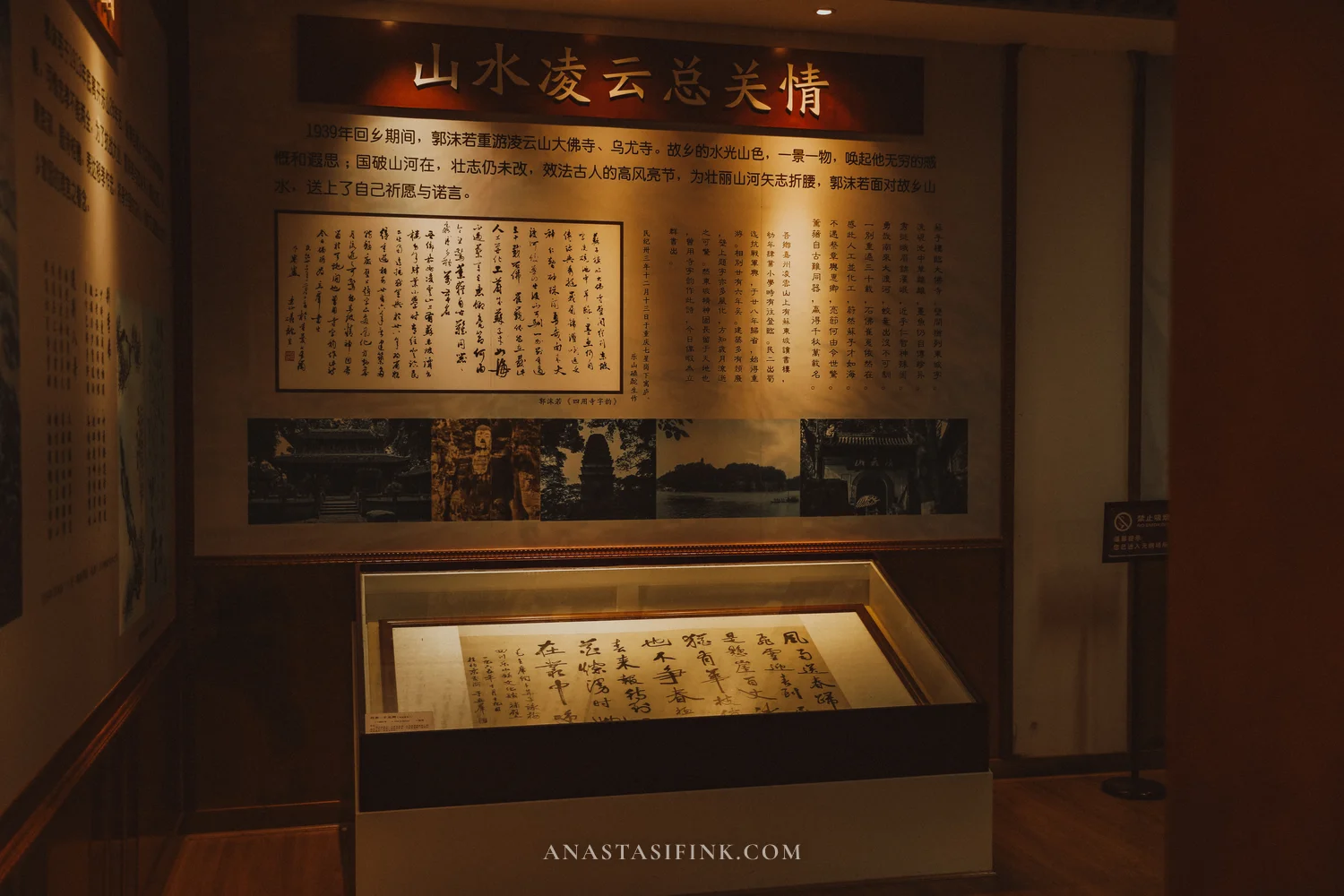
Worth a look, and a chance to rest from the stairs
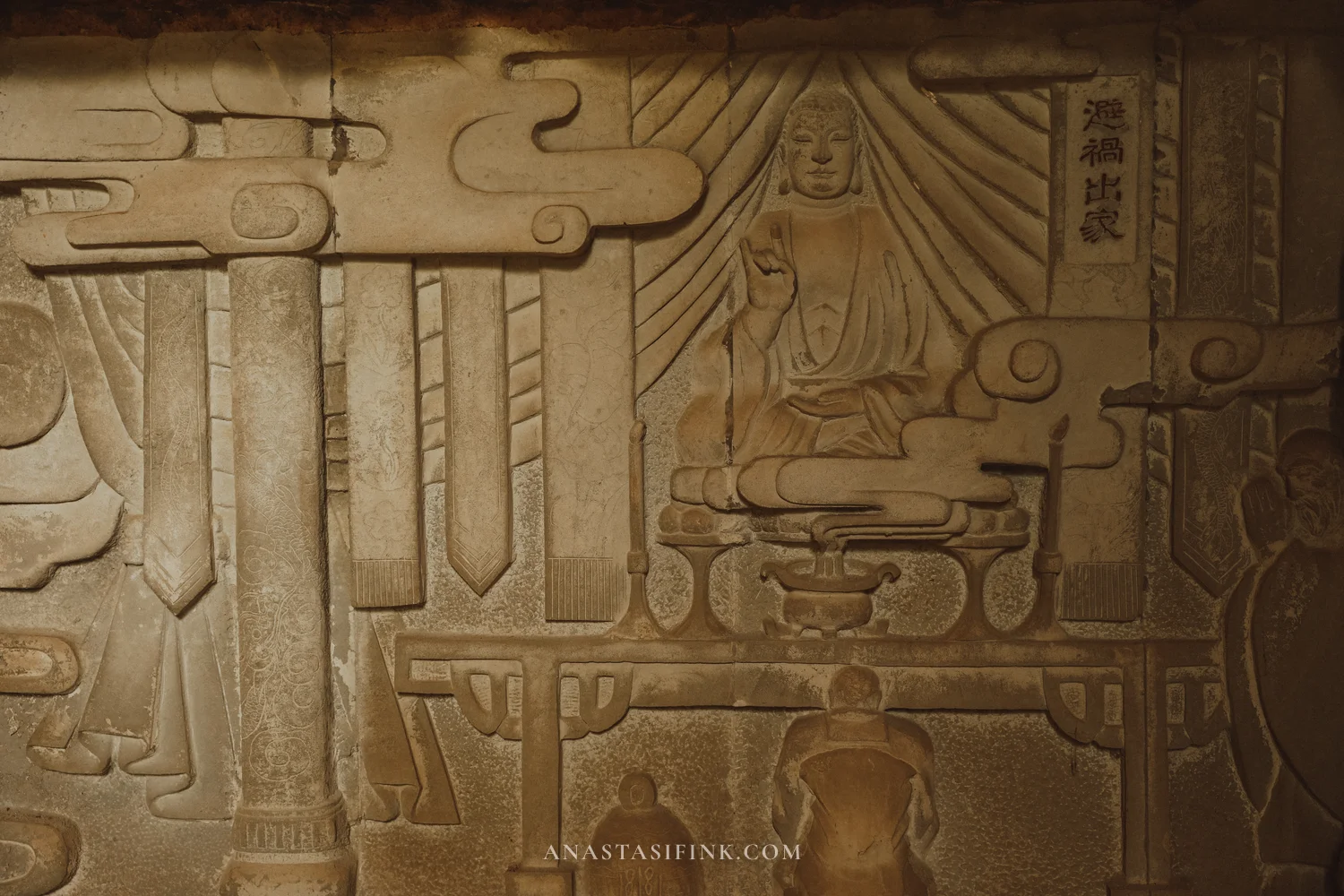
Further on, one branch of the path passes through an arch draped in greenery — the entrance to Qianfeng Cave (千峰洞, “Cave of a Thousand Peaks”). Flowers line the steps. Inside, the walls are covered in carving: inscribed steles, Buddha reliefs, bas-reliefs.
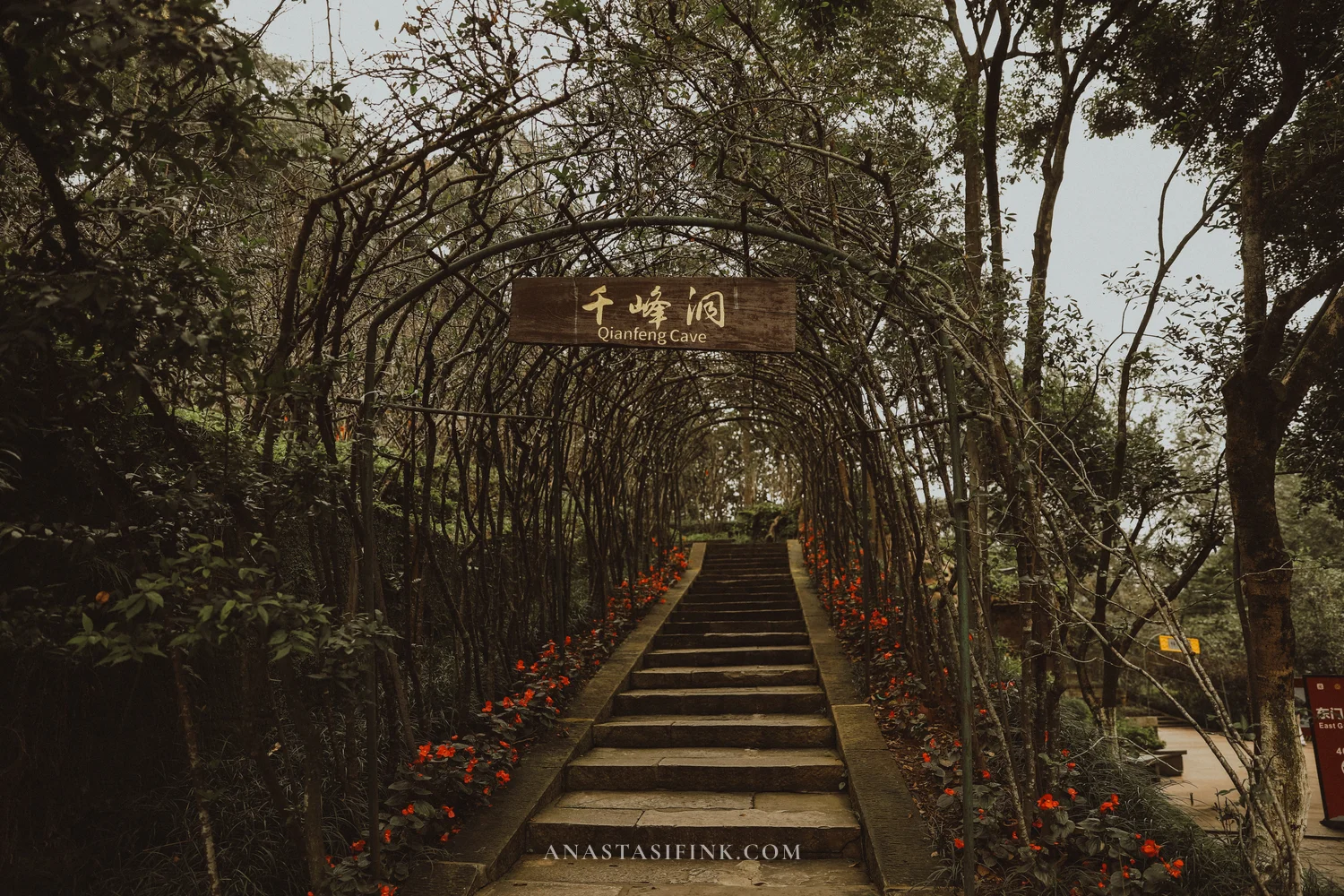
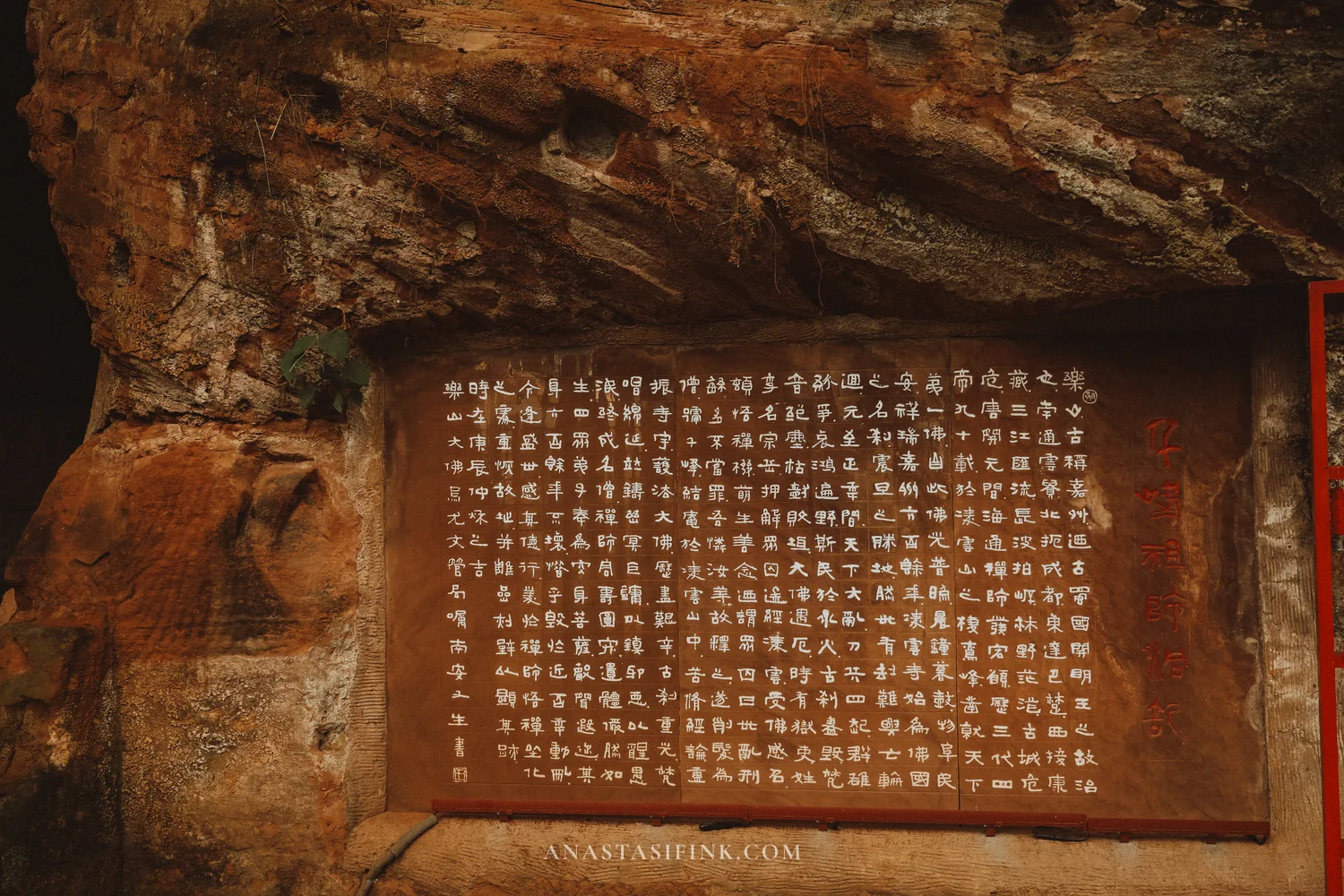
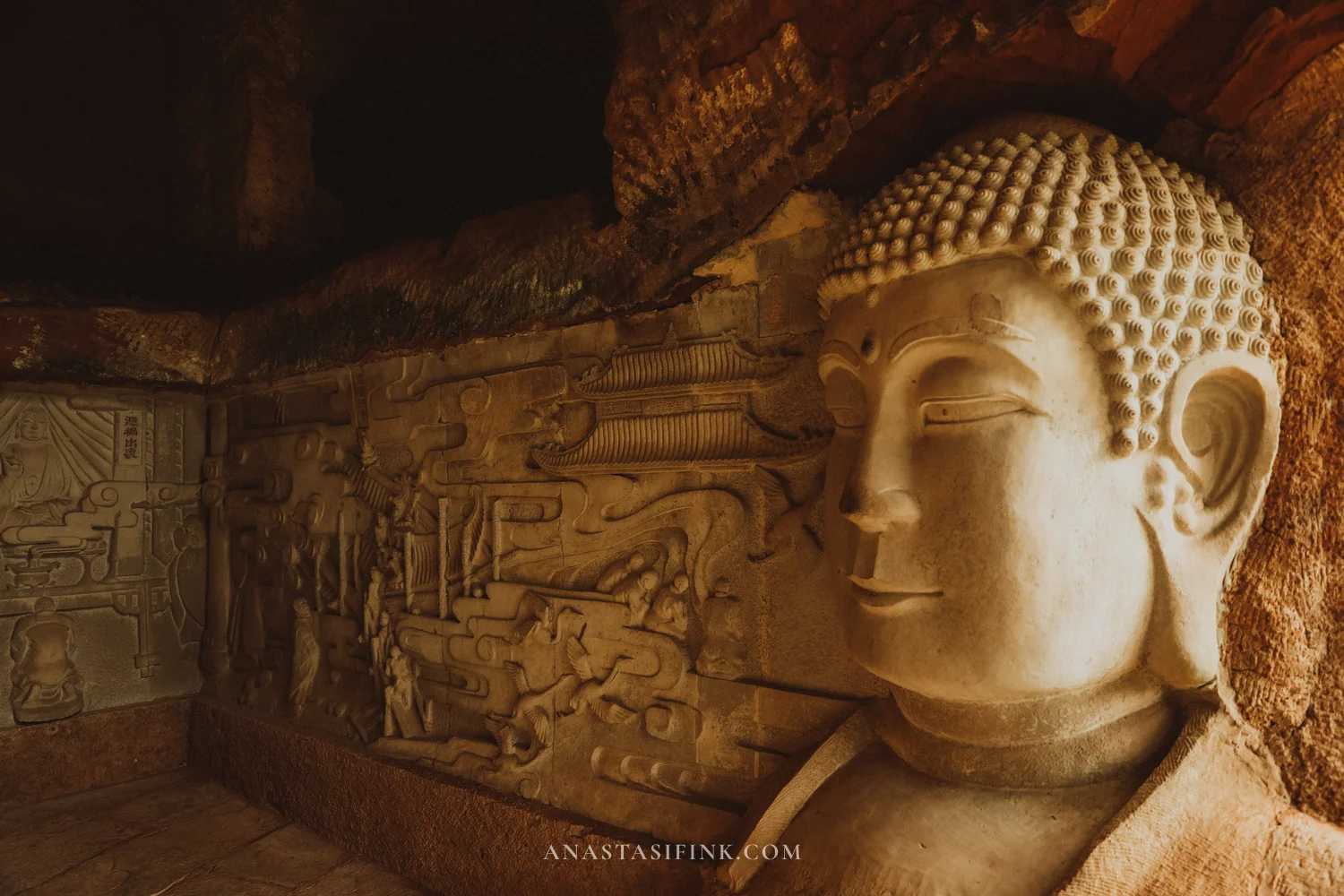
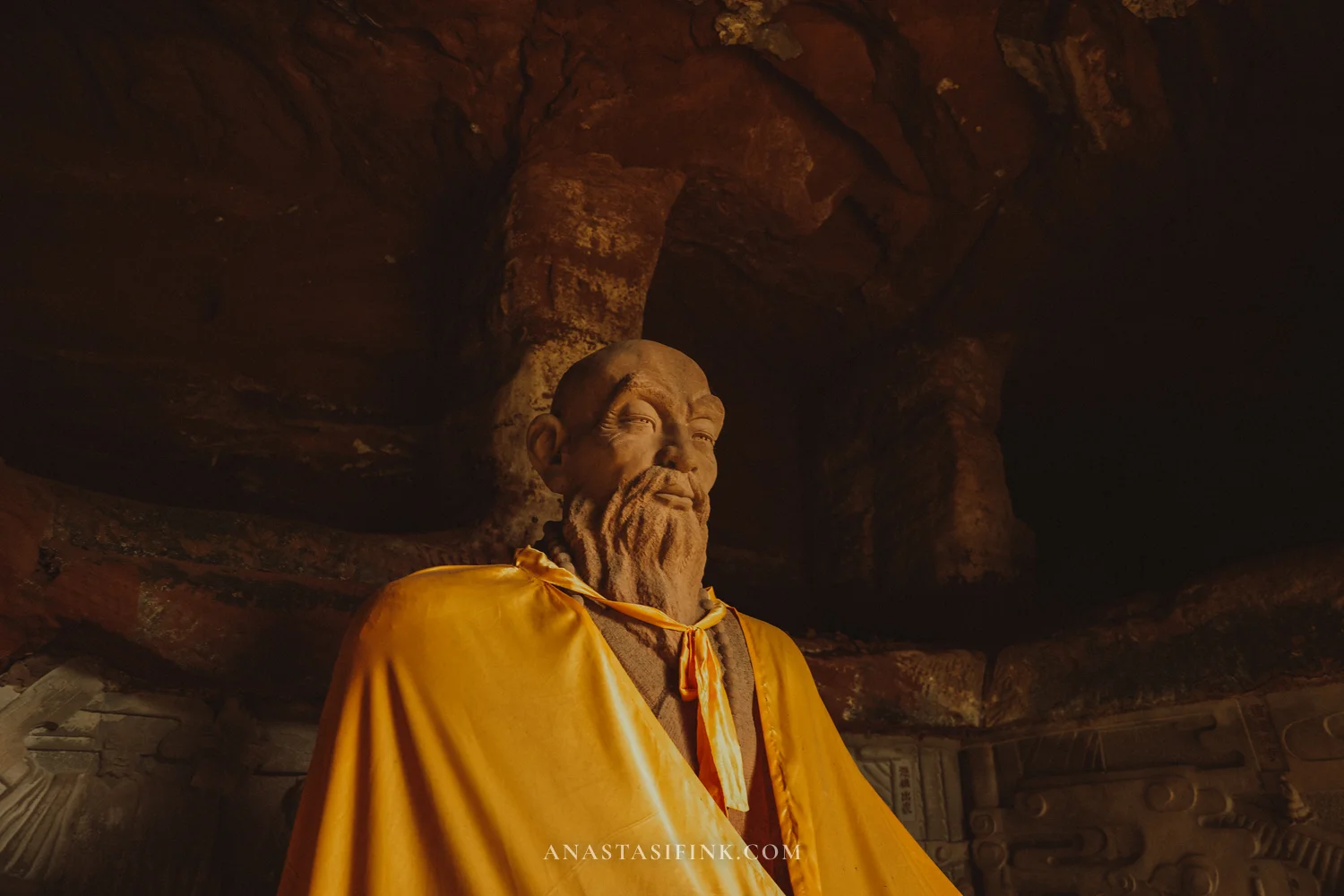
Steles, reliefs, and figures of sages inside the cave
The temple roofs are worth a look too — with their upturned eaves and decorative ridges. Ceramic dragons and beasts sit on the corners: the traditional guardians of Chinese temples.
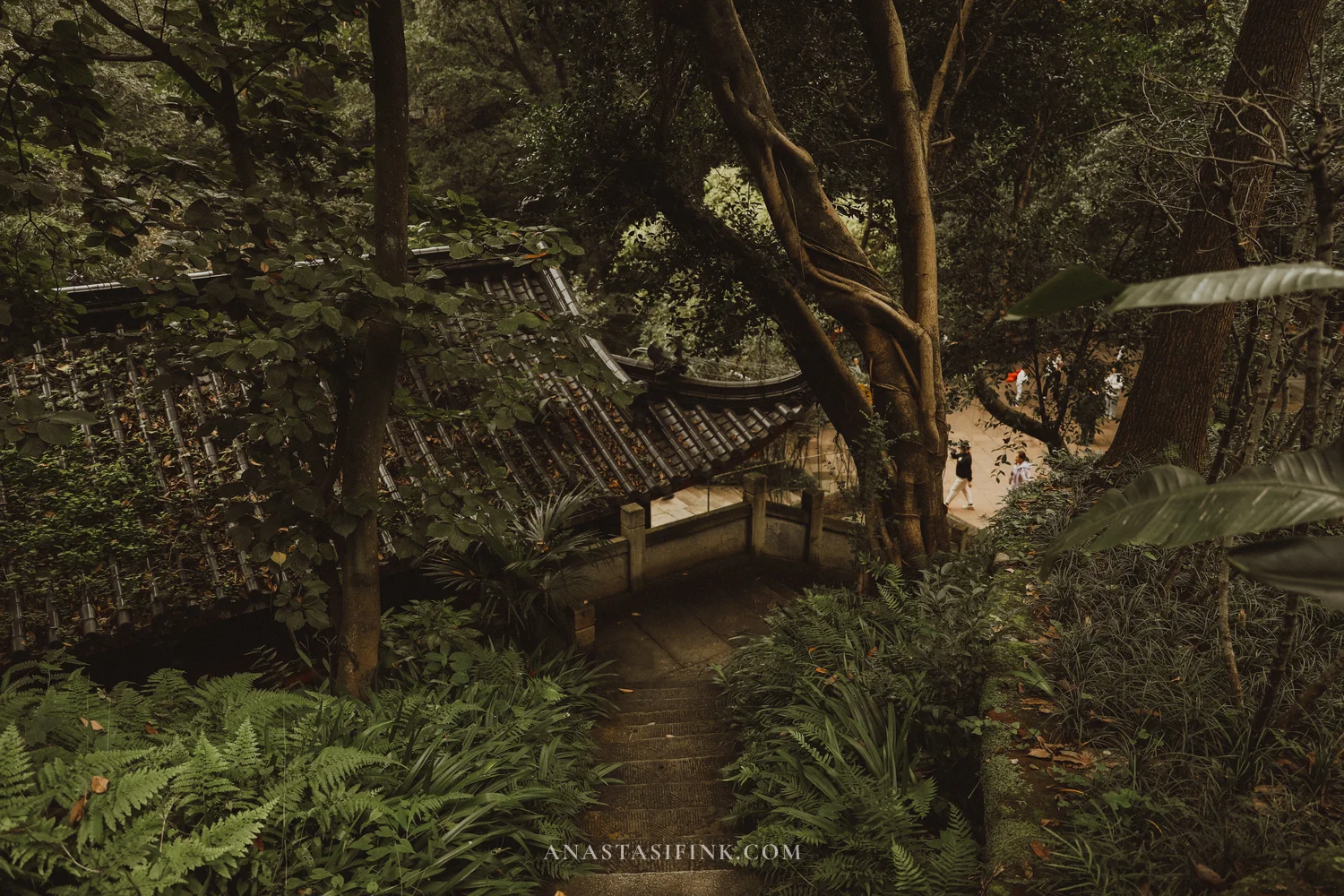
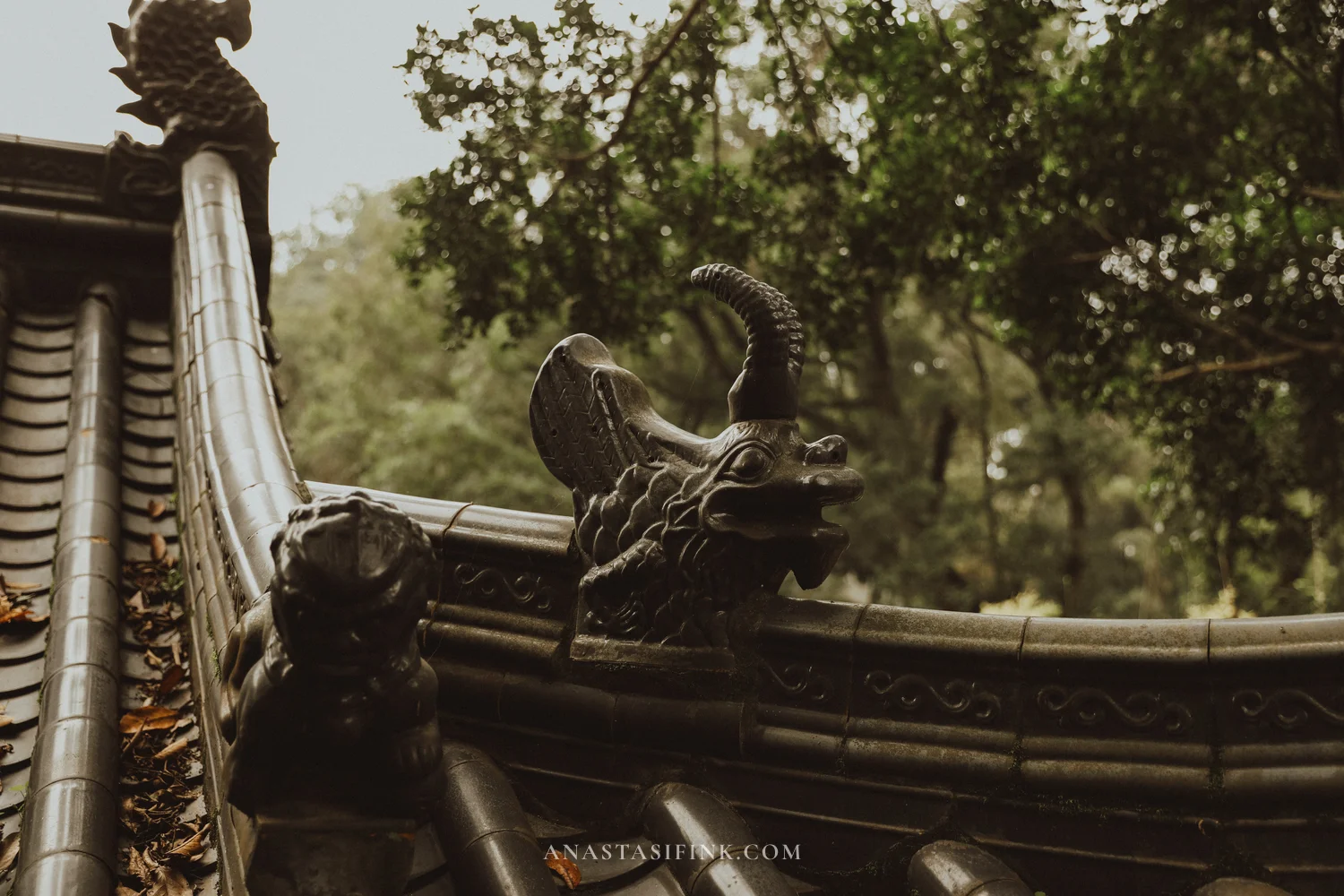
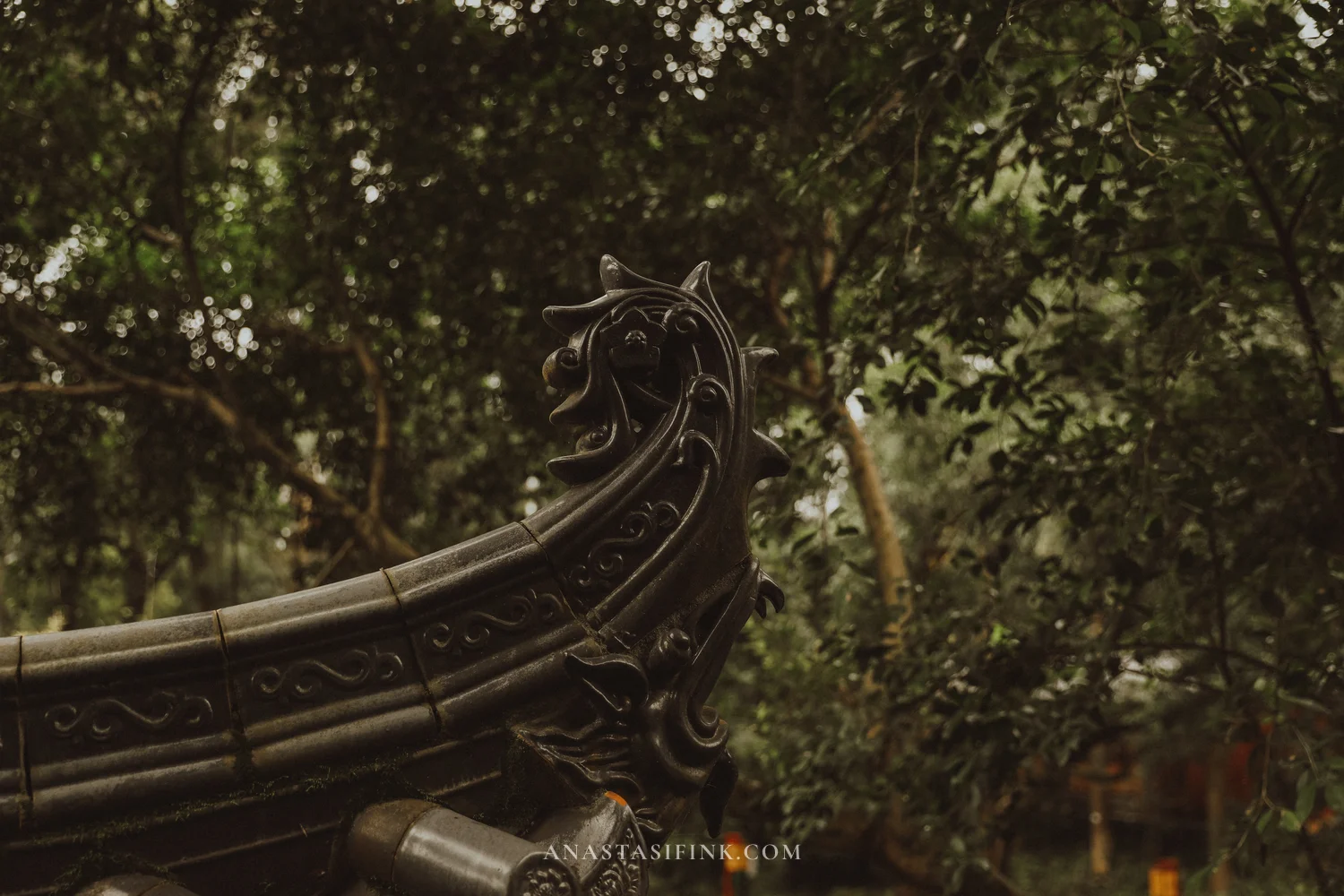
Ceramic guardian beasts sit on the roof corners
The “Book of Changes” Cave — a Daoist Corner
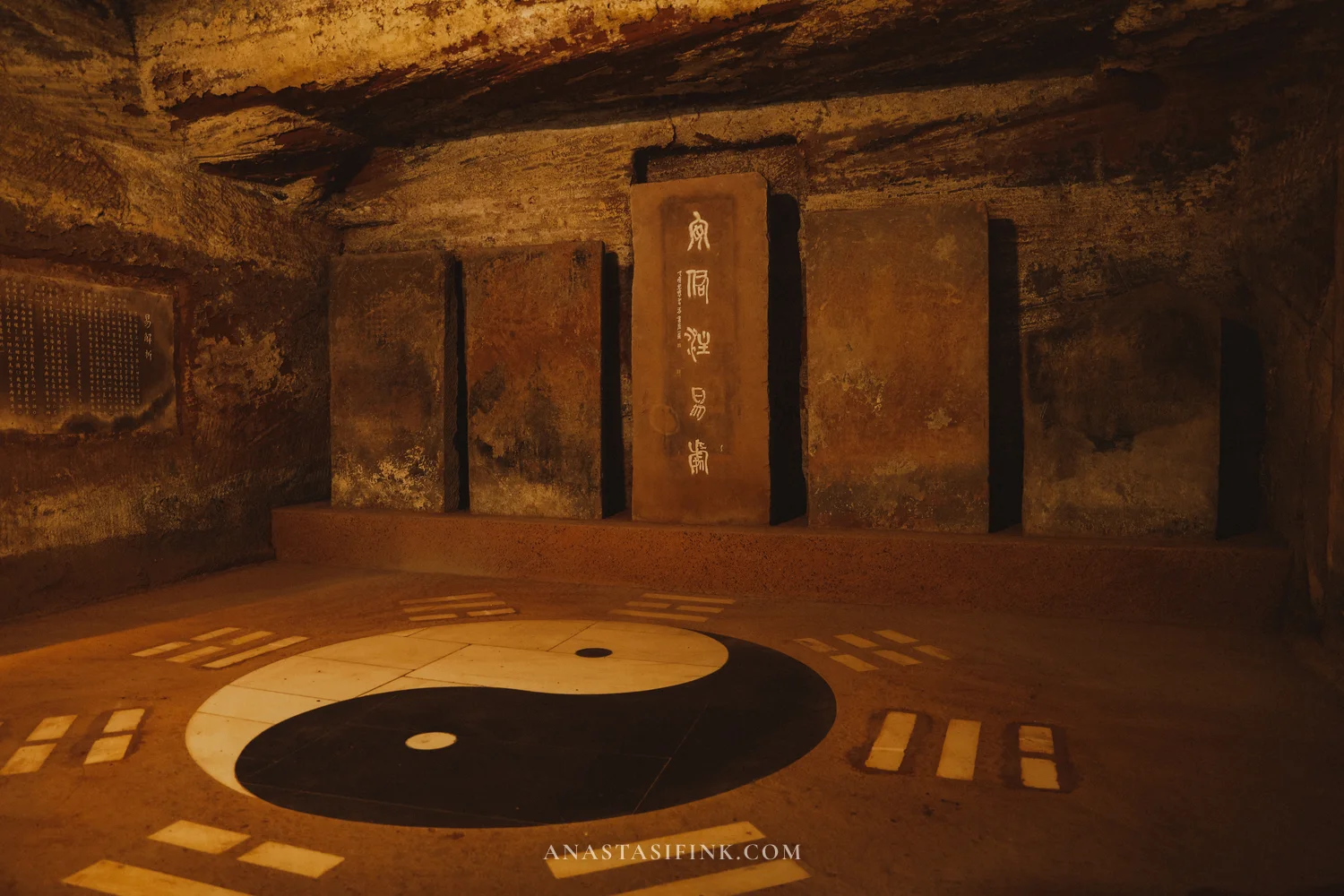
A separate and fairly unexpected part of the route is the Zhuyi Cave (注易洞), the “Yijing Annotation Cave.” It’s a Daoist site: this is where the I Ching, the ancient Chinese “Book of Changes,” was once studied. A stele with a long inscription stands at the entrance, and the English board explains it: the “Yijing Annotation Cave” stele is 1.7 metres tall and dates to the Ming dynasty.
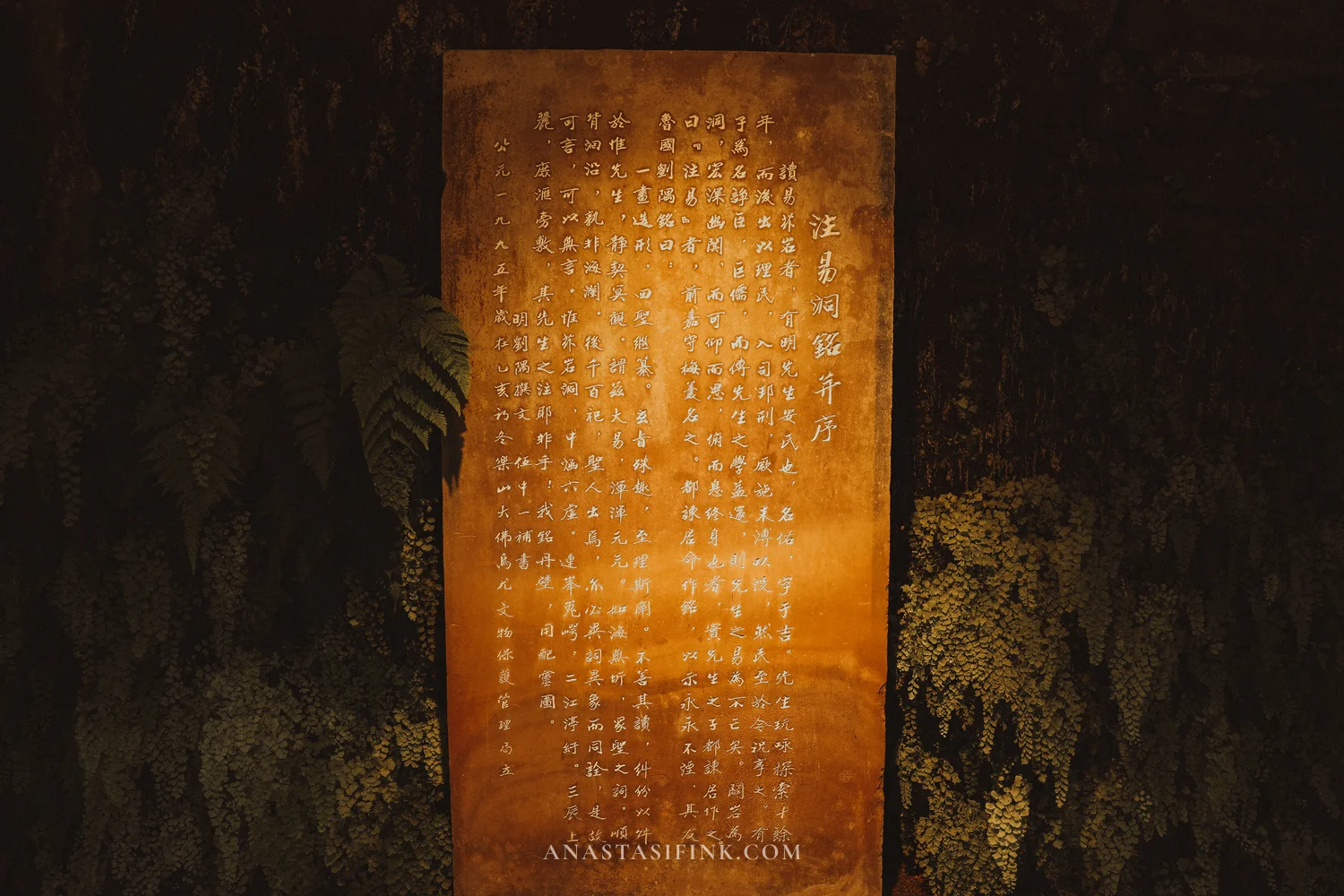
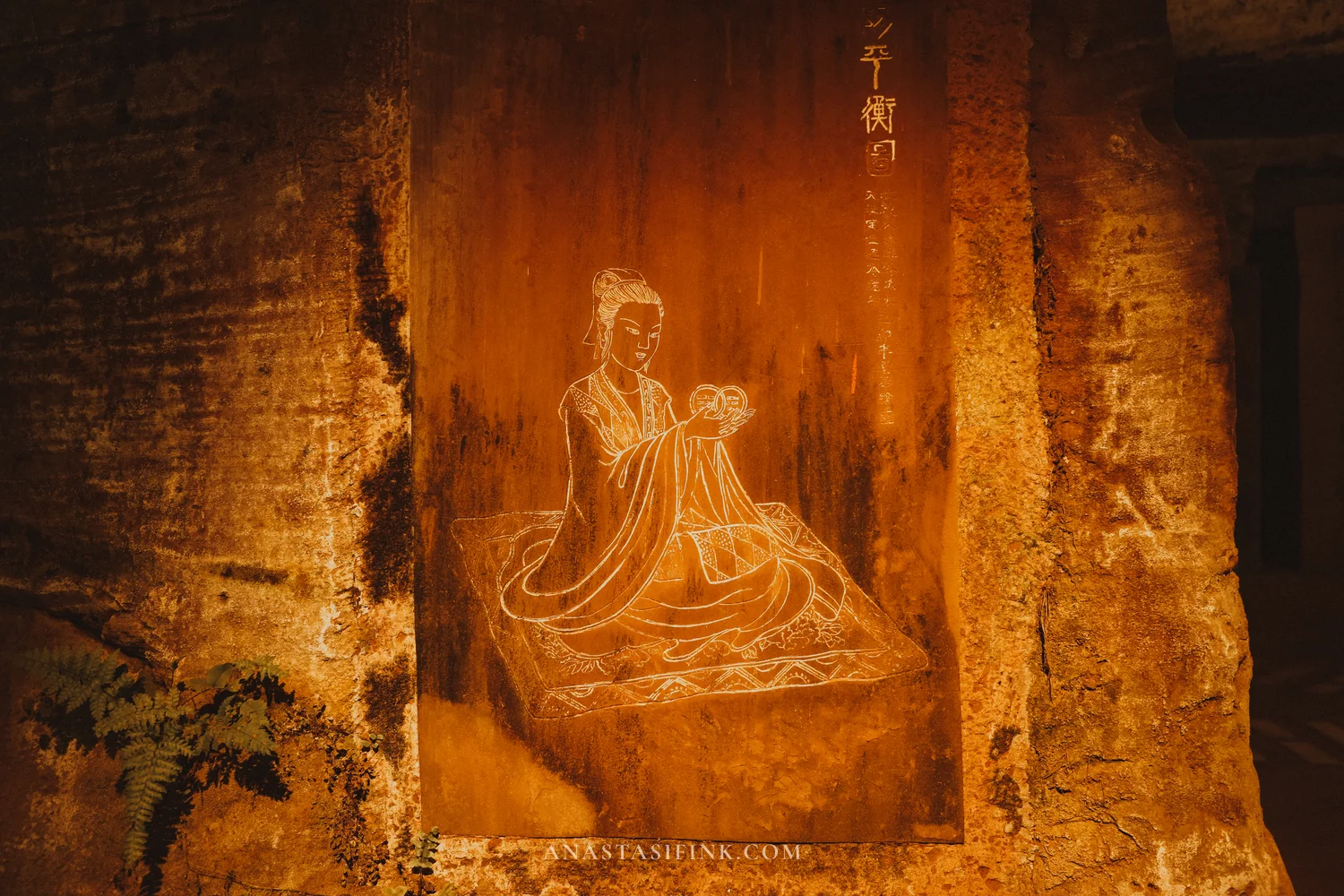
Inside are images carved in stone: a Daoist immortal riding a beast, star charts labelled with the “28 lunar mansions” (the Chinese zodiac divided the sky into four sectors — the Azure Dragon, the Vermilion Bird, the White Tiger, and the Black Tortoise), and in the centre of the hall a large yin-yang symbol laid into the floor, ringed with trigrams.
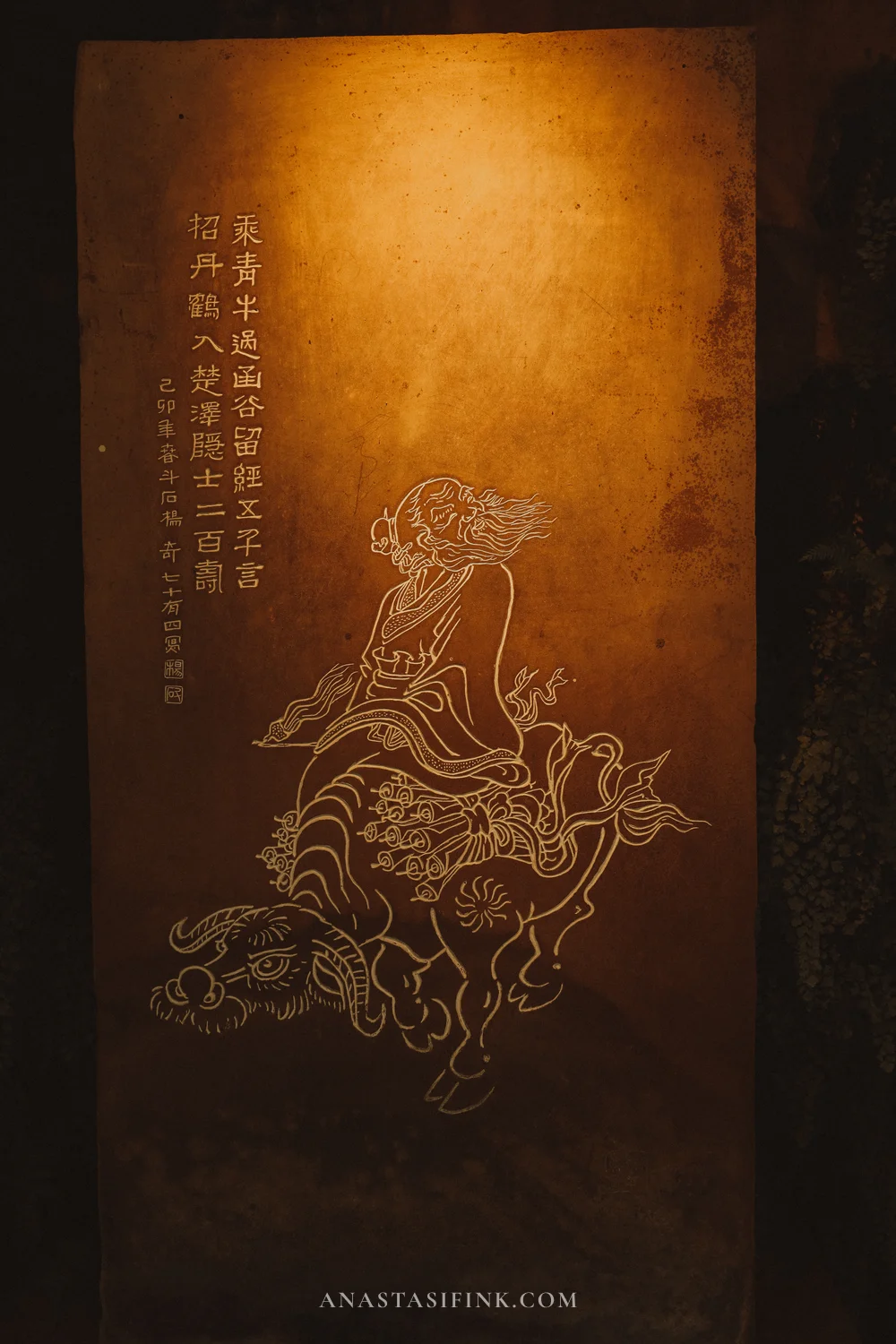
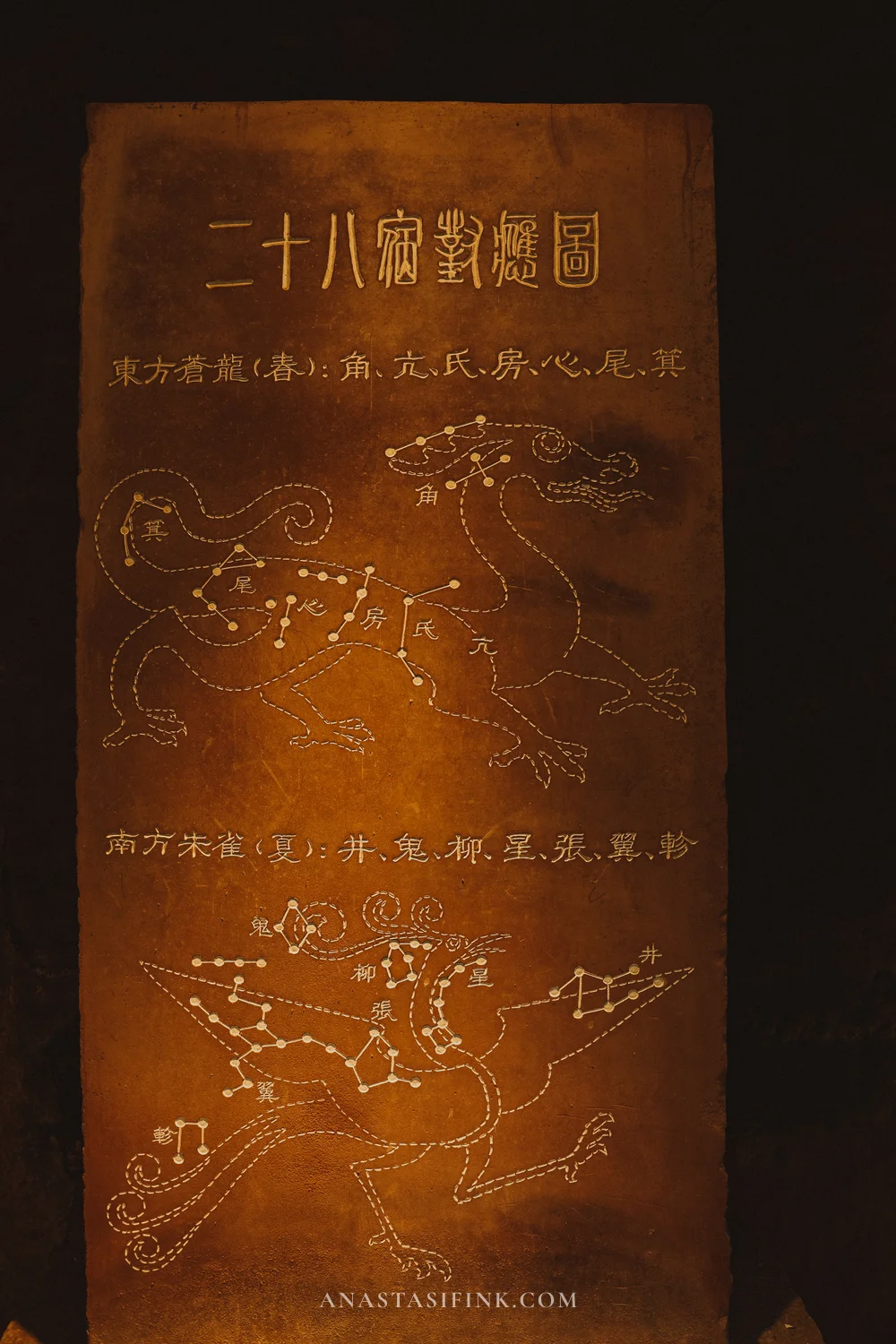
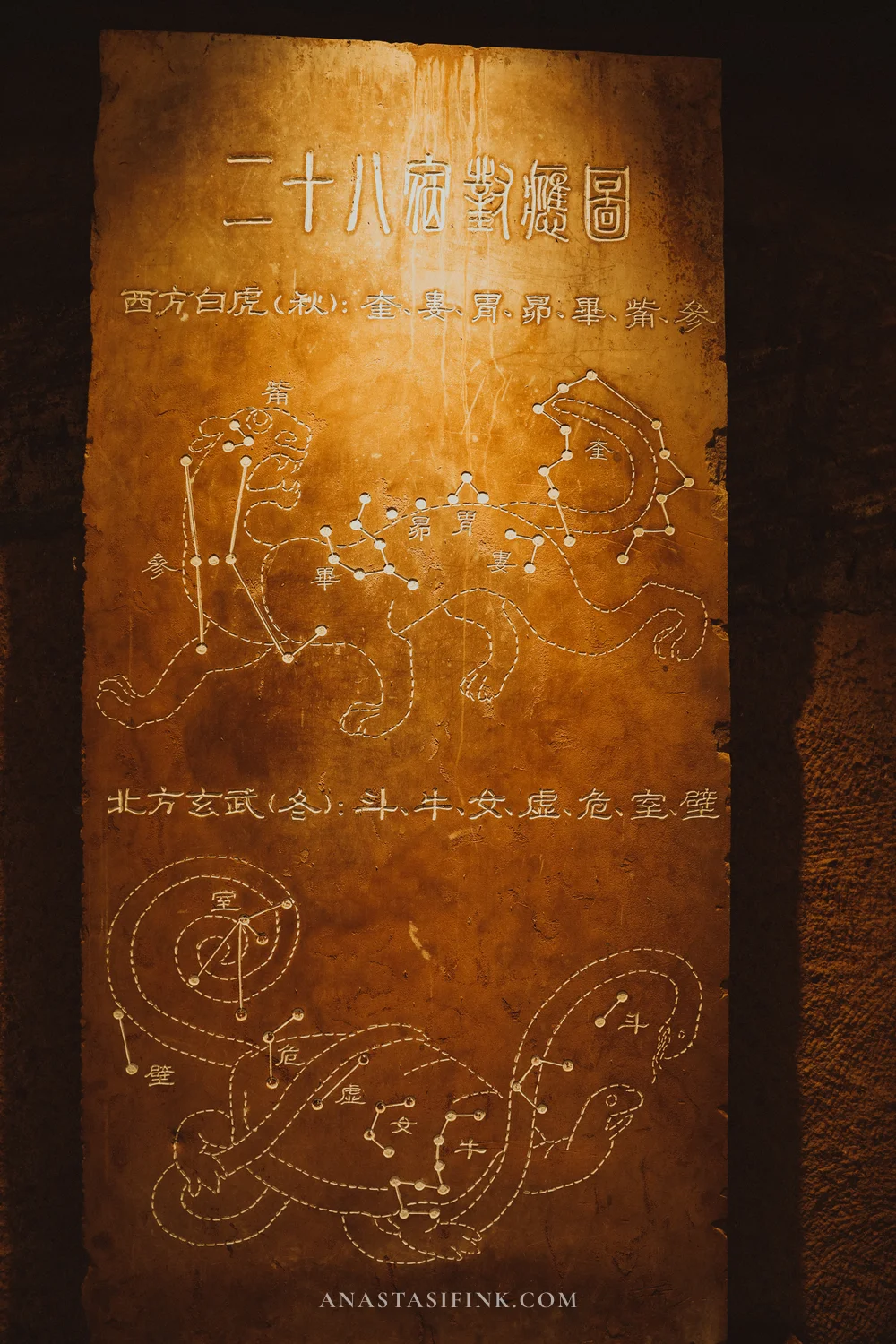
Star charts carved straight into the stone
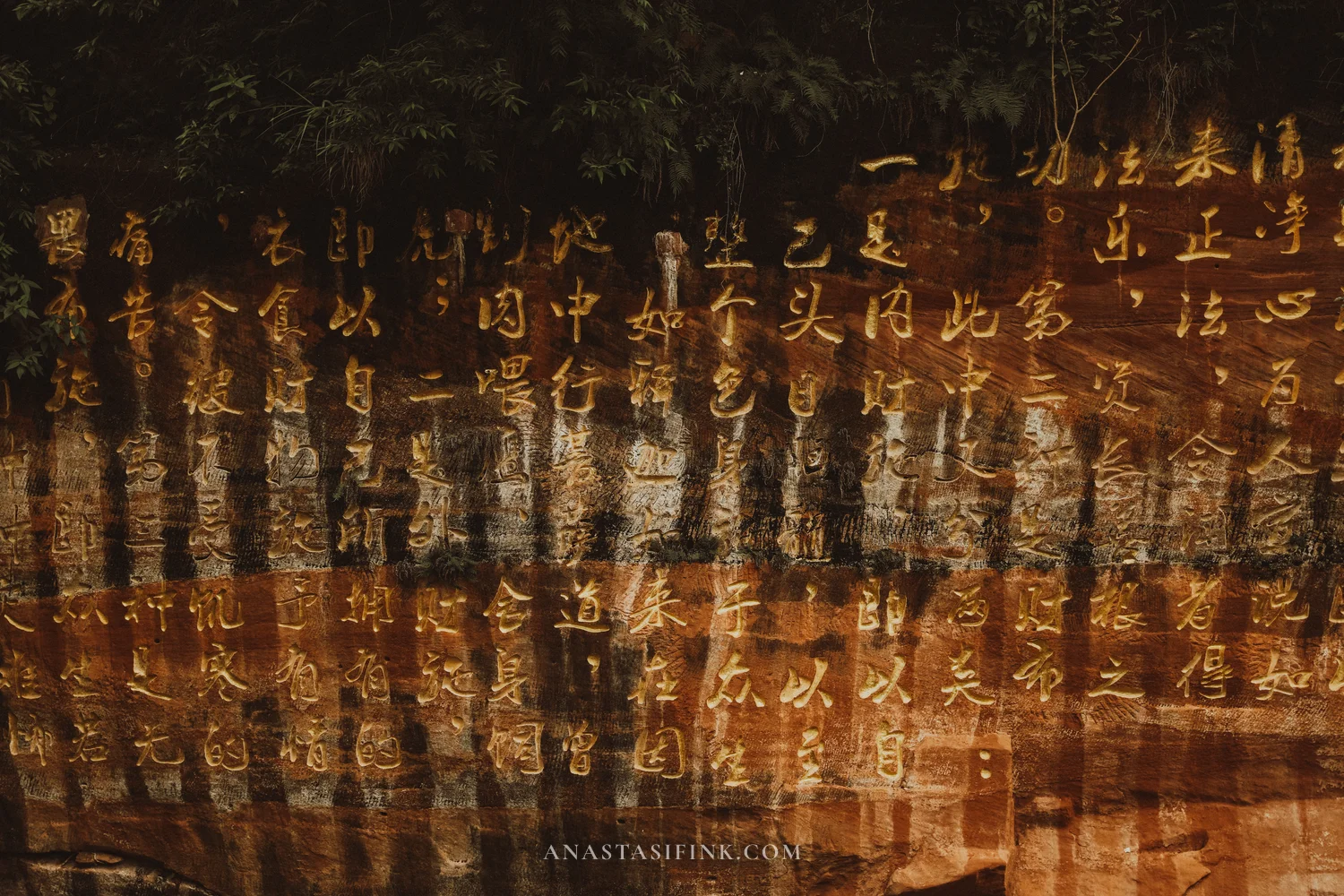
Before the next stretch, there’s one more stele with a carved mountain landscape and an entire cliff wall covered in tiny characters — the kind of wall sutras are usually carved into.
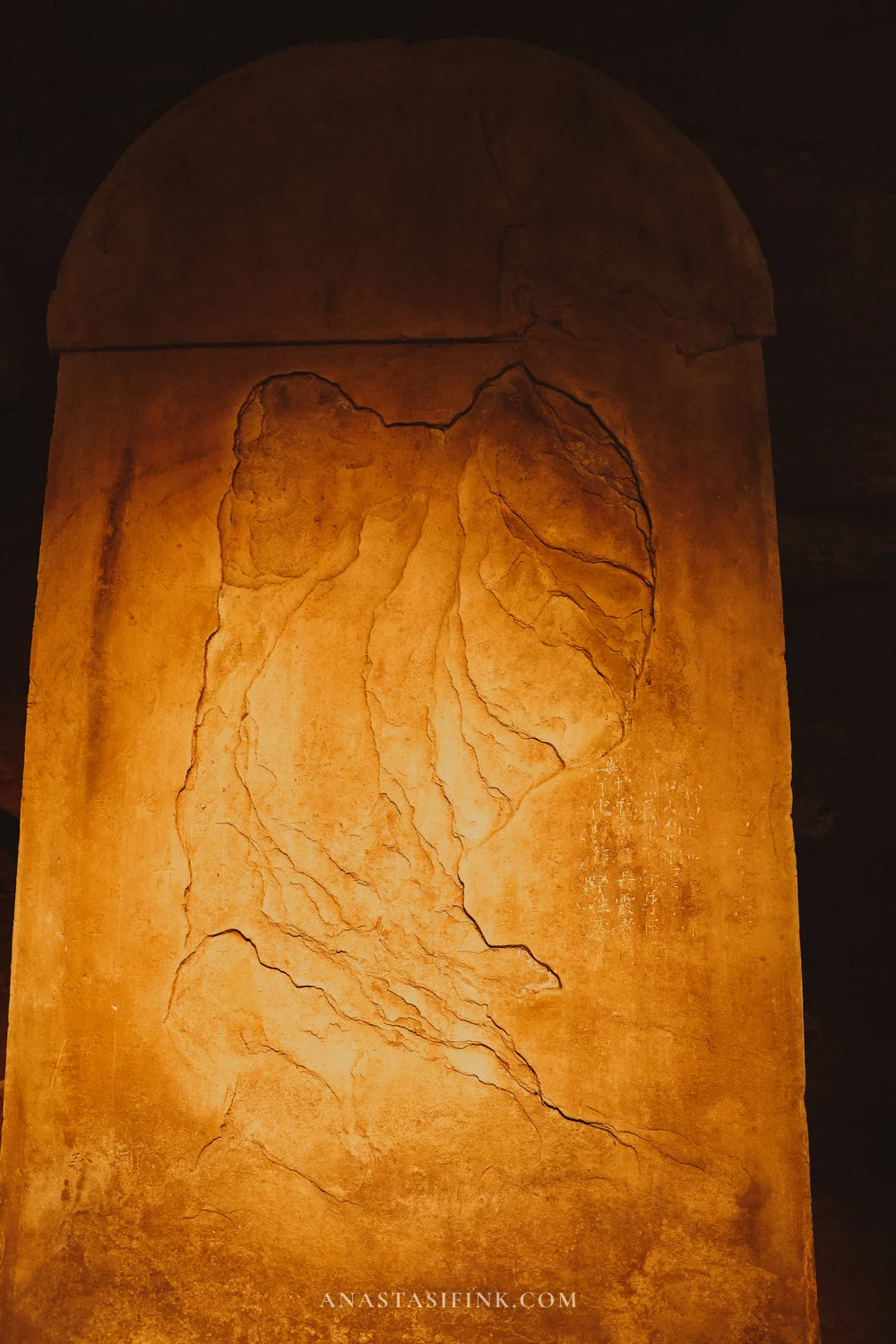
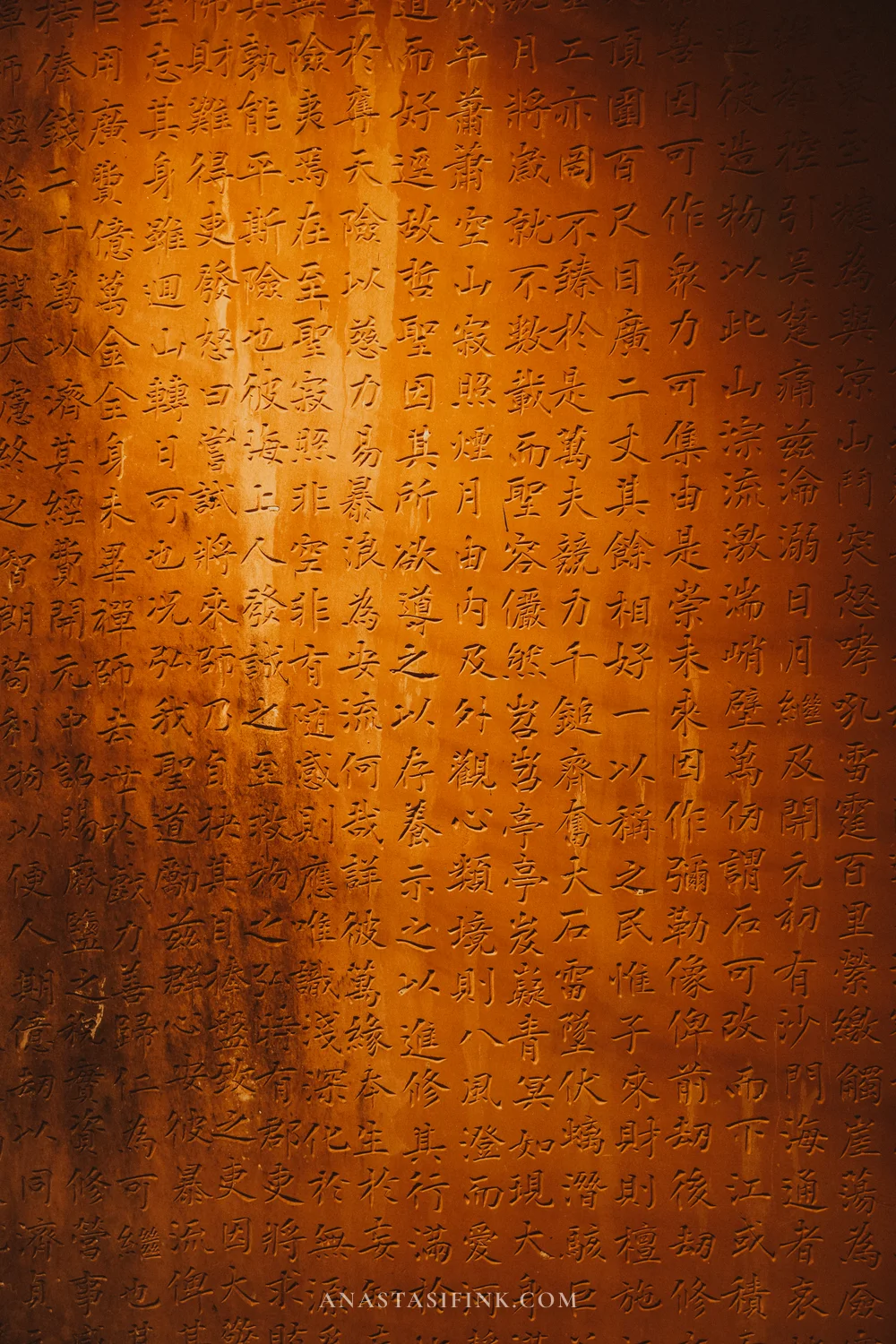
A carved landscape and a wall inscribed with a sutra
Lingyun Temple
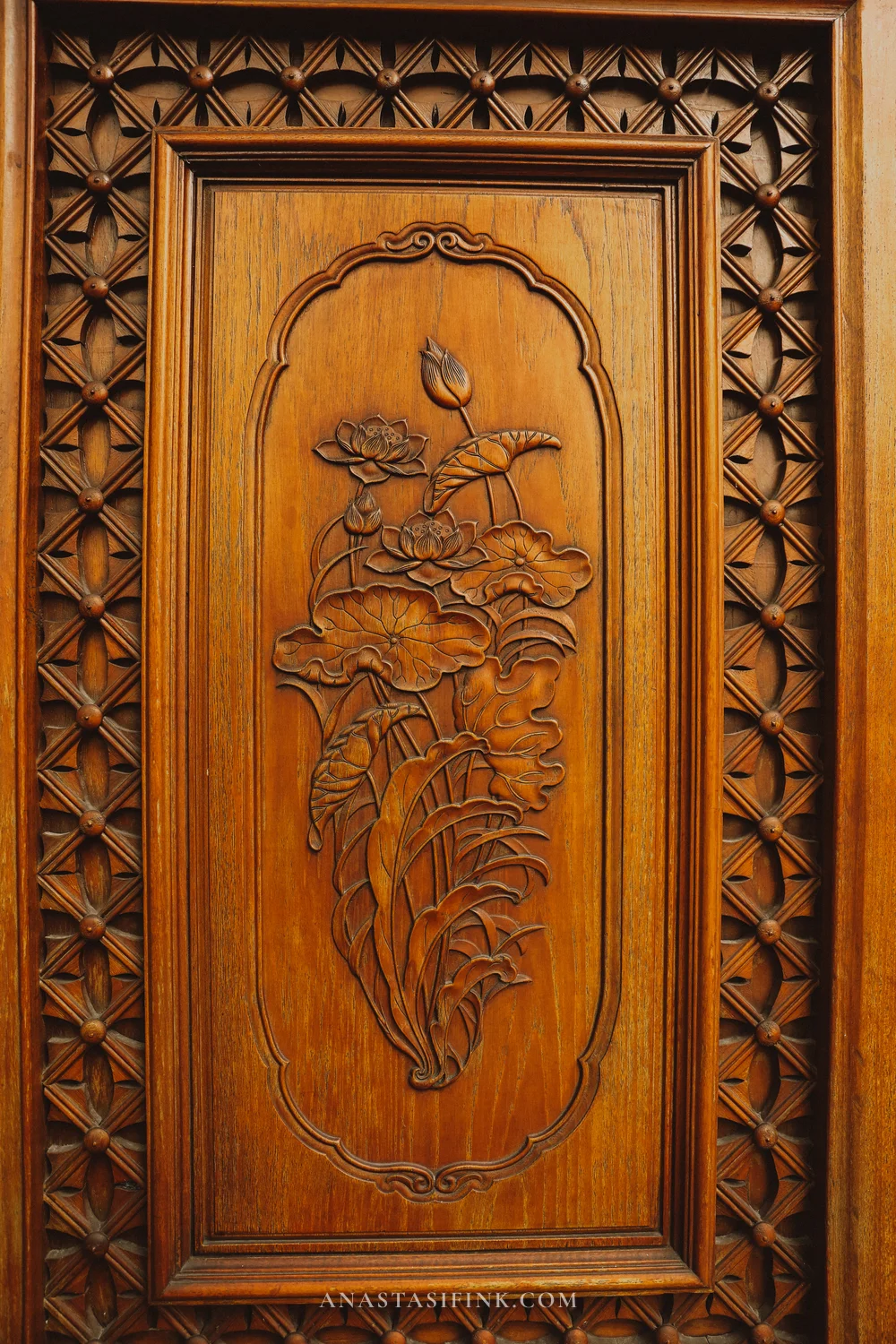
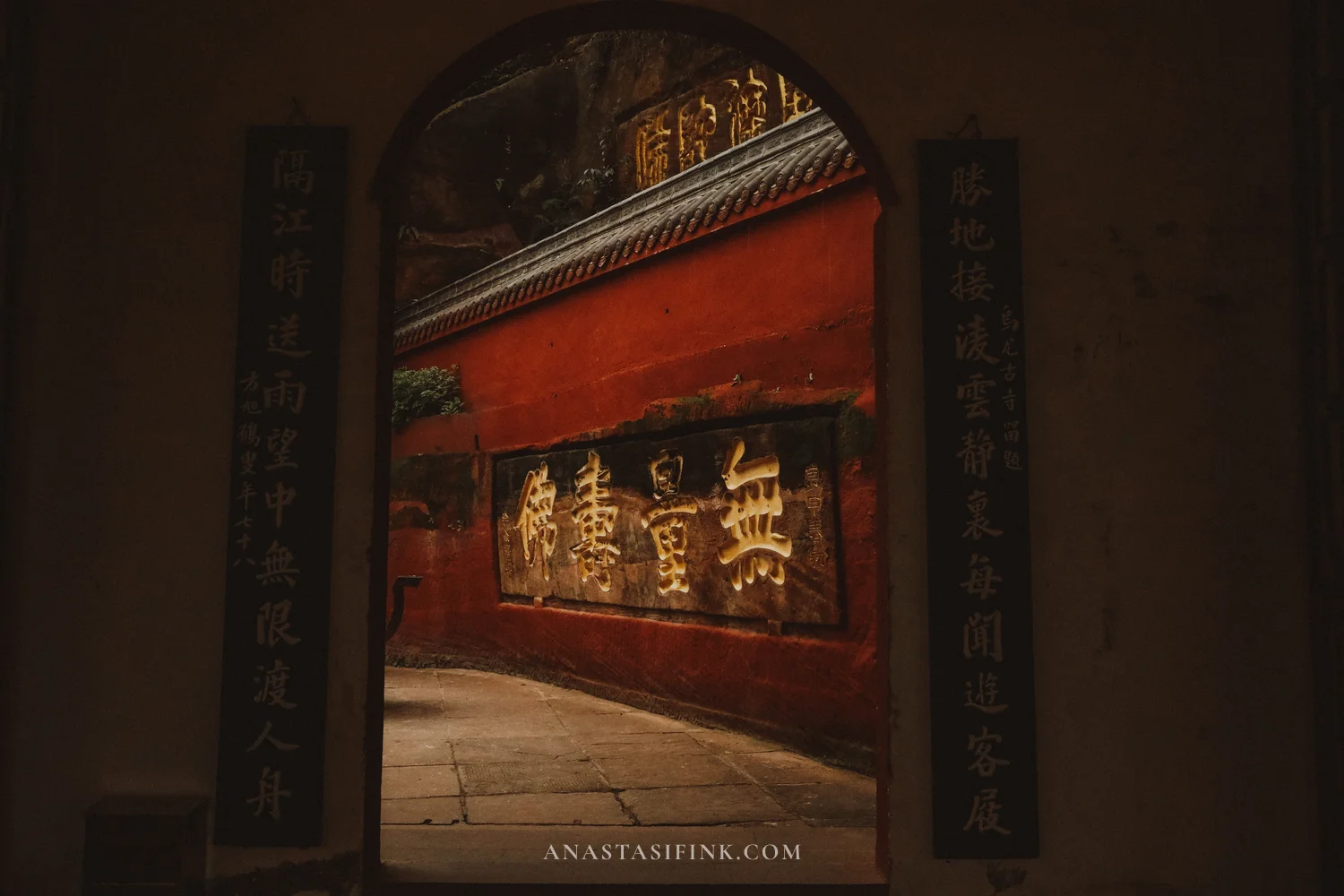
The main temple on the mountain is Lingyun Monastery (凌云寺), a working Buddhist temple that has stood here longer than the Buddha itself. There’s a lot of fine work inside: a gilded coffered ceiling with carving, rows of wooden doors with ornamental panels — landscapes, lotuses, flowers.
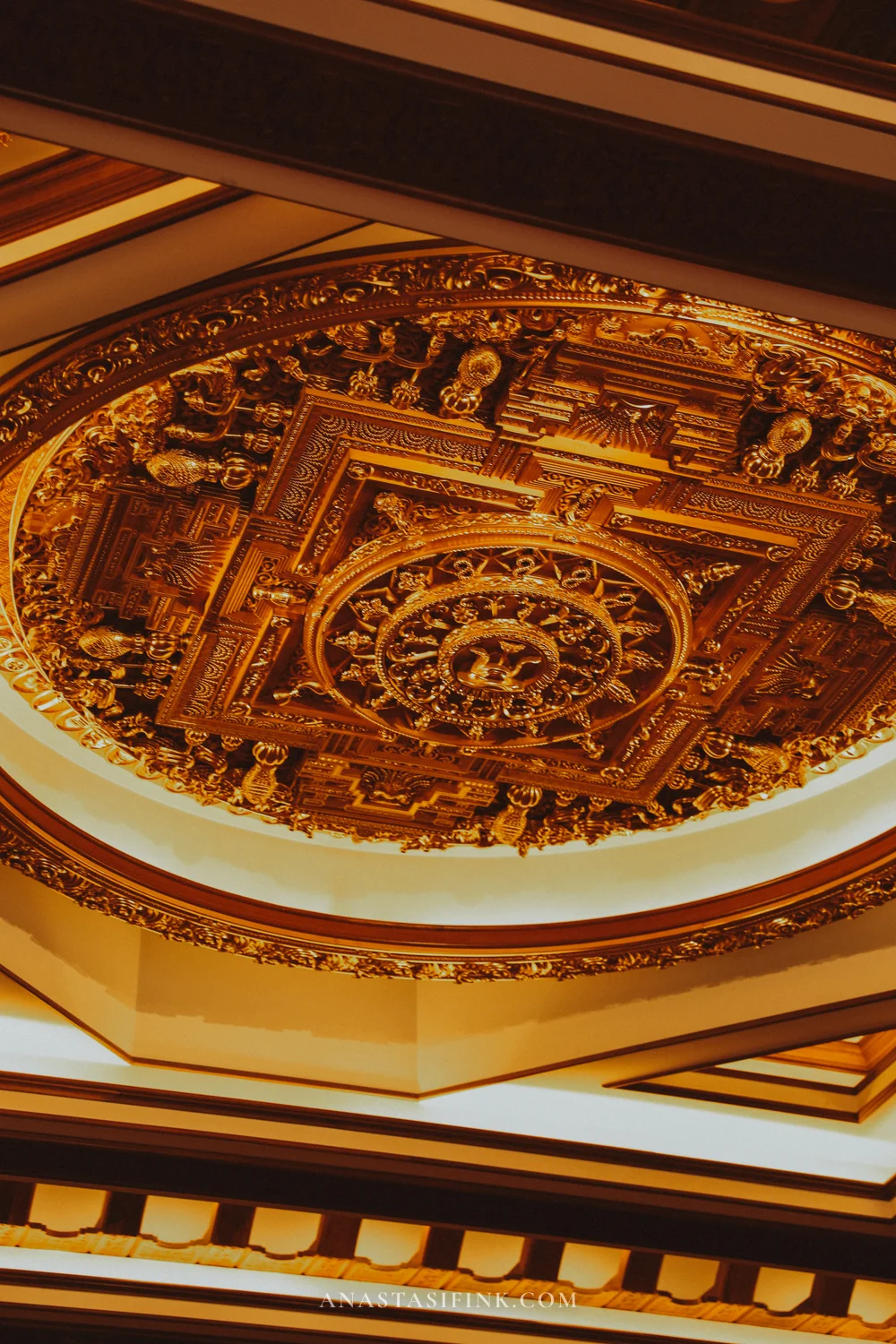
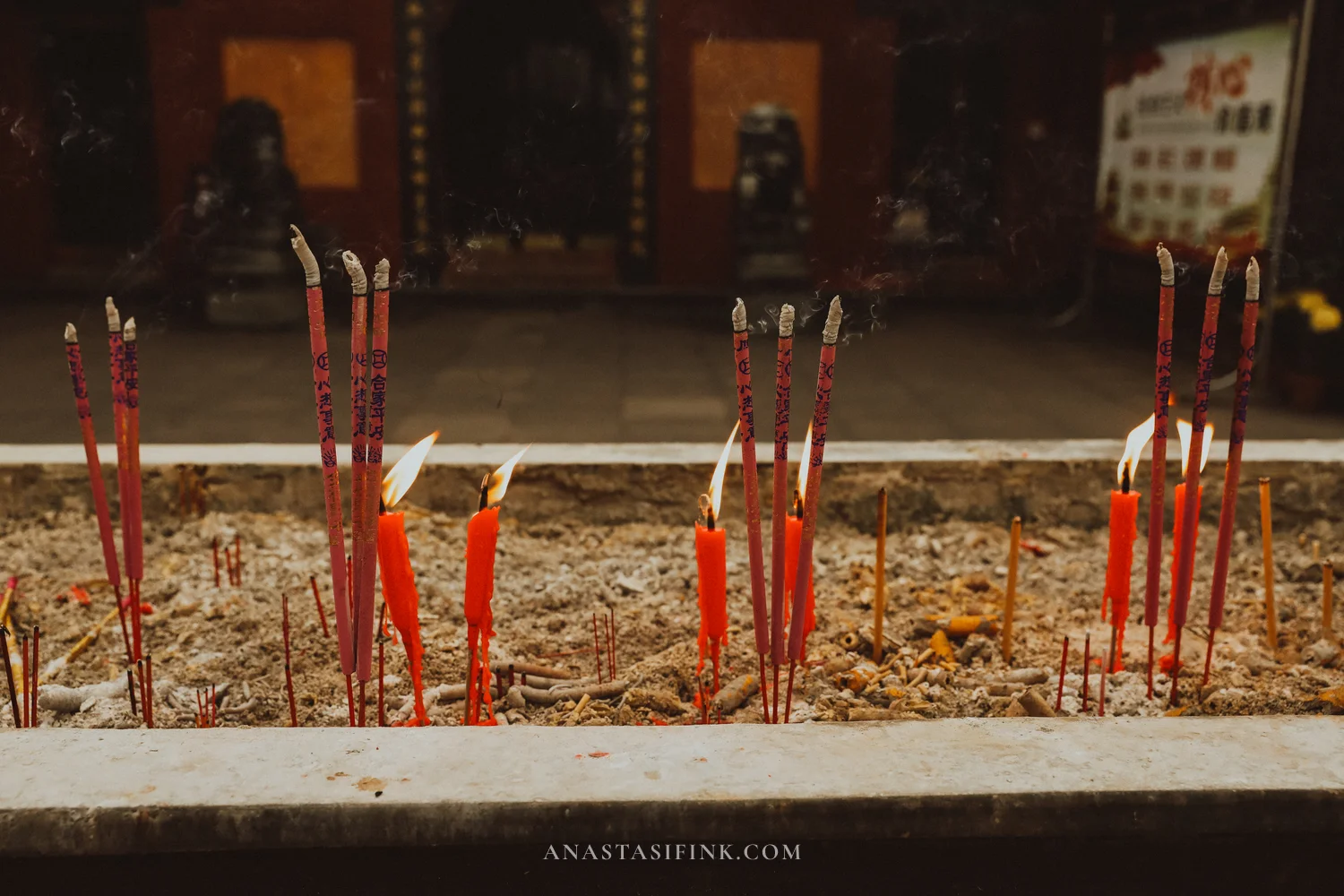
I was lucky enough to catch the monks during a service — sitting in rows in red robes before the altar. You don’t see it often, and this everyday side of the temple stays with you even more than the gold and the carving. Nearby, incense sticks smoulder and colourful lotus-shaped candles burn — red, orange, green, yellow.
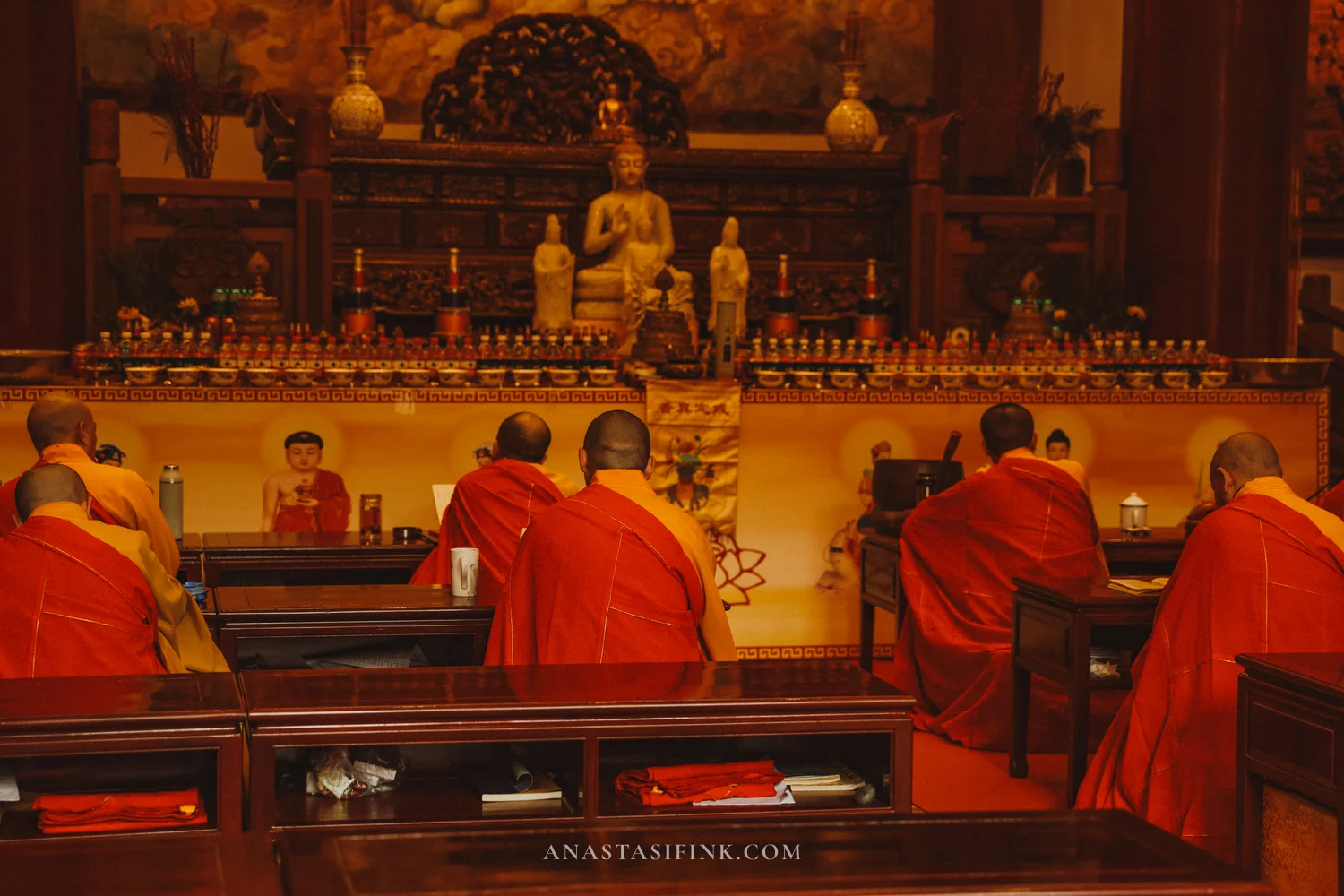
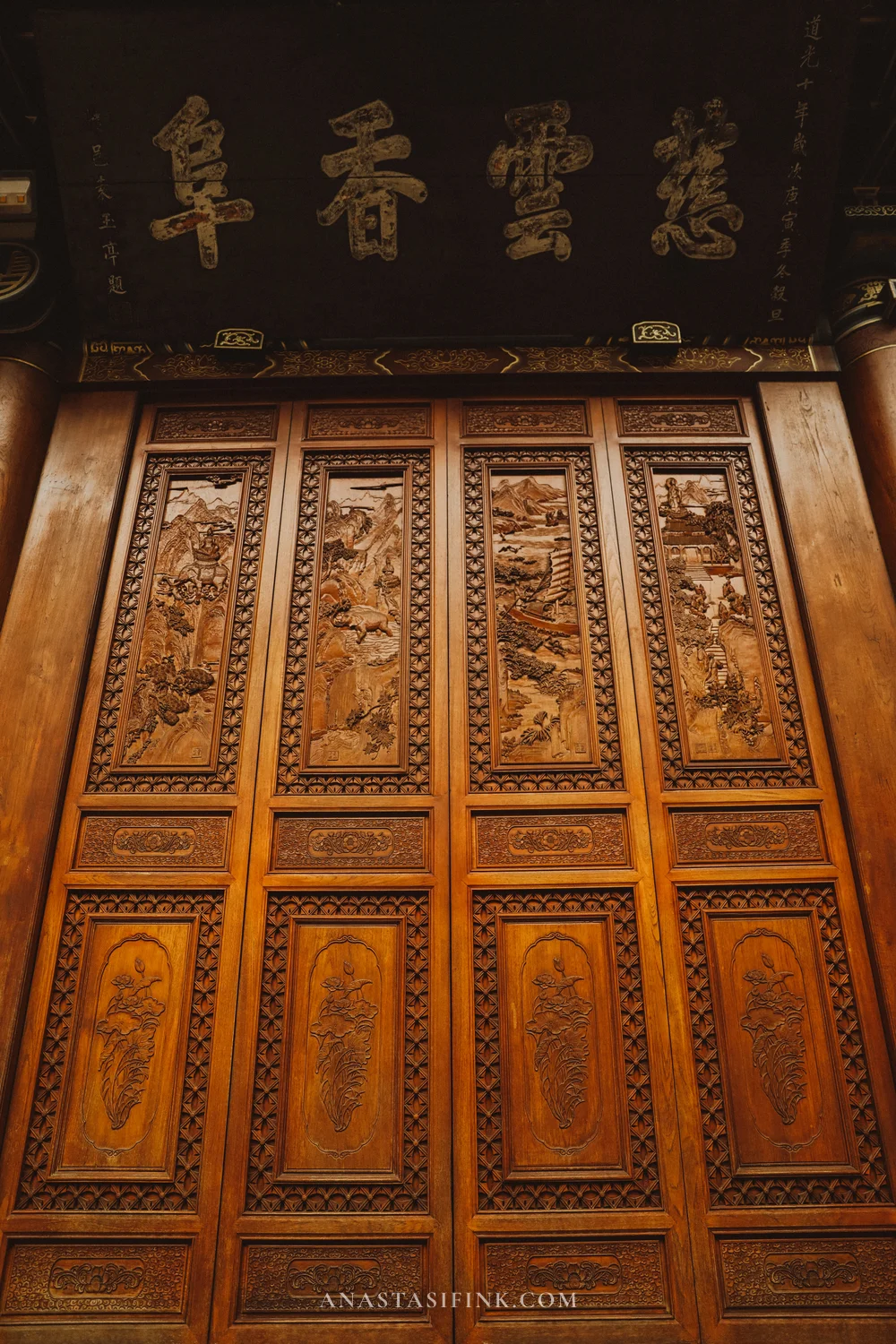
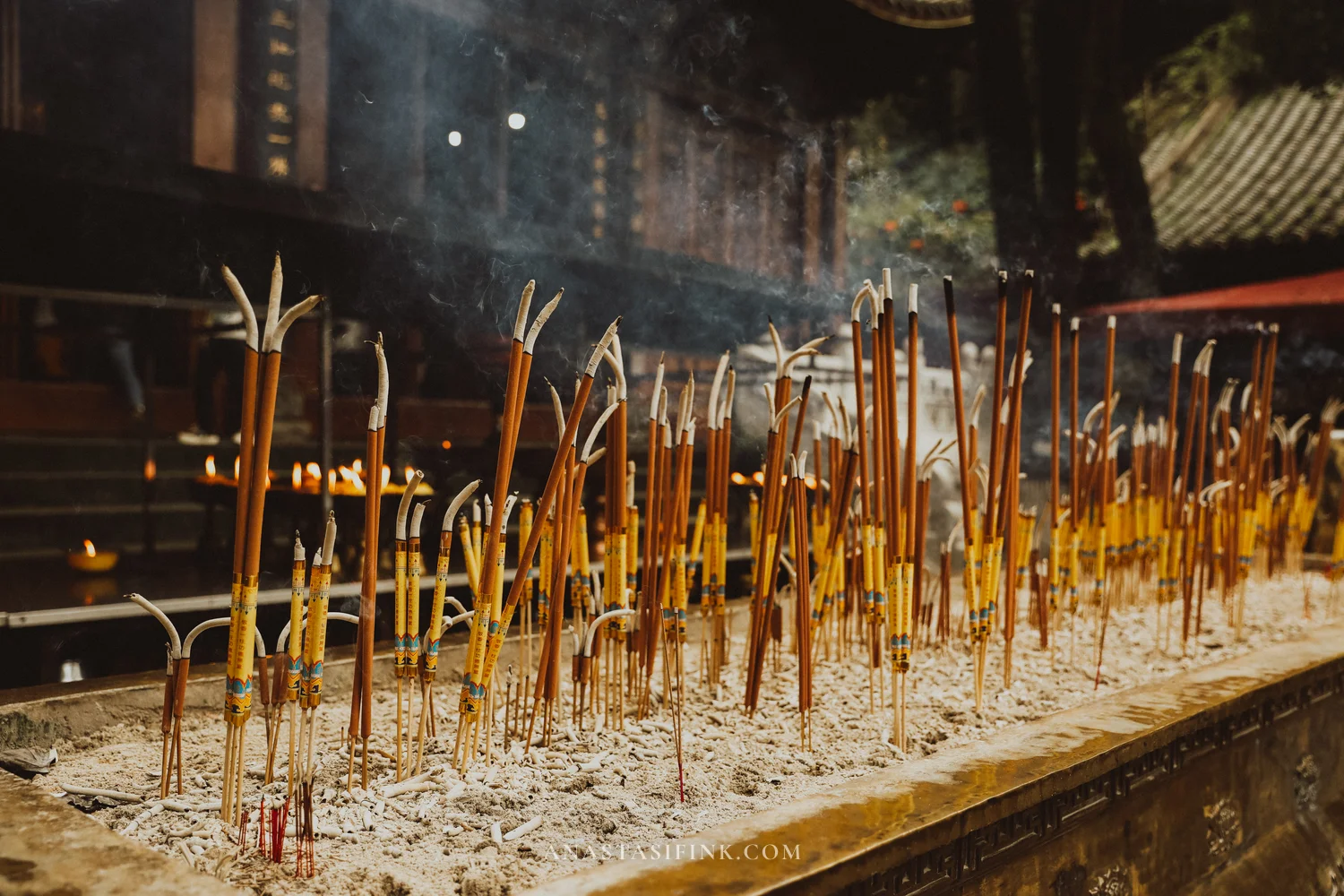
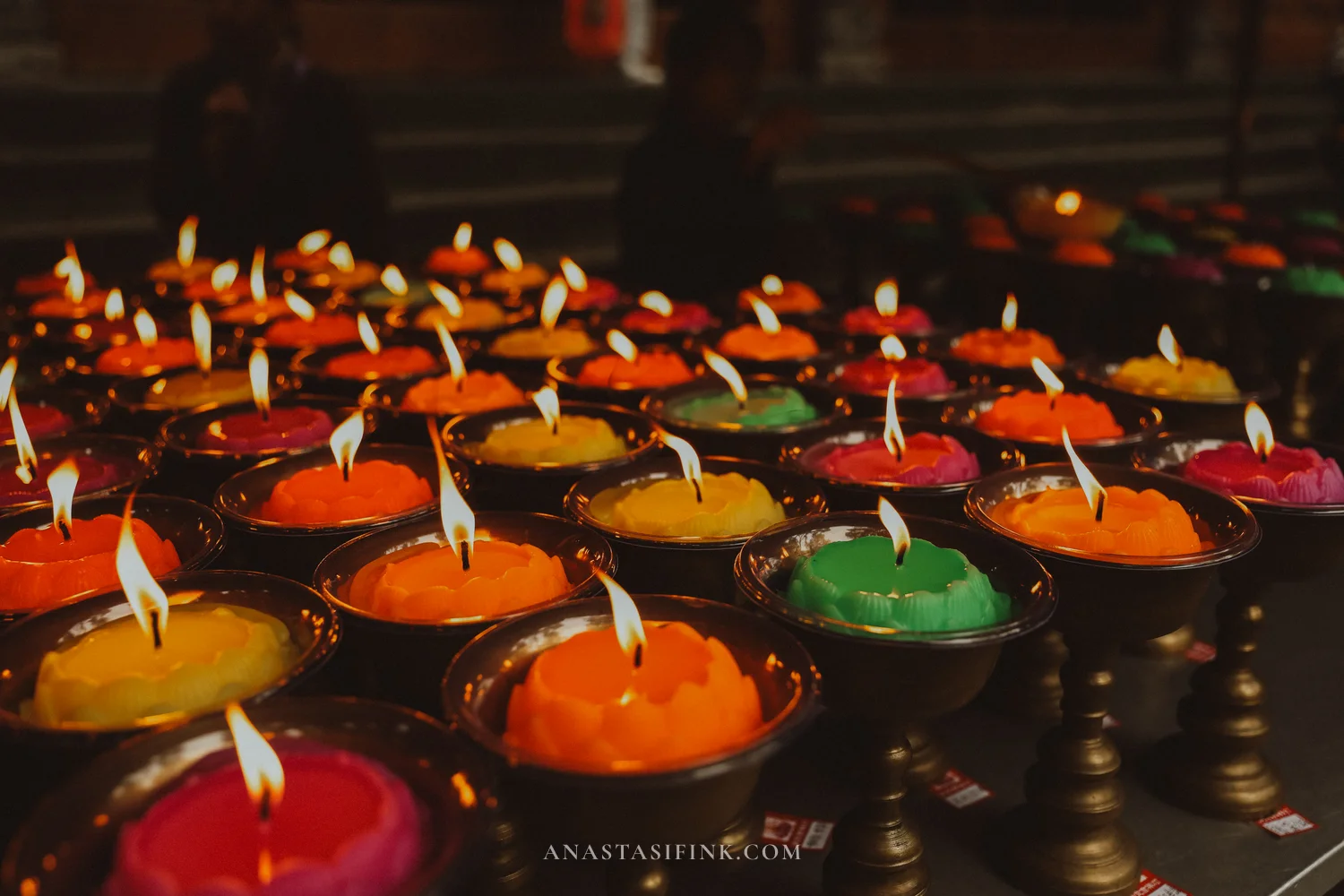
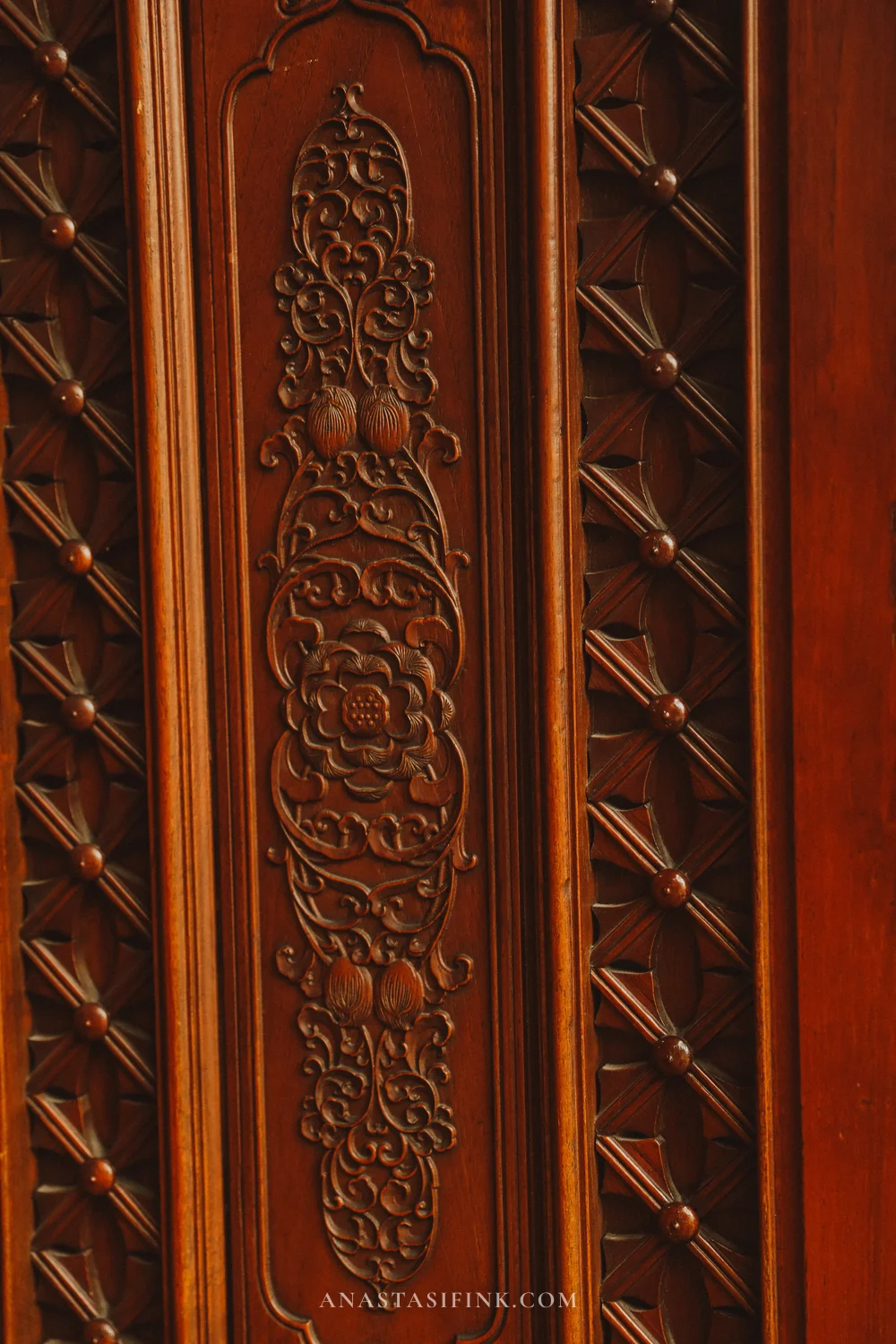
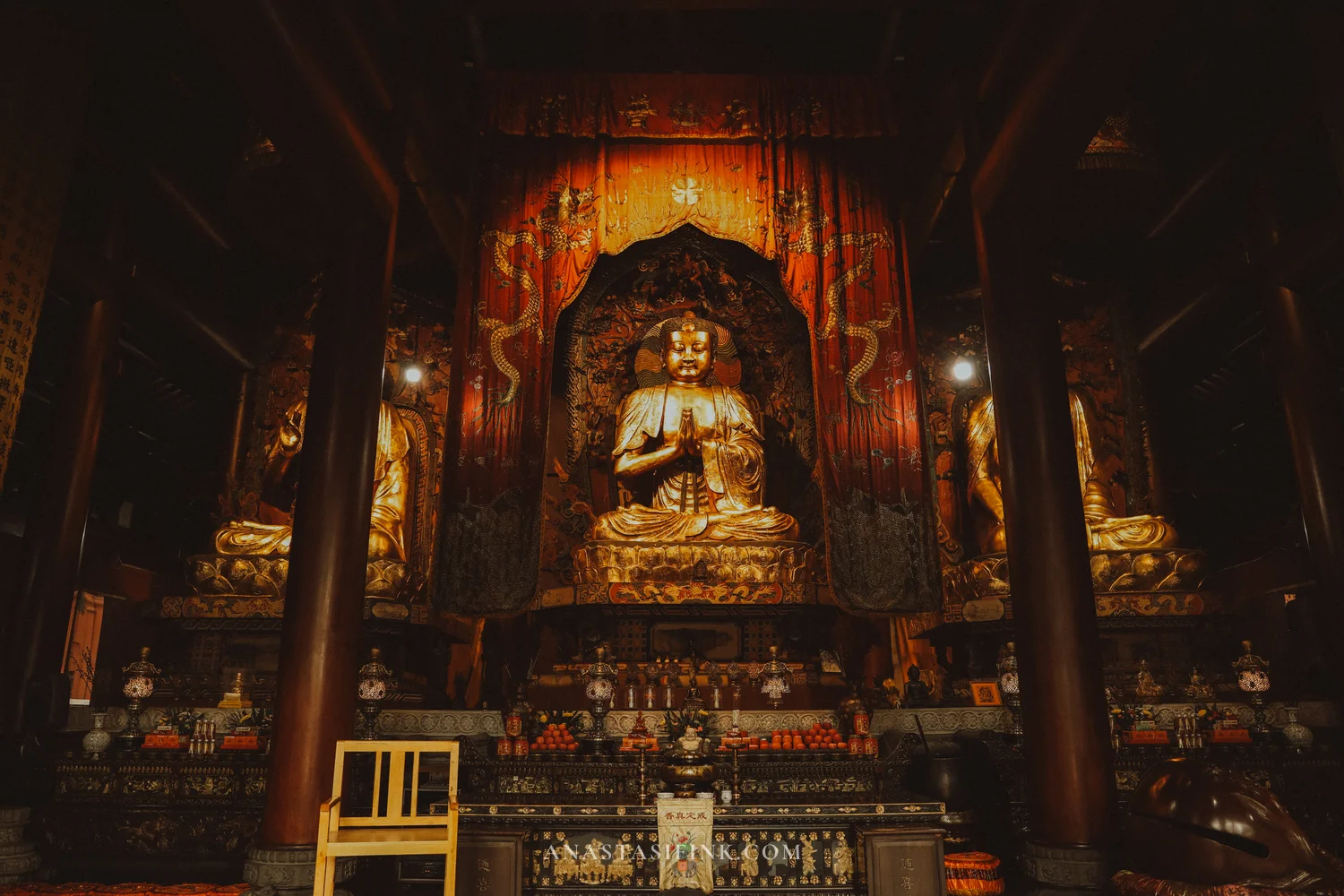
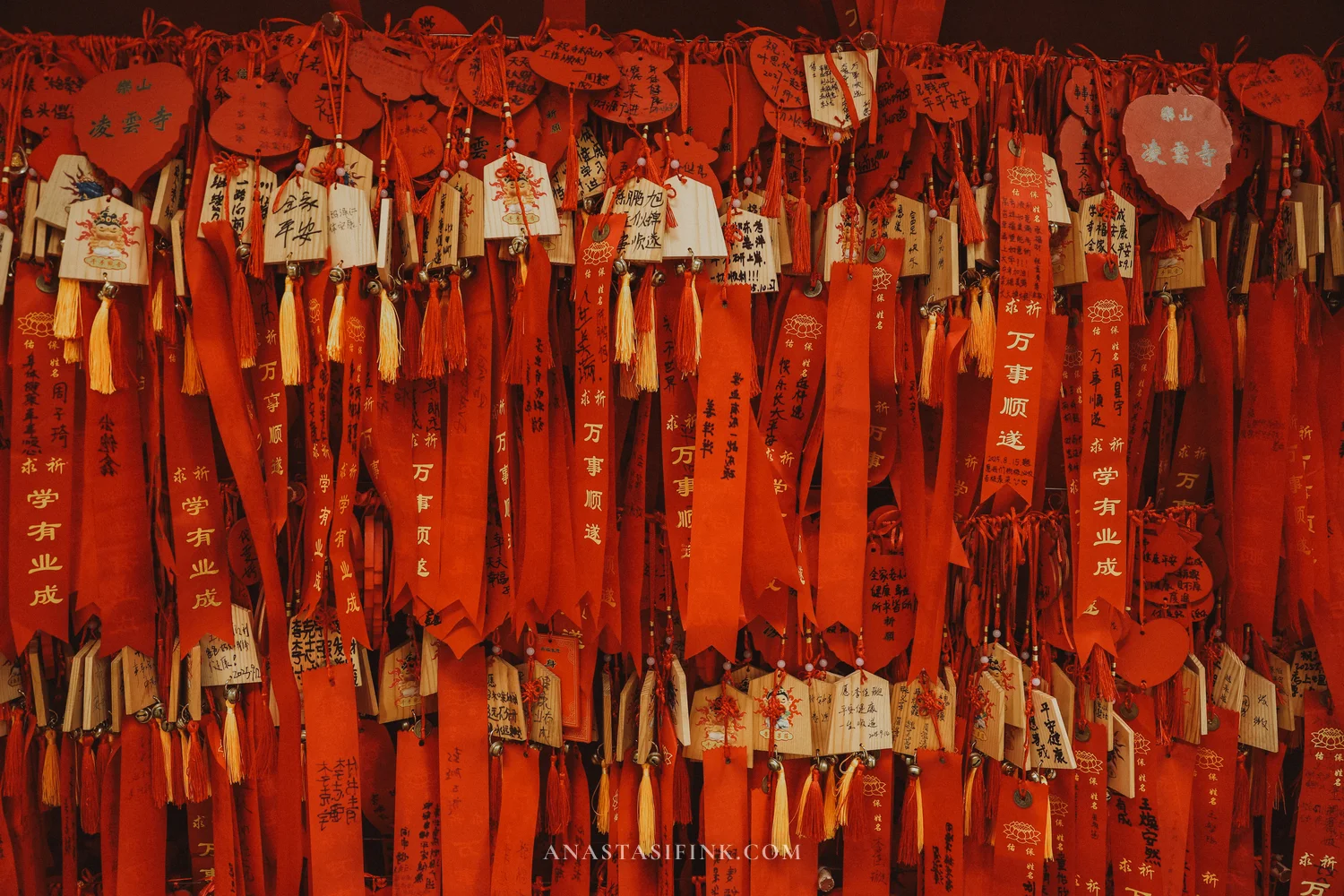
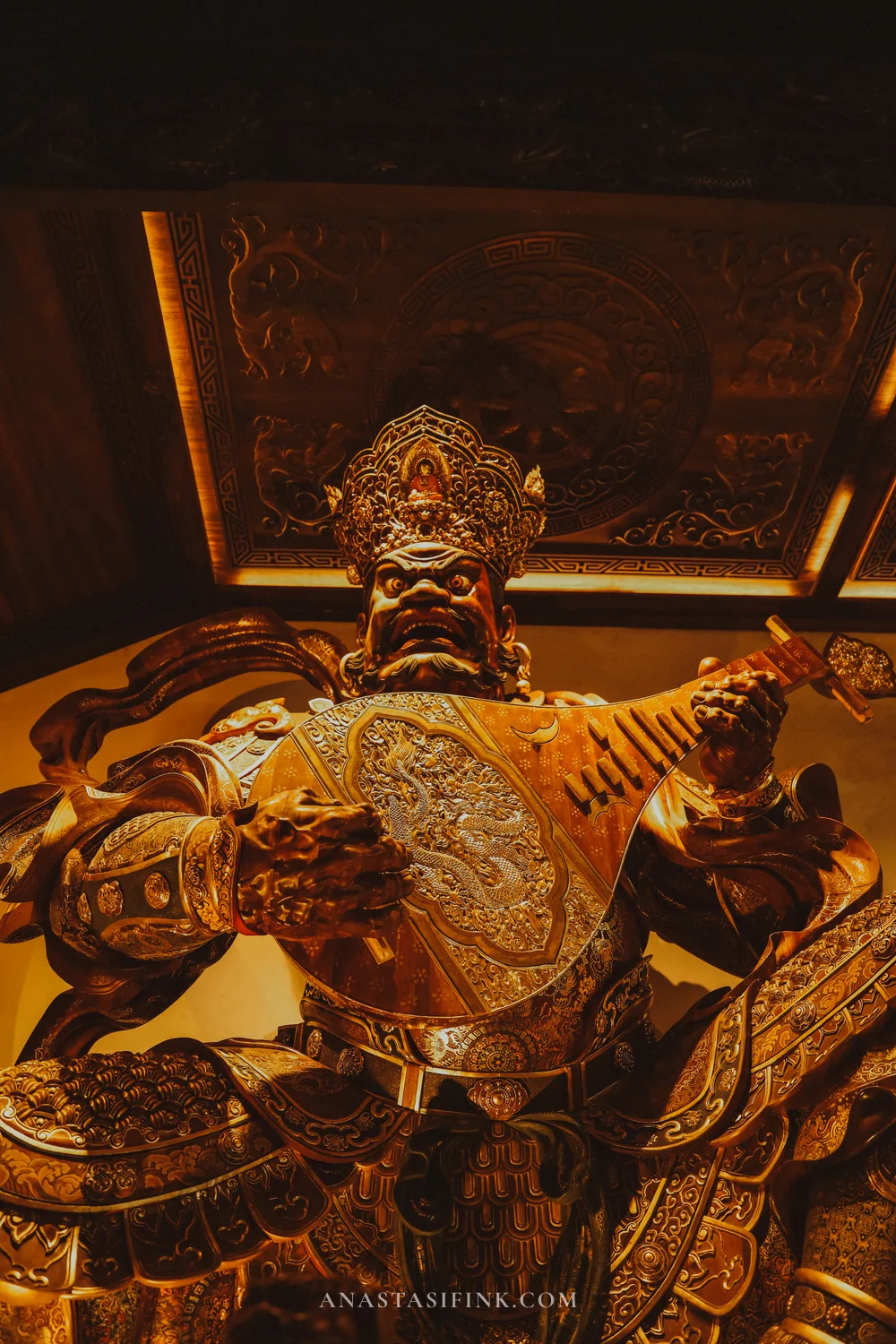
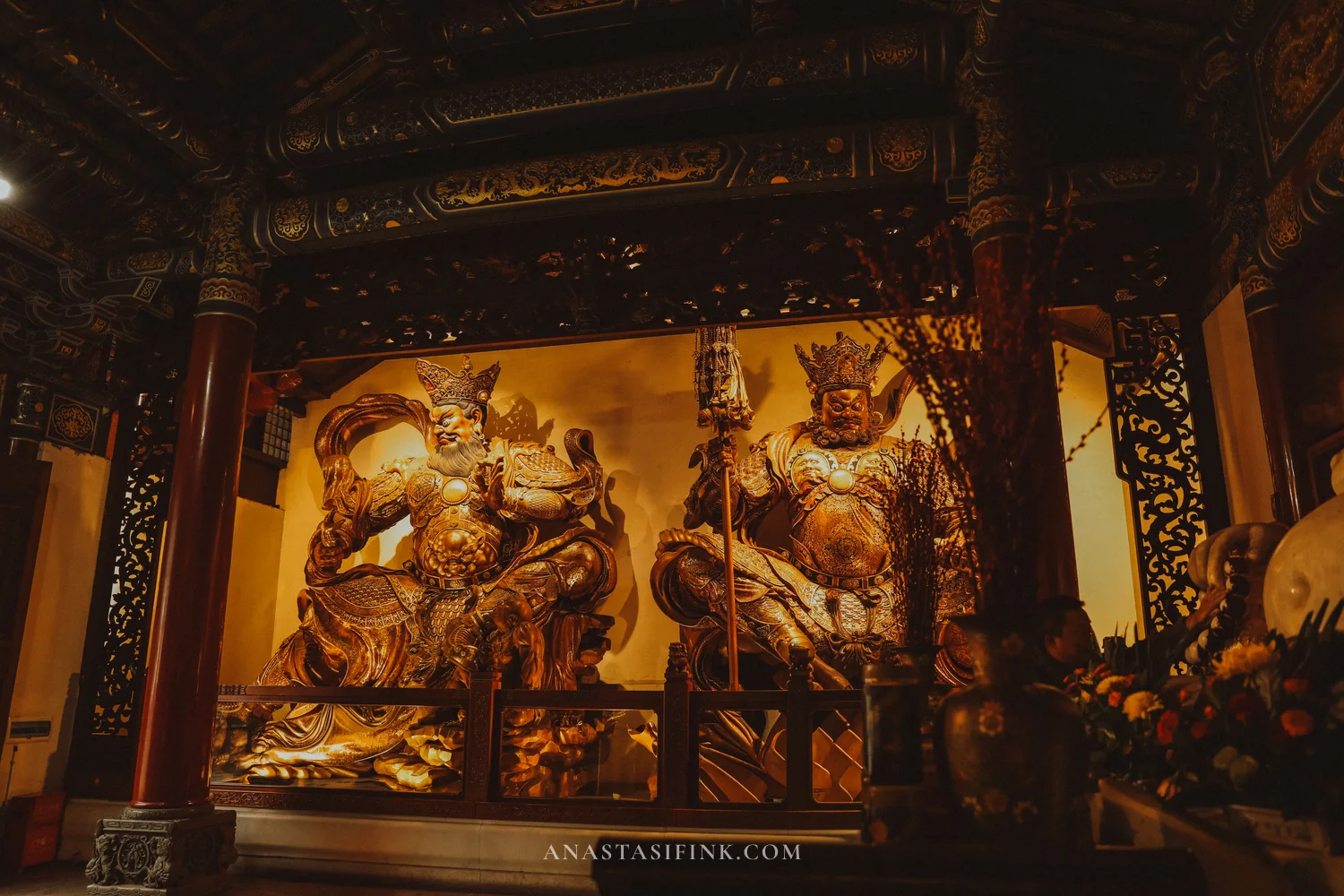
In the main hall there are three golden Buddhas, with offering tables in front of them. One wall is hung with hundreds of red ribbons and wooden wish tablets, written by pilgrims, many stamped with the “Lingyun” seal. Beside them stand gilded statues of the Heavenly Kings — the guardians of the directions; you can spot one by the pipa lute in his hands.
The Buddha’s Head and the Descent to the Feet
Behind the temple, the path opens out onto the upper viewing platform, and you find yourself level with the Buddha’s head. Take a look at the details: according to Wikipedia, the hair is made up of 1,021 coiled curls, and the ears reach seven metres. Hidden among the curls is a drainage system — concealed channels in the hair, collar, and behind the ears carry rainwater away; it’s largely thanks to this that the statue has stood for more than 1,200 years.
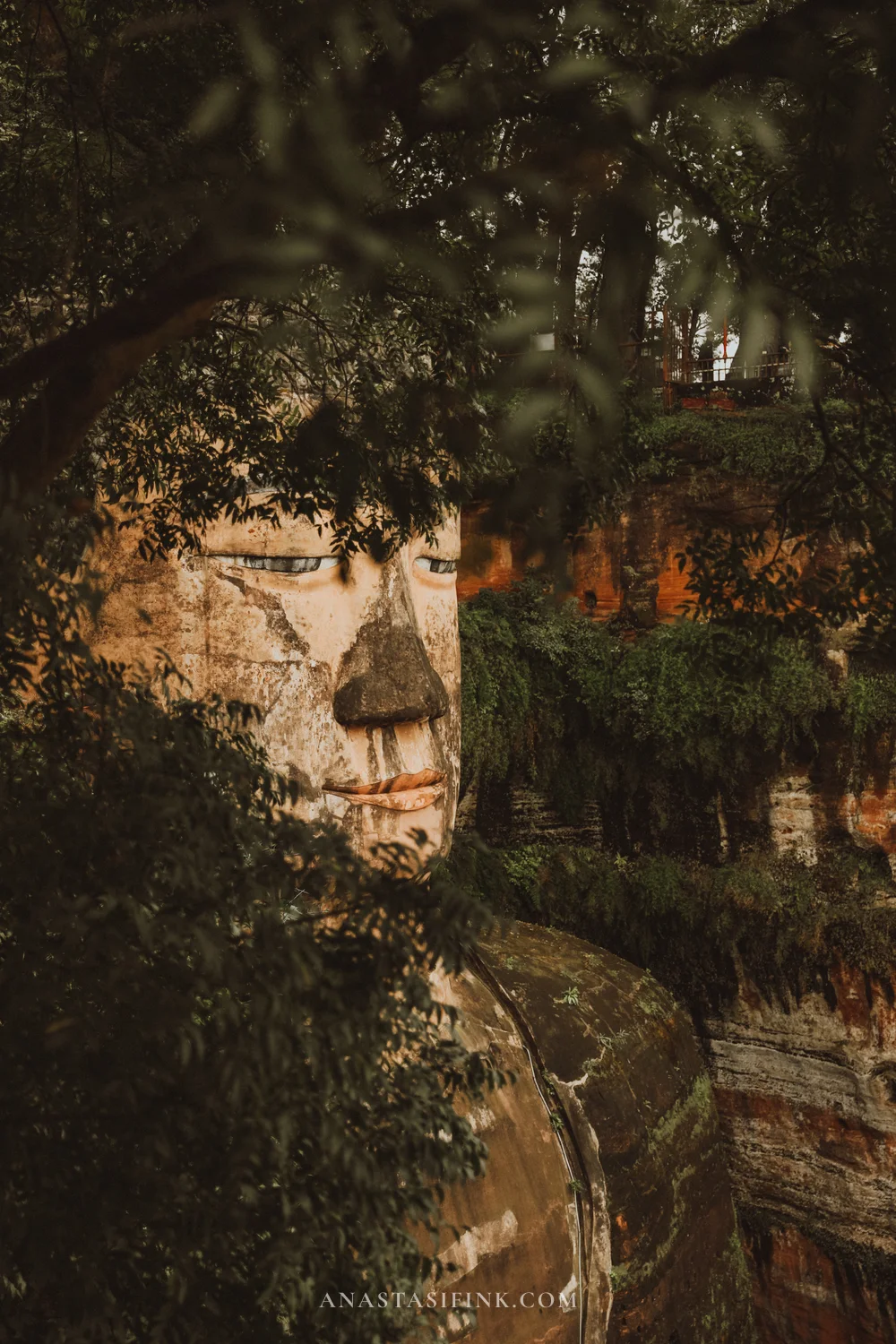
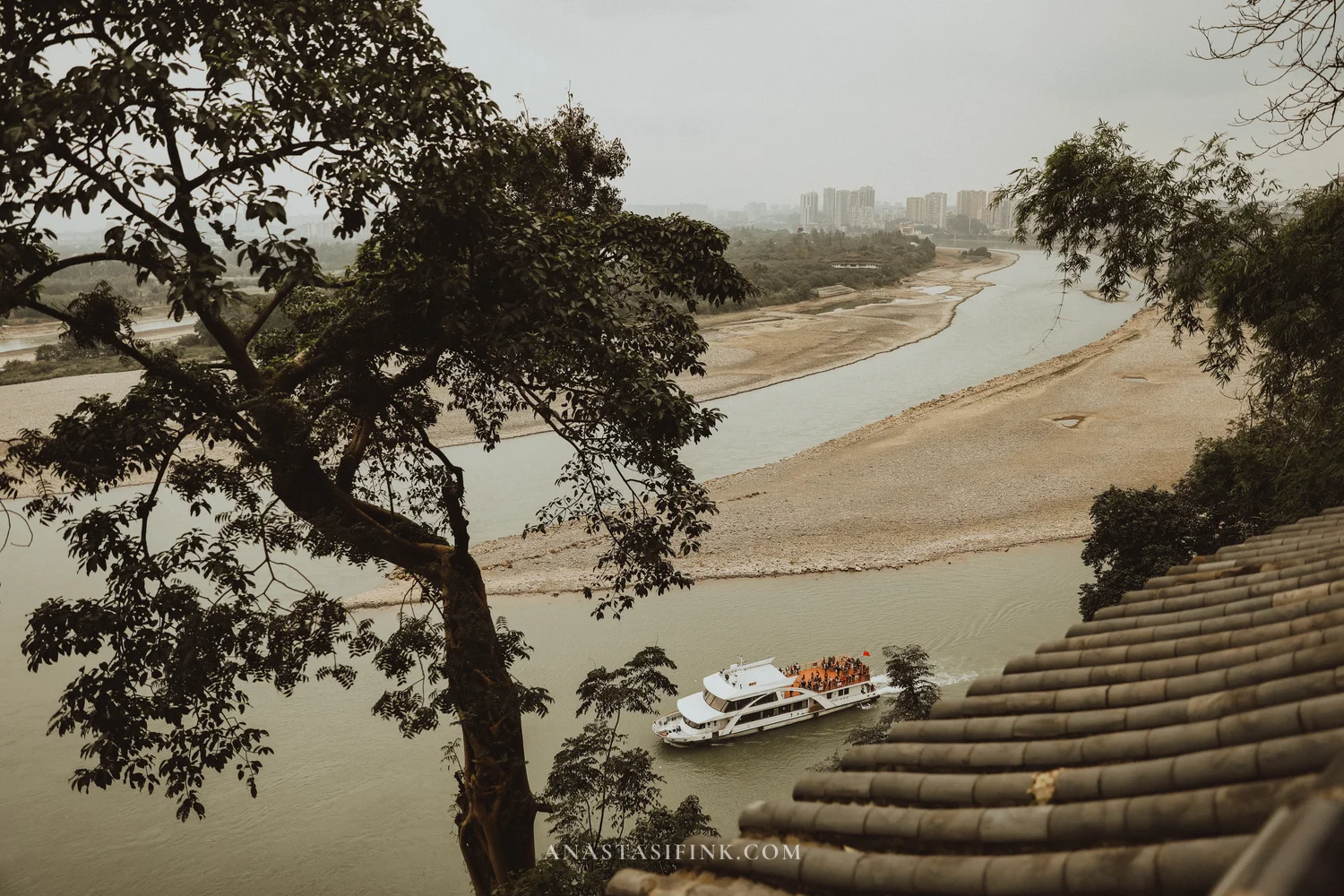
From the platform by the head you get a clear view of the whole cliff and the river below — the wide channel, the sandbars, the city across the water. This is also where the biggest crowds gather, right by the Buddha.
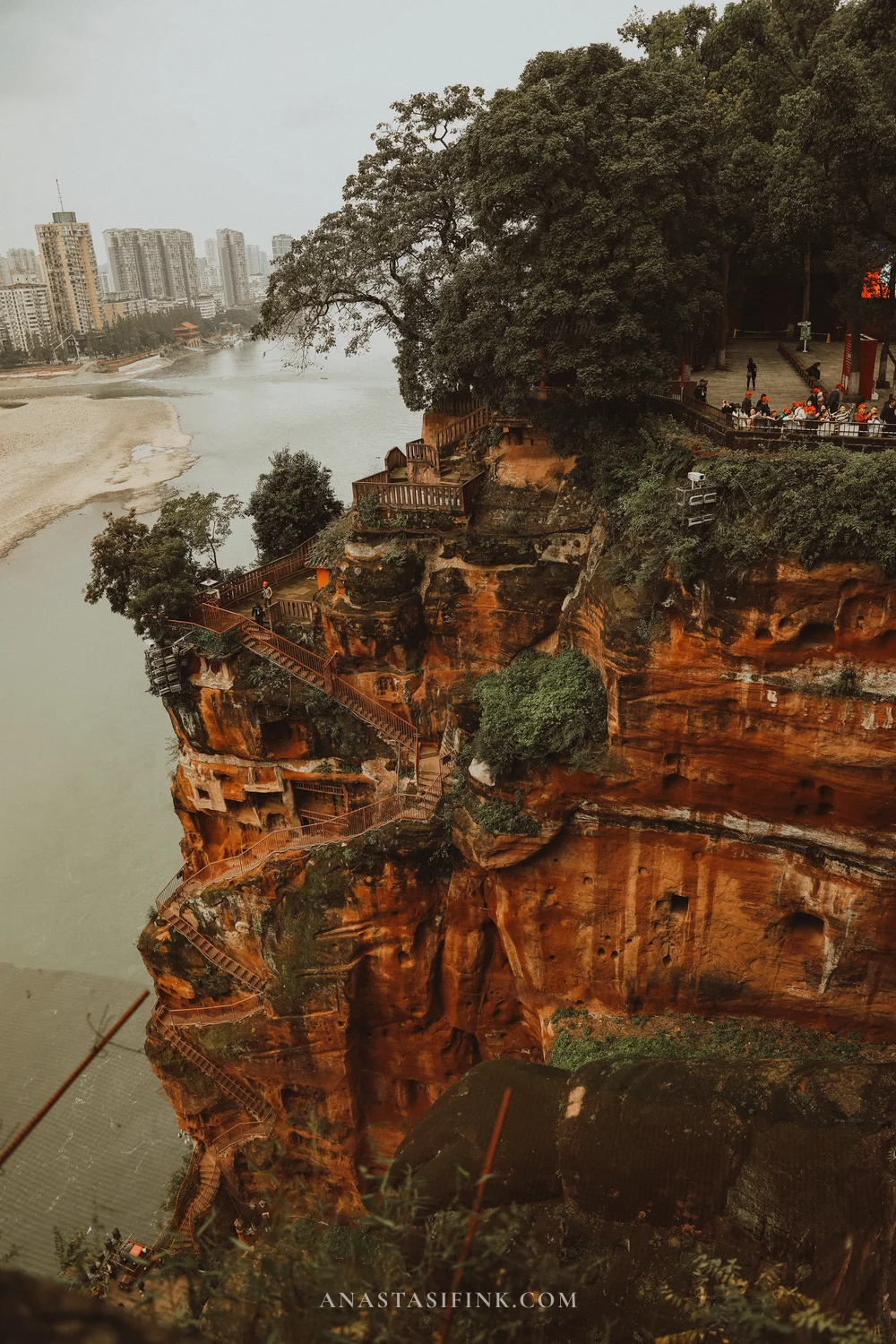
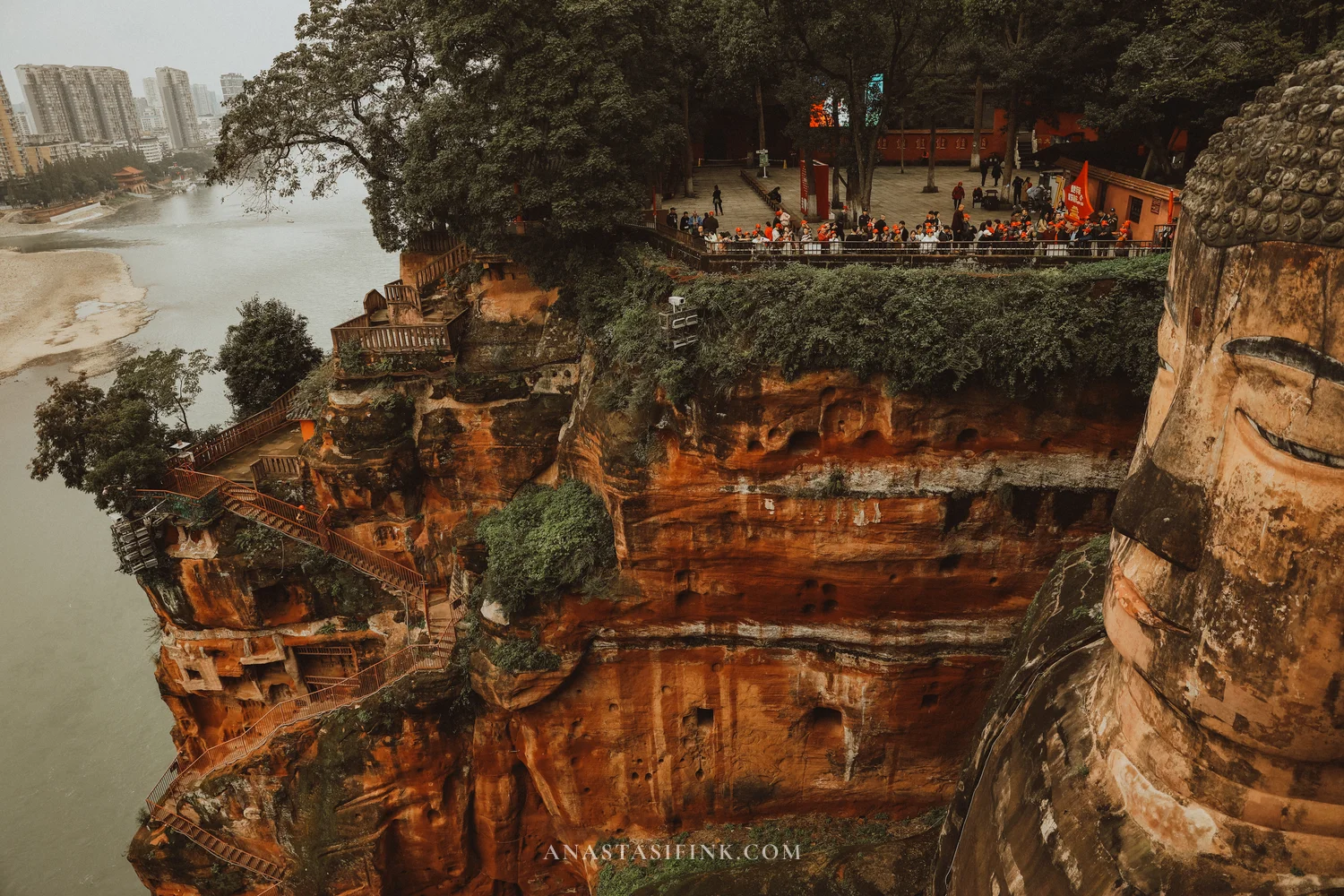
Just before the descent, it’s worth looking in at Haitong’s Cave (海师洞) — the cave-cell of the very monk who conceived the Buddha. You can’t go in: you can only peer inside from the outside, through a barrier — it’s empty and dim in there. A white statue of Haitong stands nearby.
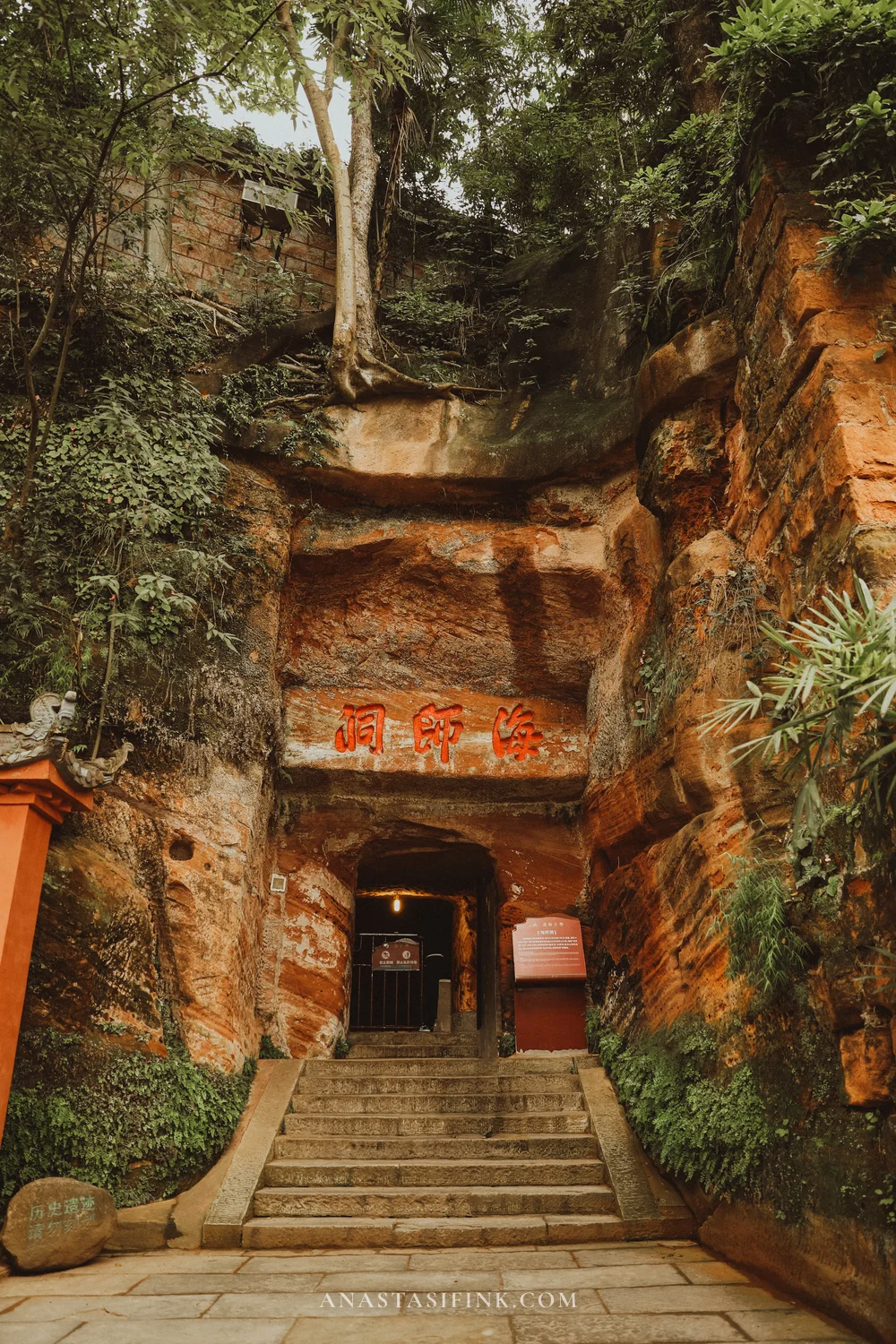
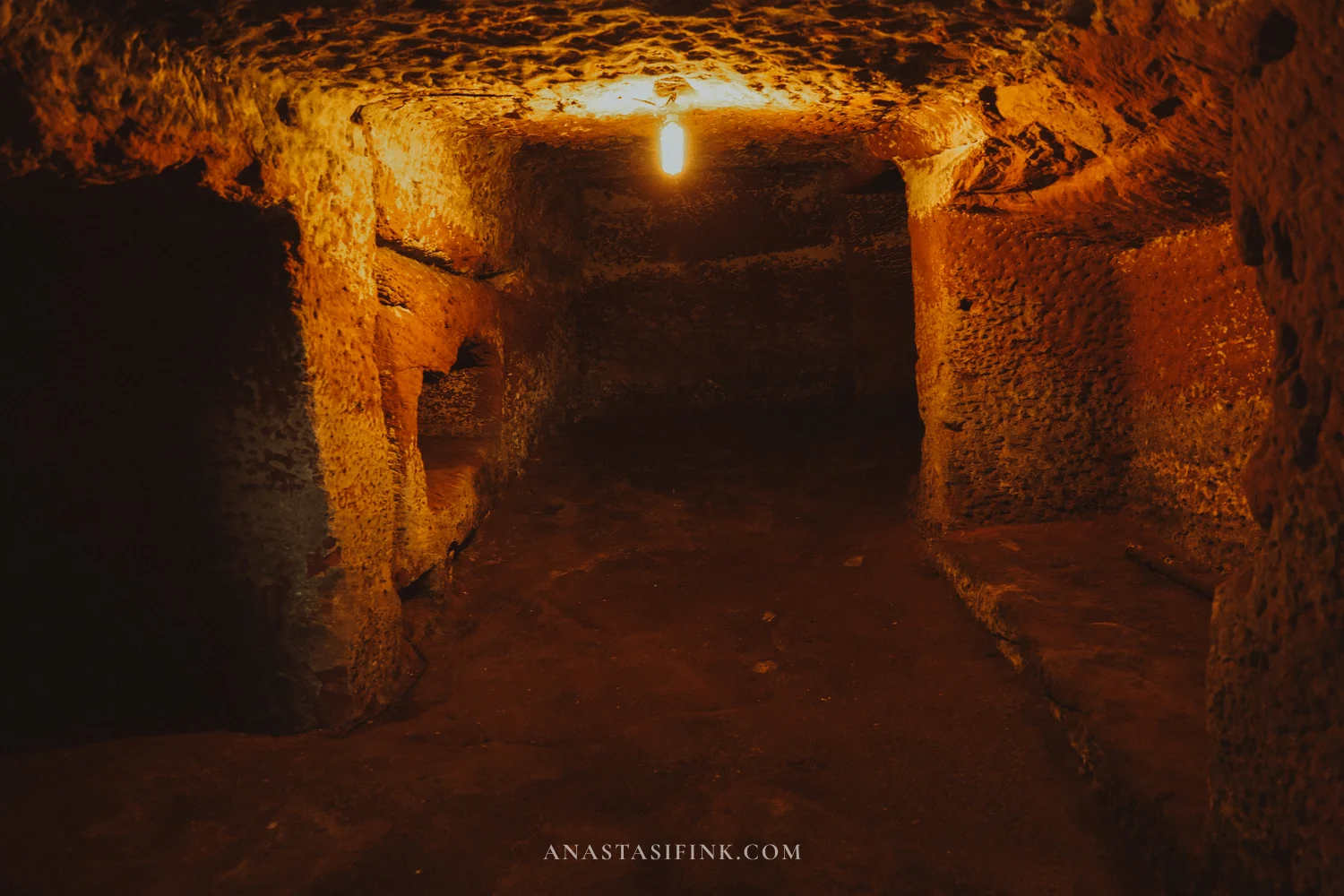
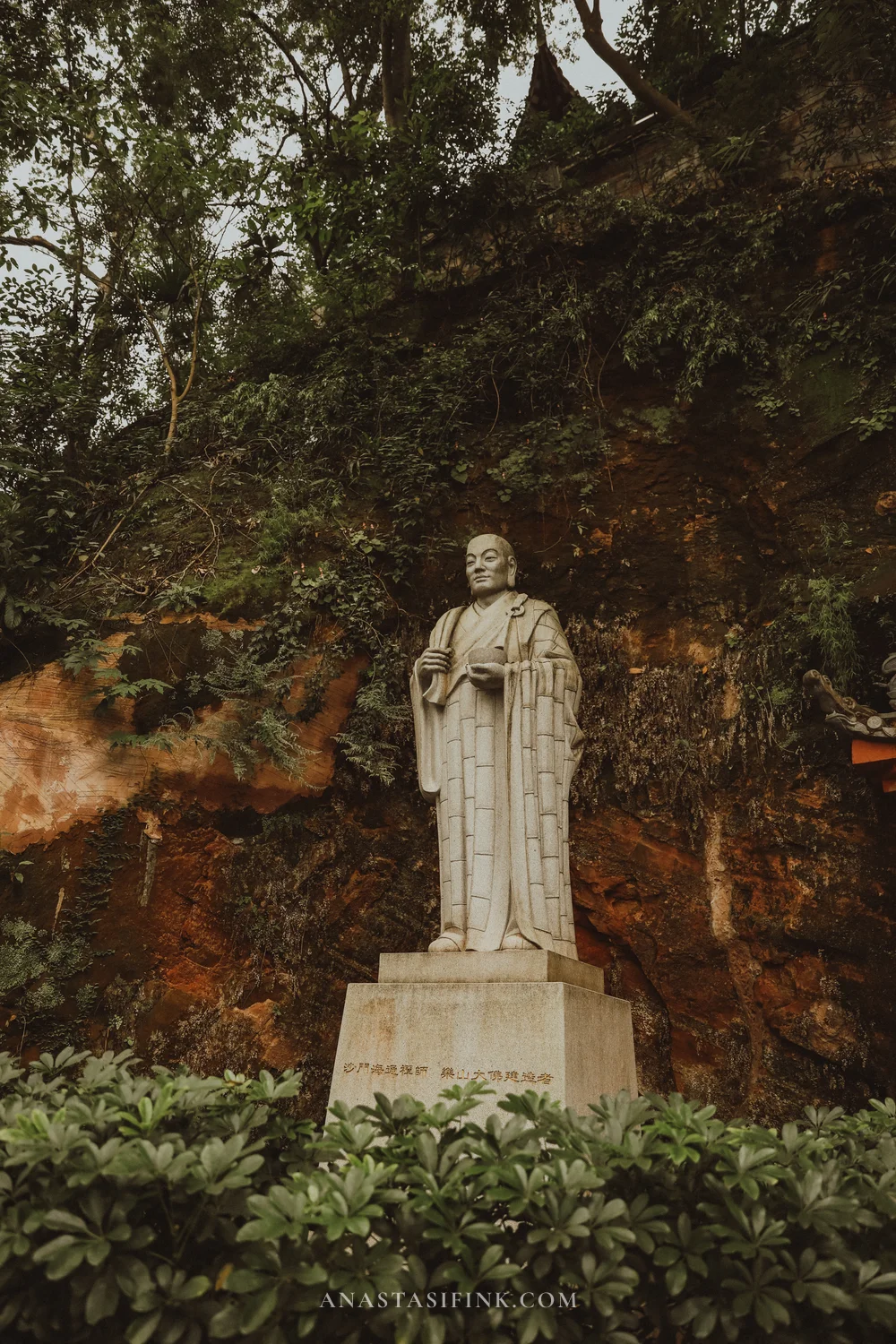
Haitong was an 8th-century Buddhist monk, and the whole project began with him. For years he collected alms for the statue, convinced that a Buddha would calm the dangerous waters at the meeting of the three rivers. When local officials tried to seize the funds he’d gathered, he is said to have gouged out his own eyes — to prove the money was going to the Buddha and nothing else. He didn’t live to see the work finished; his disciples completed it.
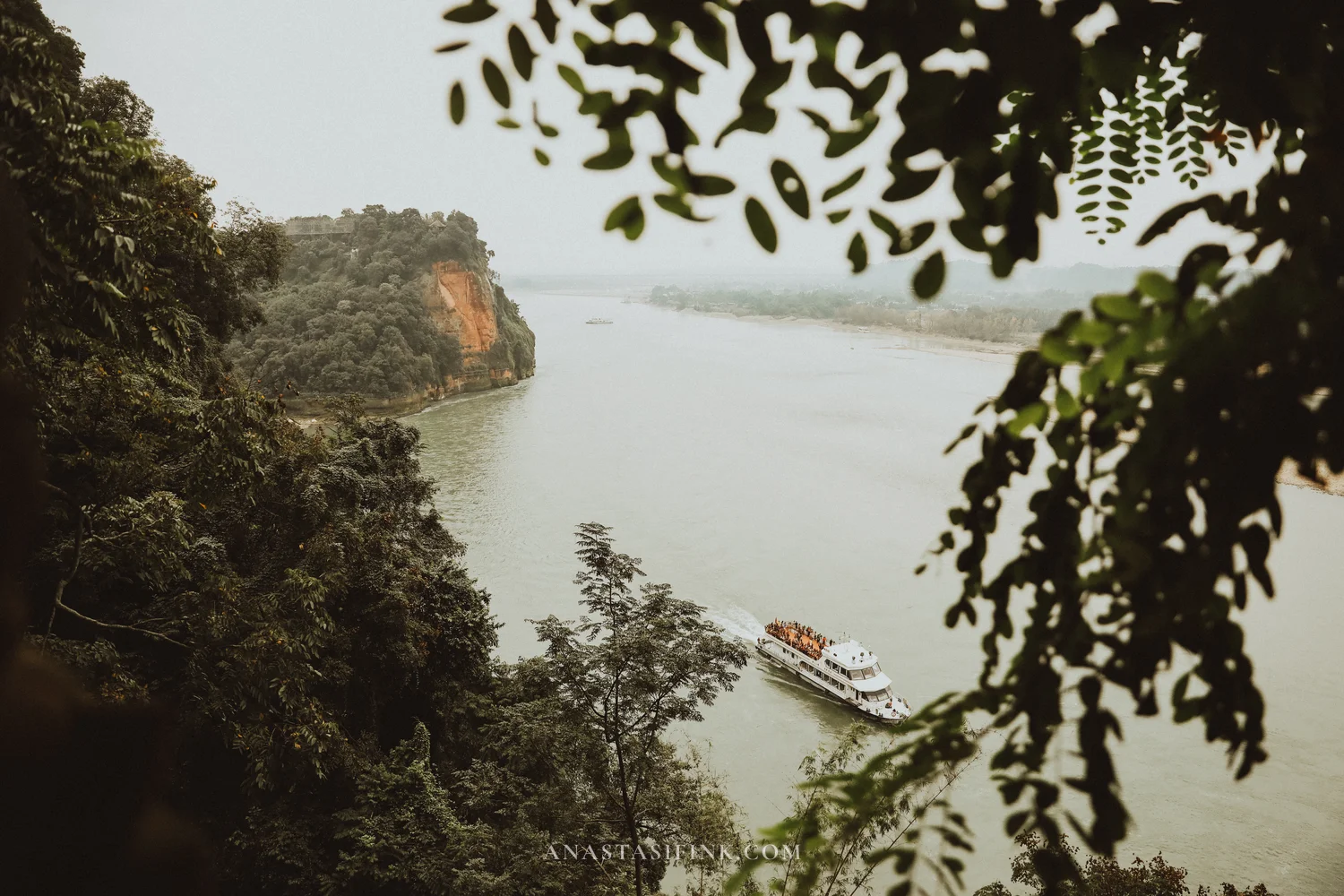
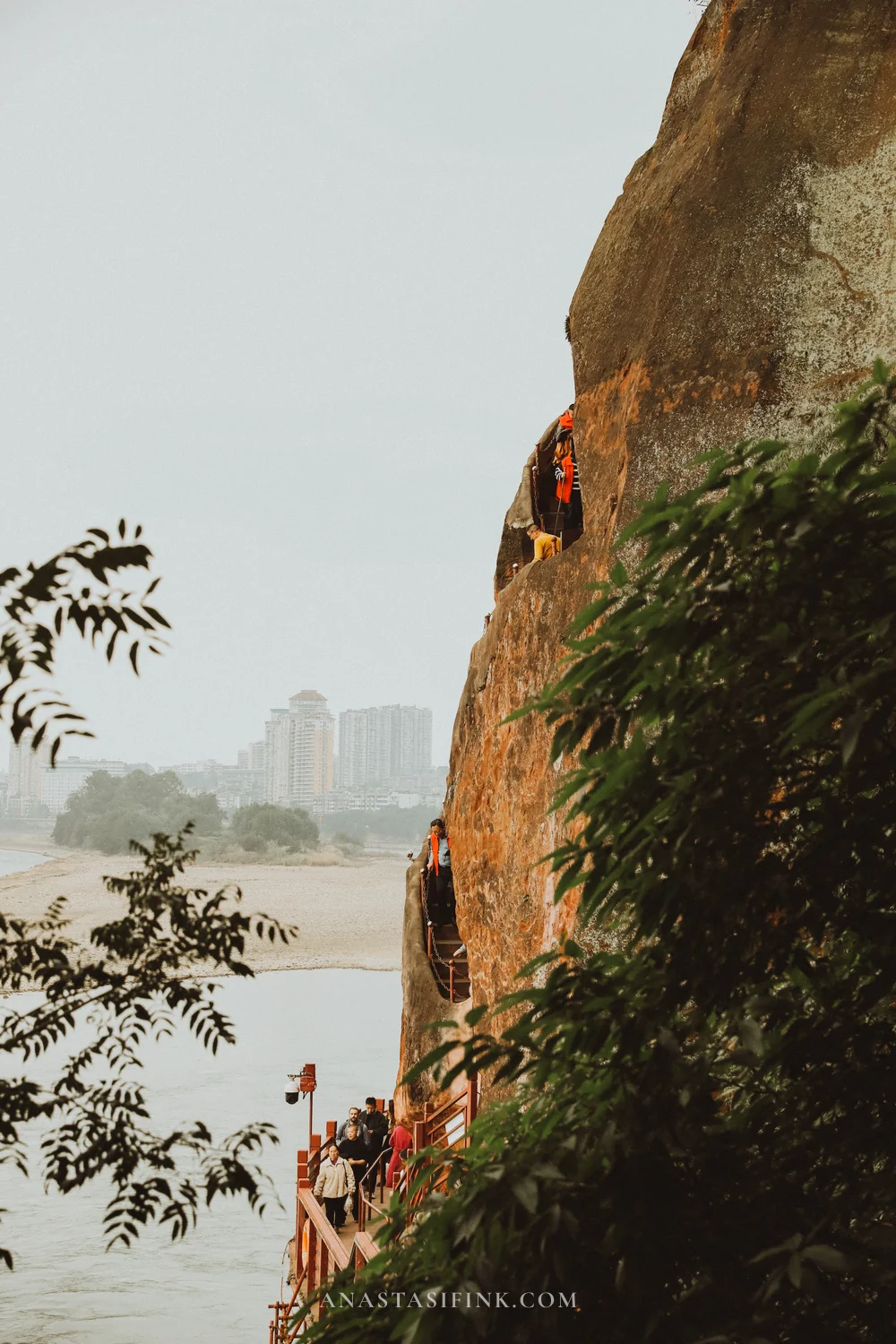
The descent to the feet goes down the “Nine-Bend Plank Road” (九曲栈道), cut into the sheer cliff: 278 steps, nine sharp turns, and at its narrowest just 0.6 metres wide — single file only. It isn’t the easiest descent: the stairs are steep and narrow, and in places it’s almost a vertical cliff with chains and railings along the edge. But don’t be put off — the railings are solid, you can take your time, and anyone in reasonable shape will manage. Best of all, it’s interesting in itself: you go down practically inside the rock, sometimes on open steps above the water, sometimes through a covered gallery cut into the stone, sometimes through a narrow dark tunnel lit by a single lamp.
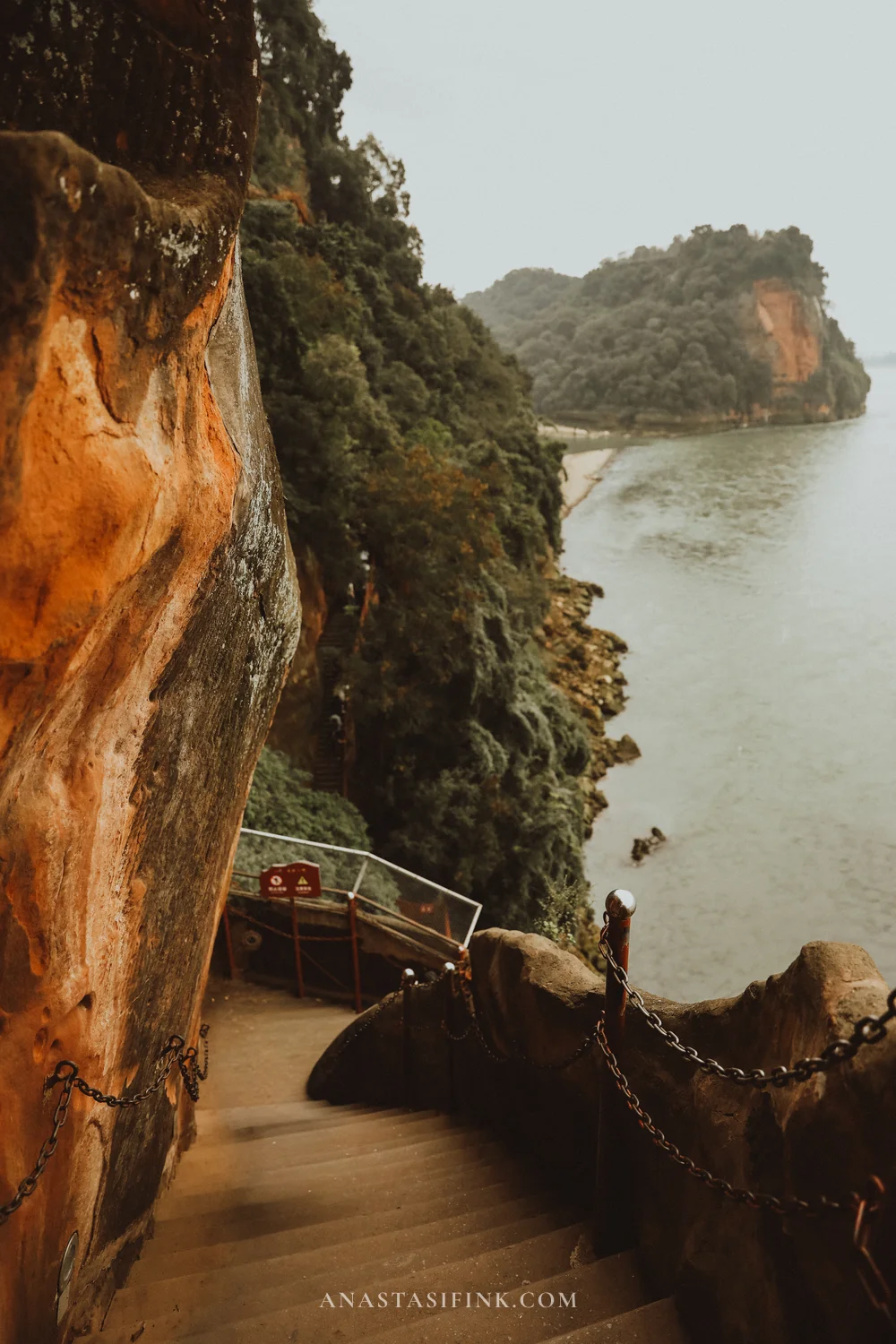
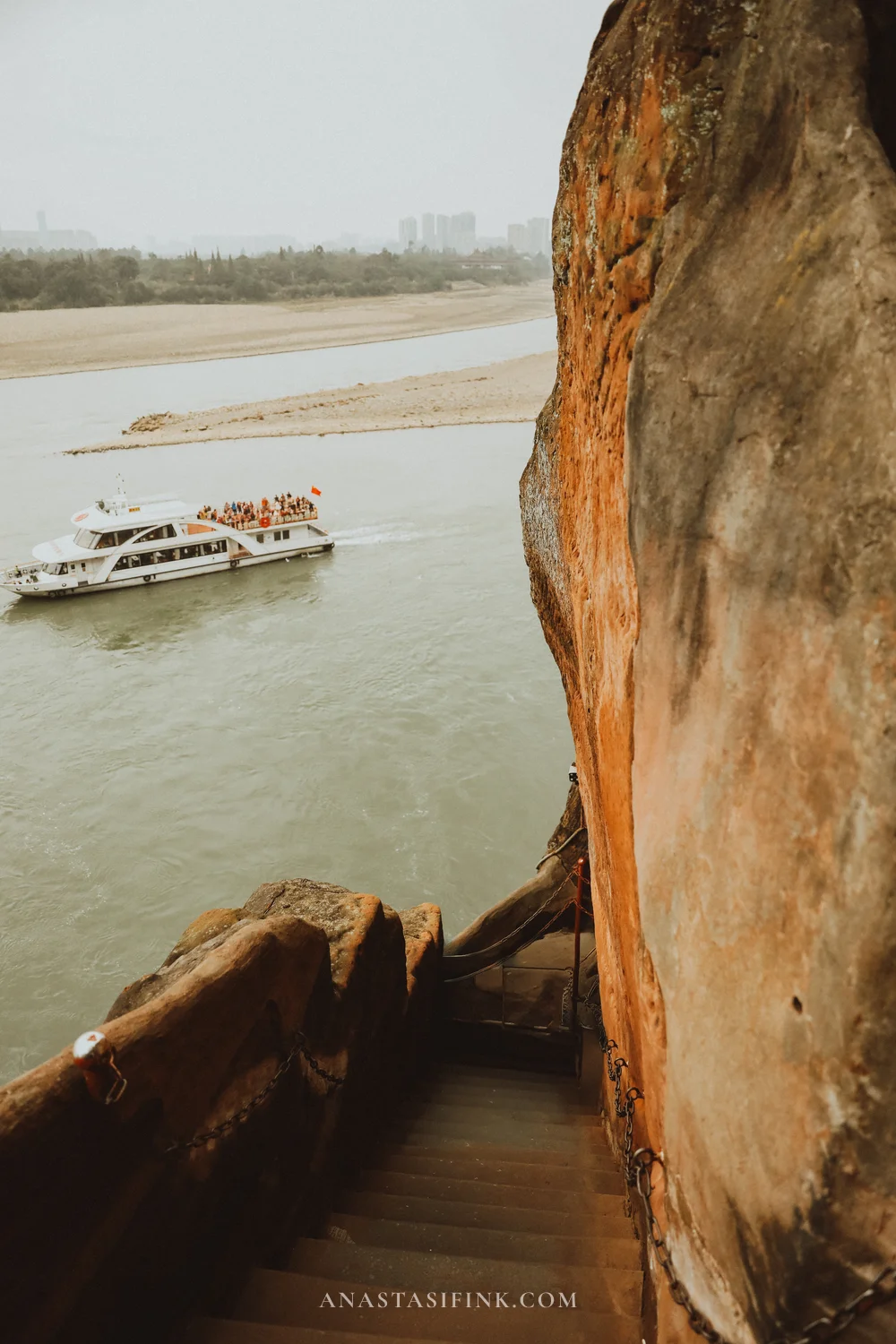
The stairs are steep but the railings are solid — you climb down right above the water
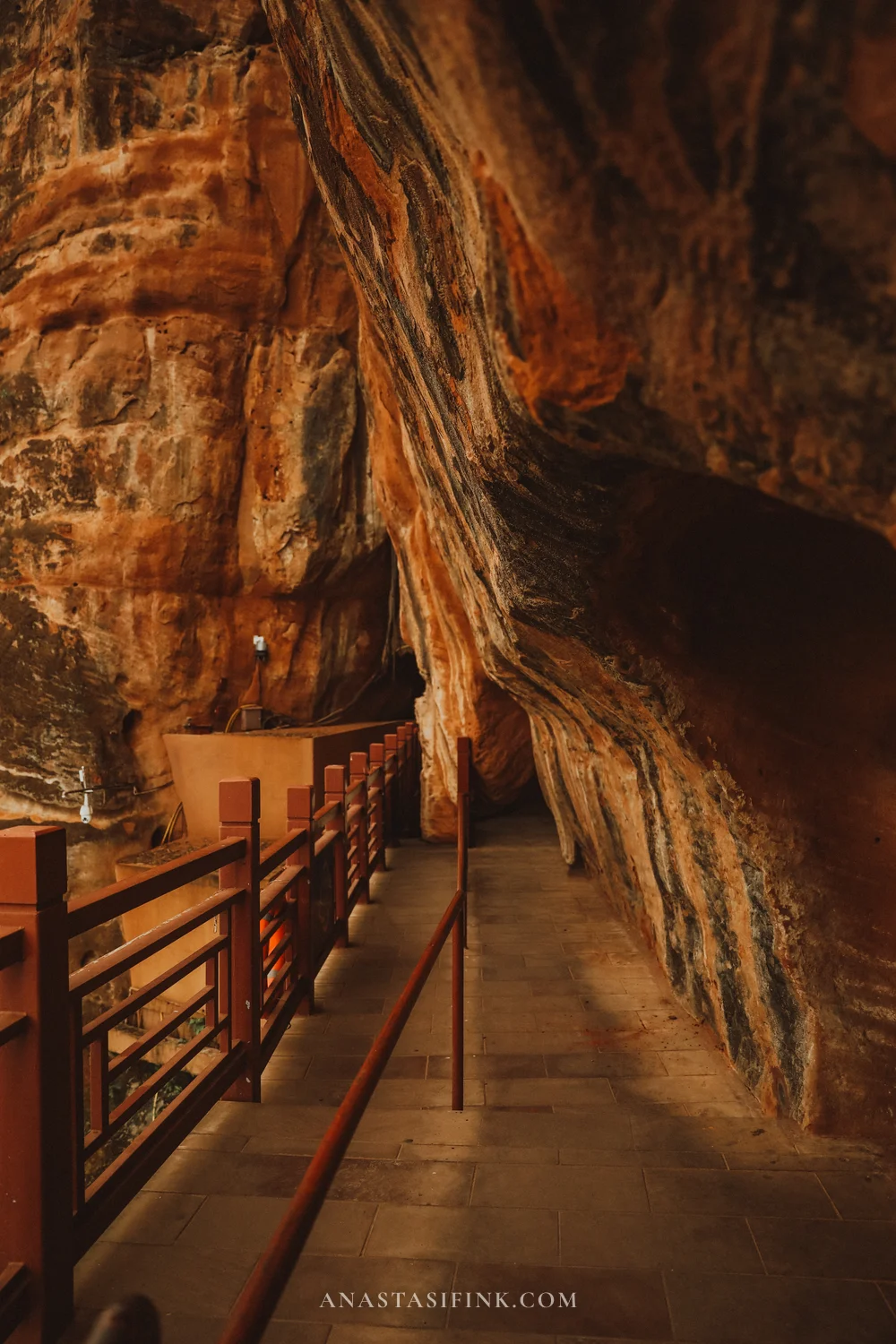
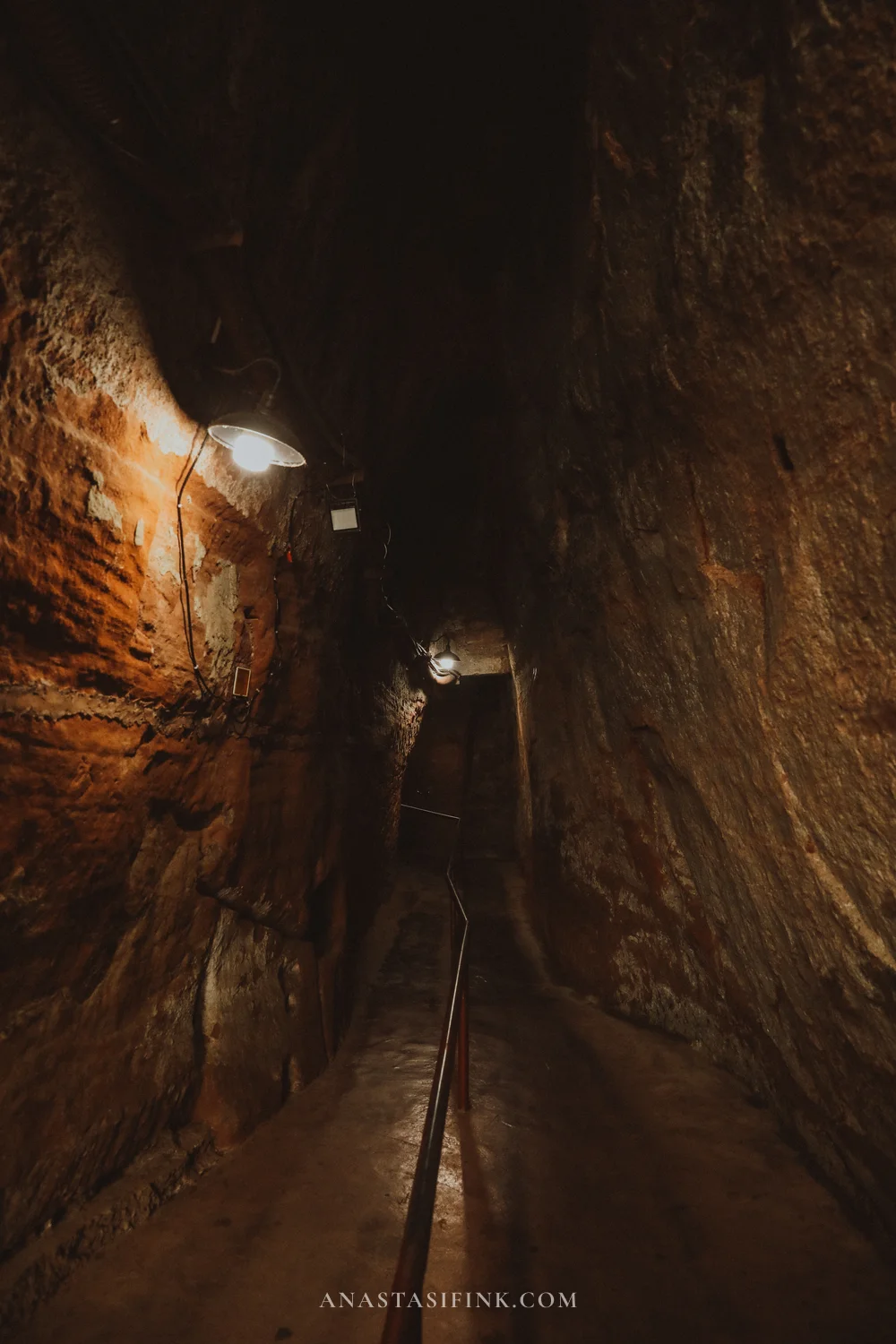
Part of the way runs through a gallery in the rock and a narrow tunnel
At the very bottom, by the Buddha’s feet, there’s a platform. From here you see the whole statue, and only now does the scale sink in: you’re standing at the feet, and the head is somewhere far above. From below you can also clearly see the side niches in the cliff with their small statues.
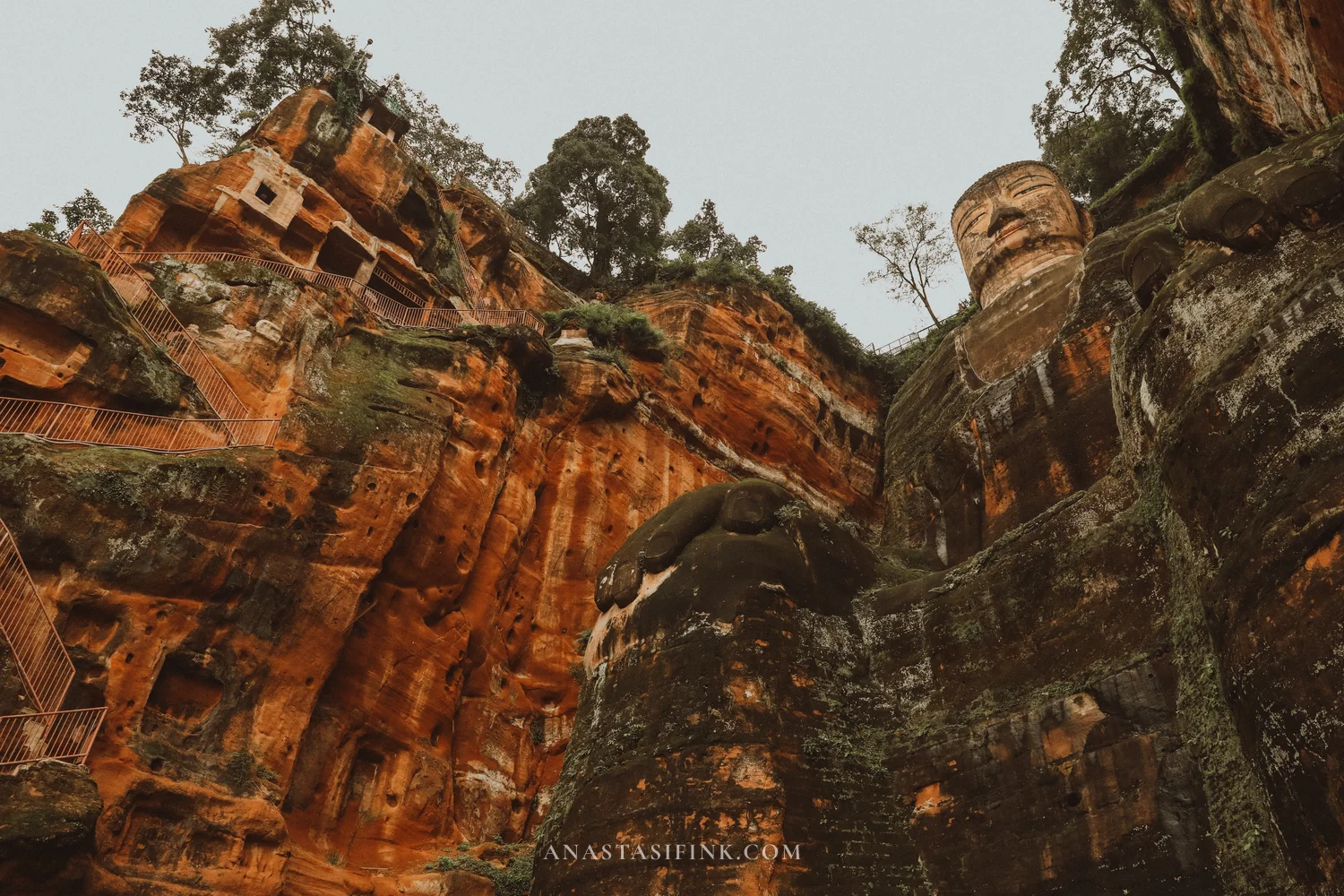
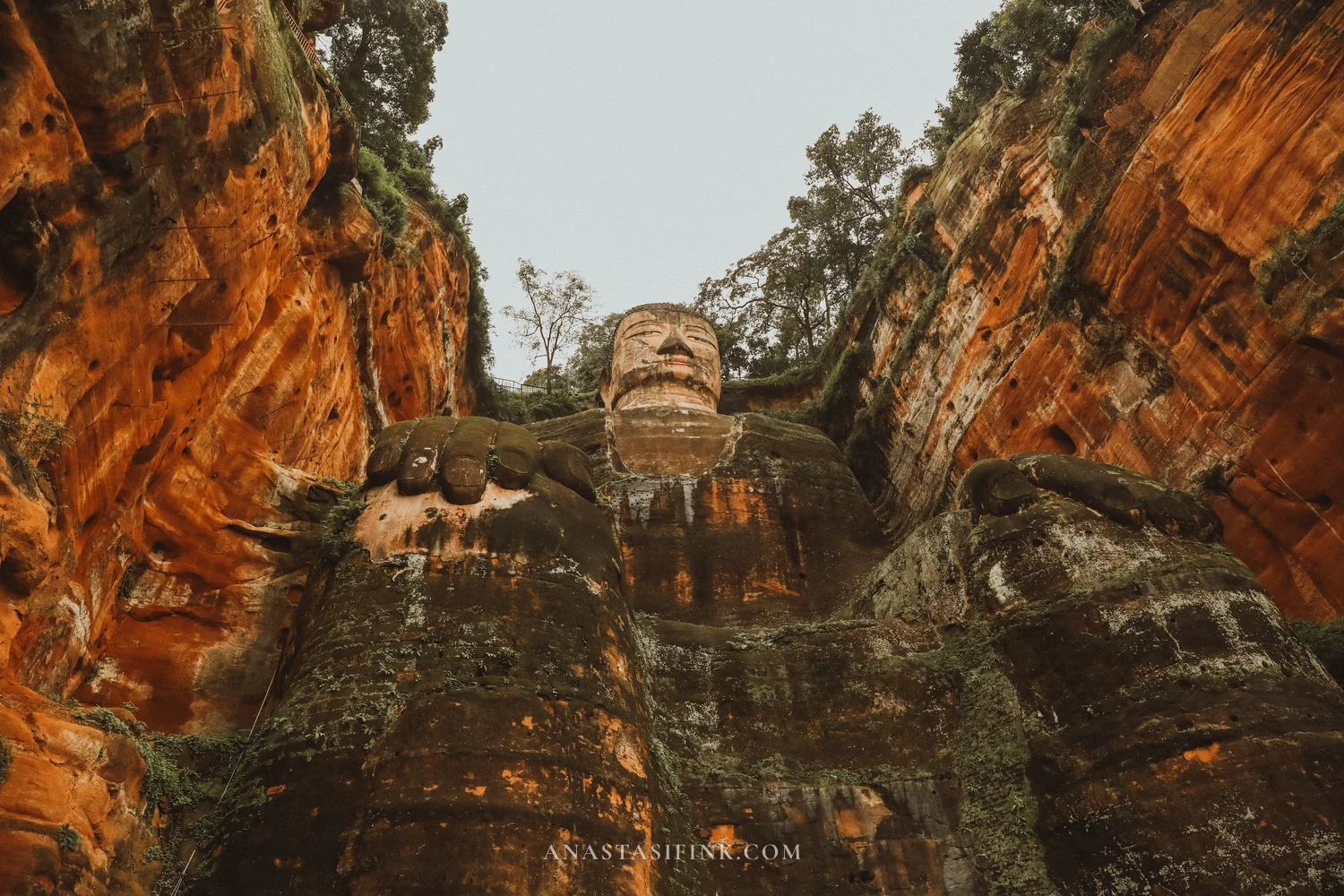
From the feet you see the whole Buddha. Only here does the true scale hit you
At the Buddha’s Feet: Boats and Seagulls
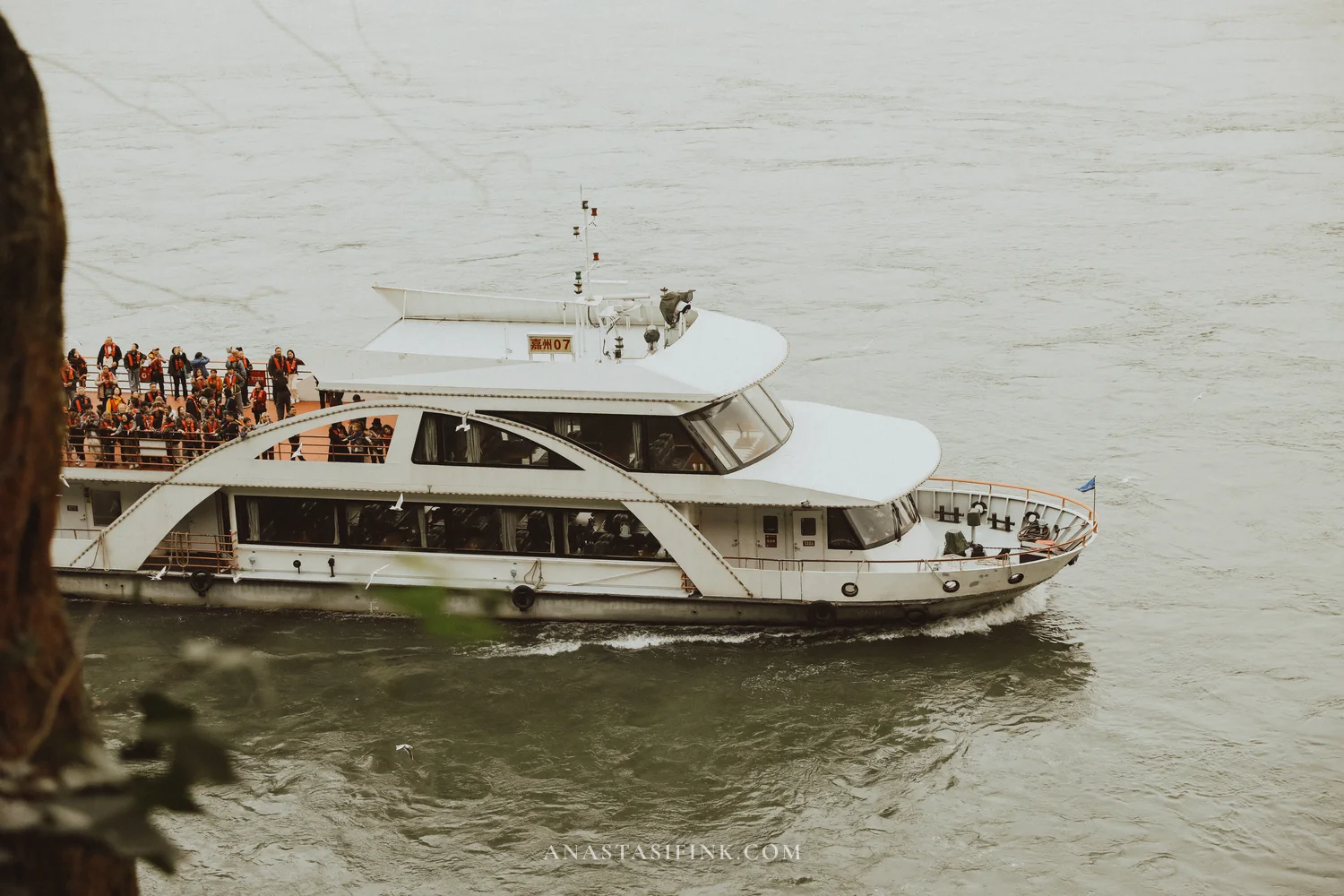
The platform at the feet is a place in itself. Tour boats pass on the river right in front of it: you can ride one separately from the walking route. The cruise lasts about 30 minutes; the boat approaches the Buddha from the water and stops for a few minutes in front of it — the only way to see the statue head-on in full, the way it was meant to be seen. You just can’t board at the feet: the boats leave from a separate pier, Jiazhou Ferry Pier near the park entrance (and from the Wuyou Temple pier during low water). It’s a separate ticket, around 70 yuan (≈ $10); there’s no fixed schedule — a boat leaves once it has enough passengers. If you have the time, it’s worth doing both the route and the boat: the walk gives you the detail, the boat gives you the whole.
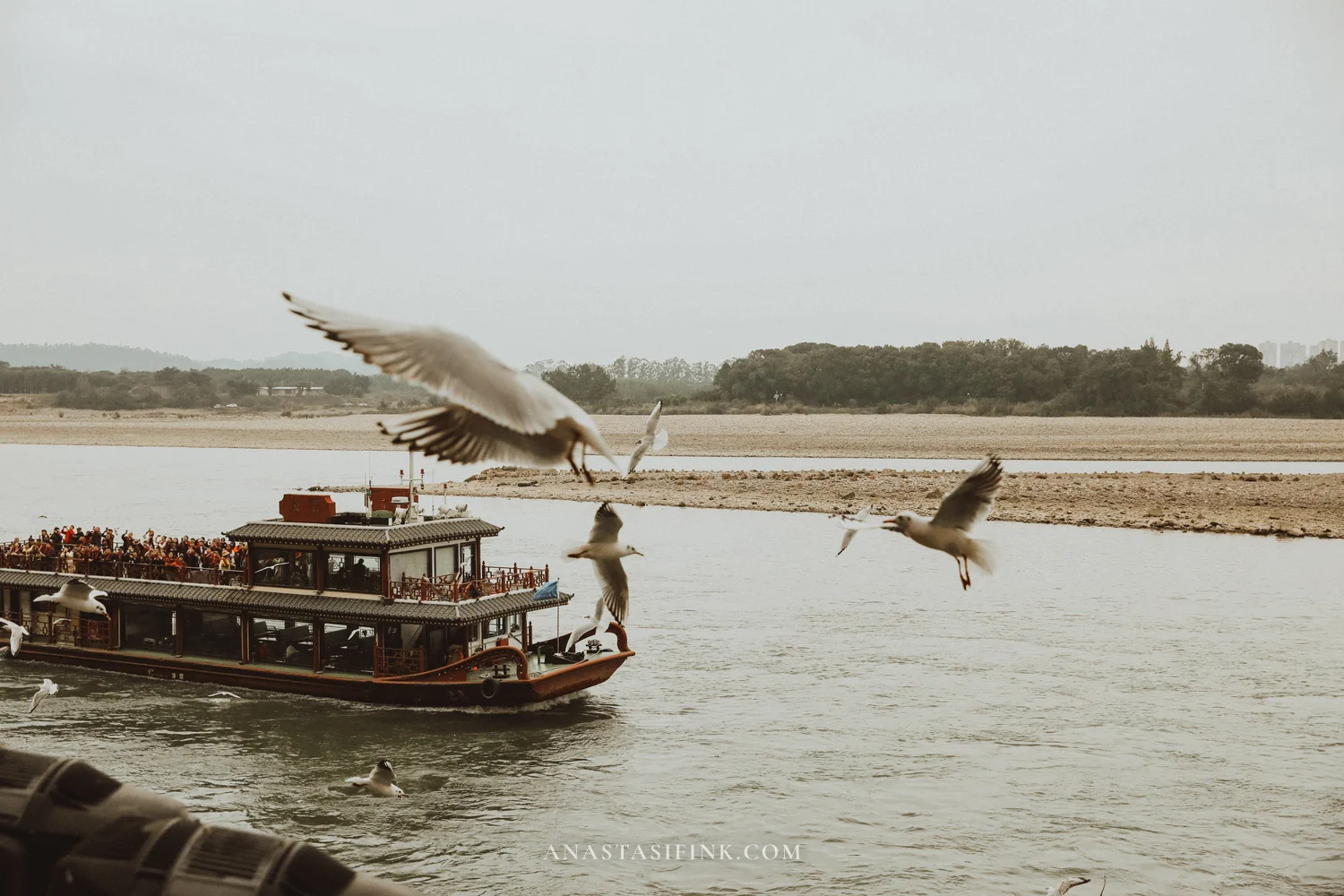
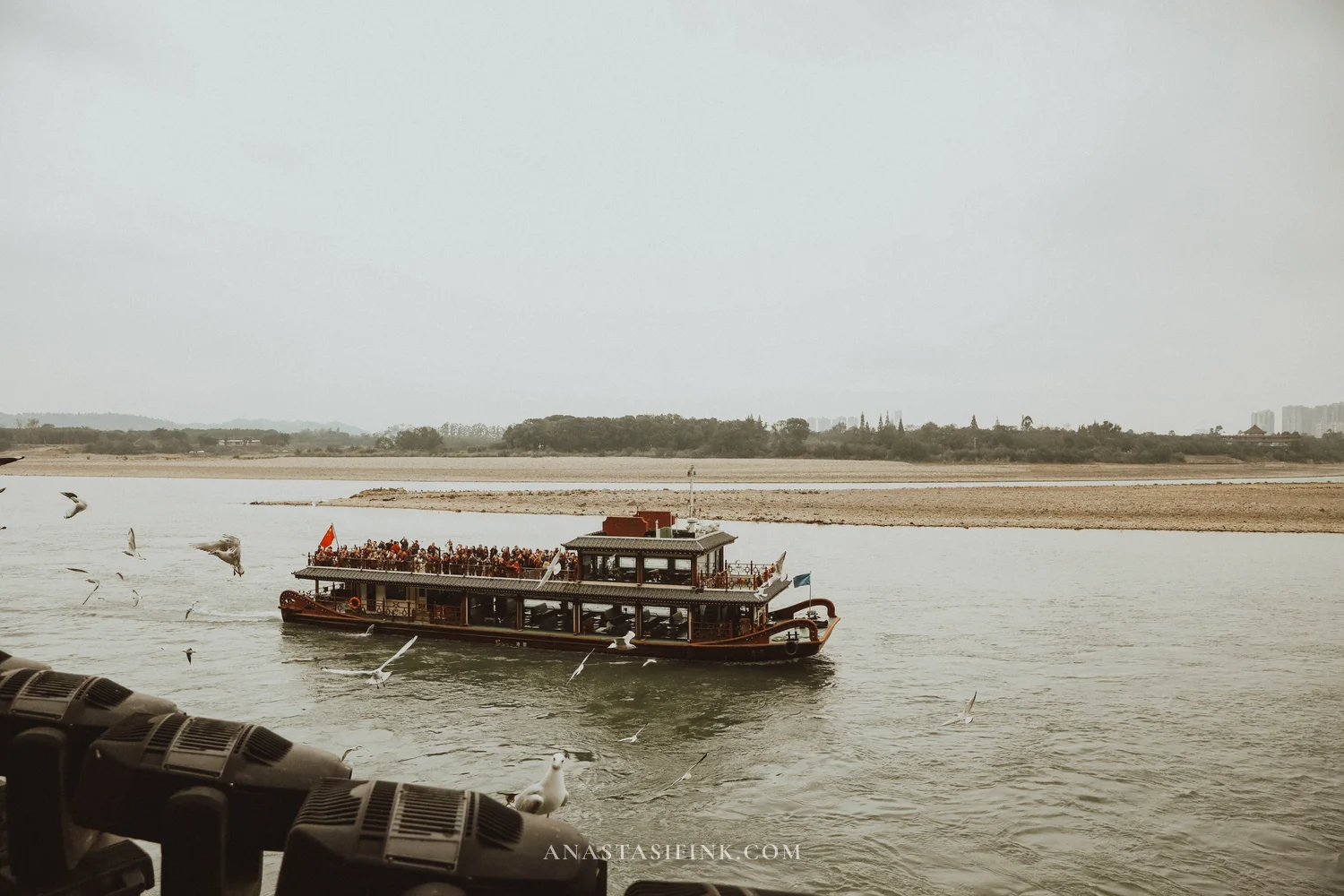
The boats come in to the Buddha from the water. Seagulls are always circling them
People also feed the gulls from the platform at the feet. The birds swoop in by the flock, hang above the water, and snatch food in mid-air. They wheel around the boats and over the platform — loud and lively; kids love it.
The Climb Back Up and the Way Out of the Park
From the Buddha’s feet the route leads back — but not by the same stairs; you go up the other side. First you head back through tunnels and caves cut into the mountain, with roughly hewn stone pillars, and then the climb begins.
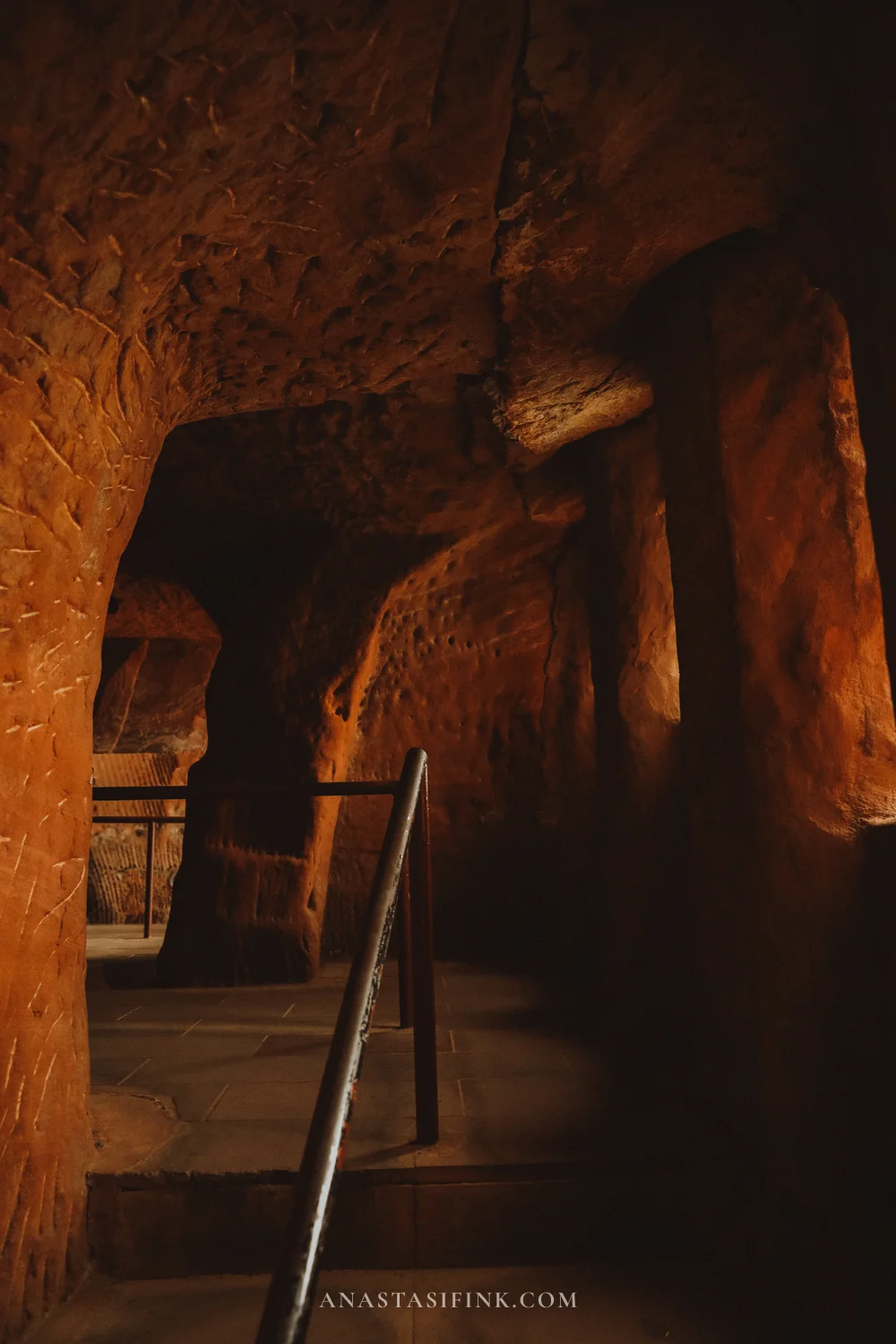
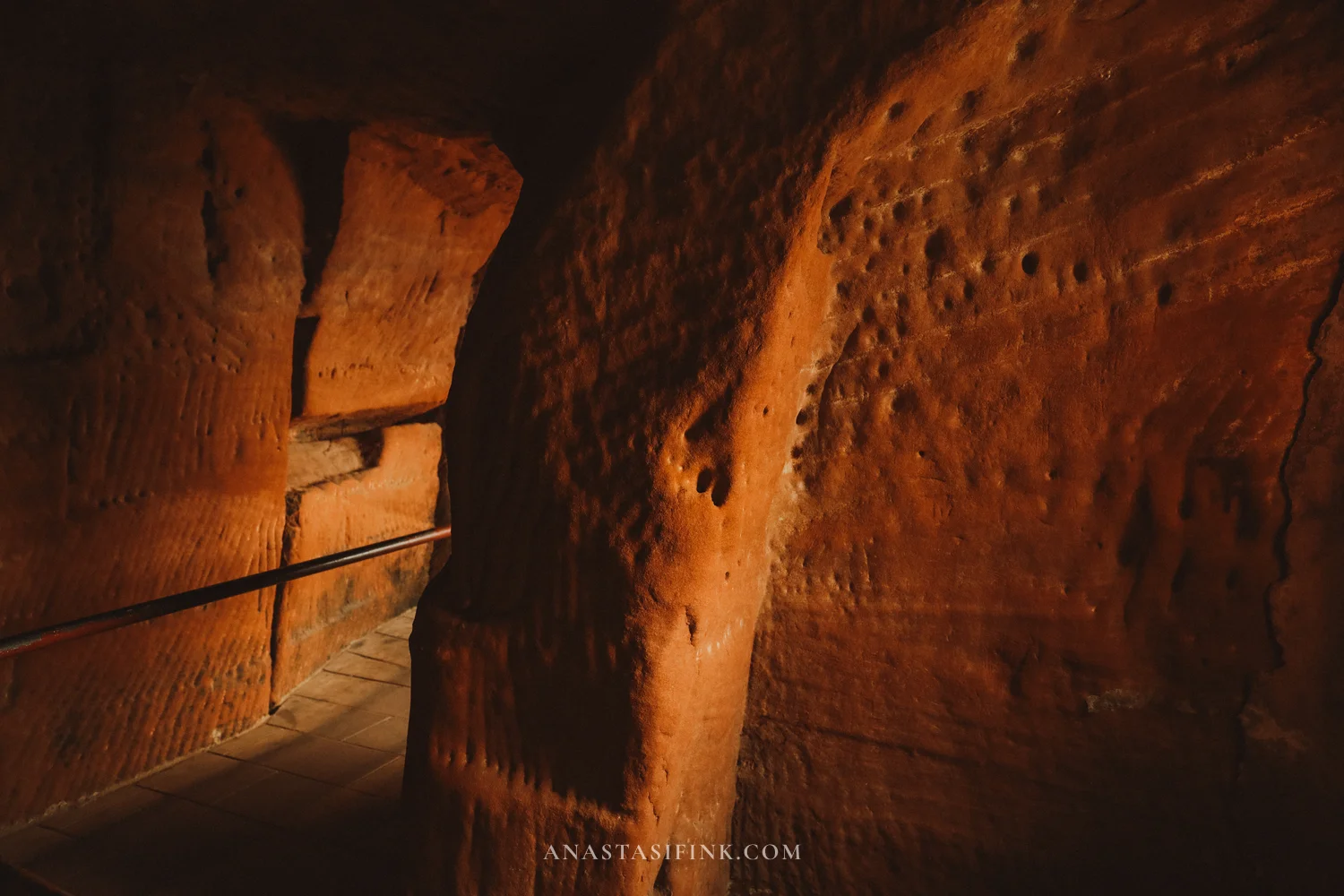
The climb up this side is also a staircase along the cliff, with red railings. From it you get a clear look at that steep descent from the start of the route — the sheer wall with the stairs running down it in a thin ribbon toward the Buddha. From below you can see just how steeply the path drops to the water.
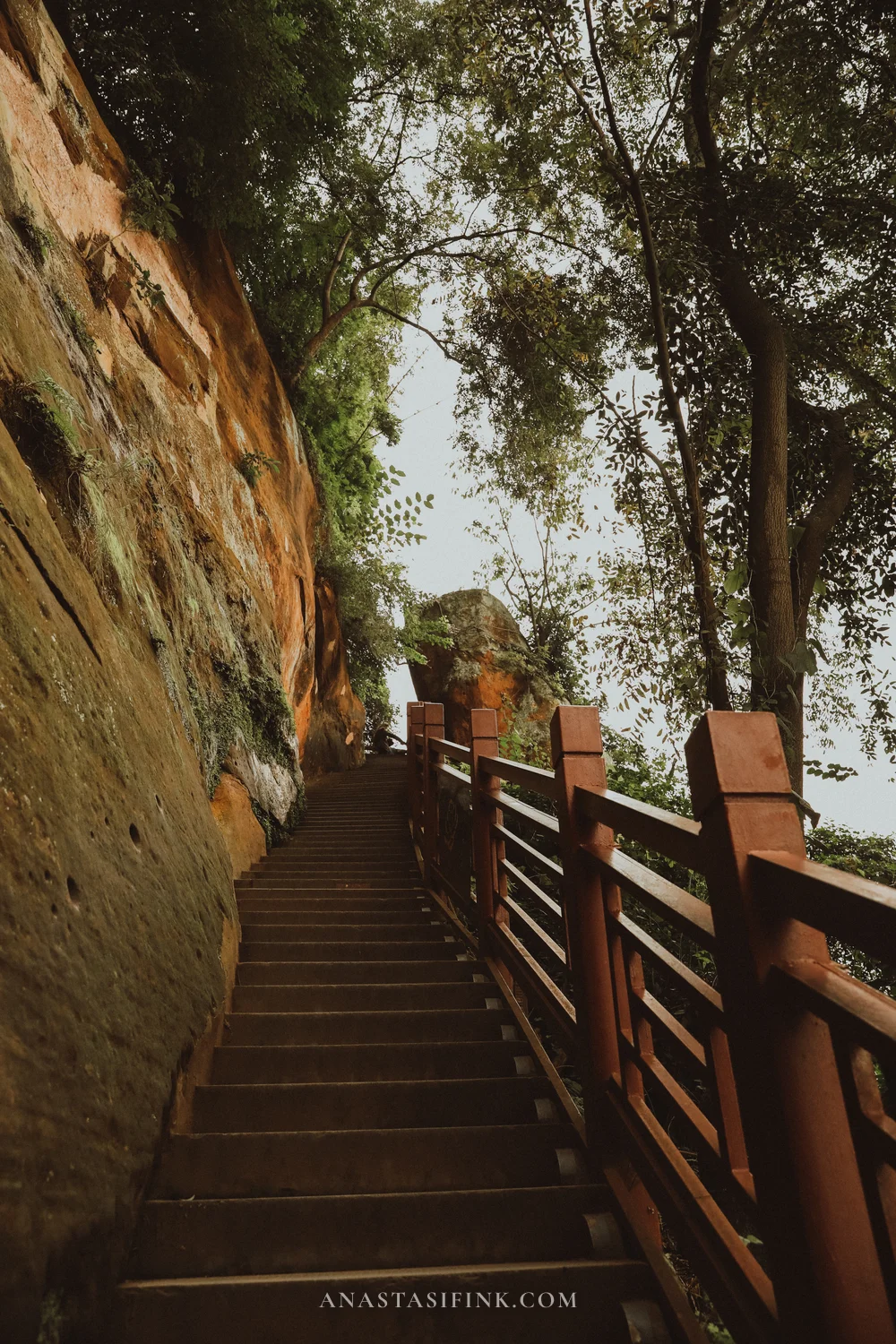
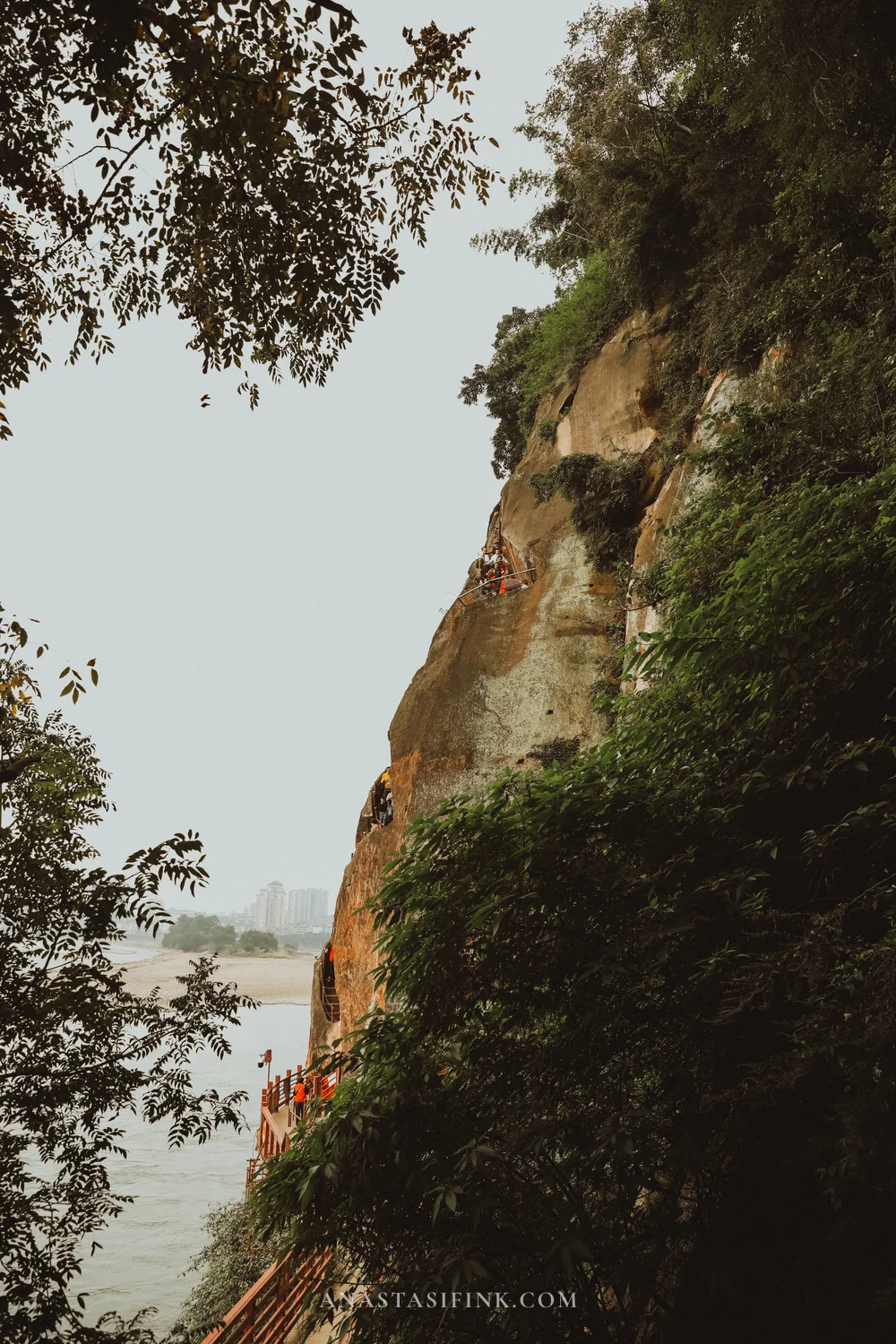
The climb up the other side. From here you can see the sharp descent at the start of the route — almost a vertical wall
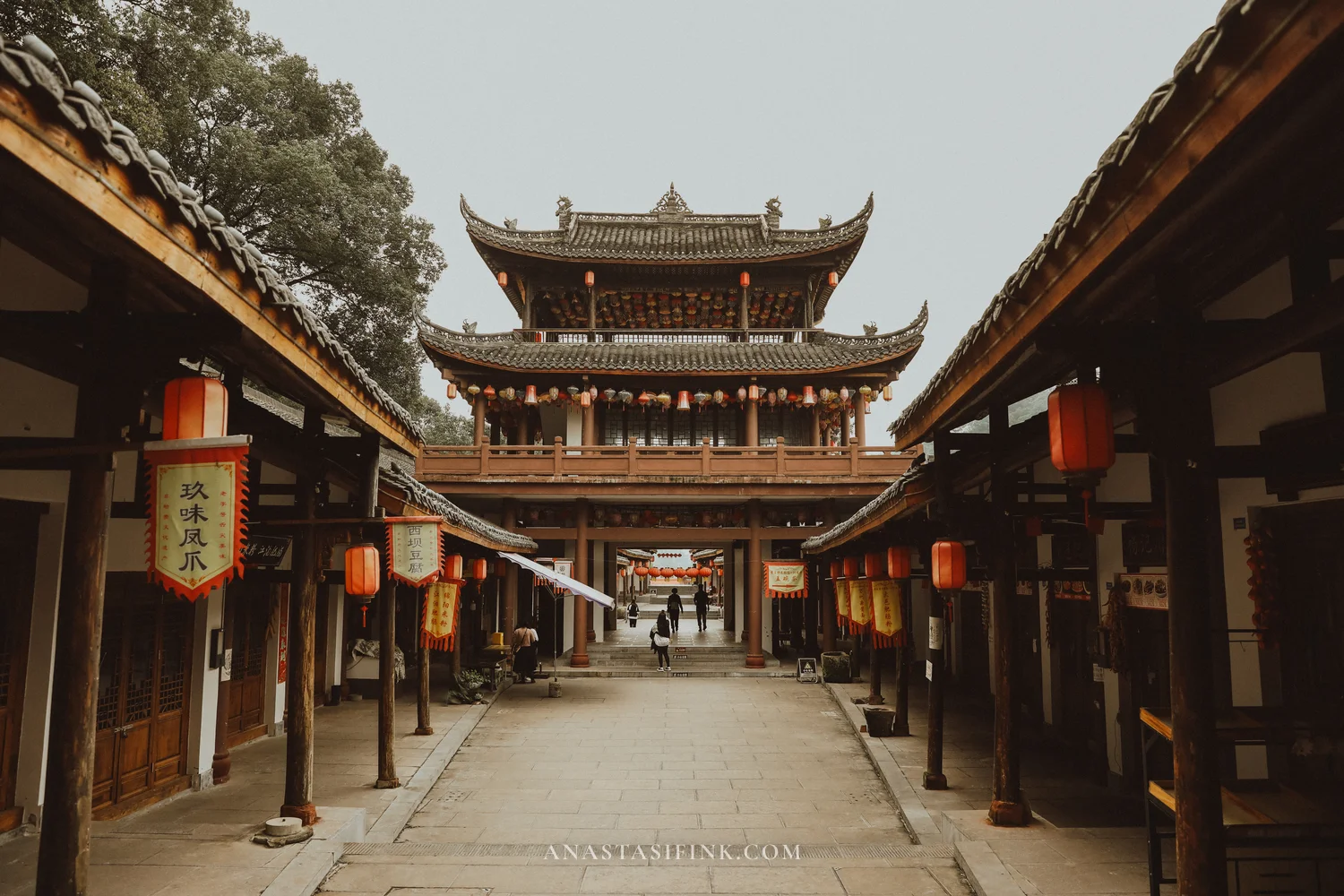
Then comes the way out of the park. At the exit stands a covered wooden gallery with red lanterns along an old street, leading to a multi-tiered gate tower. The main part of the route is behind you at this point.
The Mahao Han Cliff Tombs Museum
Right past the park exit, before the bridge, there’s a separate building with red gates — the Mahao Cliff Tombs Museum (麻浩崖墓). These are tombs cut into the rock back in the Han dynasty (25–220 AD), with a small museum attached. Reliefs survive on the tomb walls: processions with carts and horses, banquet scenes, horses grazing. There’s also a detail that resonates with the Giant Buddha next door — above one of the tombs a tiny seated Buddha is carved, one of the earliest Buddhist images in China. If you’ve got the energy left, it’s worth a look.
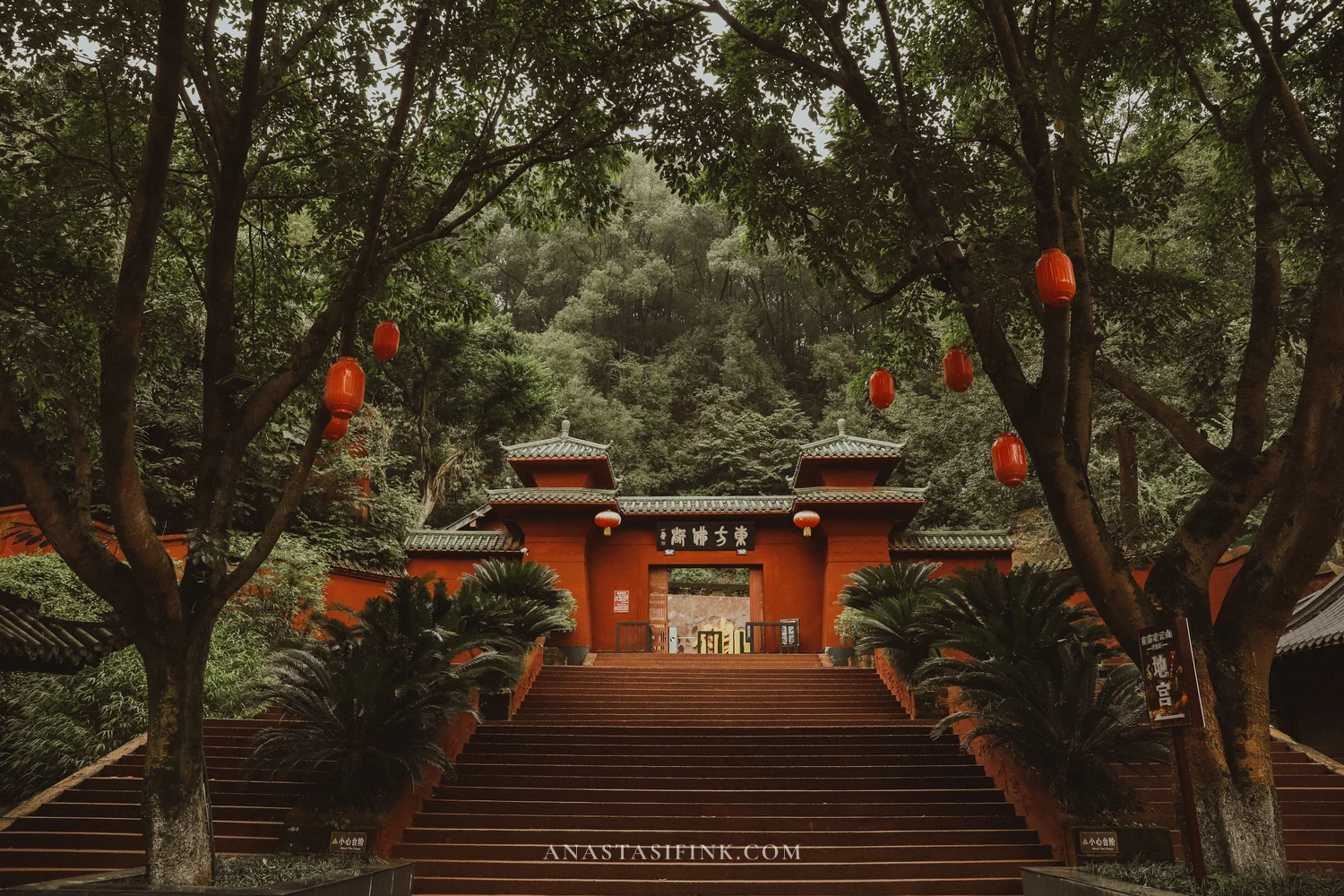
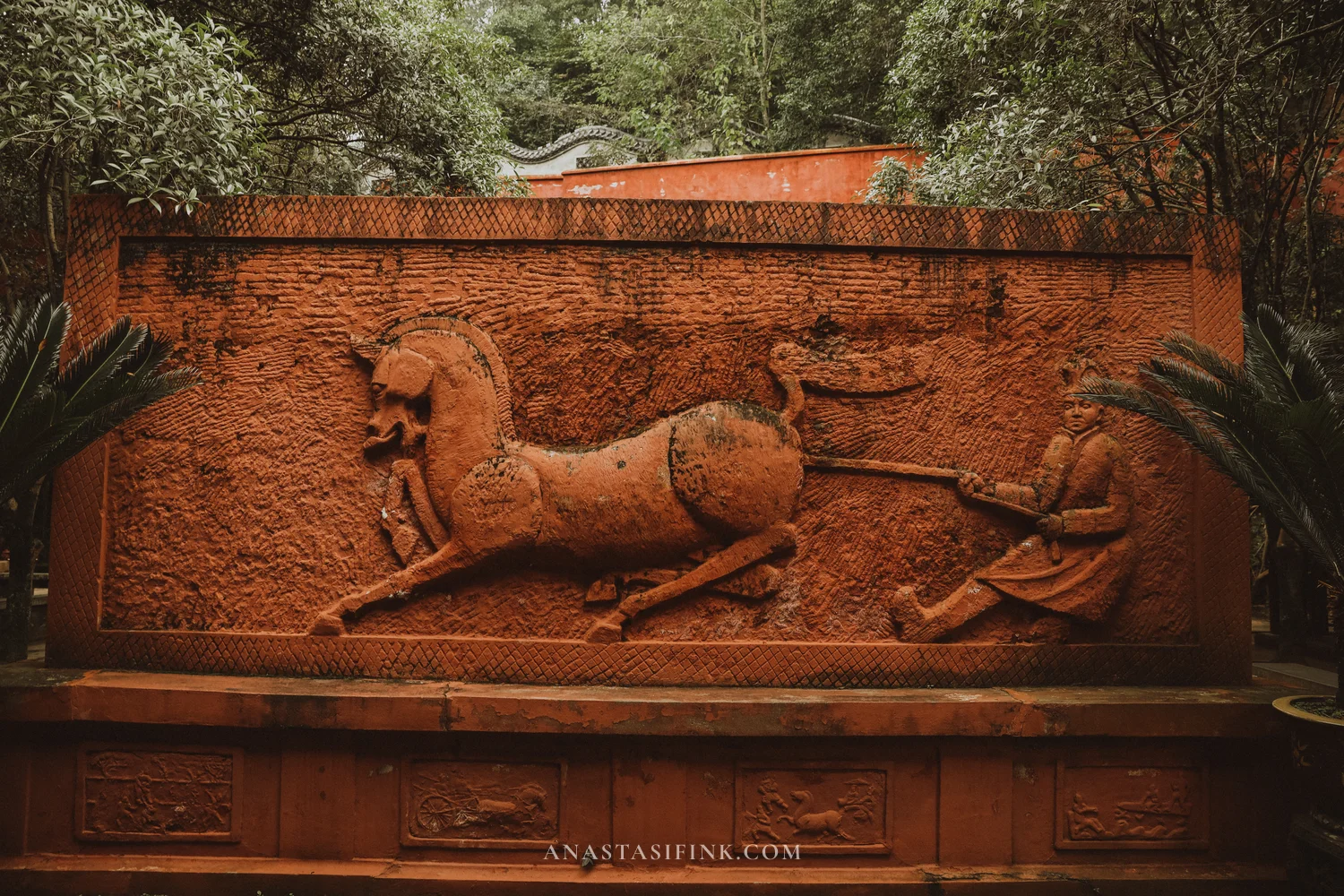
The Mahao Tombs Museum by the park exit — Han-era reliefs of horses and carts
The Bridge and the Island with Wuyou Temple
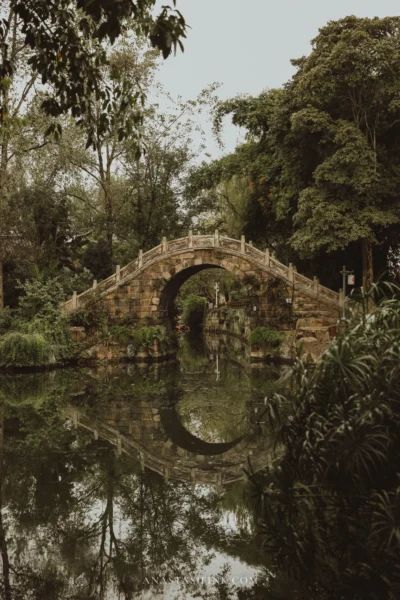
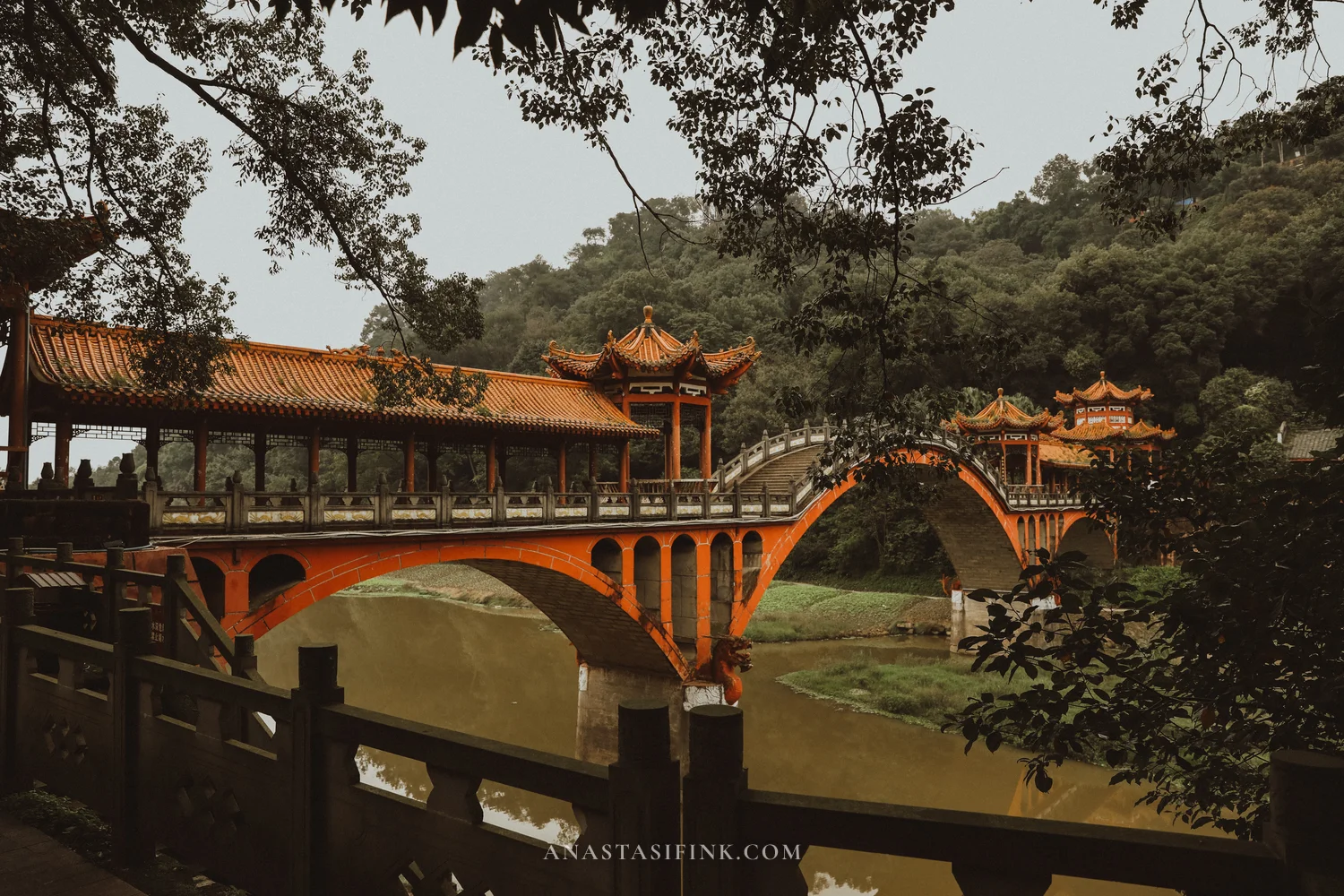
Plenty of people skip this part — and that’s a shame. Up ahead, the Haoshang Bridge (濠上大桥) spans the river — an arched bridge with covered pavilions, leading to the neighbouring hill-island of Wuyou. Warm wood, orange arches, a reflection in the water — it looks good both from a distance and up close.
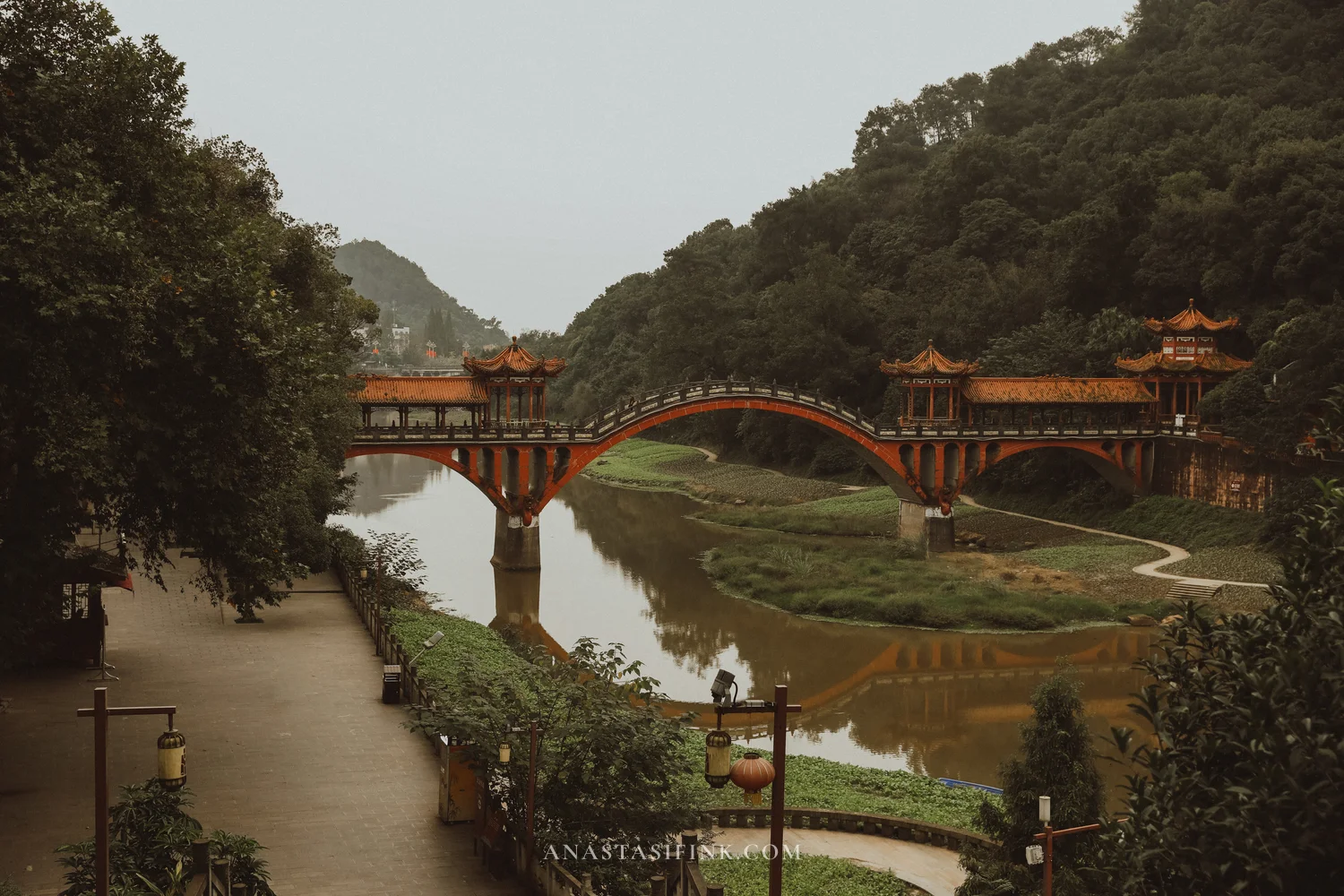
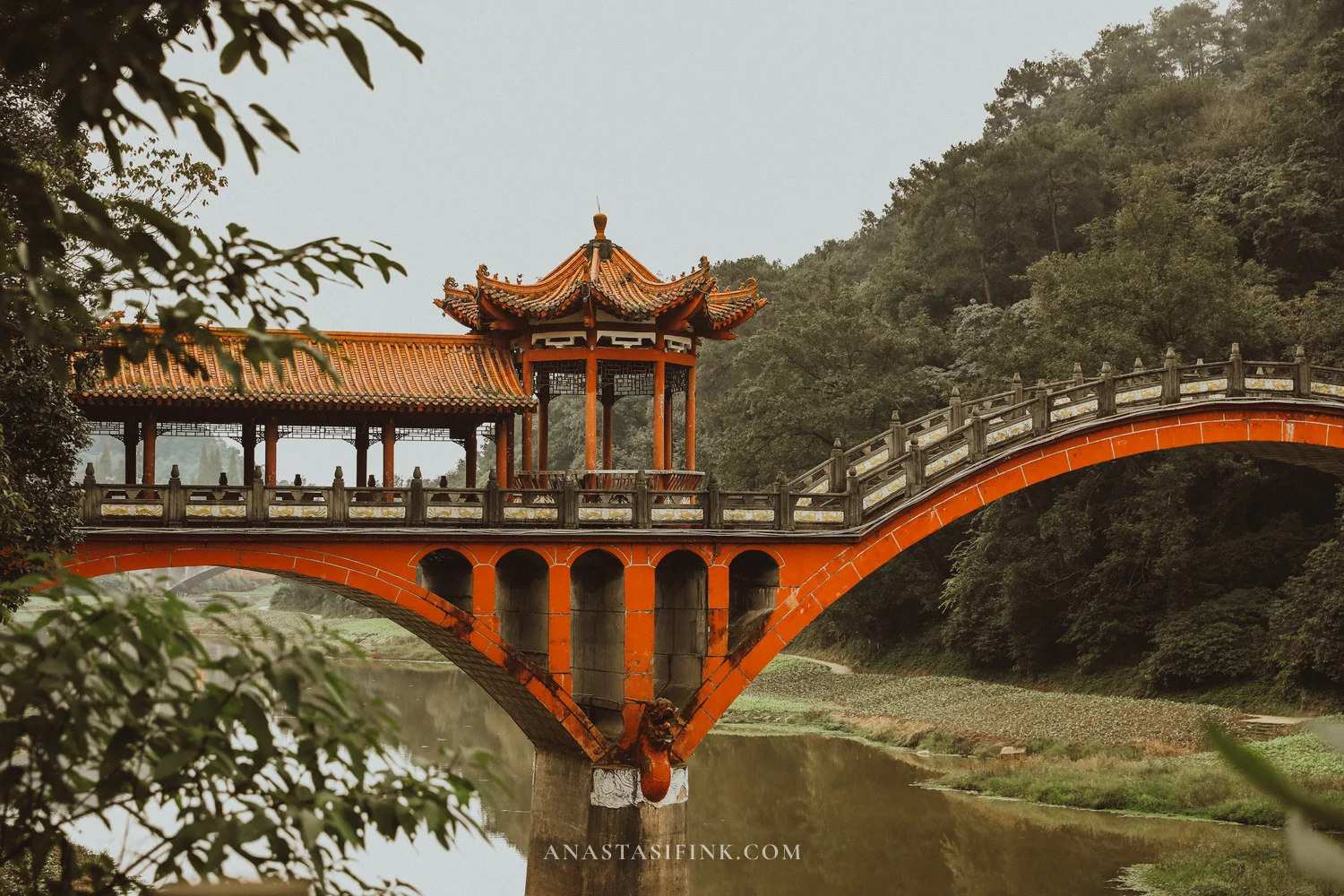
The Haoshang Bridge leads to the island with Wuyou Temple
On the island stands Wuyou Temple (乌尤寺) — an ancient Buddhist monastery on the hilltop. Before the climb, find the map: it’s labelled in English as “Leshan Wuyou Temple Scenic Spot Diagram” and shows all seven halls and the paths. The climb is short and goes up wooden staircases through the forest.
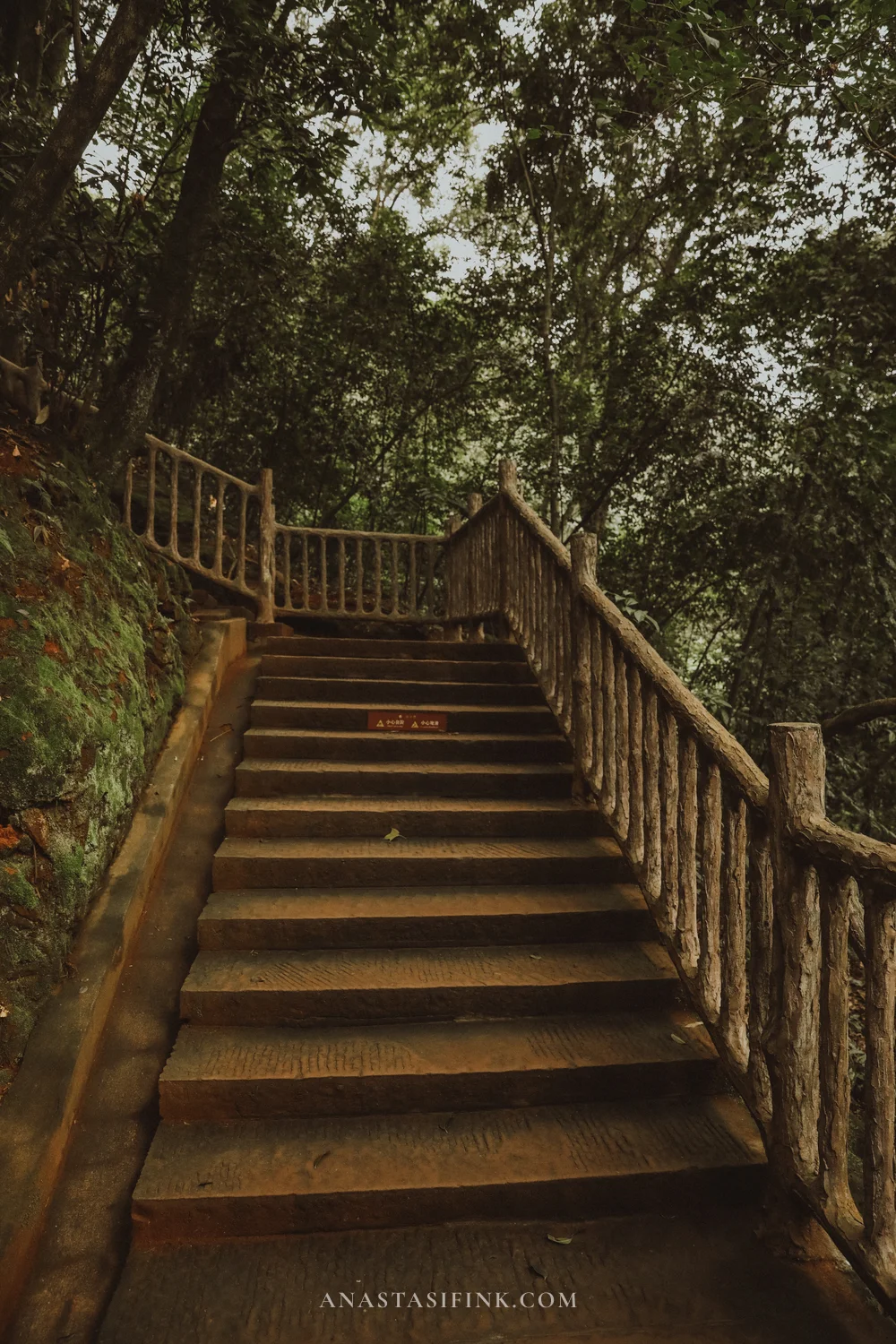
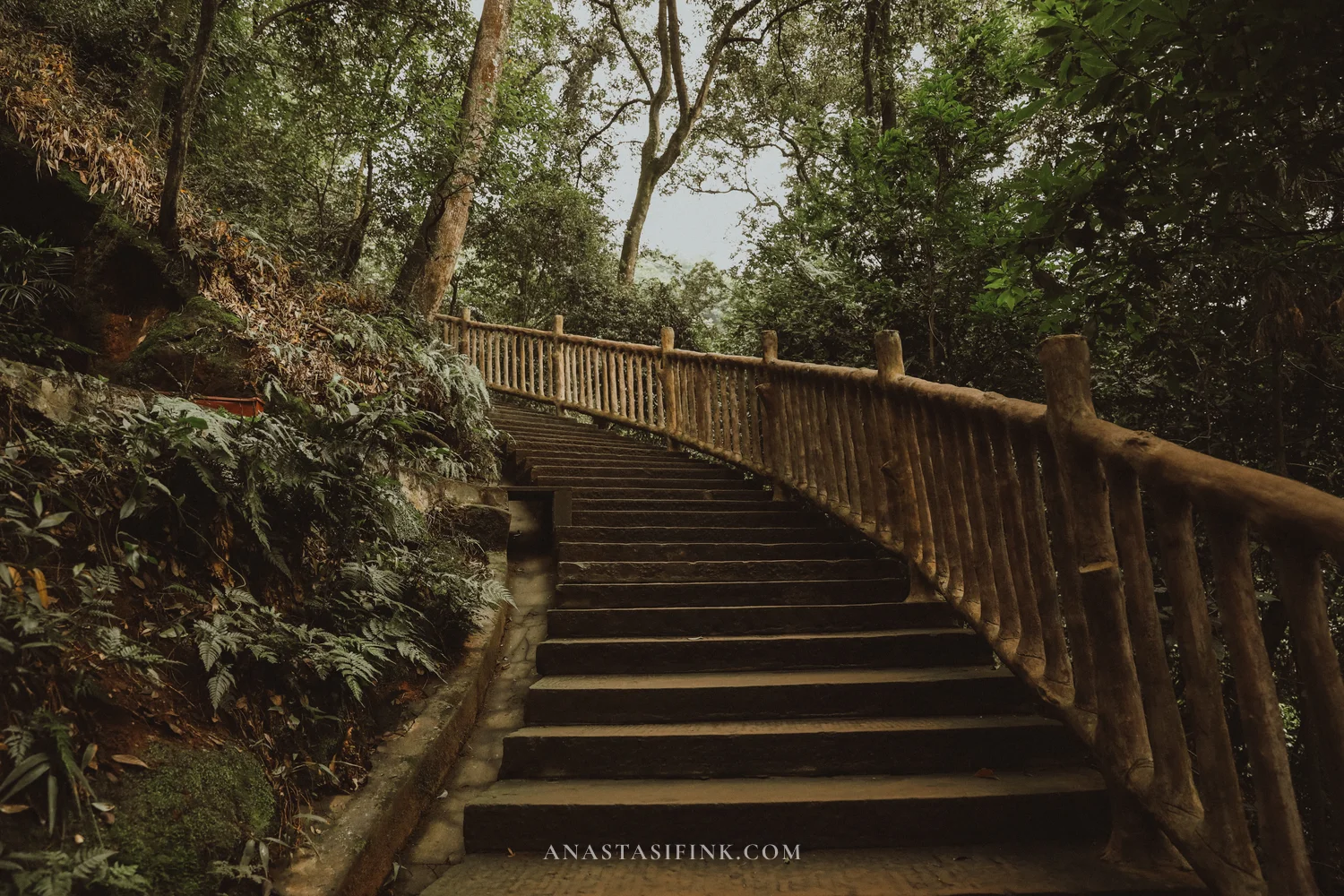
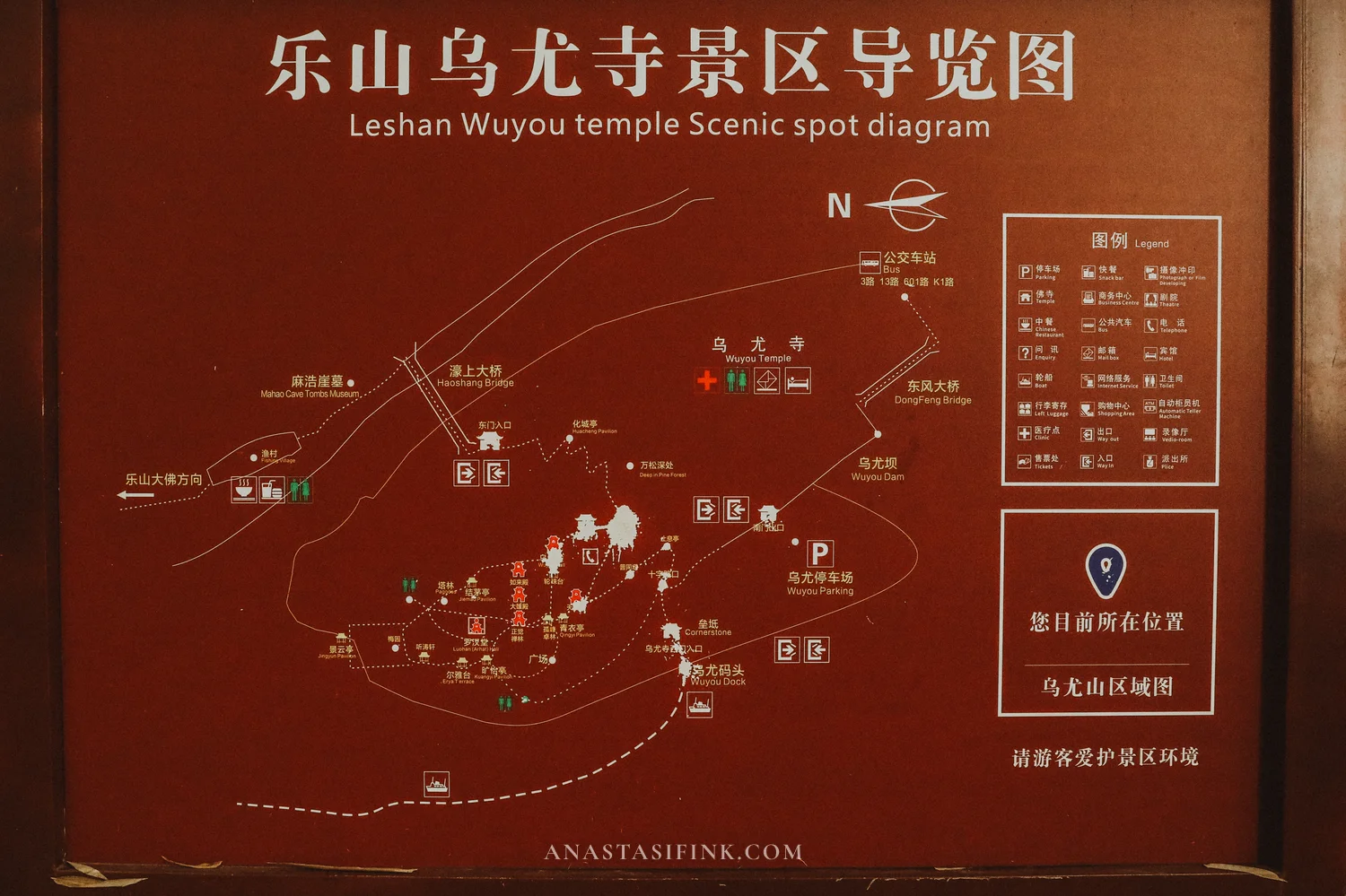
The Wuyou Temple map is labelled in English — easy to find all seven halls
At the top there’s a small Wuyou hall with a bronze censer at the entrance, its handles shaped like elephant heads. Past it, the path descends to the main, larger temple.
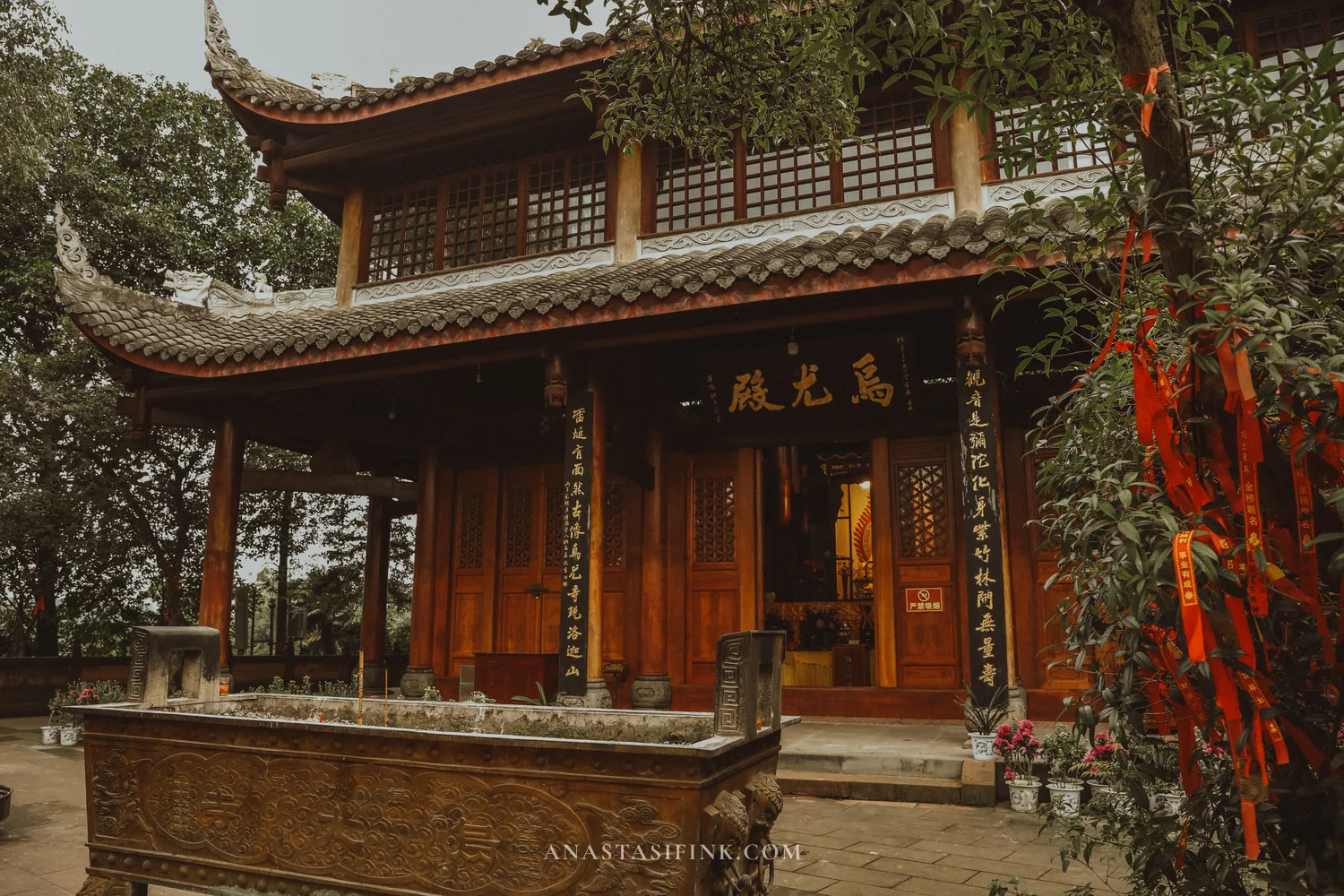
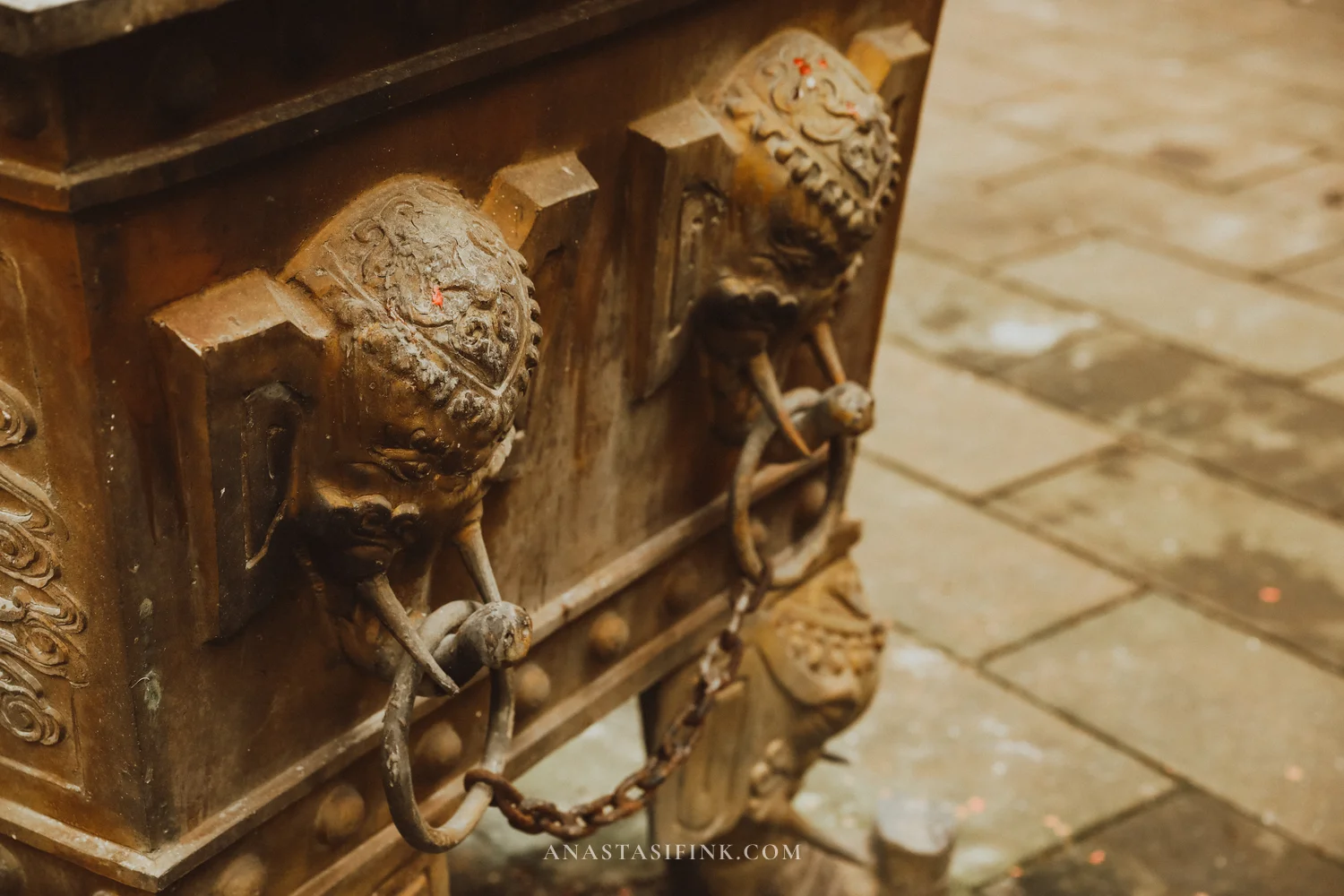
An old bronze censer with elephant heads on the handles
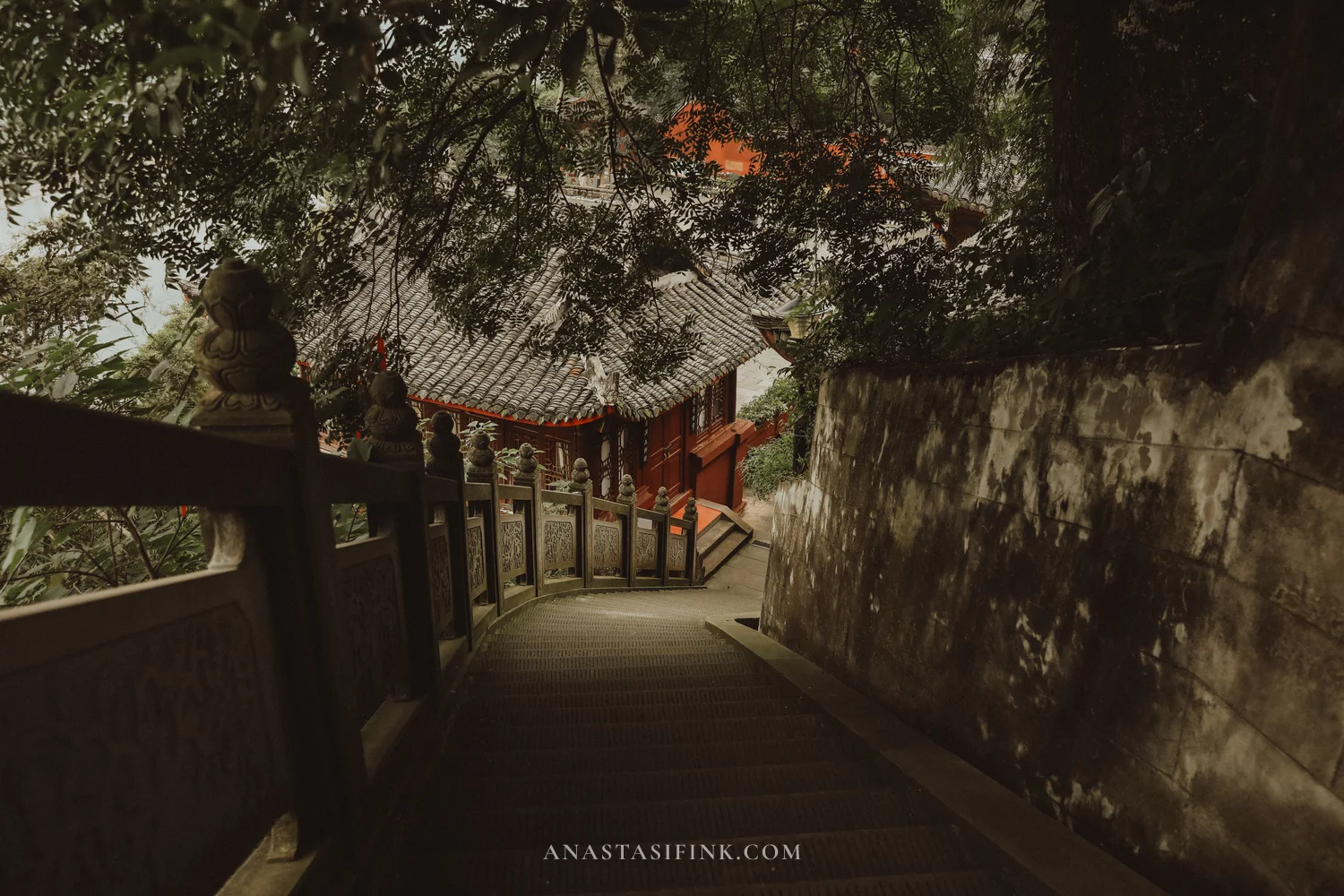
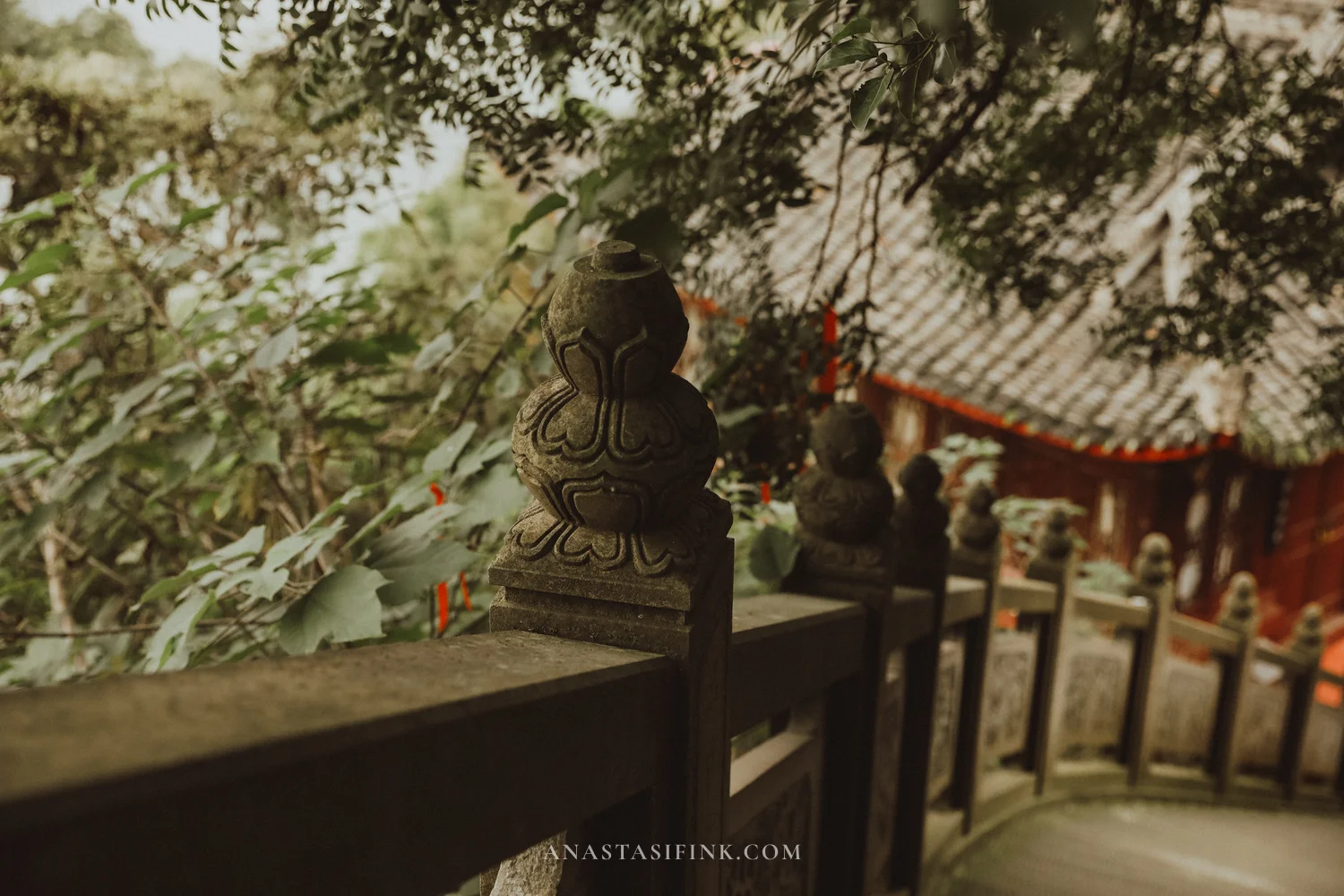
The descent to the main temple
The Main Wuyou Temple — Quiet at the End
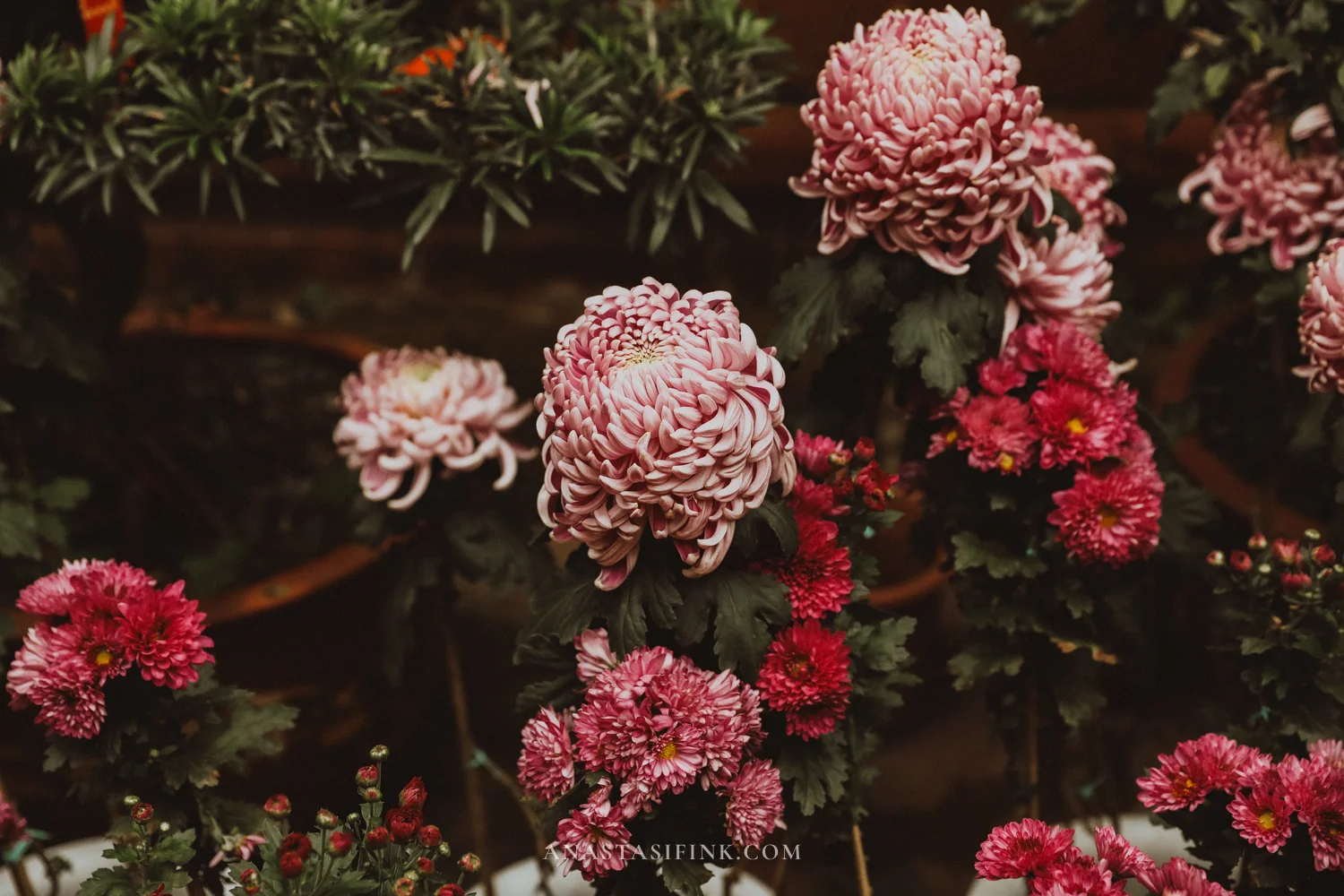
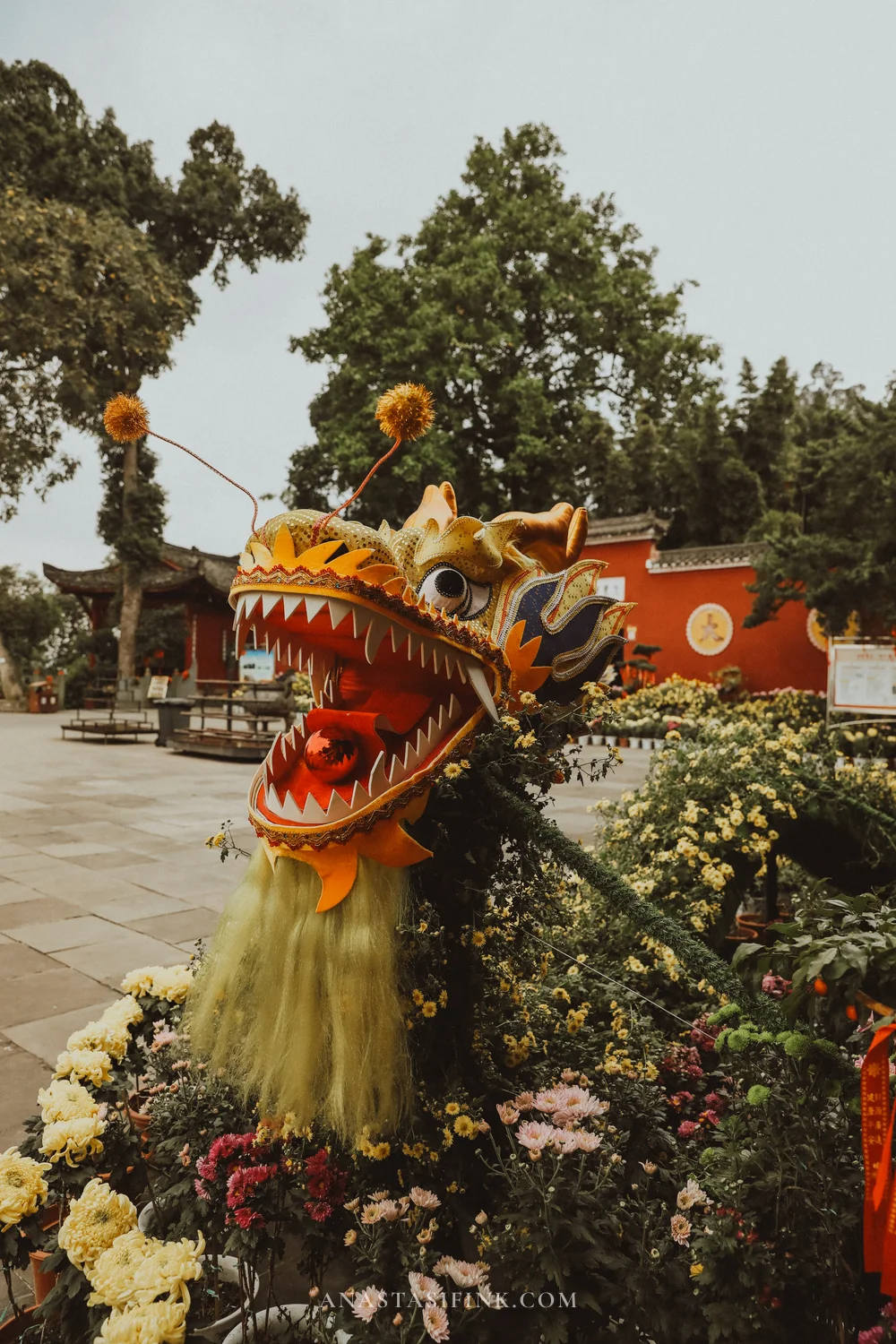
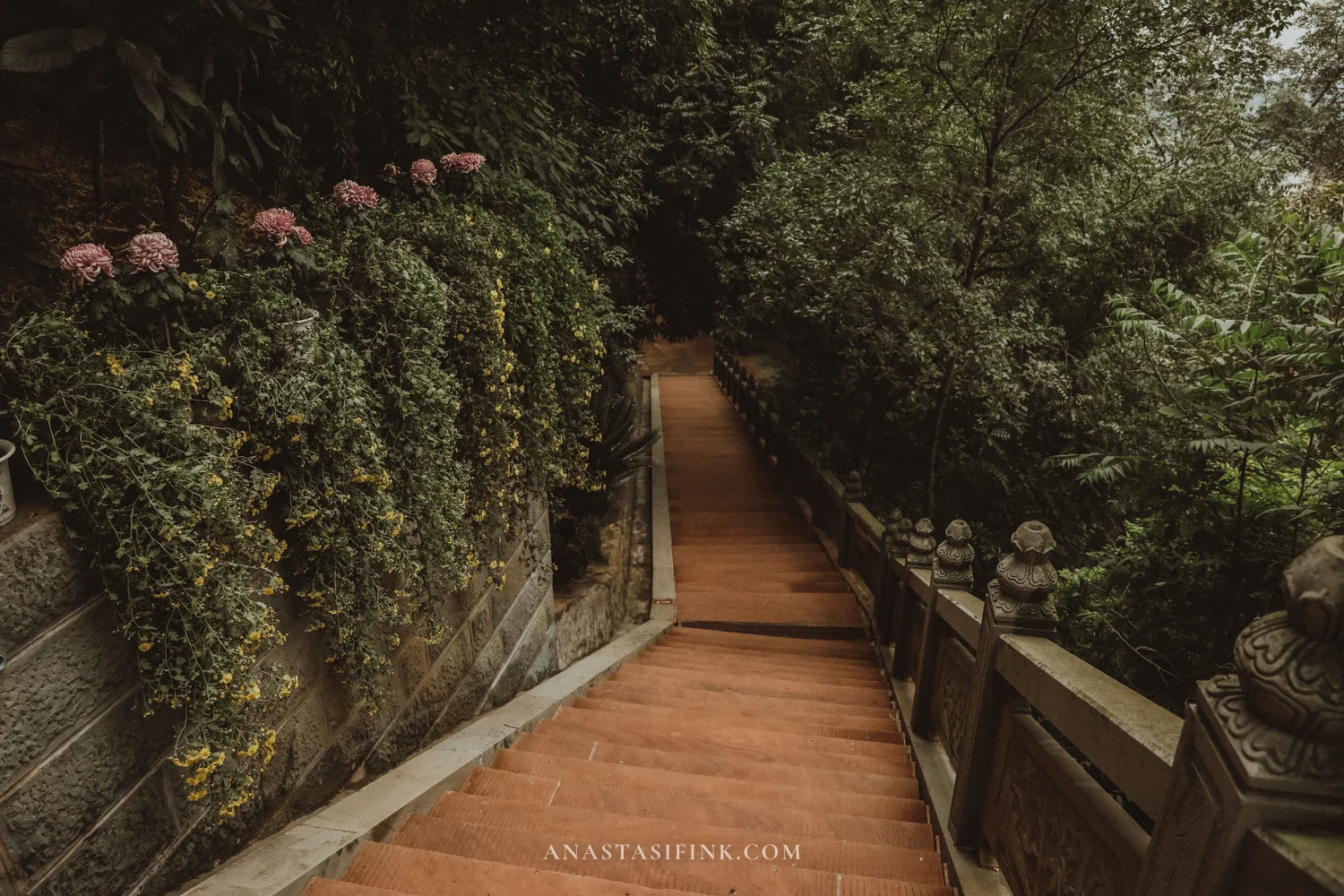
From the temple terraces there’s a view of the river and the distant fields, and in autumn the place is buried in chrysanthemums — set out in hundreds of pots, yellow, pink, deep red.
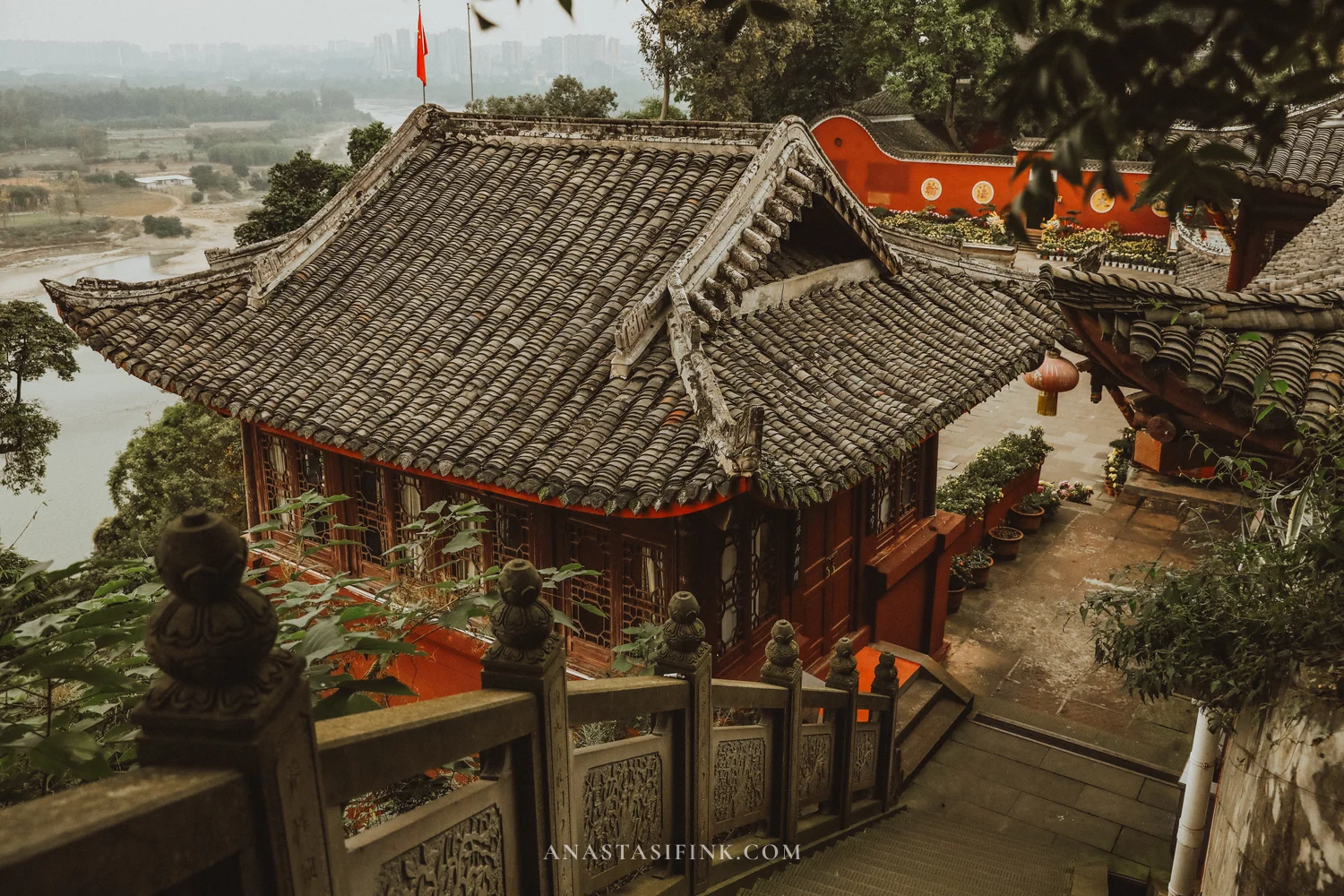
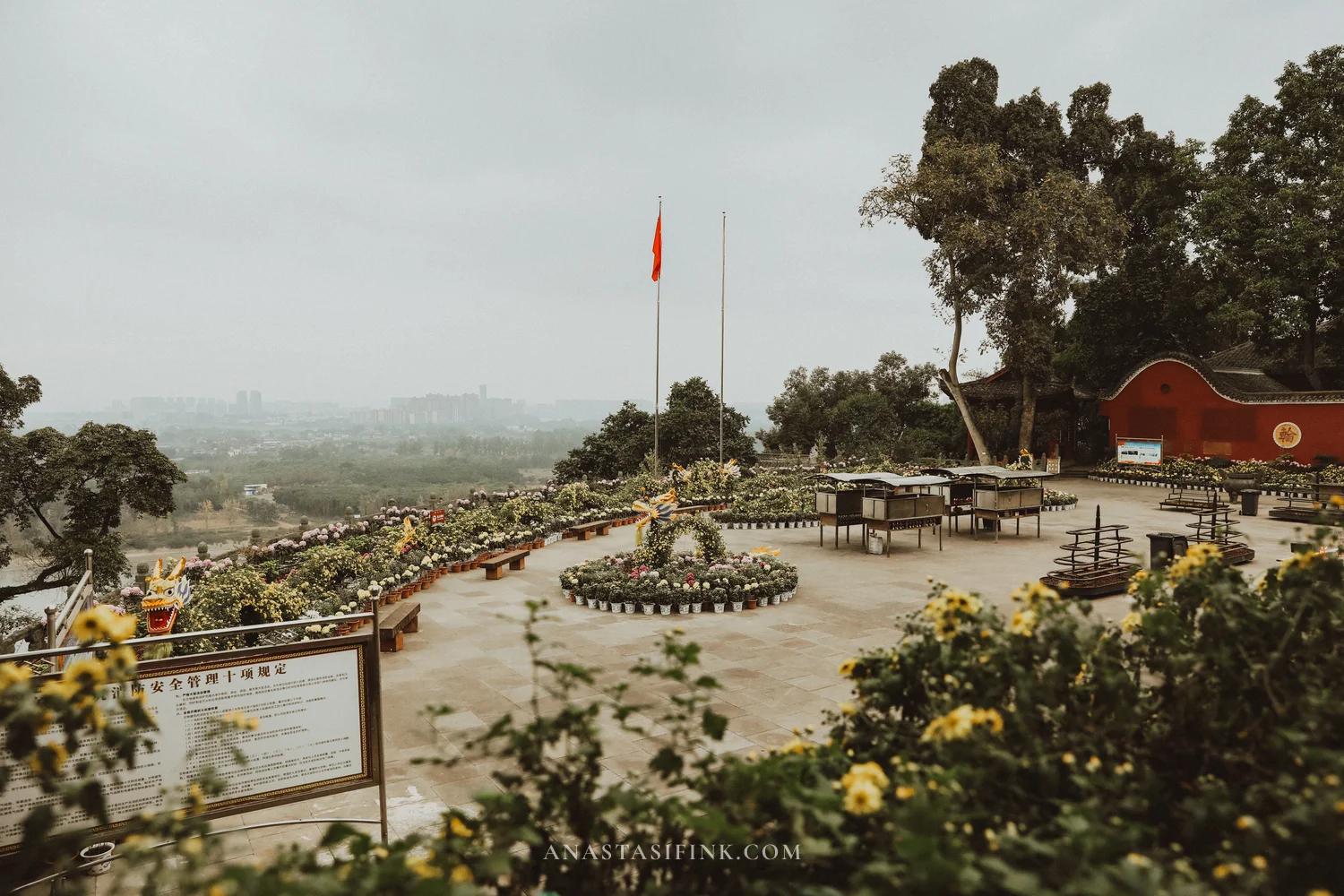
From the Wuyou Temple terraces — a view of the river and the fields
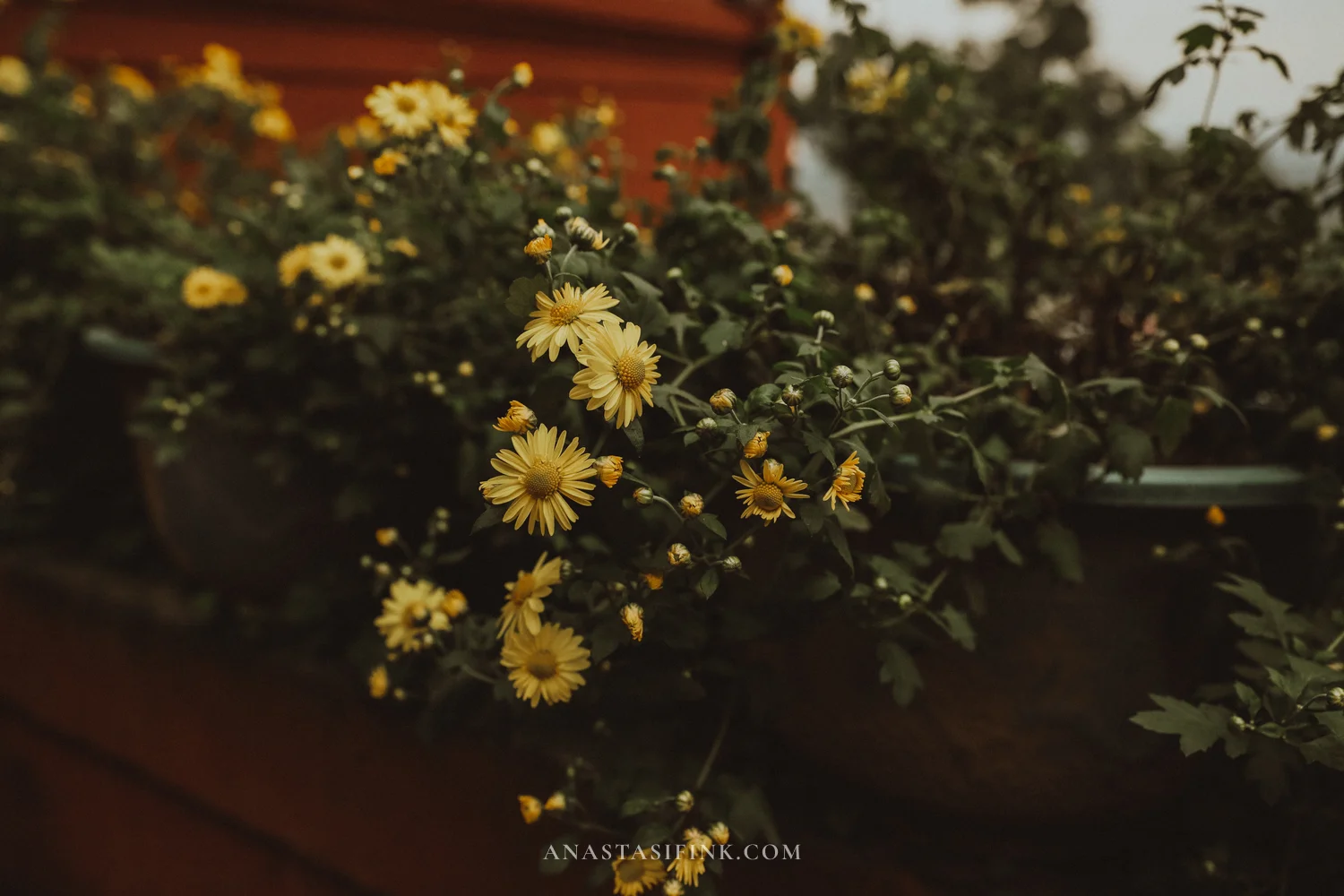
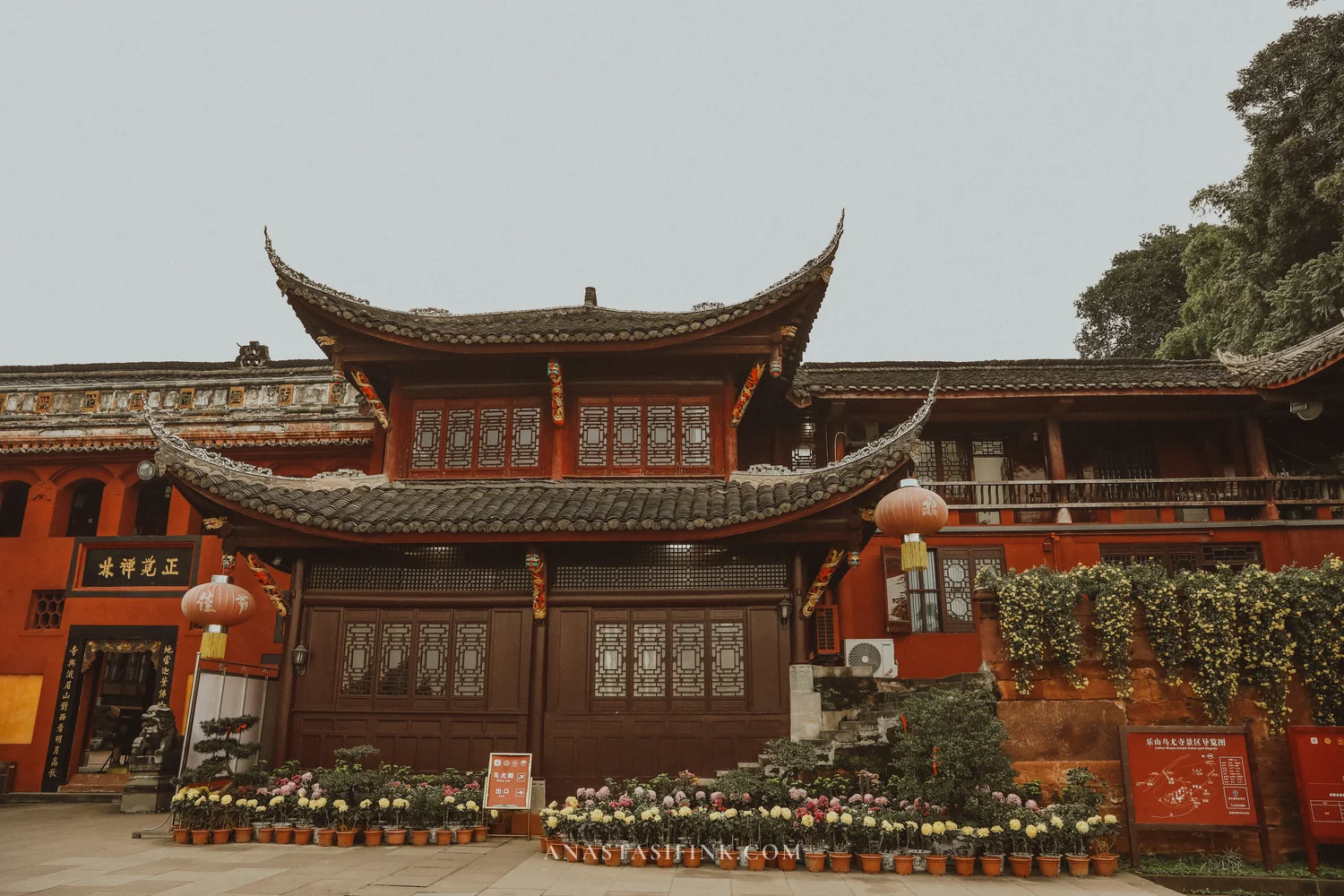
In autumn the temple sets out hundreds of pots of chrysanthemums
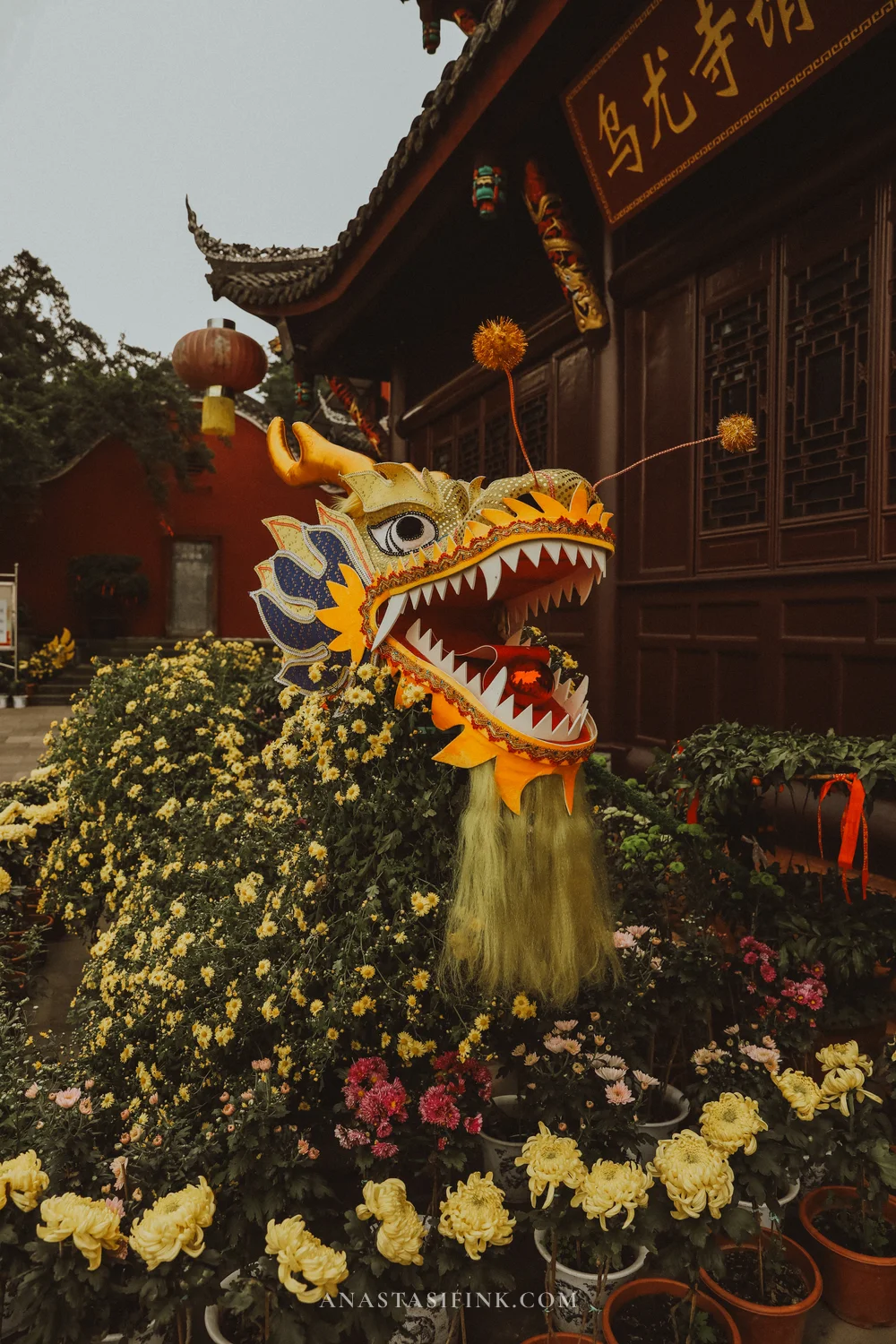
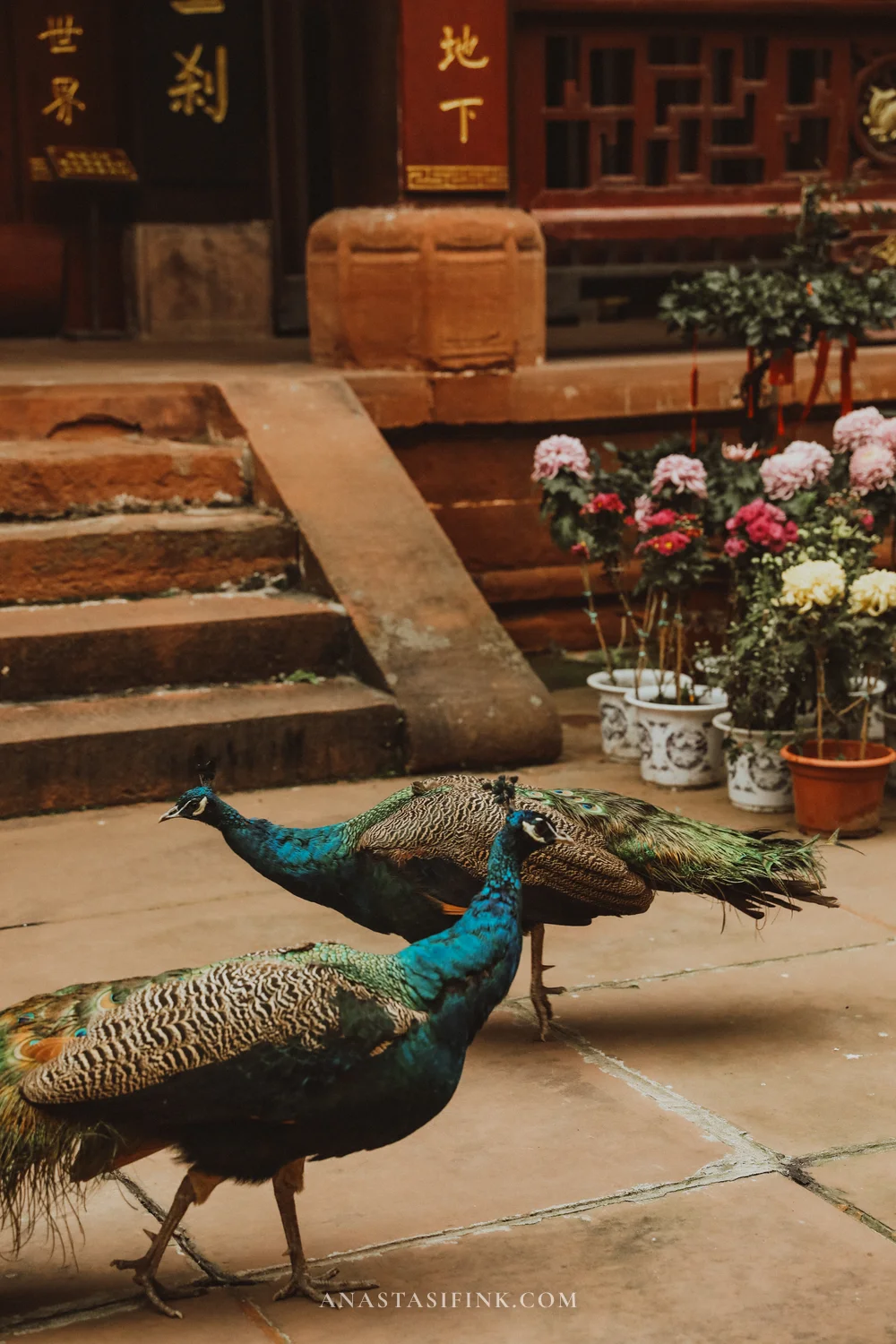
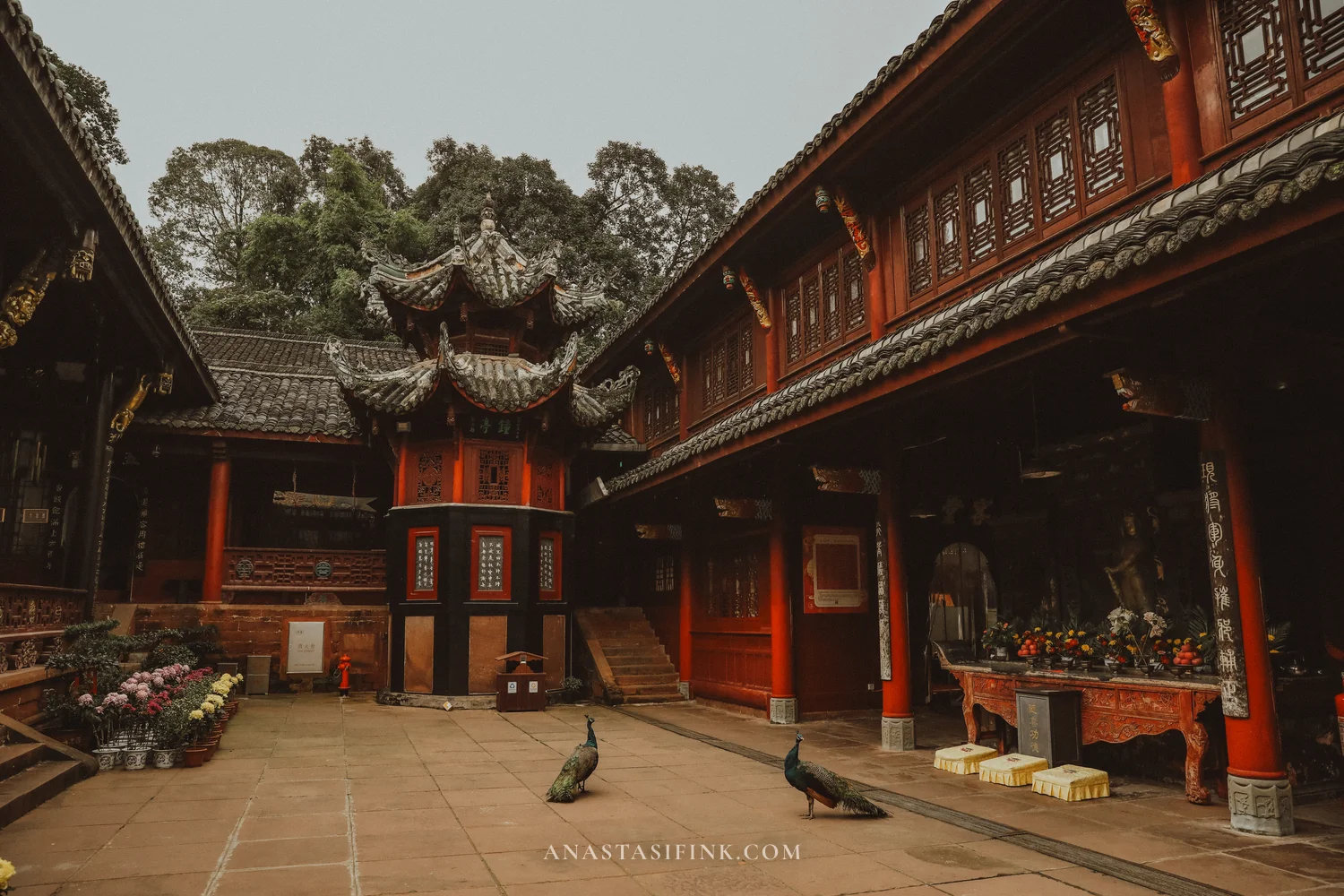
Peacocks wander the temple courtyard — real, live ones, strutting between the pots of flowers. In the centre of the courtyard stands an octagonal pavilion, ringed by red galleries. There’s hardly anyone here: Wuyou Temple sits off the main flow of visitors, and that’s its great charm.
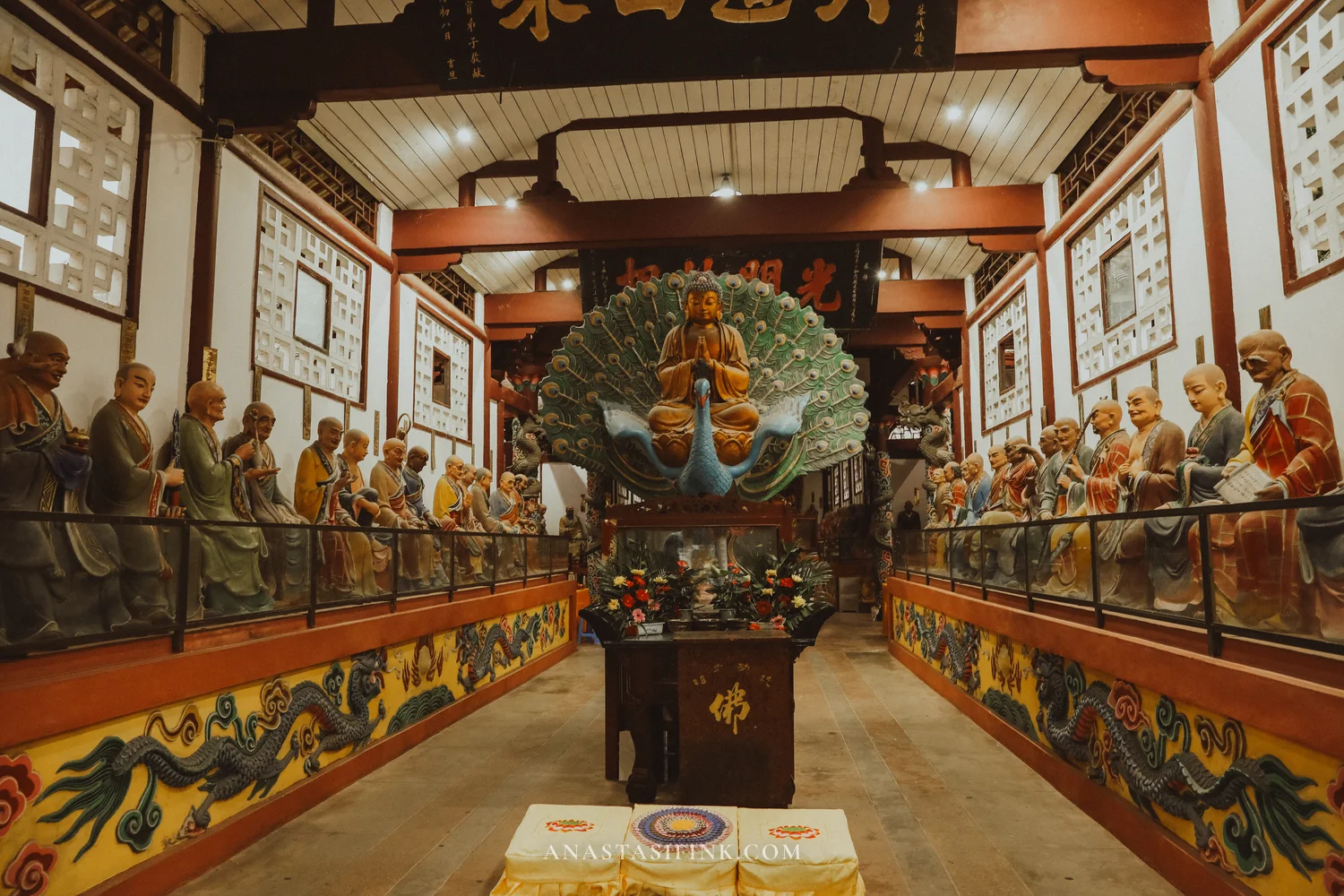
The highlight here is the Arhat Hall (Luohan Tang). It’s a long hall lined on both walls with 500 painted statues of arhats — Buddhist saints — and no two are alike: each has its own face, pose, and expression. At the centre is a figure on a peacock with its tail spread. The sheer number and variety are what make it.
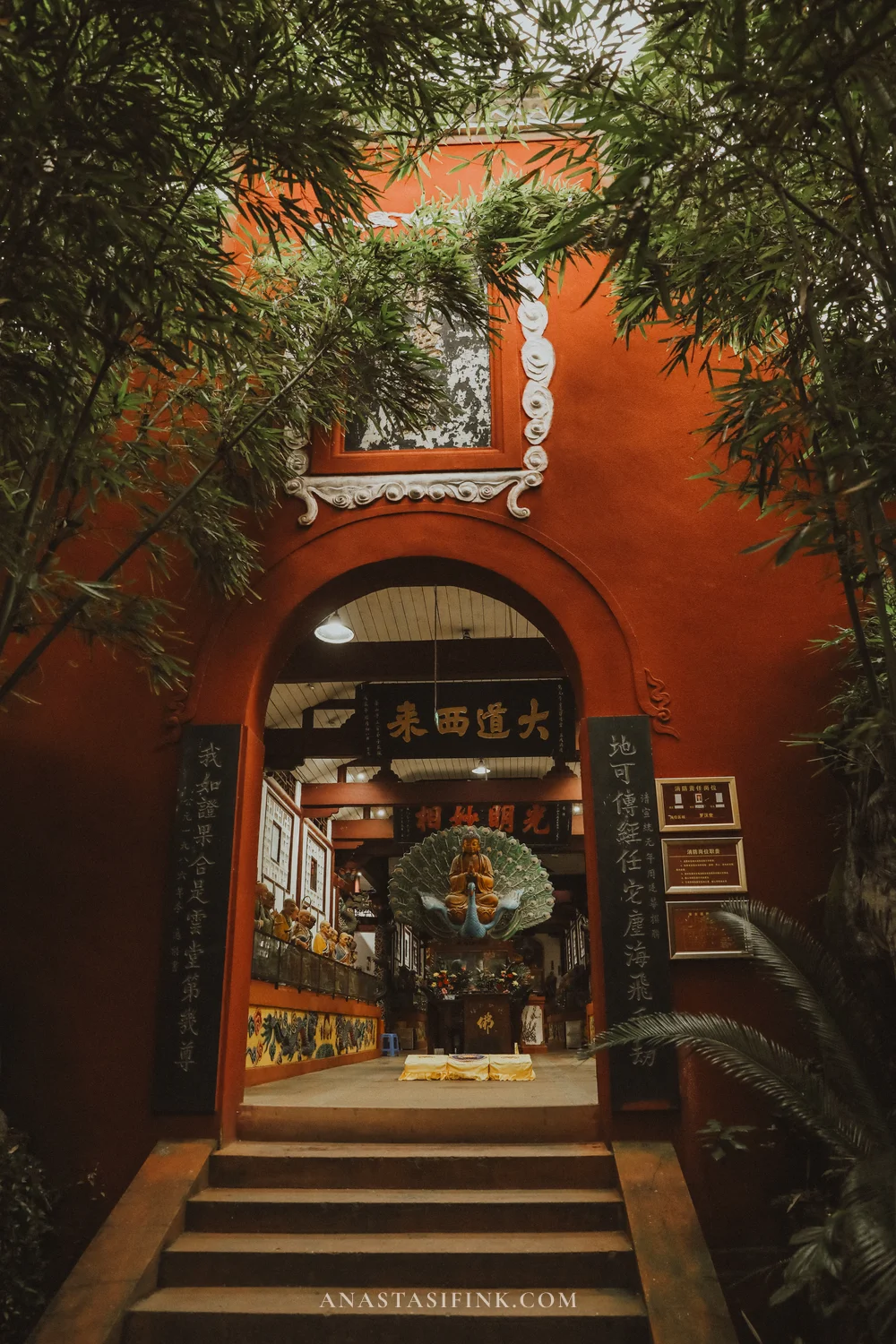
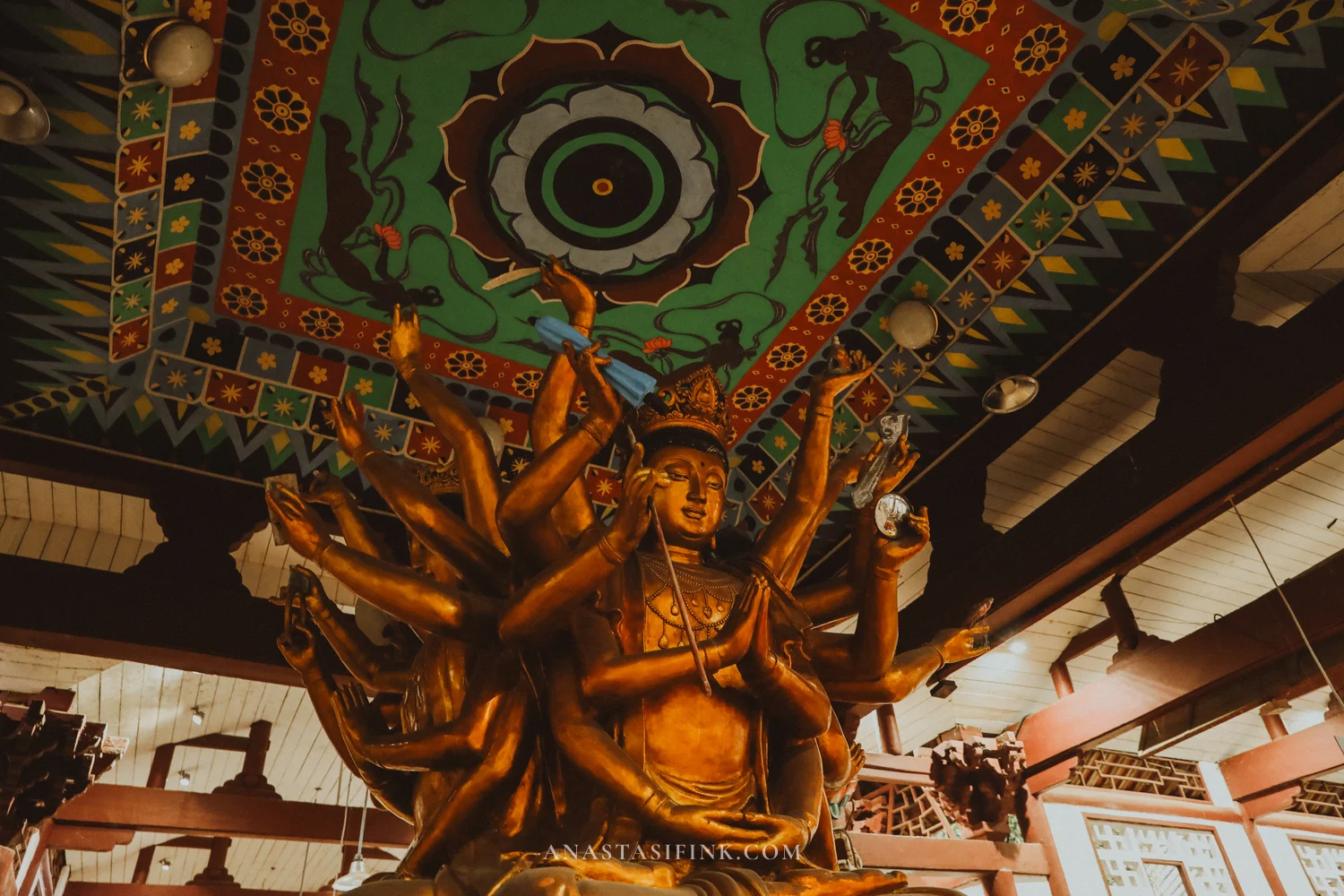
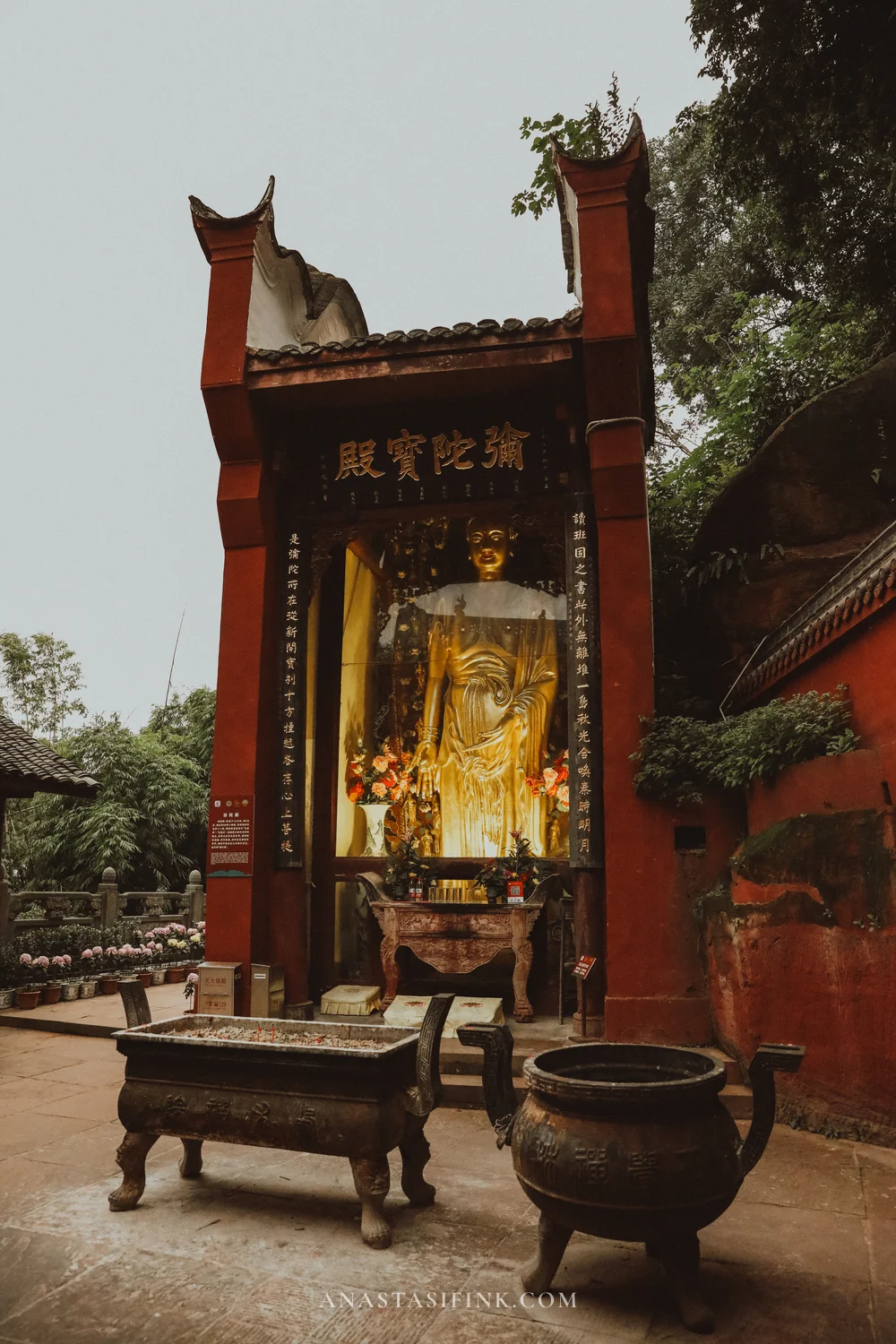
Toward the end, the temple empties out completely. In one of the halls I met a temple cat, dozing by a ritual cushion embroidered with a lotus — seemingly the only one truly at home here. In the far halls stand a gilded thousand-armed Guanyin under a painted ceiling and a golden Amitabha Buddha in a red niche.
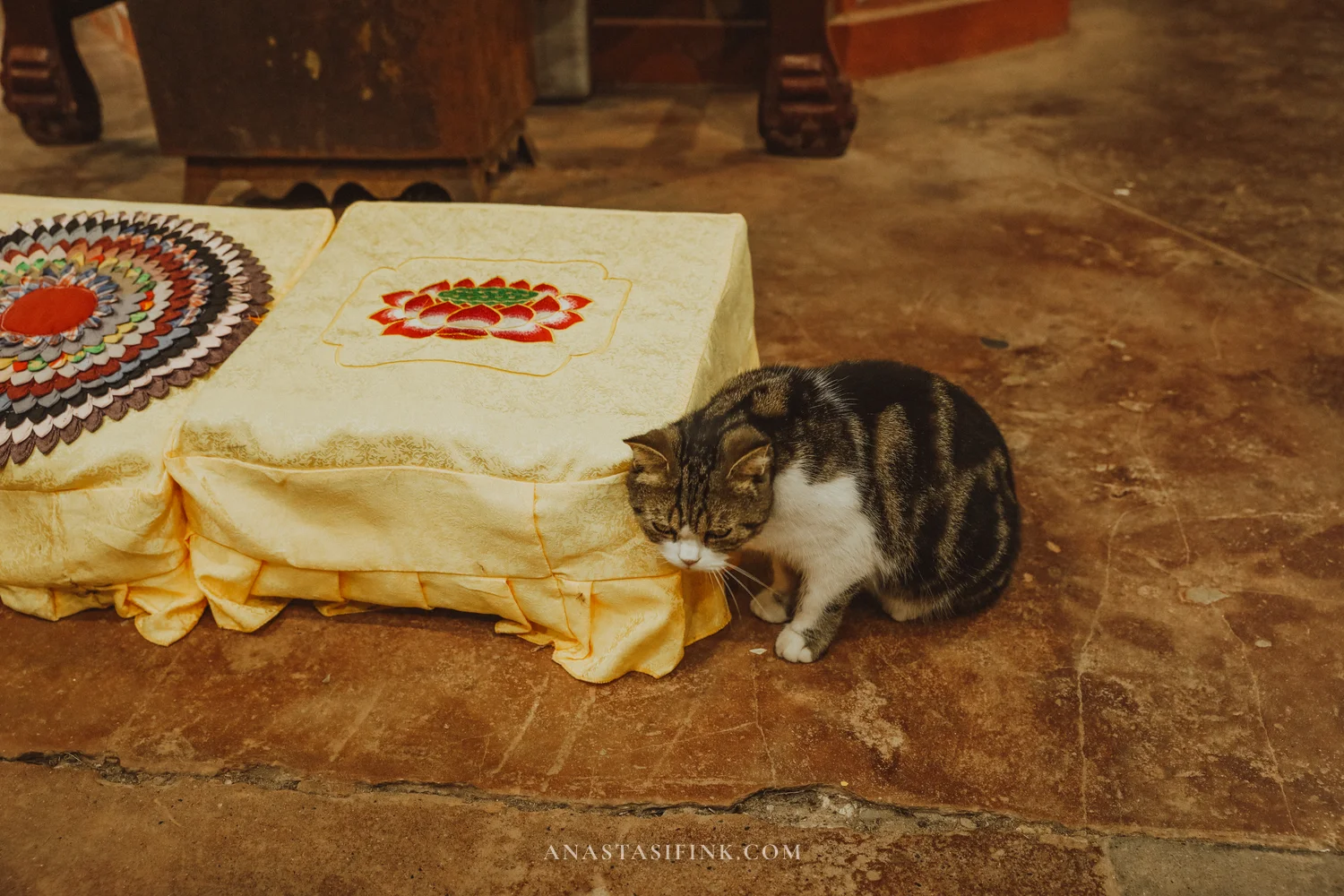
The temple cat — seemingly the real resident of these halls
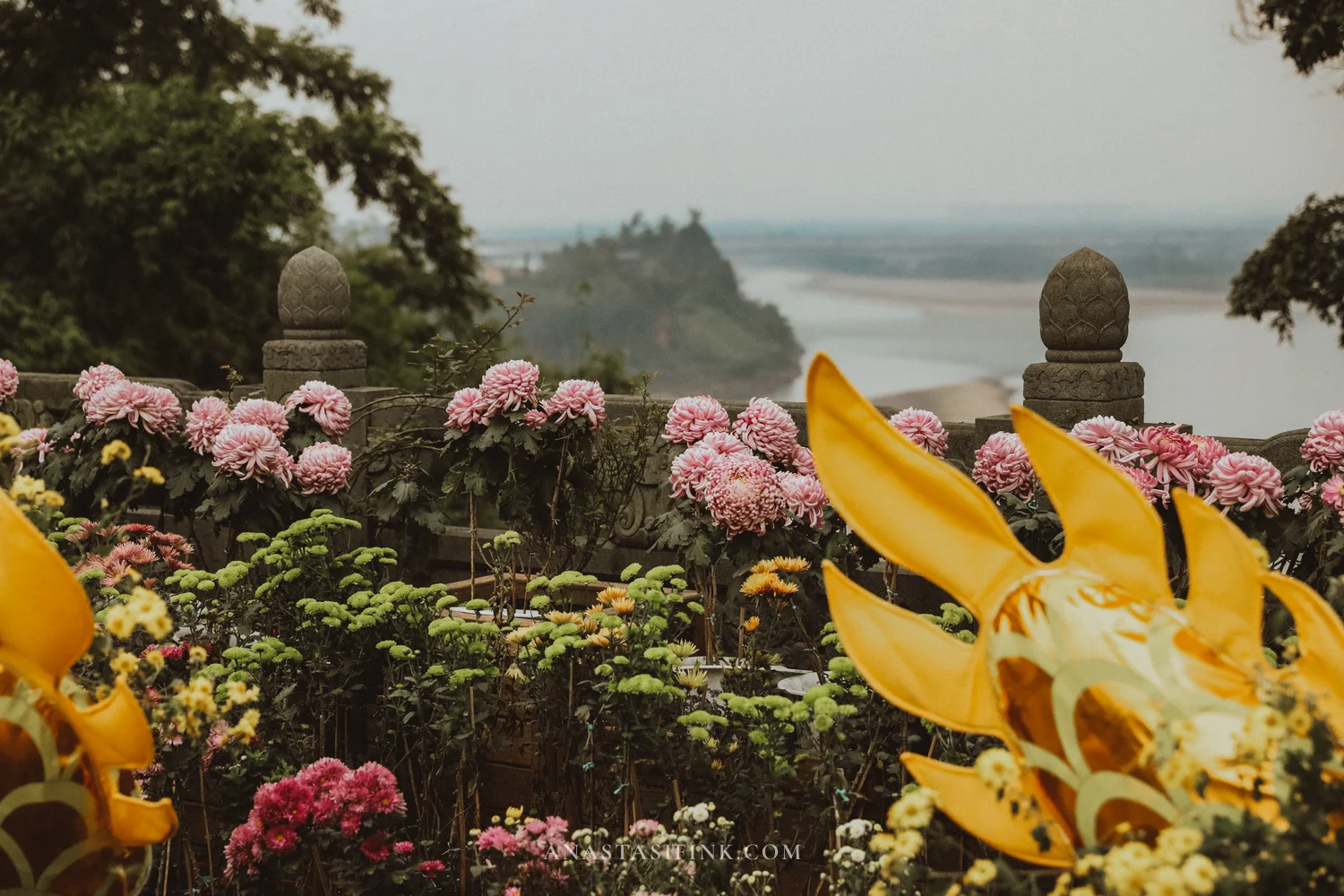
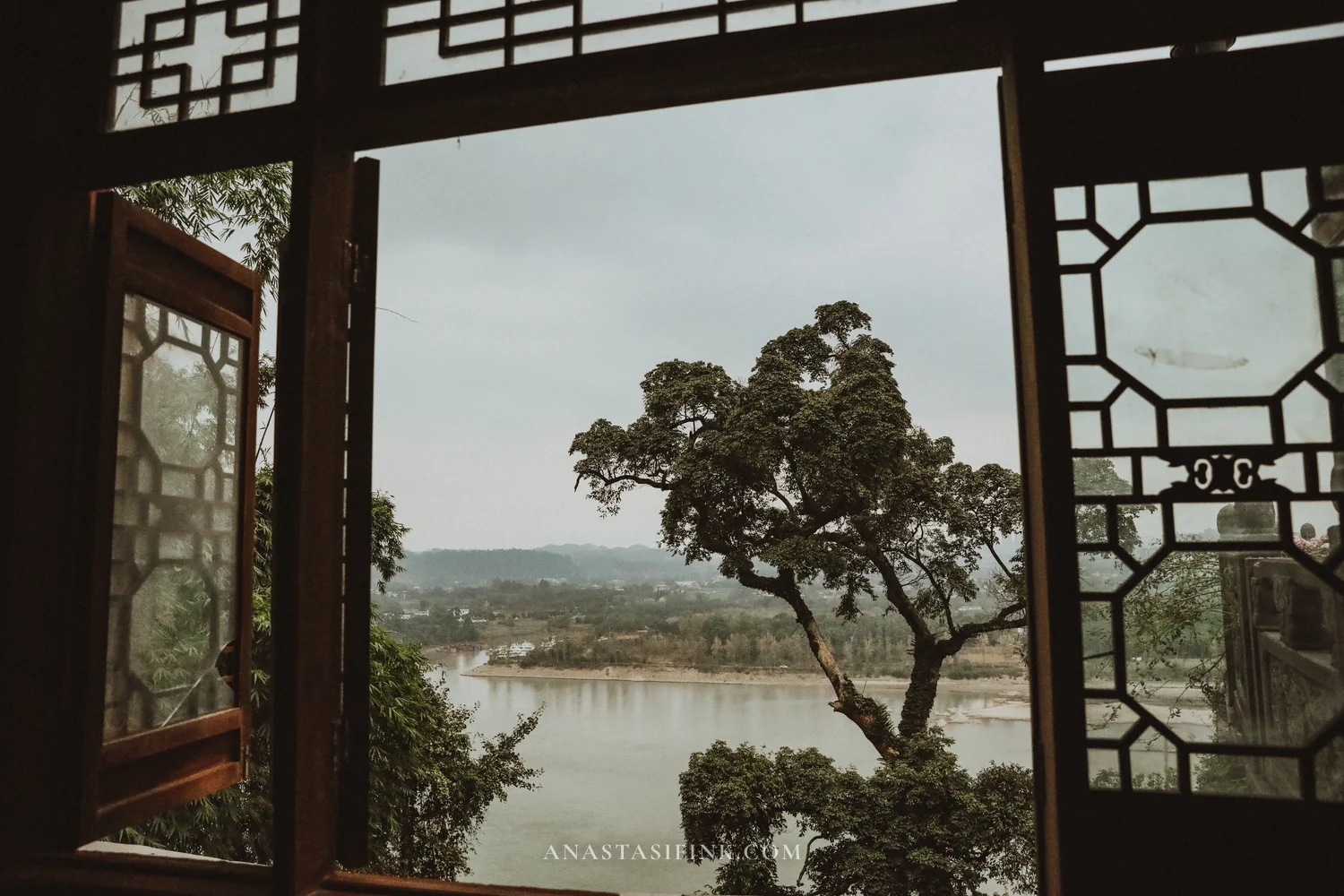
River views from the temple — through the flowers, and through a carved window
A Timing Tip: Where to End the Route
My single best tip from the whole trip — plan it so Wuyou Temple is last. Most visitors turn back right after the Buddha’s feet and never reach the island, so by the end of the day there’s almost no one here. The main Buddha is always crowded, but here you get peacocks, chrysanthemums, river views, and complete quiet. It’s the perfect calm finish after the busy descent to the statue.
The whole route — from the entrance, where you walk in, to the finish at Wuyou Temple — takes about 2–3 hours. The park is open 7:30 to 18:30 in summer (April 1 – October 7) and 8:00 to 17:30 in winter (October 8 – March 31). To reach Wuyou without rushing, go in at least 3 hours before closing — that is, no later than 15:30 in summer and 14:30 in winter. And to catch the island at its emptiest, save it for the very end: the main crowd will have thinned out by then.
Practical information
- Where: Leshan Giant Buddha, Lingyun Mountain, Leshan, Sichuan Province, China
- GPS: 29.5447, 103.7739
- Opening hours: April 1 – October 7, 07:30–18:30; October 8 – March 31, 08:00–17:30
- Ticket: high season (Apr 1 – Oct 7) 80 yuan (~$11), low season 50 yuan (~$7); free for children under 1.2 m and under 6, and for visitors 65 and over
- Boat: ~70 yuan (~$10), separate ticket; departs from Jiazhou Ferry Pier near the park entrance, ~30 minutes
- Booking: daily cap of 26,000 visitors — buy online at least a day ahead (“Dafu Tourism” mini-programs in WeChat or Alipay)
- How long: 2–3 hours for the route itself up to Wuyou Temple; with the boat and queues, about half a day
Getting There
- From Chengdu: high-speed train from Chengdu East or Chengdu South to Leshan station — about 1 hour. From Leshan station, bus No. 3 to the park, another ~45 minutes
- Inside the park: from the entrance to the start of the route you can walk or take an electric cart
Tips
- Arrive at opening: fewer people in the morning and no queue for the descent to the Buddha’s feet
- Comfortable shoes are a must — there are a lot of steep steps up and down over the day
- The Nine-Bend descent is steep but safe: there are railings, just take your time
- Read the boards — almost all are duplicated in English and explain what’s around you
- Combine the walking route with the boat: from the water you see the Buddha in full, as intended
- Save the bridge and Wuyou Temple for the end of the day — there’s hardly anyone there
- Bring water; you can buy coffee at the Luckin Coffee by the entrance
Why Go
You stand at the Giant Buddha, head tilted back, and still can’t take in the whole head at once — that’s when you understand why people come. 71 metres, 1,200 years, ninety years of carving, and a monk who gave his eyesight for the idea. And next to it, a quiet island with peacocks and five hundred stone saints, where few people make it. If you’re in Sichuan, don’t stop at the Buddha: cross the bridge and climb up to Wuyou Temple. The best part of this route is often right at the end.
Also in China: One hour from Chengdu, Huanglongxi Ancient Town has old streets, stone bridges and temples. In Shenzhen, the Fairy Lake Botanical Garden combines Hongfa Temple, bamboo and a cactus garden, with entry about 15 yuan. See all my China travel guides.
FAQ
The easiest way is the high-speed train from Chengdu East or Chengdu South to Leshan station, about an hour. From Leshan station, bus No. 3 runs to the park, another 45 minutes or so.
In high season (April 1 – October 7) a ticket is 80 yuan (about $11), in low season 50 yuan (about $7). Children under 1.2 m and under 6, and visitors 65 and over, get in free. The boat cruise is a separate ticket, around 70 yuan.
The route itself — from the entrance to Wuyou Temple on the island — takes about 2–3 hours. With the boat cruise and weekend queues, plan for roughly half a day.
The Nine-Bend descent is steep and narrow in places, but safe: there are solid railings along the edge. Anyone in reasonable shape will manage; just don’t rush. There can be a queue on the descent at weekends.
Yes, if you have the time. From the water you see the whole Buddha head-on — exactly as it was meant to be seen, and a view you can’t get on foot. The cruise lasts about 30 minutes, and the boat stops in front of the statue.
Arrive at opening, to reach the Buddha before the main crowds and skip the queue on the descent. In autumn the chrysanthemums bloom at Wuyou Temple. Leave the second half of the day for the island — few people get that far.
The Maitreya Cave, the Daoist “Yijing Annotation Cave,” Lingyun Temple, the monk Haitong’s cave, and — after the exit — the Haoshang Bridge and Wuyou Temple with its hall of 500 arhats. Wuyou Temple is the one to save for the end of the route.