Ten Thousand Buddhas Monastery, Hong Kong: Complete Guide

The Ten Thousand Buddhas Monastery in Sha Tin is one of the most unusual temples in Hong Kong. To reach it you climb a staircase of several hundred steps lined with golden statues of monks. And at the top, a Buddhist complex sits right next to a Taoist temple.
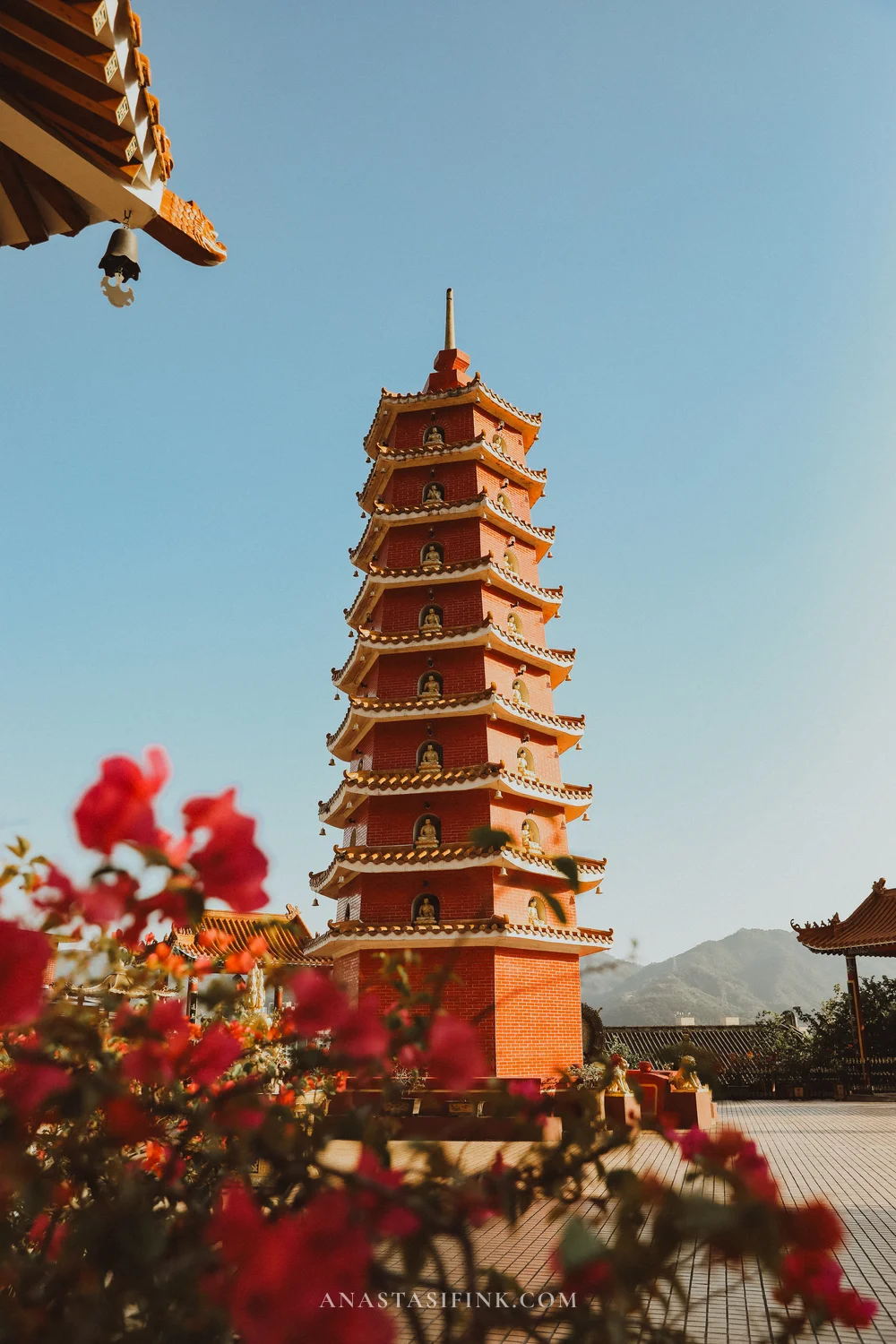
What Is the Ten Thousand Buddhas Monastery
It’s a Buddhist monastery in the Sha Tin district, out in Hong Kong’s New Territories. In Chinese it’s called Man Fat Sze (萬佛寺), which means “Ten Thousand Buddhas Monastery.” You can take the name almost literally: there really are around 13,000 Buddha figures here. And in Chinese culture, “ten thousand” tends to mean “countless” rather than an exact figure.
Quick clarification, so there’s no confusion: the “ten thousand Buddhas” themselves are the little figures in the hall at the top. The statues that escort you the whole way up the staircase are not Buddhas—they’re arhats. More on them in a moment.
The monastery was founded by a monk named Yuet Kai. He came to Hong Kong from mainland China in the late 1940s, and in 1949 he and his disciples began building right on the hillside. The work took about eight years—the monastery opened in 1957. So this isn’t an ancient monument, but a mid-20th-century temple.
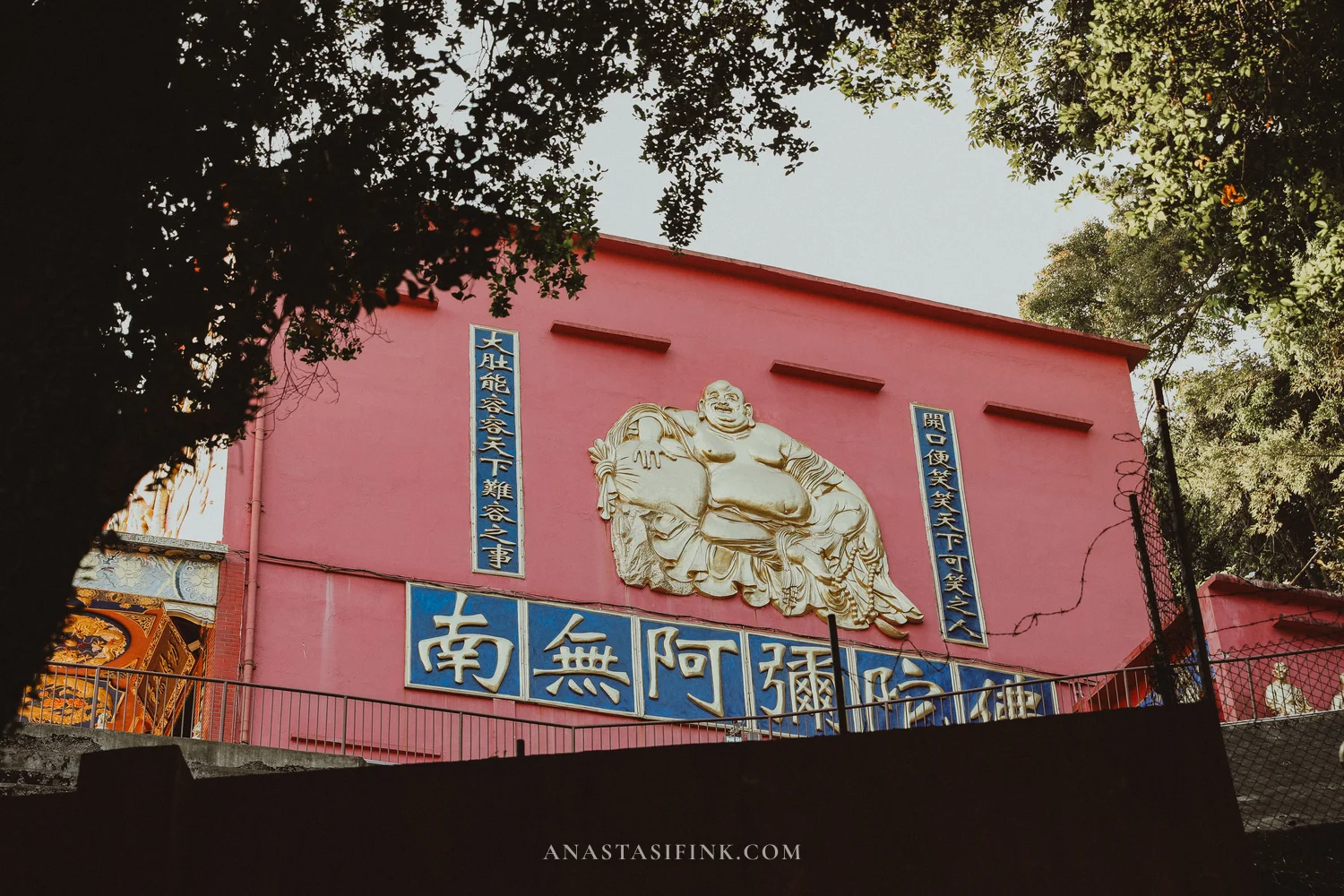
The Climb Past the Golden Arhats
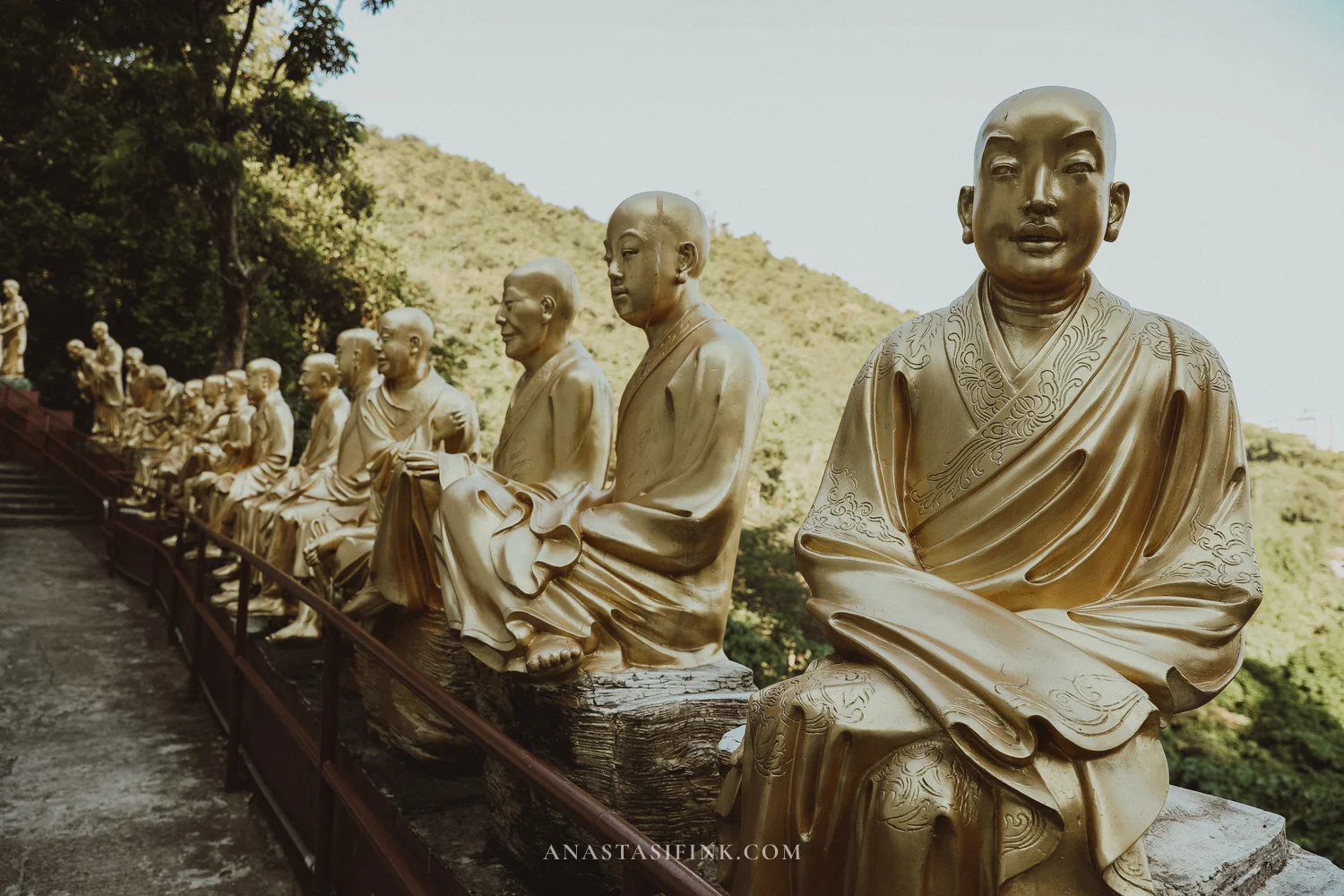
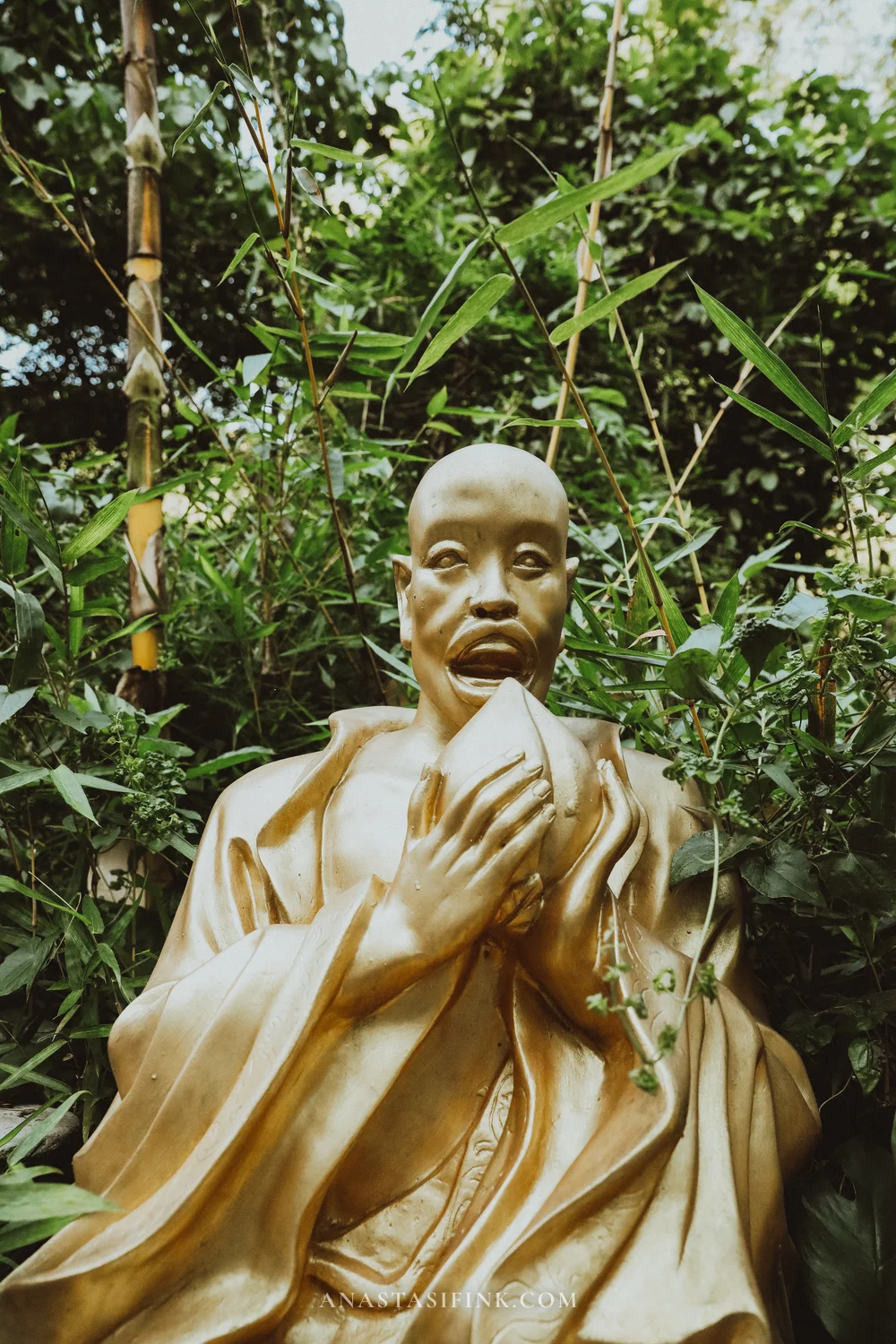
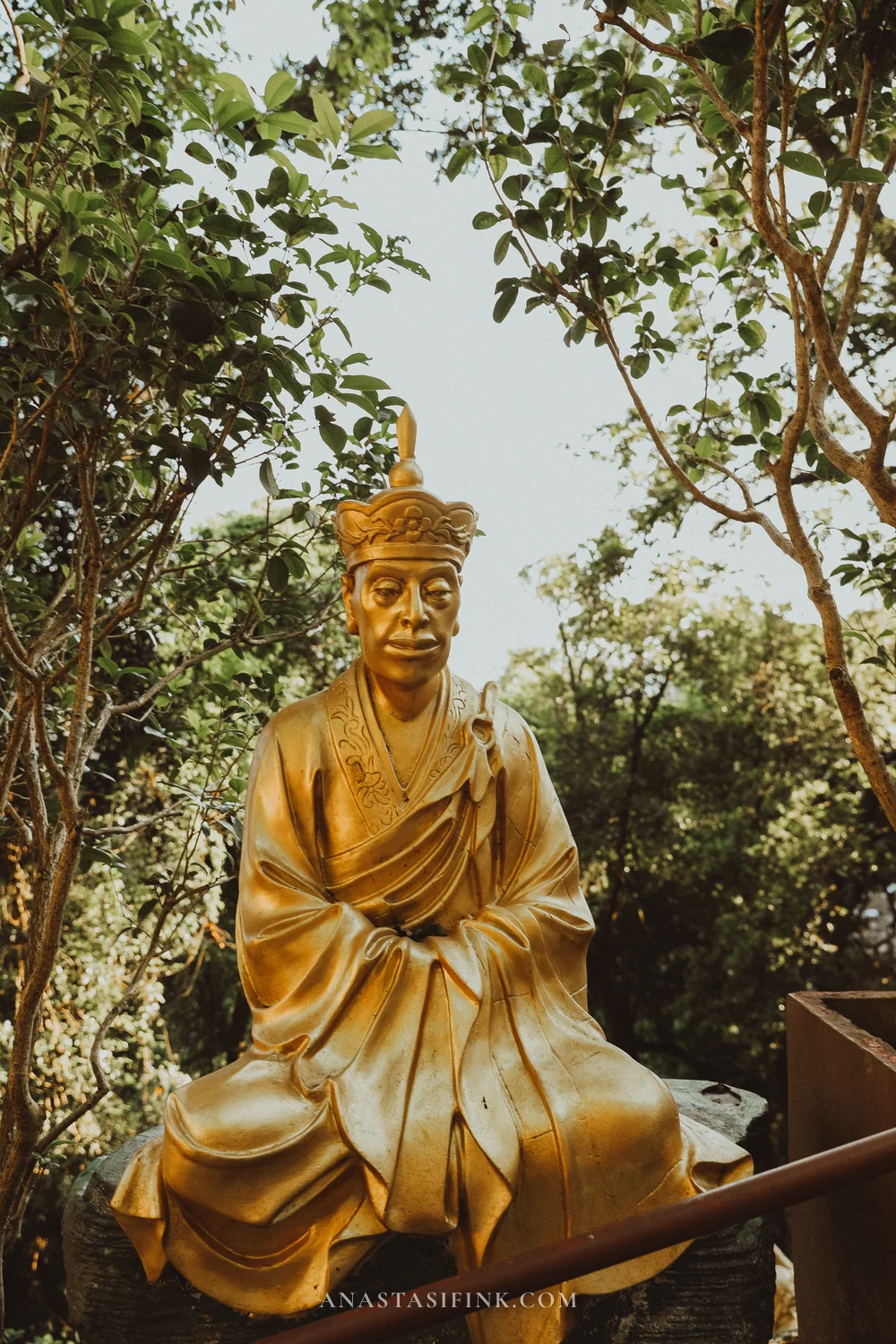
The main route up to the monastery is a staircase of roughly 430 steps, and full-size golden statues line both sides of it. These are arhats (luohan in Chinese): in Buddhism, that’s what you call disciples of the Buddha who have reached enlightenment. Think of them as the equivalent of saints in Christianity. The statues were made by craftsmen from Yunnan and Guangdong provinces, and no two faces are alike.
The Buddha left the arhats in the world to guard the teaching until the coming of the future Buddha. They’re usually depicted in groups—most often the eighteen canonical luohan, and in large monasteries like this one, around five hundred.
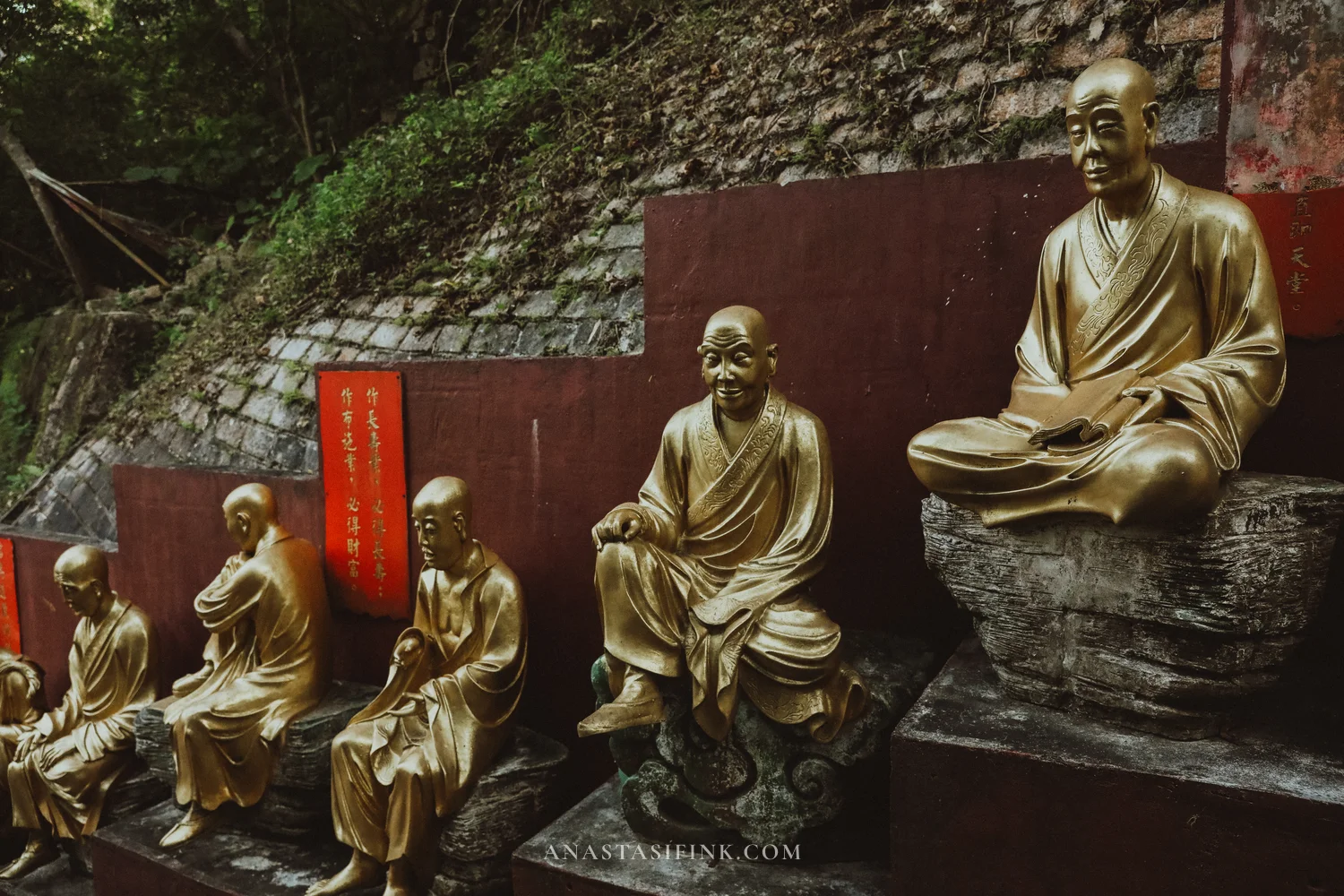
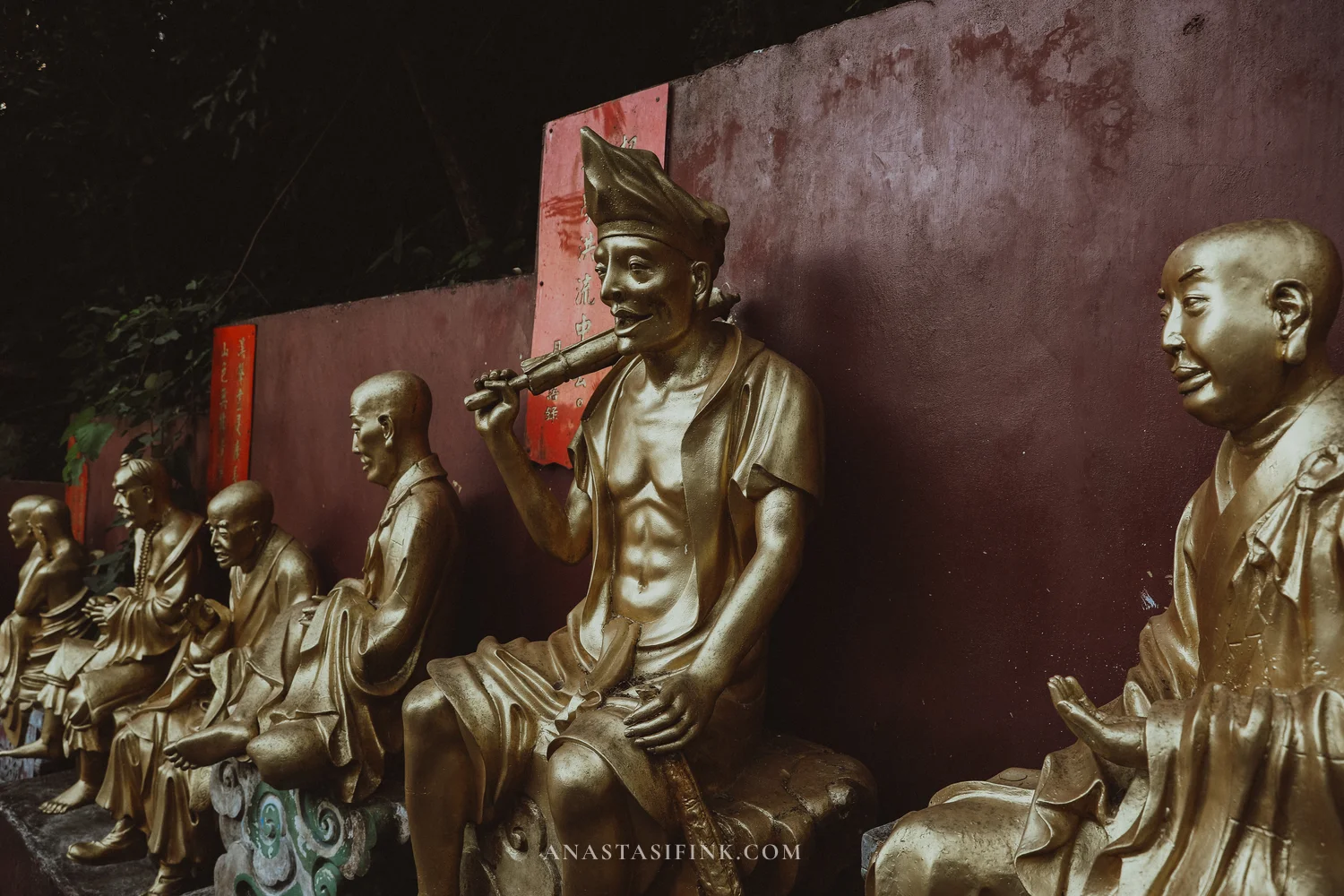
The golden arhats stretch the entire length of the climb
The climb is steep and takes some effort. If you happen to be here in summer, when all of Hong Kong is melting under the sun and it’s well over 35°C, it won’t be easy. But honestly, it’s worth it.
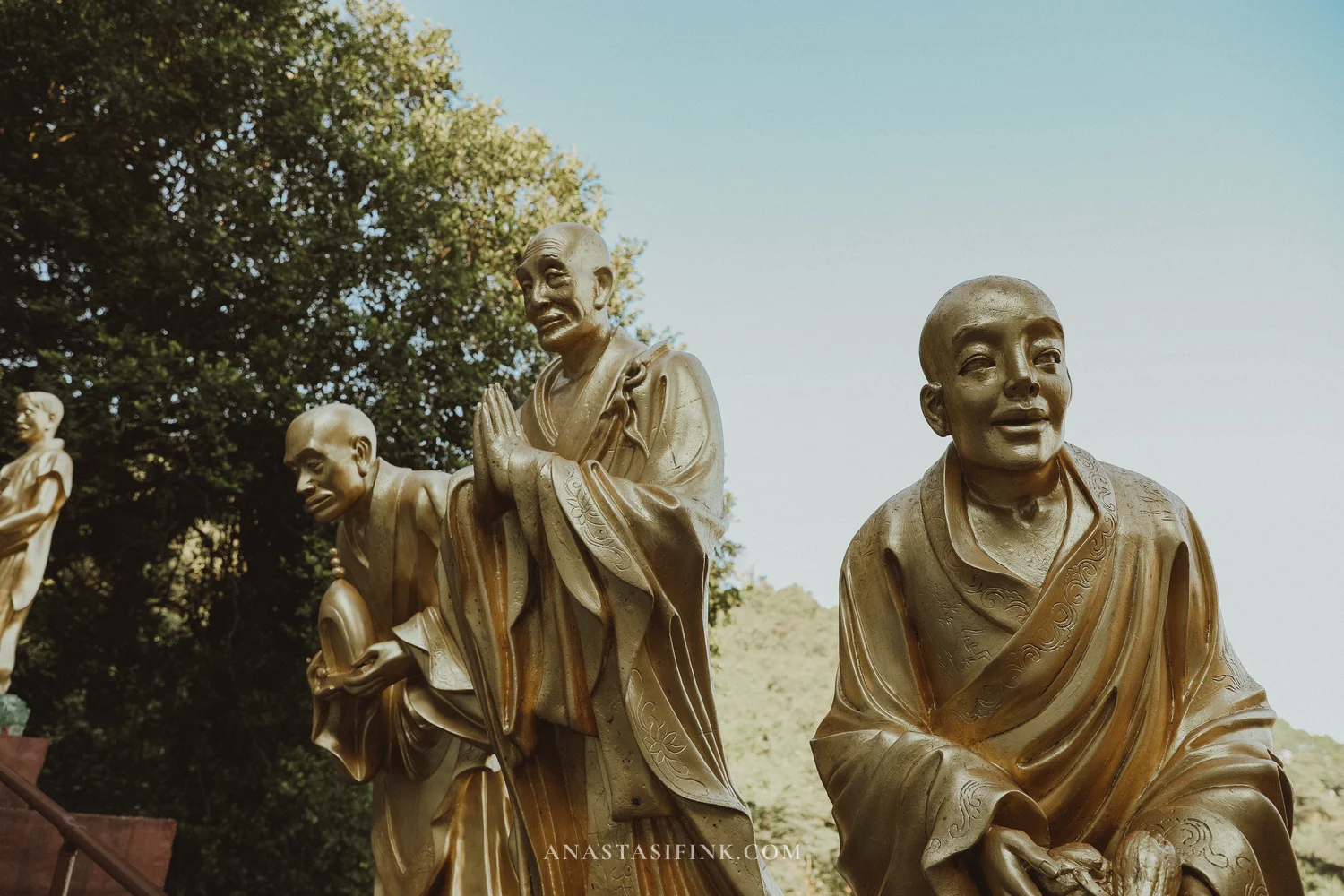
At first it feels like you’ve stepped into some surreal film. You study the statues one by one—and they’re all completely different. One has hands folded in prayer, another rests his cheek on his hand, lost in thought, a third is laughing his head off. There’s an arhat with a long beard, one who’s very young, one holding a bowl or a scroll. Living, almost caricatured characters.
And this isn’t just staircase decoration. An arhat (Sanskrit for “worthy one”) in Buddhism is someone who has walked the entire path, freed himself of desire and stepped out of the cycle of rebirth—after that, only nirvana remains. Each figure on the climb stands for its own quality: wisdom, patience, compassion, inner strength. Some hold an attribute—an alms bowl, a scroll, a staff or prayer beads; others subdue a dragon or a tiger. It’s essentially a visual language, where the pose and the object in hand tell a whole story.
So it’s worth taking a closer look at the deliberately strange figures. Eyebrows that are too long, an arm stretched toward the sky, an enormous belly—none of that is the sculptor’s whim, it’s the canon. It goes back to the oldest depictions of arhats, attributed to the monk-painter Guanxiu (9th century): he painted them as exotic foreigners—with bushy brows, big noses and sharp features. And the most striking traits carry specific meanings too. The long-armed arhat (his name is Panthaka) is one of the most recognizable: legend says his arms could stretch as far as needed, and he used them to pluck fruit from the tops of trees and to help others where an ordinary person couldn’t reach. So the long arm is about the ability to help and to “reach” those in need. And the long eyebrows on other figures are a sign of long years of asceticism and accumulated wisdom. So among these golden monks, look for character rather than beauty.
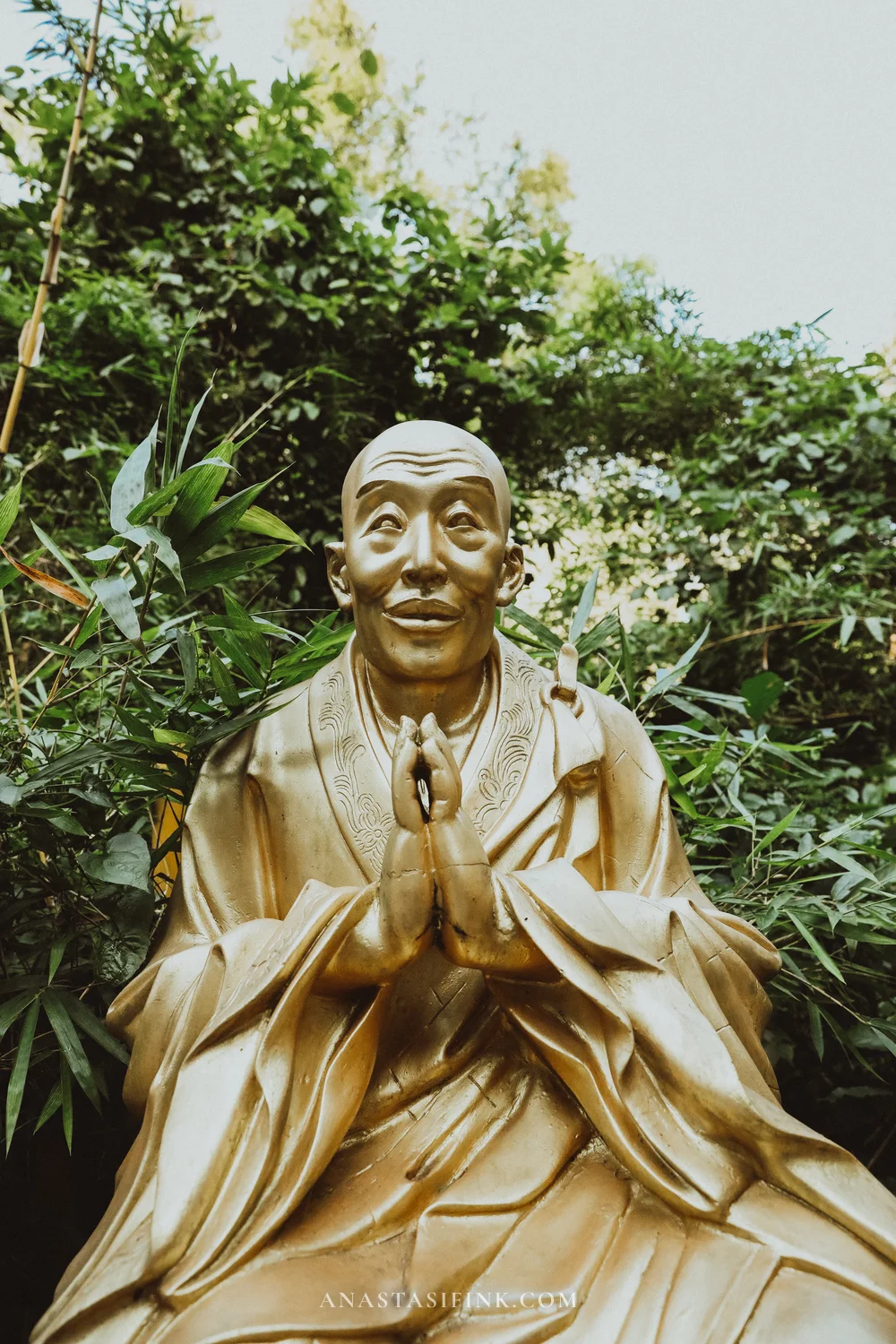
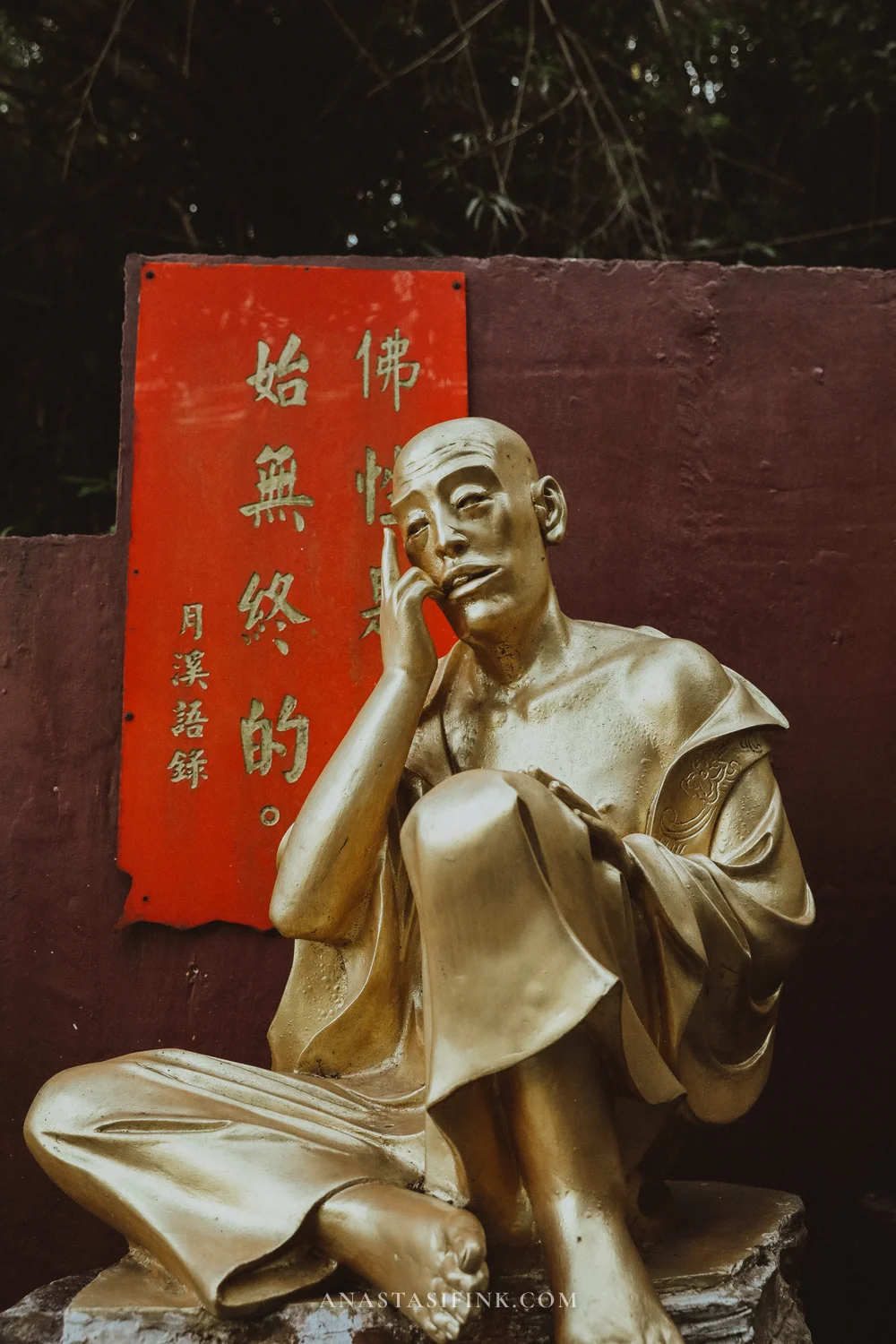
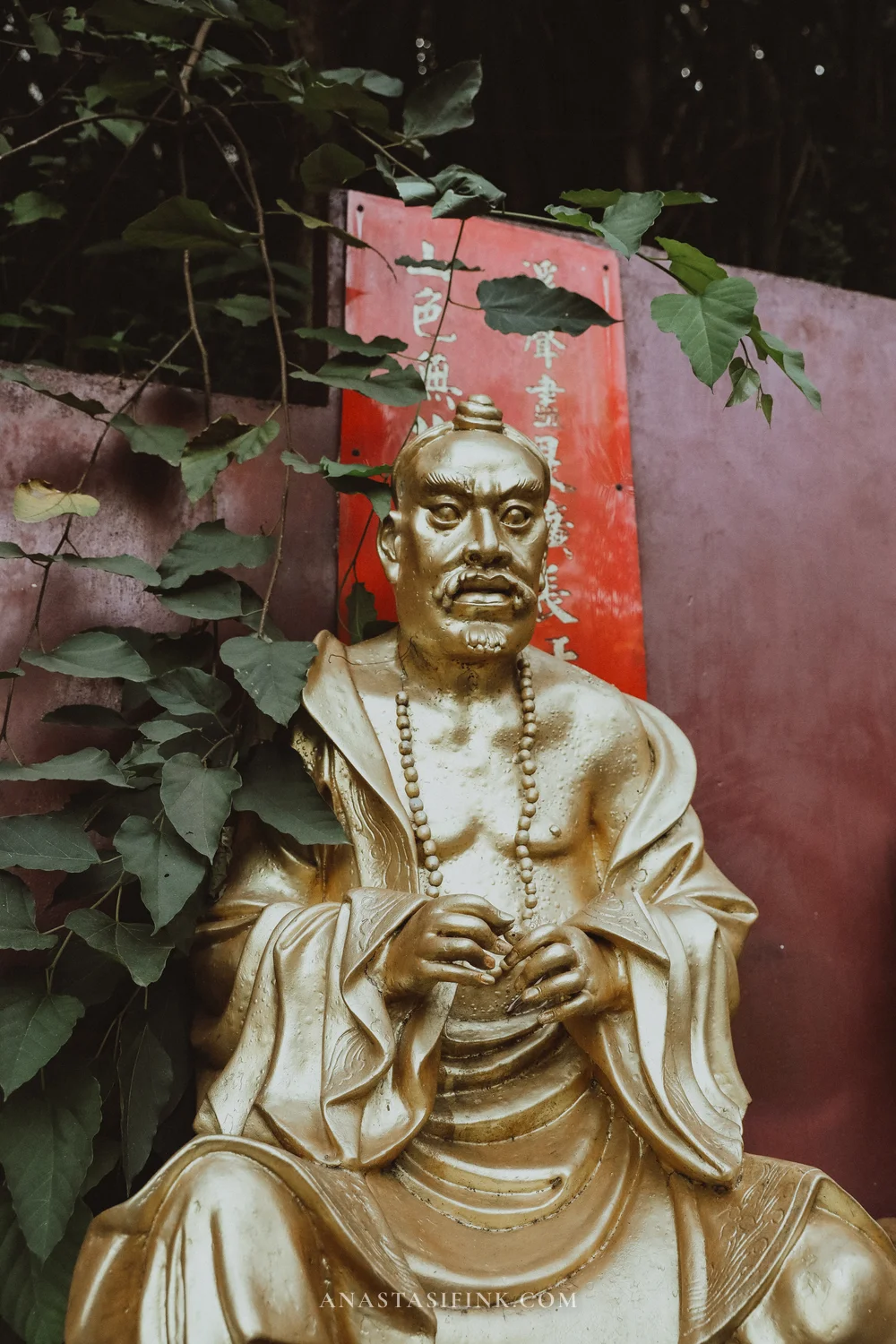
On the left, the “pondering” arhat resting his cheek on his hand; on the right, a white-bearded elder
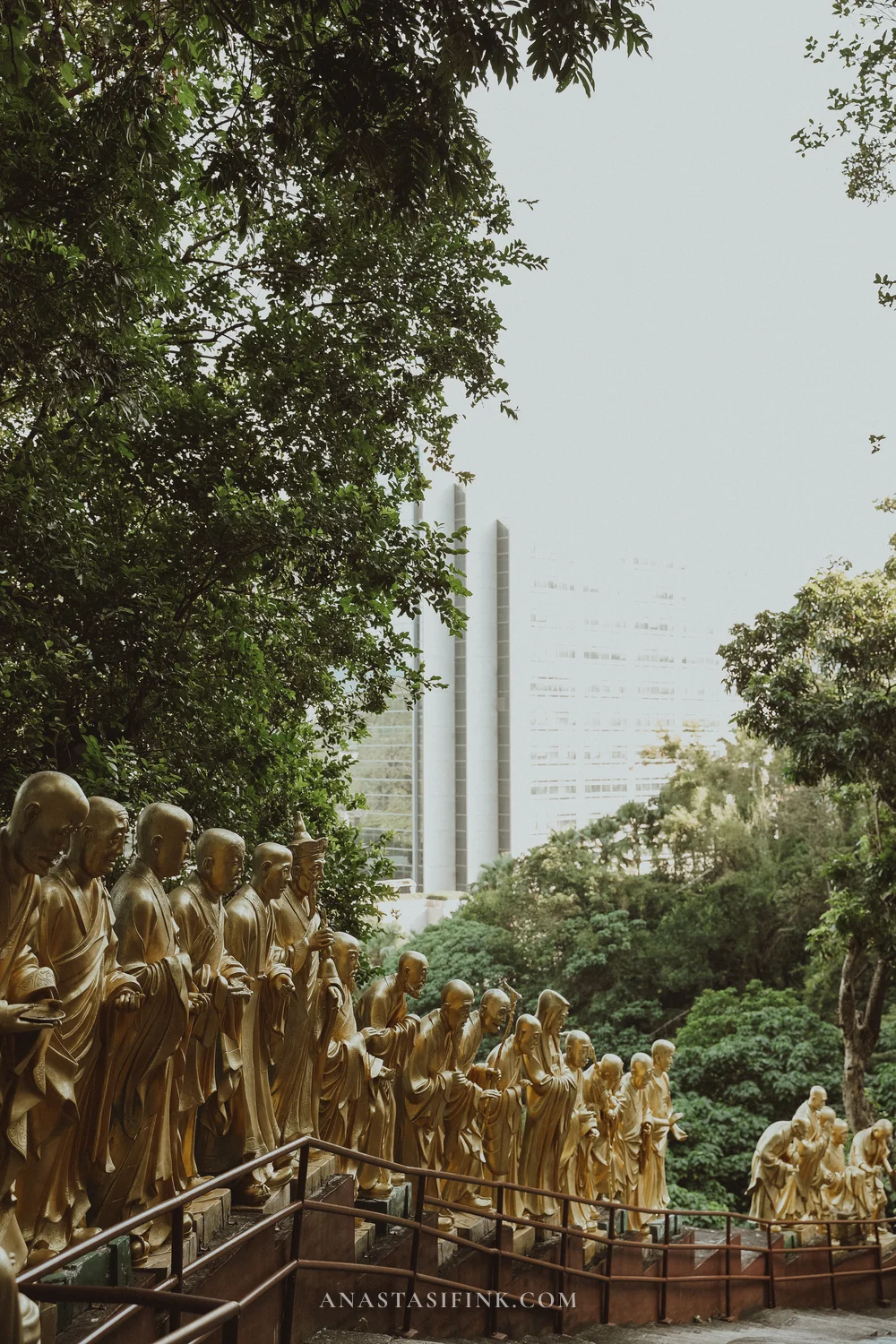
And if you turn around on the way up, residential towers of Sha Tin rise straight behind the figures. Golden monks below, high-rises above—in Hong Kong you get used to that kind of juxtaposition fast.
The monastery sits on a wooded slope, with plenty of greenery around
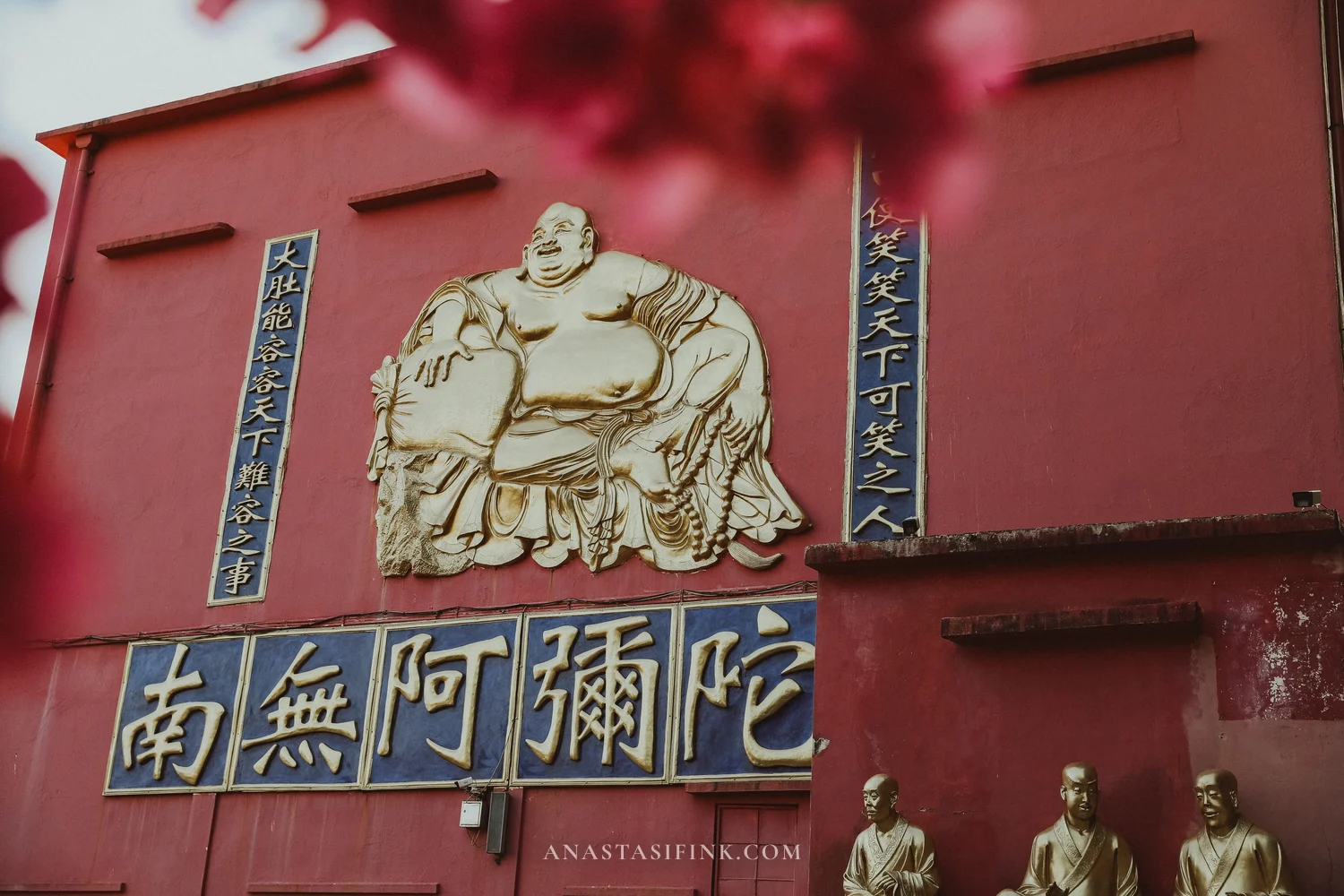
On the red walls behind the statues hang round medallions and plaques with Chinese characters. If you look closely, they’re more than decoration. The round medallions carry classic Buddhist formulas: for example, 法水長流 (“the teaching flows like water and never runs dry”) and 法輪常轉 (“the wheel of the teaching turns without end”). And the red plaques bear words from the monastery’s founder himself, the monk Yuet Kai. One of them, for instance, reads: “the Buddha-nature has neither beginning nor end.”
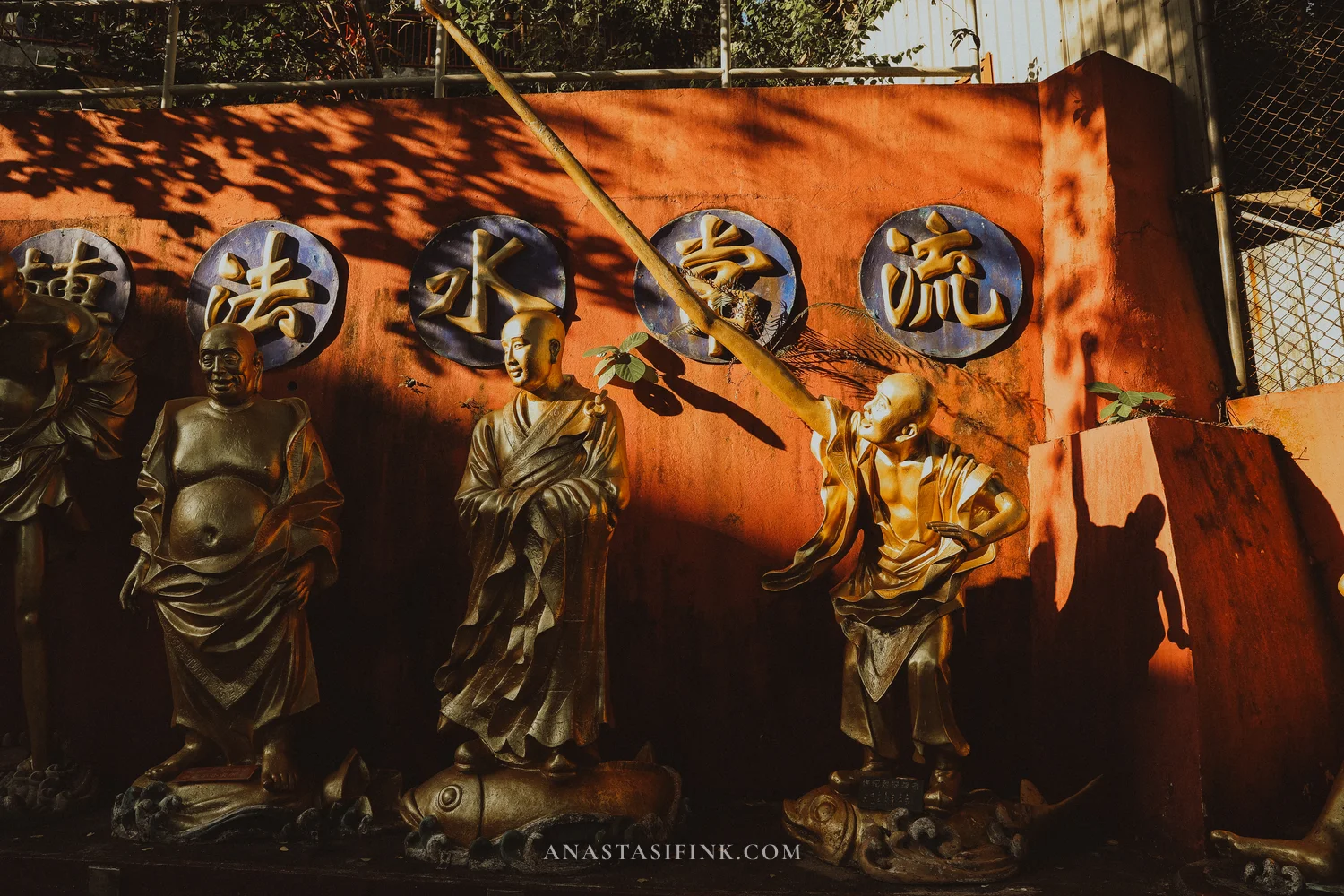
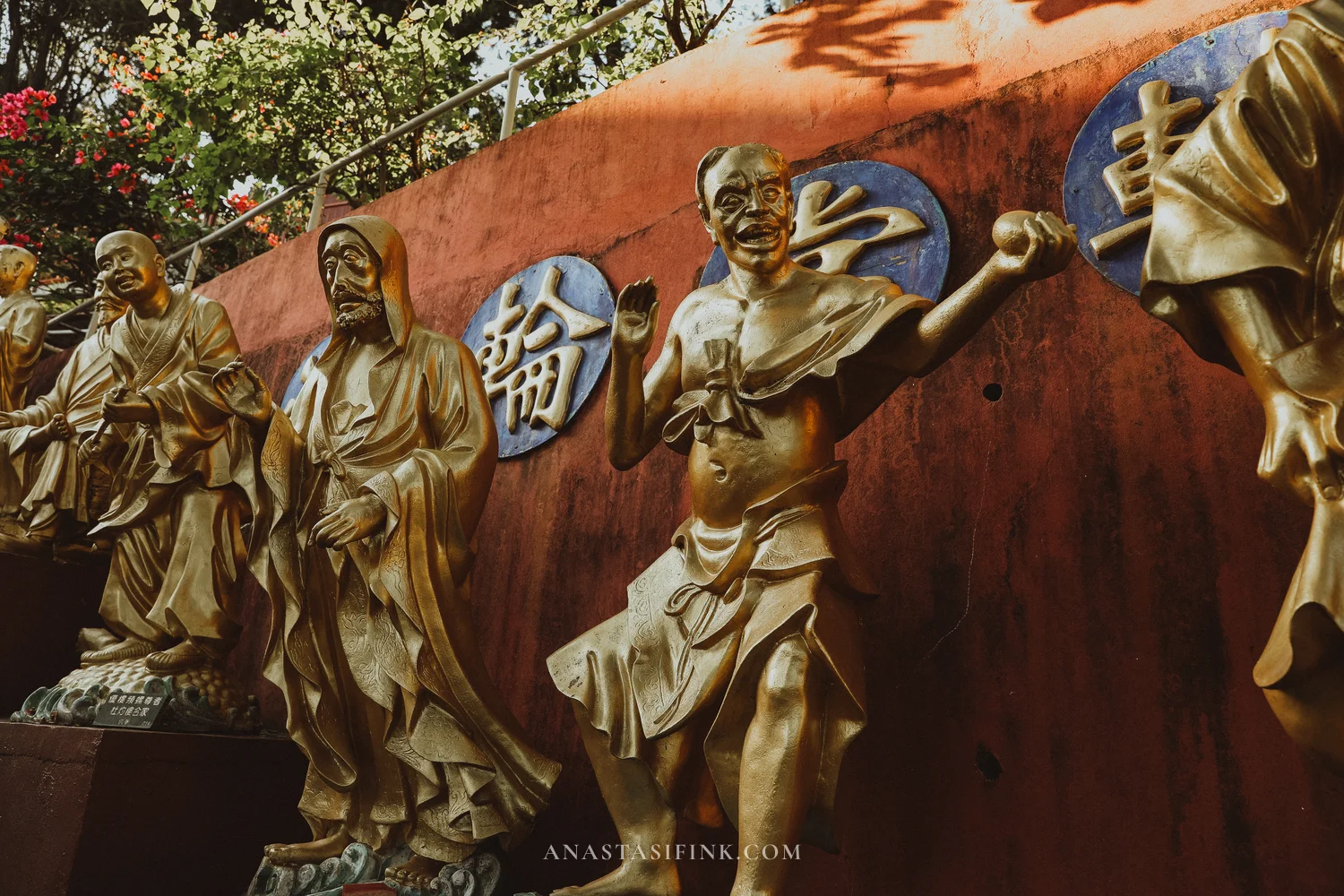
The medallions add up to Buddhist formulas—about a teaching that flows like water and never runs dry
I read that you might run into wild monkeys on the slope here, but I never saw any. If you do spot one—don’t take out food around them and don’t tease them, and you’ll be fine.
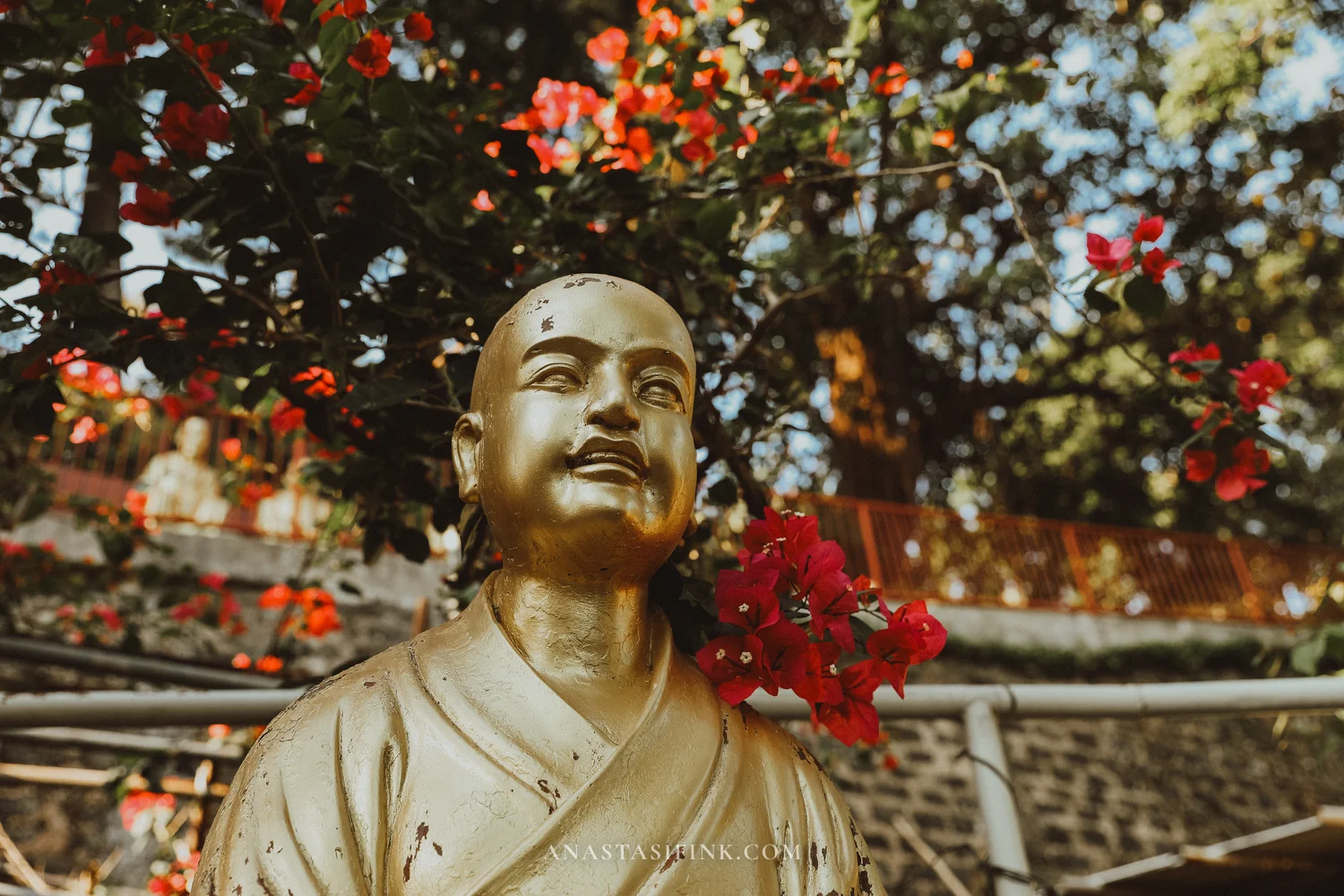
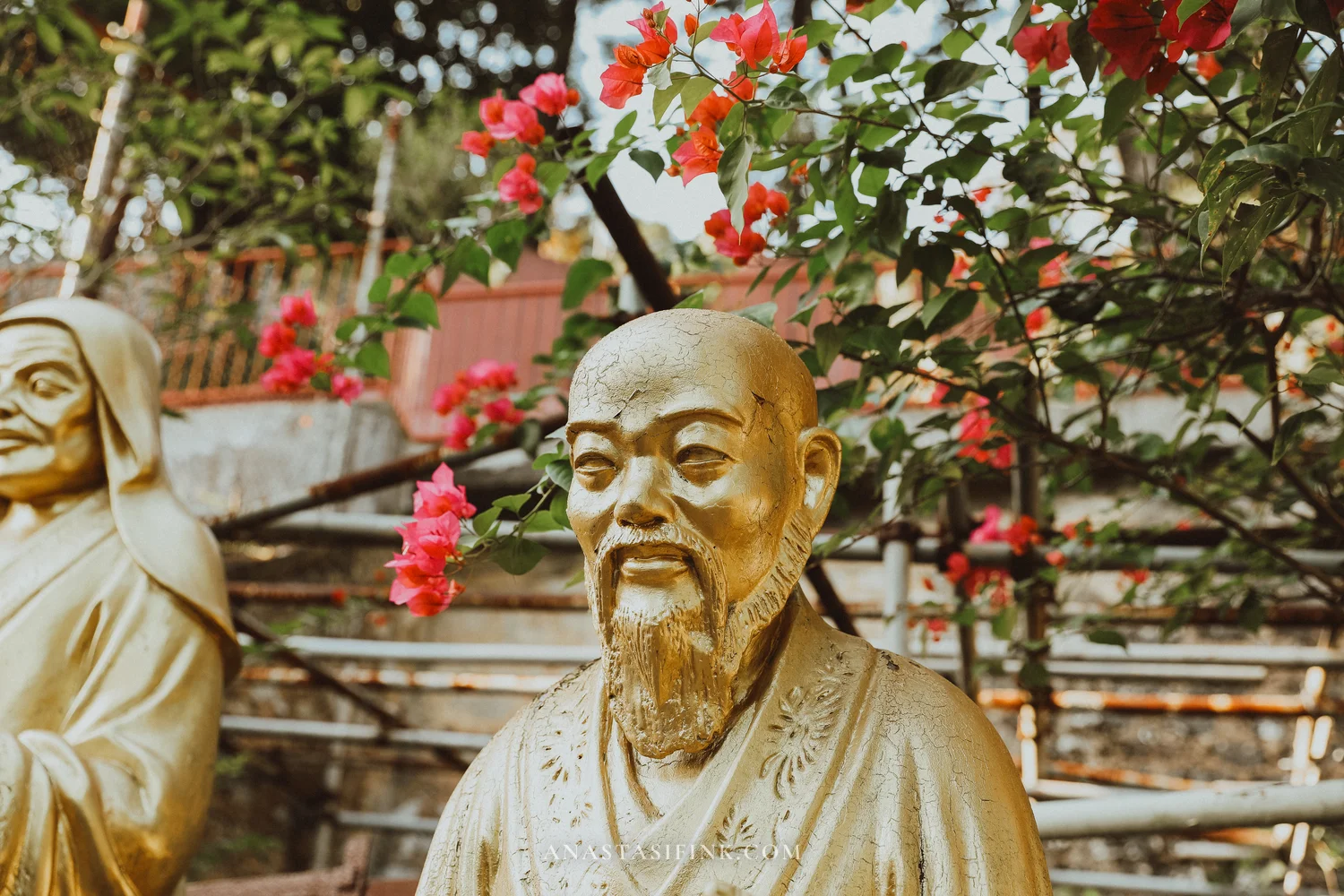
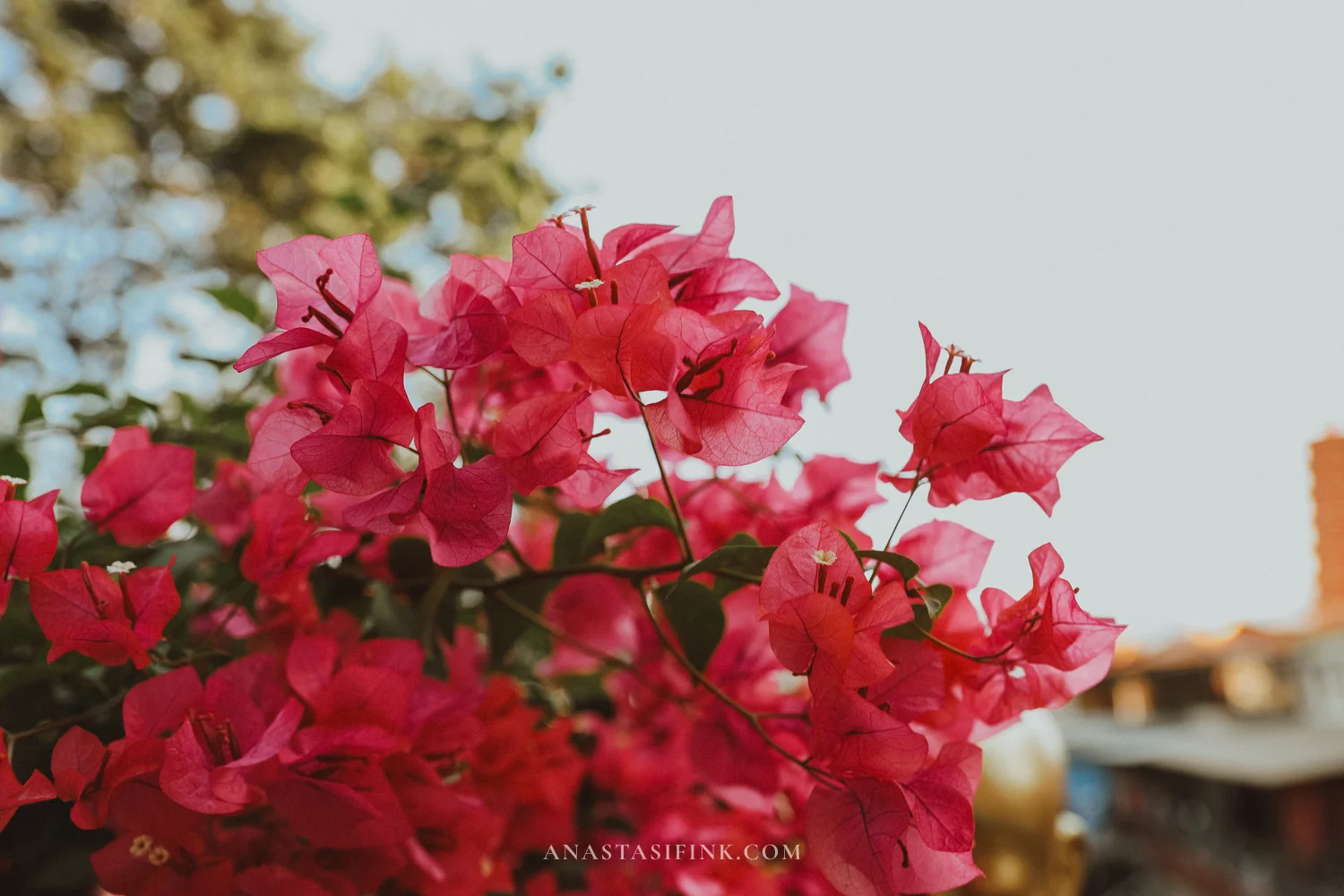
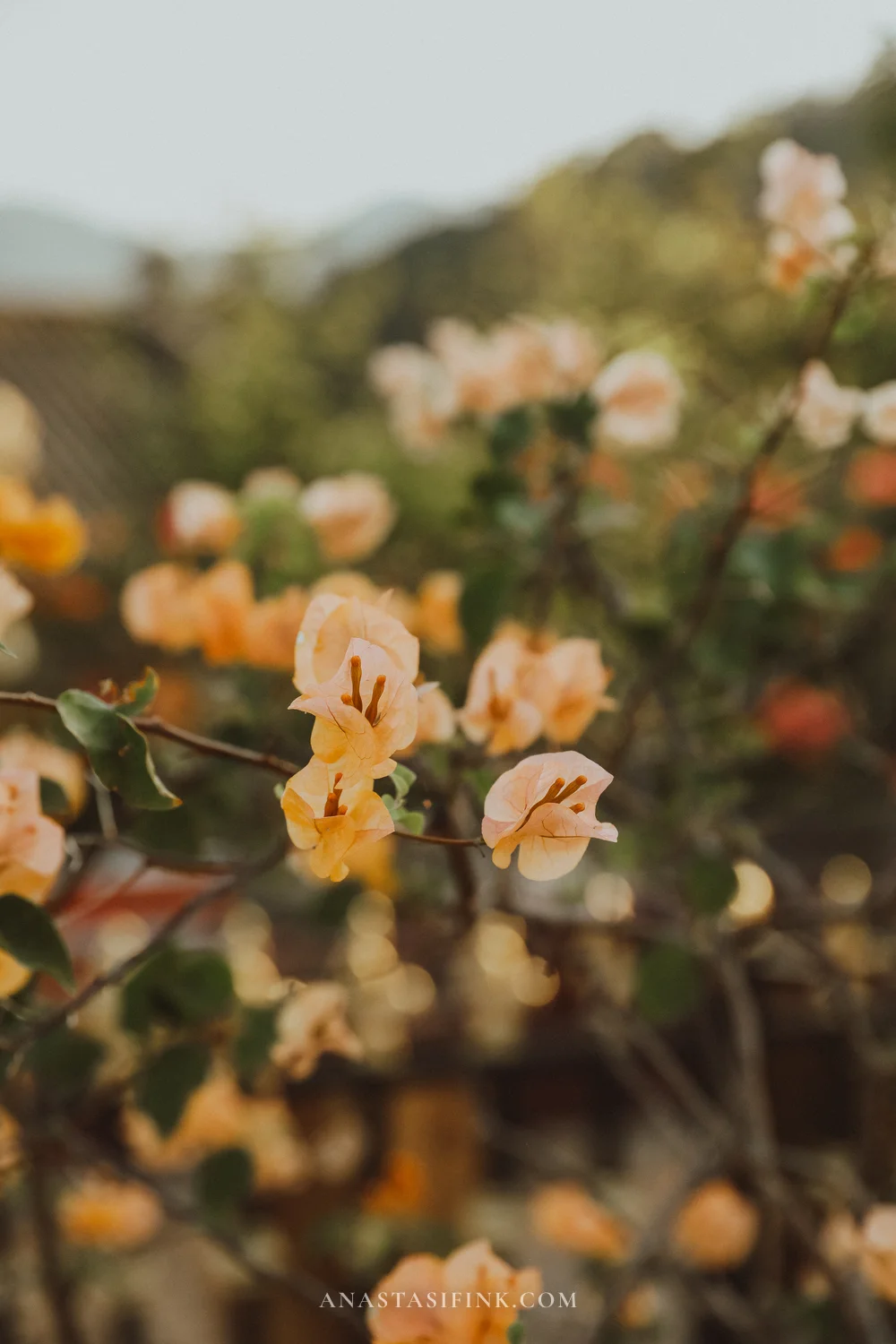
Closer to the top, bougainvillea turns up between the figures
The Main Hall: 12,800 Buddhas and the Founder’s Incorruptible Body
The climb brings you out onto a terrace, at the main hall. Step inside and the name makes immediate sense: every wall, floor to ceiling, is packed with tiny golden Buddha figures. There are around 12,800 of them, each in its own niche. Unlike the golden arhats on the staircase, these figures are small and fairly similar to one another—it’s their sheer number that’s impressive. Both the monastery and its furnishings were created with donations from ordinary believers.
The whole idea of “ten thousand Buddhas” isn’t about an exact number. The character 萬 (“man”) means both “ten thousand” and simply “countless,” so a more accurate name would be “the hall of countless Buddhas.” Behind this lies a thought that’s important to Buddhism: the Buddha is not one. It’s believed there have been and will be countless Buddhas, and that the capacity to awaken is inherent in every living being. A wall of thousands of identical golden figures is exactly about that: about the many paths to a single state.
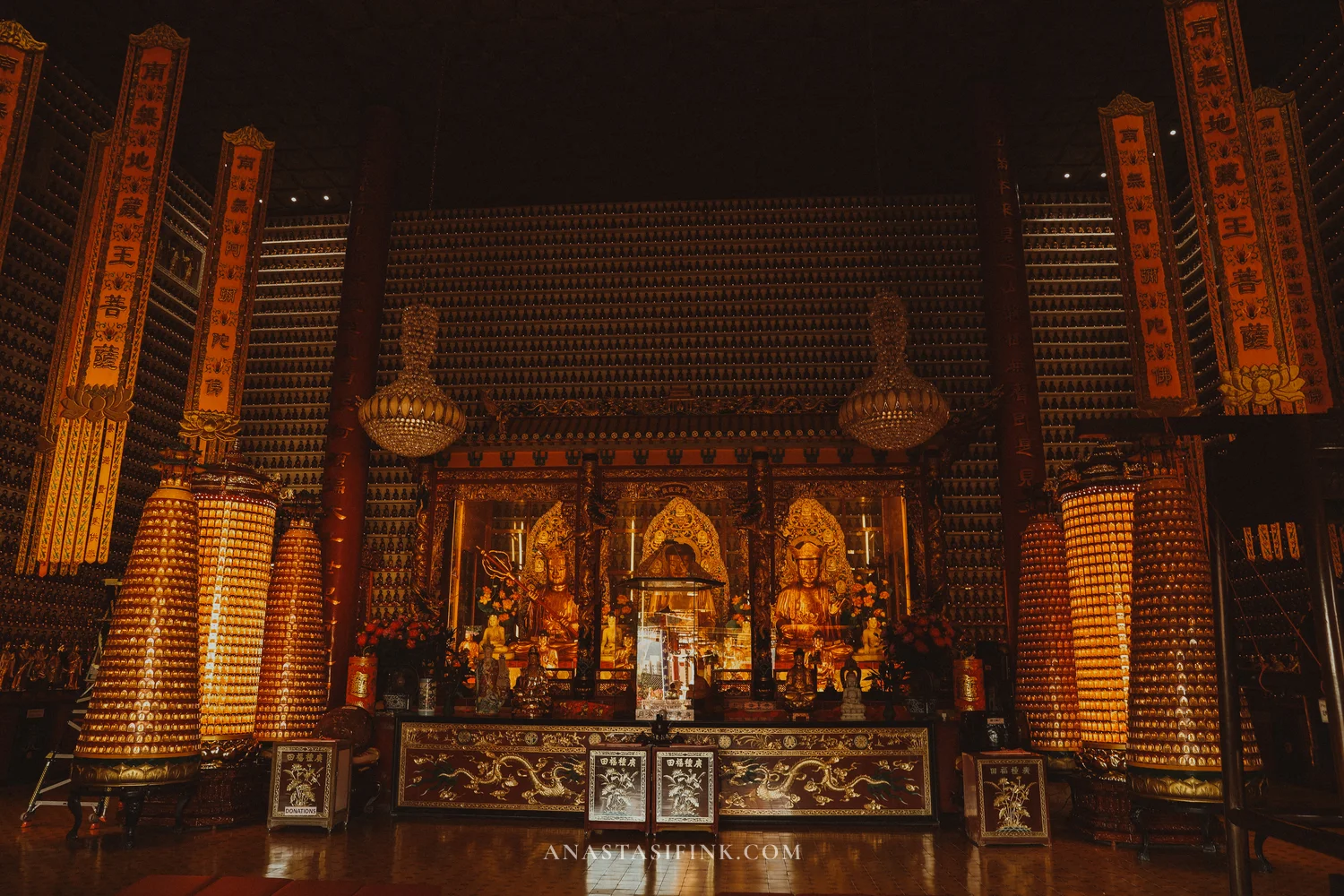
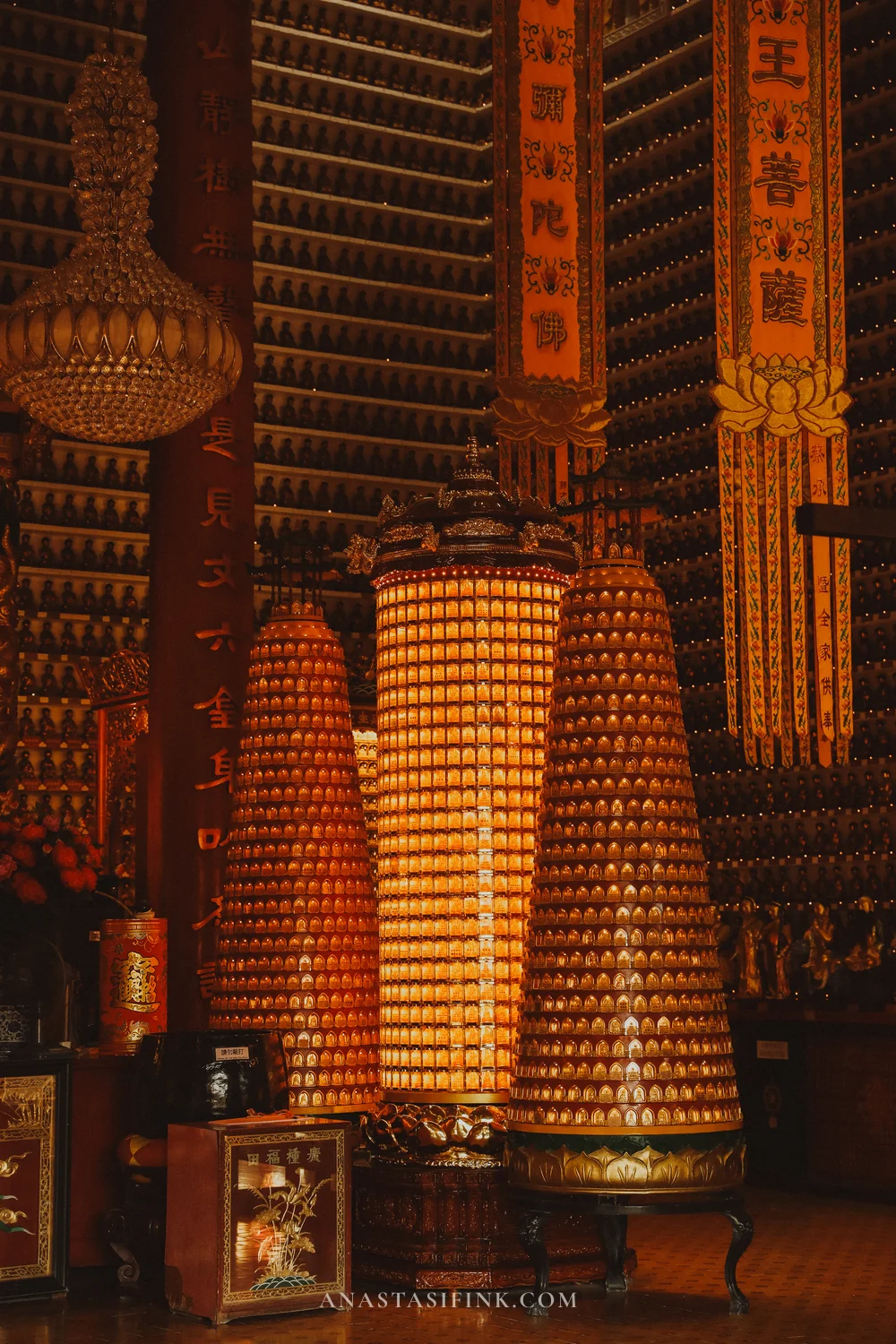
Three large golden Buddhas sit on the altar. And beside them is the thing many people come here for. The monastery’s founder, the monk Yuet Kai, died in 1965 at the age of 87. In keeping with Buddhist tradition, his body was buried in the lotus position. Eight months later the coffin was opened—and, as the story goes, the body had remained untouched. So, as the monk had wished, it was coated in lacquer and gold leaf and placed in a glass case in the hall. This relic is called the “Incorruptible Diamond Body.” I chose not to photograph it—it’s better seen with your own eyes.
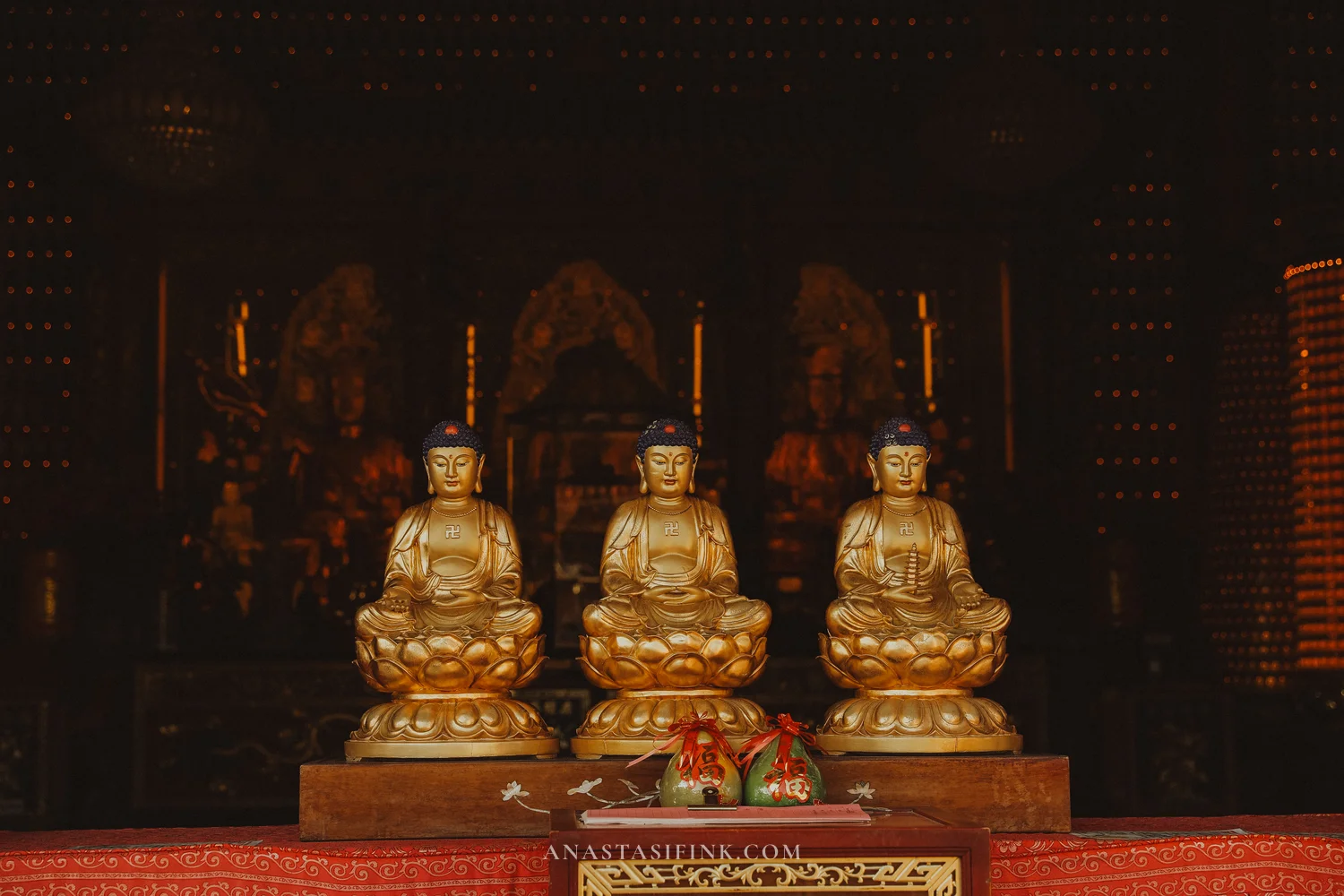
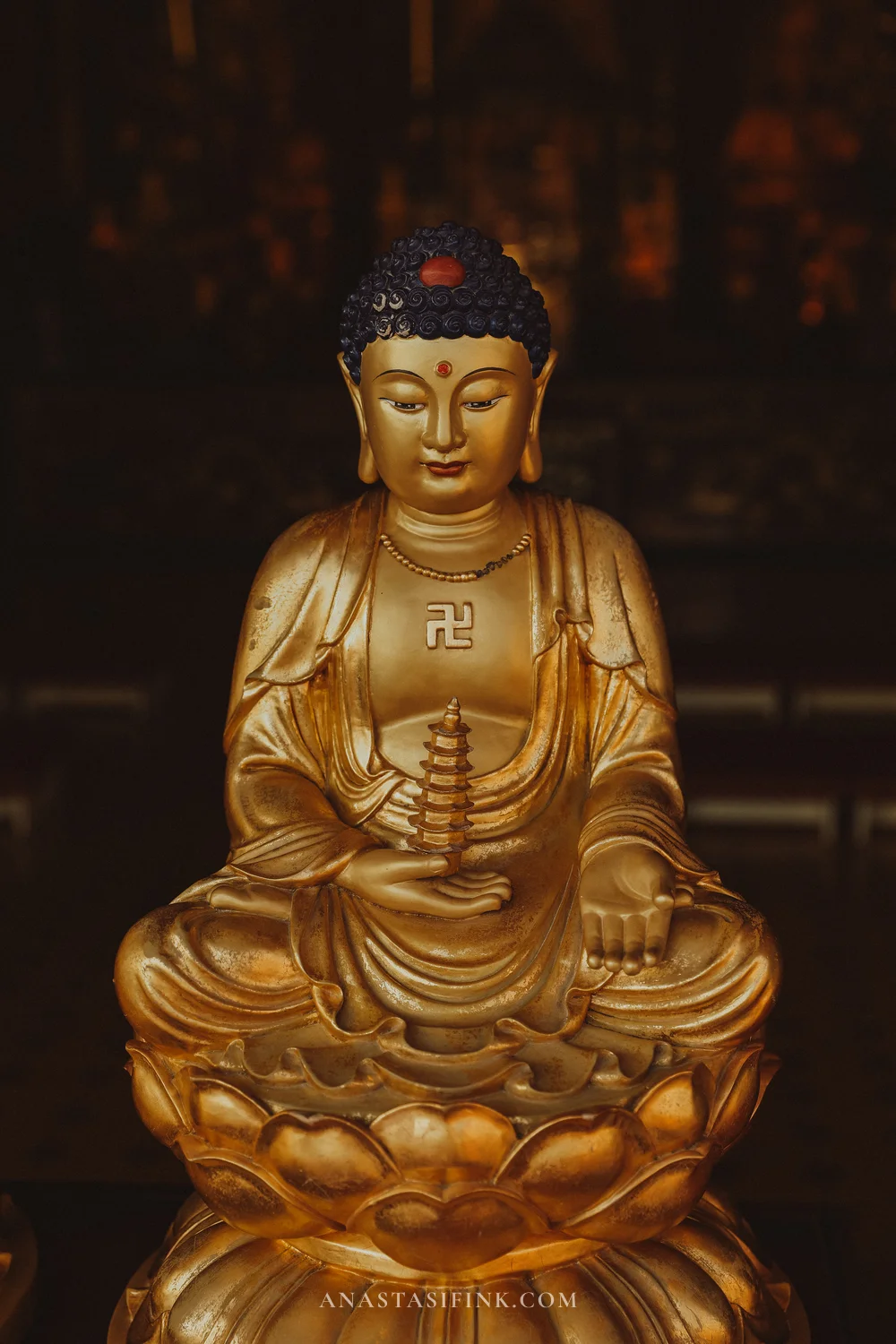
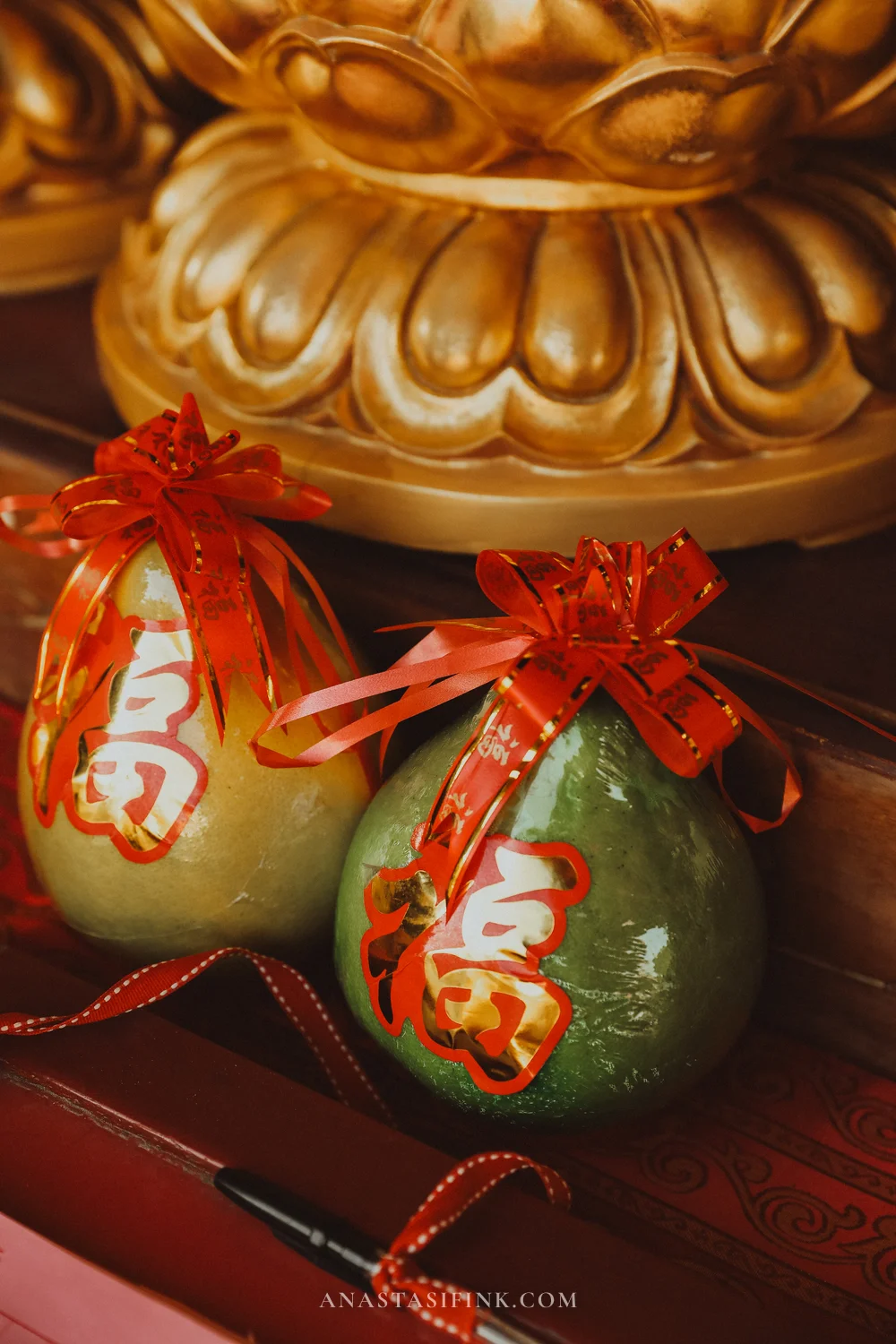
In front of the figures sit offerings—fruit tied with red ribbons. A pomelo bearing the character 福 (“happiness,” “good fortune”) is a common gift in Chinese temples.
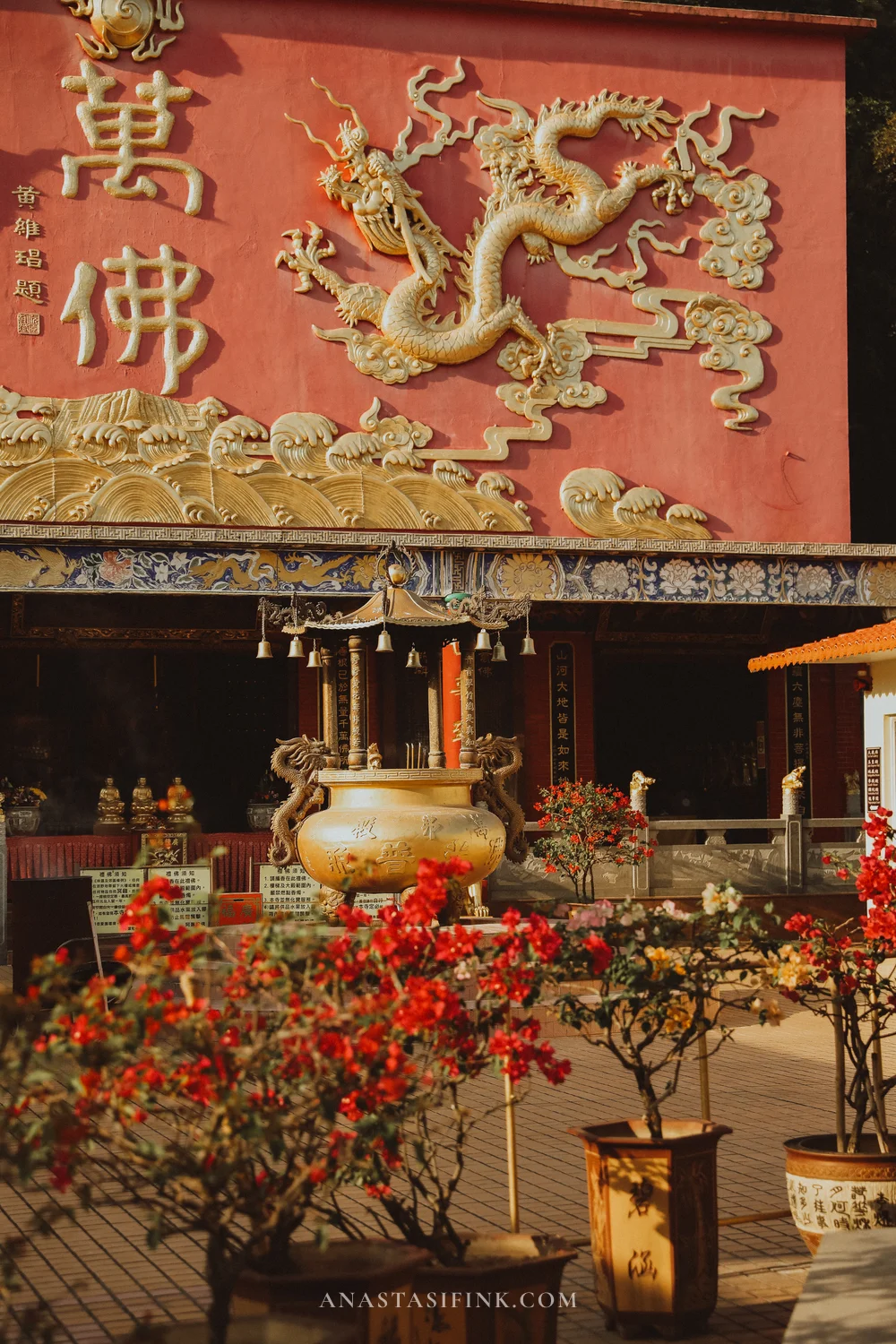
Outside, the facade of the main hall is decorated with a large golden dragon and the characters 萬佛—”ten thousand Buddhas.”
The Nine-Storey Pagoda and the Main Plaza
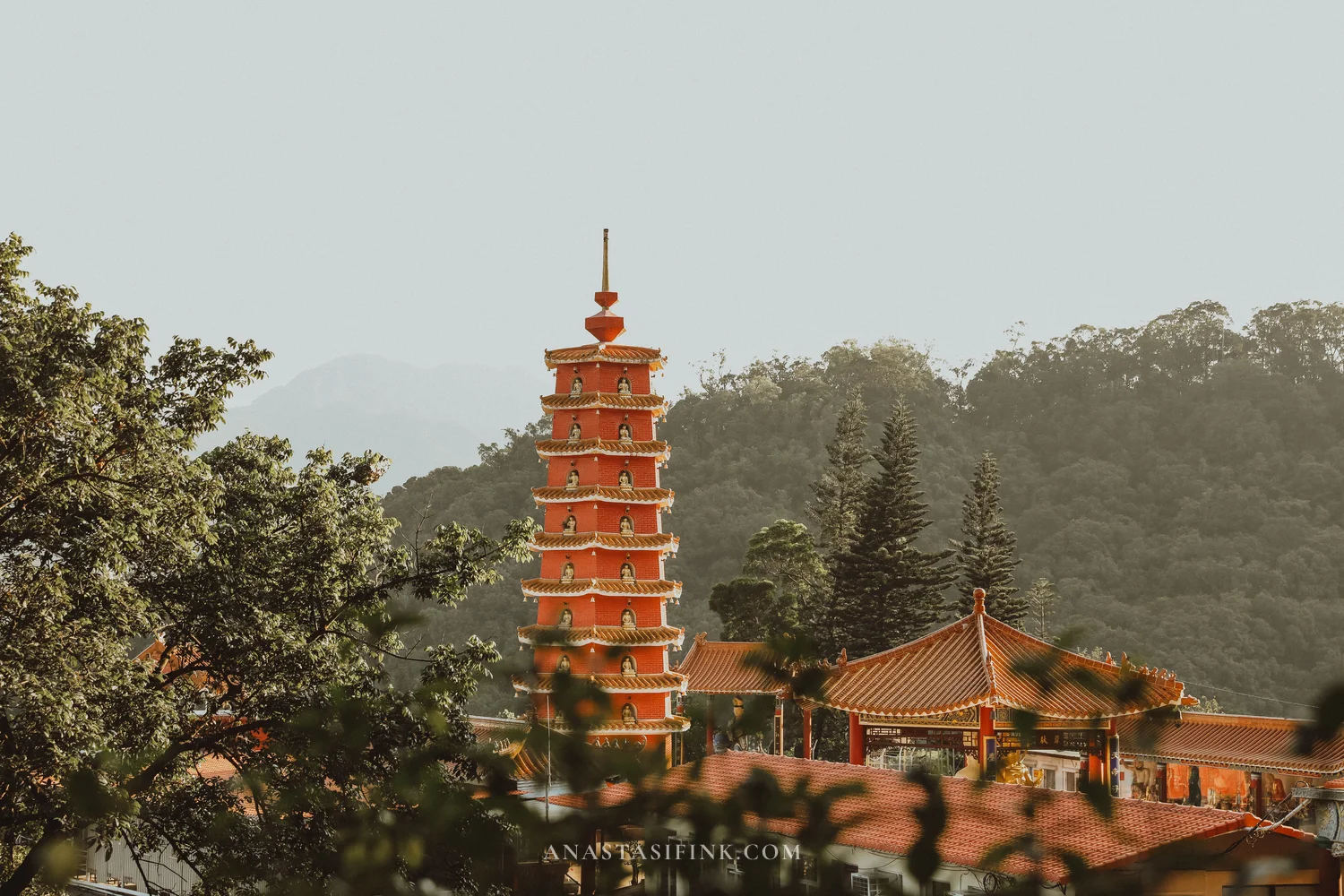
The monastery’s most recognizable landmark is the red, nine-tiered pagoda. It stands on the main plaza, and small Buddha figures are set along the facade of each storey. On a clear day, its red silhouette looks striking against the green hills.
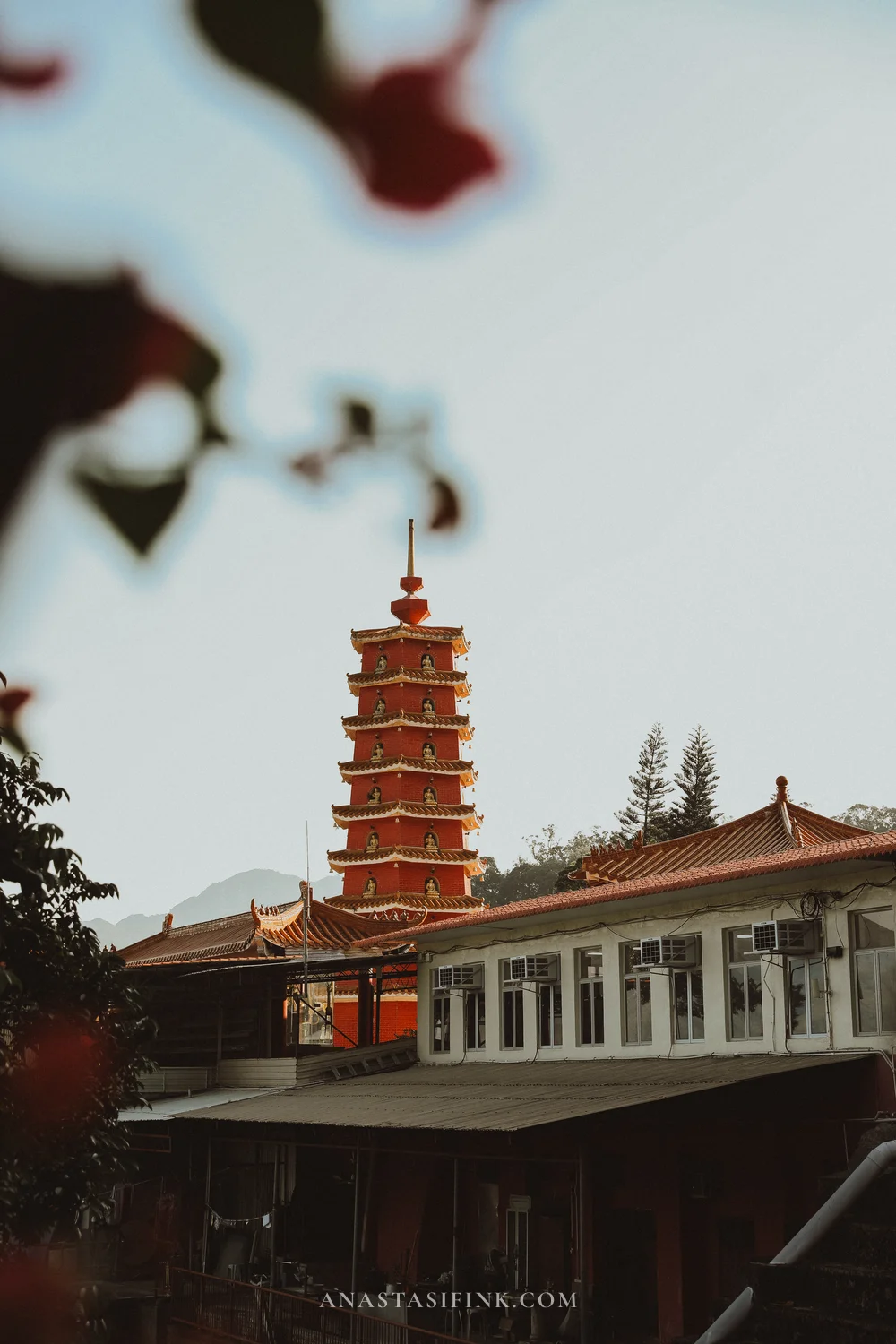
The main plaza is an open space with pavilions, large golden incense burners and statues. I was here in the afternoon, in spring, and there was hardly anyone around—you can wander everywhere in peace with no one in your way.
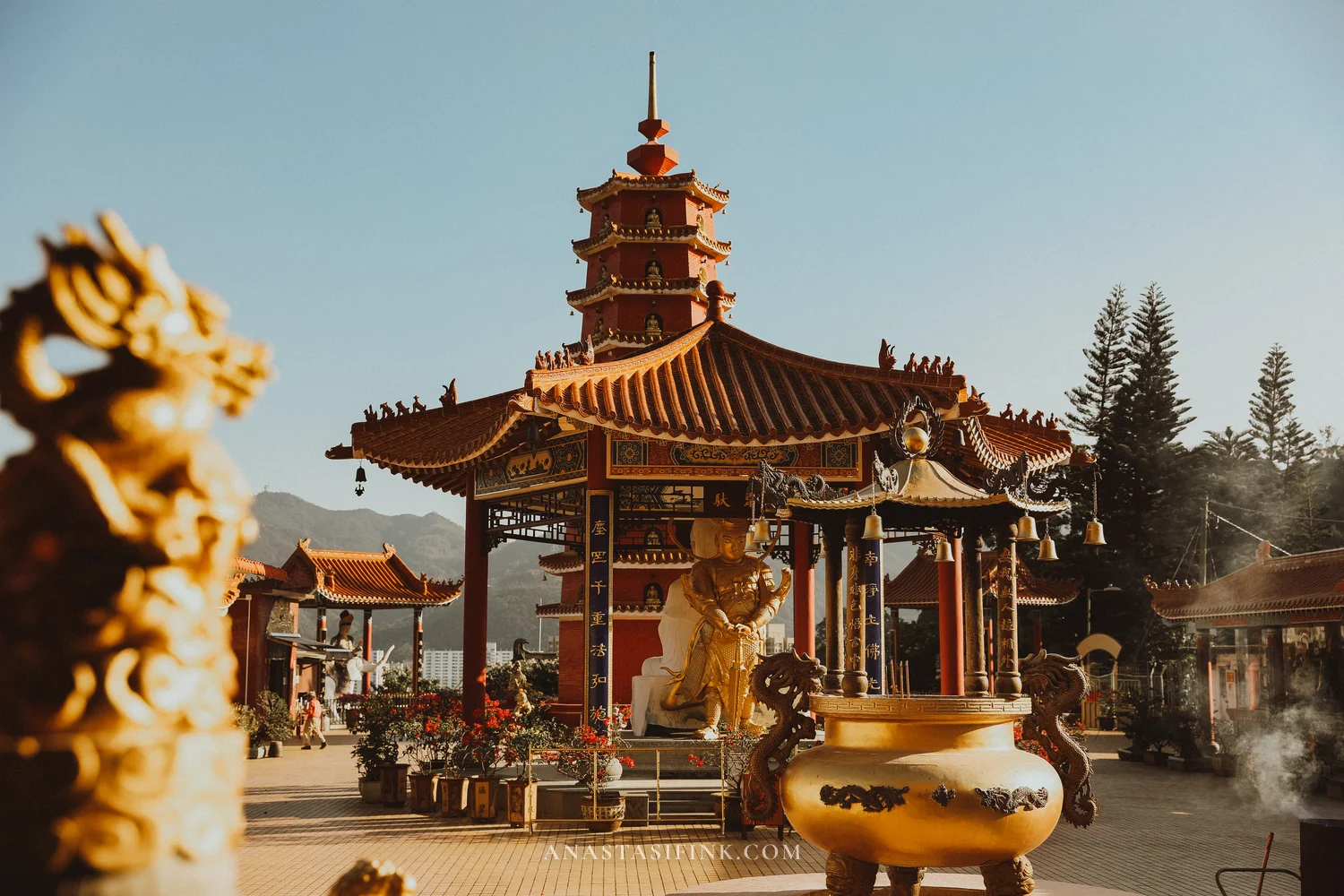
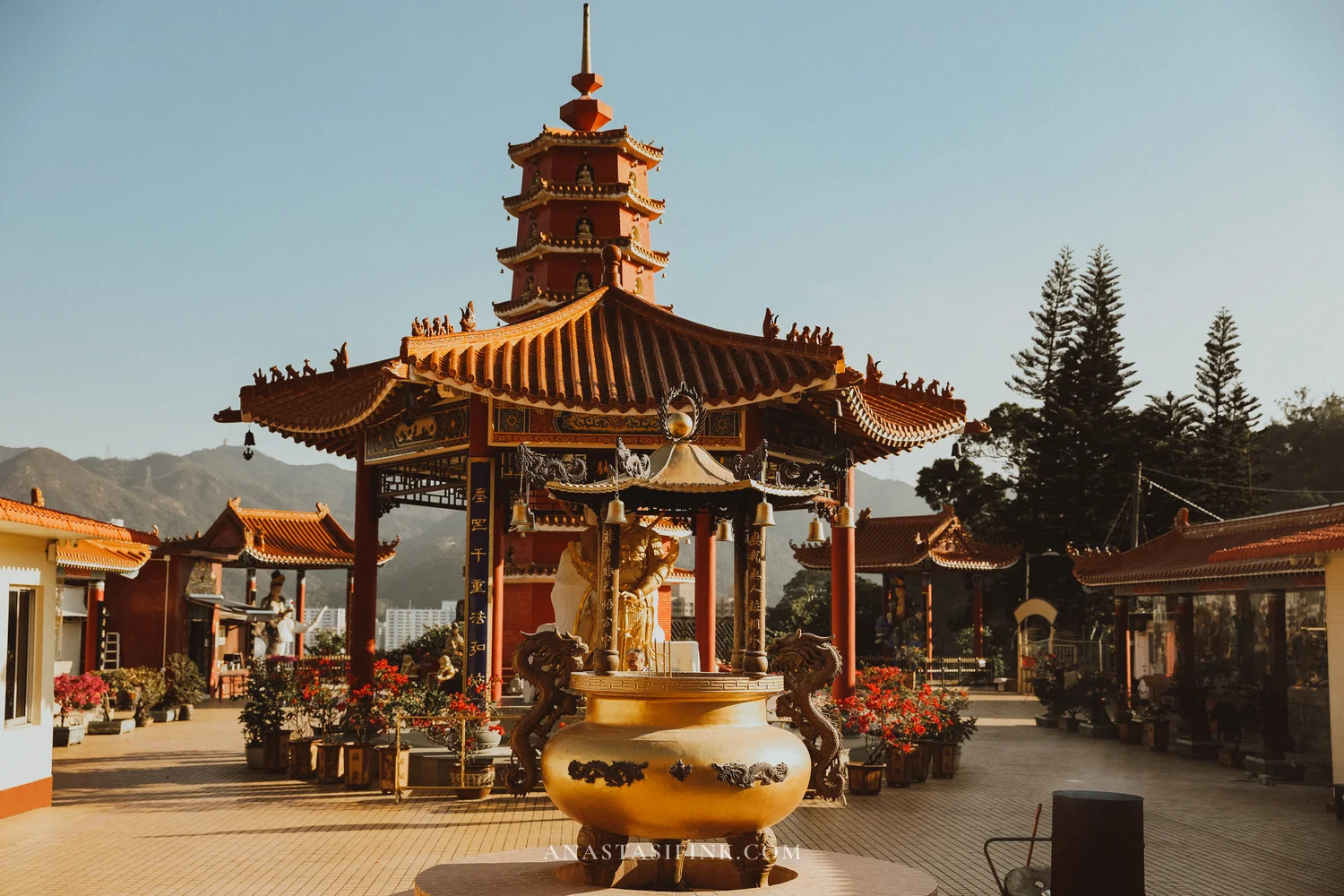
The main plaza with its pavilions. Beyond it, the forest and the mountains of Sha Tin
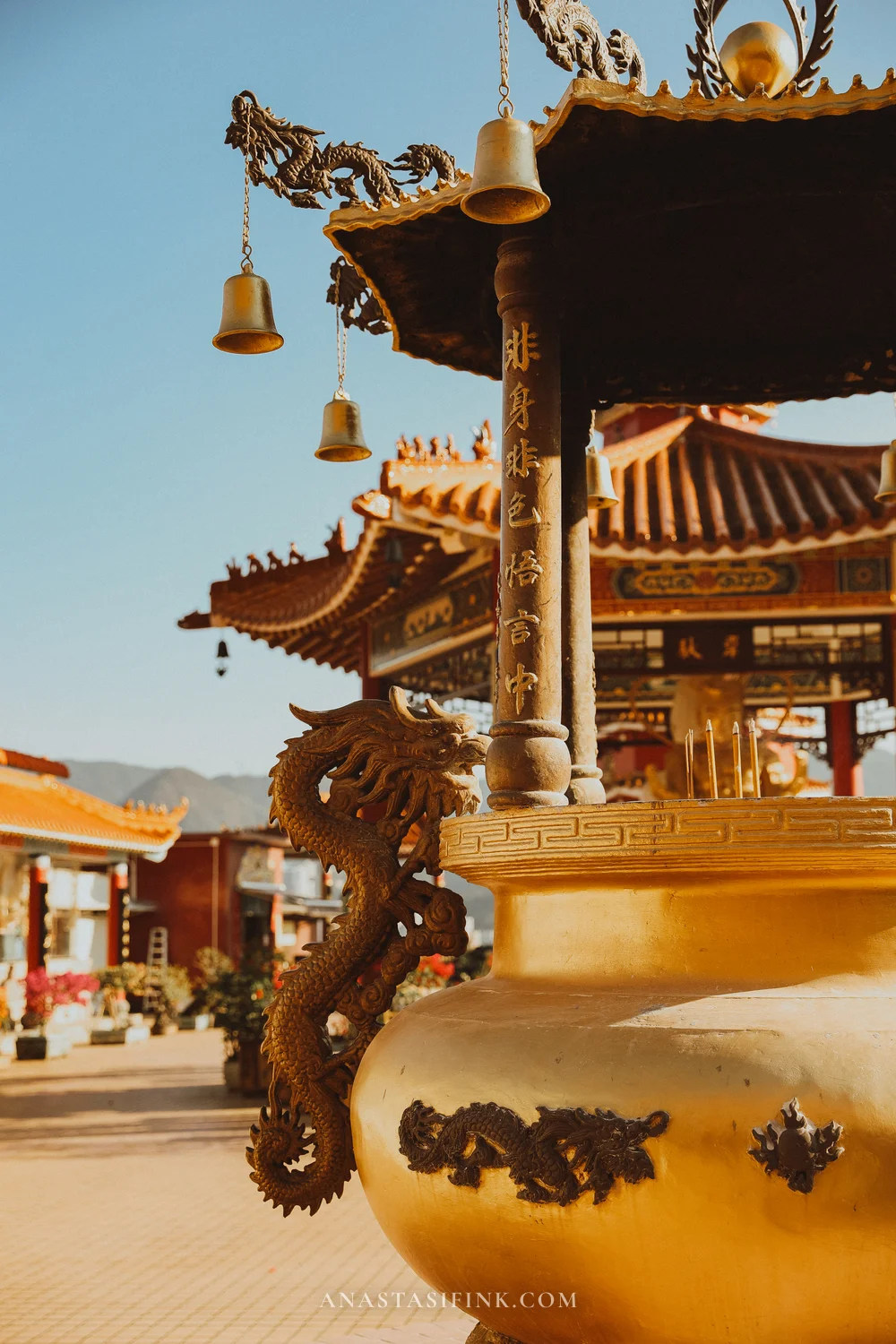
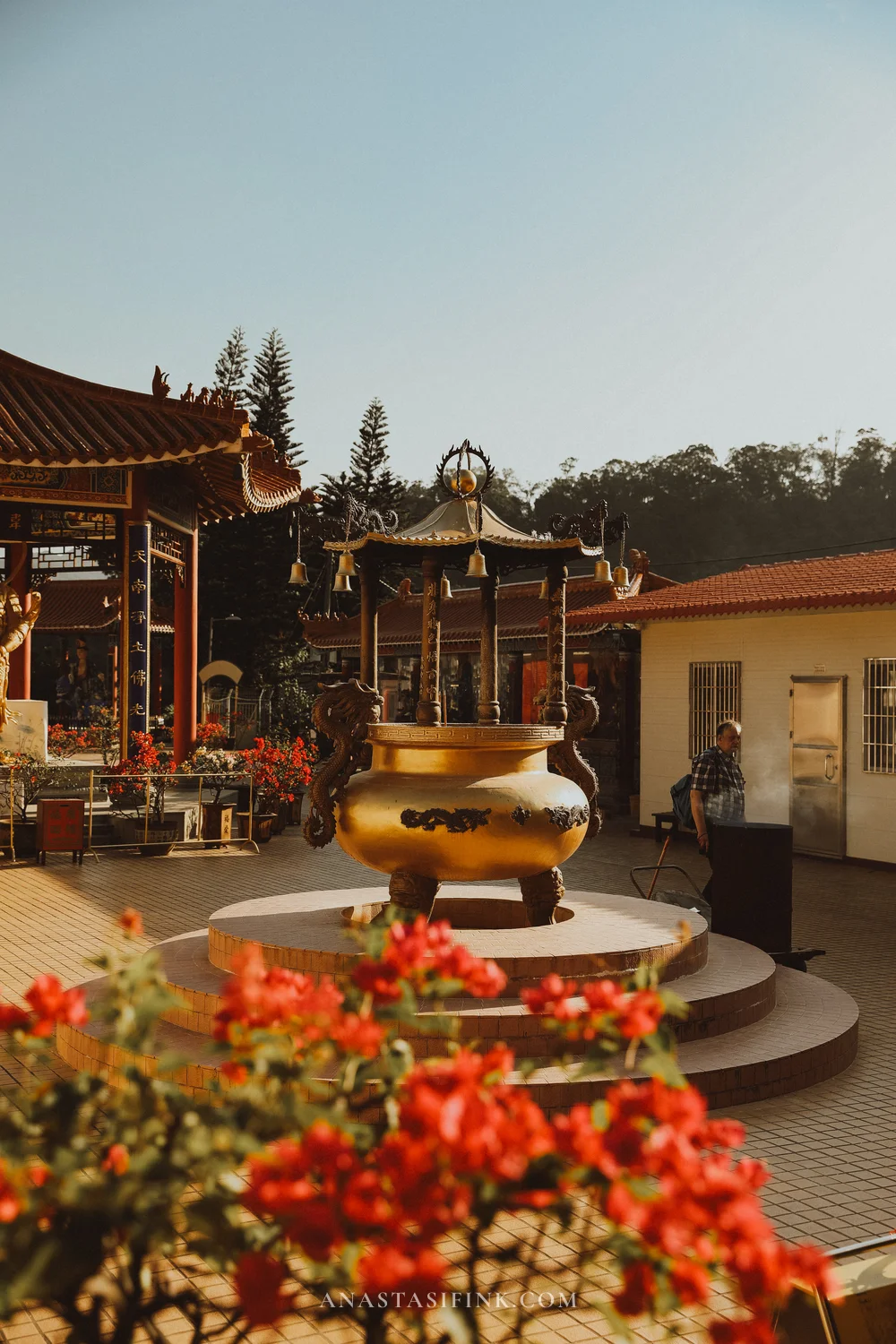
Relief dragons coil around the incense burners
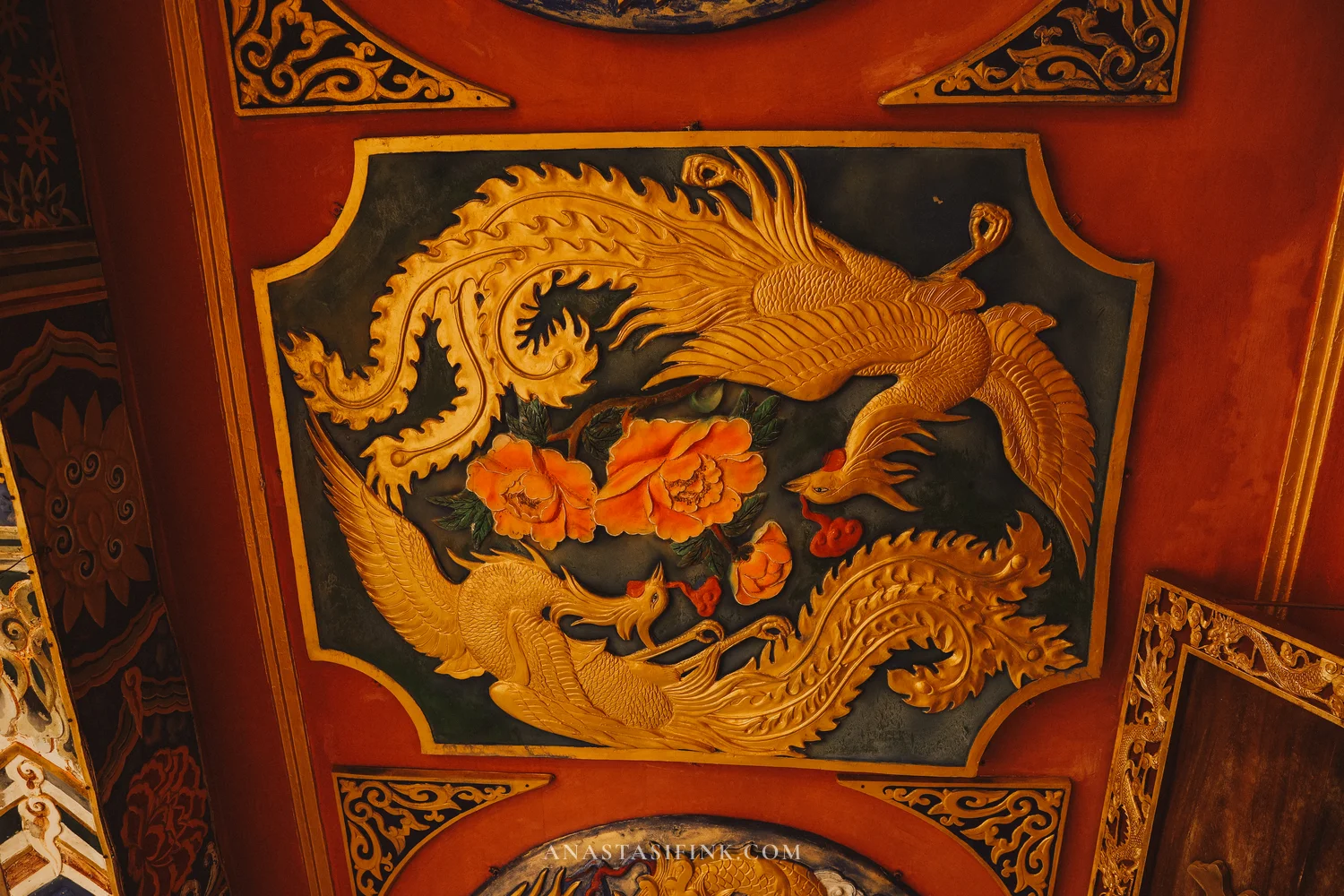
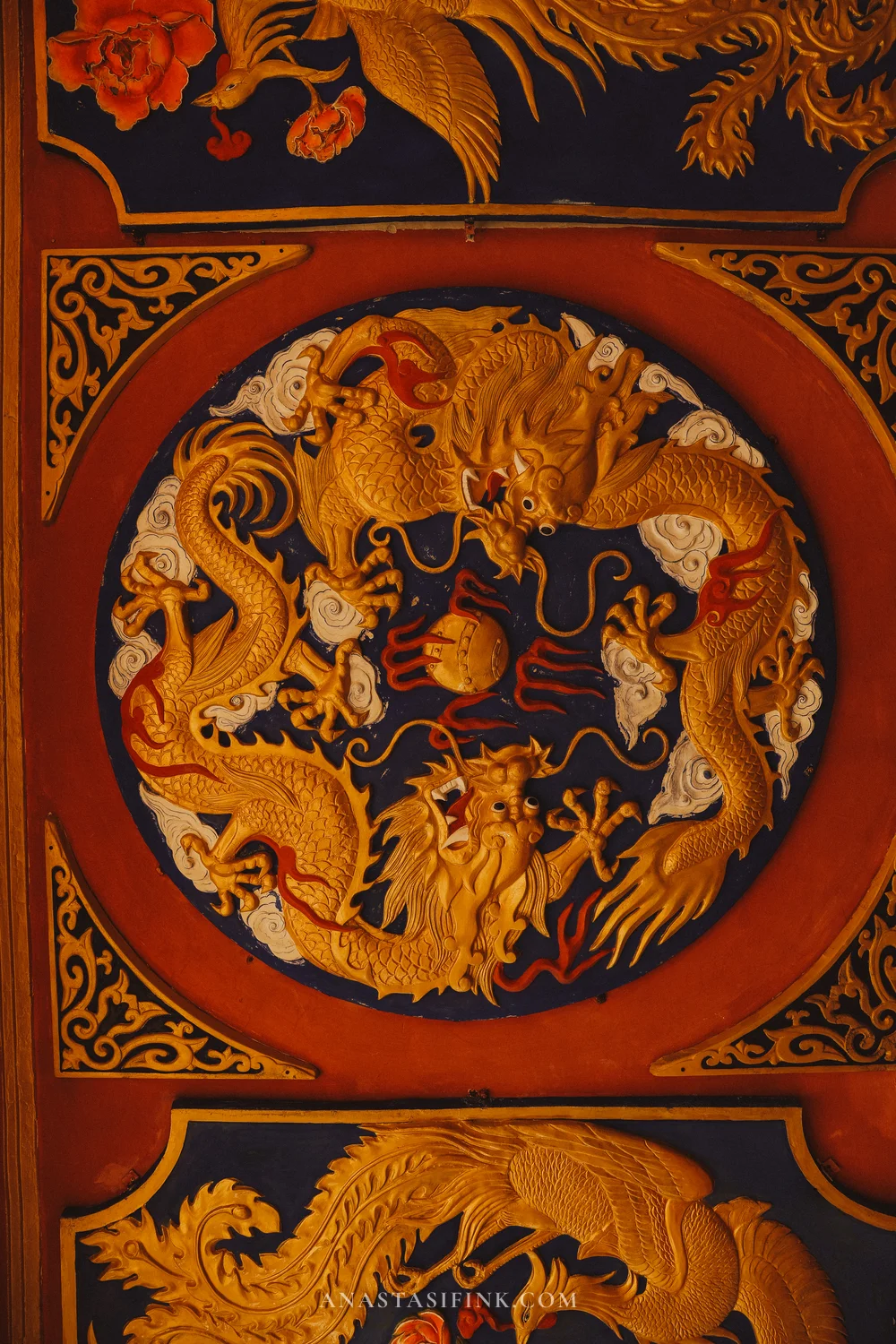
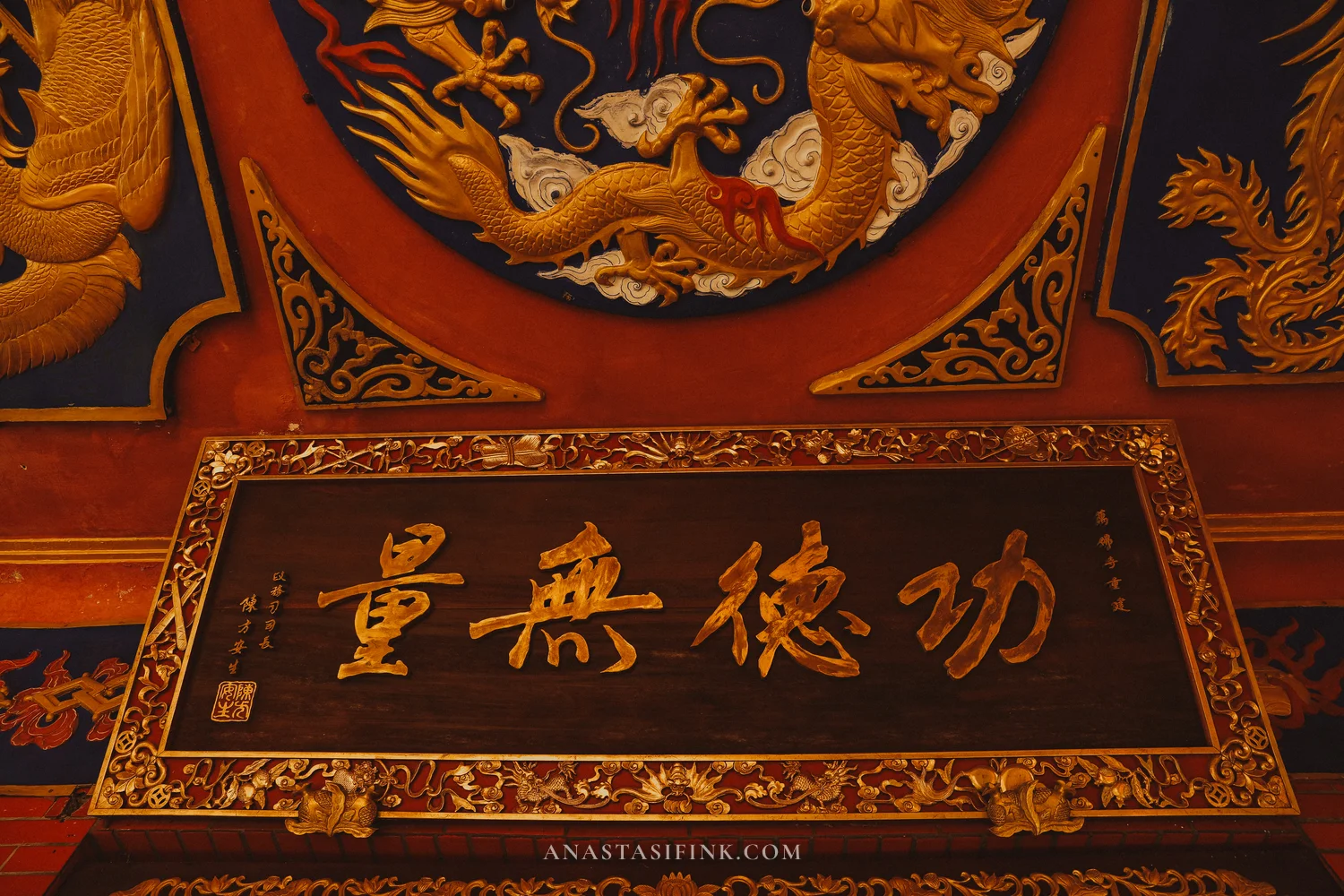
It’s worth looking up—the pavilion ceilings are painted and carved. Golden dragons and phoenixes on a deep blue and red background.
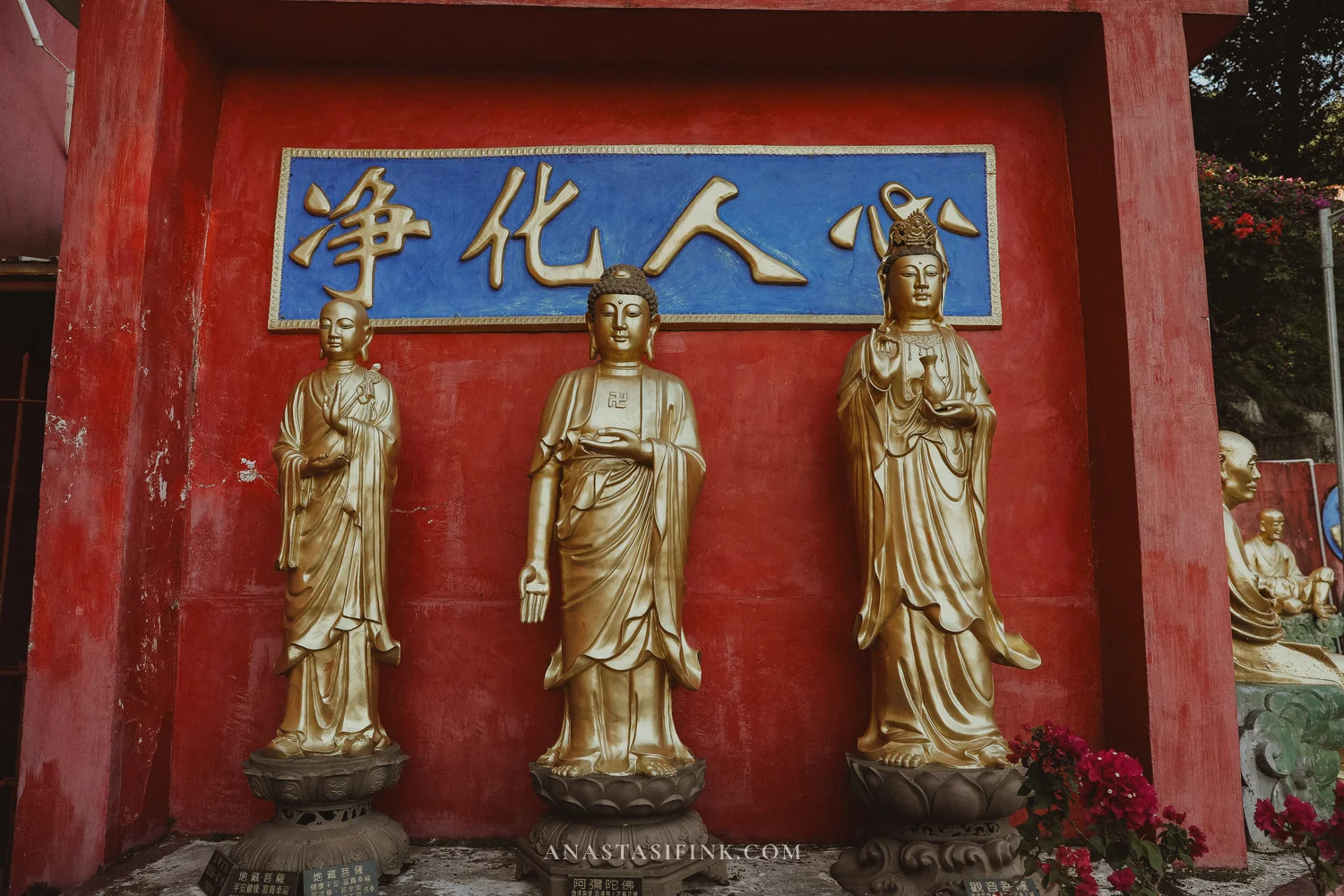
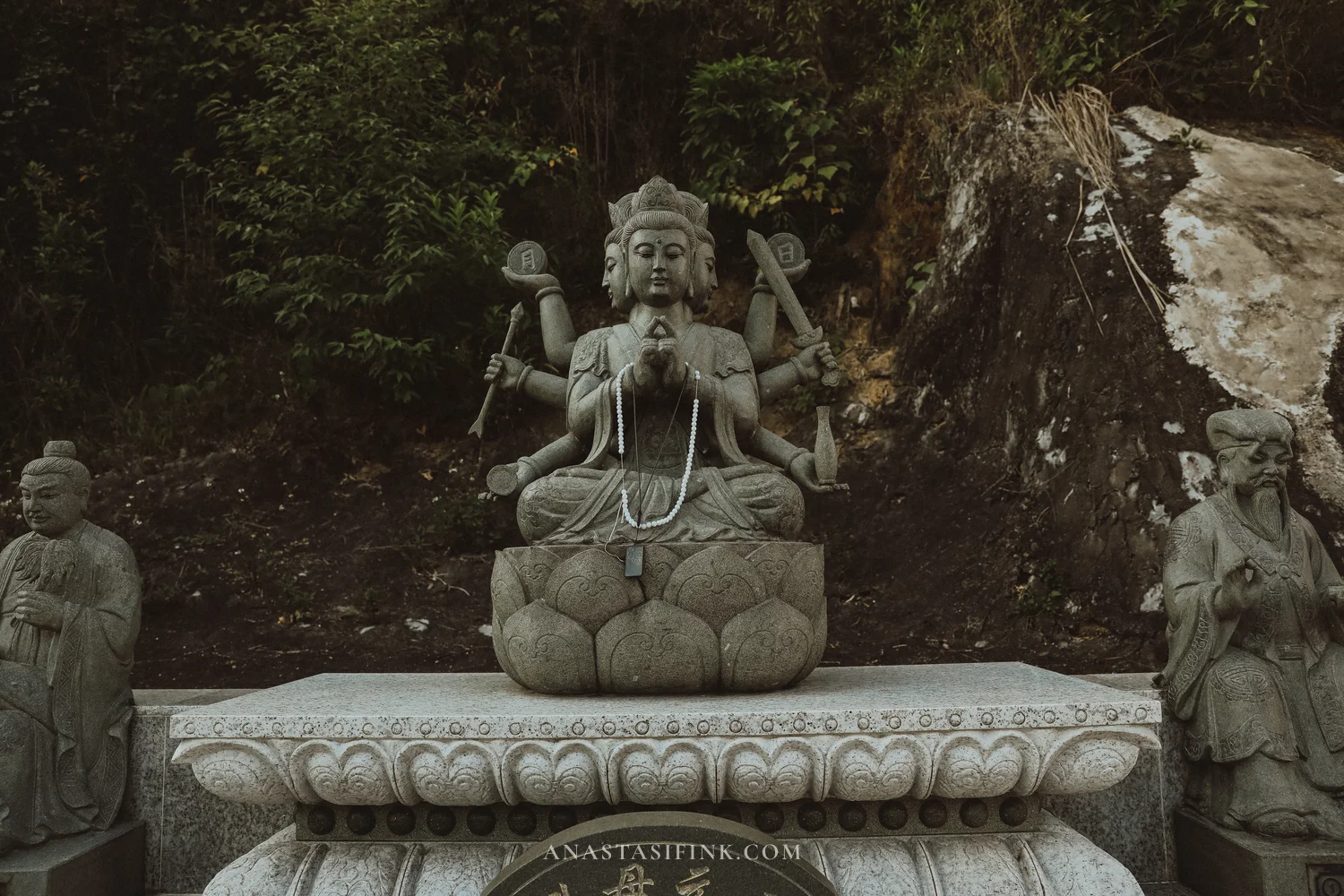
Golden statues of bodhisattvas and deities are dotted around the plaza. There’s Guanyin—the goddess of mercy, the most revered female figure in Chinese Buddhism. And Weito—the warrior protector of the teaching. And the four-faced Brahma: that’s a Thai motif, statues like this are popular all over Southeast Asia.
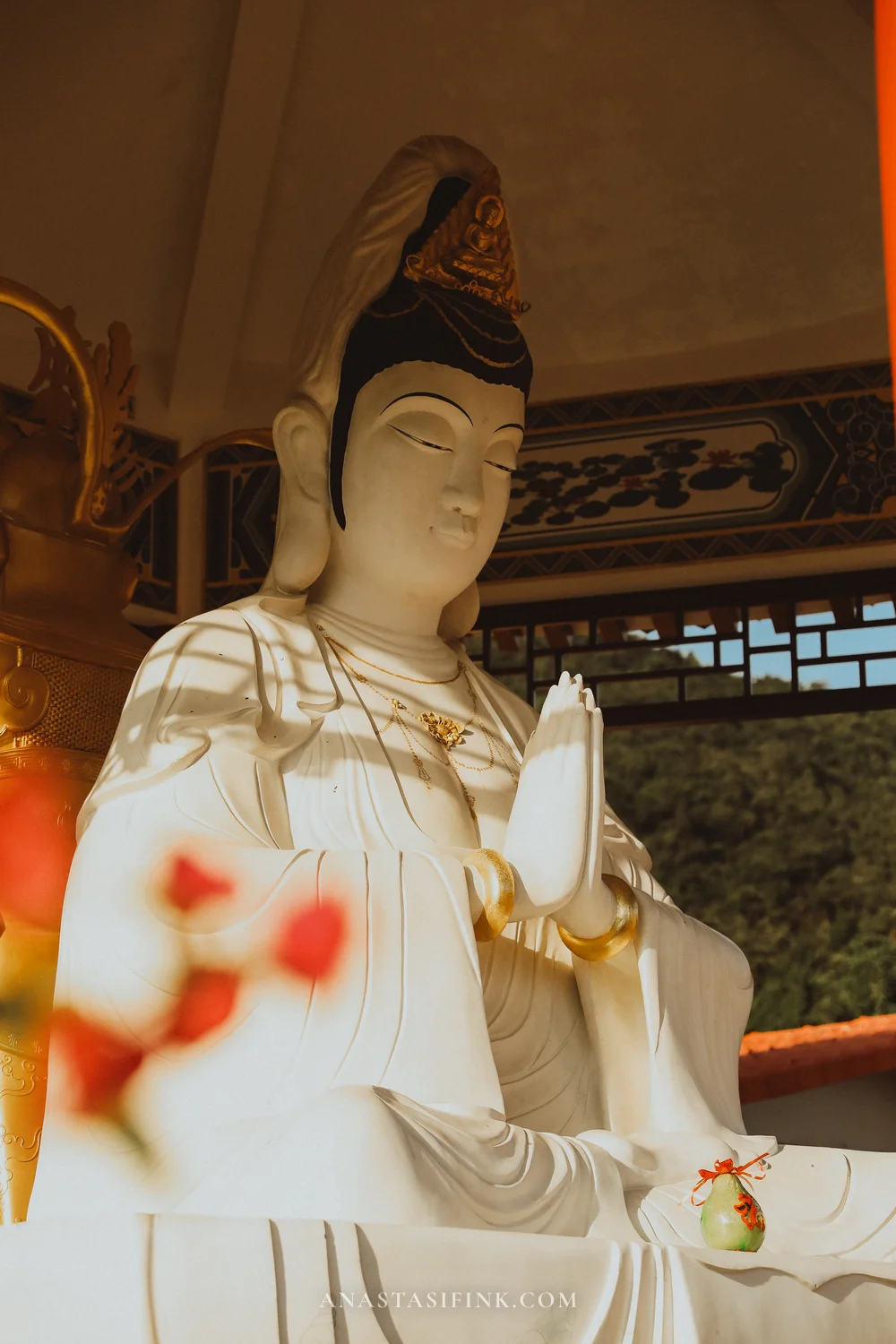
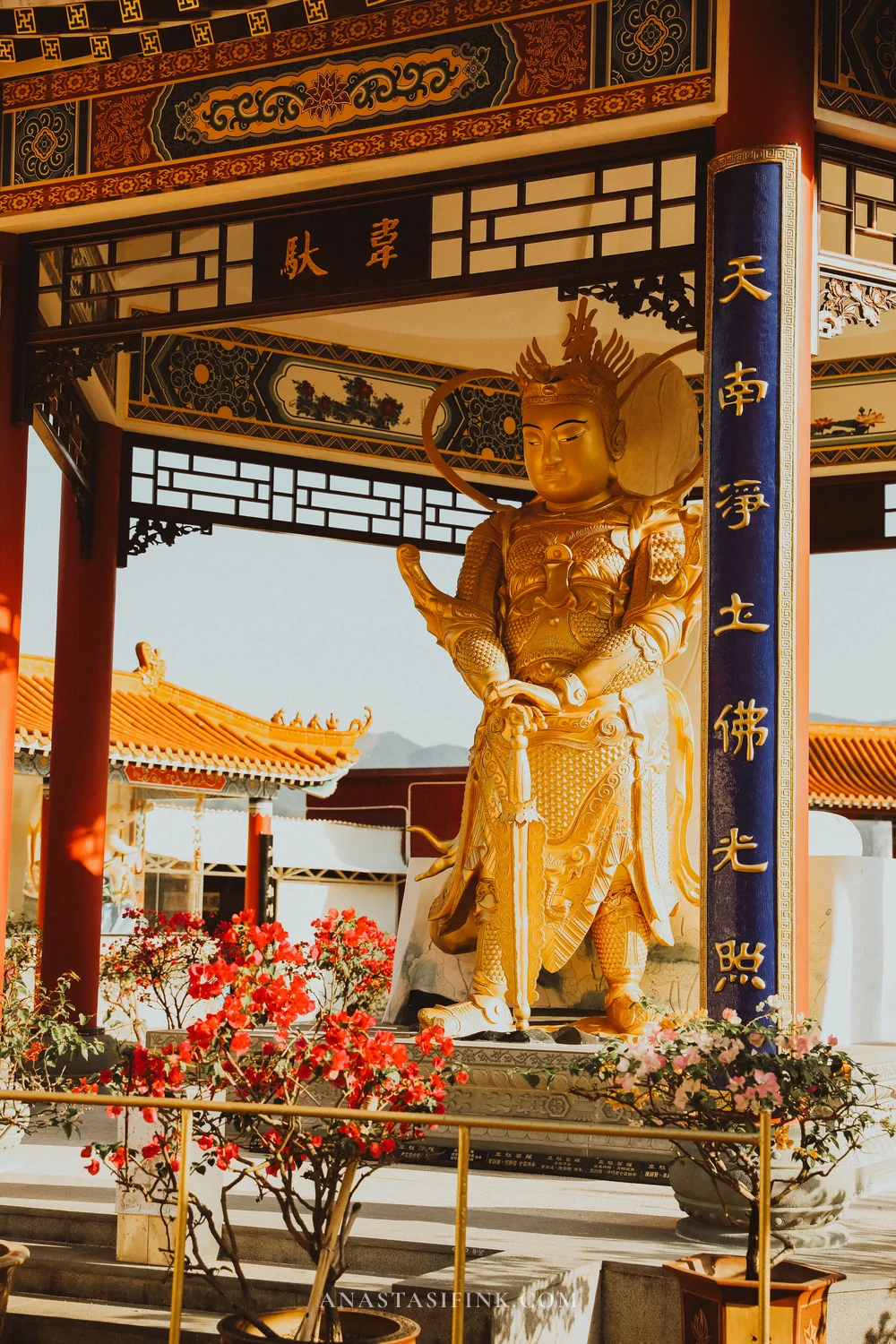
On the left, Guanyin; on the right, Weito—protector of the teaching
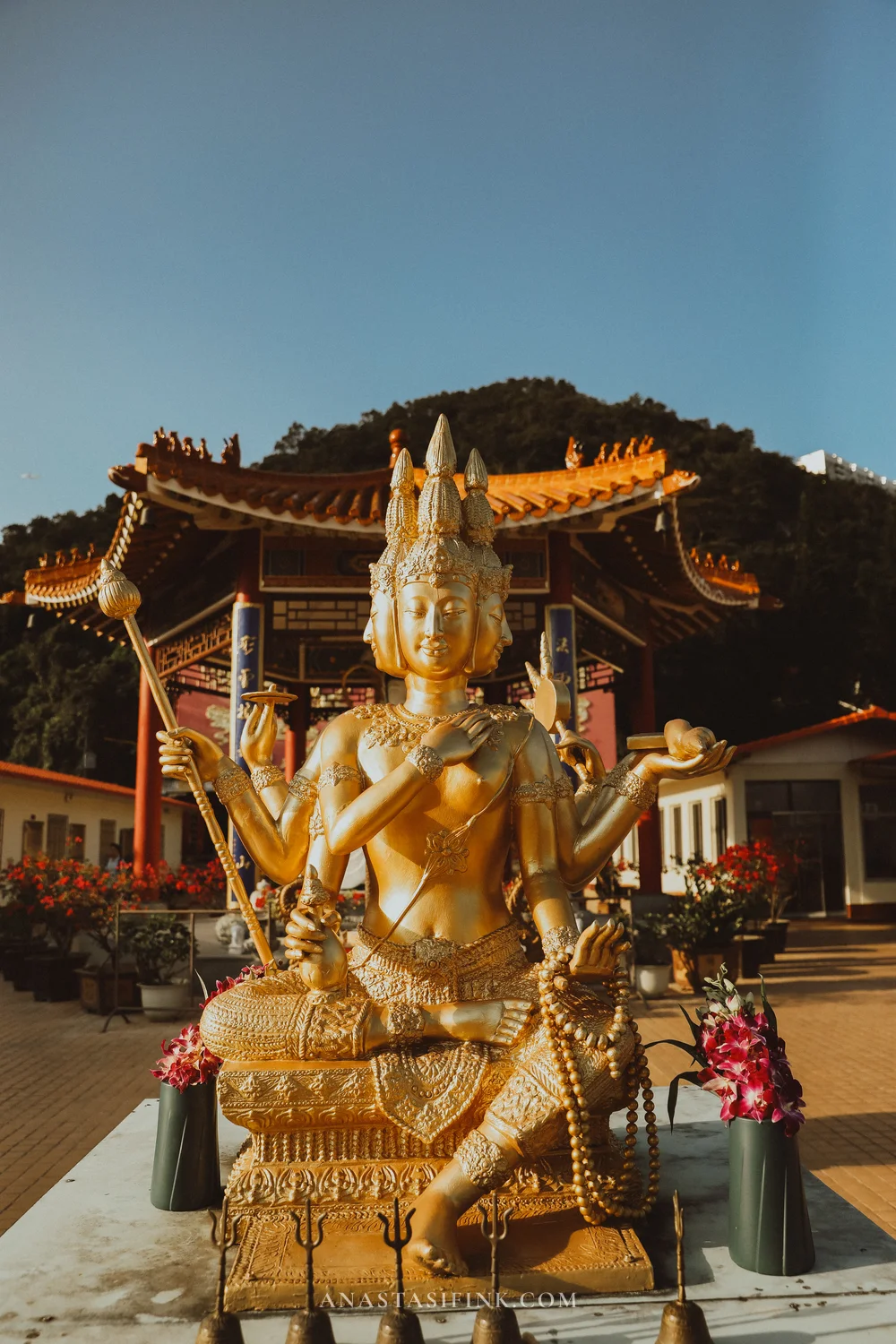
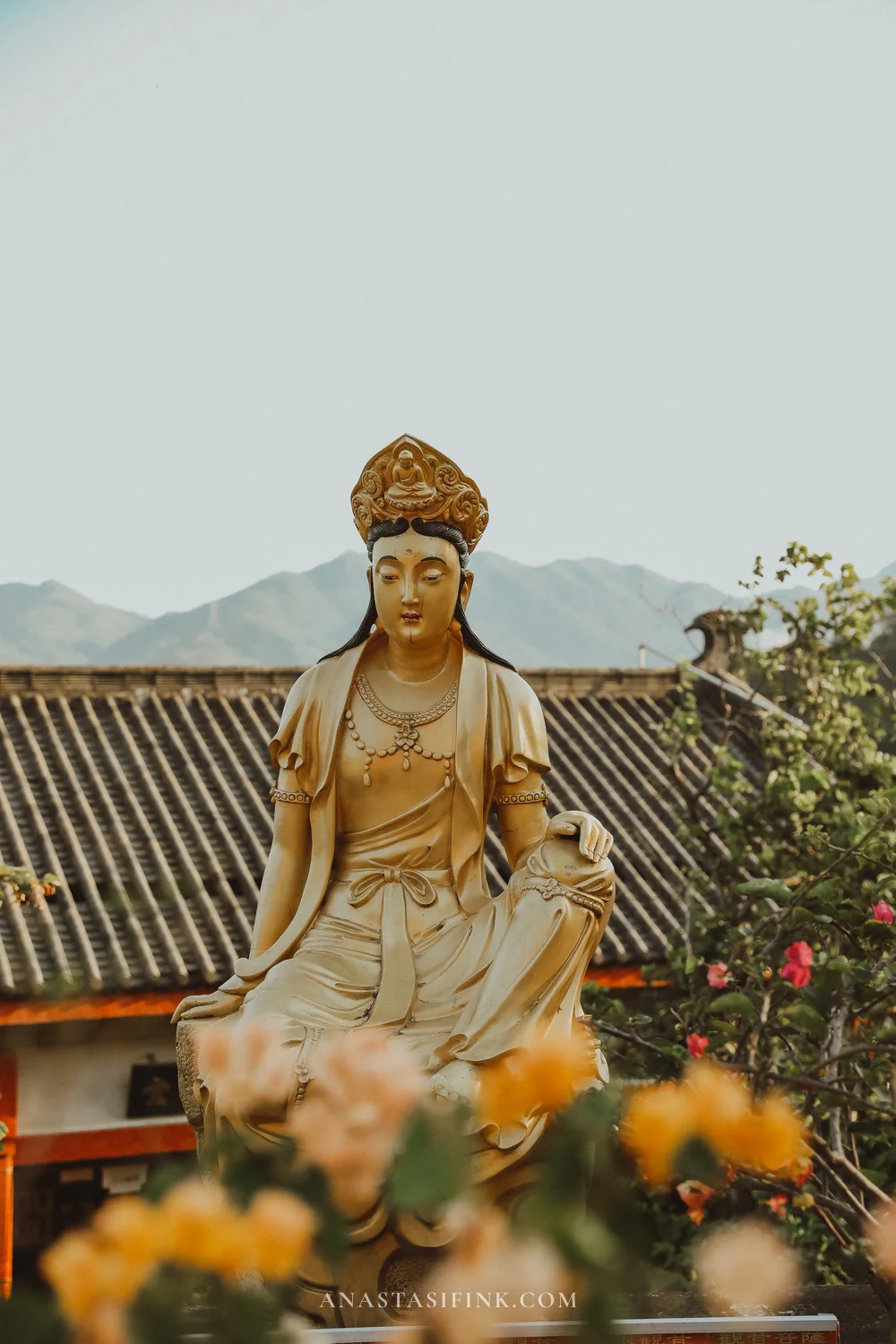
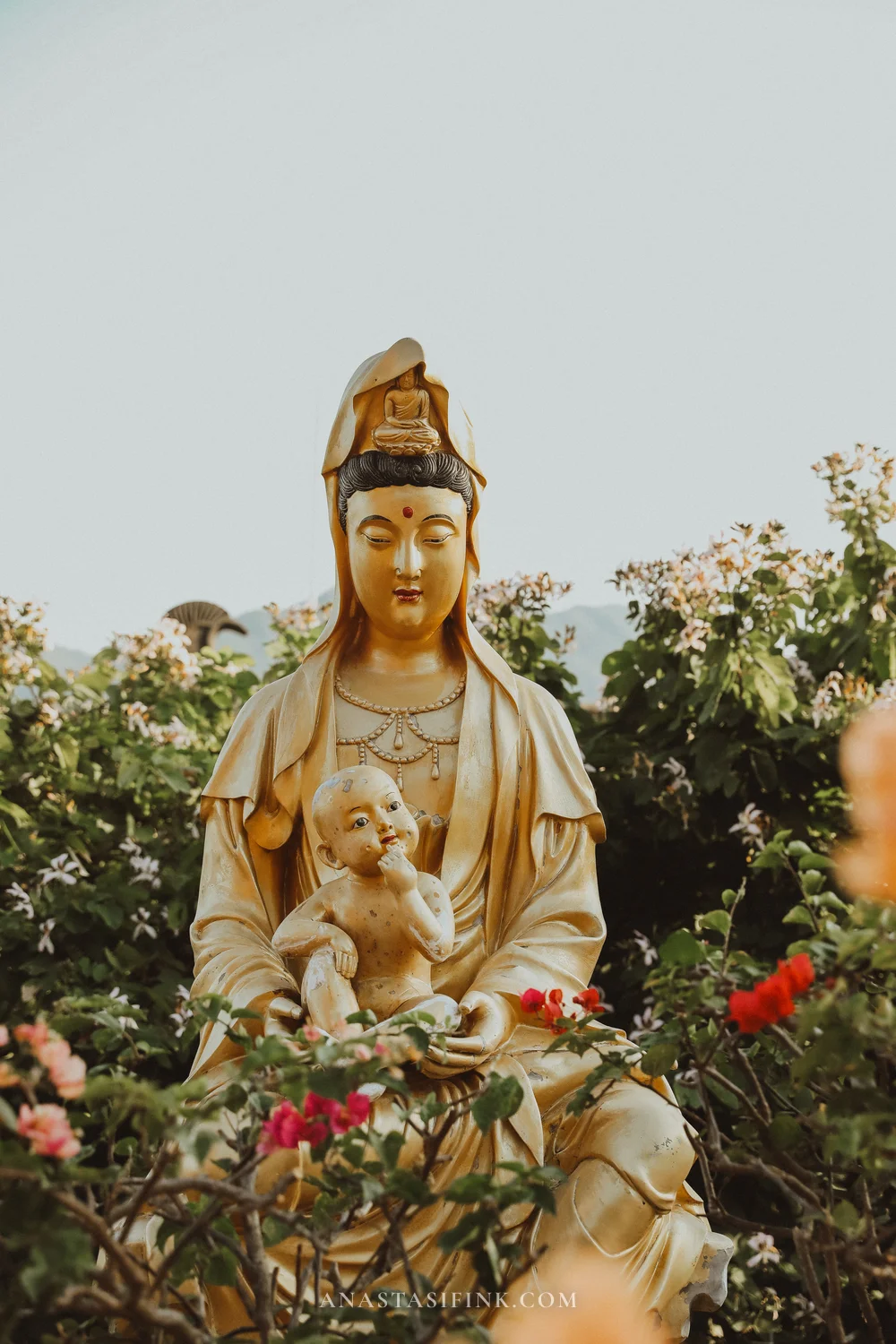
Two Guanyins. On the right, the “child-giving” one
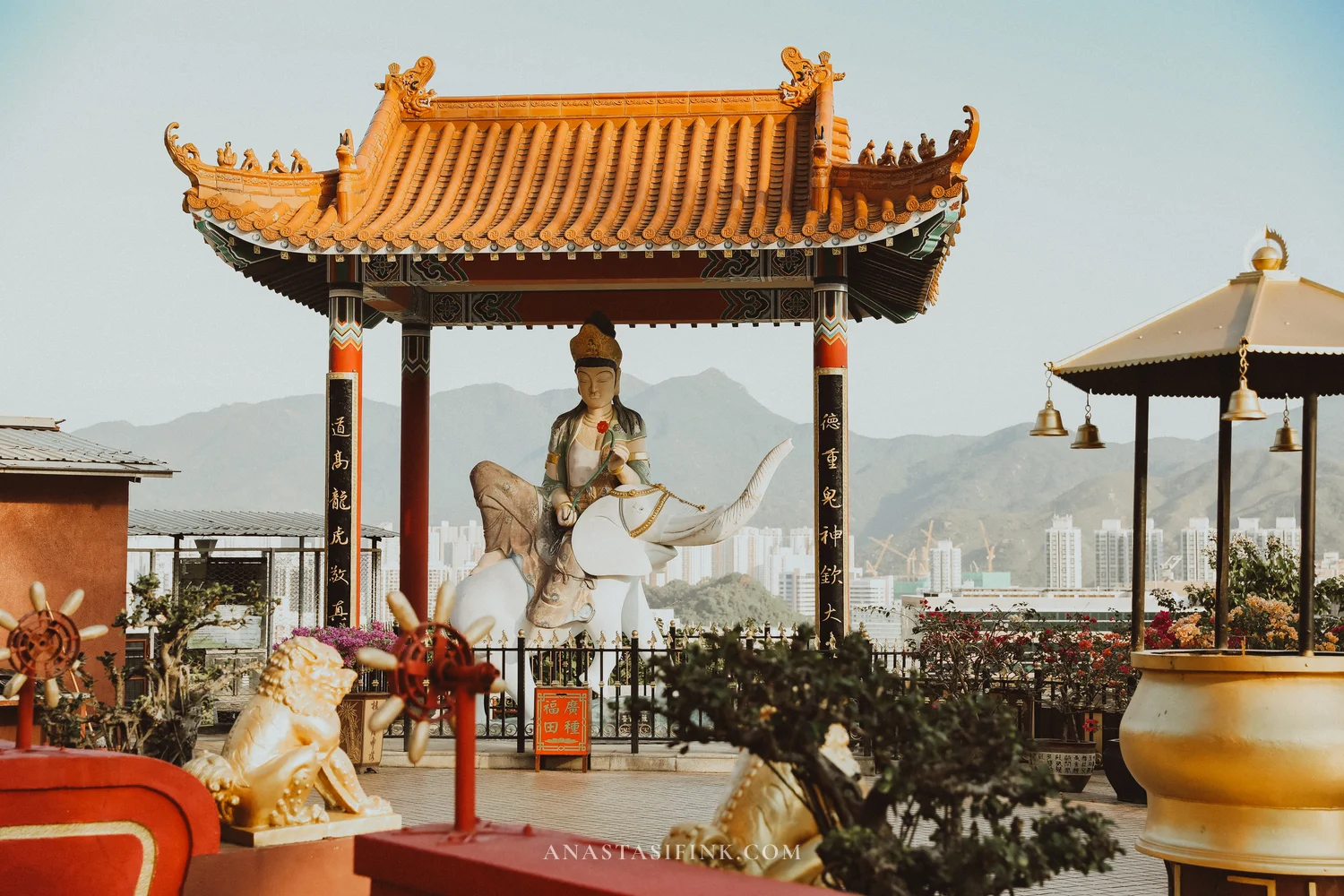
There are also bodhisattvas riding animals—on a blue lion and a white elephant. In Chinese tradition, the lion is the “mount” of Manjushri, the bodhisattva of wisdom, and the white elephant belongs to Samantabhadra. These pavilions stand at the edge of the terrace, with all of Sha Tin opening up behind them.
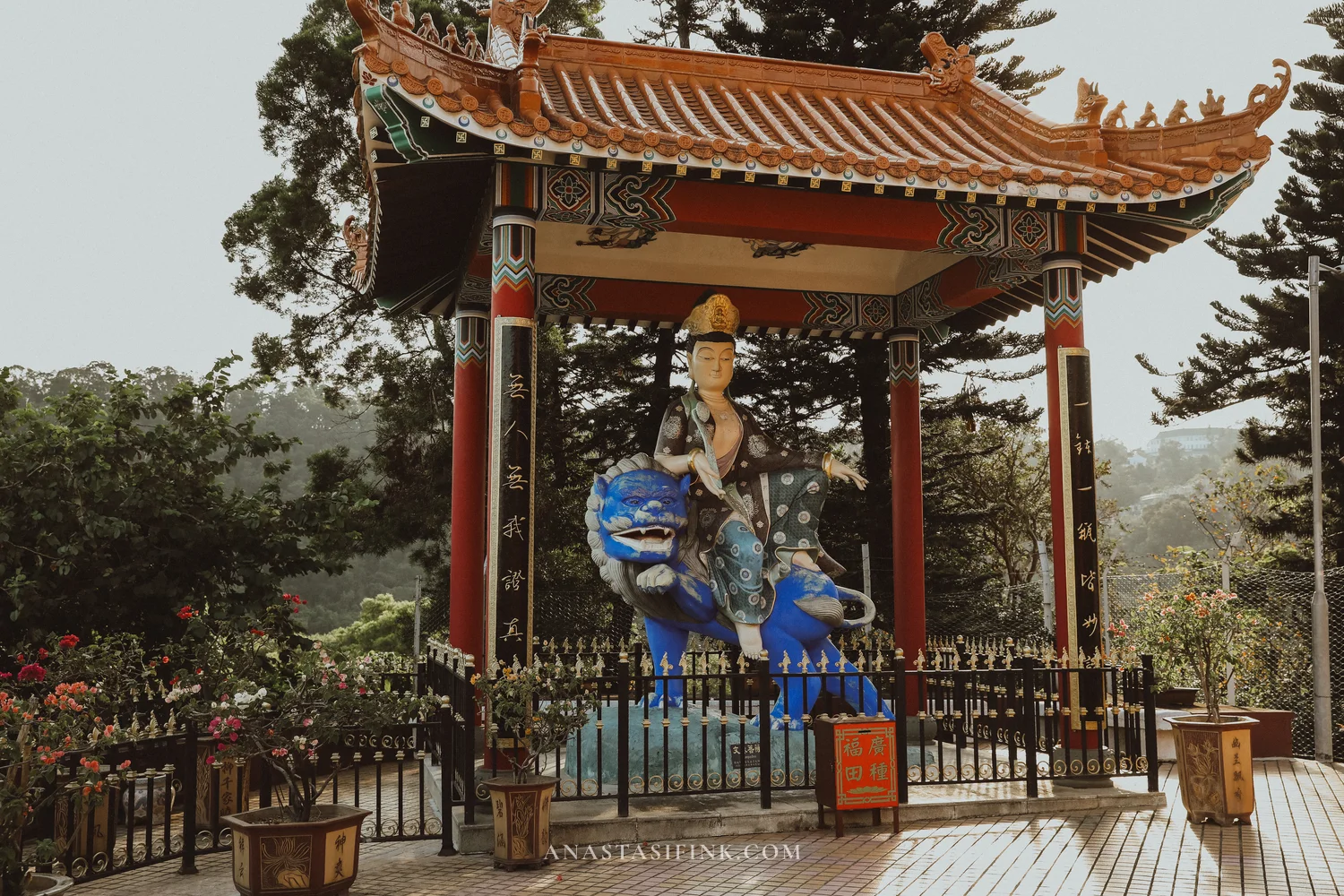
The bodhisattva on the blue lion. Behind him, all of Sha Tin
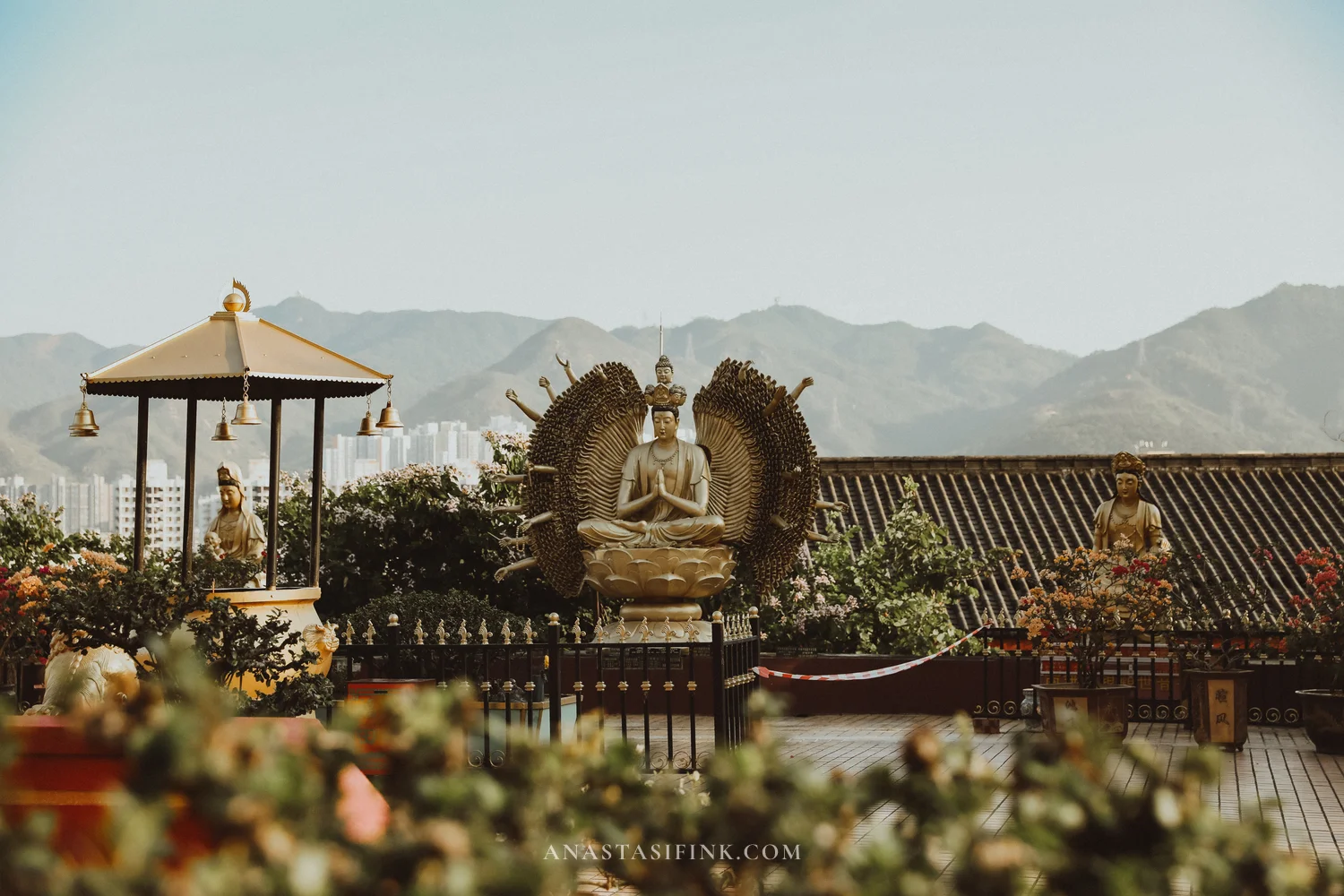
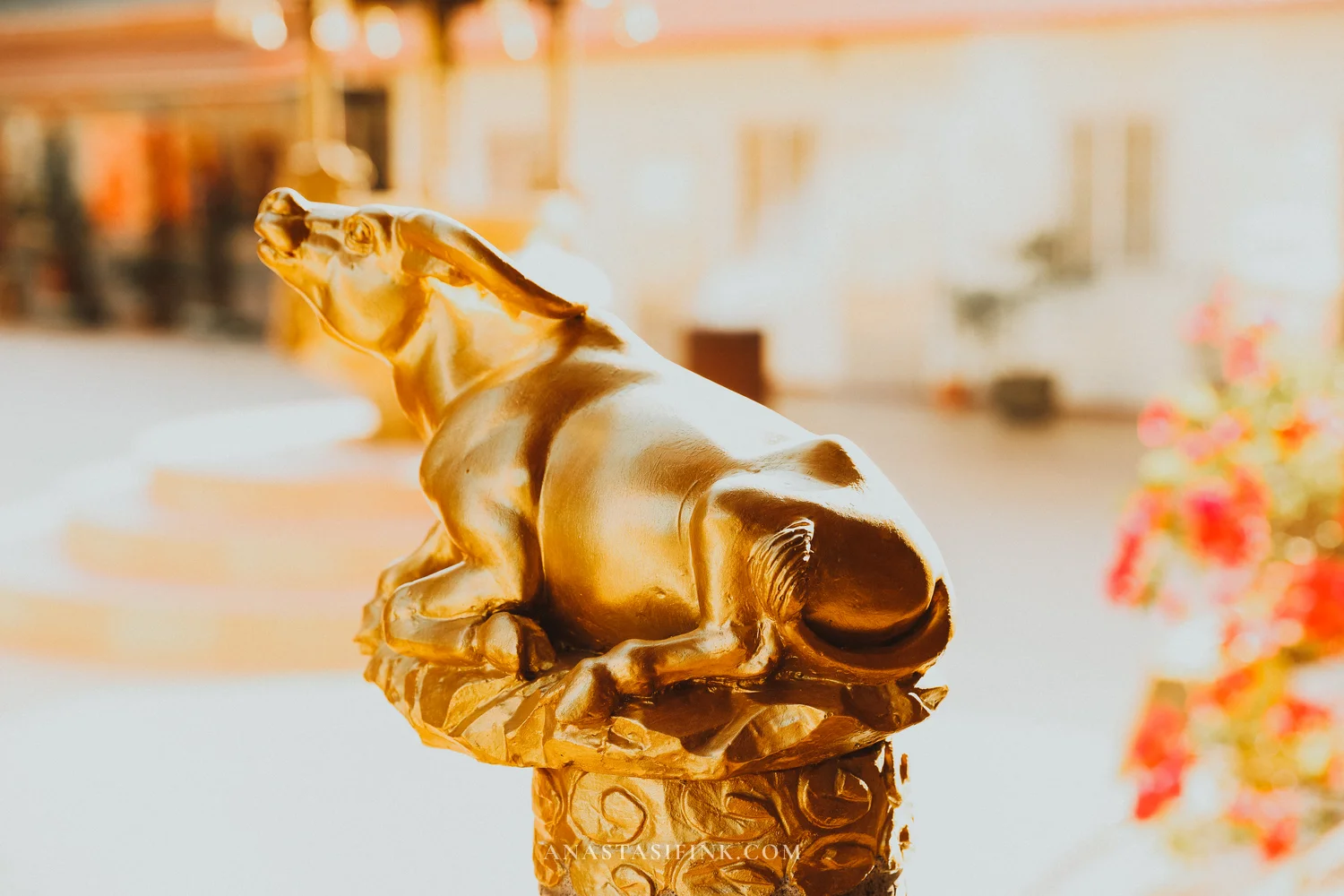
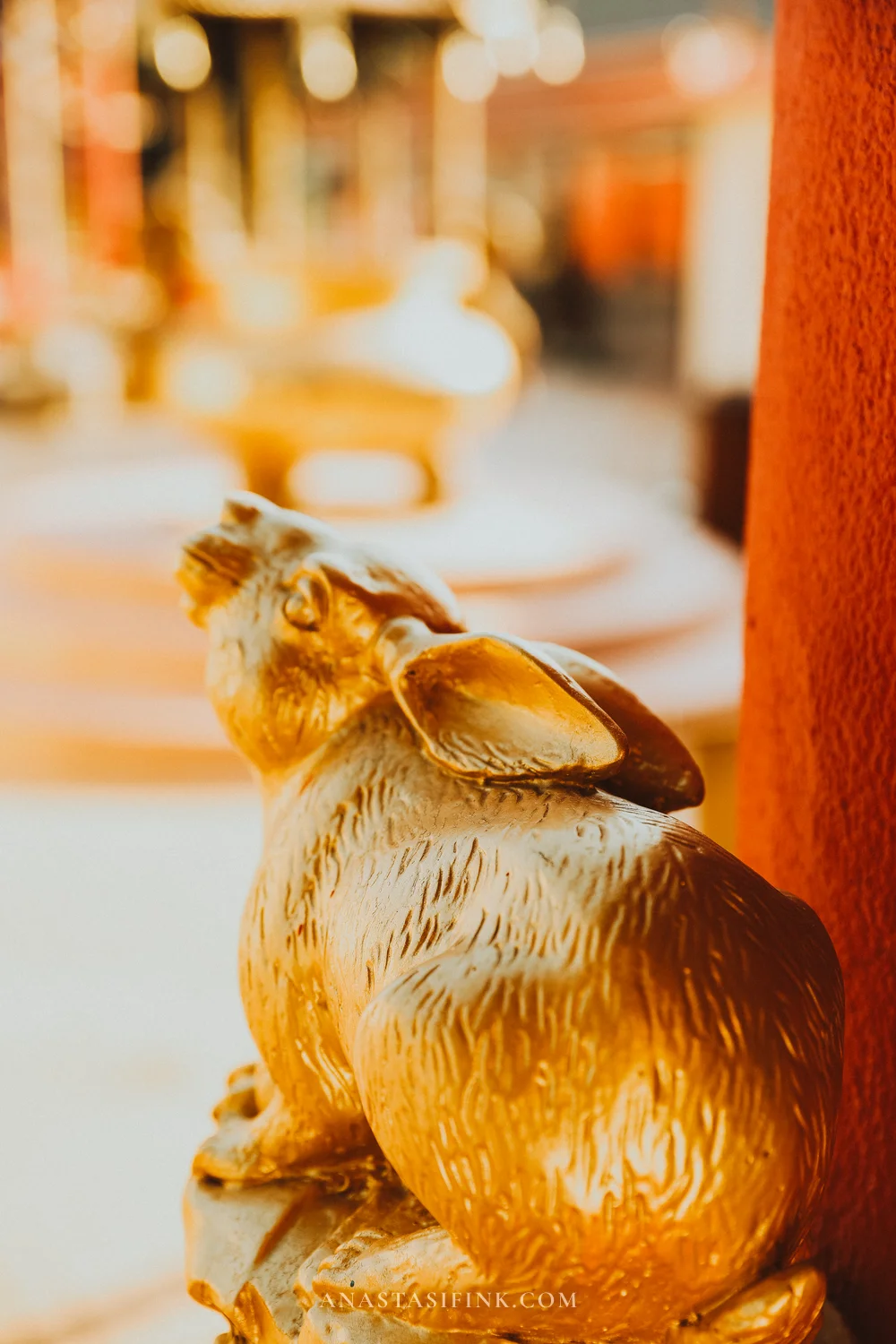
Set apart are golden figures of the Chinese zodiac animals—an ox, a rabbit and the rest. You can find your own birth year.
Amid all the gold there are surprisingly many flowers—bougainvillea especially.
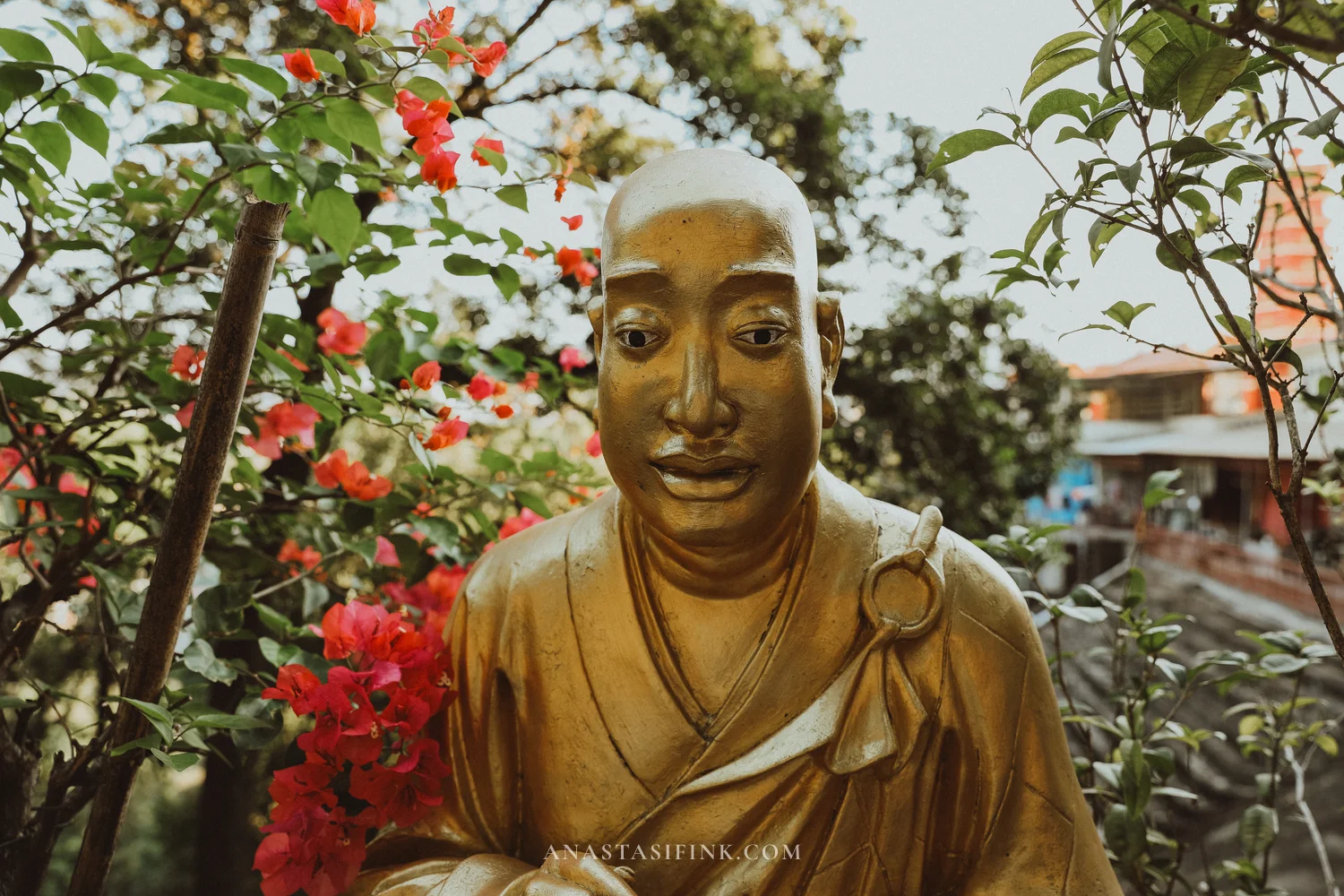
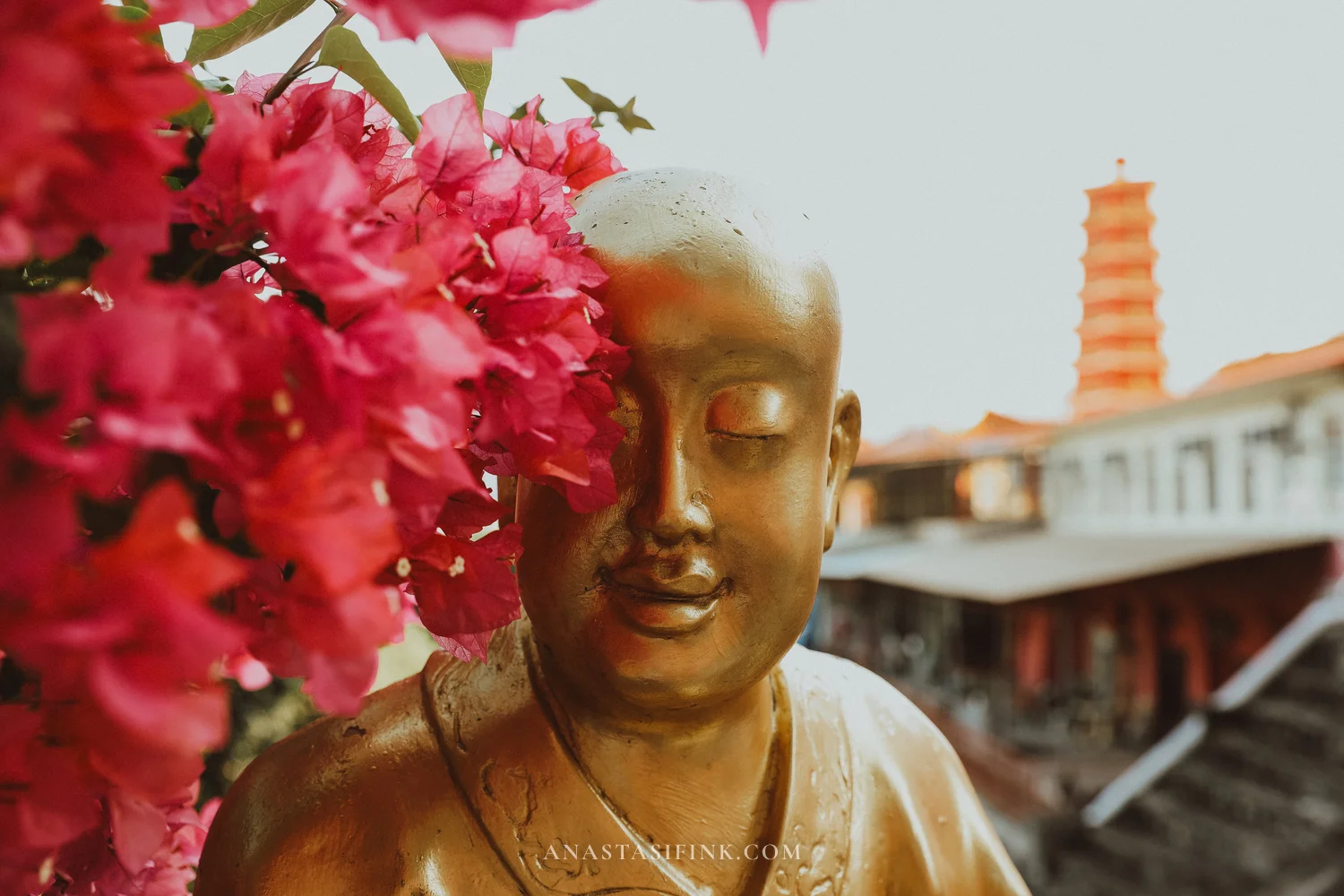
Arhats, flowers and the pagoda all at once
The Upper Level: A Taoist Temple at the Top
From the lower terrace there’s one more climb—a short trail heads up, past a red wall of arhats, to a separate upper section of the monastery.
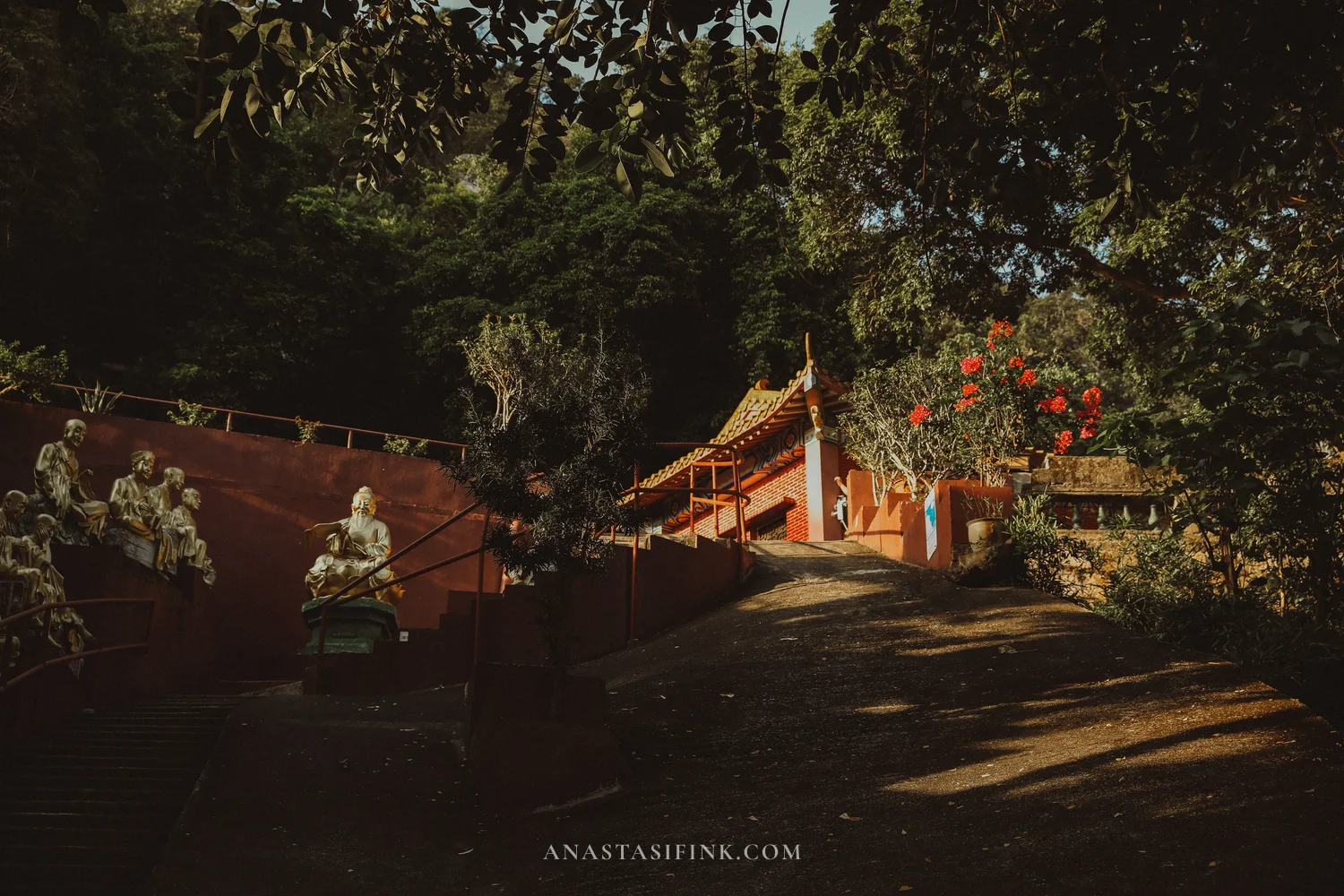
And here’s the detail that surprises a lot of people. The monastery is called Buddhist, but at the top there are Taoist shrines. For Hong Kong, this is perfectly normal. People here rarely draw a firm line between Buddhism, Taoism and Confucianism—they’re called the “three teachings” (san jiao) and are blended quite happily within a single life, and often under a single roof. After a century and a half under British rule, religion in Hong Kong was barely regulated, and mixed temples like this only flourished.
Religion in Hong Kong is approached practically: you go to different gods for different reasons. For health and success in business, people head to the Taoist Wong Tai Sin; fishermen revere the sea goddess Tin Hau; and in this same Sha Tin district stands a large temple to General Che Kung, where people queue for fortune-telling at Lunar New Year. The very same stone Tai Sui generals up top are also “appeased” at the start of the year, so it passes smoothly. So don’t be surprised to see a Buddha, Taoist gods and a queue at the incense burner all side by side—for locals it’s not a contradiction, it’s the norm.
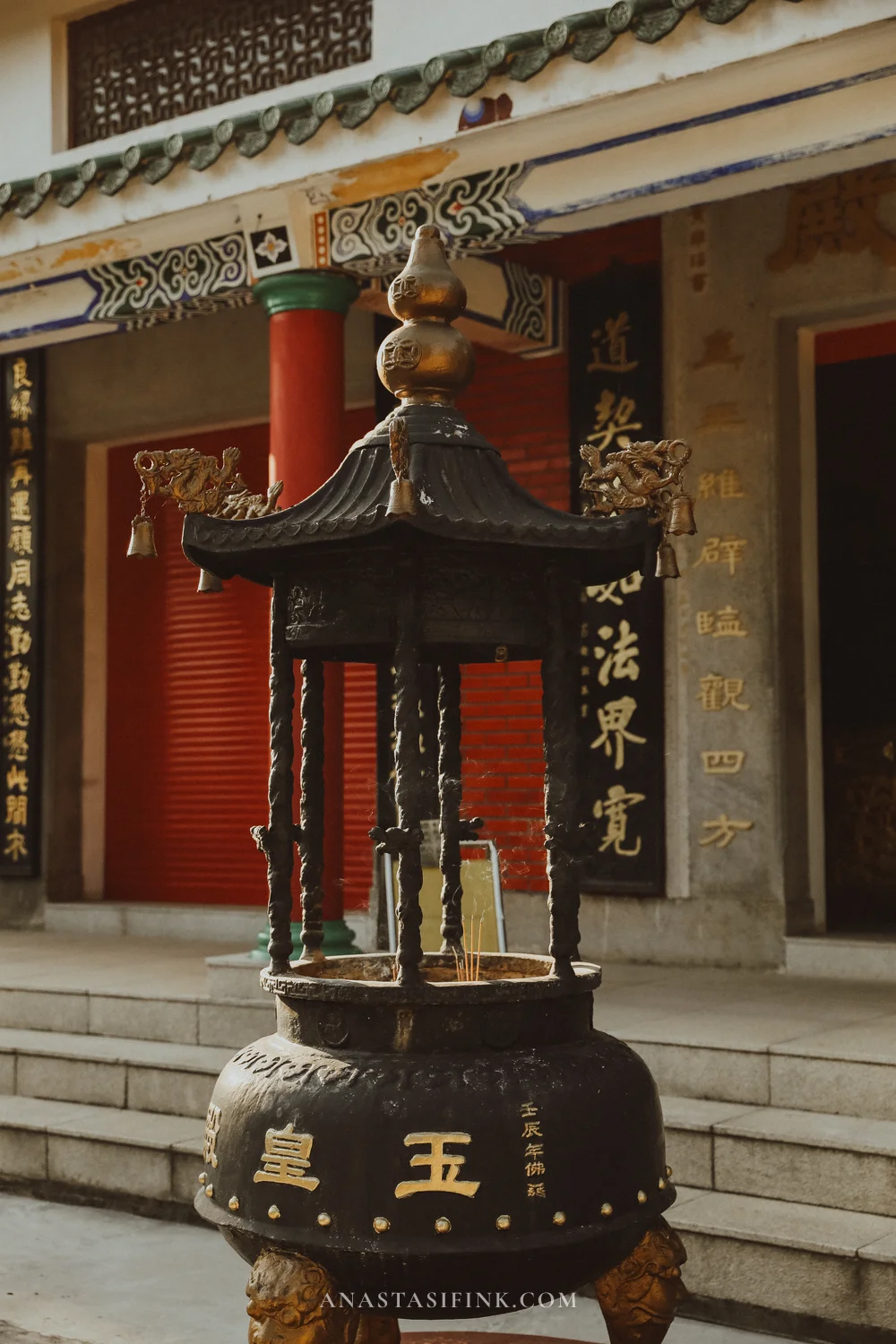
The first thing that greets you up top is the hall of the Jade Emperor (Yu-huang). In Taoism, he’s the supreme lord of the heavens, something like an “emperor of the gods.” And beside it is a whole ensemble of stone figures that makes the climb all the way to the top worthwhile.
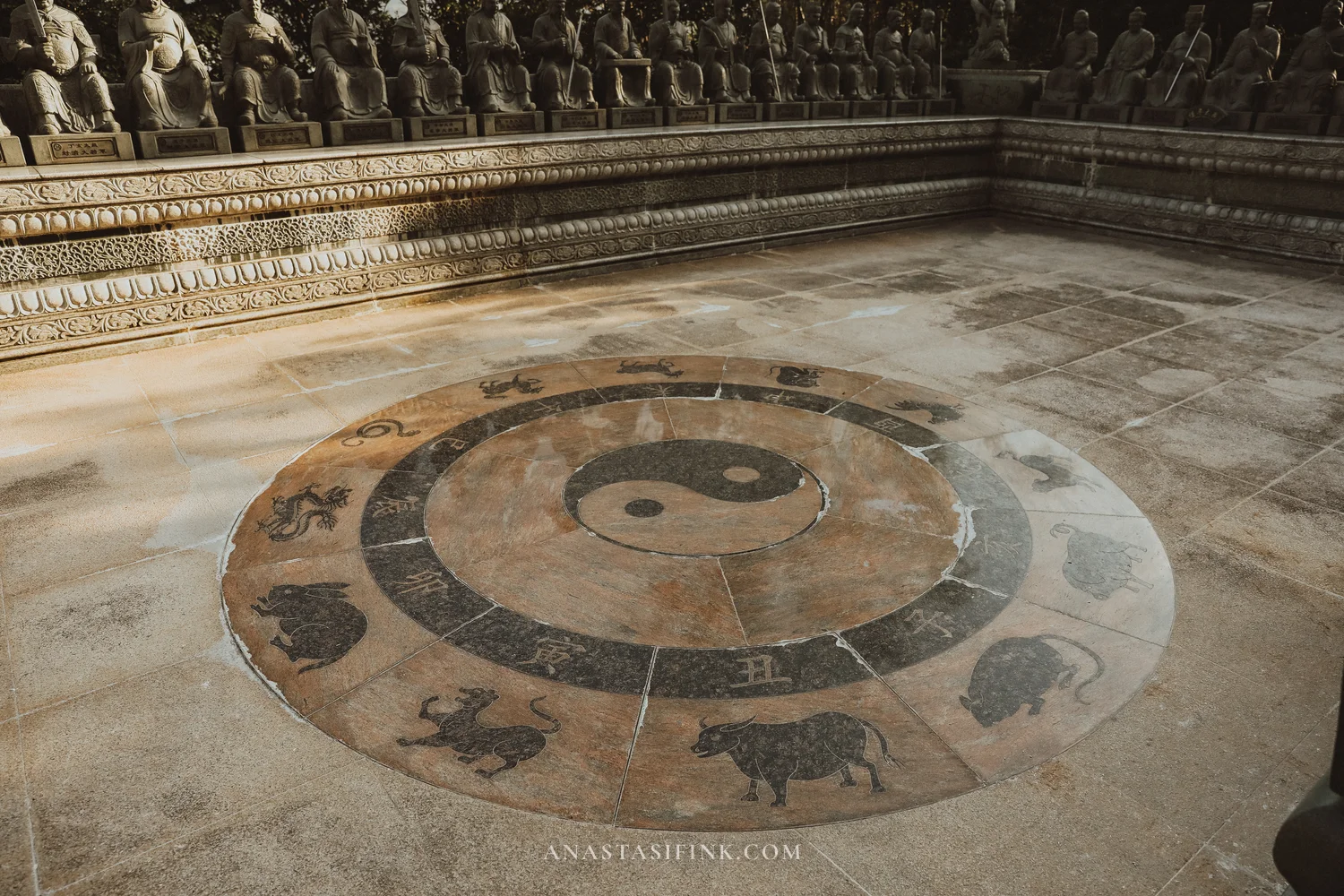
In the centre of the courtyard, a circle is laid into the floor: a black-and-white yin-yang symbol, ringed by the twelve animals of the Chinese zodiac. Around the perimeter sit sixty stone generals in armour. These are the Tai Sui—the “deities of the year.” By Chinese belief, each year of the 60-year cycle is governed by its own general, and in their year many people come to “make peace” with him so the year goes well.
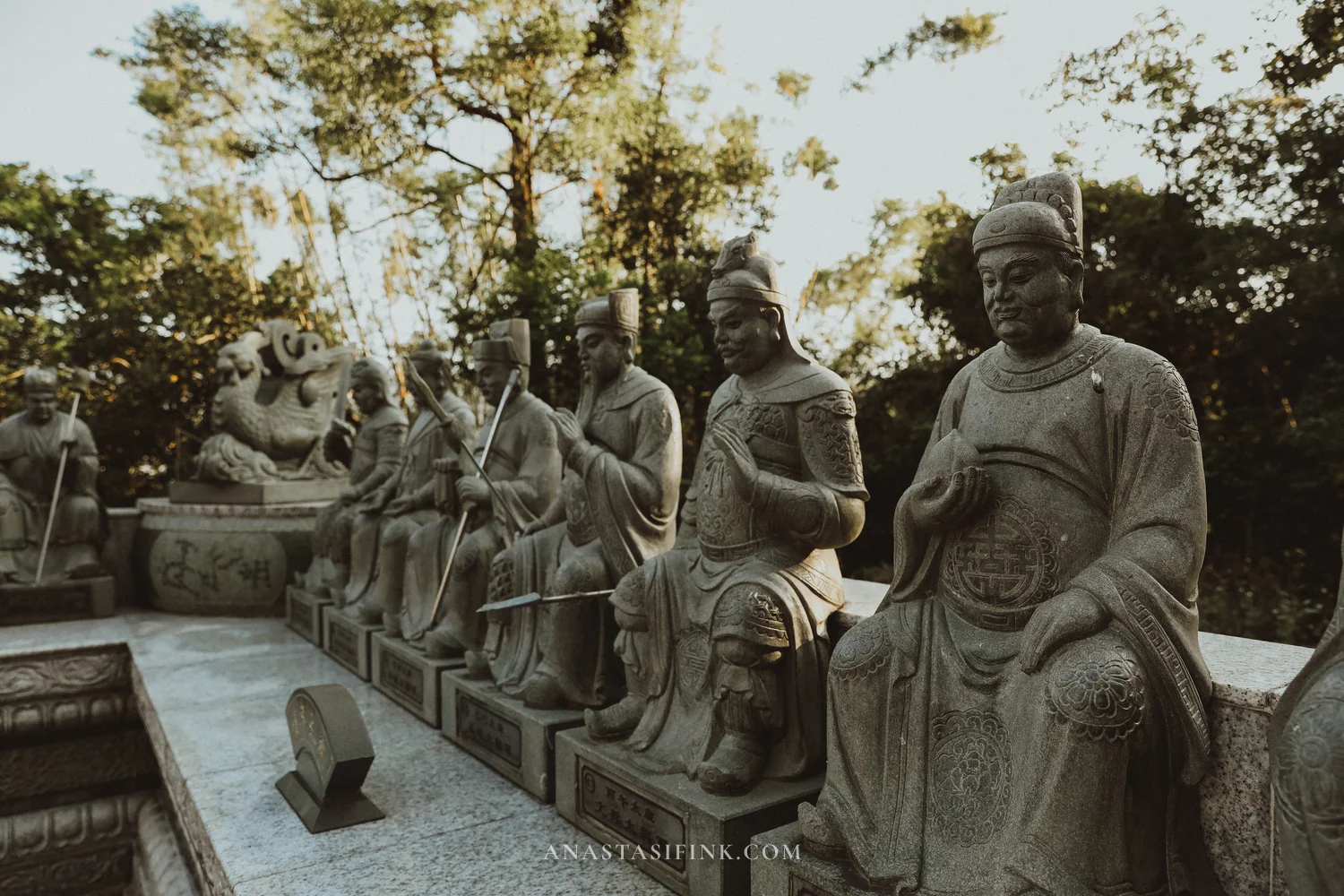
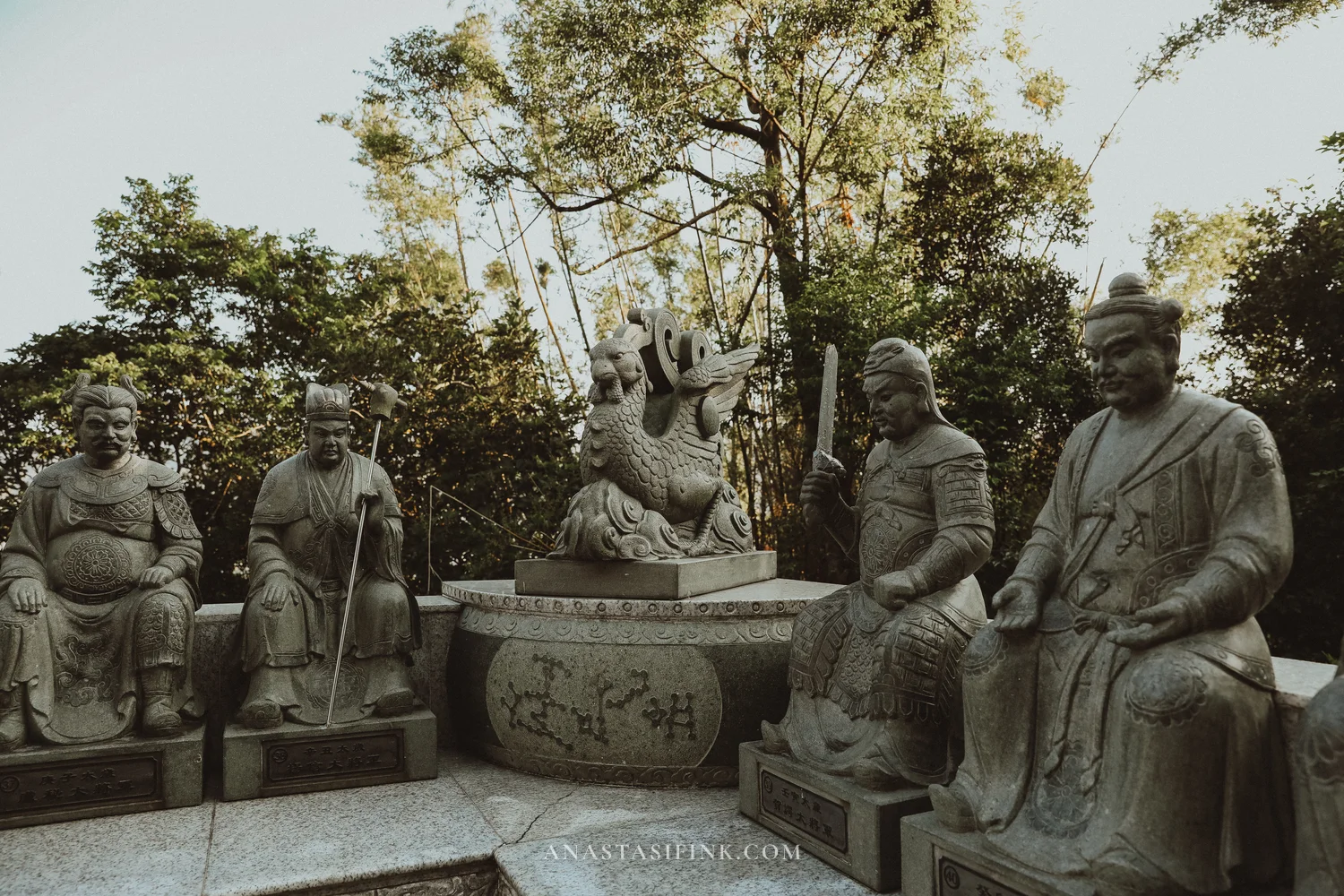
The sixty Tai Sui generals—one for each year of the cycle
The generals’ faces are all very different—stern, mustachioed, some with weapons, some with a symbol in hand. After the golden gleam of the lower monastery, this grey stone courtyard feels entirely different: quieter and more austere.
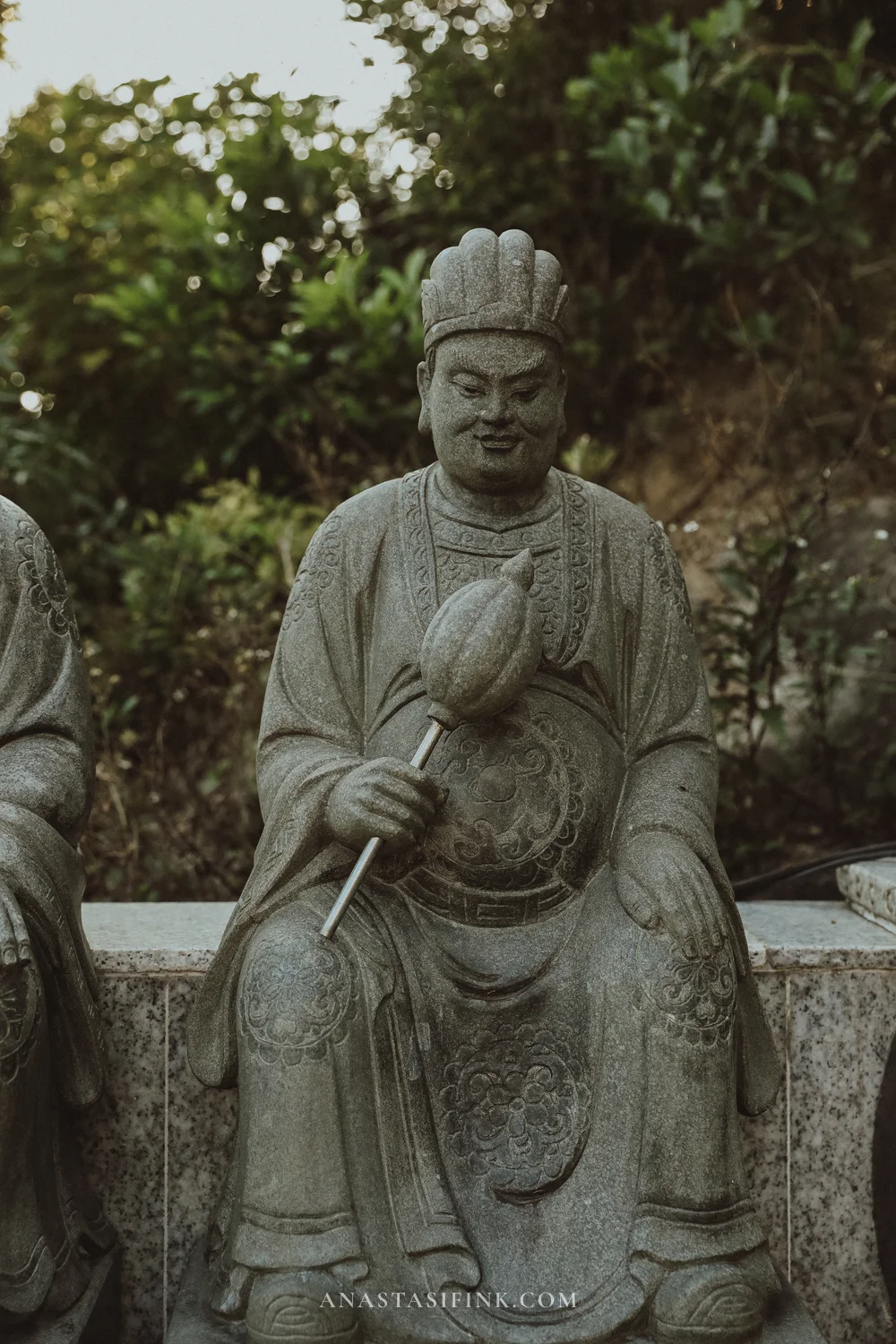
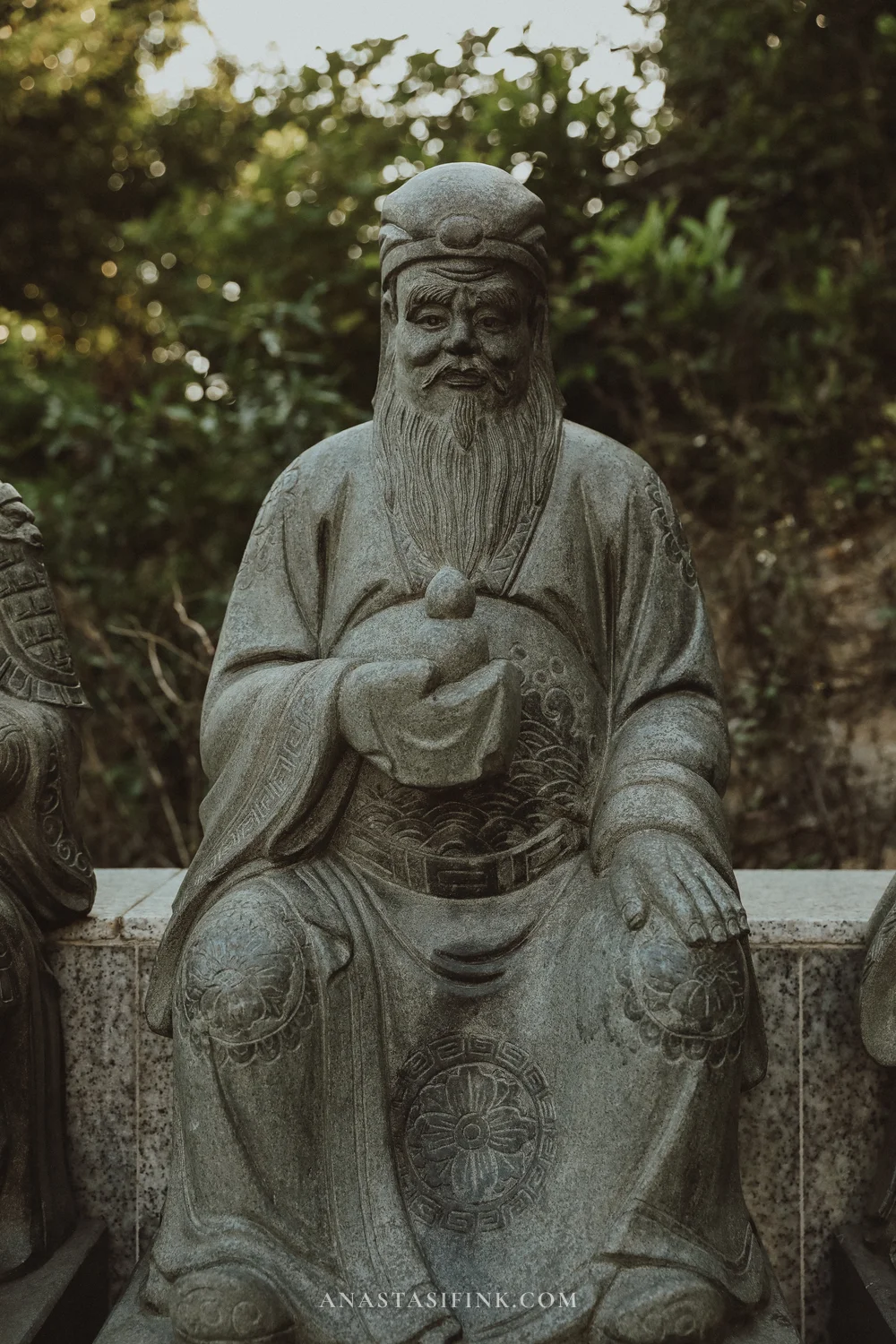
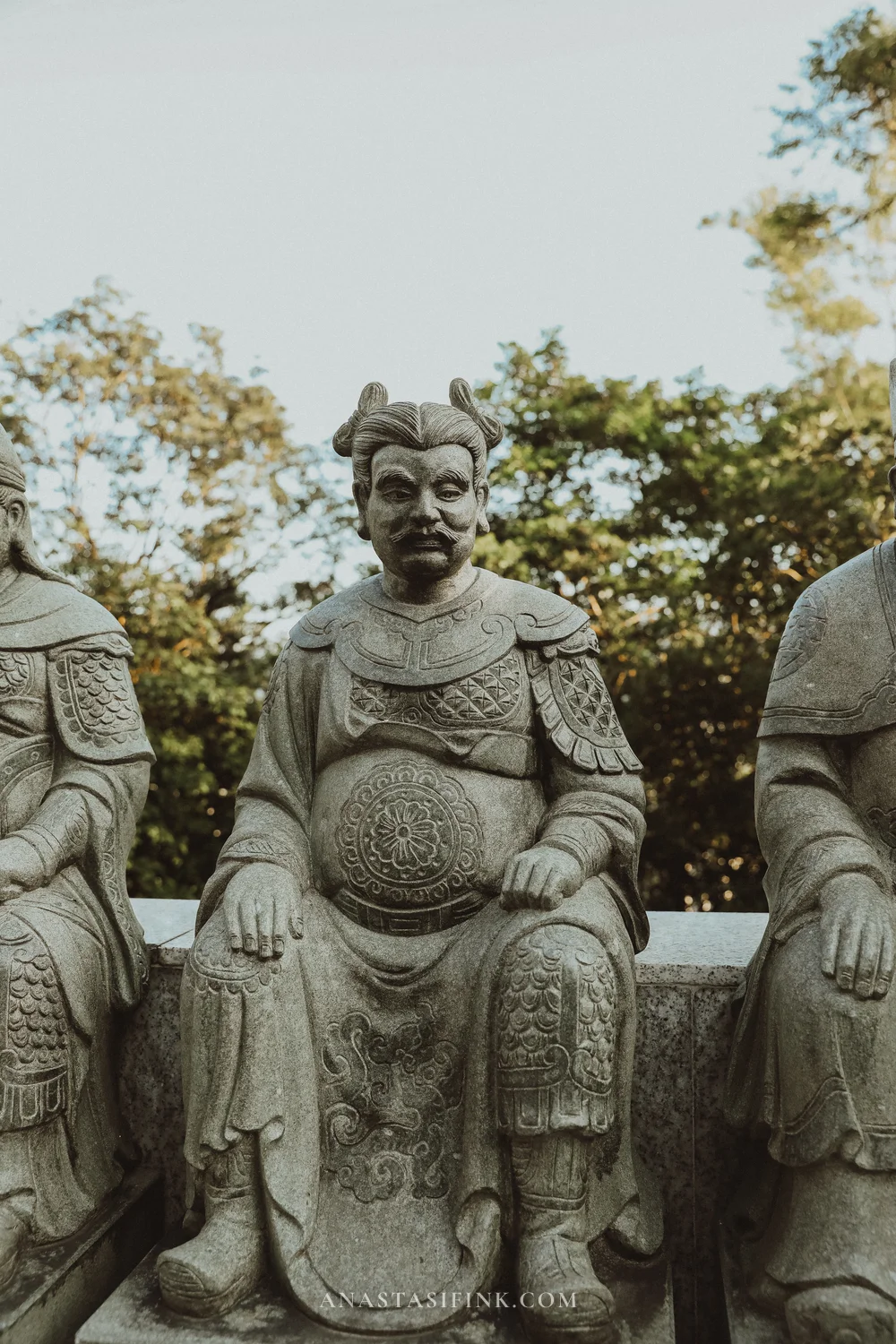
Each has his own face and attribute—just like the arhats below
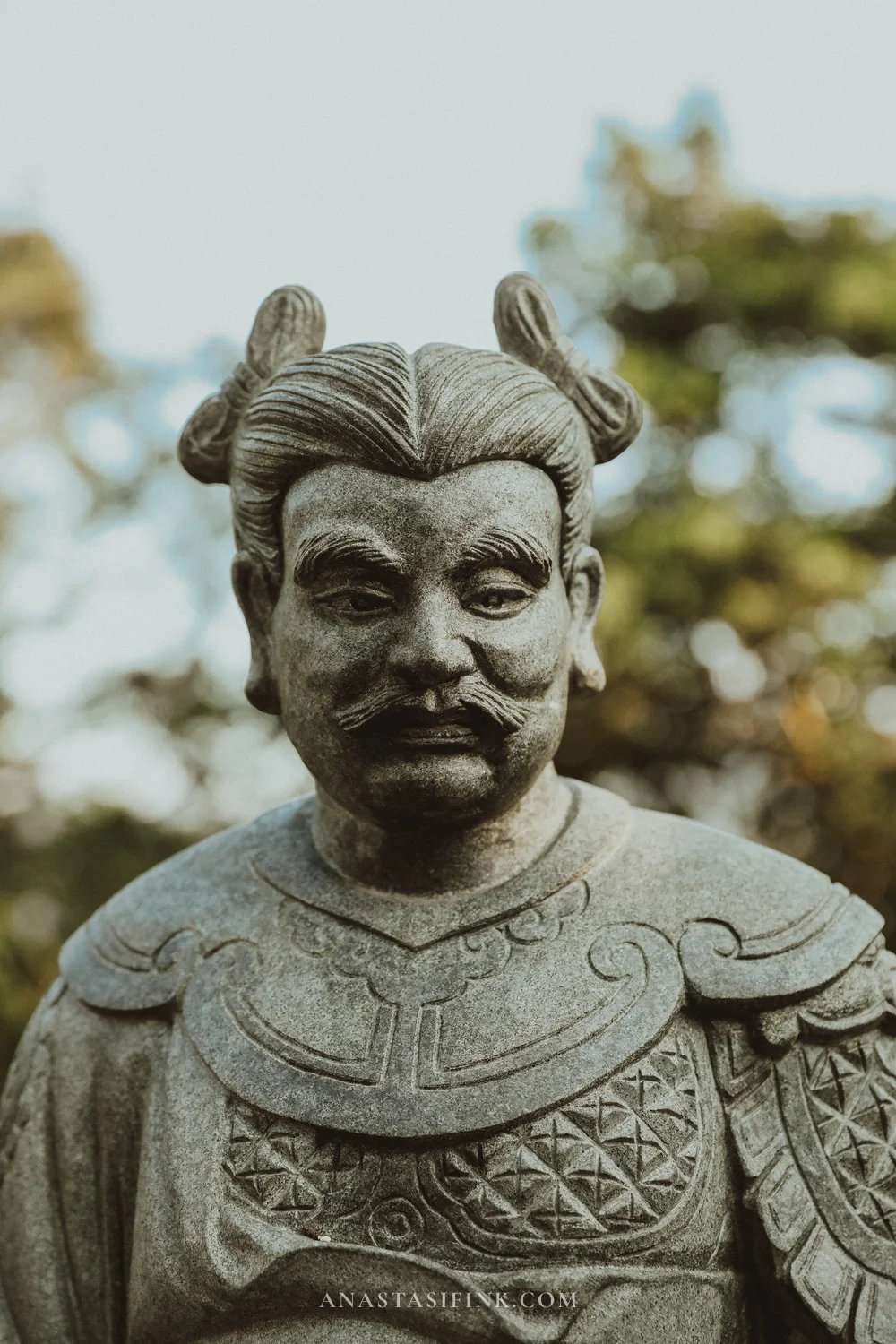
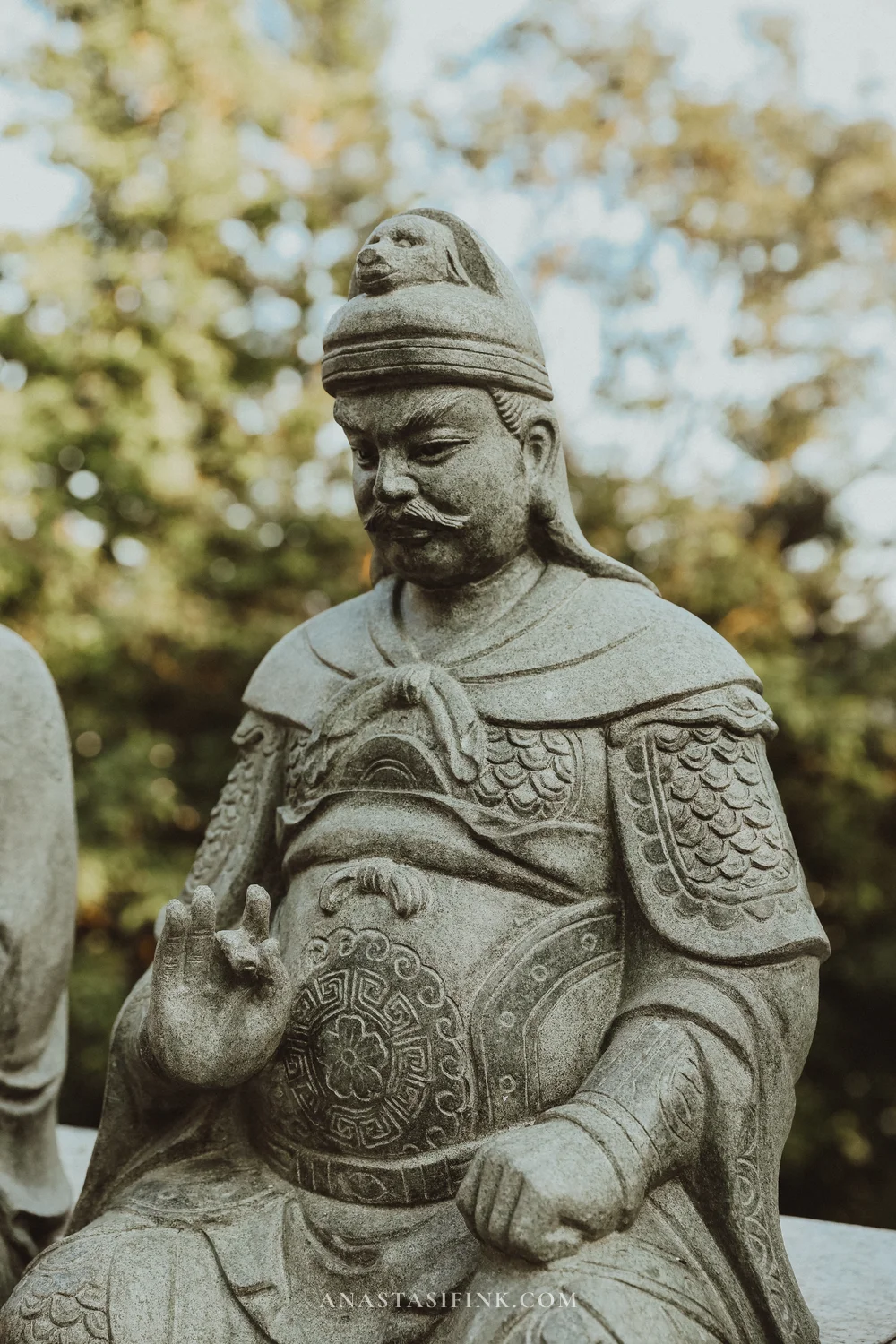
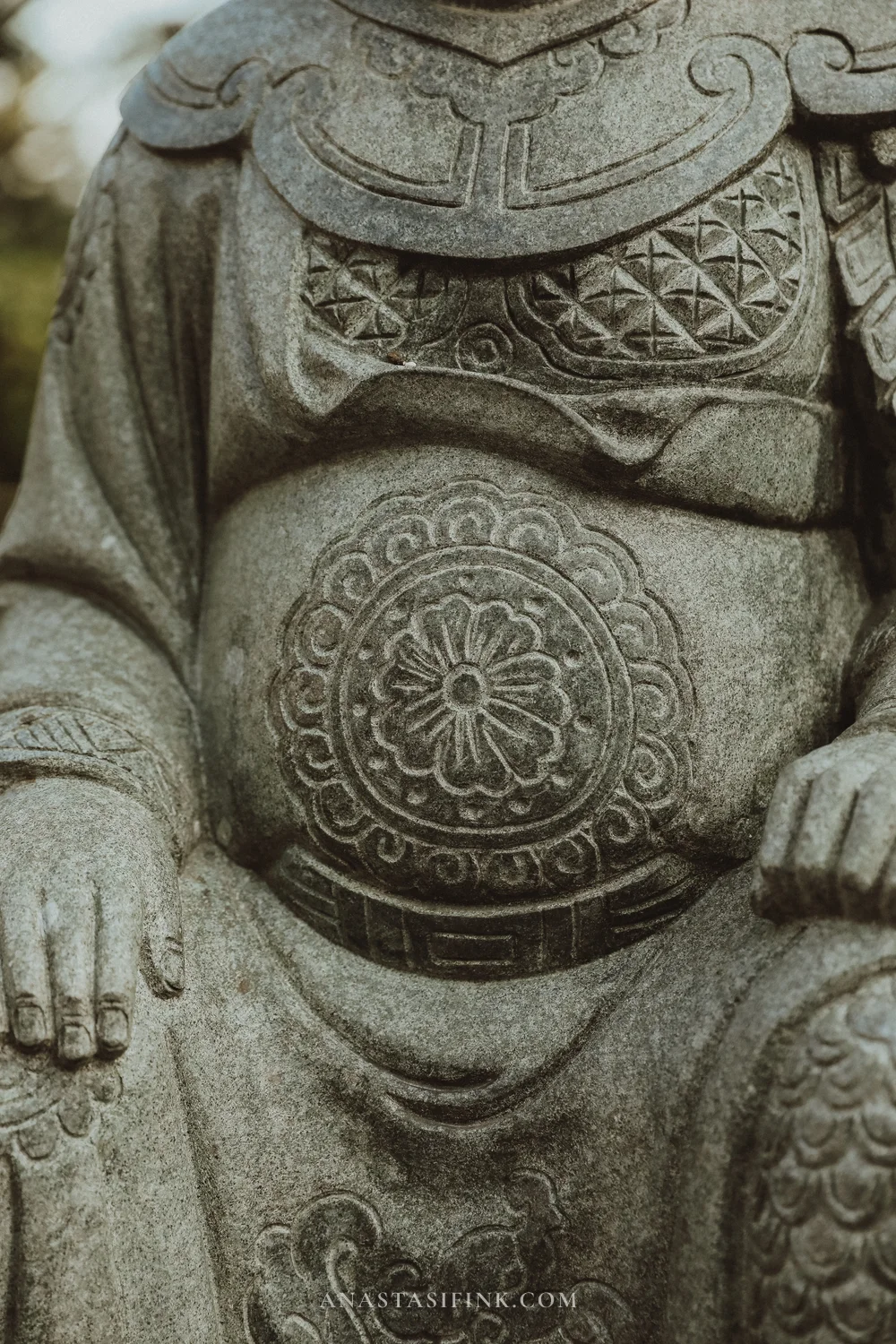
The armour and faces are worked down to the finest detail
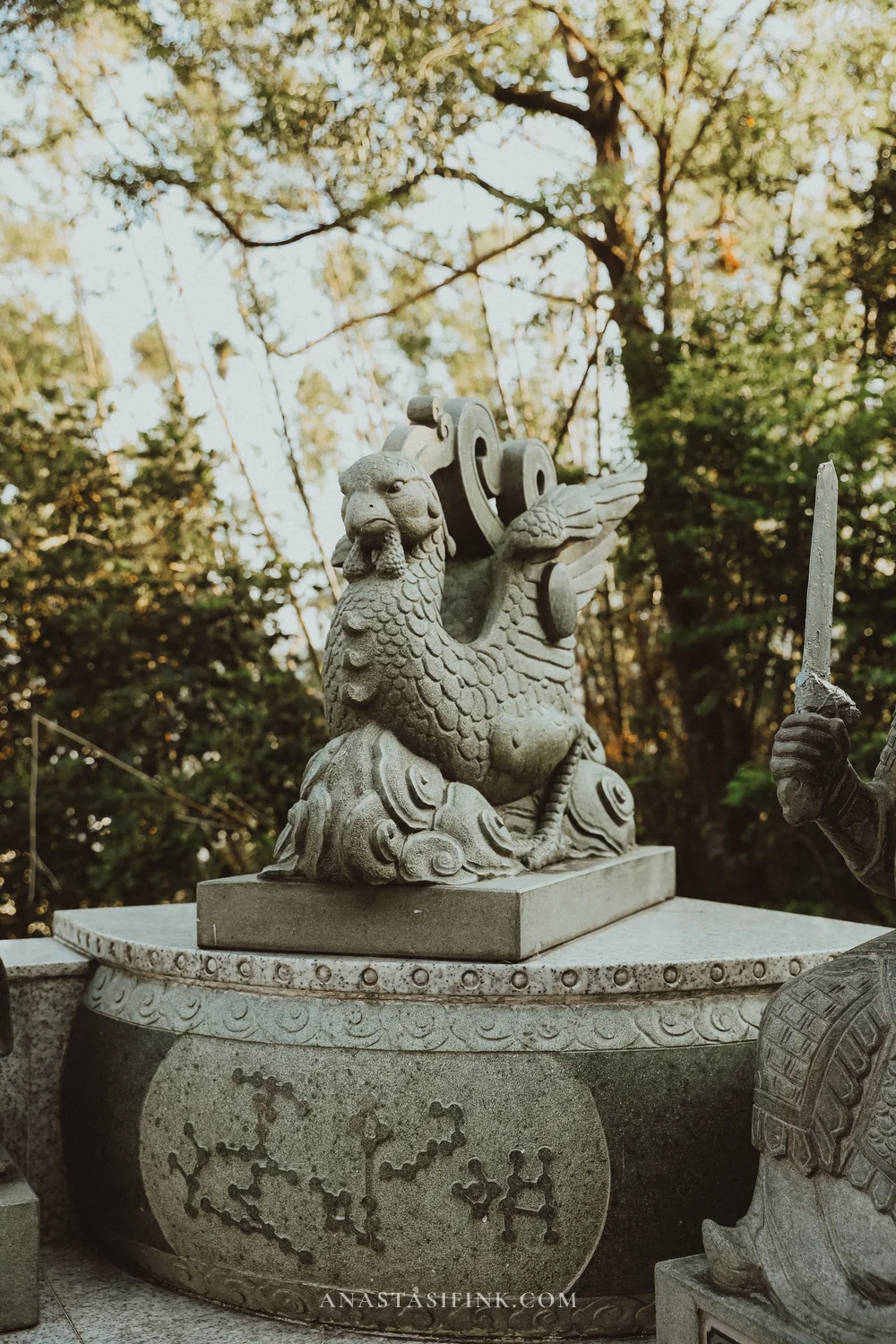
There are stone beasts too—a phoenix, for instance
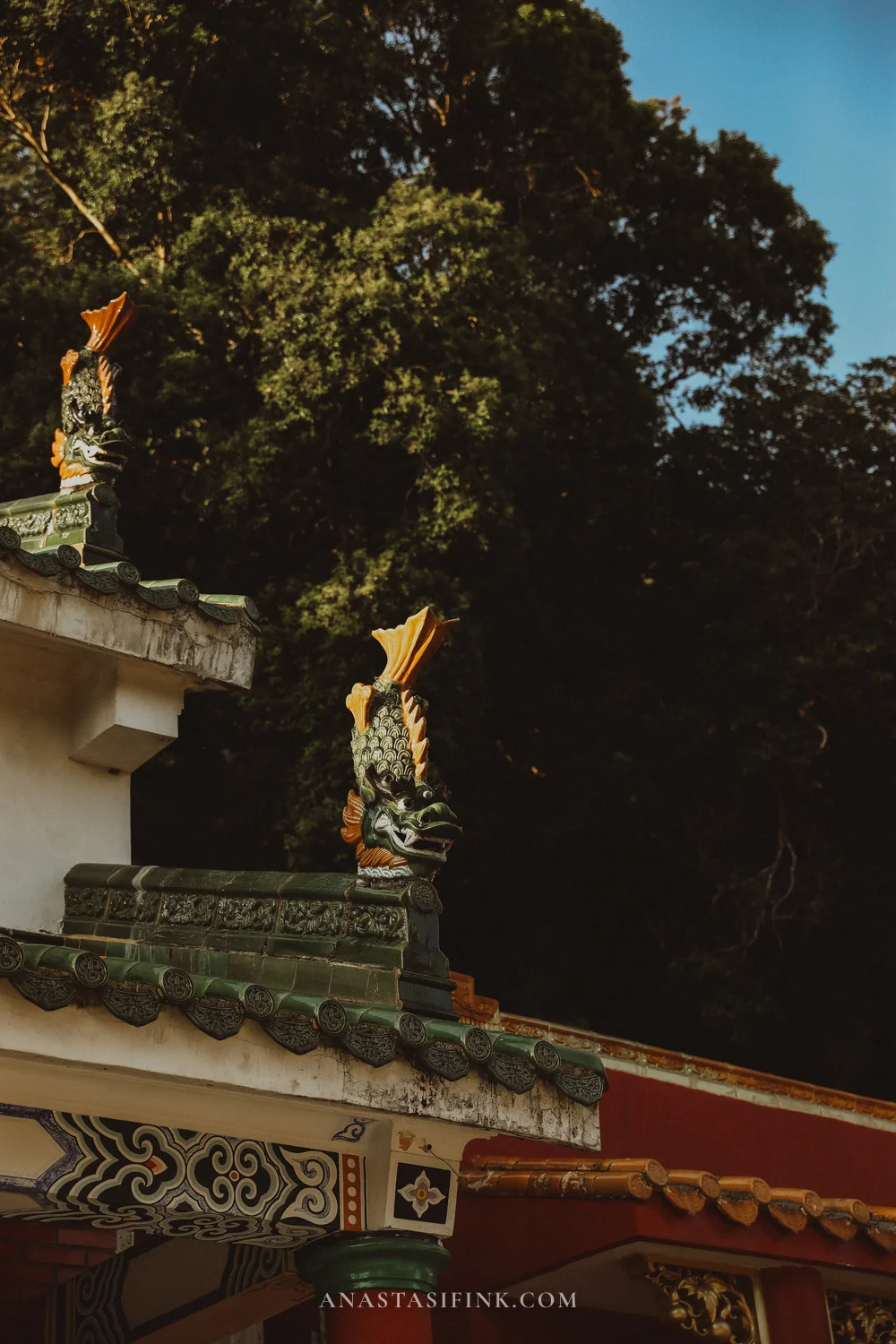
From up here, another view of the pagoda and the forest opens up—especially lovely toward sunset.
Practical Information
Practical Information
- What it is: Ten Thousand Buddhas Monastery (Man Fat Sze, 萬佛寺), a Buddhist-Taoist complex
- Address: 220 Pai Tau Village, Sha Tin, New Territories, Hong Kong
- GPS: 22.3676, 114.1875
- Opening hours: 09:00–17:00, daily
- Entry: free
- How long to allow: 1.5–2 hours for an unhurried visit including the climb
- The climb: about 430 steps, no lift
- Google Maps: Ten Thousand Buddhas Monastery
Getting There
The monastery is in the Sha Tin district, and the easiest way to get there is by metro (MTR). I put together a little map with the entry point marked—it makes it easy to walk from the station to the start of the staircase.
- By MTR: take the East Rail Line to Sha Tin station, exit B. From there it’s about a 5-minute walk to Pai Tau Village and another 10–15 minutes uphill on the arhat staircase. You’ll see a sign before the trail and steps begin.
- Heads up: don’t confuse it with the nearby Por Lam temple—local “helpers” sometimes point tourists the wrong way. The real monastery starts with the staircase of golden arhats.
- From central Hong Kong: from Hong Kong / Central station to Sha Tin is roughly 30–40 minutes, with a transfer onto the East Rail Line.
Tips
- Come early: the earlier you arrive, the fewer people and the less heat on the climb. Hong Kong summers are very humid—bring water.
- Comfortable shoes are a must—the staircase is long and steep in places.
- You might run into wild monkeys on the slope (I didn’t). If you see one—don’t take out food around them and don’t tease them.
- The lower section with the golden arhats and the upper courtyard with the stone Tai Sui generals are two places with very different moods. Go all the way to the top—a lot of people skip it.
- Combine the visit with a walk around Sha Tin: there’s a riverside promenade along the Shing Mun River and a park nearby.
Is It Worth Going
The Ten Thousand Buddhas Monastery is the kind of place you can easily lose half a day in without noticing. The climb past the golden arhats alone is worth the trip: five hundred different faces, not one of them the same. And at the top a completely different, quieter part awaits—a stone Taoist courtyard and a view of the mountains. And, perhaps the main thing: entry is free, yet the impression it leaves is one of the strongest in the city.
FAQ
By MTR on the East Rail Line to Sha Tin station, exit B. From there it’s about a 5-minute walk to Pai Tau Village and 10–15 minutes up the staircase of golden arhats. From central Hong Kong the trip takes roughly 30–40 minutes.
Entry is free. It’s one of the few major temples in Hong Kong you can visit without a ticket.
On average 1.5–2 hours: the climb up the staircase, the main hall with its Buddha figures, the plaza with the pagoda, and the upper Taoist level with the stone Tai Sui generals.
A staircase of about 430 steps leads up to the temple, with no lift. The climb is manageable but steep in places—you’ll want comfortable shoes and water, especially in the heat.
In Hong Kong, Buddhism and Taoism coexist quite comfortably. Up top are the hall of the Jade Emperor and the courtyard of the sixty Tai Sui generals—Taoist “deities of the year” people pray to for good fortune in their year.
Any day works—the monastery is open daily from 9:00 to 17:00. The earlier you come, the fewer people and the cooler the climb. Closer to sunset, the pagoda and the views from the upper terrace look beautiful.
They’re arhats (luohan)—disciples of the Buddha who have reached enlightenment, the equivalent of saints. There are around five hundred of them, and each face and pose is unique. The statues were made by craftsmen from Yunnan and Guangdong provinces.
Hong Kong International Airport (HKG) is a major global hub with direct flights from most continents, so getting here is straightforward from almost anywhere. Many nationalities also get visa-free entry, typically for 7 to 90 days—just check the rules for your passport before you go.